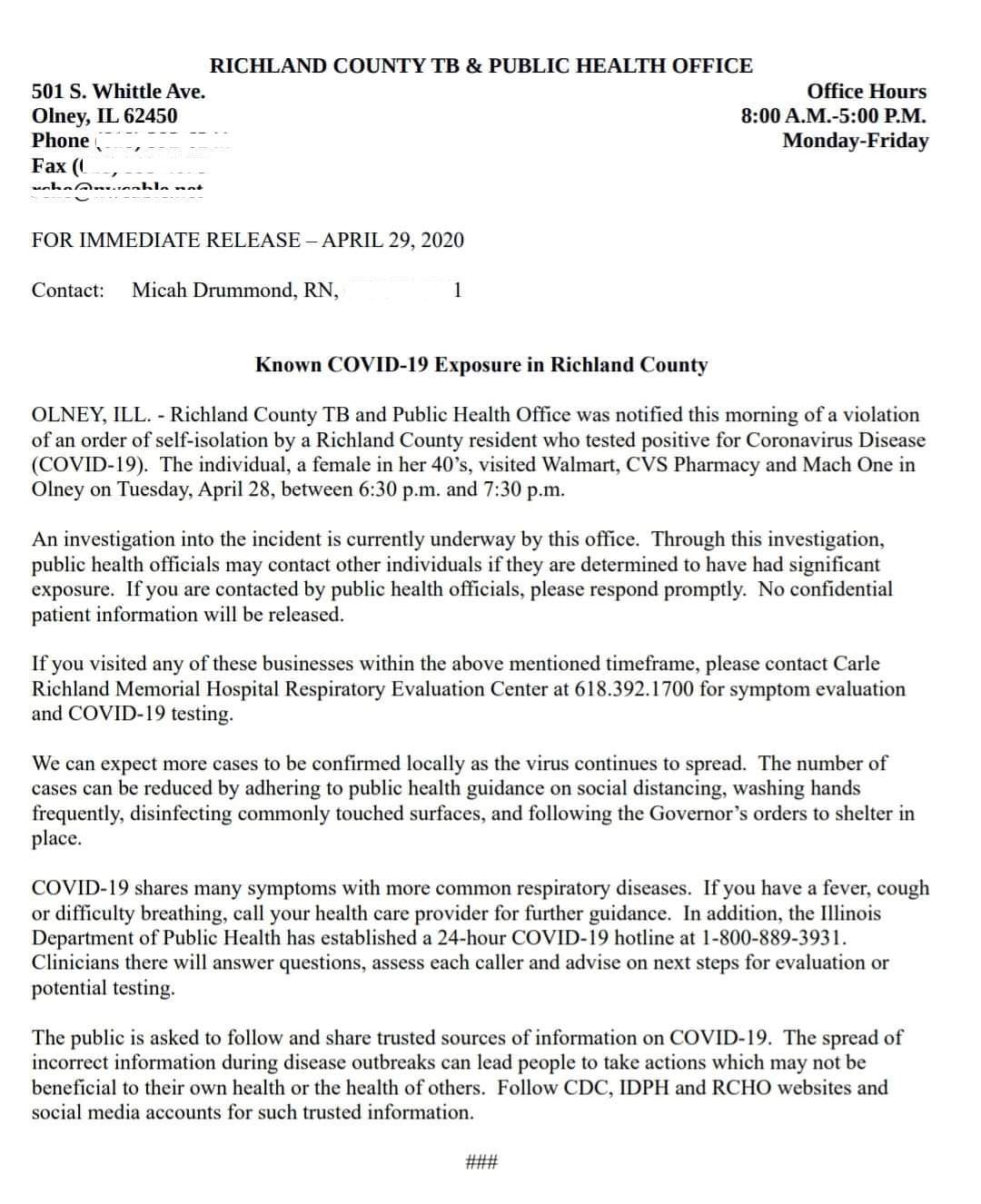
* Click the pic for a larger version…
Not saying, just saying, but she went out and about the day after Bailey prevailed in court.
…Adding… Meanwhile, Rep. Bailey is getting his publicity…
89 Comments  
|
* The governor began his press conference with some news about the PPE equipment the state has deployed, received and requested. He then said this…
We recently acquired a new decontamination system, currently deployed in Waukegan. This system can safely decontaminate and 95 masks and is an entirely free service with turnaround time of about 24 hours. I can’t overstate how important this in state resource is to our ability to help our hospitals our health care workers, our law enforcement officials and frontline workers. Each and 95 mask can be decontaminated up to 20 times without experiencing any degradation of filter performance.
IEMA is disseminating the instructions for the service to all local emergency managers, health departments and regional health care coalitions. And the information is also available on the ready, Illinois website as well. I highly encourage all healthcare entities from hospitals to long term care facilities to take advantage of this equipment, through EEMA. Again it’s fast, it’s free and it will help us help you.
As always, please pardon all transcription errors.
* He went on to talk about some new nursing home initiatives “over the last week and a half”…
Let’s start with testing. As I announced previously, we are working to test all residents and all staff for free at facilities without known COVID-19 outbreaks, allowing us to identify early the presence of COVID-19 in a facility and to isolate those cases before widespread transmission. And at facilities with known cases, we are ensuring that all employees can be tested for free, allowing us to determine who is coming in and out of an infected home possibly asymptomatic and should instead be at home in isolation. Since we started this expanded testing policy on April 19, we’ve distributed over 18,000 swabs to 68 facilities for testing with more to come.
And to expand this effort, IDPH has secured a special contract with Quest Diagnostics to run 3000 tests per day for Illinois long term care facilities at no cost to the facilities. And Quest has promised to provide results in a 48 hour window, ensuring that IDPH local health departments and long term care facilities have the answers that they need to act quickly and decisively to protect other staff and residents.
Let’s also talk about developments in staffing and IDPH’s ability to deploy teams to facilities to assist long term care staff and local health departments. In responding to an outbreak, local health departments are the first line of communication and support for more than 1000 private long term care facilities in all elements of our COVID-19 response. That said, the Illinois Department of Public Health has prioritized protecting the health care workers and the residents at these facilities. These are some of our most vulnerable Illinoisans, and the state will do everything in its power to protect them.
For many weeks now, we’ve deployed Infectious Disease Control experts, advisors and Project HOPE volunteers to these facilities, and they will continue to operate as a part of our response. But beginning today, we’re adding a new clinical support program to our ongoing protective efforts. Initially, we’re deploying 10 teams of 50 nurses to homes across the state. Over the coming days an additional team of 200 IDPH nurses will be joining their ranks to deploy to facilities across the state, every day.
Though their assistance will be tailored to meet each facility’s needs. They’ll be focused on three tasks, conducting swab testing training existing staff to take samples themselves and reviewing and improving the facilities’ hygiene practices and PPE use with some homes low on staff due to sickness. IDPH, and our Illinois Department of Financial and Professional Regulation have simplified the hiring process for long term care facilities at this time, so that they can bring on temporary nursing assistants to ensure that they have the healthy staff they need to care for all of their residents. That includes allowing our long term care facilities to tap into our Illinois Helps network where thousands of medical professionals in Illinois have indicated their willingness to volunteer their skills in the fight against COVID-19 and to support the care of facility residents covering recovering from COVID-19.
We have worked with the Federal Department of Veterans Affairs to open up existing bed capacity at VA hospitals so that our seniors can isolate and receive medical treatment there if needed. As always I want to offer my gratitude and the thanks of a grateful state to the frontline staff who dedicate their days and their nights to this work and who are stepping up in incredible ways to protect those most vulnerable to this virus. Know that your work makes a world of difference to the people that you care for to their families and to all of Illinois. So thank you.
…Adding… From the nursing home industry…
Nursing home provider associations have been meeting with the Illinois Department of Public Health and representatives from Gov. Pritzker’s administration twice a week for more than a month. Last week we submitted a comprehensive plan, and we are pleased to see the Governor has implemented some of our recommendations, including staffing reinforcements, expanding testing to all residents and staff, and ongoing PPE support.
* Dr. Ezike…
In total, we have run 256,667 tests with 14,478 being run in the last 24 hours. As far as hospitalizations, as of midnight 5,036 people were in hospitals in Illinois for COVID-19 of those 5,036, 1,290 were in the ICU and 777 patients were on ventilators.
* On to questions for the governor and Dr. Ezike. So all staff and residents at homes without cases are being tested?…
We’re in the process of that. Yeah, we don’t have enough to do it all at once so we’re getting to all of them. But I think I said 68 and i think that that’s the number.
* Lots of questions about the second lawsuit that’s been filed. Rep. Cabello, rather than the first and kind of giving you an opportunity, maybe to revise the extended stay at home order before a hearing on Monday. Your thoughts to that? Are you considering it? What do you think?…
No, I think it’s a similarly irresponsible lawsuit. You know we’re in the business here of keeping people safe and healthy. That’s what the stay at home order has been about. And I just think that lawsuit is just another attempt at grandstanding.
* Does the litigation have a point? It argues that many mom and pop retailers should be allowed to open. Big box stores are operating, similar shops can observe similar social distancing protocols. Why not allow those small business owners to do more than just drive up and delivery?…
One of the challenges that’s come up during this crisis has been that again the list of essential services and businesses that are open focuses in part on grocery stores. But as you know many big box stores have a grocery store inside them, which allows them under this order to stay open. They also have other aisles and other products that they sell.
So that’s one of the unfortunate challenges of this small mom and pop, as Eric is calling them, stores, the small business people. What we’ve tried to do for them as this pickup and delivery for any kind of retail establishment, to give them an opportunity to reopen. I am most concerned about those small businesses. It’s one of the reasons we created, even in addition to the PPP program at the federal level which I don’t think has been great for those small businesses, we created a grant program at the state level to just provide $25,000 grants to local small businesses.
There is no doubt about it that the first thing that I want to be able to do across the state is to open up those smallest businesses. Those folks have risked their lives, you know risked their livelihoods, rather, all of their savings to open up a business and along comes this terrible pandemic that no one expected. And it’s devastating, specifically those tiny those small businesses, so we’re working hard to figure out how to make that happen. And of course we will give some guidance and guidelines for stores about social distancing. How many people can be in a space, certain number of people per square feet just like you hear from a fire marshal for example, but it is a top concern of mine to open small businesses as soon as possible.
* So, in regards to the second lawsuit. They’re also hoping, you know, the legislator can get back, they want to have a conversation about all this. Is that a possibility, why not work with the entire legislature to pass a law clarifying such powers in order to be able to go back during a situation like a pandemic?…
Everybody should understand that I do the executive order, the legislature has the ability to meet. There’s nothing barring the legislature meeting. Obviously they have to follow social distancing guidelines and other things but they are considered essential as our governments around the state. And so that’s something that’ll get decided by the leaders and the members themselves about whether and how to meet.
I have suggested to the legislature that if they want guidance, and I think they will want guidance about how to do it safely, because that’s the most important thing we just don’t want anybody getting sick as to whether they meet today, a week from now or a month from now, whenever that may be. It needs we need to make sure that all the people who work in the capital for those legislators, as well as all the legislators are safe. And so I have suggested to them they may want to get guidance from our IDPH or from epidemiologists, you know, well regarded epidemiologists in the state, who would know how to design a plan for them to to meet.
Has anyone asked for that guidance?…
Several of the leaders asked to know what would that look like. And so there was an outline provided to them of what it could look like, but not knowing the details of how the legislature wants to do this. You know, it’s hard for guidelines really to be written for what they want to do, for example, are they, hoping to have committee meetings? If they are hoping to have committee meetings How do people participate in that. How is there an audience in a small committee room when we can’t have gatherings of 10 or more in a closed space? So those are complicated and I just don’t know what the legislature will want to do in that regard.
What about a virtual meeting?…
It’s not allowed by law today, but absolutely they could I know that the city council in Chicago has met by zoom. I know that some of the aldermen don’t feel like it’s a very effective way to meet but they are at least meeting.
And so yeah, that is something that the legislature could do. But in order to do that they would need to meet in person and to pass a law to allow distance meetings. So how would that happen, how does that, how do we get that ball rolling. But yeah, I would say it’s back to the legislators themselves. I mean honestly this is not my, it’s not you know for forcing people somehow. I’m not going to push legislators and they are as many have pointed out a co-equal branch, they do have the ability to make their own rules and make their own decisions. And that’s something that’s completely, you know on them with any advice, we’ll be able to provide to them.
Bill Brady suggesting today maybe wearing masks, putting up plastic shields or maybe even meeting in a place like the United Center. Why if the Department of Public Health can set regulations for how grocery stores can safely operate as a department, set guidelines for how the legislator can convene to do its work well?…
It’s kind of the same answer, and I don’t know whether they would recommend wearing face shields, or surgical masks or N95 masks. Again that’s, I’m not an expert and honestly I think that if you think about it, there are 177 members of the General Assembly. And then when you add just even one staff member per legislator, you’re at 354 people. And then, of course, there are security people at the Capitol and others. So you know when you add all that up, it’s a quite a lot of people. Yeah, you in theory you could meet anywhere, but, of course, you know that too would be an expense that would have to be borne by the state but it’s it’s doable.
If they can’t meet, what damage is being done to the legislators and ability to function during the COVID-19 pandemic?…
Well this COVID-19 has just been horrible, I mean it’s been the effect on people’s lives, the effect on the state, the ability of the state to move forward. Think of all the things that we knew that we wanted to accomplish and I’ve talked about accomplishing this year that I believe and not to mention, people who may disagree with me and the things they want to accomplish for the year. The idea that the session has been so delayed. Now remember, it is possible to meet at any time. It doesn’t have to be today or next week or even next month, it really could be at any time and again that’s up to the legislature. If I started dictating a date for them to meet, I’m sure that there would be blowback from legislators and so I have left it to them to make decisions.
* Is there any legal advantage to bypassing the Fifth State Appellate District and taking the appeal of Representative Bailey’s court case directly to the State Supreme Court, considering that appears, many more lawsuits are coming?…
That has been done, that filing, or at least the filing with the fifth district, as I understand it, the Attorney General is filing an appeal with the fifth district and simultaneously or sure moments after filing for leave to take it to the Supreme Court.
* It’s a class four felony in Illinois to carry a concealed weapon while wearing a mask. Technically prosecutors could charge a legal gun owner for obeying your executive order. The order doesn’t take effect until Friday, why not use your executive order to temporarily suspend that portion of the law?…
So actually we’ve allowed the state police to set some guidelines here and it doesn’t prohibit people from concealed carry. The rule that we put in place would not.
* Some frontline health care workers are using shower caps and rain ponchos for PPE. Is that appropriate?…
No, they should be provided PPE by their hospital, by their healthcare facility that they work for. We, as I have said we have provided to every county health department, and to hospitals and others across the state, the PPE that they’ve asked for indeed, and we are trying to keep some sense of the inventory that exists, and the inventories exists so if there are healthcare workers that are not being given PPE. First they should tell their supervisor, knowing that there are stores of PPE at the facility. Second, if that is not effective they should call their county public health department which has received deliveries from our IDPH of PPE. And we have PPe in the state, you know we’re constantly ordering more, we have you know as I mentioned there’s sort of a shortage of gowns. But as to all of the PPE that should be available to those folks when they go to their health care facility.
* Do you have data on what populations are making up the newly infected cases? We’ve been staying at home for several weeks. Are the new cases primarily essential workers, or people who are staying at home still getting sick anyway? [Really good question.]…
Dr. Ezike: Just to review how this virus is transmitted. If you have been home for, I don’t know how many days now. If you have been home. You can’t, the virus cannot come up de novo. Of course we know that there are many people in our state that do have to leave the home, whether they’re essential workers and there are many from from the healthcare workers to the first responders to government officials to people working in the grocery stores delivers people who are providing food so there are, you know, many, many people that do go out. There are people who are under the stay at home, but go you know venture out so there are still many opportunities for the virus to be transmitted. The good news is that we know just even from the are naught value from the doubling time from the way that the number of cases and the number of fatalities have have flattened that we have curve, that number significantly significantly, so I want to applaud the people of Illinois they have done the right thing, and we have gotten the desired effect. Have we gotten to the point where there’s no transmission of the virus? No, but we have done a fantastic job and that’s why we need to stay the course.
* There are a handful of counties without a single confirmed case of COVID-19. I know my home county of Schuyler County only has one case. Any more thought to lifting or easing restrictions in those specific areas?…
Actually we did, in many ways, in this new stay at home order that begins May 1. That is to say we identified state parks, many of them are in those areas of the state. And we’ve opened those, we are opening those state parks, which had been closed in part to keep the residents or other visitors safe but also to keep the state workers safe, who have to congregate in small facilities there sometimes, several of them in a, in a truck, all at once so we wanted to keep them safe.
So that’s one way or another, other ways. For example, when we allowed elective surgeries, we made sure that the areas of the state that have the most availability of hospital beds and ICU beds, had the most availability of elective surgeries. And so those are examples of the ways in which we’ve kind of, you know, gradually allowed certain areas to do more than other areas.
But I would also point out that yes it’s true. There are six counties in the state that don’t have any cases, several counties that have one case. But as you move up that list and there are 102 counties, what you find even in that bottom portion of, you know, fewer cases is that, by virtue of the population in the county that actually their infection rate is higher than in Cook County or than in other areas that seem to have many more cases, but by population, you might have a hotspot in a small less populated county so we’re keeping an eye on those areas but I 100% agree with the idea that, where it is safe and where there’s more distance for people and you know where we can open businesses that don’t force people to congregate together in larger groups than 10 at a time and so on then we want to do that as soon that’s kind of part of the thinking of the phases that you’ve been talking about and the regions that’s still on the table. That’s correct. The way we think about regions is really in health care zones, where are the hospitals, how many beds are available at the hospitals that would serve a certain area of the state, rather than the way sometimes people talk about regions of the state as well. I live in Southern Illinois or I live in little Egypt or you know whatever. These are all great ways to identify areas of the state, but the way we look at it is about health care and keeping people healthy. And so that’s how you know when you talk about regions that’s how we’re thinking about.
* Update on McCormick Place? What’s the latest on what other staffers are doing who were hired and now not needed?…
Right, so the healthcare workers that are at the current place that may not be needed are actually going to be used in other areas for example with nursing homes, other facilities we still have remember staff people everywhere healthcare workers everywhere are getting ill they’re putting themselves out there, risking themselves and some of them are getting sick and need to be home isolated or some of them even have ended up in the hospital. And of course, some have died. And so we have a shortage of healthcare workers across the state. So, those that aren’t working at McCormick, that we can redeploy we are redeploying as to the future of McCormick Place. We’ve talked a lot about standing down. Many of the beds that for the time being, you know that the facility is there to be used. But the idea of staffing all of the 3000 beds that we were going to staff because we didn’t know how high the peak was going frankly we still don’t really know, but we do see like I’ve said flattening. So, we’ve stood down 1000 of those beds and it looks like we’re going to have the ability to stand down much more of that facility. So, but again I don’t want to speak too soon because all of these identified alternate care facilities, need to be in a state of some kind of readiness. In the event that there’s a surge, either because we reopen, and God forbid we open reopen too fast or because there’s a surge that people expect in the fall, because there’s a potential for that surge.
* Do you continue to have McCormick Place up and running as an alternate care facility through the fall?…
I can’t project that far in advance, honestly. At the moment, again, everything that we prepared for what we thought would be a higher peak. And again, the reason we didn’t hit a higher peak is because of all of you at home, who are staying home and following the rules. But, you know, we need to be ready, we just don’t don’t know.
And so I think we have to watch and see what the infection rates are what you know we’ve talked about the or not. How many people does a single infected person infect. So if it’s, you know, 1.2, 1.1 [garbled] and so on. And now we believe that infection rate or the R naught as they say, the number of people get infected by one infected person is less than two and D less than one and a half, at this point, it had been up to three and a half. So all of those things factor into the way we think and we try not to project too far in the future because gosh, at this point it would be hard for anybody who’s not an epidemiologist to say, why would there be a surge in the fall, what is the fall have to do with anything and yet the experts say that is precisely the concern that we’ll be focused on.
* Michigan’s offering a GI bill for pandemic frontline workers, tuition free path for college degree, thoughts, something you would consider?…
Absolutely. I think that that you know the idea of providing, what I’ll describe as combat pay you know for people around the frontlines that’s something that we ought to be considering. As you know, we don’t have any surpluses laying around in Illinois, that would allow us to just pull that out of an old rainy day fund. There just isn’t any in Illinois, there wasn’t any when I showed up in office. So we are looking to the federal government to help us fund the loss of revenues in the state that’s come from coronavirus. And I do believe that we should be looking at how to support the people who have been truly amazing. They’re heroes to all of us and I think they deserve to be recognized as such.
* A standalone firearm range that doesn’t have a retail component says they were told they can’t operate under the order. If they aren’t allowed to operate they say they’ll look into illegal actions against the order, how do you plan to address non retail firearm training and practice rages?…
It’s not something I’ve honestly paid close attention to. Now that you’ve raised it I’ll certainly look into it, but at the moment remember we’re trying to focus on essential businesses and we followed we’ve tried to follow the guidelines of the Federal Homeland Security list of essential businesses.
* Fox 32 uncovered a nail salon operating on the north side ignoring your stay at home order. What can the state do to go after non essential businesses? How many complaints has the state received for non essential businesses operating during this temporary closure?…
Well, again, we’ve asked people to follow the rules. We also local law enforcement has the ability to go to engage with those business owners that are opening against the rule. You know we have enforcement mechanisms their permits can be taken away the state can take action local governments can take action. So lots of ways in which those businesses can suffer some penalty as a result of not obeying these executive orders.
* How does that feel when you see these businesses opened and not abiding in parties?…
I think I want to talk about the businesses, kind of separate from parties, because look you know I know that it’s very very difficult for these small businesses in this time. And so I know there is an urge to want to just open the doors because of the devastation that this coronavirus has caused.
But we have to be responsible because it’s not just you the business owner, that you know you’re keeping safe by staying closed. You’re also keeping the populace safe by keeping closed. And so it’s, we just need a little while longer here while we move past this peek.
And for those who think that the President of the United States is the person that they want to follow on this, all I can say is, they put out a federal plan, some of which I think is is right. And so, past peak, we want to make sure that we’re moving down the other side of that peak, and then we can start to open.
To people who are partying together. And I saw some comments by somebody who was at one of those parties. All I can say is that everybody at that party put themselves and everybody else they’re at risk and they put their families at risk their friends at risk their communities at risk, because when they left there remember you can have COVID-19 and be asymptomatic we’re having no symptoms. Right. So, this woman who spoke about it said well I’m not feeling anything it’s been a day I’m fine, you know. Well guess what, you can have it, and you may be asymptomatic and you may be giving it to other people.
* Woodford County has a population of 38,265 have been tested 12 positive one has died. Why do you think they should be treated just like Chicago? Density doesn’t matter data doesn’t matter explain the science behind that position?…
Well, like I said earlier, we in fact aren’t treating every part of the state the same.
And more importantly, as we began this we didn’t really know how this virus was spread, we didn’t really know that there was even asymptomatic situations where someone could have coronavirus and not know. And so, certainly we’ve learned a lot all of us from the epidemiologists have learned a lot over the course of this. You know this novel coronavirus. And so we are in fact making changes and you’ve seen some of those in the executive order that I put forward more will come. But again, I would point everybody to the president said. Indeed, I think, Amy Jacobson mentioned the plan that the President put forward, and what it takes to get to what he calls Phase One is, indeed, much of what we’re following here.
* New data from the CDC suggests there were an additional 700 deaths between March, 8 and April 11 that were not directly attributed to COVID-19. Are you aware of the spike in deaths above the average for previous years, and if so, is it possible these could be previously unidentified COVID-19 fatalities?…
Yeah it is. I mean I think everybody’s realizing, indeed, there’s been a recent report out of California I think that shows that people had COVID-19 long before anybody thought, here in the United States. And so, it’s probably true here in Illinois that people had caught a virus long before. And so some of the deaths that nobody was even talking about, they didn’t have a name for this thing, people were dying and they may have been put on their [garbled] because they died of pneumonia or some other respiratory illness. And so there’s no doubt that we’re going to need to go back through the records. That’s going to probably happen in months hence, because we have so much to do now to focus on keeping people safe and alive now. But we’re probably going to have to go back and see how many of these probably based upon all the symptoms were COVID-19.
* One feeling behind this week’s lawsuits is you haven’t listened to the needs of people Downstate. Could you do better? Some examples of where you’ve done well downstate, can you envision any scenario where you would negotiate with outsiders on less restrictive stay at home order?…
It’s being suggested by the question is that, I’ve had many, many direct conversations with legislators, Democrats and Republicans downstate, and I’ve listened to them and I think some of them would tell you that they were the ones who suggested some of the changes that we put into the May 1 executive order. And certainly the leaders of the, the Republican leaders of the House and Senate also made suggestions that were incorporated into the stay at home order for May 1.
So, I mean, is there more to do of course, I mean I know it’s hard to look back and say that I did everything exactly right, but I will say that I listened, I have listened and I continue to listen to people on both sides of the aisle.
I need best ideas, you know you heard me talk about representative Mark batt Nick at one point, who suggested that people in grocery stores and in essential businesses needed to wear face coverings. And he himself went out and promoted that in his district and has developed a terrific poster that I think should be more widely used and downloaded from his website about that, and I listened to him and indeed, obviously a portion of what we put in place in order to lower the infection rates across the state was because of the suggestion of people in those essential businesses need to wear face coverings and I thank you representative for raising that subject.
* Are there any plans to defer property taxes for small businesses, some have reached out to say their bill is due in a few months and they won’t be able to pay it since they produce no income during the stay at home order?…
As you know, property taxes are managed by local governments, county governments, municipal governments and I certainly encourage folks to think about what they can do to lower the or to extend the due dates or to change how it is they’re charging people for their property taxes. But that is something that’s being decided at the local level, it’s not a state issue
* IDPH data appears to show non COVID patients and ICU beds spiked from 991 on April 23 to 1265 the next day to 1448 on April 27. Is there an explanation for a spike in non COVID ICU patients in such a short amount of time?…
Dr. Ezike: I can only offer speculations as I don’t have the diagnosis of all the people who are non COVID, I know as I follow the literature and actually from hearing anecdotal information, we are seeing people with acute heart attacks and strokes and as I’m going through the literature I’m seeing how this virus actually affects the blood vessels and how it’s promoting clots. And so there may be additional heart attacks and strokes and other clotting events that may or may in fact be related to COVID so again without being able to study the you know the the medical records of each of those additional cases, We can speculate. But I think maybe the people in the hospitals could maybe, maybe round out the information and give us more granular details as we go forward.
* Can you offer an update on the Midwest coalition of states and whether anything has really happened with how you all are dealing with Missouri and Iowa or cross border travel? [He’s said multiple times that he’s not sealing state borders.]…
We are in consistent communication. I in fact was in contact with three other governors that are part of our coalition just this morning.
And in terms of cross border traffic I mean we’re not stopping people from traveling. So, that’s not something that we’re looking to do we are you know the county health departments across borders, do talk to one another about how to make sure that you know we’re keeping people safe and healthy.
And so you know those are obviously as indicated by the question peculiar to those areas of the state. We’re very concerned for example about areas like East St Louis and Belleville and all of St. Clair and Madison counties, because there has been an outbreak, obviously a hotspot in St. Louis, and that has an effect on people who are just across the river. So we’re keeping a very close eye on it. And of course we’re doing a lot of testing in that area and focusing on health and safety and keeping people at home.
* When the mask requirement takes effect would you advise businesses to refuse service to anyone not wearing one?…
I would, and in part because that is the intent of the executive order. And in part because I think that people don’t want to go into your establishment if you have people in there, who are have the potential to infect each other by virtue of not wearing a mask.
* Can you provide an update on your tracing efforts how many workers what technology will there be phone banks how much funding is being allocated?…
I think I answered this yesterday, but we absolutely are in process of building this thing it’s not something that will happen overnight. But there’s no doubt that we are hiring. A number of people are in process of putting the infrastructure together to hire people. And there are a number of different technologies that are available. As you know I came out of the technology industry before I became governor. And so I have some opinions about that but most importantly we just want the technology that will work best and there are examples of it working in Massachusetts in particular, but I’m going to take a look at all of it and you know we’ll make a decision. I will not be the final arbiter of which technology gets chosen but I have some opinions to offer and certainly salient questions.
* Are you considering to any plans to possibly allow hairdressers and barbers to reopen before June one for example if everyone wears a mask and salons are sanitized regularly?…
Look, we’re considering how to open all kinds of different businesses. It is hard, I mean I’ve listened to epidemiologists about this and Dr. Ezike and others. It is hard to, you know, in businesses where people are going to be face to face or, very close to one another in providing a certain service. You know, there’s no social distancing that could be done in that circumstance.
Having said that, we’re looking at, we’ve seen other states doing, thinking about this and where they put it in their phases of reopening. And that’s one that we’re certainly considering. Haven’t figured out exactly which phase to put that in.
I would like that to happen sooner rather than later.
* What guidance is IDPH giving to food manufacturers when they have identified an outbreak among workers? Should they shut down? How should companies and health departments make this call? Companies say there is a lack of clear guidance…
The federal government regulates those facilities and we were just informed today by the White House that the President has invoked the defense production act to protect those facilities from being closed. But the guidelines for how to keep the workers safe, in my opinion, needs work. And so we here in Illinois are most concerned about the people who work in those facilities. We want to keep the supply chain going. That’s very important you know meat processing and proteins, very important in the supply chain for food.
So we want to make sure that they’re open, but we also want to make sure that they’re safe and so we’re trying to augment the efforts of the federal government, and also examine what they put out today which involves some guidelines from their department of agriculture, OSHA, the Department of Labor, these are all US departments, as well as the CDC. But in my opinion that you know everybody should be wearing a mask in these facilities, everybody should have PPE available to them, they should be cleaned if there is a an outbreak. And of course the workers there who are either COVID positive or exposed to COVID positive workers should be allowed to stay home and recover or isolate until they’re considered free of COVID.
* SEIU has said workers of more than 40 nursing homes will strike May 8. Have you gotten involved in the negotiations, or will you get involved to keep workers on the job will the state step in if facilities strike?…
I have not been involved in that I have, you know I am encouraging and would encourage both sides to come to the bargaining table and get this done, get a deal done get a contract done. We cannot let our seniors down We can’t let people who are in long term care facilities down. It’s too important.
* Downstate TV stations have both asked IDOC to release a list of 4000 inmates released since March 1. Were these released due to COVID? Winnebago county state’s attorney says you cannot notify victims families quick enough. What do you say to those families?…
No, it’s my understanding that a majority - I haven’t heard that 4000 number until I read it recently - majority of those releases are people who simply their sentences came to an end and they were released as they normally would be.
* On March 20 you said all non essential businesses must halt operations. What law gives the executive branch power to indefinitely shutter private businesses?…
Well there’s nothing indefinite about it, it’s in response to an emergency. So when there’s an emergency the Emergency Management Act gives authority. And then, of course there are authorities given to the Emergency Management Director as well as the Director of the Department of Public Health under different a different law to effectuate these things. But there’s nothing indefinite about it, there’s what it’s intended to do is while an emergency is ongoing and there clearly is an emergency folks. I mean let’s pay attention to the fact that people are dying every single day. What was predicted by some a couple you know a month ago to be will only have 10,000 deaths only 10,000 deaths in the United States we’ve now I think surpassed 60,000. And, in Illinois we continue to have people die every day and, so, look, I know the intent of the question is to ask about the indefinite nature of there’s nothing indefinite about this.
* Since the governor keeps saying the hospitalization number is the most important. Can you explain what those numbers need to look like in order for the layperson to know how the state is doing? Is a percentage of all beds just ICU beds, etc.?…
I think the basis of the question, if I understand is, when are we going to be able to move into the different phases of opening, is that the intention of the question about hospitalizations? We watch hospitalizations, but they can’t keep going up, they’re going up, ICU bed beds are still filling. And so, we need to, again I would look at the President’s guidelines as one measure here which is you have to peak and then move down the other side for 14 consistent days. And I think that’s a good way to think about what the timing might be. But again hospitalizations are a very important maybe the most important measure here because you don’t want to have your hospitals overrun with cases.
* Has the governor received a letter from Central Illinois mayors, including those from East Peoria and Pekin, proposing reopening their economies in phases, if so does the governor have a response to their proposal?…
Yes, I very much appreciate different groups of mayors or areas have offered their plans for reopening. Those are extremely instructive. And I appreciate that very much. We also got one from Quincy, and from mayor’s around the Chicago area, and so on. These are very helpful. And so as we look at the phasing back of the economy, we’ll be taking all of those letters into consideration and I want to thank the local officials, many of whom I’ve spoken with directly on the phone, including the mayor of East Peoria, and so I look forward to the reopening, and to listening as I have, along the way here to listening to their ideas and incorporating them in the phased-in plan so we can get everybody back to work, back to school.
-30-
58 Comments
|
2,253 new cases, 92 additional deaths
Wednesday, Apr 29, 2020 - Posted by Rich Miller
* Press release…
The Illinois Department of Public Health (IDPH) today announced 2,253 new cases of coronavirus disease (COVID-19) in Illinois, including 92 additional deaths.
- Cook County: 1 male 30s, 1 female 40s, 3 males 40s, 3 females 50s, 1 male 50s, 8 females 60s, 10 males 60s, 6 females 70s, 11 males 70s, 3 females 80s, 7 males 80s, 4 females 90s, 3 males 90s, 1 female 100+
- DuPage County: 1 female 80s, 1 male 80s, 1 male 90s, 1 female 100+
- Jasper County: 1 male 90s
- Jefferson County: 1 male 80s, 1 male 100+
- Kane County: 1 male 50s, 2 females 90s
- Kankakee County: 1 female 90s
- Kendall County: 1 male 90s
- Lake County: 1 male 60s, 1 female 70s, 1 male 70s, 1 male 90s
- Madison County: 1 male 80s
- McHenry County: 1 female 80s, 1 male 80s
- Sangamon County: 1 female 80s
- Shelby County: 1 male 70s
- St. Clair County: 1 female 70s, 2 males 80s, 1 female 90s
- Vermilion County: 1 male 70s
- Will County: 1 male 60s, 1 male 70s, 2 females 90s
Currently, IDPH is reporting a total of 50,355 cases, including 2,215 deaths, in 96 counties in Illinois. The age of cases ranges from younger than one to older than 100 years. Within the past 24 hours, laboratories have processed 14,478 specimens for a total of 256,667.
19 Comments
|
COVID-19 roundup
Wednesday, Apr 29, 2020 - Posted by Rich Miller
* The news out of Germany is not heartening…
Germany faces the prospect of returning to a stricter lockdown after a surge in coronavirus infections and deaths.
The country has slowly been easing its lockdown after faring much better than its European neighbors as a result of an aggressive policy of mass testing.
But the country’s virus reproduction rate - known as “R” - which measures how many people the average person with Covid-19 infects has bounced back to just below one.
That means one person with the virus infects one other on average. Earlier this month, the rate was at 0.7. […]
Chancellor Angela Merkel has warned if the R rate increases even slightly above 1 then the country’s health service faces being overwhelmed.
“If we get to a point where each patient is infecting 1.1 people, then by October we will be back at the limits of our health system in terms of intensive-care beds,” she said.
“If we get to 1.2 . . . then we will hit the full capacity of our health system as early as July.
* More…
Earlier this month, the country took its first step to gradually restart public life as the propagation rate of the virus fell.
Small retailers with a surface area of up to 8,600 square feet, car and bicycle dealerships, as well as bookstores, were allowed to reopen while keeping social distancing in place. Next week, some students are expected to return to school.
* Hannah Meisel at the Daily Line…
Illinois Department of Health Director Dr. Ngozi Ezike on Monday said the most recent confirmed R0 figure for Illinois was 1.4 — a number epidemiologists use to determine the reproductive ratio of a virus — or how fast a virus is spreading in a given population.
Illinois’ R0, or R naught, value is decreasing, but hasn’t yet fallen enough yet to let up on the state’s stay-at-home order, Ezike said. The R0 value is the reproductive ratio of a virus.
Germany didn’t start to reopen until it was at R0.7 and now it’s rising again. Illinois is somewhere around R1.4. But, hey, a few folks are screaming about reopening right away, so let’s listen to them!
* Finke…
Jacksonville Republican Rep. C.D. Davidsmeyer said Wednesday Illinois lawmakers should be called back to Springfield to vote on whether to extend the state-at-home order that Gov. JB Pritzker is planning to extend.
Davidsmeyer, along with Reps. Norine Hammond of Macomb and Dan Ugaste of Geneva, contended that Pritzker does not have the authority to extend the order beyond its original 30 days. Pritzker declared the original order – which was to expire April 30 – will be extended until the end of May, although with modifications.
“What we are talking about here is the governor’s authority to go past that 30 days of emergency power,” Davidsmeyer said. “Whether you agree with the governor or disagree with the governor, we believe that a separate but equal branch of the government, the General Assembly, should have input in the direction of the state of Illinois.”
So far, there has been no public commentary by either House Speaker Madigan or Senate President Harmon about reconvening.
* WMBD TV…
The Woodford County state’s attorney said he will not enforce Gov. J.B. Pritzker’s stay-at-home order extension at the county level.
State’s attorney Greg Minger sent an email to chief deputy of the Woodford County Sheriff’s Office Dennis Tipsword this week, essentially saying he will not prosecute those who violate the governor’s order. He said the people should determine what is best and safest for them and their community, whether that means staying home or going back to work and opening nonessential businesses.
“I cannot let the powers that be continue to impose their will on the people in violation of separation of powers, due process, and our most basic concepts of liberty and freedom for all,” Minger wrote. “We need to live in a world with COVID-19…no doubt about it. But the basic ideals our country were established on and that people have fought so hard for over the past more than 200 years cannot be eroded in this way.”
That’s the same state’s attorney who is prosecuting a nine-year-old for murder.
* Press release…
Aurora Sportsmen’s club today issued letters of inquiry to Governor Pritzker, Attorney General Kwame Raul, and Director of the Department of Commerce and Economic Opportunity Erin Guthrie seeking rationale for the governor’s executive orders and the subsequent rule-making surrounding them. Additionally, a letter was sent to Attorney General Barr alerting him to what we believe is an overreach of the governor’s emergency authority in prohibiting constitutionally protected activities.
Over the past three weeks members of our board of directors have reached out to State of Illinois and DeKalb County officials for a clear explanation for the reasons ASC can not operate beyond the fact that we were not specifically named as an essential business in the governor’s executive orders. None have been provided. We are now publicly seeking answers.
While some firing ranges are allowed to operate under the Governor’s March 20th, 2020 Executive Order #10, ranges that do not have a retail presence selling firearms or firearms related accessories or ammunition have been told they are to remain closed.
Aurora Sportsmen’s Club believes the mandated closure of shooting ranges that do not have a retail presence is unconstitutional under Heller v. District of Columbia, McDonald v. City of Chicago, and particularly Ezell v. City of Chicago.
We believe that if dog groomers and marijuana dispensaries, neither of which are protected by an enumerated constitutional right, are allowed to operate, then shooting ranges such as Aurora Sportsmen’s Club should be allowed to operate as well.
Aurora Sportsmen’s Club continues to weigh it’s legal options and the responses to our letters of inquiry from government officials in Springfield will weigh heavily on our decisions moving forward.
* But…
The Harrisburg City Council decided not to defy Illinois Gov. J.B. Prtizker’s stay-at-home order by allowing retailers, hair and nail salons to open May 1 as Mayor John McPeek originally proposed. Instead, McPeek and council members opted for a softer approach. They are encouraging area government and business leaders to write letters to the governor asking that he begin to take steps to further loosen restrictions in areas with relatively few COVID-19 cases.
During a special meeting Tuesday morning broadcast via Zoom, the council heard from several Harrisburg business owners who believe they should be able to begin accepting clients again, with restrictions. But McPeek said the potential consequences are too risky for the city to endorse a policy in opposition to the state’s. Some of the business owners also said that, while they want to open, it would not be worth it for barbers, cosmetologists and aestheticians to risk their state licensure.
* Tribune…
Protesters who want Gov. J.B. Pritzker to announce a plan to reopen the Illinois economy have scheduled a Friday rally outside the Thompson Center in the Loop. […]
The Loop event is being organized by Freedom Movement USA, which on its website describes itself as “a group of like-minded Republican activists.” The organization has held pro-President Donald Trump rallies in other parts of the state.
I looked around Facebook and this is a pretty small group.
* Tribune live blog…
Chicago area unemployment reached 4.8% in March as coronavirus took its toll. Experts say that number will jump in April.
Experimental drug remdesivir proved effective against COVID-19 in major study, drugmaker Gilead says
Trump order keeps meatpacking plants open, but unions say workers unsafe
Voices of the pandemic: How the coronavirus changes the lives of Chicagoans, in their own words
Divvy extends free rides for health care workers, lower charges for others
Medline wants FDA approval to sterilize N95 masks with ethylene oxide. Two other federal agencies are against it, citing cancer risks for health care workers.
Illinois COVID-19 restrictions will ease for nonessential retailers and animal groomers, but it won’t be business as usual
* Sun-Times live blog…
South Side seniors keep up weekly bingo date with video chat
Roomier trains, wider bike lanes and more proposed solutions for safer public transit during coronavirus
Married 70 years, husband and wife with COVID-19 held hands in hospital before their deaths
NBC Sports Chicago to host star-studded COVID-19 fundraiser, pay tribute to front-line workers
Chicago police announced Tuesday seven more cases of COVID-19, bringing the number of cases in the department to 421.
Eighteen employees at a Tootsie Roll manufacturing plant in Chicago have tested positive for COVID-19 since the end of March.
Rep. Raja Krishnamoorthi is pressuring the FDA to police COVID-19 antibody tests
Pandemic’s disorder in the court
22 Comments
|
Question of the day
Wednesday, Apr 29, 2020 - Posted by Rich Miller
* Clay County Circuit Court Judge Michael McHaney on Monday…
Counsel, I couldn’t agree with you more that it’s no joke and, while we’re on that subject since you brought it up, at a recent press conference, this Governor was asked by a reporter what about easing restrictions in counties in Illinois that don’t have COVID or don’t need it, and his response was, wait for it, laughter. I agree. It ain’t funny.
His comment is getting some play on social media, but he didn’t quite explain the question Pritzker was asked.
* The question the governor laughed at…
Many people in rural parts of the state want to quarantine Chicago and the suburbs and reopen parts of Downstate Illinois that aren’t seeing infection rates like the urban areas. Why has the state not done that?
The governor’s response…
I, I’m, I’m not sure how to answer that except that this virus knows no boundaries, folks. No one is immune from this virus, no matter where you live and we are trying to take into account the differences between population density in one area of the state, versus another and you’re seeing that in the executive order, the modifications to the executive order that we put out today.
The audio…
…Adding… Just for clarification, the question was read by Pritzker’s press secretary. The question was submitted online by Daily Herald reporter Jake Griffin.
* The Question: How would you have reacted? Make sure to explain your response. Thanks.
85 Comments
|
* As we discussed yesterday, Rep. John Cabello R-Machesney Park) has filed a lawsuit attempting to void the governor’s executive order. Here are some of the relevant portions…
A. Entering an order declaring the Illinois Legislature specifically delegated the supreme power of isolation and quarantine of its citizens to the Illinois Department of Public Health. Pritzker has no legal authority under the Illinois Constitution to enter isolation or quarantine of Cabello, or any citizen of the State of Illinois similarly situated;
B. Enter an order declaring that Section 1 of the March 20 Executive Order, or any subsequent order issued by Pritzker with substantively the same provision as Section 1 of the March 20 Executive Order, requiring Cabello, and all other citizens similarly situated, to “stay in place” be found void ab initio;
C. Awarding the Plaintiff his costs incurred in this matter as may be allowed by law;
D. That the Court grant such other and further relief as is just and proper. […]
A. Entering an order declaring Pritzker declared the COVID-19 pandemic a state-wide disaster on March 09, 2019;
B. Entering an order declaring there has at all times relevant only been one disaster, that being COVID-19.
C. Entering an order declaring the April 01 Proclamation was acknowledging the same COVID-19 disaster which was declared on March 09, 2020.
D. Entering an order declaring the emergency powers granted Pritzker as a result of the March 09 Proclamation lapsed on April 08, 2020;
E. Entering an order declaring the emergency powers of section 7 of the IEMAA in March 20 Executive Order lapsed at the end of April 07, 2020 on their own terms;
F. Entering a declaring that Pritzker’s April 01 Executive Order, extending the effective date of his March 20 Executive Order until April 30, 2020, as it relates to the exercise of emergency powers of section 7 of the IEMAA, was in excess of the authority granted him under IEMAA;
G. Enter an order declaring that any further exercise by Pritzker of the emergency powers enumerated within section 7 of the IEMAA, attempting to be enforced subsequent to April 08, 2020 are void ab initio; […]
A) Entering an order finding Section 1 of the March 20 Executive Order is void as it violates the procedural due process rights of Cabello, and all citizens similarly situated;
B) Entering an order finding Section 1 of the March 20 Executive Order is void as it violates the substantive due process rights of Cabello, and all citizens similarly situated;
C) Entering an order that any subsequent orders issued by Pritzker with substantively the same provision of Section 1 of the March 20 Executive Order is void ab initio; […]
A. Finding that Cabello, and all citizens similarly situated have a right, to insist from Pritzker that Section 1 of his March 20 Executive Order, or any subsequent order issued with substantively the same restrictions, must have been issued within any authority delegated by the legislature or from any authority granted him from the Constitution, and ; and
B. Finding that Cabello, and all citizens similarly situated have a right, to insist form Pritzker that Section 1 of his March 20 Executive Order, any subsequent order issued with substantively the same restrictions, must still be valid and not have lapsed by the express language of the IMEAA;
Void ab initio means “to be treated as invalid from the outset.” And I still say that the EO does not command anyone to be isolated or quarantined.
* And then he asks for an injunction…
Enter an injunction permanently enjoining Pritzker, or anyone under his authority, from enforcing the March 20 Executive Order, any subsequent order issued with substantively the same restrictions, against Cabello, and all citizens similarly situated, from this date forward.
Enter an injunction permanently enjoining Pritzker from entering any further executive orders against Cabello, and all citizens similarly situated, from restricting their freedom of movement to leave their homes and further restricted the activities they might engage within the entire State of Illinois.
*** UPDATE *** Jordan Abudayyeh…
This callous disregard for science, reason, and the value of human life will be settled by the courts. The governor is focused on the statewide response to COVID-19, an effort that is not just legal, but is keeping people safe and saving lives.
62 Comments
|
Credit Unions Are Better for Illinois
Wednesday, Apr 29, 2020 - Posted by Advertising Department
[The following is a paid advertisement.]
As part of the credit union industry response to the COVID-19 pandemic, we recently launched a website to provide a repository for COVID-19 related resources as well as testimonials and examples of credit unions serving their members during these times. For more information, please go to www.BetterForIllinois.org.

Comments Off
|
* Center Square…
Illinois Retail Merchants Association’s Rob Karr said retailers have been working with the governor’s office, but something has to give for businesses on the brink of breaking.
“Because they’re watching an entire life savings, sometimes decades of family work, evaporating,” Karr said. “Many of them are telling me absent some kind of opening, they won’t make it to June 1.”
Karr said as policymakers and industries have worked well on the fly for solutions during the virus outbreak, there is a concern there could be rolling economic shutdowns if public health issues flare-up in the future.
“We as a society, we as businesses, employers, the government, have to learn how to live, how to coexist with COVID-19”
I don’t disagree that we have to figure this out, but you don’t send people back into the fire while it’s still raging and it sure looks like we are still at the peak of this thing.
* Let’s go back to that recent 60 Minutes interview of Gen. John Hyten, the vice chairman of the Joint Chiefs…
2019 normal will never exist again. We have to figure out how to operate and fight through a world where coronavirus exists. If we just wait for what, you know, everybody hopes is gonna happen, which is the disease goes away, and it doesn’t, and we haven’t planned for the– for the other case, we’re in a bad situation.
That’s correct, but even the greatest military the world has ever seen doesn’t have this figured out yet. I mean, one of the people 60 Minutes interviewed was Air Force Brig. Gen. Pete Fesler, who was speaking from a bunker “underneath 1,500 feet of granite” in Colorado. Visitors and new workers must be quarantined for two weeks before they can enter.
So, yeah, I’ll stay home, thank you very much.
* And as long as the military doesn’t quite know what to do, I’m sure as heck not listening to people like this…
Ken Cooley, of ShapeMaster Inc. in Champaign County, said workers were already practicing such measures as they make things for hand sanitizer plants starting up in central Illinois and even components for COVID-19 antibody testing. […]
“It’s got to be opened and it’s got to be opened now.”
This virus is clearly a serious national security threat. And you don’t have governors and business groups making national security decisions. For the kabillionth time, the federal government needs to get its act together.
65 Comments
|
* WBEZ…
Saint Anthony Hospital, a century-old, West Side fixture for poor and uninsured people, is suing the director of the Illinois Department of Healthcare and Family Services for at least $22 million as it grapples with treating COVID-19 patients.
Theresa Eagleson runs HFS, which oversees the state’s Medicaid health insurance program for low-income and disabled people. In its lawsuit, Saint Anthony said the hospital has less than two days of cash on hand — less than $500,000. That’s because HFS and private health insurers the state has contracts with are slow to pay back Saint Anthony for medical care its doctors provide. Sometimes, the hospital doesn’t get paid at all.
* Kristen has more on Twitter…
* Bloomberg Law…
The Illinois Department of Healthcare and Family Services “has been working with the hospital for several weeks to address the hospital’s claim that it has not received all of the payments it is due,” DHFS Director of Communications and Public Affairs John Hoffman told Bloomberg Law. The hospital hasn’t yet provided the state with information demonstrating it’s due any payment, he said. “It is unfortunate that the hospital has chosen the path of litigation instead of continuing to discuss its concerns with” DHFS, he said.
15 Comments
|
“Excess deaths” way up in Illinois, other states
Wednesday, Apr 29, 2020 - Posted by Rich Miller
* New York Times…
Total deaths in seven states that have been hard hit by the coronavirus pandemic are nearly 50 percent higher than normal for the five weeks from March 8 through April 11, according to new death statistics from the Centers for Disease Control and Prevention. That is 9,000 more deaths than were reported as of April 11 in official counts of deaths from the coronavirus.
The new data is partial and most likely undercounts the recent death toll significantly. But it still illustrates how the coronavirus is causing a surge in deaths in the places it has struck, probably killing more people than the reported statistics capture. These increases belie arguments that the virus is only killing people who would have died anyway from other causes. Instead, the virus has brought a pattern of deaths unlike anything seen in recent years. […]
We compared these provisional death counts with the average number of deaths each week over the past five years. Public health researchers use the term “excess deaths” to describe a gap between recent trends and a typical level of deaths.
It’s difficult to know whether the differences between excess deaths and the official counts of coronavirus deaths reflect an undercounting of coronavirus deaths or a surge in deaths from other causes. It’s probably a mix of both.
Chart…
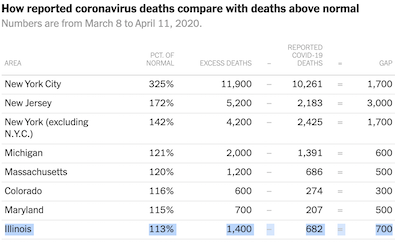
If those percentages hold up, by my count that would mean around 1,190 2,237 more excess deaths as of yesterday than the latest reported 2,125 COVID-19 total [Thanks to a mathematician for the correct forumla: 2,125*1,400/682 - 2,125 = 2,237]
14 Comments
|
* Assistant Chief Deputy Attorney General Thomas Verticchio at Monday’s Clay County hearing on Rep. Darren Bailey’s lawsuit…
Jasper County, 42 cases, less than 10,000 residents in the county. As a result, it suffers one of the highest per capita infection rates in Illinois. Its rates are doubling every three days.
Jefferson County is one of the few to exceed Jasper. Its rates double every two and a half days. Randolph County, one of the fastest doubling rates in the state.
Those doubling rates are scary high.
But, hey, you say, the problem is mainly confined to nursing homes and other congregate settings. But, as I keep saying, these facilities do not exist in a vacuum. Sometimes residents leave (perhaps transported to a hospital) and come back. Staff comes and goes, three shifts a day. They go home. They or their family members go shopping. The virus then gets into the community and most of our rural areas have few hospital resources to deal with the sickness and there’s a very real risk of being overrun.
* Springfield, thankfully, has plenty of hospital capacity, but the point about staff still stands. Here’s Bernie…
Forty new positive COVID-19 cases — including residents and staff — were reported Tuesday at The Villas East nursing home in Sherman, according to the Sangamon Department of Public Health.
The new totals were reported as tests have now been administered to most staff and residents, according to the county spokesman, Jeff Wilhite.
Wilhite said the newly reported cases included 20 residents and 20 staff members, bringing total positive cases at the facility to 46 residents, including five who died, and 35 staff members. […]
Among staff, there were two men and three women in their 20s, one man and three women in their 30s, five women in their 40s, one man and two women in their 50s, and one man and two women in their 60s.
…Adding… As pointed out by a commenter, the Randolph County issue is about a local food processing plant…
The Gilster Mary-Lee Corp. baking mix plant in Steeleville will shut down for two full weeks after Friday, as the manufacturer and the Randolph County Health Department try to stem the tide of coronavirus cases that continues to plague the company and the county. […]
The Randolph County Health Department announced Tuesday that another 29 positive cases were confirmed in the last 24 hours, bringing the county’s total to 138 - 86 of them active. Randolph County is currently ranked fifth among Illinois counties in infection rate, behind only Cook County, Jasper County, Lake County and Will County.
According to Oathout, fully 75% of all Randolph County’s COVID-19 cases can be traced to Gilster Mary-Lee plants in Chester and Steeleville.
Workers go home and live their lives, and that means the virus gets spread further.
32 Comments
|
Open thread
Wednesday, Apr 29, 2020 - Posted by Rich Miller
* Most folks drastically underestimated the impact a month ago…
At last check, the nation’s official death toll is 59,284.
Anyway, try to keep your comments Illinois-centric and be nice to each other.
38 Comments
|
|
Comments Off
|
|
 Support CapitolFax.com
Visit our advertisers...

 ...............
 ...............
 ...............


|
   
|
Hosted by MCS |
SUBSCRIBE to Capitol Fax |
Advertise Here |
Mobile Version |
Contact Rich Miller
|