* Press release…
The Governor’s Office was notified this afternoon of a recent exposure to COVID-19 and as result of that possible exposure is currently conducting contact tracing and following all necessary health protocols from IDPH. The exposure was the result of an external meeting with the Governor that took place on Monday in a large conference room in the Governor’s Office. The Governor was tested today and his results will be made public when available. The Governor is currently isolating pending his test results.
From what I know, the governor has very few in-person external meetings. But he did say he met Monday with restaurant industry representatives, which would be quite ironic since they were trying to convince him to keep restaurants open for indoor dining.
I’m assuming that reporters who’ve attended his press conferences this week should probably now get tested as well.
…Adding… Crain’s…
Gov. J.B. Pritzker is headed back to quarantine again after his office was notified this afternoon of a recent exposure to COVID-19 that occurred during a Nov. 2 meeting with Illinois Restaurant Association representatives.
Sam Toia, president of the association, confirmed the positive case among his team. The restaurant association has been actively lobbying the governor’s office to ease limits on indoor dining the state imposed amid a surge in COVID cases across the state.
A half-dozen association members met with Pritzker’s team this week to discuss easing indoor dining restrictions. “We were social distancing, everyone had their masks on,” Toia said. “We did everything like we were supposed to do.”
Toia is saying the same thing about the alleged safety of indoor dining, by the way.
*** UPDATE *** Press release…
Governor Pritzker and staff who attended the meeting Monday where they were exposed to someone who tested positive for COVID-19 have tested negative. The PCR tests were conducted Friday afternoon. This is the second negative test result for the Governor and staff after they underwent their weekly test on Wednesday.
Per the CDC, the Governor and staff who attended the meeting, are not considered close contacts because they met with the individual prior to 48 hours before symptom onset. Following CDC guidance, the Governor and staff will not be required to quarantine for 14 days.
Comments Off  
|
Pritzker talks contact tracing
Friday, Nov 6, 2020 - Posted by Rich Miller
* This is being distributed by the governor’s office…
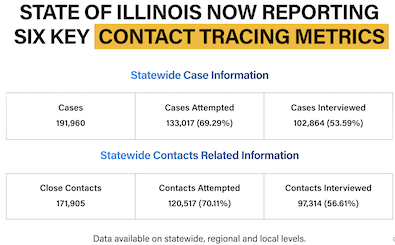
A press release is coming on this, but the governor explained today that outside Cook County and Chicago, contact tracers were able to reach 90 percent of those who test positive. The city and the county have real issues that need to be fixed. I’ll be updating as he goes along.
* He talked about outbreaks and exposures…
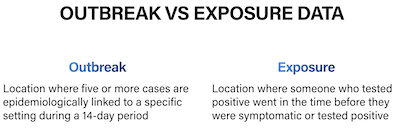
These are two words that get thrown around incorrectly, a lot, but they actually have very specific distinct meanings in public health. To start, let’s talk about an outbreak.
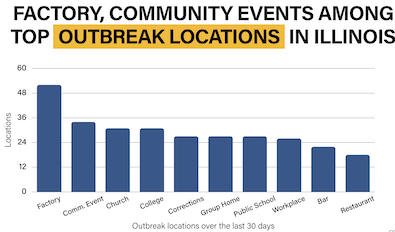
The location of an outbreak is more difficult to identify than the location of an exposure. An outbreak is defined as five or more cases that are linked to a specific setting during a 14 day period. Linked cases must be from different households and not already connected from other sources. And while certain settings like a college campus a factory or group home may make it easier to determine an outbreak, most establishments that are frequented by the public like restaurants, or grocery stores are not easily determined as the setting of an outbreak, based upon those rules. Add on to that that this disease is a respiratory in nature and a person might take some time before they start to show symptoms. And you can see why where outbreaks occur is important information, but far from the whole picture.
Please pardon all transcription errors.
* Exposures…
Much more useful for identifying regular locations that amplify the spread of the virus is exposure data. Particularly useful for the average person who wants to design their day to day in a way that reduces the highest risks.
Exposure data comes from contact tracers talking to confirmed positive covid patients about the places that they went in the time before they were symptomatic or tested positive for. For most people, especially those who don’t have the ability to work from home. That’s going to amount to multiple locations.
The day before a person tested positive for example, she might go to work, and then stop at a grocery store, and then stop and get drinks with friends at a bar that’s three exposure locations, and that’s just one day. Why is this important? Because exposure data is going to give you a sense of where you’re at the greatest risk for catching COVID-19, and particularly when we see community transmission as high as it is around the state, the risk is going to scale up across the board. Remember, masks are vitally important and the best tool for reducing risk but even with a mask. You don’t eliminate risk, especially when the inside in proximity to other people. And when you’re taking your mask off in public to eat, or to drink, or even to chat. You’re upping your risk.
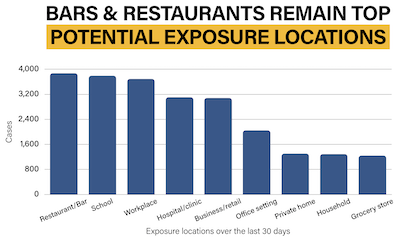
So here’s our exposure data, to date, in Illinois, as you would guess workplaces in schools are going to be big. Because anyone reporting to their workplace every day, or any student or teacher engaged in in person learning, who tested positive is probably going to list school or work as a place they were before they tested positive.
But the single largest category of exposure locations statewide is restaurants and bars. And we see similar trends on a region by region basis, which you can review on the IDPH website. This aligns with the CDC study that came out earlier this fall. The study shows that when a COVID positive person could not identify a close contact that may have given them they were twice as likely to report dining in a restaurant in the two weeks prior to diagnosis.
These are facts. And if the facts change we can change our response, but all the data we have so far. points to these locations where people move, remove their masks in close contact for an extended period of time, as a major source of risk and, frankly, importantly, our mitigation plans, reflect the fact that those are a major source of risk.
* School exposure data…
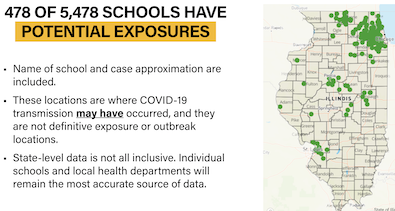
Moving to school exposure data. I know the size of that school column on the exposure sites might alarm some parents. So I want to offer a couple of caveats on this data.
First, this is exposure data, not necessarily the exact location where a student or teacher actually contracted COVID-19. Anyone who goes into a school building regularly would have likely reported school as a place they went before they became a confirmed positive. That doesn’t at all mean that school is where they contracted the disease originally. And remember that masks are required in school and are not intended to be removed for extended periods of time.
Second, while we have school based data broken out by school on our website, this is exposure data that comes through contact tracings at local health department’s. The best data for any one specific school will come from the area local public health department. Schools are required to let parents and local health officials know about any positive cases. In terms of school outbreaks we have 10 schools that have currently reported confirmed COVID-19 outbreaks across the state. Again local health departments will be the best source of information on any specific school.
These outbreaks do not include secondary cases that may occur in a household among a household member who’s not been on the school grounds, but they do include those associated with before and after school programs like sports.
* Back to outbreaks…
In our statewide outbreak data we see a pattern of formal group gatherings, making up the majority of our confirmed outbreaks. Again, these are the settings where it’s easiest to trace the origins of someone’s illness and declare a situation a formal outbreak. I mentioned that the reasons why outbreaks are difficult to pin down, and I’ll add that with rates of spread the way they are right now, it’s only going to get harder, because this disease isn’t concentrated. Right now, it’s widespread.
…Adding… The promised press release is here.
9 Comments
|
*** UPDATED x1 *** 10,376 new cases, 49 additional deaths, 4,090 hospitalized, 786 in the ICU, 9.6 perccent case positivity rate, 11.1 percent test positivity rate, 75 of 102 counties at warning level
Friday, Nov 6, 2020 - Posted by Rich Miller
* Press release…
The Illinois Department of Public Health (IDPH) today reported 10,376 new confirmed cases of coronavirus disease (COVID-19) in Illinois, including 49 additional deaths.
Following Centers for Disease Control and Prevention guidance, beginning November 6, 2020 and going forward, IDPH will report confirmed cases and probable cases combined. A confirmed case is laboratory confirmed via molecular test. A probable case meets clinical criteria AND is epidemiologically linked, or has a positive antigen test. If a probable case is later confirmed, the case will be deduplicated and will only be counted once. Probable deaths and confirmed deaths will continue to be reported separately.
Today’s additional deaths:
- Carroll County: 1 female 90s
- Champaign County: 1 female 70s
- Coles County: 1 male 70s
- Cook County: 1 female 60s, 2 males 60s, 2 females 70s, 1 male 70s, 4 females 80s, 1 male 80s, 2 females 90s, 1 male 90s
- DuPage County: 1 female 60s
- Edgar County: 1 male 80s
- Fayette County: 1 male 90s
- Ford County: 1 female 90s
- Jackson County: 1 male 60s
- Kendall County: 1 male 80s
- Knox County: 1 female 80s, 1 male 80s, 1 male 90s
- Macon County: 1 male 80s
- Macoupin County: 1 male 70s
- Marion County: 2 females 80s
- Mason County: 1 female 90s
- Monroe County: 1 female 80s, 1 female 100+
- Peoria County: 1 male 60s
- Piatt County: 1 male 80s
- Pike County: 1 male 80s
- Rock Island County: 1 male 90s
- Sangamon County: 1 male 60s
- Shelby County: 1 male 80s
- St. Clair County: 1 female 90s
- Tazewell County: 1 male 70s
- Vermilion County: 1 male 70s
- Wayne County: 1 female 70s
- Whiteside County: 1 male 50s, 2 females 70s, 1 male 70s, 1 female 90s
- Will County: 1 male 90s
Currently, IDPH is reporting a total of 465,540 cases, including 10,079 deaths, in 102 counties in Illinois. The age of cases ranges from younger than one to older than 100 years. Within the past 24 hours, laboratories have reported 98,401 specimens for a total 8,215,129. As of last night, 4,090 people in Illinois were reported to be in the hospital with COVID-19. Of those, 786 patients were in the ICU and 339 patients with COVID-19 were on ventilators.
The preliminary seven-day statewide positivity for cases as a percent of total test from October 30 – November 5 is 9.6%. This is the number that IDPH has been consistently reporting in its daily releases and is calculated using total cases over total tests. Similar to the Centers for Disease Control and Prevention, IDPH has been using test positivity for regional mitigation metrics on its website since mid-July. Test positivity is calculated using the number of COVID-19 positive tests over total tests. On October 29, 2020, IDPH began reporting the statewide test positivity in its daily releases. The preliminary seven-day statewide test positivity from October 30, 2020 – November 5, 2020 is 11.1%.
Case positivity and test positivity rate are both relevant and offer insight into the bigger COVID-19 picture. Case positivity helps us understand whether changes in the number of confirmed cases is due to more testing or due to more infections. Whereas, test positivity accounts for repeated testing and helps us understand how the virus is spreading in the population over time.
Seventy-five counties, plus the city of Chicago, are currently reported at a warning level – Adams, Alexander, Bond, Boone, Bureau, Calhoun, Carroll, Chicago, Christian, Clay, Clinton, Coles, Cook, Crawford, Cumberland, DeKalb, Douglas, DuPage, Effingham, Franklin, Fulton, Gallatin, Greene, Grundy, Hamilton, Hancock, Iroquois, Jackson, Jasper, Jersey, Jo Daviess, Johnson, Kane, Kankakee, Kendall, Knox, Lake, LaSalle, Lee, Livingston, Logan, Macon, Madison, Marion, Mason, Massac, McHenry, Mercer, Monroe, Morgan, Moultrie, Ogle, Peoria, Perry, Pike, Pulaski, Putnam, Randolph, Rock Island, Saline, Sangamon, Scott, Shelby, St. Clair, Stephenson, Tazewell, Vermilion, Wabash, Warren, Washington, Wayne, Whiteside, Will, Williamson, Winnebago, and Woodford.
*All data are provisional and will change. In order to rapidly report COVID-19 information to the public, data are being reported in real-time. Information is constantly being entered into an electronic system and the number of cases and deaths can change as additional information is gathered. For health questions about COVID-19, call the hotline at 1-800-889-3931 or email dph.sick@illinois.gov.
*** UPDATE *** Some of you have noticed that IDPH has some different case numbers today. Dr. Ezike explained this at the daily briefing…
In addition to the data that the governor just spoke about I want to tell people that we are also adding similar to the CDC. We will begin reporting confirmed, and probable cases.
I know that the various CDC terms may be new and are confusing, so I want to explain this update so you can best understand the numbers. I’m thrilled that so many people are following along on our on our website and following the information, so want to make sure it’s all clear.
As treatment and testing have evolved, so too has our response. In August, the national case definition was changed so that an antigen test alone would be considered a probable case. The increased use of antigen tests, we will get more probable cases and we want to make sure that we capture all of those cases that are diagnosed via antigen test, similar to how the CDC does this, and similar to how other states are calculating this as well, so that we can show our actual true Burden of Disease here in Illinois. The result of this is that the total number of cases, since the beginning of the pandemic that we report today is going to look quite a bit higher, because we have added all the probable cases, since the beginning of the pandemic.
Those were already reported each week on our website but we’re bringing that in so there’s approximately 7600 additional cases that will be added to Illinois, total number of cases. To be clear, these are being counted as new cases that occurred in the last 24 hours. These are previously reported probable cases that are now being included in our total grant case count. Instead of having them separated out. So today for the cases that we’re, new cases that were reported over the last 24 hours. That number is 10,376. And that creates total number of cases, 465,540.
Please pardon all transcription errors.
10 Comments
|
The return of the circular firing squad
Friday, Nov 6, 2020 - Posted by Rich Miller
* I told subscribers about this attempt to oust Leader Durkin on Thursday morning. Here’s Politico today…
While Democrats wring their hands about leadership, state House Republicans are buzzing about the Nov. 16 vote for minority leader. Rep. Tony McCombie has put her hat in the ring to run against Rep. Jim Durkin, who’s held the position since 2013.
McCombie told Playbook she’s talking to caucus members as she moves to line up support. “What I’m hearing is that people want change,” she said. “We need to build a bench. We need to diversify the caucus. We need more women and people of color. And we need to quit talking about it, take action and do it.”
McCombie’s campaign comes as Republicans nationwide elected at least more 13 women to Congress — a record-breaking recruitment effort.
“We have been the minority party for a long time and haven’t picked up net seats since 2013,” she said. In 2012, House Republicans held 47 seats and today they hold 44. They are picking up two, and possibly three, after Tuesday’s election thanks to the coattails of President Donald Trump. “To hold the majority accountable, we have to expand our caucus not just accept bread crumbs and make deals [with Democrats] that don’t expand our caucus or our voice in Illinois.”
McCombie’s entry in the leadership race prompted Durkin’s team to announce that he’s “already secured a majority of votes” to hold on to the minority leader position, according to a statement sent to Rich Miller’s CapitolFax blog.
That may be so, says McCombie, but an election will prompt some healthy discussion.
If Durkin is right and he’s already secured the majority, then I’m not sure what sort of discussion this challenge will prompt. We’ll see.
And the HGOPs picked up four net seats in 2016, including her seat. The Republicans were slammed all over the country in the 2018 midterms.
Also, Rep. McCombie chairs the House Republican Organization. You know, the same group that recruits candidates, raises money and oversees campaigns. So, when she talks about recruiting more women and people of color and winning more races, that’s actually what she’s supposed to have been doing for the past couple of years.
I asked her about this today and haven’t yet heard back. I’ll let you know if I do.
* Also, on a related note, congrats to Mahoney on being named to Crain’s 40 Under 40…
“There’s always a middle ground,” says Michael Mahoney. The trick, especially at a time of unprecedented polarization at every level of American government, is to find that middle ground and get something done, to be “a problem solver,” as his boss describes him.
Mahoney is widely considered in Springfield to be just that, someone who certainly is loyal to his boss, House Republican Leader Jim Durkin, but also someone who knows how to digest and frame complex issues in such a way as to highlight the advantages to all sides of resolving those issues instead of just fighting. […]
Included along the way was a stint as policy adviser for pension and revenue to ex-Gov. Bruce Rauner, who was little inclined to find common ground with Democrats on much of anything. Rauner “knew what he wanted to do, but he had no idea how to do it,” says Mahoney. “You have to put time into being a politician. It’s not easy.”
That last line says it all.
…Adding… Text from Rep. McCombie…
HRO encompasses a lot of parts as you know… 2018 was an overall restructure year…. and our executive director change was not in place til end April/May… the bench needs a few on the seat to get started… as you know petitions start in the fall. Jayme Odom did a fantastic job with the lack of bench warmers and time she had to vet candidates. Some of which were soundly elected!
23 Comments
|
* Yesterday’s truly awful COVID-19 numbers prompted some warnings from Gov. Pritzker…
Gov. J.B. Pritzker on Thursday said he will again impose tougher statewide restrictions if the latest resurgence of the coronavirus, which has now claimed more than 10,000 lives in Illinois, continues to escalate. […]
“If the current trajectory continues, if our hospitals continue to fill up, if more and more people continue to lose their lives to this disease, we’re going to implement further statewide mitigations, which nobody, and I mean nobody, wants,” Pritzker said during a particularly bleak daily coronavirus briefing.
Illinois hasn’t had this many people in the hospital since May 21st. And the ICU bed situation hasn’t been this dire since June 4th.
* The governor talked about possibly moving regions into Tier 3 of the IDPH mitigation plan…
Suspend elective surgeries and procedures; implement surge capacity; assess need to open Alternate Care Facility
Institute remote work for all non-essential workers
Suspend organized indoor and outdoor recreational activities
Suspend all non-essential retail; only essential retail open (i.e. grocery stores, pharmacies)
Suspend salon and personal care operations
Ugh.
* But he also mentioned earlier phases, without committing to doing so…
“If the numbers keep going in the wrong direction, we will need to impose further mitigations,” Pritzker said. “I think we all remember what phase three looked like, what phase two looked like. Those are all things that are under consideration.”
The second phase of Pritzker’s regional, five-phase reopening plan allowed “nonessential” retail stores to reopen for curbside pickup and delivery, and for outdoor activities like golf and boating to resume. The third phase allowed for manufacturing, retail, offices, and salons and barbershops to reopen with capacity limits and physical distancing between people. Gatherings were limited to 10 people.
* NBC 5…
Illinois is currently averaging 3,400 hospitalizations due to coronavirus, well above the 1,500 the state reported at the start of October. Data has also shown a rise in the number of patients in the ICU, which have more than in the last month, Pritzker said.
“If the current trajectory continues, if our hospitals continue to fill up, if more and more people continue to lose their lives to this disease, we’re going to implement further statewide mitigations – which nobody wants to do,” Pritzker warned. […]
Pritzker warned specific regions, including Region 7, which includes suburban Will and Kankakee counties and is at a 13.4% positivity rate, and Region 1 in northwest Illinois, which is at an “alarming” 15.8% positivity.
“We are headed down a dark, dark path toward where we were last spring,” Pritzker said.
* ABC 7…
Across the state, hospital admissions have increased dramatically. In fact, every region in the Chicago area has seen hospital admissions double or more than triple in the past 30 days.
Numbers like these, Pritzker said, suggest the resurgence mitigations are not working or are simply not being followed to be effective.
Gov. Pritzker admonished municipalities that are not enforcing the indoor dining ban amid reports that a large number of bars and restaurants have continued to ignore the restrictions.
“When one of them gets a citation, others hear about it. When five of them get a citation, all of them hear about it,” Pritzker said. “They know that if there was enforcement, if there were actual consequences for their actions at the local level, and they’re supposed to enforce state laws. And when they don’t enforce them, people die.”
* Miletich…
“Far too many local governments across the state are failing to enforce any mitigation measures, allowing this continued rise in positivity to balloon out of control. It’s time to take some responsibility,” Pritzker exclaimed.
* Capitol News Illinois…
Meanwhile, Pritzker and IDPH Director Dr. Ngozi Ezike both cautioned Illinoisans about traveling, hosting parties or gathering in large get-togethers over the upcoming Thanksgiving Day holiday.
“Let’s be clear. Travel will increase your chances of contracting and spreading COVID-19, as well going to a crowded event, as well having multiple people in your home for Thanksgiving,” Ezike said. “So, in terms of travel, we do recommend avoiding travel to areas of higher risk. But as you are seeing, that is almost everywhere. That includes essentially every county here in Illinois. That includes almost every state in the United States and many countries around the world.”
*** UPDATE *** The governor said today at his briefing that he wasn’t leaning toward closing down all restaurant on-site service because outdoor service was much safer.
39 Comments
|
|
Comments Off
|
|
 Support CapitolFax.com
Visit our advertisers...
  ...............
 ...............
 ...............
 ...............
 ...............
 ...............


|
   
|
Hosted by MCS |
SUBSCRIBE to Capitol Fax |
Advertise Here |
Mobile Version |
Contact Rich Miller
|




