* Three days in a row of a positivity rate at or above 8 percent leads to IDPH mitigation, and Region 3 has hit that point. The region runs from eastern Sangamon County over to the Mississippi River and as far south as Calhoun County.
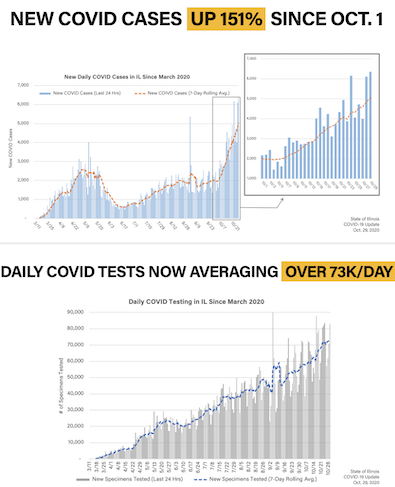
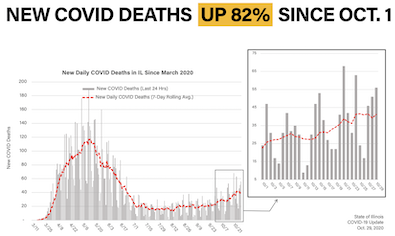
The Illinois Department of Public Health (IDPH) today reported 6,363 new confirmed cases of coronavirus disease (COVID-19) in Illinois, including 56 additional deaths.
- Adams County: 1 male 70s
- Christian County: 1 male 80s
- Clark County: 1 female 80s
- Clay County: 1 female 70s
- Clinton County: 1 female 90s, 1 male 90s
- Cook County: 1 male 40s, 3 females 60s, 1 male 60s, 1 female 70s, 1 male 70s, 1 female 80s, 2 males 80s, 1 female 90s, 2 males 90s
- DeKalb County: 1 male 80s
- DuPage County; 1 female 40s, 1 female 80s
- Edgar County: 1 male 70s
- Ford County: 1 female 70s
- Kane County: 2 males 60s, 1 female 70s
- Lake County: 1 female 80s, 2 females 90s, 1 male 90s
- LaSalle County: 2 females 90s
- Livingston County: 1 female 70s
- Macon County: 1 male 30s
- Marion County: 1 male 70s, 1 female 80s, 1 male 80s
- McDonough County: 1 male 60s
- Morgan County: 1 male 60s
- Ogle County: 1 male 60s
- Rock Island County: 1 male 70s, 1 female 90s
- St. Clair County: 1 female 60s, 1 female 80s
- Tazewell County: 1 male 70s, 1 male 90s
- Wabash County: 1 male 70s
- Wayne County: 1 male 90s
- Will County: 1 male 70s, 1 female 80s, 2 males 80s
- Winnebago County: 1 male 70s, 1 male 80s, 1 male 90s
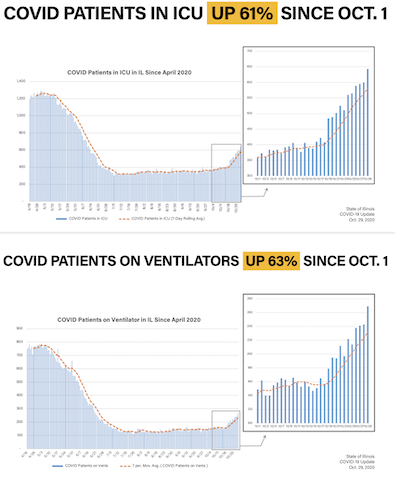
Currently, IDPH is reporting a total of 395,458 cases, including 9,675 deaths, in 102 counties in Illinois. The age of cases ranges from younger than one to older than 100 years. Within the past 24 hours, laboratories have reported 83,056 specimens for a total 7,542,098. As of last night, 3,030 people in Illinois were reported to be in the hospital with COVID-19. Of those, 643 patients were in the ICU and 269 patients with COVID-19 were on ventilators.
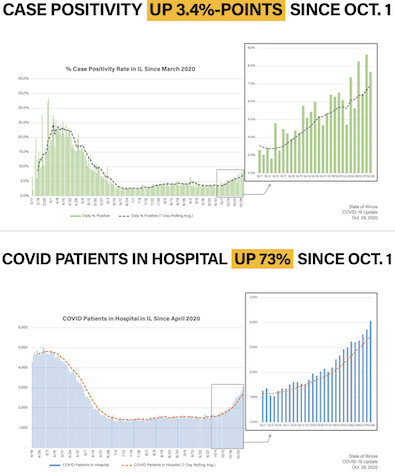
The preliminary seven-day statewide positivity for cases as a percent of total test from October 22 – October 28 is 6.9%. This is the number that IDPH has been consistently reporting in its daily releases and is calculated using total cases over total tests. Similar to the Centers for Disease Control and Prevention, IDPH has been using test positivity for regional mitigation metrics on its website since mid-July. Test positivity is calculated using the number of COVID-19 positive tests over total tests. Beginning October 29, 2020, IDPH is reporting the statewide test positivity in its daily releases. The preliminary seven-day statewide test positivity from October 22, 2020 – October 28, 2020 is 8.2%.
Case positivity and test positivity rate are both relevant and offer insight into the bigger COVID-19 picture. Case positivity helps us understand whether changes in the number of confirmed cases is due to more testing or due to more infections. Whereas, test positivity accounts for repeated testing and helps us understand how the virus is spreading in the population over time.
*All data are provisional and will change. In order to rapidly report COVID-19 information to the public, data are being reported in real-time. Information is constantly being entered into an electronic system and the number of cases and deaths can change as additional information is gathered. For health questions about COVID-19, call the hotline at 1-800-889-3931 or email dph.sick@illinois.gov.
Governor Pritzker and the Illinois Department of Public Health (IDPH) are announcing COVID-19 resurgence mitigations will be implemented in Region 3—West-Central Illinois—beginning at 12:01 a.m. on Sunday, November 1, 2020. The region has seen a 7-day rolling average test positivity rate of 8 percent or above for three consecutive days, which exceeds the thresholds set for establishing mitigation measures under the state’s Restore Illinois Resurgence Plan. Region 3 includes Hancock, Adams, Pike, Calhoun, Jersey, Greene, Scott, Brown, Schuyler, Cass, Morgan, Macoupin, Montgomery, Christian, Sangamon, Logan, Menard, and Mason counties.
The administration continues to provide relief for small businesses impacted by the ongoing pandemic. Today, the administration announced that through both the historic Business Interruption Grants (BIG) program and Local CURE funding, a total of $94 million has already been deployed to Illinois businesses and communities to help offset costs and losses due to the pandemic. In Region 3 alone, nearly $40 million in emergency grants and assistance has been awarded via both programs. Moving forward, businesses in Region 3, as well as other regions currently under additional mitigations, will receive priority consideration for the current round of BIG. These programs are guided by an equity framework and seek to address the hardest hit communities with emergency relief dollars.
“As of this morning, Region 3 – which encompasses Quincy, Springfield and much of West-Central Illinois – has now sustained an average positivity rate of 8 percent or higher for three days, today hitting 8.8 percent – meaning that, starting Sunday, they will join the majority of the state in operating under resurgence mitigations,” said Governor JB Pritzker. “Something has got to give, and these mitigations aim to cut down on those high-risk activities until we bring down the positivity rate in an area once again. Because let’s be clear: well-meaning and reasonable people can have fair disagreements about how and where to draw lines and connect dots – but when every single metric in every single corner of the state is trending poorly, we have to take meaningful action to keep our people safe.”
“This is the first time a central Illinois region has needed to implement mitigation measures because of increasing positivity,” said IDPH Director Dr. Ngozi Ezike. “For those residents living in regions and communities where the virus didn’t seem to be ‘that bad,’ things are changing with positivity rates steadily increasing. We’ve seen regions move into and then out of mitigation, so we know the measures work. The more people adhere to the measures, the quicker we can move out of mitigation.”
Mitigation measures taking effect November 1 in Region 3 include:
Bars
No indoor service
All outside bar service closes at 11:00 p.m.
All bar patrons should be seated at tables outside
No ordering, seating, or congregating at bar (bar stools should be removed)
Tables should be 6 feet apart
No standing or congregating indoors or outdoors while waiting for a table or exiting
No dancing or standing indoors
Reservations required for each party
No seating of multiple parties at one table
Restaurants
No indoor dining or bar service
All outdoor dining closes at 11:00 p.m.
Outside dining tables should be 6 feet apart
No standing or congregating indoors or outdoors while waiting for a table or exiting
Reservations required for each party
No seating of multiple parties at one table
Meetings, Social Events, Gatherings
Limit to lesser of 25 guests or 25 percent of overall room capacity
No party buses
Gaming and Casinos close at 11:00 p.m., are limited to 25 percent capacity, and follow mitigations for bars and restaurants, if applicable
These mitigations do not apply to schools or polling places.
From the onset of the pandemic, support for small businesses has been one of the central features of the Pritzker administration’s COVID-19 response. Since March, the administration has launched a menu of small business and community relief programs – with over $500 million in grants and programs launched by the Illinois Department of Commerce and Economic Opportunity (DCEO), including emergency hospitality grants, a downstate small business stabilization program, Fast Track Capital, and more. For more information on programs available for businesses and communities, please visit DCEO’s website.
DCEO is also actively processing reimbursements for local governments impacted by COVID-19 via the state’s Local CURES program. To date, more than $8.5 million has been awarded to governments in Region 3 to help cover the costs of the emergency response, with eligible costs including PPE and other public health expenses. All eligible governments in Region 3 can submit their certification to the department and begin submitting reimbursement requests. For more information on programs available for businesses and communities, please visit DCEO’s website.
Region 3 is currently seeing an 8.8 percent positivity rate, an increase from 4.6 percent in September, a summer peak of 6.2 percent in August, and a low of 0.9 percent in June. While most regions are seeing sustained increases in both positivity and hospitalization rates, today Region 3 is experiencing triple the amount of COVID-related hospital admissions since early September.
In the coming days, IDPH will continue to track the positivity rate in Region 3 to determine if mitigations can be relaxed, if additional mitigations are required, or if current mitigations should remain in place. If the positivity rate averages less than or equal to 6.5% for three consecutive days, then the regions will return to Phase 4 mitigations under the Restore Illinois Plan. If the positivity rate averages between 6.5% and 8%, the new mitigations will remain in place and unchanged. If the positivity rate averages greater than or equal to 8% after 14 days, more stringent mitigations may be applied to further reduce spread of the virus.
As of today, including Region 3, a total of nine of the state’s 11 regions have triggered one of the state’s failsafe state-action metric. Regions 4, 5, 7, 8, and 9 will all soon operate under Tier 1 mitigation measures given that these regions continue to report a 7-day rolling positivity rate above 8 percent. By tomorrow, Regions 10 and 11 will both operate under Tier 1 mitigations given that these regions triggered additional mitigations based on sustained increases in both positivity and hospitalization rates. Region 1 is currently operating under Tier 2 mitigation measures after continuing to see a rise in positivity, even under the Tier 1 mitigation framework, with the highest rolling positivity average in the state.
As part of the administration’s robust response to the pandemic, the state continues to strengthen its nation-leading testing operation, given that testing remains a critical step to reduce further spread of the virus. Testing is readily available throughout Illinois, with the state now averaging more than 72,000 tests per day. For a more targeted approach, the state provides mobile testing allowing testing to be directed toward communities most impacted by COVID-19. In Region 3, mobile sites will be at the Sangamon County Health Department this weekend. To find the nearest testing center, please visit DPH.Illinois.Gov/Testing.
IDPH will continue to work closely with local health departments in Region 3 to provide education to the public and offer information to businesses and organizations on safe ways to reopen. The significance of face coverings, social distancing, and hand washing have been consistently emphasized by the administration throughout the pandemic.
A full list of mitigation measures pertaining to some businesses and industries may be found on the DCEO website at www.dceocovid19resources.com/restore-illinois.