* Former Chicago Bears quarterback Jim McMahon is in town the for the team’s 30th anniversary of its Super Bowl win. He talked to the Tribune about how medical marijuana helped him get off pills and ease his pain from multiple injuries…
Now 56, McMahon has been plagued by debilitating health problems following his 15-year career and multiple concussions in the National Football League. He has been diagnosed with early-onset dementia and has severe headaches, depression, memory loss, and vision and speech problems. He also said he suffered a broken neck. […]
McMahon got his medical marijuana card in Arizona, where he lives, after it was approved by a voter referendum in 2010. Before that, he said, he’d been taking 100 Percocet pills a month for pain in his shoulders, neck and arms.
“They were doing more harm than good,” he said. “This medical marijuana has been a godsend. It relieves me of the pain — or thinking about it, anyway.” […]
His comments come as Illinois Gov. Bruce Rauner considers whether to approve eight more medical conditions to add to the list of about 40 that qualify for medical marijuana here. A state advisory board recommended adding the new conditions, including pain that doesn’t respond to conventional treatment.
The majority of patients in some other states that have legalized medical marijuana, like California and Colorado, qualify to use it to treat pain. But Illinois, which has perhaps the strictest law allowing medical marijuana in the nation, does not allow it for pain, as lawmakers have expressed concerns that the category is too broad and vague and would allow for abuse.
They should just legalize it, but an expansion to include pain in the interim would be a positive step forward.
Veterans gathered at the Capitol this morning to ask the Governor Rauner to add Post Traumatic Stress Disorder to the list of illnesses that could be treated by medical marijuana.
They had hoped to deliver those signatures to the Governor in person but things didn’t go as planned.
After repeated requests to deliver their signatures, they were told the boxes were going into storage.
Despite their frustration the group went ahead with their rally as planned.
* I could hear them from the gallery yesterday, but couldn’t make out what they were saying. Here’s the SJ-R…
Protests and rallies at the Statehouse are usual during legislative sessions, and a big gathering in the rotunda Wednesday included hundreds of people chanting things like “budget first” even as Gov. BRUCE RAUNER delivered his State of the State address in the House chamber.
At least in the House gallery, some of the chants — muffled by the chamber’s closed doors — could be heard as the governor spoke.
Why that tactic?
“I think it was necessary so the governor understands and all the lawmakers understand that families and communities need a budget right now, and they need one that chooses revenue over cuts to veterans, seniors, those with disabilities,” said NEAL WALTMIRE, spokesman for the Responsible Budget Coalition.
The coalition includes about 250 groups, from statewide teacher unions to Land of Lincoln Goodwill Industries and the Hope Institute for Children and Families.
“We were respectful of the instructions,” Waltmire said. “We just wanted to make sure that the governor heard our concerns. It was hard to ignore us.”
Unfortunately, Illinois’ economy has been split in two, one part with modest growth, the other in decline. There are areas within 90 minutes of O’Hare Airport that compete with other expensive mega-cities around the world. Thanks to access to global transportation infrastructure, first class universities, and world class cultural amenities, white-collar communities in the Chicago area have mostly been able to overcome the financial mismanagement that is now strangling Chicago and Cook County.
But it’s difficult in the rest of the state: Harvey, Blue Island, Kankakee, Rockford, East Moline, Peoria, Decatur, Danville, Mt. Vernon, and Marion. Those communities have to compete with other states like Indiana, Wisconsin, Iowa, Tennessee, Texas and South Carolina. And too often, we’ve been losing.
In recent years, we’ve lost more than 300,000 manufacturing jobs.
Many of you have argued that we shouldn’t try to compete with other states, because that would be a race to the bottom.
Well, the numbers prove otherwise.
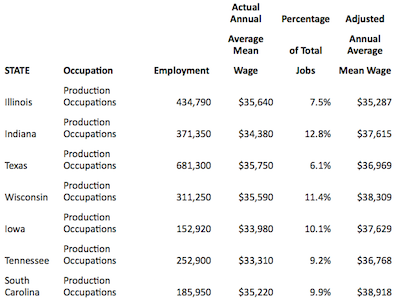
Factory workers in Indiana, Wisconsin, Iowa, Tennessee, and South Carolina, when you adjust for the cost of living, now make more than workers in Illinois. That’s unacceptable!
Factory workers in Texas are now making more than Illinois folks, even without adjusting for the cost of living.
That’s outrageous! We should be kicking Texas’ tail!
But the numbers don’t lie. We are losing the race for good paying jobs.
…Adding… The governor’s office sent along this chart, which it says is based on U.S. Bureau of Labor Statistics - “Occupational Employment and Wage Estimates” and U.S. Bureau of Economic Analysis…
*** UPDATE *** The Tribune fact checked his numbers…
Rauner: “Our average working family is making less than they were eight years ago.”
Fact check: Rauner bases this claim on the most recent U.S. Census Bureau data, but that’s 2 years old: He’s actually comparing 2014 with 2006. In 2014 dollars, the average Illinois household income did fall from $57,150 in 2006 to $54,916 in 2014. But take that drop with a healthy pinch of salt — it’s well within the large margin of error built into the Census Bureau’s calculations. It’s entirely possible the average family made more in 2014 than it made in 2006 and that it’s making more now than it made in 2008.
According to slightly more recent data from the Illinois Department of Employment Security, the state’s average salary in early 2015 was $54,531, up from $45,961 in early 2007. Even allowing for total inflation of 15 percent over that period, that’s a 3 percent increase in the average Illinois wage over the last eight years. […]
Rauner: “In many cases, people are paying more in property taxes over the course of living in their home than the original purchase price.”
The right-leaning Illinois Policy Institute came up with this calculation. It adds up, if you assume the 2.32 percent effective property tax rate and, perhaps a little unrealistically in most cases, that a homebuyer will live in a home for at least 43 years
* The Democrats started moving a MAP grant bill yesterday. The governor’s office doesn’t like it and is proposing an alternative, as well as calling out legislators who voted against the original appropriation last year…
From: Director Tim Nuding, Governor’s Office of Management and Budget
To: Members of the General Assembly
Date: January 28, 2016
Re: GOMB Analysis of SB 2043 and HB 4539/SB 2349
House Amendment 2 to SB 2043 would make appropriations of $721 million for the Monetary Award Program (MAP) and community colleges programs. The funding levels for these programs are the same as those contained in last year’s General Assembly-passed unbalanced budget, which was opposed by Representatives Drury, Franks, Nekritz and Yingling along with all Republican legislators and which was vetoed by the Governor.
House Amendment 2 to SB 2043 provides no funding source to pay for the additional spending as it is not tied to spending reductions, revenue or cost-saving reforms. The Governor’s Office of Management and Budget concludes that House Amendment 2 to SB 2043 would add $721 million to the deficit, increase the state’s bill backlog by the same and delay state payments to providers, vendors and contractors. Therefore, GOMB would recommend the Governor veto this legislation if it came to his desk.
HB 4539/SB 2349, on the other hand, would appropriate $1.6 billion dollars for all programs included in SB 2043 and Illinois’ public universities. The legislation is tied to another bill, HB 4521/SB 2338, which would grant the Governor authority to respond to an unbalanced budget by reallocating funds and reducing spending in various ways.
HB 4539/SB 2349’s approach is far more fiscally responsible than SB 2043 as it would help MAP students, community colleges and universities without exploding the deficit, skyrocketing the bill backlog or exacerbating the state’s cash flow crisis. Therefore, GOMB would recommend the Governor sign this legislation if it came to his desk with HB 4521/SB 2338.
Creates the Unbalanced Budget Response Act. Provides authority and procedures for the Governor to establish contingency reserves of previously appropriated funds, and to transfer balances between special funds in the State treasury and the General Revenue Fund. Describes the agencies and programs subject to this authority. Provides that designated agencies may adopt emergency rules to carry out the purposes of the Act. Defines terms. Provides that the Act is repealed on July 1, 2017. Amends the Illinois Administrative Procedure Act to make conforming changes. Amends the Illinois Public Aid Code. Adds actions taken under the Unbalanced Budget Response Act to a Section relating to applicability. Amends the State Mandates Act to require implementation without reimbursement by the State. Effective immediately.
The state’s Road Fund and some others would be exempt from the sweeps provision.
That bill gives the governor a whole lot of control, which the GA may not be inclined to do since the majority doesn’t actually trust him, but it would help him avoid a complete budgetary meltdown.
Rauner spokeswoman Catherine Kelly said the governor will veto the bill when it reached his desk. Ahead of the vote, Rauner’s budget chief sent a memo to lawmakers warning that if the measure became law, it would force the comptroller to put off payments for other services.
Democrats were not deterred, quickly passing the bill in both the House and Senate. Two Democrats voted against the bill, Rep. Scott Drury of Highwood and Rep. Jack Franks of Marengo. Eight Republicans voted “present,” a way to avoid looking like they voted against funding for schools without bucking Rauner. […]
While Democrats were able to pass the legislation, it’ll be a tougher battle to override a Rauner veto. On Wednesday, Madigan acknowledged he does not have a “working” supermajority, a reference to the difficulties he’s had in wrangling all 71 of his Democratic members to remain united to override vetoes.
* You can watch or listen to the speech online here and here. I’ll also be doing a preview starting at noon on Public TV with Jak Tichenor and Amanda Vinicky. Click here to watch it online. All four legislative leaders are also scheduled to appear on Jak’s show after the speech. You can also check out the various reaction pressers by clicking here.
And, of course, you can follow everything in real time right here with ScribbleLive…