React to Pritzker’s new plan
Tuesday, May 5, 2020 - Posted by Rich Miller
* Illinois Manufacturers’ Association…
“Illinois’ economy has been devastated by this pandemic, which has put at risk not just lives but also livelihoods. While many manufacturers across the state have continued operating to produce needed medical products, safe and nutritious food, and equipment for our first responders, others are eager to start production and put people back to work,” said Mark Denzler, president & CEO of the Illinois Manufacturers’ Association. “We appreciate Gov. Pritzker’s focus on a plan that puts Illinois on a path to safely re-opening. Manufacturers are ready to unleash their full economic might to help restore our state’s economy.”
* Senate President Don Harmon…
“This is the kind of forward-looking plan that people across Illinois have been expecting. It offers hope during economic dark days while reminding everyone of how dangerous and deadly this virus remains. That another 176 people lost their lives to COVID-19 in the past day tells us that the enemy is still out there. We will get through this together by following the advice of medical professionals and public health experts.”
* Comptroller Susana A. Mendoza…
“I want to thank Gov. Pritzker for his carefully-thought-out, science-based approach to restoring Illinois, region by region. I appreciate the leadership, concern and compassion he has demonstrated to the entire state during this awful and deadly COVID-19 coronavirus pandemic. The governor’s Restore Illinois plan provides all of us with a predictable road map for reopening Illinois.
“If we all follow these guidelines, we will move forward. Not adhering to these protocols will move us backward, jeopardizing all of our shared sacrifice to date and lead to many more needless deaths at the hands of an invisible enemy. We all look forward to the days when we can all get back to normal. In the meantime, we need to exhibit personal responsibility and look out for each other. I believe we will get through this together.”
This post will be updated as responses come in. The House Republicans say they are still evaluating the plan.
* Rep. Mike Murphy (R-Springfield)…
“I’m glad the Governor has finally heard our calls for a regional approach to addressing COVID-19 and a plan for safely reopening our state. The unintended consequences of the one size fits all approach has been devastating for families and small businesses across central Illinois,” said Murphy. “However, the timetable for implementation in different regions, the ability of informed local officials to be a part of the decision-making process, and the vagueness of requirements leave too many unanswered questions. Saying it will be a regional approach is one thing, but if the decisions are still being made by someone from outside our region with limited local consultation, then we still risk being the victim of a one size fits all cure that does more harm than the virus itself.”
* Senate GOP Leader Bill Brady…
Ensuring the public’s health remains our top priority, and any loss of life as a result of this deadly disease is a tragedy. While it is important to have a plan that gives us hope, we need to look at it in greater detail. However, the question of why Illinois needs to maintain a 28-day window before moving between phases, as opposed to the 14-day recommendation of Dr. Fauci, which is what states like New York are using in their reopening plans, needs to be answered.
* This is all I’ve seen from the HGOP…
Nothing at all from Speaker Madigan.
42 Comments  
|
* Let’s talk about this first of the four regions. Do you see any of them, can you look ahead and Dr Zika and think that any of those four regions on May 29 might be moving to phase three?…
Remember this is a data driven and science driven plan, and so everybody will be able to watch, it’s hard for me to just pick out a region and say, what will happen in the future. There have been a lot of things that have happened that no one expected, so it’s hard for me to point at a region and say this one might go first. But I think that people will be able to follow it every single day going on the IDPH website, they’ll be able to see what the metrics are and whether they’re meeting those metrics.
Please pardon all transcription errors.
* I thought we were already having gatherings of 10, why is it phase three that it’s only 10?…
We have actually have not we have essential gatherings of 10 that are available now things that fit in that essential category, but in the next phase it would be any gathering of 10 that people want to have.
* And then phase four is 50, not exactly a huge crowd either…
Again I’ll remind you, the virus is still out there and if maybe things will change. Maybe we will have a very successful treatment to offer to people and therefore we’ll be able to change the guidance for that phase. But as for now that’s what we see going forward.
* But to go from 50 to then everything’s open with phase five is a huge leap…
It is but remember that the gate for getting to phase five is that there’s a vaccine, or a highly effective treatment or that by virtue of herd immunity there just aren’t any new cases coming up.
* So schools, are you saying schools should not open until phase five?…
No, no schools can open in phase four, but again things going forward, Maryann will look different. There’s no doubt about it I mean already as you are walking the streets, you can see people are wearing face coverings. They will still need to do that in phase three, they’ll still need to do that in phase four if there’s no effective treatment that’s available, because people will still have the ability to get sick.
* It doesn’t sound important, obviously with so much going on and so many lives loss but when you say conventions festivals, let’s just say the word Lollapalooza so that folks who asked, you’re saying no way…
I’m saying that if you follow the data and you’ll look at how fast things could happen. I mean, like I said, if there is an effective treatment that comes out, and people can see that really you won’t get that sick if you get COVID-19, then I think, you know, all bets are off, you know you could, things could get worse.
* Let’s be honest, I mean we’re in May right now and that’s, July, August, that’s not going to happen…
I think people will make their own projections going forward about the likelihood of it. I’m hopeful, I must say when I see things like remdesivir getting approved and it having some effect for people who get sick, not you know not dying and you know being able to recover. That’s just one of 70 treatments that’s being examined right now and under trials. So I have some real hope that one of those or several of those will become available widely.
* We went from such few deaths the last couple of days, and still every single death is important. I’m not trying to minimalize, but to go to 176 is so many overnight are is every single one of those Dr. Ezike, are they all COVID… How are they classified because some are questioning truly are they all COVID related?…
Can I just answer it just the first part and then I’ll turn it over to the doctor, which is that one thing I think people should note is they should really look at a multi day average because, as you saw, we had 46 one day, and 170 to another and I even said yesterday, I think, in answer to a question from David McKinney, that you can’t look at one day’s results, and think that you know what direction things are going. And so you really need to look at a multi day average but I’d be happy to turn it over to Dr Ezike about the validity of whether somebody is considered COVID-19.
Dr. Ezike: No, everyone that is listed did have a test that was positive for COVID-19 so it’s not assumptions or guess there was a positive COVID test to confirm that that person had proven.
* Elizabeth Matthews at fox 32, again about masks, I do see facilities are being asked to bring in their own masks from home, even homemade masks at the Taylorville Correctional Center. Our inmates are getting face masks once a week, but not the staff. Is that what is being instructed from the state?…
Oh no that’s not being instructed, I don’t know why that would be I’ll certainly look into it, but I can tell you that we are providing PPE to every facility, Taylorville and every other facility that we control as a state to make sure that we’re protecting people who are either staff members at those facilities or residents.
* Several people have asked me about the Chicago Tribune article about a mutant more contagious coronavirus. Have either of you heard about this, is it possible that it’s a threat here in Illinois?…
Dr. Ezike: I’m not sure I’ve read the exact article that you’re referring to, but in my discussions with [garbled] I do understand that there are two very presentations that they’re seeing of this virus, so whether that’s different strains but there’s a much more lethal strain that’s harder to deal with on the ventilator they’re seeing. Just a more aggressive progressive illness that again the settings as they tried to adjust the settings on the ventilator they just can’t get the right ,settings to be able to help appropriately oxygenate these people and deal with the acute respiratory distress syndrome. And then we see others that don’t have that more malignant course and so I don’t know if that’s what you’re referring to, but I definitely have heard that described that this H variant and this L variant and so I know there’s some articles that have come out about that and I think that is that is well described in both the literature and what I’ve heard from clinicians, here in Illinois.
* Some businesses are already quietly opening with under 10 people and socially distancing, what kind of action might the state take against those businesses?…
Again what we’ve asked is local law enforcement, other officials at a local level should remind people that they can have their permits, their licenses removed from them for opening. There is action that the state can take and enforcement but we’re trying not to, we’re looking to ask people in their local communities to remind the folks who are going against the order that they’re putting other people at risk. And of course I think most people, as we know most people in Illinois are doing the right thing, and they won’t be patronizing those stores, knowing that they may be spreading the virus.
* Any reaction to President Trump last night speaking about cities and states that are run by Democrats, that the democrats in blue states are implying that they are the only ones asking for a bailout? Does Illinois need a bailout from the federal government, police, fire and teachers?…
It’s just so sad that the President has made this political. The fact is that every state, and I talked to Republican governors and Democratic governors, you can imagine what’s happened, in every state revenues have fallen off a cliff right because of stay at home orders or because people don’t want to go out those states that are dependent upon sales taxes alone and no income taxes. They’ve gone, you know, really truly into the deep end of the well. And then income taxes as you know in Illinois, we had to postpone collecting income taxes here, and did so because the federal government postponed federal income taxes until July. So everybody’s got this problem, it’s not a Democratic or Republican problem who are looking for more help from the federal government and we’re gonna get through this. Indeed, I was on a call with Governor Hogan, the Republican governor of Maryland, as well as many other governors with the White House, and we all were expressing the same thing which is, we’re all going to need help in this next package of relief, because remember states are providing states and local governments are providing the supports that people need. We’re the ones who are keeping the police on the streets were the ones who are, making sure that firefighters are available. We’re the ones who are providing the healthcare supports that people need when they’re having trouble with COVID-19 recovering from COVID-19, or just need to isolate because someone in their household may have COVID-19. And so we’re going to need help to make sure that we’re able to do all of those things. And going forward, this is not ending as you know this virus is still out there. And until we see a vaccine or a serious treatment, this is something that the states are going to be dealing with it is extraordinarily expensive.
What we’re looking for though is support for the lost revenues that all the states have experienced. Nothing more, nothing less. It would not go to serve to help pay the pension problems, they know that is not what I’m seeking.
* State Representative Kam Buckner, perhaps you’ve seen on Twitter, his profile, the story of what it was like for him shopping with a mask, when he left asked for ID. Question made you feel as if perhaps he was not there honorably. What do you think of that?…
Yeah, I’m saddened by it I read the tweets and truth truly I think this is happening.
And it’s something that we’re looking into. We obviously believe that there is discriminatory behavior taking place here, so we’re going to make sure that we try to address it.
* Greg Bishop wants to know as the legislature appears to be gearing up, outside of the budget and addressing laws with sunsets, what else should the legislature accomplish this year?…
You know, I can tell you that it will be at least before, my guess is before May, that there’ll be a relatively limited number of things that can get accomplished, just by virtue of how difficult it is to get all of those people together in one place and then to ask people to stay overnight, where they may need hotel rooms or something else. And this is a big state and representatives come from all over the state hours away. So it may be very difficult to do a lot during the month of May, and certainly while we’re in the stay at home order and need to remain in this order.
But you know there are things being talked about. A question was asked yesterday about the Chicago casino bill and whether that could get passed. There you have to prioritize all these things a budget certainly is a priority high priority. So I would suggest that we start with the highest priority and work our way down.
* Are the nurses hired from McCormick Place being reassigned to nursing homes?…
Dr. Ezike: We are in fact providing some healthcare personnel to a variety of locations where there is a staffing problem. You understand that, that when people are tested positive, staff at a facility are tested positive, perhaps multiple of them, they need to isolate and there aren’t a lot of healthcare personnel available these days, because everybody is dealing with this crisis. Every healthcare person, or every member of the healthcare profession, even those who are retired have come back into it and still there is a bit of a shortage here so we are providing wherever we can some help to these facilities.
* How do we know this long plateau that we seem to be experiencing is not in fact, a baseline level of infection, until there’s a vaccine, or stronger mitigation?…
What I can say is that we’ve seen a directionally significant reduction in the R naught, you’ve heard us talk about that. We’ve seen directionally that coming down to a plateau in other places has led to a drop off on the proper side of the curve. And so we anticipate that this is not much different than that.
* How can a school with more than 50 students open safely in phase four? I’m assuming you’re saying that schools don’t have to abide by the 50 right?…
There would be strict IDPH guidelines for schools and we talked about this early on when we were trying to figure out if we needed to close schools or not, that, could you have classrooms of [garbled] kids meeting, if the restriction was 50 for example. And would that work and so the answer is IDPH is going to be working with schools on how they can best do this coming into the fall assuming that we’re in phase four.
* With the four regions, coming back to this news today, that you’ve identified Chicago and Cook County alone have by far the majority of the cases. How is it fair to a group, let’s say McHenry County with only 800 cases into that region when neighboring Winnebago county and Rockford had a close, 680, are these four regions set in stone? Are you willing to look on a closer county level?…
[This was done] many many many years ago as part of the IDPH plan for emergency medical services. That’s why they’re in the regions that they’re in. I know that someone living on the border of a county that might be in another region might have a differing opinion, but this is the way that the IDPH and public health professionals look at the state, because it’s really about hospital bed availability and the ability for us to manage a surge, if there are a surge of cases.
* Illinois base revenues in April fell $2.6 billion below last year. COGFA says it will put out revised estimates soon for FY 20 and 21. When will we see specific plans from the administration for adjusting this year’s and next year’s budgets?…
We’re again talking to members of the General Assembly, working together with them, I know they have plans, thinking about getting together in May. And so my hope is that we’ll be able to work together on a budget for the year. This is clearly the most unusual budget that anybody will have ever seen because, who has ever seen at least in our lifetimes. The drop off of revenue, because of a pandemic. And so there’s no doubt there’s going to have to be a lot of collaboration, even across the aisle to get things done.
* Where do things stand with your commitment to coordinate reopening with other Midwest governors, have you been meeting what will this coordination look like what areas are you focused on?…
Well, again, the coordination is a sharing of best ideas and a common set of of principles that we’re all operating on, that we don’t want to lift restrictions too fast and have a overwhelming of our hospitals, and so on, all the things that we’re talking about and you can see those reflected in the plans that other Midwestern governors have put out.
* Can you please explain in detail the testing and hospitalization thresholds to move from phase two, to phase three and then phase three phase four?…
I would just direct you to that there’s a plan that we put out and sent out to all the members of the media. If you don’t have it certainly our press secretary will send it to you. But that’s got the details in it.
Click here for that detailed plan.
* As regions of the state reopen if some are progressing through the phases in your plan more quickly than others, how do you address people moving between the different regions, would you implement restrictions to prevent infections between regions?…
We’re not restricting travel here. But this is an opportunity for people to start to move toward more normalcy, and certainly you know we want the entire state to enjoy more normalcy. And it’s just a matter of making sure that people who live in certain regions have access to health care, and that those hospitals are not overwhelmed.
* What are the state’s plans for operating nursing homes if workers follow through on their plans to start striking on Friday, has your administration talked to the owners who will ensure the residents care continues?…
We certainly have encouraged both sides to reach an agreement. I think there’s a desire on the part of both sides to reach an agreement. But, you know, but I wouldn’t put a plan out there. I think that they know that they must reach an agreement to make sure we’re taking care of our seniors.
* The Franklin Williamson bi-county health department has asked IDPH about enforcement guidance after West Frankfort Mayor Tom Jordan gave the go ahead to all city businesses to reopen. What guidance if any is IDPH offering?…
Dr. Ezike: So again, I have talked to local health department leaders, my local health department partners, they’re not they’re not law enforcement. We are trying to advocate the best things for overall the public’s health. I don’t want to put people in harm’s way by instigating altercations. I know that there is law enforcement that hopefully is supporting this order. supporting the measures and is going to be able to encourage people. It’s not anybody’s goal to round up people and put them in jail right. We don’t want to put somebody in a congregate setting to start with. So let’s just work together. We’re looking for people to take responsibility and do the right thing. We’re not looking to create a police state where we’re marching around and trying to put people in jail. We want to protect people’s health and we want everyone to help us do that and I hope that we can all understand why these things are in place so that we can affect the best possible outcome for the people of Illinois.
Gov. Pritzker: And I would just point out that elected officials who are encouraging people to gather to break these rules are in fact encouraging people to get sick. That’s what’s going to happen if you tell the people of your city, of your township, of your county to just go out and ignore these orders. These are doctors who are issuing these who are suggesting these things this is science and data. And I guess if you don’t believe in science and data and you’re an elected official, you’re not doing the public service that you ought to be doing for the people that elected you.
-30-
22 Comments
|
*** UPDATE *** Click here to read the full plan in its entirety.
* Press release…
Building on data, science, and guidance from public health experts and after consulting with stakeholders across the state, Governor JB Pritzker announced Restore Illinois, a five-phase plan focused on saving lives, livelihood, and safely reopening Illinois.
“”We have to figure out how to live with COVID-19 until it can be vanquished – and to do so in a way that best supports our residents’ health and our healthcare systems, and saves the most lives,” said Governor JB Pritzker. “Restore Illinois is a public health plan to safely reintroduce the parts of our lives that have been put on hold in our fight against COVID-19. This is also a data-driven plan that operates on a region-by-region basis, a recognition that reality on the ground looks different in different areas of our state.”
The five-phase plan is guided by public health metrics designed to provide a framework for reopening businesses, education, and recreational activities in each phase. This initial plan can and will be updated as research and science develop and as the potential for effective treatments or vaccines is realized.
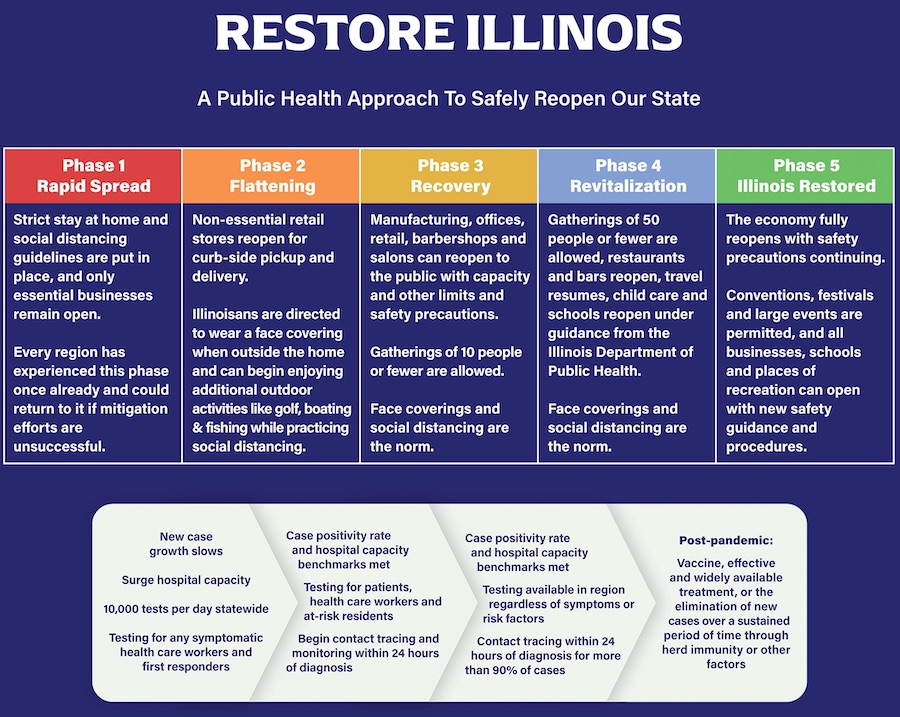
The five-phase plan is based on regional healthcare availability and recognizes the distinct impact COVID-19 has had on different regions of our state as well as regional variations in hospital capacity. The Illinois Department of Public Health (IDPH) has 11 Emergency Medical Services Regions that have traditionally guided its statewide public health work. For the purposes of Restore Illinois, from those 11, four health regions are established, each with the ability to independently move through a phased approach: Northeast Illinois; North-Central Illinois; Central Illinois; and Southern Illinois.
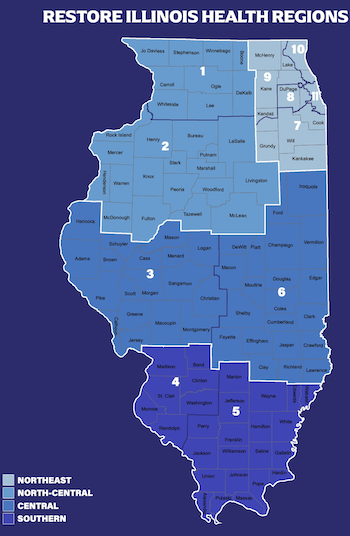
The five phases of reopening for each health region are as follows:
Phase 1 – Rapid Spread: The rate of infection among those tested and the number of patients admitted to the hospital is high or rapidly increasing. Strict stay at home and social distancing guidelines are put in place and only essential businesses remain open. Every region has experienced this phase once already and could return to it if mitigation efforts are unsuccessful.
Phase 2 – Flattening: The rate of infection among those tested and the number of patients admitted to the hospital beds and ICU beds increases at an ever slower rate, moving toward a flat and even a downward trajectory. Non-essential retail stores reopen for curb-side pickup and delivery. Illinoisans are directed to wear a face covering when outside the home, and can begin enjoying additional outdoor activities like golf, boating and fishing while practicing social distancing. To varying degrees, every region is experiencing flattening as of early May.
Phase 3 – Recovery: The rate of infection among those tested, the number of patients admitted to the hospital, and the number of patients needing ICU beds is stable or declining. Manufacturing, offices, retail, barbershops and salons can reopen to the public with capacity and other limits and safety precautions. All gatherings limited to 10 or fewer people are allowed. Face coverings and social distancing are the norm.
Phase 4 – Revitalization: The rate of infection among those tested and the number of patients admitted to the hospital continues to decline. All gatherings of up to 50 people are allowed, restaurants and bars reopen, travel resumes, child care and schools reopen under guidance from the IDPH. Face coverings and social distancing are the norm.
Phase 5 – Illinois Restored: With a vaccine or highly effective treatment widely available or the elimination of any new cases over a sustained period, the economy fully reopens with safety precautions continuing. Conventions, festivals and large events are permitted, and all businesses, schools, and places of recreation can open with new safety guidance and procedures in place reflecting the lessons learned during the COVID-19 pandemic.
Until COVID-19 is defeated, Restore Illinois recognizes that as health metrics tell us it is safe to move forward, health metrics may also tell us to return to a prior phase. With a vaccine or treatment not yet available, IDPH will be closely monitoring key metrics to immediately identify new growth in cases and hospitalizations to determine whether a return to a prior phase is needed.
As millions of Illinoisans continue working together by staying at home and following experts’ recommendations, the result has been a lower infection rate, lower hospitalizations, and lower number of fatalities than without these measures. As the state’s curve begins to flatten, the risk of spread remains, and modeling and data point to a rapid surge in new cases if all mitigation measures are immediately lifted. The governor and his administration continue to urge all Illinois residents to follow the state’s stay at home order and to follow the guidance issued by the state and public health experts.
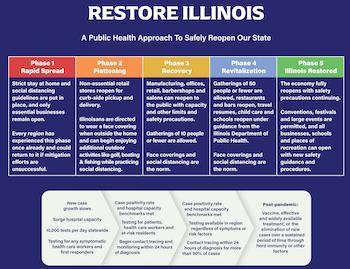
Click here or on the image discussing the phases if you’re having trouble seeing the pic.
Discuss.
…Adding… I’ve asked what this “continues to decline” stuff means. For how long must these rates decline?
*** UPDATE 1 *** I’m told a multi-page plan is about to be sent out, so we’ll get the answer to that question I posed soon, apparently.
Pritzker clarified that Phase One ended on April 30. Phase 2 is where the state is right now.
*** UPDATE 2 *** The governor is going into more detail today…
IDPH will watch the identified health metrics closely to determine when regions have attained them so each can move from phase two, to phases three and four. And more specifically those metrics are:
First, a region must be at or under a 20% test positivity rate and increasing by no more than 10 percentage points over a 14 day period, and a region must have either not had an overall increase or must have maintained overall stability in hospital admissions for COVID like illness in the last 28 days, and a region must maintain the availability of a surge threshold of 14% availability of ICU beds of medical and surgery beds and ventilators.
Because May 1 marked the beginning of phase two in which we loosened and modified a number of mitigations, that is the first day for the 14 and 28 day measurement periods to begin, meaning that the earliest that a region can move to phase three is May 29.
Changes to mitigation strategies in each phase will impact the data in each phase. So the assessment period begins when each new phase begins. IDPH will be tracking each of the four regions on these metrics, and we’ll make that available data available online to you every day, so that the public can track it to. Importantly, just as public health indicators will tell us when to move forward at any time. They could also signal that we need to move backward. IDPH will be tracking metrics here as well, moving backward is honestly the last thing that anyone wants to do. But if the virus begins to attack more people or the healthcare systems are heading toward becoming overwhelmed in any region swift action will need to be taken.
We have named phase four “revitalization” because it is in this phase that everyone in Illinois will be rebuilding what school and work will look like for a while, until we reach the other side of this pandemic.
The only way that we can cross into phase five “Illinois restored,” with all the sectors of the economy running with completely normal operations is with a vaccine, or a widely available and highly effective treatment or with the elimination of any new cases over a sustained period of time.
It brings me no joy to say this, but based on what the experts tell us, and everything we know about this virus and how easily it spreads in a crowd, large conventions festivals and other major events will be on hold until we reach phase five.
* More from the governor…
I spent decades in business, so I understand the urge to try and flip the switch and reopen our entire economy. Here’s the problem: that switch simply does not exist with a virus that can’t currently be eliminated by medical science. And I won’t open the door to overwhelming our hospital system and possibly 10s of thousands of additional deaths by exposing everyone to the virus today just because a loud but tiny minority would like to indulge in that fantasy.
On that note, I do want to touch on the enforcement of these phases at the state level. We don’t have the capacity or the desire to police the individual behavior of 12.7 million people. Enforcement comes in many forms. And our first and best option is to rely on Illinoisans working together to see each other through this pandemic. But we are also working with local law enforcement, and I’ve asked for their assistance to monitor for violations and consider taking actions when necessary, but that is not the option that anyone prefers.
It’s important to remember that we put this plan together not only because the state needs a plan, but because mayors need a plan, because small business people need a plan, workers need a plan every day Illinoisans need a plan. But this plan as vetted and data driven as it is, is a plan for responding to and recovering from a global pandemic in the 21st century, there is no modern day precedent for this. We are quite literally writing the playbook as we go. The scientists learn more about this virus every day. And we can, we will make our restore Illinois plan, smarter, as we move forward. I’m not afraid to redesign the playbook if the rules change.
He then went on to give a pep talk to the state.
66 Comments
|
2,122 new cases, 176 additional deaths
Tuesday, May 5, 2020 - Posted by Rich Miller
[Headline was fixed. Sorry!]
* Dr. Ezike at today’s briefing…
To date, we have run a total of 346,286 tests for COVID-19, with 13,139 being reported in the last 24 hours.
Today we are reporting an additional 2122 new cases of COVID-19 here in Illinois, for a total of 65,962 cases. Unfortunately I’m also reporting the largest number of fatalities reported in a single 24 hour period with 176 deaths which brings us to a total of 2838 lives lost in Illinois associated with COVID-19.
Regarding hospitalizations, in the hospitals throughout the state we have 4780 people who were reported to be in the hospital, of those 1266 patients were in the intensive care unit. And of those Intensive Care Unit patients 780 were on ventilators.
On the recovery front, cases who responded to our survey continue to report recovery from this deadly virus. 47% of those surveyed within 14 days from their positive test report illness recovering. 74% of individual surveyed 28 days after their positive test, no longer experiencing COVID-19 symptoms and are reporting recovering.
* Press release…
The Illinois Department of Public Health (IDPH) today announced 2,122 new cases of coronavirus disease (COVID-19) in Illinois, including 176 additional deaths.
Bureau County: 1 male 90s
Clinton County: 2 female 80s
Cook County: 1 female 30s, 1 female 40s, 4 males 40s, 3 females 50s, 6 males 50s, 8 females 60s, 20 males 60s, 5 females 70s, 17 males 70s, 18 females 80s, 15 males 80s, 11 females 90s, 8 males 90s
DuPage County: 2 males 50s, 2 males 60s, 2 males 70s, 2 females 80s, 1 male 80s, 4 females 90s
Kane County: 1 male 40s, 2 males 50s, 1 female 60s, 1 male 60s, 1 female 70s, 1 female 90s, 1 male 90s
Kankakee County: 1 female 90s
Kendall County: 3 females 80s
Lake County: 1 male 40s, 1 male 90s
Macoupin County: 1 female 40s
Madison County: 1 female 80s
McDonough County: 1 female 90s
McHenry County: 2 females 90s
Randolph County: 1 male 60s
Rock Island County: 1 female 50s, 1 male 60s, 1 male 90s
Sangamon County: 1 female 70s, 1 female 80s, 1 female 90s
St. Clair County: 1 male 60s, 2 males 70s, 2 females 80s, 1 male 80s
Union County: 1 male 80s
Will County: 2 females 70s, 3 females 80s, 5 females 90s
Currently, IDPH is reporting a total of 65,962 cases, including 2,838 deaths, in 97 counties in Illinois. The age of cases ranges from younger than one to older than 100 years. Within the past 24 hours, laboratories have processed 346,286 specimens for a total of 13,139.
11 Comments
|
State delays $1.2 billion bond sale
Tuesday, May 5, 2020 - Posted by Rich Miller
* Bloomberg…
Illinois delayed the planned auction of $1.2 billion of short-term debt as it faces record-high penalties to borrow on Wall Street because of the deep financial hit the state is being dealt by the coronavirus shutdown.
The worst-rated state had planned to sell about $1.2 billion of short-term tax-exempt general-obligation debt on Wednesday, its first borrowing during the pandemic, to ease the revenue shortfall in the last two months of the fiscal year. The deal has been moved to “day-to-day status,” meaning it will be sold if market conditions warrant.
With the economic slowdown raising the risk of Illinois having its bonds cut to junk, investors have driven the yields on its two-year debt to nearly 4 percentage points above benchmark, far exceeding every other U.S. state.
The timing of the sale was a little “strange” because there are a lot of short-term unknowns with state finances, said Daniel Solender, head of municipals at Lord Abbett & Co., which owns Illinois debt as part of its $27 billion in municipal assets under management.
“It’s not a complete surprise they delayed it,” he said. “There is the Fed program which hasn’t really been set up yet and states are still waiting on what Congress is going to do.”
This was supposed to be a bridge loan. The state would pay it back within a year.
…Adding… Related…
* County looks at other options besides furloughs: Macon County has just about enough money to last them through the June payroll.
9 Comments
|
* As you already know, Rep. Darren Bailey (R-Xenia) has withdrawn his request for a TRO against the governor’s executive order. But the governor is pressing ahead with the Illinois Supreme Court…
The Governor maintains his request for supervisory relief under Rule 383, which included a request for a stay of circuit court proceedings. Given the changed circumstances brought about by Bailey’s decision to consent to the vacatur of the TRO he had sought and obtained, the Governor now seeks under Rule 383 resolution of the underlying legal question presented by this case—that is, whether the Governor acted within the scope of his authority under the Illinois Emergency Management Act (“Act”), 20 ILCS 3305/1, et seq., and the Illinois Constitution when he issued disaster proclamations and executive orders in response to the COVID-19 pandemic—and a stay of the circuit court proceedings pending resolution of this supplemental motion.
More info about Rule 383 is here.
* Reasoning…
As detailed in the Governor’s April 29 emergency motion, the exercise of supervisory authority is appropriate here because the normal appellate process will not afford sufficient relief and because the resolution of the underlying legal question presented will have a profound effect on the Governor’s response to the public health emergency presently facing Illinois. The dissolution of the TRO, which will prolong the normal appellate review process, only heightens these considerations.
Indeed, the deleterious effects of the circuit court’s order—even though dissolved—will not cease unless and until this Court makes a definitive pronouncement on the scope of the Governor’s authority to protect the health, safety, and welfare of Illinois residents during a global pandemic. As one example, there are already indications that the uncertainty over the lawfulness of the Governor’s emergency actions has caused individuals to stop complying with the stay-at-home directives. Two days after the court entered the TRO, a COVID-19 positive individual living in Bailey’s district visited three stores in violation of the stay-at-home order. And on May 1, 2020, protestors gathered in Chicago and Springfield in violation of the stay-at-home order. Additionally, the initial entry of the TRO has caused litigants to file similar suits seeking relief from the stay-at- home orders. Similar lawsuits will likely follow in Illinois courts, which are already minimizing operations, and lead to a patchwork of conflicting orders when concerted guidance is needed. […]
Moreover, the mootness doctrine does not prevent this Court from reviewing whether the Governor acted within his authority. Courts of review generally will not decide questions that are moot, in the sense that “the issues involved in the trial court no longer exist because intervening events have rendered it impossible for the reviewing court to grant effectual relief.” But a reviewing court may decide issues that are moot under various exceptions to mootness, including the public interest exception, and the exception for issues capable of repetition but evading review. Accordingly, to the extent this Court determines that the underlying question is moot, it is not precluded from reaching the question because both of these exceptions apply here. […]
(T)here is unquestionably a likelihood of future recurrence of the question raised in this case. Bailey agreed to have the TRO vacated, but he did not voluntarily dismiss his case with prejudice. So in this case alone, the question is likely to recur. And, again, other litigation will certainly present the same question. Resolving that question sooner rather than later, after a period of needless uncertainty about whether the Governor’s executive orders are legally authorized, will greatly serve the public interest. […]
Indeed, Bailey, apparently seeking to manipulate the court system to his advantage, has reserved the right to have the same issue decided against the Governor. But he should not be given a veto over where, and when, the courts ultimately decide that issue. Instead, this Court should now take the issue that he first raised (and reserves the right to raise again) and decide it for the benefit of the Governor and all the people of Illinois.
…Adding… Chicago Daily Law Bulletin…
Bailey’s attorney Thomas DeVore said his client intends to file an amended complaint by the end of the week.
His initial complaint argues the governor cannot exercise his emergency powers beyond 30 days, and that the state’s authority to quarantine is delegated to the Illinois Department of Public Health and local health departments.
“I feel their request for the supreme court to intervene under these facts is unprecedented and is an insult to the honorable circuit court,” DeVore, an attorney with Silver Lake Group Ltd. in Greenville, said in an email.
26 Comments
|
|
 Support CapitolFax.com
Visit our advertisers...
  ...............
 ...............
 ...............
 ...............
 ...............
 ...............


|
   
|
Hosted by MCS |
SUBSCRIBE to Capitol Fax |
Advertise Here |
Mobile Version |
Contact Rich Miller
|