|
*** UPDATED x1 *** The tide shifts a bit
Tuesday, Jan 17, 2017 - Posted by Rich Miller * Back when Pat Quinn was governor and before he raised taxes, some folks were saying Quinn should follow California Gov. Jerry Brown’s example and allow state services to deteriorate so much that people would literally beg for a tax hike. Quinn wouldn’t do something like that. His heart just wasn’t in it. But after over two years without a real budget and services crumbling everywhere, opinion at the newspaper editorial board level is starting to change. For instance, this is from the usually tax-averse Jacksonville Journal Courier…
Pretend purpose? The state hadn’t made its pension payments out of GRF in years and had been borrowing billions to make the payments for two years while bills were piling up fast. And if 2011’s tax increase was “massive,” this one is even bigger, raising the personal rate to 4.95 percent and adding on a sugary beverage tax and eliminating some business tax incentives. But, hey, whatever gets you through the night. * Rockford Register Star…
They want that casino so bad they’ll take those tax hikes and like ‘em. * From a January 10th Chicago Tribune editorial…
So, after railing against the 2011 tax hike they’re gonna push hard for a 2017 tax hike? Will wonders never cease? *** UPDATE *** The Belleville News-Democrat, no fan of tax hikes, also looked kindly on the Senate plan, as did, to a somewhat lesser extent, the Champaign News-Gazette.
|


|
Zombies!!!
Tuesday, Jan 17, 2017 - Posted by Rich Miller * From the Illinois Policy Institute…
And on and on like that they go, concern trolling over a harmless little resolution with bipartisan support. * Actually, Welch’s idea might do some good. From the resolution…
…Adding… As noted in comments, the Centers for Disease Control and Prevention has a Zombie apocalypse preparedness page. So, this ain’t new. * Rep. Welch defended himself on Twitter and a snit broke out… 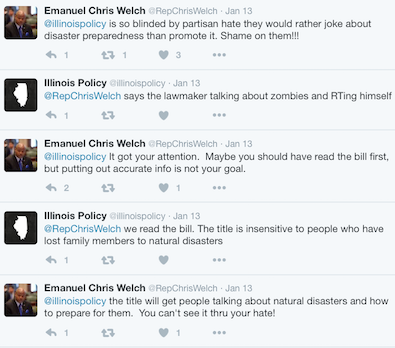 Oh, for crying out loud. * And then it took a turn for the worse… 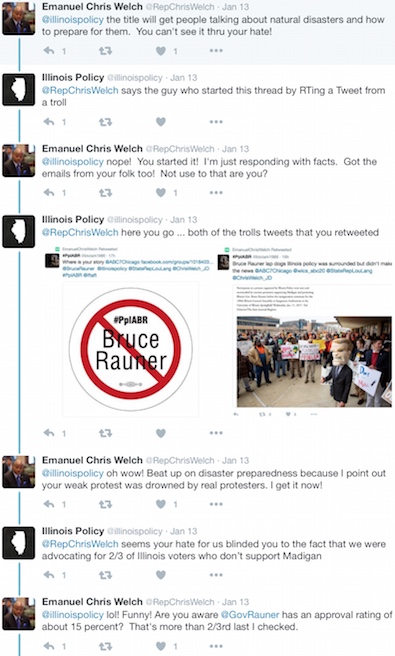 Sheesh. Also, I know of no poll that shows Rauner at 15 percent disapproval, but I digress. * Eventually, I intervened and so did GOP Rep. Grant Wehrli (a noted Twitter troll himself) and everybody stopped arguing and went on to enjoy their holiday weekends. All that energy expended over a little resolution.
|
| « NEWER POSTS | PREVIOUS POSTS » |