* Kurt Erickson fact checks this excerpt from the governor’s lawsuit against state employee unions…
“Since 2004, the unions have negotiated wage increases of approximately 80 percent during collective bargaining negotiations. By comparison, total inflation over the same time period was approximately 26 percent, and private sector employee salaries increased by a total of 31 percent,” the suit notes.
Erickson calculated that the lawsuit claims a person making $50K a decade ago would be earning $90K right now. Could that possibly be true? He took a look at state union contracts and concluded it wasn’t…
Based on those contracts, workers were in line to receive wage increases totaling just over 32 percent — a figure that matches up more favorably with the private sector number cited by Rauner in his lawsuit.
The Rauner administration’s response…
“It includes overtime and is based on salary averages,” Lance Trover wrote in an email last week.
Overtime costs are mainly driven by worker shortages. Hiring more workers would drastically lower those OT costs, but doing so would also drive up other costs for things like training, health insurance and pensions.
However, there are other ways to get pay raises under the contract, including step increases. I’m no expert here, so maybe some commenters can fill us in. And I have yet to see someone challenge Rauner’s basic fact: State employee salary costs have risen 80 percent over the past decade.
* Meanwhile…
Three top administrators at the Illinois education agency took big bonuses home in their paychecks earlier this month.
According to a review of state payroll records by the Quad-City Times Springfield Bureau, the Illinois State Board of Education paid a total of more than $41,000 in bonuses to the trio.
A state board spokesman said the employees received the extra cash because each of them took on added duties.
“(T)heir salaries will return to the previous levels during the next pay period,” Illinois State Board of Education spokesman Matt Vanover said in an email. […]
“Given the significant reduction in agency headcount and the increased burdens placed on the agency by the Legislature, it is disingenuous to suggest that only the senior level administrators have had to take on additional duties meriting these adjustments in pay,” noted Aviva Bowen, spokeswoman for the Illinois Federation of Teachers.
ISBE employees are represented by the IFT, and those frontline workers have indeed taken on extra duties without additional pay - unlike the top brass.
*** UPDATE *** From AFSCME Council 31…
FALSE CLAIM: “Since 2004, unions have negotiated wage increases of approximately 80 percent”
FACT: Negotiated wage increases since 2004 are 32.25 percent. The average increase over that period is 2.9 percent per year.
FACT: The average wage increase in the current contract is just 1.3 percent per year — below inflation for that period (1.73 percent per year).
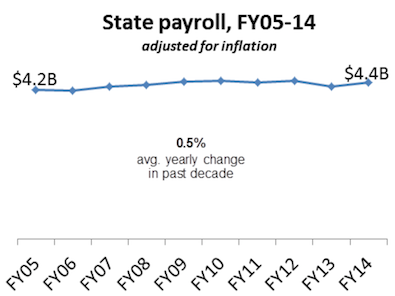
FACT: Adjusted for inflation, payroll is effectively flat since 2004 – up just 0.5 percent per year.
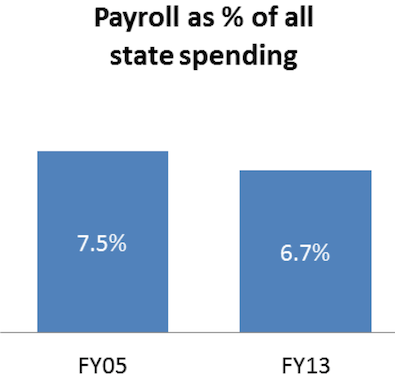
FACT: Payroll is a small share of state spending, and dropped from 7.5 percent in FY05 to 6.7 percent in FY13.
Two charts…