National Journal ranks Illinois races
Wednesday, Jul 18, 2012 - Posted by Rich Miller
* From the National Journal…
Three wave elections in a row have done plenty to scramble the House landscape. This year, it’s unlikely another wave will develop–at least any wave that could overwhelmingly benefit one party. Instead, we’re likely to see an anti-Washington backlash, one that could cost a number of members their jobs, even if neither side sees a big net increase.
* The National Journal looked at 75 US House districts that it deems the most likely to change hands. Here are the Illinois rankings…
3. IL-08 (R, Rep. Joe Walsh): Walsh complained recently that Democratic nominee Tammy Duckworth, an Iraq war veteran and former Veterans Affairs official, uses her service as a way to duck political issues. She would have to address issues more if Walsh didn’t keep sticking his foot in his mouth. The seat gave President Obama more than 61 percent of the vote in 2008, and 45 percent of its residents are nonwhite. As one of Walsh’s colleagues might say, the cake is baked.
8. IL-10 (R, Rep. Robert Dold): Of all the Republican-held House seats, this one gave the greatest share of its 2008 presidential vote to Obama. But Democrats failed to capture it from Mark Kirk in several attempts last decade, and they couldn’t keep Dold from holding it for the GOP in 2010. Dold’s legitimate moderate streak (and a formidable war chest) gives him a glimmer of hope, but Democrats have a strong, moderate nominee in Brad Schneider. Schneider will hammer Dold all autumn for his two votes for the Ryan budget plan. Obama could win the district with 60 percent again, and it would be difficult for Dold to peel off a full sixth of Obama supporters from Schneider.
16. IL-17 (R, Rep. Bobby Schilling): Democrat Cheri Bustos is quickly raising cash in a district that, like nearly every other GOP-held seat in Illinois, got more Democratic after redistricting. The swing districts outside Chicago’s orbit aren’t quite as fertile ground for Democrats as the ones closer to the city, but Schilling is competing at a structural disadvantage.
17. IL-11 (R, Rep. Judy Biggert): Biggert is a moderate on social issues, and that helped her appeal across party lines against tough opposition in 2008. But Obama won 54 percent in that seat; he took 61 percent of the vote in the new seat. Obama probably won’t do as well this year, but that still makes it tough to figure out the math necessary for Biggert to beat well-funded ex-Rep. Bill Foster.
23. IL-12 (Open D, Rep. Jerry Costello retiring): Though the district voted for both John Kerry and Barack Obama for president, Southern Illinois is exactly the type of predominantly white, working-class place where Democrats have had serious trouble recently. Republicans think businessman Jason Plummer can wrestle the seat away for them. Democratic nominee Bill Enyart, who commanded the Illinois National Guard, joined the race just weeks ago after the Democratic primary winner dropped out for health reasons. Enyart seems like a great recruit so far, but he has a lot of money and name identification to make up in a hurry.
53. IL-13 (R, Rep. Tim Johnson): Republican nominee Rodney Davis has never appeared on the district’s ballot; GOP county chairs chose him to replace Johnson after the incumbent declined to run in the general after winning the primary. But Democratic nominee David Gill might have appeared before voters too many times. He lost to Johnson three times in the last decade, and a more Democratic district might not be enough to boost him over Davis this year.
Thoughts?
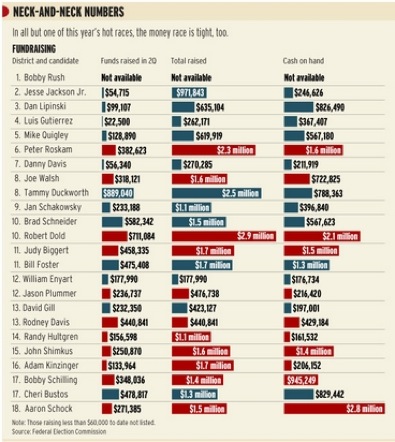
* A fundraising chart from Crain’s…
* More…
The only candidate to have a clear fundraising advantage is freshman Rep. Robert Dold.
The North Shore Republican had more than $2.1 million in the bank after hauling in $711,084 in the three months ended June 30, according to the latest campaign finance reports.
His Democratic opponent from Deerfield, management consultant Brad Schneider, raised almost as much in the quarter — $582,342 — but had only $567,623 in cash on hand after spending most of the $1.5 million he’s raised so far on a tough primary. […]
In the open downstate seat of retiring Rep. Tim Johnson, R-Urbana, Republican candidate Rodney Davis has outraised Democrat David Gill by almost 2-to-1, making it less likely to become one of the state’s hottest races.
…Adding… Oops. I forgot to make mention of the Tribune’s scathing editorial about Joe Walsh…
Our “true heroes”? As opposed to what, exactly?
Walsh’s opponent is Democrat Tammy Duckworth, who flew combat missions in Iraq as a member of the Illinois Army National Guard. In 2004, Duckworth was piloting a Black Hawk helicopter when it was hit by a rocket-propelled grenade fired by insurgents. She guided the aircraft safely to the ground, then passed out from loss of blood. Her comrades dragged her from the wreckage, wrapped her in bandages and whisked her to safety. Duckworth, who lost both of her legs in the attack, was awarded the Purple Heart.
Those are facts.
A military website interviewed her a few weeks after the attack.
“I hope this is the worst thing that happens to anyone in the 106th during this deployment,” she said. “This is not so bad. There is always somebody worse off than you are. I’m just glad it was me and not one of my guys out there.”
Now what was that, Rep. Walsh, about true heroes?
24 Comments  
|
* House Speaker Michael Madigan has taken the unusual step of responding point by point to a highly critical series of stories published by the Chicago Tribune last month. He prefaced his detailed attempt at refutation with an open letter to the General Assembly, which was forwarded to me this morning by a Republican legislative employee…
As you know, the Chicago Tribune published several articles that implied conflicts of interest between my law practice and my position as Speaker. These articles provided ample speculation, but few facts. I have come to learn from individuals interviewed by the Tribune that the authors were provided information that directly contradicted the reporters’ conclusions-but that information appears nowhere in the articles.
Despite the implications, it is clear that the reporters have failed to uncover any evidence of conflicts of interest or quid pro quo between my legislative acts and the interests of my law firm, or of any other unethical conduct on my part. They have failed to find any evidence because it does not exist. Yet they insist on publishing articles that imply, if not outright state, that I have engaged in inappropriate conduct.
None of my actions as Speaker or as an attorney have been inappropriate or violative of any applicable law or ethical rule, I have imposed requirements on my law firm and myself, beyond what is required by the law, to ensure ethical conduct, and I go to great lengths to make certain there is a clear division between my law practice and my actions as a public official. Any potential law firm client who seeks a State benefit is not accepted. If a client requests my intercession with a State agency, I refuse. If a client expresses an interest in legislation, I recuse myself from consideration of the bill.
Even though the Tribune consistently ignores information that might cast their stories in a considerably different light, I am grateful to share such information with you. Enclosed you will find information relevant to the implications, as well as several inaccuracies found in the articles.
With kindest personal regards, I remain
Sincerely yours,
MICHAEL J. MADIGAN
Speaker of the House
* You should really read the whole thing. But here are some excerpts. First up, “Whether legislation that transformed the supportive living facilities pilot project into a permanent program was the result of Pathway Senior Living hiring my law firm”…
On June 2,2012, the Chicago Tribune published an article entitled “Favorable legislation flows to private clients of House Speaker Madigan.” The article implied that the passage of Senate Bill 1651 of the 94th General Assembly - which was unanimously approved by the General Assembly and became law July 26, 2005 - was somehow attributable to the relationship between my law firm and Pathway Senior Living, LLC (”Pathway”). It is true that my firm represents one of Pathway’s twelve properties, and it is presumably true that Pathway benefited from the State’s decision to make the program permanent. But neither Pathway nor I initiated the legislation. In fact, if the Tribune had researched this issue at all, they would have discovered that the legislation was the direct result of actions taken by Governor Blagojevich - who has never been mistaken for an ally of mine - and a gubernatorial agency. The legislation implemented a rule proposed by the Department of Public Aid and approved by the Joint Committee on Administrative Rules (”JCAR”) that ensured that the Department had sufficient statutory authority to operate the supportive living facilities program, which had proven to result in significant savings to the State of Illinois. […]
At no time did any person in my firm or I discuss this pending legislation, or any pending or proposed legislation related to Pathway’s properties or senior living facilities in general, with any officer or representative of Pathway. In fact, to the best of my knowledge, I have met with representatives of Pathway on only one occasion. My law partner, Bud Getzendanner, and I met with James Kaledjian, President of Pathway, on October 24,2004, to discuss the firm assisting with property tax issues with a senior living facility Pathway intended to build at l05th and Michigan Avenue in Chicago, now known as Victory Center of Roseland, Mr. Kaledjian’s statements in the article confirm my recollection. Additionally, I believe he made it clear that we never discussed legislative issues and that Pathway’s decision to hire my firm had nothing to do with their legislative interests.
ccordingly, it is undisputed (but barely mentioned in the June 2nd article) that this legislation (i) was initiated by a governor who by no means was an ally of mine; (ii) received unanimous legislative support; (iii) resulted in significant savings yo the State by providing a lower-cost method of care; and (iv) benefits countless poor and elderly citizens in Illinois, The Tribune reporters would ignore virtually all of this relevant information and focus, instead, on that the fact that one of the companies that owned these facilities utilized the services of my law firm for one legal project months after that legislation passed. I believe it would be clear to any reasonable person - armed with all of the relevant information, not just that cherry-picked by the reporters - that there is no connection between my firm’s representation of Pathway and the passage of that legislation.
* Another topic…
The Tribune article published on June 2,2012, implied that the passage of Senate Bill 2185 of the 94th General Assembly, which became law on January 19,2007, somehow demonstrated a conflict of interest between my firm and my public acts. Given that I voted “present” on the legislation and recused myself from consideration of the matter, I am at a loss to understand why the Tribune believes that I had a conflict of interest. I voted “present,” as I usually do on property tax issues, as an act of caution. In light of the Tribune’ s strained attempts to link my legislative actions to clients of the firm who might “benefit” from such actions, my caution appears to be well-founded. […]
Senate and House records indicate that the Illinois Equity Fund, Developer Services Group, and Illinois Health Care Association supported the legislation. Again, there is no record indicating that Pathway was a proponent of the bill. Senate Bill 2185 was approved unanimously by the General Assembly with one exception - I voted present.
* Medicaid funding spared…
The Tribune article published on June 2, 2072, states that certain Medicaid providers, such as nursing homes, pharmacies, and supportive living facilities, received favorable treatment, and they imply that this supposed preferential treatment was due to my relationship to certain facilities via my law practice. As I will explain below, their premise is incorrect - there was no favorable treatment - and, in any event, I exerted absolutely no influence to benefit any of them. […]
Despite what the Tribune perceives as my many conflicts of interest, however, I stood alone among the legislative leaders in refusing to agree to these inflated figures and by insisting that the Medicaid problem would not be resolved solely on the backs of the poor and needy, without the providers sharing in the pain. I very easily could have agreed to these higher savings estimates and, by doing so, could have spared the nursing homes, supportive living facilities, and pharmacies from any cut to their rates whatsoever. This indisputable fact, which appears nowhere in the Tribune article, belies any notion that my public positions are dictated by my law practice. […]
…the full $700 million did not need to be cut from the providers (as originally proposed by Governor Quinn) was due to several factors, namely (i) the enhanced eligibility verification; (ii) the new hospital assessment, which generated an additional $100 million for Medicaid expenses; and (iii) the use of the FY12 surplus money. […]
The Tribune makes much of the fact that the Governor’s proposal called for the elimination of funding for supportive living facilities, a proposal that the legislature rejected. According to Representative Sara Feigenholtz, the lead negotiator for the House Democrats, LMAC concluded that it was unwise to eliminate supportive living facilities, as they were more cost effective than other Medicaid providers, and resulted in substantial savings for the State, Representative Feigenholtz explained this to one of the Tribune reporters during an interview, She also stated that the decision to preserve the supportive living facilities was made in the early stages of LMAC’s work - long before one of my attorneys, David Ellis, began attending meetings. Furthermore, Representative Feigenholtz was specifically asked if I requested that these facilities be protected or that my clients receive some sort of preferential treatment, and she stated that I had never discussed this issue with her. But, again, none of this information was included in the article.
With respect to the article’s inferences that supportive living facilities received preferential treatment, let me be clear - I disagree with that premise, but regardless, I did not exert any influence or direct any outcome with respect to the supportive living facilities. […]
To any knowledgeable observer of the Medicaid negotiations, the notion that pharmacies received preferential treatment is not only false but laughable. Pharmacies, like almost every other Medicaid provider, received a rate cut of approximately 3 percent in the Medicaid legislation. Moreover, the pharmacy community - represented by the Illinois Retail Merchants Association (”IRMA”), Illinois Pharmacists Association, Association of Indian Pharmacists in America, and Illinois Council of Health System Pharmacists - had agreed in February to a significant rate cut of 5.9% in fees, and to move to performance based contracting (which could also result in a significant cut), When the across-the-board Medicaid rate cuts were announced this year, which included pharmacies, representatives of the pharmacy community furiously objected that it was unfair to subject pharmacies to a second rate cut. They lobbied one legislator after another about the unfair treatment of pharmacies. For newspaper reporters, purporting to comprehensively research a topic, to fail to capture these easily-ascertainable facts is negligent at best.
What is even worse, however, is that I am told that David Vite, president of IRMA, explained this background to one of the Tribune reporters in each of two interviews. He explained that pharmacies had agreed to rate cuts and performance based contracting earlier in the year, and that now they were subjected to an additional 3 percent cut, in addition to the fact that approximately $18 million in prescription revenues would no longer be made available because of other cuts made by LMAC. Mr. Vite explained to the reporter how pharmacies were being treated much worse than other Medicaid providers. Yet these facts did not appear anywhere in the Tribune series. Instead, the Tribune reporters skillfully avoided these inconvenient details; rather than focusing on pharmacies in particular, they simply made the global claim that pharmacies and other providers “avoided the worst of the proposals” made during the Medicaid negotiations. That claim is only technically true and, particularly in the case of the pharmacies, is incredibly incomplete and misleading
* Foreclosure legislation…
On June 4,2072, the Tribune published an article entitled, “Michael Madigan tax clients unscathed in foreclosure debate, ” Given that I have been a leading voice in combating predatory lending practices of Illinois financial institutions for more than a decade, I am offended by the Tribune’s insinuation that I would place personal gain ahead of the families that have been impacted by this crisis and the decimation of communities that has occurred as a result of thousands of boarded-up houses in my neighborhood and throughout the State. I can only assume that the reporters did not contact those who represent the financial industries in Springfield, Had they taken the time to do so, they would have learned that the industry does not view me as an ally. Joyce Nardulli, Vice President of Government Relations for the Illinois Bankers Association, has said that she disagreed with the Tribune ’s inferences, mainly because I have been anything but helpful to the banking industry.
There’s lots more. So, again, go read the whole thing.
Also, this was copied and pasted from a pdf file, so there may be some typos that I missed.
…Adding… The Tribune series is here.
29 Comments
|
* Ali Ata cooperated with the government and will avoid prison…
Ali Ata will not go to prison for his role in the “pay-to-play” scheme of former Illinois Governor Rod Blagojevich.
Ata is the former head of the Illinois Finance Authority. He was appointed to that post by Blagojevich after making a pair of $25,000 contributions to the Governor.
Ata pled guilty to making false statements to a government agent and to filing a false income tax return in 2002.
He has already paid $150,474 in restitution and was fined $50,000 on top of the four-year probation sentence.
* The US Attorney’s office and Ata’s defense counsel both argued for a light sentence…
Assistant U.S. Attorney Brandon Fox said Ata is the most “honorable man” among all of the defendants in the case and said his testimony was important in winning the convictions of the former governor and of political fixer Tony Rezko.
Ata, a chemical engineer, was let go by Nalco, the Naperville company where he’d worked for 25 years, soon after the Sept. 11, 2001, terror attacks, according to his lawyer, Thomas McQueen. Ata was questioned by the FBI following the terrorist attacks and, because of his name, was asked to take a retirement package, McQueen said.
It was after his job dismissal that Ata focused on his real estate investments and met Rezko, McQueen said.
Ata fell under Rezko’s “spell,” he said.
In court, McQueen said that once Ata got away from Rezko’s influence, he was able to “right his wrong.”
* His firing because of his name after 9/11 was taken into consideration by Judge James Zagel…
Zagel said that seemingly wrongful dismissal may have been a significant factor in Ata’s decision to depart from an otherwise useful and honorable career.
* The Sun-Times tells us who got what so far…
† Tony Rezko, former top fund-raiser for Blagojevich and President Barack Obama, shook down companies seeking state business: 10 1/2 years in prison.
† John Glennon, a former adviser to now-imprisoned ex-Gov. George Ryan, covered up kickbacks that involved Stuart Levine, who was convicted of corrupting two state boards Blagojevich controlled: Two years of probation.
† John Harris, Blagojevich’s former chief of staff, helped Blagojevich try to sell an appointment to fill the U.S. Senate seat vacated by Obama: 10 days in prison.
† Alonzo “Lon” Monk, law school roommate and former chief of staff who schemed with Blagojevich to get rich off state deals: Two years in prison.
† Joseph A. Cari Jr., tried to extort an investment company that sought pension-investment business from Blagojevich’s administration: Three years of probation.
* One Blagojevich-related defendant still awaiting sentencing is Bill Cellini. His lawyers are asking for a delay…
Attorneys for a Springfield powerbroker with links to former Gov. Rod Blagojevich are expected to ask for a delay to his sentencing hearing scheduled for Monday.
William Cellini’s lawyers requested a hearing for Wednesday to argue for a later sentencing date. But the motion they filed in federal court in Chicago was sealed and so their grounds for a delay weren’t clear.
Cellini’s sentencing hearing was already delayed once. Prosecutors have asked that he get up to 8 years behind bars.
*** UPDATE *** Cellini’s sentencing was, indeed, delayed today until October…
Cellini, 77, was scheduled to be sentenced July 23 but his attorneys asked U.S. District Judge James Zagel to postpone the date because of Cellini’s failing health.
Cellini’s attorneys said that their client suffered a heart attack in June. A few days later, he suffered a blood clot, they said.
Cellini’s lawyer Dan Webb wouldn’t comment further but said Cellini’s doctors were made available to prosecutors.
“The issue is Bill’s health and whether he can travel for sentencing,” Webb said.
Prosecutors did not object to the continuance request.
8 Comments
|
|
Comments Off
|
|
 Support CapitolFax.com
Visit our advertisers...

 ...............  ...............  ............... 

|
   
|
Hosted by MCS |
SUBSCRIBE to Capitol Fax |
Advertise Here |
Mobile Version |
Contact Rich Miller
|



