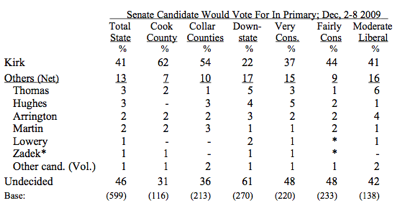
* So, how much of a threat is Patrick Hughes to Mark Kirk? Not much so far…
Kirk 41
Thomas 3
Hughes 3
Arrington 2
Martin 2
Lowery 1
Zadek 1
Other cand. (Vol.) 1
Undecided 46
Yes, the undecideds represent 46 percent of the vote, but that 41-3 Kirk-Hughes lead is gonna be incredibly tough to overcome, to say the very least. According to the Tribune poll, just 8 percent of voters have heard enough about Hughes to rate him.
Even Hughes’ own claimed recent polling shows he’s in serious trouble. From a press release…
A recent survey conducted on December 9th and 10th by Wilson Research Strategies of 600 likely Republican primary voters, shows the race for Illinois’ open U.S. Senate seat is largely undecided. 63% of voters indicated that they are undecided about who they will vote for in the February 2nd Primary. 28% of voters indicated they were leaning towards Congressman Mark Kirk and 5% were leaning towards Hinsdale developer Patrick Hughes. Looking closer at the numbers only 7% of voters polled indicated that they were Definitely voting for Kirk while 2% indicated they were Definitely voting for Hughes. No other candidate polled higher than 1%.
Hughes does go on to claim this, however…
When information was given to the voters about Mark Kirk’s support for Cap and Trade support for Hughes surges to 47% and the support for Kirk drops to 13%
Kirk flip-flop explained. You don’t need a weather man to know which way that wind blows.
Kirk is even leading among “very conservative” voters. That could change if Hughes can get his act together, but so far he hasn’t. Hughes sent out a single mailer to quite a few GOP voters a week or so ago, but that won’t get him very far. Even interested voters will only look at a mailer for a few seconds before tossing it in the garbage.
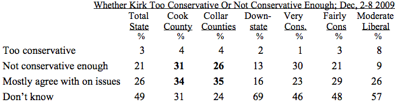
“Thinking now about Senate candidate Mark Kirk - compared to your political beliefs, do you think Kirk is too conservative on the issues, not conservative enough, or do you mostly agree with him on the issues?”…
From the pollster…
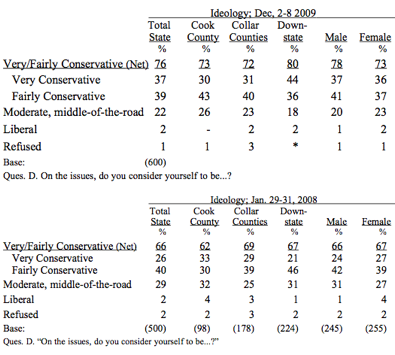
Voter composition in a primary can change over time. The current poll yielded 76% of likely voters who describe themselves as conservative, 37% very conservative, up from the previous results.
In four previous GOP primary polls, Jan., ’08, Dec. ’07, March ’06, and Feb. ’06, total conservatives ranged from 64% to 66% including 21% to 26% very conservative. Who is on the ballot may affect composition of voter turnout. But it is also likely that national politics is having an effect on elections this year.
So, the GOP electorate is getting more “very conservative” than in years past, but it’s still probably not enough to defeat Kirk in a primary with anyone in this field.
Conservative polling history…
Notice that the number of Republicans who once defined themselves as “moderate” dropped to 29 percent. That is partially because so many of those people left the party.
Nearly half of voters who call themselves conservatives said they are undecided in the contest. About the same number of conservative voters said they did not know when asked if Kirk’s ideology was too conservative or not conservative enough.
But Hughes’ candidacy represents an emerging, and very real, challenge for GOPers: In an era of tea partiers, the centrist Kirk has to move to the right to win a primary. Those moves have already cost Kirk, as Planned Parenthood and environmental groups have repudiated him for recent statements. Conservative challengers to more centrist favorites in NH, FL, OH, CO and other states could make those favorites move to the right.
Dems have been hammering Kirk for his rightward move, and they stand ready to do the same for the more moderate candidates in other states. Kirk has a big lead, and one has to wonder whether he needed to leap so quickly to his right, given his lead in the primary. Other centrists should look to their own poll results to see just how much of a threat conservative candidates really are; it might make their general election mission of appealing to centrist voters all that much easier.
Kirk, whose centrist positions on certain issues have led to some speculation about his primary vulnerability, is not over 50 percent. But no other candidate appears to have asserted him- or herself as a strong alternative with a month and a half to go in the primary.
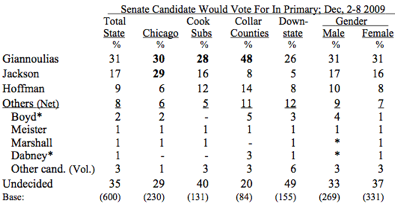
Jackson is doing significantly better in the Tribune poll than in any of the other surveys. Hoffman is about the same. After getting a bump in November, Giannoulias is about the same.
Giannoulias’ strongest geographic support came from collar-county primary voters, 48 percent of whom backed his bid compared with 14 percent for Hoffman and 8 percent for Jackson. Among Chicago voters, Giannoulias and Jackson were virtually tied at around 30 percent support, while the treasurer held a 28 percent to 16 percent edge over Jackson in the Cook County suburbs, where 40 percent of voters said they were undecided.
If Jackson has the money to compete, she’ll likely come close to sweeping the African-American vote and may do significantly better with women. Whether that’s enough to be victorious will depend on whether Hoffman can somehow jump-start his campaign and Meister can gain a little traction. Meister is focusing on the gay and gay friendly vote as his base, and that’s not inconsequential. Still, Boyd was removed from the ballot, but still outpaced Meister, who has put serious money into his campaign.
Name rec…
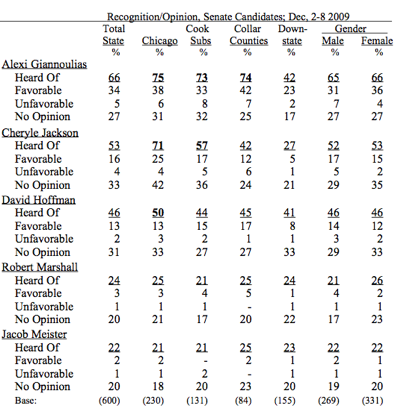
You can probably downplay the generic name rec numbers in these contests. It’s probably better to focus on the percentage of people who know enough about the candidates to rate them. A good example of this is Robert Marshall, a radiologist who practices in Kankakee and Joliet. He’s never run for office as a Democrat and has received almost zero coverage, yet 24 percent claimed to have heard of him. Only four percent knew enough about him to rate him, however, and that’s probably too high.
If you look at the name rec numbers that way, you get this…
Giannoulias 39
Jackson 20
Hoffman 15
Marshall 4
Meister 3
Back to the story…
The survey found plenty of room for movement before the Feb. 2 primary elections, with 35 percent of Democratic voters saying they were undecided. The major contenders only recently have begun to roll out their campaigns on the TV airwaves.
Methodology…
This Chicago Tribune Poll is based on interviews of confirmed registered voters likely to vote in the February 2nd Democratic and Republican primaries. In 2008, Illinois primary elections were moved to the first Tuesday in February - for both presidential and off-year state office contests. Before then, primaries were held on the third Tuesday in March. Interviewing was conducted December 2nd to the 8th.
State samples of 600 were interviewed for each state primary. Potential margin of error for each sample is +/- 4.0% at the 95% confidence level. Likely voting was determined based on scale question response.
That last sentence apparently means they didn’t use a voter file to determine likely voters in any of these polls. So, this survey probably captures a lot of low-information voters.
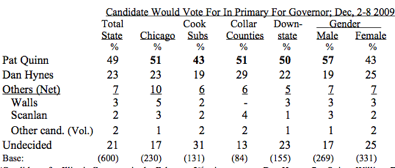
Among the 600 likely Democratic primary voters surveyed by telephone Dec. 2-8, Quinn had the support of 49 percent to 23 percent for Hynes, the three-term comptroller. Among other candidates, activist William “Dock” Walls had 3 percent, and attorney Ed Scanlan had 2 percent. An additional 21 percent were undecided; 2 were for others. The poll has an error margin of 4 percentage points.
Early benchmark polling for Quinn had him leading Hynes 54-to-26, with other polls showing similar results. […]
Recent polling conducted by other statewide Democratic candidates show Quinn ahead of Hynes 50-to-38 and 50-to-35, sources say.
So, Hynes is either regressing back to the days before he spent over $2 million on TV ads, or he hasn’t moved up since this race began. Hynes has been able to slightly lower Quinn’s numbers, but he’s stuck. Bad. Very bad.
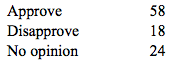
Quinn job approval among Democrats…
That’s pretty darned huge for an incumbent governor with an $11 billion deficit who’s been hit hard in TV ads by his Democratic primary opponent and one GOP opponent (McKenna).
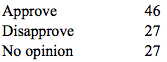
“Do you approve or disapprove of how Pat Quinn is handling state budget issues?”…
Voters also approve of Quinn’s handling of ethics reform in the post-Blagojevich era by a nearly 2-1 ratio and gave him a similar advantage over Hynes when asked which candidate would better eliminate corruption.
The beauty of the Tribune posting their full questions and answers is that we know from the polling memo that Quinn’s 2-1 ratio on his handling of ethics reforms works is actually 42-22. Not party time, but not bad considering all the heat he’s taken on the editorial pages. As far as which candidate would be better at “eliminating” corruption in government (a goofy premise, to be sure), 34 percent said Quinn and 16 percent said Hynes. 15 percent said “none” and 29 percent didn’t know.
Back to the Tribune’s narrative…
Hynes could try to link Quinn to Blagojevich. Quinn served two terms as Blagojevich’s lieutenant governor and has refused to apologize for backing Blagojevich. During the 2006 re-election campaign, Quinn defended Blagojevich as someone who has “always been a person who’s honest and one of integrity,” despite myriad investigations into his administration.
Maybe. Just 11 percent of Dems said they were less likely to support Quinn when reminded that the governor “ran twice as Lieutenant Governor and running-mate to former Governor Rod Blagojevich.” From what I’ve been told, polling for both Democratic candidates shows that a Blagojevich attack just doesn’t work well against Quinn.
Also, Democrats are split on whether a tax hike is necessary, with 42 percent saying it is necessary and 47 percent saying it isn’t - even though both candidates are pushing for a tax hike…
Among Quinn’s supporters, 57 percent said they believed a tax increase is needed, while 38 percent of Hynes’ backers said they think one is necessary.
That’s one big reason why Hynes has been slamming Quinn on taxes. At least that part of his message is working.
* On to the Republicans and a big Jim Ryan lead…
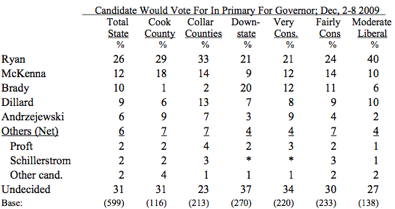
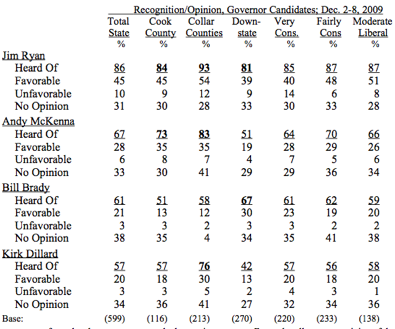
The Trib says that this is a name ID race so far, and they may be right…
Notice in the head-to-heads that 37 percent of Republicans classify themselves as “very conservative.” That’s why the far right is so hopeless statewide.
The Tribune results are pretty close to Adam Andrzejewski’s poll taken in mid November, except that Andrzejewski scores much lower in the Tribune poll. The Trib’s new numbers are in parentheses…
Jim Ryan 30% (26%)
Adam Andrzejewski 11% (6%)
Bill Brady 11% (10%)
Andy McKenna 10% (12%)
Kirk Dillard 7% (9%)
Bob Schillerstrom 3% (2%)
Dan Proft 2% (2%)
Andy McKenna has spent a fortune on TV ads in the weeks since that Andrzejewski poll was taken, but he hasn’t budged.
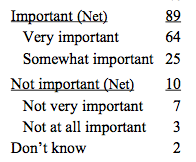
The Trib asked: “All of the Republicans running for Governor oppose increasing state government taxes. How important is a candidate’s opposition to a state tax increase in deciding on a choice for Governor?” The answers were predictable…
Dillard and Ryan’s recent open-mindedness to a tax hike won’t help there, but just 45 percent said it was likely that the winner would keep his promise to oppose tax hikes, while 49 percent said it wasn’t likely he’d keep it.
But it is the 31 percent of undecided voters that makes the outcome of the contest far from certain as candidates use the post-New Year holiday period to ramp up TV advertising and telephone pitches. A majority isn’t necessary to win the nomination — in 2006, Judy Baar Topinka won a four-way primary with 38 percent of the vote.
The race has been pretty much static since Jim Ryan declared his intentions. Dillard’s TV blitz during the Tribune’s polling period didn’t help at all. Maybe the voters will change their minds come the big (and, don’t forget, very crowded) January hoo-ha, but unless somebody’s message really catches fire, this is Ryan’s race to lose.
* MWRD President Terry O’Brien is releasing his own polling results today in an attempt to counter the Tribune’s poll showing him in last place in the Cook County Board President’s race and trailing badly.
The O’Brien poll was conducted by Cooper & Secrest November 11-17 of 605 likely Democratic primary voters with a margin of error of +/-4%.
The polling memo, which can be downloaded by clicking here, claims that “Dorothy Brown is likely a temporary frontrunner” and, of course, claims that O’Brien is “positioned to emerge as the ultimate winner.”
O’Brien’s head-to-heads compared to the Trib’s.
*** UPDATE *** I don’t know how I did this, but I screwed up the poll numbers. Preckwinkle is at 16 and O’Brien is at 15. Oops. Sorry about that…
Brown 29% (80% name rec) - Trib: 29% Preckwinkle 16% (52% name rec) - Trib: 20% O’Brien 15% (39% name rec) - Trib: 11% Stroger 13% (96% name rec) - Trib: 14%
More from O’Brien’s pollster…
Just 13% of all primary voters are strong Brown voters… 16% are weak
The memo also touts O’Brien’s second place finish despite being the least well known of the candidates. And it points to Preckwinkle’s four votes for pay raises.
A new Rasmussen Reports telephone survey of Illinois voters finds Giannoulias ahead of Kirk 42% to 39%. Three percent (3%) prefer some other candidate, and 15% are undecided.
In October, the two men were tied at 41% each. In mid-August, Kirk held a modest 41% to 38% lead over Giannoulias.
So, Giannoulias has managed to flip the numbers since August. The other Democrats still trail Kirk, but they’re closing the gap…
Kirk remains ahead of another Democratic hopeful, Cheryle Jackson, president of the Chicago Urban League and a former top aide to disgraced Governor Rod Blagojevich, but his lead has shrunk dramatically. Ahead of Jackson by 17 points – 47% to 30% - in October, he now leads just 42% to 39%. Four percent (4%) like another candidate, and 15% are not sure.
The Republican holds a similar 42% to 38% lead over Chicago Inspector General David Hoffman, another contender for the Democratic senatorial nomination. Kirk led Hoffman 43% to 33% in October. Seventeen percent (17%) are undecided, while three percent (3%) favor another candidate.
* Meanwhile…
Fifty-one percent (51%) approve of Governor Pat Quinn’s performance. Forty-seven percent (47%) disapprove. But Illinois voters are nearly three times as likely to strongly disapprove rather than strongly approve of the job he’s doing.
President Obama’s Illinois approval/disapproval numbers are 58-42, and that’s way better than Rasmussen’s national number of 47-51. Running against Obama is not a great idea here.
A proposal has been made to house some Guantanamo prison inmates in Illinois at the Thomson correctional facility. Do you favor or oppose housing Guantanamo prisoners at the Thomson correctional facility in Illinois?
39% Favor
51% Oppose
10% Not sure
No surprise there. The crosstabs show that Republicans oppose the plan 70-28, while a plurality of Democrats support it, 49-37.
His support remains soft, but the opposition is strengthening.
Afghanistan is becoming somewhat of an issue in the Democratic US Senate primary, with Cheryle Jackson and David Hoffman questioning the president’s new plan. But the crosstabs show large support for the president’s proposal among Democrats. 62 percent of Democrats “overall” favor the plan, 60 percent of liberals back it and 82 percent of African-Americans support it as well. Jackson is the most opposed of all the candidates, but that issue doesn’t appear to work well with African-American voters.
How it was done…
This telephone survey of 500 Likely Voters in Illinois was conducted by Rasmussen Reports December 9, 2009. The margin of sampling error for the survey is +/- 4.5 percentage points with a 95% level of confidence.
*** UPDATE 1 *** From a Mark Kirk press release…
Kirk Widens Lead over Giannoulias among Key Independent Voters to 34 Points in Latest Rasmussen Poll
Survey Shows Kirk and Giannoulias Remain in Statistical Dead Heat despite Democrat’s Network TV Ad Blitz
Northbrook, Ill. – A non-partisan poll released by Rasmussen Reports today shows Republican Congressman and Navy veteran Mark Kirk widening his lead over Democrat Alexi Giannoulias among key independent voters to 34 points despite Giannoulias’ early launch of network television ads to boost his numbers.
Responding to TV ads launched by Democrat David Hoffman, Giannoulias launched his own network television ad campaign at the beginning of the month to boost his name recognition and favorable ratings. But according to the Rasmussen survey, Kirk maintains a 50-32 favorable to unfavorable rating compared to Giannoulias’ 48-36 fav/unfav. Kirk holds a net positive strongly favorable/unfavorable rating of 13-8 while Giannoulias holds an even intensity ratio of 14-14.
The survey released today shows Kirk leading Giannoulias among key independent voters 54-20. In October, Rasmussen showed Kirk leading Giannoulias among this group 53-24. While the October poll showed both Kirk and Giannoulias at 41 with a 4.5-point margin of error, the survey released today shows Giannoulias with a slight 42-39 edge – remaining a statistical dead heat within the margin of error. A November 3rd poll by Magellan Data and Mapping Strategies showed Kirk with a 44-38 advantage.
“Despite more than a week of Giannoulias network television advertising, Congressman Kirk widened his lead over Alexi Giannoulias among key independent voters to 34 points without any television advertising from his own campaign,” Kirk spokesman Eric Elk said. “In addition, the survey shows Congressman Kirk and Alexi Giannoulias remain in a statistical dead heat. With a proven record of fighting tax increases, reining in spending and spurring economic growth, Congressman Mark Kirk brings the experience, integrity and reform-minded leadership Illinois needs to create jobs, end corruption and get our state back on track.”
*** UPDATE 2 *** From Giannoulias spokesperson Kati Phillips…
“Bizarre press release aside (which shows him losing), Mark Kirk can’t hide the fact that voters tend not to like flip-floppers who put politics before principles. Whether it’s having it both ways on earmarks, women’s rights, cap n trade, or Sarah Palin’s endorsement, voters know a pander bear when they see one.”
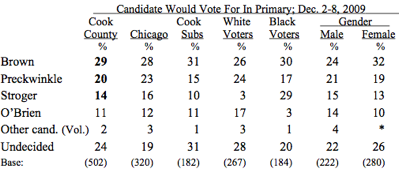
Faced with widespread voter dissatisfaction, embattled Cook County Board President Todd Stroger trails Circuit Clerk Dorothy Brown and Chicago Ald. Toni Preckwinkle in the race for the Democratic primary nomination, a Chicago Tribune/WGN-TV poll shows.
Brown had the support of 29 percent of likely Feb. 2 primary voters, ahead of Preckwinkle’s 20 percent, in the poll of 502 likely voters. Stroger received 14 percent and Terrence O’Brien, president of the Metropolitan Water Reclamation District, had 11 percent.
But the survey found that 26 percent of primary voters are undecided in the race or for someone else — meaning plenty of room exists for the contest to become even more fluid in the post-holiday sprint to the ballot box. […]
O’Brien is the lone white candidate in the race, but the prospect of three African-American candidates splintering the black vote to enable him to win isn’t borne out in the survey.
What is surprising is that for the first time that I can recall, the Tribune has released its questions, toplines and some crosstabs. Click here to download.
Toni Preckwinkle already has a press release out…
We are exactly where we expected to be at this point in our campaign. We entered this race 11 months ago and have been building positive momentum since. We are confident that, as voters continue to hear Toni Preckwinkle’s message - her commitment to repeal the Stroger sales tax increase and bring real reform to County government, that we will win the only poll that matters - on election day.
Our own recent polling shows that Dorothy Brown had a 2:1 name recognition advantage. Yet polling shows even though voters know her, they are unconvinced she deserves a promotion.
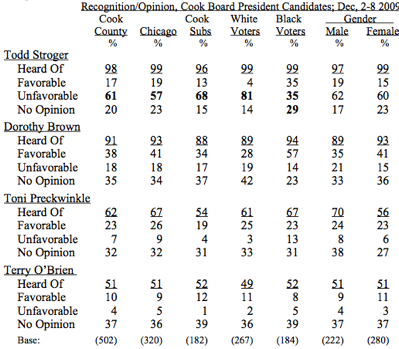
The Trib poll’s name recognition advantage for Brown over Preckwinkle - 91 vs. 62- isn’t nearly as high as Preckwinkle claims in her own polling. However, those with either a favorable or unfavorable opinion of the two is about two-to-one for Brown - 56-30. O’Brien comes in last in the Trib poll at 51 percent name rec, while just 14 percent know enough about him to rate him…
And here are the Trib’s crosstabs on the head-to-heads…
Preckwinkle absolutely needs to raise some money to get her message out. Her campaign has done a good job of leaking negative research on Brown and O’Brien to the media, but she obviously needs to reinforce that with advertising.
O’Brien needs to up his name ID, and only lots of cash will do that.
This is one reason why the reformers’ hatred of campaign cash is so misguided. Incumbents are already well-known. Challengers have to establish themselves with voters, but nobody in the reform movement is talking about making TV and radio ads lots cheaper.
Data…
This Chicago Tribune Poll is based on interviews of confirmed registered voters likely to vote in the February 2nd Cook County Democratic primary. Interviewing was conducted December 2nd to the 8th. The sample involved 502 Cook County Democratic primary voters, for a potential margin of error of 4.4% at the 95% level of confidence.