Monday, Nov 7, 2011 - Posted by Advertising Department
[The following is a paid advertisement.]
A group of wealthy Chicago businesspeople has been masquerading as economic experts under an organization called “Illinois is Broke,” pinning the blame for the state’s budget problems on the modest pensions earned by teachers, nurses and other public employees.
It’s ironic on two levels.
First, Senate Bill 512–the pension legislation put forth by “Illinois is Broke”–would make Illinois even more broke.
Buck Consultants, one of the world’s leading actuarial firms – true pension experts –analyzed the legislation, concluding it would actually cost taxpayers an additional $34 billion. (Read here for more details.)
The State Journal-Register raised serous questions about the cost of the legislation today, which would be a disaster for Illinois taxpayers.
Second, the premise that modest pensions earned by public employees caused the state’s budget problems is flat out wrong. Whether they are police or fire fighters, teachers or caregivers, these working men and women have contributed to their pensions from every paycheck. It’s the politicians who failed to make their payments.
Illinois is Broke: Intentionally deceitful? Or just painfully incompetent? Either way, their reckless legislation should not be taken seriously.
At an unscheduled status hearing this afternoon, in open court, U.S. District Judge James Zagel set sentencing for Rod R. Blagojevich at 10 a.m. on Dec. 6 and, if necessary, Dec. 7, 2011. The government and defense were ordered to file their respective sentencing memos by Nov. 30, 2011.
Blagojevich’s lawyer, Shelly Sorosky, said in court Monday that he thought the sentencing would take two days.
Sorosky said the ex-governor will testify at the hearing. “I think I can safely say that,” Sorosky told the judge.
Zagel told the defense to notify prosecutors by Dec. 1 if it intended to call any witnesses.
Assistant U.S. Attorney Reid Schar said he thinks most of the witnesses Blagojevich might call already have testified and been cross-examined.
“I don’t know what can be illuminated by calling more witnesses,” Schar said.
[ *** End Of Update *** ]
* The Sun-Times, by the way, has excerpts from the tapes that convicted Bill Cellini. Click here. And the Barrington Patch has an interview with Cellini juror Jennifer van Boven…
“I served with a phenomenal group of people,” van Boven said. “Everyone was respectful of each other’s thoughts and opinions.”
After three days of deliberation, the jury reached its verdict. Cellini was convicted on two counts: conspiracy to commit extortion and aiding and abetting the solicitation of a bribe. The prosecution made their case that Cellini agreed to use his power at the Illinois Teachers Retirement System to squeeze campaign donations from a Hollywood producer who did business with the state.
“The bulk of the evidence was in the tapes,” said van Boven, referring to Cellini’s voice on government recordings tying him to the extortion scheme. “There’s no doubt, he was clearly involved.” […]
“It was enlightening to see first-hand the corruption that exists in our state,” she said. “I hope our verdict sent a clear message that people will be held accountable for their actions.”
* The Sangamon County Republican Foundation’s chairman Andy Van Meter says Bill Cellini will continue serving as his group’s treasurer as long as Cellini wants, claiming that Cellini has mostly an honorary title anyway. Van Meter also chairs the Sangamon County Board. The SJ-R points to significant links to the foundation which go beyond a mere honorary affiliation…
* The foundation’s director is Janis Cellini, Bill’s sister;
* The administrative assistant of the political action committee, Robin Ellison, has the same title with the Illinois Asphalt Pavement Association, of which Bill Cellini remains executive director;
* In the three months ending Sept. 30, the foundation paid the asphalt group $397 in reimbursements for postage, copies and telephone use.
* And the offices of the foundation and the asphalt association are both in Near North Village, a building at Fifth and Jefferson streets that originally was developed by Cellini and other partners. The foundation paid $600 in rent to Near North Village over the same three-month period.
Asked about the connections, Van Meter said via email, “I can’t follow all this guilt by association.
The foundation raised less than $6,000 last quarter, but it had almost $300,000 in cash and investments. By comparison, the Sangamon County Republican Central Committee had just $31K in the bank.
Bill Cellini is highly respected in Springfield GOP circles, so I understand why his longtime friends don’t want to kick a man when he’s down. If this was a less serious conviction or a simple tax problem or whatever, I wouldn’t make a deal out of it. But he was convicted of two felonies relating directly to government and politics. Cellini should do Van Meter a favor and fall on his sword. Also, since the state GOP chairman has made a career out of slamming Democrats for their corruption, perhaps he ought to step in here.
* It is often said that the Lottery is a tax on the mathematically illiterate. With a hat tip to a commenter, much the same can be said of pay-to-vote online straw polls and Ron Paul supporters…
A strong internet presence pushed Ron Paul to the top in the Illinois Republican straw poll. The Texas congressman bested the other presidential candidates in the survey, which wrapped up on Saturday.
Casting a ballot in the straw poll cost $5, and the Illinois Republican Party said more than 3600 people participated. Three quarters of them did so online, which is how Ron Paul claimed more than 50 percent of the vote.
“I think what this does is it shows the relative strengths of the candidates,” said U.S. Sen. Mark Kirk at a press conference announcing the results. “Ron Paul is obviously a big online performer.”
Mr Paul won 66.5 per cent of the votes cast over the Internet and 8 per cent of those cast in person.
Former Massachusetts Governor Mitt Romney earned 7 per cent of the online votes cast and 35 per cent of the in-person votes, winning the most in-person votes cast at 22 locations, the party said.
* Romney did not come in second place overall, however. That spot went to Herman Cain…
Finishing behind Paul’s 1,907 votes was businessman Herman Cain with 670 votes or 18 percent; former Massachusetts Gov. Mitt Romney with 515 votes or 14 percent; former House Speaker Newt Gingrich with 332 votes or 9 percent; Texas Gov. Rick Perry with 87 votes or 2.5 percent; former Utah Gov. Jon Huntsman with 54 votes or 1.5 percent; former Pennsylvania Sen. Rick Santorum with 43 votes or 1.2 percent; and Minnesota Rep. Michelle Bachmann with 41 votes or 1.1 percent.
The poll — at least momentarily — had pivoted the conversation from the Iowa and New Hampshire primaries to Illinois, fueling races up and down the ticket with both enthusiasm and campaign cash.
That may be way too generous.
* A small blip occurred when 30 people tried to cast more than one vote. Mark Kirk blamed it on Tom Cross…
That apparently wasn’t clear to the House Republican Organization, a political group headed by state Rep. Tom Cross, the GOP leader in the Illinois House. An email to supporters said online participants “can vote multiple times to ‘run up the score’ for your favorite candidate.”
“Yeah - [Cross] was incorrect,” Kirk said when asked about the email, which was first written about on the website Republican News Watch. “And so, we did find 30 people that tried to vote twice and they were eliminated.”
Republicans trying to block a Democratic-drawn congressional redistricting map have told a federal court panel that documents show a concerted effort from Springfield to Washington to “get more Democratic pick-ups” at the expense of GOP members in the Illinois delegation.
Republicans are using the documents involving the Democratic Congressional Campaign Committee, the staffs of Illinois House Speaker Michael Madigan and Illinois Senate President John Cullerton of Chicago, and others to bolster their contention that the new map is unconstitutional because it is politically gerrymandered and dilutes Latino representation.
In the request for a permanent injunction, filed late Friday night with a three-judge federal court panel, Republicans cite correspondence in which Ian Russell, the DCCC’s Midwest political director, thanks a member of Cullerton’s staff for guidance on how to “advance our goal — more Democratic pick-ups.”
The Democrats freely admit that politics played a major role in the remap process. The GOP allegations amount to a legal longshot, however…
Trying to get a court to reverse a map based on political decisions has historically been difficult.
That’s an understatement.
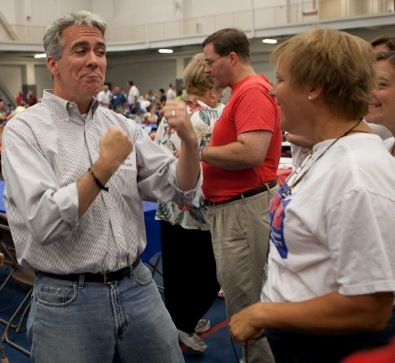
* And let’s conclude our GOP roundup with a GOP caption contest. Here’s Congressman Joe Walsh…
Take it easy in comments, people. Don’t get carried away with violent imagery. I don’t like it. Thanks.
Pat Quinn seems to have a cloud hovering above him, even when he is the bearer of good tidings.
There was Governor Quinn on Thursday morning, inside a Red Line el stop at 35th Street and the Dan Ryan Expressway, to announce impressive financial help for desperately needed Chicago Transit Authority improvements.
But he seemed as upbeat as Jackie Gleason portraying Maish, the conniving but kind-hearted boxing manager in the film version of “Requiem for a Heavyweight,” who looks out a coffee shop window and forlornly mumbles, “I’m in Pittsburgh and it’s raining.” […]
Quinn might climb atop the Hancock Center if he took things quite as personally, given his legislative defeats and evolving caricature as gadfly-turned-bumbling executive […]
As I left the wind-swept Red Line stop, I ran into Jacky Grimshaw, a transit authority board member and longtime community organizer-activist. She has known Quinn since their days as young bucks with Gov. Dan Walker in the mid-1970s.
“He’s still the populist he was back then, with the same basic bottom-line value system, looking out for the little guy,” Grimshaw said.
That sounds quaint to Springfield’s hard-bitten crowd. But there are worse reflexes.
By last Thursday, when Warren attended that presser, Gov. Quinn had completely toned down his act. The controversy over his leadership style wasn’t because of his purely upbeat press conferences beginning last Wednesday. The seeds of the legislative and media backlash were sown weeks earlier.
More and more lawmakers are expressing frustration with Gov. PAT QUINN and the way he operates. Some even compare Quinn with his unbeloved predecessor, ROD BLAGOJEVICH.
The frustration comes from a couple of areas. One is Quinn’s penchant for doing things seemingly without fully thinking through the consequences. A prime example is the regional school superintendent issue, where Quinn eliminated money for their salaries without any plan for how their duties, specified in state law, would be carried out.
Some lawmakers also believe Quinn is becoming more confrontational. Quinn unloaded on lawmakers a couple of weeks ago, suggesting their votes on the smart-grid bill were bought and paid for with utility company donations. Last week in Chicago, Quinn said he doesn’t have to be a pal with lawmakers.
Pals? Not necessarily. But as long as the legislature remains a branch of government, it’s probably a good idea to at least reach a working accommodation with them. If not, it’s going to be a very long three years until the next election.
*Quinn also raised hackles last week with comments on the gambling-expansion bill. After first signaling an interest in negotiating a bill with lawmakers, Quinn said, “I don’t think the word negotiate is appropriate.”
What is appropriate? The “my-way-or-the-highway” approach? That’s always successful in government.
The question now is whether Quinn stopped the legislative bashing too late to stem his veto session losses.
* The governor held a press conference today and stayed uniformly positive and professional…
I had to chuckle when I heard the governor say that before Cardinal George and the bishops sent out a press release to publicly criticize him they should’ve asked for a private meeting to discuss his attendance at Personal PAC’s fundraiser. Excluding the past five days or so, Quinn’s behavior has made the Cardinal’s look almost tame by comparison.
* Roundup…
* Illinois man freed after murder conviction vacated: One of five men sent to prison for the rape and murder of a middle school classmate two decades ago walked out of an Illinois prison Friday, exonerated by new DNA evidence that also has cleared at least two of the others, including his half-brother. James Harden, now 36, stood outside the walls of Menard Correctional Center in Chester and said the taste of freedom was “like breathing new life in my body.”
* Would speed cameras really save lives? - Ticketing may bring in revenue, but statistics show city’s proposed ’safety zones’ are not where most kids are killed by speeders
* Moody’s: Removing Property Tax Exemption for Illinois Hospitals Would Be “Credit Negative”
* Brady: Tax break bill should pass this week: “We warned Gov. Pat Quinn when he threatened to pass this (income) tax increase that there would be ramifications,” Brady said. “And, we’ve seen them and not just in these two companies but in several companies.”
In an exclusive interview last week, CME Group Executive Chairman Terry Duffy said he’s more than ready to leave Illinois if he doesn’t get what he believes is a “fair” tax deal from the General Assembly.
The company owns the Chicago Board of Trade and several other firms. It’s a very big wheel in this state and leaving would be the worst sort of news for Democrats who raised taxes this year.
Duffy has been under intense pressure all year from Wall Street to reduce expenses. State taxes are listed as expenses on corporate books, so Duffy has been publicly fuming about his company’s $150 million a year state tax burden since corporate tax rates were increased.
Duffy claims CME pays 6 percent of all corporate income taxes here, and pays more than any other company. “I don’t know another company in the world that pays 6 percent of another state’s taxes.”
As recently as four years ago, the vast majority of CME’s trades were physically handled on the floor of his exchanges like the Chicago Board of Trade. Now, almost 90 percent of trades are performed electronically, and Duffy says that difference means CME shouldn’t be paying taxes on trades which are obviously originating in other states and other countries. Trouble is, he won’t (and insists he can’t) reveal exactly where those trades are originating, so state negotiators instead decided to reduce his tax burden by roughly two-thirds, which means $100 million a year less in state income taxes paid by CME.
Duffy said he’d talked to at least half of the General Assembly’s members in the past several days, many of whom said they wanted something else in exchange for helping his company, like tax breaks for other industries.
“I really think these people don’t believe that I have an alternative,” a defiant Duffy said, pointing to very generous offers from other states.
The executive chairman claimed he’s been offered as much as $600 million to move Aurora’s high tech center and mentioned a report about how Indiana Gov. Mitch Daniels had offered CME $150 million a year in tax relief — CME’s entire state tax burden. When reminded that Gov. Daniels had denied the offer was made, Duffy said “The governor denied the number, but he didn’t deny the discussions. My shareholders heard it. They’re going to say, ‘What the hell did you do that (stay in Illinois) for? We care about us.’ ”
I’ve criticized Duffy for waiting until after his taxes went up to complain about how his company had historically been mistreated by the state’s tax code. This year’s tax hike cost CME $50 million, but Duffy wants double that amount to stay put. Since he didn’t seem to care about his taxes until January, why should the state give him anything beyond what the tax hike cost the company? Duffy claimed he’d been working on the situation for at least two years. He said he didn’t think he needed to make anything public until he was forced to when he was asked about the tax hike during a shareholders’ meeting.
However, Duffy said he hadn’t met with the governor or anyone else here before the tax hike. “Why work with Illinois when other states have a more business friendly approach?” he asked.
And as to why CME refuses to offer anything tangible in return for its tax deal, like all other companies seeking tax relief have to do, Duffy said he doubted the legality of those agreements. If Motorola broke its subsidy deal, Duffy said, it’s doubtful there’d be any real legal ramifications. “We’ve been here 163 years,” Duffy said. “We think we’ve demonstrated that we’re good corporate citizens. I can’t tie my shareholders’ hands like that.”
But if CME is such a good corporate citizen, why demand all that cash when Duffy knows the state budget is still so tight? I mentioned a recent $4.6 million state cut to homeless services which has resulted in tens of thousands of people being turned away from shelters. “I’m not asking the state for $100 million,” Duffy said, “I’m asking to give me a rule to say this is what I think is being traded in Illinois and here’s what I’ll pay, whatever the tax rate will be.”
CME, Duffy said, has averaged 19 percent growth for 30 years. “I pay people and they pay taxes and that money can go to the homeless shelters.”
He didn’t make it sound as harsh as it looks, but it’s an argument he has to deal with.
* It wasn’t covered by the media, but the CME tax cut and the company’s Chicago TIF money were a major focus of Occupy Chicago’s interruption of Wisconsin Gov. Scott Walker’s Union League Club speech last week. Watch…
The “mic check” is necessary in New York because the city bans megaphones on public streets. It’s kinda creepy and weird when the occupiers use it when they don’t have to. The call and repeat sounds almost cultish to my ears. But, tactically, it works well when you’re trying to shout down somebody who has a “real” microphone.
Oberhelman shared a story of a recent Asian business summit in China. Two Chinese businessmen asked why Caterpillar maintains its business presence in Illinois, with the state’s well-documented corruption and high business costs.
The question angered Oberhelman. When he returned to the U.S., he said he fired off a letter to Gov. Pat Quinn. To this point, it hasn’t done any good.
“Our biggest, most important plants are rooted here,” he said when an audience member pressed him on why Caterpillar does stay in Illinois. “From a corporate standpoint, it would be hard to uproot 4,000 engineers from our Peoria headquarters.”
He paused a moment and added, “But that doesn’t mean it’s forever.”
It hasn’t done any good at all? Really? The workers’ comp reforms this year weren’t completely to Cat’s liking, but the Illinois Manufacturers’ Association was in full support, as were other business groups and most Senate Republicans. It’s done some good. And what about all those kind words Oberhelman had for Illinois this past spring?…
“We’ve got a lot of good things going for us in Illinois,” [Oberhelman] said.
While Oberhelman’s letter informed Quinn of offers by four other states that sought to lure Caterpillar from Illinois, the CEO reaffirmed his commitment to the state. “Cat is here to stay. We’ve got 23,000 manufacturing jobs in this state.” [..]
Regarding the increase in the state income tax that Caterpillar said would cost its employees $40 million this year, Oberhelman called the increase “inevitable” since the state’s “(economic) hole is so deep.”
Business interests played a key role in the most significant restructuring of the corporate income tax code of the past decade or so, when the state restricted the tax to profit stemming from in-state sales and eliminated property value and payroll size from the formula.
The move cut tax bills of Illinois-based manufacturing giants and other multinationals, whose sales are spread worldwide. The cost to the state has been an estimated $100 million annually, [House Majority Leader Barbara Flynn Currie] said.
Proponents had projected the change would spur 285,000 new manufacturing jobs. Instead, the sector’s employment shrank to about 600,000, down from as many as 800,000 when the legislation took effect.
Cat was the number one cheerleader behind that change to the single-sales factor, which cut the company’s state tax burden down to almost nothing. Instead of adding workers like it promised, though, the company has cut back here and created new jobs in union-hostile states and in China. All Illinois really did was essentially subsidize Cat’s gradual move out.
* CME’s boss is angry, Cat’s boss is angry and the occupiers are angry about the taxpayer help already given to CME and Cat. Heck, even Mother Tribune is sounding a little occupyish these days…
Through what tortured logic, then, was it necessary for taxpayers to gift the Sox with a steakhouse? The sports authority spent $7 million to build and equip Bacardi at the Park, adjacent to the stadium. The Sox get the proceeds. Why? Because nobody at the table was looking after the taxpayers.
“We said to Jerry, ‘Jerry, can we have part of the profits?’” Thompson told the Tribune’s Jared S. Hopkins. “And he said no. We said OK.”
Think about that a minute. In 1988, Reinsdorf got his way by saying or else. This time all he had to say was no. […]
Gov. Pat Quinn has already replaced the board members who serve as his appointments. Mayor Rahm Emanuel ought to do the same. It’s time we stacked that board with people who don’t have trouble remembering whose interests they’re supposed to represent. Hint: It’s not Jerry Reinsdorf.
* Related…
* Saving jobs focus of brewing Illinois tax deal: “If you’re going to see broad-based changes, it’s going to take a lot of work and a lot of time,” said Todd Maisch, vice president of government affairs for the business representative group, the Illinois Chamber of Commerce. Maisch said lawmakers are expected to vote on the CME tax package next week during the final week of the fall veto session, but he said he doesn’t believe the legislators will begin working on major tax reform until 2013. Until then, Maisch said, Illinois businesses are going to have to live with the reality that the state’s tax code does play favorites. “If you’re a dry cleaner and a third of your customers work at Sears, you are happy with this (package)” Maisch said. “If you have a cleaning contract with CME, then you are happy about this. But if you’re a small business that is not directly tied in, then you are feeling jilted. No doubt about it.”
* Time for a level-headed approach to business, taxes: “One of the problems in economics is the seen versus the unseen,” the Tax Foundation’s Robyn said. “We see a big corporation leave our state and take 1,000 jobs, and that’s very visible and we say, ‘We’ve got to keep those jobs here.’ But what you don’t see is when those 1,000 jobs leave, what other opportunities open up in the state or, more importantly, if you buy them off and give them all this money to stay, what you don’t see is the opportunity you lost with that revenue. You could have used that money for something else.”
Cardinal Francis George said Sunday that he did not have all the facts when the Catholic Conference of Illinois issued a statement decrying Gov. Pat Quinn for his involvement with an abortion-rights organization that, it turned out, plans to give an award to an advocate for rape victims.
George, leader of the Roman Catholic archdiocese of Chicago, and the five other bishops who oversee the church in Illinois released the statement Wednesday criticizing Quinn, a Catholic, for his plans to present an award Nov. 17 at the annual luncheon for the Personal PAC. The statement said Quinn had “gone beyond a political alignment with those supporting the legal right to kill children in their mothers’ wombs to rewarding those deemed most successful in this terrible work.” […]
“I deeply regret that,” George said Sunday afternoon, en route to Holy Name Cathedral in Chicago, where he was scheduled to present awards to parishioners for their dedication to ministries. “A rape victim demands all the respect and sympathy that anybody can give.”
“I first heard of Ms. Goodman only after we had crafted the statement (and) published it. Then, all of a sudden she comes forward. All of a sudden, she was there, and that wasn’t part of the story as we did it,” George said.
Speaking outside a banquet celebrating the 130th anniversary of Chicago’s St. Elizabeth Parish, George said “had we known that [Goodman] was involved and known her story we may have found another occasion to say something about the governor.”
Later Saturday, the Catholic Conference of Illinois also said the “bishops were not aware of her and her tragic story.”
The statement said that conference executive director Bob Gilligan “takes responsibility for not adequately informing the bishops.”
Director Gilligan has been very aggressive with his attacks on Gov. Quinn. I doubt they’ll subside, but perhaps Gilligan will be more precise in the future. He obviously didn’t give the Cardinal and others the full story before they unloaded both barrels on Gov. Quinn last week. Perhaps a little more thought and reflection are in order here. As I write this, there’s no apology on the Catholic Conference’s website. The top story is from Fox Chicago’s Mike Flannery about the controversy, which both hyped Cardinal George’s original attack and seemed to demonize the opposition.
Two weeks out of high school, Jennie Goodman had not been up long that summer morning back in 1991 when a football player friend bound for college paid an unexpected visit to her North Shore home.
Wearing the T-shirt and shorts she had slept in, she felt unkempt but noticed that he was “looking at me differently,” Goodman said. The young man, who was not a boyfriend, asked whether they could go somewhere away from her mother, who was at home, too. The shed behind her home popped into Goodman’s mind.
“I thought we’d go into the shed, and we’d make out. How exciting. I was nervous because I was inexperienced with that,” said Goodman, who was an 18-year-old virgin. “I knew he dated other girls and knew he was much more physically experienced.”
Once in that shed, excitement turned quickly to pain. The young man took off her shirt, then her shorts. He pinned her to the ground, closed his eyes and raped her, ignoring her pleas to stop.
That violent act 20 years ago reshaped Goodman’s life and now has made her the unlikely focal point of a nasty spat between two of Illinois’ most powerful men: the state’s Roman Catholic governor and the spiritual head of 2.3 million Chicago area Roman Catholics.
* Carol Marin, a Catholic who isn’t all that popular with the Archdiocese, summed it up…
In the current controversy, Goodman cut a 2010 campaign commercial for the pro-choice Quinn, saying, “I was raped at 18. I don’t know what I would have done if I had gotten pregnant.”
The cardinal and the Catholic Conference now question Quinn’s Catholicism. The Rev. Larry McNally, pastor of Ascension Catholic Church in Oak Park, does not.
“He comes to church at Ascension. I give him communion,” McNally said Friday. “His heart is with the needy and the poor.”
McNally knows what it’s like to be in the cardinal’s cross hairs.
Reprimanded by the archdiocese for supporting the ordination of women, he was ordered to publicly apologize for deviating from church doctrine, and he did.
“I love my priesthood and my parish,” he said. “Staying was more important than leaving.”
Pat Quinn has chosen to stay in the church of his birth as well. As the Gospel of Luke makes clear, we all walk among people with whom we profoundly disagree.
It doesn’t hurt to love them.
Or listen.
* I’m taking the morning off, but any attacks on Ms. Goodman in comments during my absence will be met with the full force of my considerable retaliatory capabilities. Don’t even think about it.
* I like and respect Chuck Sweeny, and I don’t mean to single him out, but this sort of opinion appears to be rampant these days…
The Legislature returns to Springfield this week for three days of nothing much as far as I’ve been able to determine. The lawmakers will get their per diem payments and return home, not to come back until January.
And 2012 being an election year, there isn’t much hope that controversial work will get done then. Can Illinois wait until 2013 before problems of epic proportions created by a generation of lawmakers and governors are addressed? […]
I am talking, rather, about real problems like the state’s $14 billion debt, the worst-in-the-nation $85 billion unfunded pension liability and the billions owed to businesses and nonprofits that have performed services and provided goods to the state but must wait months to get paid.
I’m not sure where that “$14 billion debt” figure comes from, but whatever.
Chuck’s column was titled “Lawmakers know what to do; I doubt they do it.” It didn’t really contain much in the way of solutions to our immediate problems, and it showed a lack of understanding for where we’ve been. So…
For instance, here are base state revenues (blue) vs. base spending (red) from FY 1995 through FY 2010…
Almost the entire backlog of overdue state bills was generated during that last bizarrely unprecedented spike. Illinois has been dragging those unpaid bills behind it ever since.
Look at the history and disregard the propaganda. Revenues and spending mostly went hand in hand until after the 2006 election, when Rod Blagojevich declared all-out war on Speaker Madigan and Madigan responded in kind. We had huge spending increases while revenues tanked with the international economy. I’ve always believed that Madigan deliberately tried to bring the government to its knees during this period. It almost worked. Trouble was, Rod got arrested and was then impeached, so Madigan, et al had to dig their way out of the hole they created in the wake of what was by all definitions a political civil war (a war which I supported, by the way, but also repeatedly warned of its consequences).
* The ferocity of the international collapse obviously took Madigan and others by surprise. By the time they looked up from their war, the budget had gone to heck and the piper had to be paid. Here’s revenue growth ending FY 2010…
Couple the lower [federally reimbursable state spending] with a return to a lower [federal] match rate on what spending does take place, and federal sources are expected to fall $1.036 billion from last year’s levels.
Monday, Nov 7, 2011 - Posted by Advertising Department
[The following is a paid advertisement.]
Enough is enough. Let’s look at their claims:
STOP Claim: “Taylorville Energy Center electricity will cost SEVEN times market price.”
The Truth: STOP compares today’s historically low market prices with a price that includes 30 YEARS OF INFLATION. It’s like comparing the price of gas at the pump today with what we’ll pay between now and 2041.
STOP Claim: “Tenaska wants Illinois consumers to pay even if their plant produces no power.”
The Truth: The legislation was changed six months ago at the request of ComEd so this remote possibility could never happen. Consumers aren’t “on the hook.” Which part do STOP and ComEd not understand?
STOP Claim: “We don’t need any new baseload. The speculation on the closure of baseload plants is just that, it’s speculation.”
The Truth: So far, 239 coal plants are scheduled to close because of the new EPA rules. Industry analysts expect Illinois to lose up to HALF of its coal plants, which currently provide 45% of Illinois electricity.
A diverse coalition of elected officials, business and labor, consumer and environmental groups from around the state knows the truth and supports SB 678, the Comprehensive Energy Efficiency and Investment Act.
Interviews with legislative leaders, union officials and business leaders suggest that a vote [on the pension reform bill] will probably not take place this week. Pressure from organized labor, incumbents’ nervousness about running for re-election in new districts, concern over inciting primary-election challenges and legislators’ penchant for delay when facing politically treacherous issues are creating a strong headwind.
Ultimately, one person will decide whether to call the pension bill for a vote: Mr. Madigan. According to legislative and business leaders who have spoken to him, he has not revealed his plans. “This might be something he’d rather do in the spring, but he has not expressed that to me,” said Mr. Cross, who is sponsoring the bill with Mr. Madigan. “He doesn’t always explain to you what he’s going to do.”
Reading Speaker Madigan’s mind ain’t easy, but this time he’s pretty clear, regardless of the spin…
Mr. Madigan’s spokesman said the speaker would call Senate Bill 512 as soon as Mr. Cross signaled he was ready. Yet without confirmation from Mr. Madigan that he will have the 30 Democratic votes needed for passage, Mr. Cross is likely to wait.
“When our friends on the other side of the aisle are ready, we’ll be there,” Mr. Cross said. “I’ve been living this issue for so long. I’m ready to get it done.”
SB 512 is Leader Cross’ bill. Cross is the chief sponsor, so he can call the bill whenever he wants, and Madigan has repeatedly said that Cross has full control of the legislation. So the above report is way over-analyzed, to the point of obfuscation. Also, Madigan’s people have told me that the Speaker has never promised Cross that he’d put 30 votes on the pension reform bill. Cross is stalling. Why? Either he doesn’t have the 30 votes he says he has or he truly doesn’t want to move a bill before it’s ready, or both. I’m betting on both.
But there’s a catch… the [pension] reforms mainly apply to new hires, not to the existing state workforce. This was apparently a bridge too far, politically and also legally, because state constitutions and court decisions make it difficult to reduce current pensions. That the governors’ new ideas apply mostly to future hires limits their short-term financial impact. […]
No one said that it would be easy to take on public-sector unions; nor are pensions the sole cause of state and local financial distress. The Democratic governors who have acted, even tentatively, deserve credit.
But the problem is so big that they will eventually have to do more. Sooner or later, state and local governments must further rein in benefits for current employees — so that the cost of providing for public servants tomorrow does not make it impossible to provide actual public services today.
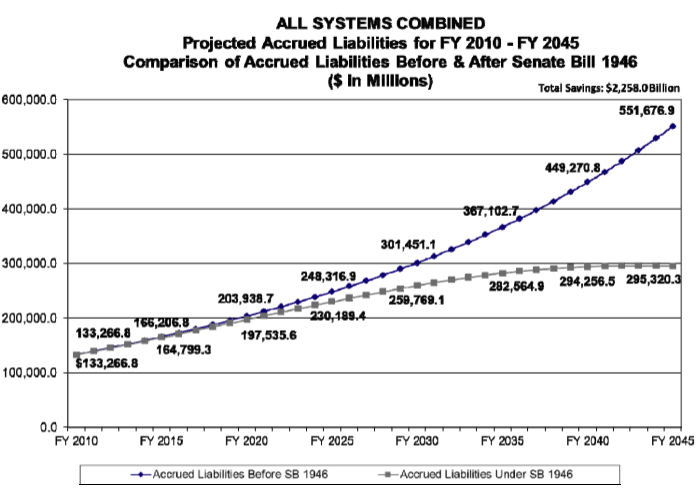
* The state’s pension reform law has been widely panned, particularly by the Tribune. But let’s look at some real numbers, shall we? From the Commission on Government Forecasting and Accountability’s most recent pension report…
• Under P.A. 96-0889 [the pension reform bill for new hires], State contribution for fiscal years 2010 – 2045 will be reduced by $71.1 billion as a result of a second tier of benefits for new hires.
• Under P.A. 96-0889, the projected accrued liability for the five State retirement systems combined in fiscal year 2045 is reduced significantly from $555.7 billion to $295.3 billion. […]
• [Under P.A. 96-0889], the projected unfunded liability for the five State retirement systems combined in fiscal year 2045 is reduced from $55,167.6 million to $29,532.1 million.
That’s pretty significant. And look at the difference that bill made…
• Tier 1 active employees will decline in number until about FY 2018, when total active membership will be roughly equal between Tier 1 and Tier 2 members.
Under P.A. 96-0889, the unfunded liability will increase for a number of years at a faster rate than it otherwise would have, until about FY 2035, when it is projected to decrease. This is because of the decreased accrued liability in FY 2045 which is attributable to a second tier of benefits for new hires. This decreased accrued liability means the State now must reach 90% of a lowered target, and thus contributions will decrease accordingly. While contributions will decrease, in the immediate future liabilities will accrue at much the same pace as they would have before the second tier of benefits went into place since most active employees will be “Tier 1” employees for the foreseeable future.
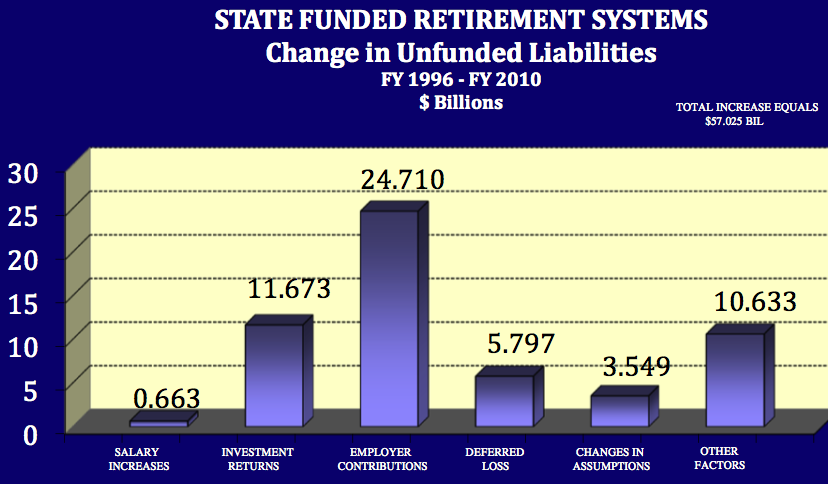
As shown in chart below, the single largest driver of the increase in the unfunded liability has been insufficient employer contributions. Other factors contributing to the growth in the unfunded liability include investment losses when compared to the assumed rate of return, benefit increases, and changes in actuarial assumptions. The category “other factors” encompasses miscellaneous actuarial factors such as rates of termination, disability, and pre-and post-retirement mortality.
* State university chiefs lobby against pension reform bill: In the note, the school presidents and chancellors say their ability to recruit top staff would be hurt if the state shifts retirement costs to individual workers, rather than having taxpayers pick up the tab.