* Reason Foundation…
In 2020, local governments across the United States collected just under $9 billion in fines and fees. Local governments in three states—New York ($1.4 billion), California ($1.26 billion), and Texas ($1.17 billion)—collected well over a third of the $9 billion in fines and fees in 2020.
Local governments in New York, California, Texas, Illinois, Florida, Georgia, Ohio, New Jersey, Washington, and Pennsylvania collected the most fines and fees in 2020. In all, 20 states saw their local governments bring in more than $100 million in fines and fees in 2020.
On a per capita basis, local governments in New York, Illinois, Texas, and Georgia collected more than $35 per resident in fines and fees in 2020. In contrast, local governments in New Hampshire, Connecticut, Maine, Nebraska, and Kentucky collected less than $3 in fines and fees revenue per resident in 2020. […]
At least 482 local governments derived 10% or more of their general revenue from fines and fees in 2017.
Illinois ranked second at $50 per capita. Locals imposed $641.6 million in fines and fees overall.
Sangamon County derived 15.8 percent of its revenue from fines and and forfeits in 2020, according to the study. That’s $14 million, or $70 per capita. Menard County was the worst offender, at 30 percent of revenues and $422 per capita.
Ten Illinois counties received at least ten percent of their revenue from fines and fees in 2020: Ogle, Mercer, Ford, Fulton, DeWitt, Menard, Sangamon, Cumberland, Richland and Massac.
Grundy was one of 15 counties which received at least 5 percent of revenues from that source ($1.9 million at $37 per capita).
* And a ton of suburban and exurban towns also received at least 5 percent of their revenues from fines and fees…
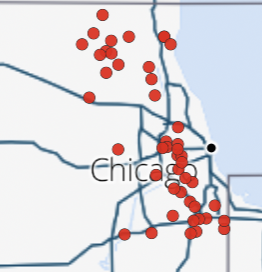
* Among their recommendations…
Develop standardized tools to determine the ability to pay and scale fines accordingly
Determination of a defendant’s ability to pay fines should not be left solely to the subjective assessment of an individual judge. This can result in wildly different outcomes for otherwise comparable defendants. Establishing standard practices would ensure that individuals are treated equally under the law. Scaling fines according to an individual’s ability to pay would also reduce the administrative costs associated with pursuing uncollectable debts.
Affidavits, bench cards, or ability-to-pay calculators may be used to standardize ability-to-pay determinations. Income-based fines, or day fines, could also be used to scale penalties according to an individual’s financial status. There is room for experimentation among the states in this area. Still, state law should clarify the factors that are considered when determining an individual’s ability to pay. Defendants should be made aware of these factors and what documentation they will be expected to provide.
Provide alternatives to monetary sanctions
Indigent defendants should be able to receive alternatives to monetary sanctions. Community service is one possible alternative to fines but it may prove overly burdensome for some. For example, community service may conflict with work schedules or family obligations. Such conflicts should be avoided, as maintaining employment and social ties are critical to reducing the risk of recidivism. Courts should be able to consider a range of alternatives, including waivers, job training, and drug or mental health treatment. Incarceration should never be considered an alternative to monetary sanctions, and fees should never be charged for alternatives to monetary sanctions.
Discuss.
…Adding… From comments…
As soon as the secret was out that duplicating state laws as local ordinances was something that could be done by municipalities to increase the percentage of fines they would keep from writing tickets, all bets were off with this.
Almost nobody looks at their ticket to see if it was written under a state law violation, or an identical local ordinance violation. More people should though. An example would be a ticket for not wearing a seat belt. When that state law is duplicated into a local ordinance, the tickets written locally are then written under the ordinance instead of the state law. That allows the locality to keep almost all of the fines, instead of those fines being paid to the state.
I don’t see that mentioned anywhere in the analysis.
The incentive to generate revenue through fines would go away quickly if that revenue from writing tickets was being primarily being generated for the state instead of the locality.
But I won’t be holding my breath any municipality will willingly change this practice, without legislation forcing them to.











- washingtonPark - Thursday, Feb 2, 23 @ 12:59 pm:
I wonder if there is a breakdown with each county…would be curious to see what percentage Leland Grove is for Sangamon county
- Dan Johnson - Thursday, Feb 2, 23 @ 1:03 pm:
A friend of mine who lobbies in Missouri told me that one of the underlying issues that sparked the protests in Ferguson were the heavy reliance on fines and fees (and thus the inevitable over-policing).
- Socially DIstant watcher - Thursday, Feb 2, 23 @ 1:10 pm:
Dan’s on to something. The study can express fines per capita, but how many fine payers actually reside there and how many are passing through? Are these towns truly tapped out for raising money locally and how many are looking to fund services without draining constituents they care about?
- TheInvisibleMan - Thursday, Feb 2, 23 @ 1:16 pm:
As soon as the secret was out that duplicating state laws as local ordinances was something that could be done by municipalities to increase the percentage of fines they would keep from writing tickets, all bets were off with this.
Almost nobody looks at their ticket to see if it was written under a state law violation, or an identical local ordinance violation. More people should though. An example would be a ticket for not wearing a seat belt. When that state law is duplicated into a local ordinance, the tickets written locally are then written under the ordinance instead of the state law. That allows the locality to keep almost all of the fines, instead of those fines being paid to the state.
I don’t see that mentioned anywhere in the analysis.
The incentive to generate revenue through fines would go away quickly if that revenue from writing tickets was being primarily being generated for the state instead of the locality.
But I won’t be holding my breath any municipality will willingly change this practice, without legislation forcing them to.
- Jaguar - Thursday, Feb 2, 23 @ 1:17 pm:
Most of the municipalities on this list that are near me have a reputation for giving out a lot of moving violation tickets. Not sure that that lends itself to scaling fines based on ability to pay.
- DuPage - Thursday, Feb 2, 23 @ 1:17 pm:
Speaking of big local fines, the city of Zion just lost in court some of their ability to levy fines. It appears it applies to every local government statewide. There is a saying “you can’t beat city hall”, but it looks like somebody did.
- thechampaignlife - Thursday, Feb 2, 23 @ 1:21 pm:
The most important of their recommendations is to fully fund courts from state budgets.
===Eliminating user fees in the justice system may require states to assume greater responsibility in funding their court systems. Allocating funds from general revenues would protect against potential conflicts of interest. The particular structure of court systems in each state may complicate this process, especially in states without unified court systems. This obstacle is worth overcoming to ensure that courts are adequately and equitably funded.===
Fines and fees should go into state funds. Going into general funds or supplemental funding for locals is fine, but the direct relationship between the local or county cops and judges issuing the fines and receiving the funds is a conflict of interest.
- DuPage - Thursday, Feb 2, 23 @ 1:23 pm:
https://www.youtube.com/watch?v=qpbsX-YVpcg
Link to Zion article.
- Jerry - Thursday, Feb 2, 23 @ 1:27 pm:
Look at all the government overreach downstate. I thought they wanted the gubbamint out of their lives!
- Xeno - Thursday, Feb 2, 23 @ 1:45 pm:
I’ve watched city cops for years sitting out on highways many miles from their city limits running radar.
- ArchPundit - Thursday, Feb 2, 23 @ 1:50 pm:
===A friend of mine who lobbies in Missouri told me that one of the underlying issues that sparked the protests in Ferguson were the heavy reliance on fines and fees (and thus the inevitable over-policing).
It’s a bit worse in Missouri as they have criminal municipal courts. It’s bonkers in North Saint Louis County with several small communities essentially being speed traps to bring people into the muni courts to fine them. I’ve had maybe 6 traffic tickets over my life, two of them in North Saint Louis County where you would hardly know where one town ended and another started and they were inevitably expensive tickets too with court fees that were outrageous. Every one of those could then issue a warrant if you did not appear and those are were the worst stories come from. People who may not have paid two tickets being shuffled between three or more jurisdictions for days if not weeks.
Illinois at least requires municipal violations through county courts, but as TheInvsibleMan pointed out, the muni’s have found a to gather revenue from dual violations. It’s an awful system and if a state law exists, there shouldn’t be the opportunity for double charging by a muni that is literally an agent of the state government.
- Pot calling kettle - Thursday, Feb 2, 23 @ 1:56 pm:
== the tickets written locally are then written under the ordinance instead of the state law.==
There is (or was) a benefit to the violator. Ordinance violations don’t (or, in the past didn’t) show up as moving violations and, thus, saved money by not increasing one’s insurance premiums. At least, that’s what I was told back when I pled guilty…
- froganon - Thursday, Feb 2, 23 @ 2:11 pm:
The locals are on the hook for the expenses of enforcement unless the State Police are chasing down violators. Local and state taxes need to cover the costs. Fees and fines shouldn’t be more than a percent or two of any budget. Were bail profits a part of this calculation? It’s worth noting that the places where the fees and fines are highest are where so many “victims” of government overreach live and vote.
- Annonin' - Thursday, Feb 2, 23 @ 2:13 pm:
Of course this brings back to the cashless bail story and that counties skim 10% of the bail money regardless of the outcome of the case. Those $$ are used for some of the good deeds performer by Sheriffs and States Attorneys. Hence some outrage.
- move on - Thursday, Feb 2, 23 @ 2:15 pm:
Illinois absolutely should eliminate the ability for locals to impose these fines, but there needs to be a plan in place to replace that revenue Illinois eliminated many of the fines and fees imposed during the criminal process, but now the judiciary is even more underfunded and local circuit clerks and court houses are flailing to keep up.
- TheInvisibleMan - Thursday, Feb 2, 23 @ 2:19 pm:
Home rule makes changing the behavior of municipalities in this regard a little difficult. However, there is at least one option I can see now.
The state/IDOT regularly partners with local law enforcement for ’safety campaigns’. The state/IDOT pays for the extra patrols by local police in a certain pre-determined area. You’ve probably seen these announced as ‘enforcement campaigns’ around the holidays.
Changing that funding model to require any citations issued during such an enforcement period to be written under state laws and not local ordinances would at least stop the state from subsidizing local agencies from writing tickets as ordinance violations.
It’s not a perfect solution by any means, but it at least puts municipalities on notice that they are being watched by the legislature and continued abuses of duplicating state laws into local ordinances will result in additional restrictions on state funding.
There’s a carrot, and a stick. The choice then becomes a local decision. And the consequences do as well.
- ArchPundit - Thursday, Feb 2, 23 @ 2:23 pm:
===At least, that’s what I was told back when I pled guilty…
It’s essentially a way to buy your way out if you can. The problem is, who does that hit the hardest and then warrants are issued and potentially arrests made.
- The Office - Thursday, Feb 2, 23 @ 2:24 pm:
Local gov in Illinois is truly the wild wild west with more bandits than heroes. Illinois gave such sweeping home rule authority that these little fiefdoms largely go unchecked and are to blame for a lot of the expense for living in this state
- Robert Montgomery - Thursday, Feb 2, 23 @ 2:44 pm:
Perhaps restoring the Local Government Distributive Fund would reduce the reliance on local fees/fines?
- 47th Ward - Thursday, Feb 2, 23 @ 3:03 pm:
===Ten Illinois counties received at least ten percent of their revenue from fines and fees in 2020: Ogle, Mercer, Ford, Fulton, DeWitt, Menard, Sangamon, Cumberland, Richland and Massac.===
Sangamon is kind of an outlier in that list, but the others seem like small towns trying to make bank. Seems like that’s been going on forever.
I grew up near Kankakee, and remember Bradley cops being the worst. You always had to remember to slow down in Bradley or you’d be pulled over.
I like to see the data on this, but it really confirms what we know from experience, doesn’t it?
Also, it seems like Chicago police stopped bothering with traffic enforcement a decade or two ago. You have to practically drive on the sidewalk to get the police to notice you.
- Rich Miller - Thursday, Feb 2, 23 @ 3:07 pm:
===You have to practically drive on the sidewalk===
lol
People were driving freely on the lakefront bike path last summer
- TheInvisibleMan - Thursday, Feb 2, 23 @ 3:12 pm:
–restoring the Local Government Distributive Fund–
Okay. Deal. Lets restore it to the amount municipalities were getting at its inception, when the income tax was 2.5 percent.
Every income tax increase also increases the LGDF. Municipalities are getting far more today, even with the adjustments to the LGDF, than they were in 1970. What exactly would you like to restore about it?
Griping about the LGDF is just a more well disguised greed from municipalities. They are getting more now with a 4.95 percent income tax than they were at any point in the history of the LGDF.
- George - Thursday, Feb 2, 23 @ 3:35 pm:
That’s how they keep the property taxes so low
- Rich Miller - Thursday, Feb 2, 23 @ 3:40 pm:
George, you forgot the snark tag /s
- Holding Back - Thursday, Feb 2, 23 @ 3:44 pm:
As some of you may not know, that State of Illinois Standardized fines and fees a few years ago with fee waivers. However, they have not been applied evenly or been enforced by all counties. There needs to be some more appellate cases to line this out.
- yinn - Thursday, Feb 2, 23 @ 4:14 pm:
My city is ridiculous. Fines for parking tickets are $25 and 99% of the fines get paid.
Fines for most other ordinance violations start at $300 and many of these don’t get paid, mostly because most people who are ticketed live in low-income neighborhoods. If you don’t know how to navigate the system, you’re subject to an avalanche of fines and fees. Fighting, for example, starts at $300 fine but if you don’t pay before the hearing or get to the hearing to plead, they’ll fine the maximum of $750 plus $100 in hearing costs. If you can’t pay in 35 days they slap another 35% on and send you to collections owing $1,147.50, which makes you ineligible to obtain permits or run for city office.
The icing on the cake is that some ordinance violations — including fighting — don’t require a personal appearance so they won’t send you a Notice to Appear that outlines these consequences.
Some of the people fined are kids, and in my school district 65% of families are classified as low income.
- Holding Back - Thursday, Feb 2, 23 @ 4:22 pm:
Ordinance Violations need to be hammered out. There needs to be some more appellate decisions regarding these cases.
- Stormsw7706 - Thursday, Feb 2, 23 @ 4:44 pm:
This is a little surprising. I knew it was bad but not this bad. These practices present as a horribly regressive tax, especially in poor communities. I accept that I have to pay high property taxes and high income taxes. I love living in Illinois. These predatory behaviors by municipalities are brutal and need examined. How many hundreds of poor people have been pulled over for traffic issues and then subsequently held or had vehicles impounded for unpaid fees and fines. The Illinois court system is also one of the worst offenders as they charge defendants courts costs that are wildly inexplicable. Just plain awful