|
State school funding is not keeping up, but CPS is still paying the price for its pandemic mistakes
Thursday, Jul 9, 2026 - Posted by Rich Miller * It looks like the state’s progress has stalled out on its equity based funding level goals. From Capitol News Illinois… 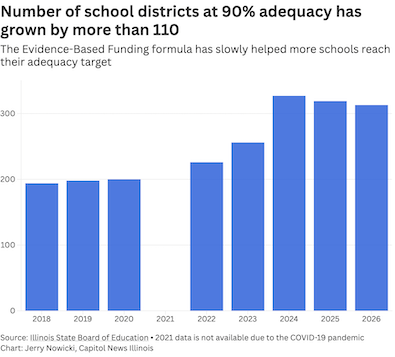 The chart shows the state hit a high of 327 schools at 90 percent adequacy in 2024, and then dropped to 313 in 2026. That’s not a huge drop, but it’s most definitely not an increase. One reason is that the state’s annual $300 million payments have not kept up with inflation. $300 million in July of 2017, when the program started would be $410.7 million today. It would be more interesting to see how, exactly, we went from 226 schools at 90 percent adequacy in 2022 to 327 in 2024. CNI…
Illinois was supposed to reach 90 percent adequacy by Fiscal Year 2027, which is the current fiscal year. The problem is the annual “ramp” of $300 million was not enough to accomplish that and nobody really pushed to change it. * Moving along to property taxes…
The tax rate dropped by 10 percent. Something, but not much. Again, inflation contributed to this not only with the state EBF money, but also the annual $50 million designated for property tax relief, which has been paused at least a couple of time. $50 million in July of 2017 would be $68.5 million today. * OK, let’s switch up a bit. This is from a recent Chicago Public Schools report…
According to the report, the district “has more than $9 billion of existing long-term debt that requires $900-plus million in annual debt service payments.” Instead of using the COVID money to pay down its debt, which the state did for itself, CPS put that money into increasing its permanent spending base. And this is from my newspaper column published almost exactly two years ago…
Discuss.
|
 |
|
|
|
|










- Pundent - Thursday, Jul 9, 26 @ 2:06 pm:
CPS has put the Governor in a real trick bag. Adequately funding schools requires taxpayers to support a tax increase. But the easiest way to defeat a tax increase is to tell the taxpayers that it’s nothing more than a CPS bailout.
- Steve - Thursday, Jul 9, 26 @ 2:26 pm:
CPS has more staff and less students since 2019. That’s what Chicago voters want. That’s what they get. Everyone knew the COVID funding would not last forever. Chicago has the taxes for the school system they want.
- Three Dimensional Checkers - Thursday, Jul 9, 26 @ 2:44 pm:
Could school districts use CARES Act funding to pay down long-term debt? Or did the law allow local districts to supplant normal operations expenses with the federal money and pay down the debt with local money?
- Original Rambler - Thursday, Jul 9, 26 @ 2:45 pm:
Break out the layoff notices.
- DuPage Saint - Thursday, Jul 9, 26 @ 2:51 pm:
When is the last time Chicago passed a referendum for school financing?
- Rich Miller - Thursday, Jul 9, 26 @ 3:02 pm:
===Or did the law allow local districts to supplant normal operations expenses===
I think that’s how the state did some of it, yes.
- Two Left Feet - Thursday, Jul 9, 26 @ 3:46 pm:
I bet the increase in schools at 90% adequacy is the Corporate/Personal Property Replacement Tax. The number spiked in 2022 while its impact on the EBF formula lagged. Year 1: District gets CPPPT, Year 2: Year 1 CPPPT goes into EBF as CPPPT, Year 3: Year 1 CPPPT is now part of the base funding minimum. CPS has a massive CPPPT that caused it to be Tier 2 in 2023. This let the smaller districts get more Tier 1 funding. More money went to more districts.
- Sue - Thursday, Jul 9, 26 @ 3:49 pm:
I think I saw Johnson declare that Chicago is ready for a Revolution and demanding Illinois allow him to tax the rich- he is reading from his old employer’s (CTU) hymnal sheets- As he often forgets who he actually works for- April can’t come soon enough when Chicago can cancel his CTU LOA
- TNR - Thursday, Jul 9, 26 @ 3:53 pm:
== When is the last time Chicago passed a referendum for school financing? ==
I believe the answer is never. CPS financing is mostly governed by a Chicago-only section of the school code (Article 34) which has no explicit language enabling a referendum, unlike the sections that apply to all the other school districts.
This is probably another provision of the school code that needs to be updated now that Chicago is gonna have a fully elected school board.
- Rich Miller - Thursday, Jul 9, 26 @ 4:14 pm:
Two Left Feet, you may be right.
- JS Mill - Thursday, Jul 9, 26 @ 4:52 pm:
@Two left feet is correct, CPPRT is the reason for the up tick in the adequacy rate. CPPRT revenue nearly doubled, dropped us down a Tier and slowly returned to normal levels. We eventually went back to Tier 3.
Districts were allowed to supplant costs to some degree if you could show that the money was being used for things like sanitation or student focused services. It wasn’t hard to do that. A lot of districts used money for onetime projects like improved HVAC or other facility projects that met requirements.
But a first year superintendent knows you don’t use temporary grant money for legacy costs (staff or programs) if you don’t have a plan to sustain costs. CPS’s plan to demand more money from the state wasn’t much of a plan. They reap what they sow and the state owes them nothing.
- Just a guy - Friday, Jul 10, 26 @ 11:51 am:
So much to unpack here. Starting with the fact that there is a moratorium on school closings until 2027. That, right there, already handcuffs administrators. You have a school like Douglass Academy, which literally has less than 35 students in it, still operating. As others have said, the enrollment continues to decline, yet CPS adds more staff, asks for more money, and when taxpayers look at tests scores and want to know - rightly so - what is being done with the growing pot of money, CPS shrugs it off and says it’s because they need more money. Our property taxes went up nearly 24% last year. We watched nearly $3,200 of that increase go to education. In my company, if I tell my boss I need more money for a program or campaign, I am going to have to explain why we did it and how it benefited the company. Yet when someone tries to apply these rules in the public sector, opponents say that asking those questions means people don’t want to see brown and black children succeed. There really is no good way to address it. And this fully elected school board is only going to make it more complex as those elections and the politics behind them drive the future of education in Chicago.