* Investigate Midwest…
Data center construction is shifting toward rural America. At the same time, rural residents report greater concern than urban and suburban Americans about what those projects could mean for their electricity costs and farmland use.
That’s according to a survey released June 26 by researchers at the University of Illinois and Purdue University. The survey of about 1,000 U.S. adults, conducted in February, found rural residents expressed the highest average level of concern overall. Their greatest concern was rising electricity costs, followed by the use of agricultural land for data centers and overuse of water.
* From the survey narrative…
Three outcomes were presented to survey respondents. “New data centers will impact electricity costs,” had an average worry level of 5.17 out of 7. “Overuse of water” had an average worry level of 4.77 out of 7. Finally, “Agricultural land will be used for data centers” had an average worry level of 4.56 out of 7. All three levels of worry were above the midpoint. These are not the only potential concerns associated with either AI or modern data centers, but they are the issues that most consistently appear in news stories focused on rural and/or agricultural issues. […]
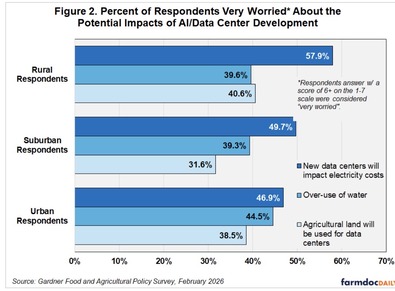
Rural residents were more likely to be ‘very worried’ about the impacts of AI/data centers across the board. Respondents who rated their level of worry a 6 or 7 on the 1-7 scale were considered ‘Very Worried.’ Fewer suburban residents were very worried about the use of farmland than either urban or rural respondents. By contrast, urban respondents were more likely to be very worried about water usage (44.5%) than rural or suburban respondents.
The gap between urban, suburban and rural responses was most pronounced in electricity costs. Of these three issues, the rising cost of electricity was the issue most likely to affect people’s personal finances. Rural residents were 11 percentage points more worried than urban residents and 8 percentage points more worried than suburban residents. How data center electricity costs affect consumers varies by state. In regulated states like Virginia, utilities can build generation and grid infrastructure for data centers and recover those costs across all or specific ratepayers with regulatory approval. In partially deregulated states like Illinois, generation is market-based, so data centers can influence wholesale energy and capacity prices. In some instances, the increased generation costs required for a new or expanding data center may be borne by that customer. However, individual consumers may also bear costs through regulated transmission and distribution upgrades needed to serve large new loads.
* Percent of respondents very worried about the potential impacts of AI/data center development, including “New data centers will impact electricity costs,” “Overuse of water,” and “Agricultural land will be used for data centers”…
* Back to Investigate Midwest…
By 2030, the energy requirements for data centers are projected to more than double in Illinois and triple in Indiana, Michigan, Minnesota and Wisconsin, researchers added, citing the University of Virginia’s Weldon Cooper Center for Public Service.
According to a separate April analysis of mapping data by the Pew Research Center, a major shift is underway. Nearly 90% of all existing data centers are in urban areas, but 67% of planned facilities are slated for rural communities and 39% are planned in counties without an existing data center.
More than 1,500 data centers are in development nationwide, according to PRC. Virginia leads the way with 398 operating and 287 planned; Illinois is the top Midwest state with 139 operating and 123 planned, according to the April analysis. The nonpartisan thinktank reported that the Midwest has 419 planned data centers and 655 existing ones – a 64% increase from its current total. The South leads the way — with more than 750 planned data centers and 1,209 existing ones.
* More…
* Illinois Times | Residents sue to stop Sangamon County data center: The filing also cites an Illinois local zoning law that says any county board decision related to zoning is subject to fresh judicial review “as a legislative decision,” so long as any action taken to seek judicial review begins no later than 90 days after the decision – meaning July 6 was the last day petitioners could cite that law based on the April 7 action.
* Shaw Local | Questions arise over data centers’ water use, Illinois considers mandating water-efficient cooling systems : The currently stalled state legislation, known as the POWER Act, does not mandate closed-loop cooling, but does require developers to use any type of cooling system [for data centers] that is at least as efficient as closed-loop cooling. An advocate of the POWER Act, state Sen. Rachel Ventura, D-Joliet, said her residents have “consistently raised concerns about rising water rates and the increasing cost of living.” […] “There are ways to cool these centers without water, so the language needs to be flexible enough for those solutions, as well,” Ventura said.
* TCD | Illinois officials face data center moratorium push as sixth grader says, ‘We need our water’: The Mahomet Aquifer, the region’s main water source, was at the center of the East Central Illinois dispute over large-scale data centers. MPR News reported that more than 100 people attended the meeting with signs reading “Protect Our Water” and “Approve the Moratorium,” reflecting fears about what new development could mean for the aquifer. Among those who addressed the county board was sixth grader Samuel Tomory, who argued that protecting the aquifer mattered more than expanding artificial intelligence.
* WAND | Macon County residents speak on potential data center ordinance: A member of the board told WAND News in early June that a data center moratorium would be considered in the future. Communities are asking for transparency throughout the process and want the board to consider all the potential drawbacks of a data center. “Do you want to be remembered as someone who helped trillion dollar companies replace the American workforce, or as someone who had the courage to stand against the behemoths who care more about money than our families and neighbors?” one resident posed.
* WAND | Aurora residents say data center noise is disrupting daily life despite mitigation efforts: “At its worst, it’s like a helicopter. At its best, it’s a low hum, a noise that will never stop,” Evans said. Neighbors compare the sound to having a train behind their homes every night. They say the noise is often worse overnight. After years of complaints, CyrusOne has taken steps to reduce the noise. But residents say the sound remains disruptive. “Instead of being a helicopter on a roof, it might be a helicopter coming from about 50 feet away,” Evans said. David Szala agrees. After measuring the sound levels, he said the data center has reached 80 decibels, which is about as loud as a running blender.











- Candy Dogood - Friday, Jul 10, 26 @ 12:56 pm:
Data centers were a free lunch just a few years ago. It is a good thing for the public to be reminded that there is no such thing as a free lunch. We just need to internalize that someone who is showing up with a free lunch is engaged in deceptive practices.
It does not appear that a single tech firm or builder was ever honest with stakeholders about what they were building and what impact it was going to have. They just needed to sell the lie until they got the things built.
- 47th Ward - Friday, Jul 10, 26 @ 1:34 pm:
My feelings on data centers, and I am not an expert on this at all, is that there is an avalanche of money behind the race to build an infrastructure for AI. Nobody asked for AI, and a lot of people don’t understand why it’s tech companies think they must have it. Sadly, we won’t find out what it will do until everything is up and running.
The whole thing feels nebulous, and I think that contributes greatly to the growing unease seen in polls like this.
- Rich Miller - Friday, Jul 10, 26 @ 1:40 pm:
===The whole thing feels nebulous===
I think Duncan Black may be onto something in his latest https://www.eschatonblog.com/2026/07/ai-agents.html
- Friendly Bob Adams - Friday, Jul 10, 26 @ 2:06 pm:
When electricity costs triple and you don’t have enough water to take a shower, the AI people will still be asking for more…
- yinn - Friday, Jul 10, 26 @ 2:24 pm:
I’m surprised “overuse of water” wasn’t the number one concern, and I think it will be at some point. Sure, the newest data centers might be using closed loop cooling systems and other conservation measures, but older developments are still phasing in under the early, more lax conditions. Meta in DeKalb, for example, only has the first of a multi-phase development finished, but its water agreement with the city will probably not be amended for future phases. It calls for huge daily/monthly water reservations for city water, priority over residents in case of shortages, and permission to drill its own wells. (Drilling might not even be necessary, considering Meta is building on ag land that probably already has existing wells on it.)
- Ducky LaMoore - Friday, Jul 10, 26 @ 3:18 pm:
More data centers. More Flock cameras. More license plates readers. They’re not just for urban areas. The rednecks are flipping out now, and I don’t blame them one bit.
- Dotnonymous x - Friday, Jul 10, 26 @ 3:34 pm:
https://www.aclum.org/publications/ai-powered-surveillance-is-turning-the-united-states-into-a-digital-police-state-now-is-the-time-to-stop-it/