Thursday, Sep 24, 2015 - Posted by Advertising Department
[The following is a paid advertisement.]
Recently, Exelon announced that all of its nuclear plants in the PJM market cleared the most recent capacity auction and that it will defer any decisions about the future operations of its Quad Cities and Byron nuclear plants for one year. As a result, the Quad Cities nuclear power plant will run through at least May 2018, while the Byron plant will run through at least May 2019.
This is encouraging news for Illinois. According to a report by the State of Illinois, the Quad Cities and Byron plants support 5,075 jobs and contribute $1.39 billion to the state’s economy. Overall, Illinois’ nuclear energy facilities produce 90 percent of the state’s carbon-free energy, support 28,000 jobs, and inject nearly $9 billion into the Illinois economy every year.
While the recent results of the PJM capacity auction which reflect new market reforms that better recognize the unique value of always-on nuclear energy is encouraging, Quad Cities and Byron, as well as Clinton, remain economically challenged. These plants are long-lived assets with decades of useful life left and today’s announcement is only a short-term reprieve. Policy reforms are still needed to level the playing field for all forms of clean energy and best position the State of Illinois to meet EPA’s new carbon reduction rules.
The Chicago Tribune filed a lawsuit Thursday alleging that Mayor Rahm Emanuel violated state open records laws by refusing to release communications about city business conducted through private emails and text messages.
The lawsuit, filed in Cook County Circuit Court, asks a judge to order the mayor to comply with a state Freedom of Information Act request from the Tribune and produce the documents. The lawsuit also seeks to have Emanuel declared in violation of the Illinois Local Records Act for failing to preserve emails and texts he sent or received while doing city business. […]
Illinois law says written communications by government officials are subject to Freedom of Information Act requests. The law covers “electronic communications,” but does not spell out the rules for the use of personal email and text messages on private cellular phones, according to experts.
The office of Attorney General Lisa Madigan has issued an opinion on the matter. In 2011, in a case involving members of the Champaign City Council, Madigan’s public access counselor determined that written communications about government business on personal email accounts and private cellphones are subject to FOIA. In essence, the office said it was not the device that mattered but the person using the device and the content of the communications.
The case was appealed to the Illinois Appellate Court in Springfield, which took issue with some aspects of the attorney general’s opinion. But the court agreed that emails and texts on personal devices sent by council members during a public meeting were subject to FOIA.
On your blog, there has been a lot of discussion about a lack of good news. Today, the City of Chicago legalized food carts– a huge win for Hispanic food vendors who have been operating illegally. Additionally, this creates significant growth opportunities, similar to what we’ve seen from food trucks in Chicago.
Here is a copy of the legislation.
Matt
—
Matt Paprocki
Senior Vice President
Illinois Policy Action
Background article is here. The legislation is here.
* From Emily Miller at Voices for Illinois Children…
Today in an Illinois House Committee lawmakers discussed SB2046, a bill appropriating funds for social service programs, and Voices for Illinois Children heard a different tone from lawmakers on both sides of the aisle.
It seems that a growing number of lawmakers are listening to providers in their districts who are unsure how they will keep their doors open in the face of this budget impasse. There appears to be a growing understanding of the vital role these providers play, and a recognition that these services are worth paying for.
While SB2046 appropriates funds to pay for services, the promise of funding runs pretty shallow when you take into account the fact that Illinois lacks the revenue to make good on that promise.
Voices was very encouraged to hear Representative Tryon say in his remarks before the committee that the time to have a revenue discussion is now.
He wondered aloud how that conversation starts. We hope it just did.
I hate to say it, and I really hope I’m wrong, but I just don’t think things will move forward until some sort of major calamity happens - and maybe not even then.
Calamity isn’t enough. Then will come the blame game and then someone will have to clearly lose the blame game before this thing starts to resolve itself. Calamity will at best mark the end of the beginning and not the beginning of the end.
Thursday, Sep 24, 2015 - Posted by Advertising Department
[The following is a paid advertisement.]
The final results are in and as many analysts have noted, “Exelon was the big winner in this year’s [PJM grid capacity} auction.” Here are the highlights:
$1.7 BILLION RATE INCREASE FOR EXELON – Exelon engineered the new rules to increase their profits. Their $1.7 BILLION reward will be paid for by struggling Illinois ratepayers.
Byron and Quad Cities Both Cleared the Auction and are Obligated to Run Well into the Future
Exelon’s Low Carbon Portfolio Standard would have raised $1.6 billion over 5 ½ years for Exelon. The Capacity markets, under Exelon-pushed rules, earned Exelon $1.7 billion over only three years.
Illinois doesn’t have a balanced budget, service providers are being decimated and real people across Illinois are hurting. It’s time for Exelon to take their HUGE $1.7 BILLION WINDFALL and stop asking legislators to keep padding their profits.
Enough is enough!
Just Say “NO” to the Exelon Bailout
BEST Coalition is a 501C4 nonprofit group of dozens of business, consumer and government groups, as well as large and small businesses. Visit www.noexelonbailout.com.
* And, yes, we have video. GOP Rep. Ed Sullivan was rightly outraged at Sherman’s goofiness and Democratic Rep. Greg Harris correctly disassociated himself from the comments…
Also contrary to popular belief, the state does not tax its citizens more heavily than its neighbors. While Illinois ranks near the top nationally in property tax collections — all of which go to school districts and other local governments — the state is more middle-of-the-pack for state income and sales taxes as a percentage of personal income, according to the Federation of Tax Administrators.
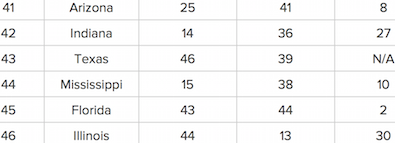
* WalletHub recently ranked Illinois 46th worst for overall tax fairness. The first number is the overall rank, the second is for dependency on property taxes, the third is for dependency on income taxes and the fourth is dependency on other taxes…
You just can’t ignore property taxes. Yes, they’re local, but they’re high because of a lack of state support and because some governments are just way over-spending.
Those high property taxes meant WalletHub ranked Illinois as 10th worst for the middle class and 3rd worst for the bottom 20 percent.
As Senate President John Cullerton has argued for years, Illinois would be in much better financial shape if it had the exact same tax laws as some of its neighbors. For example, if Illinois had Wisconsin’s revenue structure — higher income tax rates, a tax on retirement income, sales tax on services — the Prairie State would collect almost $10 billion a year more than with its current taxing provisions, more than enough to cover Munger’s projected shortfall.
Or they would’ve already squandered it.
* None of this is to suggest that the state has no revenue deficiency problem. It obviously has one and raising income tax rates isn’t a killer on its own. But it also has a serious problem with high property taxes outside of Chicago, and even that’s about to change now. Those taxes should be factored into the equation, so something needs to be done about them alongside state revenue solutions.
An aide to Mayor Rahm Emanuel is testifying before state lawmakers on a proposed property tax exemption as Chicago looks to increase property taxes to help pay pensions.
Deputy Mayor Steven Koch told legislators Thursday that the city wants to protect residents whose homes are worth $250,000 or less and Chicago’s downtown business core will absorb much of the burden.
Emanuel has called for a $543 million property tax over next four years. But he needs sign off from Springfield on an exemption. Democratic legislative leaders say they’re on board, but Gov. Bruce Rauner hasn’t been as receptive.
* The Question: Do you support this concept? Take the poll and then explain your answer in comments, please.
* It’s a credit to all the state’s many vendors that this hasn’t been a bigger problem already. How long these folks can hold out is anybody’s guess, however…
The state’s Department of Veterans’ Affairs confirmed Wednesday that some food vendors for the agency’s veterans homes have said they may have to suspend deliveries because of the state’s ongoing budget problems.
The agency said it is working to find alternative suppliers to ensure that food service is not interrupted to the four homes the state operates.
“There are vendors who either have, or may have to suspend deliveries in the future,” Veterans’ Affairs spokesman Ryan Yantis said in a prepared statement. “For those vendors, alternate solutions have been identified to ensure the homes receive needed supplies and services to continue to provide care to residents.”
Yantis said that includes finding other companies willing to supply the homes with food products.
That may not be easy, considering the somewhat remote locations of some of those homes.
Richard Tego hasn’t coped well with the recent cutoff of services to help him deal with autism.
“He will sit and cry because he can’t go see his friends,” his mother, Veronica Morse of Carlinville, said Wednesday. “He’s going back into his shell.”
Richard, 13, an eighth-grader at Carlinville Middle School, is among more than a dozen children who were cut off from services at The Autism Program of Illinois’ Springfield center in late August because of the ongoing state budget impasse.
The regression Morse has seen is what Autism Program officials fear will happen to hundreds of children statewide as the impasse continues to cause unprecedented damage to a network of autism diagnostic and treatment services that began to be developed in 2003. […]
Diagnostic services and treatments for children with autism have stopped at nonprofit agencies in Chicago and Charleston that receive state funding through The Autism Program, Bonanno said. A program in Rockford that gets money from the program soon may run out of cash.
The Illinois State Council of the Service Employees International Union said Wednesday that it has endorsed Chicago City Clerk Susana Mendoza for state comptroller next year.
The SEIU is one of the state’s most politically active unions, and its backing could help Mendoza in a Democratic primary bid against state Sen. Daniel Biss of Evanston. The two announced candidates are vying to face Republican Comptroller Leslie Munger in a special statewide election in 2016. Munger was appointed to the post by GOP Gov. Bruce Rauner after the December death of Judy Baar Topinka.
Tom Balanoff, president of the 150,000-worker SEIU Illinois council, said Mendoza would work to “to champion the needs of the most vulnerable Illinoisans by restoring balance, reviving neighborhoods and helping to build an economy that works for everyone, not just the wealthy few.”
With Cook County State’s Attorney Anita Alvarez on the electoral bubble, you can logically expect the Democrats and their allies will make sure there’s a Latina on the ticket next fall.
Construction and mining equipment maker Caterpillar plans to lay off more than 10,000 workers in a bid to save $1.5 billion a year in operating costs, it announced Thursday.
Nearly half those job losses — 4,000 to 5,000 salaried and management employees — will come before the end of 2016, with most completed this year, the company says in an SEC filing.
Doug Oberhelman, CEO of the Peoria-based firm, blamed “challenging marketplace conditions” in the energy and mining sectors, as Caterpillar, one of Illinois’ biggest employers, revised downward its sales projections for 2015 by $1 billion, to $48 billion.
It noted in a news release that this is the “company’s third consecutive down year for sales and revenues, and 2016 would mark the first time in Caterpillar’s 90-year history that sales and revenues have decreased four years in a row.”
· An expected permanent reduction in Caterpillar’s salaried and management workforce, including agency, of 4,000 – 5,000 people between now and the end of 2016, with most occurring in 2015, and with a total possible workforce reduction of more than 10,000 people, including the contemplated consolidation and closures of manufacturing facilities occurring through 2018.
· The company will offer a voluntary retirement enhancement program for qualifying employees, which will be completed by the end of 2015.
· Slightly less than half of the $1.5 billion of cost reduction is expected to be from lower Selling, General and Administrative (SG&A) costs. The reduction in SG&A will largely be in place and effective in 2016 and occur across the company.
· The remaining cost reductions are expected to come from lower period manufacturing costs, including savings from additional contemplated facility consolidations and closures, which could impact more than 20 facilities and slightly more than 10 percent of our manufacturing square footage. A portion of these cost reductions are expected to be effective in 2016, with more savings anticipated in 2017 and 2018.
Caterpillar remains committed to Peoria, though with Thursday’s announcement central Illinoisans shouldn’t expect construction to begin soon on the new Downtown world headquarters complex.
That was the message from the Fortune 50 company after announcing a significant restructuring and the likely reduction of 4,000 to 5,000 employees worldwide by the end of 2016 and potentially as many as 10,000 — with likely facility closures or consolidations — by 2018.
“Above all, we remain committed to Peoria and Illinois,” spokeswoman Rachel Potts said. “Our vision and our hopes and plans for a headquarters in Downtown have not changed.”
That said, “given the current conditions, now is not the time to start, and we cannot say now when that will begin,” she said by phone Thursday morning.
Illinois Times [yesterday] sued Gov. Bruce Rauner after Attorney General Lisa Madigan ruled that the governor must turn over his appointment calendar in response to the paper’s request made under the state Freedom of Information Act.
The newspaper asked for Rauner’s appointment calendar last spring after the governor walked out of a Holocaust remembrance ceremony. The newspaper’s request came after the governor’s press office ignored an emailed query asking where the governor had gone while a Holocaust survivor spoke at the annual ceremony held at the Old State Capitol.
Rauner gave the newspaper a redacted version of his appointment calendar showing that he had attended a meeting in the governor’s office while the ceremony continued. The governor redacted the names of the person, or people, with whom he met. The newspaper subsequently appealed to the attorney general, who ruled that Rauner must disclose the names of the people who attend meetings memorialized in his appointment calendar, which is prepared by public employees on public time using public equipment.
Rauner had claimed that the calendar was maintained for the governor’s convenience, but the attorney general determined that the calendar is the public’s business.
“(T)his office’s review of the redacted entries indicates that they all appear to pertain to the business of the state, rather than the personal affairs or private business interests of the governor,” Michael J. Luke, counsel to Madigan, wrote in the 18-page decision issued Tuesday. “Because the governor’s calendar was prepared and is maintained by the governor’s office and pertains to public business, it is a public record of the governor’s office for purposes of the Illinois FOIA.”
Governors leave events early all the time, but he kinda walked right into that one, so to speak.
Thursday, Sep 24, 2015 - Posted by Advertising Department
[The following is a paid advertisement.]
When you join a credit union, you’re a member — one of nearly three million in Illinois. Even so, members are not just a number. They know their credit union is a trustworthy place where the best interests of individuals and their communities come first.
Cornerstone Credit Union in Northwestern Illinois is no exception, where helping their members build strong financial futures, offering community assistance and supporting aspiring college students are top priorities.
A Community Relations Committee empowers staff to fulfill year-round outreach programs. This has been a top level initiative because the credit union’s board of directors, who serve in a volunteer capacity themselves, value the fundamental credit union principle of freely offering assistance to their neighbors in need.
For the past 17 years, Cornerstone has facilitated a scholarship program to the tune of two, $5,000 scholarships for local college students per year. That’s $170,000 of welcome relief given back to local families faced with the continuing rise of college tuition.
When life presents many financial challenges and opportunities, credit unions are the best partner to help members build strong financial futures. Isn’t it nice to know that someone is looking out for your best interests? Credit unions truly are A Smarter Choice.
* WBEZ’s Tony Arnold has a long story today about Richard Goldberg, AKA the governor’s chief legislative liason , AKA “The Prince of Snarkness.” We’ve already covered pretty much everything in the piece, but there are some funny new lines. For instance, Senate President Pro Tempore Don Harmon offered up this observation…
“Rich’s job is to be the governor’s unmentionable anatomy. And he embraces that role with the flare and enthusiasm that can only have been born of years of experience in fraternity houses and undergraduate bars,” Harmon said.
After the initial interview with Harmon, WBEZ went back to clarify what the senator mean when he said, “unmentionable anatomy.” He said he meant something that rhymes with “grass bowl.”
Rauner’s administration did not make Goldberg available for an interview for this story. But his office did send a written statement.
“It’s no surprise that these local legislators aren’t willing to clean up Springfield, when they relish the opportunity to personally attack a Navy reservist who served our country fighting terrorism in Afghanistan,” said Lance Trover, a Rauner spokesman.
In other words, Trover said: Hey Democrats, you just called a war veteran a ‘grass bowl.’
And we wonder why the two sides ain’t getting anywhere. /snark
* It’s still pretty darned early for this. Also, pay attention to the generic ballot numbers at the end…
U.S. Rep. Mike Bost, R-Murphysboro, is leading Democratic challenger C.J. Baricevic 51 to 35 percent, with 14 percent undecided, in a poll of 12th U.S. House District voters released Monday by Harper Polling, a GOP-leaning polling firm. […]
Harper’s poll showed that 24 percent of those surveyed strongly approved of Bost’s job performance, while another 30 percent somewhat approved. Sixteen percent somewhat disapproved, 11 percent strongly disapproved and 18 percent were not sure, according to a survey conducted Sept. 12-13 of 400 likely 12th District voters. […]
Bost is also viewed favorably by majorities of Republican voters (71 percent) and independents (53 percent), according to the survey from Harper Polling, which is based in Harrisburg, Pa.
In addition, 71 percent of voters surveyed said they believe the nation is headed in the wrong direction, while another 21 percent said it was moving in the right course. Likely voters were almost evenly split between a generic Republican candidate (43 percent) and a Democratic candidate (41 percent), with 9 percent of voters responding they are not sure, according to the poll.
That district is a lot different in presidential years. Democrat Bill Enyart defeated Jason Plummer by 9 points in 2012.
This is not to say that Bost is in trouble, by any means. Underestimate that guy at your own peril - Enyart and the DCCC did and look where that got them last year.
I’m just saying that the generic ballot doesn’t match up that well with actual district performance.
After months of an intense public campaign to expose and reverse so-called “emergency” rule changes made by Gov. Bruce Rauner to the highly-successful Child Care Assistance Program – a statewide effort driven by providers, parents, children’s advocates, even First Lady Diana Rauner herself – a new report suggests the appearance of cracks in the governor’s dam.
This morning, the Peoria Journal Star reported that Rep. Jehan Gordon-Booth, sponsor of the legislation to overturn Rauner’s extreme administrative CCAP changes (SB 570), has identified – and in one case already converted – Republican legislators needed to reverse Rauner’s reckless and inhumane policy:
“With the possibility that not all Democrats would be present, she called on the audience to lobby local Republican representatives, even as she warned them that child care for low-income families is not a Republican or Democratic issue.
Gordon-Booth specifically mentioned Reps. Mike Unes, R-East Peoria, Don Moffitt, R-Gilson, and Dan Brady, R-Bloomington. She said another Republican legislator, Dave Leitch, R-Peoria, would vote for the bill but he is sick and unable to attend Thursday’s session.
Contacted later, Leitch said he would probably vote for the bill if he was able to travel to Springfield. “It’s one of the unfortunate casualties of not having a budget yet,” Leitch said. “But I hope it passes, it should pass.”
Earlier this month, SB 570 came up just one vote short on the floor of the Illinois House, and is likely to be reintroduced in Springfield in the coming weeks.
Republicans are now facing the hard reality that the public understands the truth behind Rauner’s extreme rule changes to CCAP, made by Rauner himself without public input or legislative debate – that they have absolutely nothing to do with the current budget impasse in Springfield, and are intended to dismantle the program entirely.
For months, Rauner and his allies have attempted to conflate these extreme, inhumane changes to the CCAP program with the budget impasse generally. Now, it appears the truth about this terrible policy – both cruel and harmful to Illinois’ economy – is now even understood by the Republican legislators Rauner has spent so much time trying to buy and bully.
With Rep. Esther Golar’s passing, the House Democrats are at least one vote shy of the 71 votes needed to pass the bill. So, with Rep. Leitch not attending due to illness and the expected absence of at least one other Democratic legislator, I doubt we can expect a vote.
The bill is on Postponed Consideration, so supporters aren’t facing a fast-approaching deadline. As long as Rep. Dunkin doesn’t skip town again and Rep. Leitch is eventually able to make it to Springfield the bill will likely pass on the next go-around.
Democrat state Rep. Jack Franks of Marengo is constantly viewed as being vulnerable and his reluctance to back Boss Madigan on all things leaves open the possibility that Madigan and the Dems could sacrifice him if push came to shove.
Franks does represent a heavily Republican district. But the GOP has yet to find a viable opponent. Maybe that’ll change with Rauner’s bigtime money. I don’t know.
What I do know, however, is that while Madigan might possibly, conceivably, maybe, perhaps take a pass on saving a member in an overwhelmingly Democratic district during a primary (cough*Dunkin*cough), he ain’t handing over a seat to the GOP as long as he gets his vote for Speaker, no matter how much of a pain in the rear Rep. Franks can be.
The only conceivable scenario is that Madigan is putting out electoral fires everywhere next November (not hugely likely considering that it’ll be a presidential year) and Franks is so far out of contention that it isn’t worth spending money on him. But, even then, I dunno.
* This is quite titillating, but I’d have some faith in it if Smith had given us at least one example of those “dirty details”…
Andre Smith, a former personal assistant to the Rev. Corey Brooks, is threatening to dish dirty details about the clergy’s efforts to help Gov. Bruce Rauner attract black voters.
“I sat in on 98 percent of Corey’s meetings with Rauner. Nobody knows what I know,” Smith told me Friday.
Apparently, it was a cozy partnership until Rauner pulled out an ax to tackle the state budget.
“I took a stand with Corey [during the campaign] that Rauner wasn’t going to do these things, so me and Corey fell out,” Smith said.
“I believe that I am part of this dreadful thing that is hurting our people,” Smith said. “I believe that I should take the lead in helping to fix it.”
Smith, 47, twice ran for alderman in the 20th ward. He now has his sights on challenging state Rep. Ken Dunkin (D-Chicago).
Dunkin has come under fire for skipping the critical override vote on a major union bill. He was the only Democratic no-show, and his absence helped Rauner gain ground in his ongoing tug-of-war with House Speaker Michael Madigan.
All Smith will say is “stay tuned.”
This is Illinois, so obviously we can’t rule out the possibility of dirty dealings, but I’d really like to see something concrete before jumping to any conclusions.
* And speaking of Pastor Brooks, he just endorsed the governor’s choice to replace retiring Rep. Ed Sullivan. Press release…
Pastor Corey B. Brooks, Sr., founder of New Beginnings Church of Chicago and a community leader, endorses Nick Sauer for State Representative in District 51.
Pastor Brooks said, “Our state has been moving in the wrong direction for some time. We need strong and bold leadership to take us into a brighter future. I believe Nick Sauer is the type of leader we must have in these days and times if we are to forge ahead and create a better Illinois.”
Gov. Rauner appointed both Brooks and Sauer to the tollway board.
Republican presidential hopeful Jeb Bush has won the backing of two key Illinoisans: former Gov. Jim Edgar and U.S. Rep. Adam Kinzinger, the Tribune has learned. The two will be state chairmen for Bush’s White House run. Bush was tops in Illinois presidential fundraising last month.
State Rep. Edward Acevedo (D-Chicago) is angry with GOP presidential candidate Donald Trump and what Acevedo called “derogatory comments” towards women and Latinos. Tuesday, the ten-term lawmakers introduced a House resolution calling on the RNC to denounce Trump and “distance themselves from him in the future.”
Acevedo’s resolution says “Donald Trump has repeatedly made misogynistic, sexist, and derogatory comments towards women; and Donald Trump has repeatedly made offensive and abhorrent comments towards people of Latino descent, Mexican immigrants, and Asians ..”
If the resolution passes, Acevedo wants copies of the resolution sent to the Republican congressional leaders, RNC Chairman Rheince Priebus and the GOP members of the Illinois delegation.
Jamie Anderson grew up in the foster care system. She relies on her 4-thousand-dollar MAP grant to pay tuition at the University of Illinois Springfield. She says she works two jobs totaling 50 hours a week to cover living expenses.
So what does she do in her spare time?
“I volunteer with kids,” Anderson says. “I’m in the 4-H program, I’m a mentor, I’m in Big Brother Big Sisters Program, so I’m a Big….”
Hoping to become a child welfare worker, she’s set to graduate in May with a degree in social work. But like the other 130,000 needy Illinois college students, Anderson needs lawmakers to fund the Monetary Award Program.
Most campuses, including UIS, have floated students in the fall semester, counting on eventual repayment from the state. But State Treasurer Michael Frerichs says college administrators around Illinois have told him they cannot afford to make the same bet for the spring semester.
Fear gripped 49-year-old Tina Wardzala of Cicero by the throat at a young age. It rarely has loosened its grip.
As a young girl, Tina said while her father was away driving a truck, her mother would invite men in, get drunk and pass out. Then the men would come to “play” with her.
About 15 years ago, Tina worked as a line cook at a diner and the regulars were like family. One of those regulars was elderly and ill. Tina was delivering a meal to the customer when she entered a dimly lit apartment hallway and found three men waiting. They raped her.
Before that moment of terror, Tina had worked at the diner and a branch library. She enjoyed music and waded into crowds at Grateful Dead and Neil Young concerts. In that moment, fear took her hostage. Mental illness enveloped her. She suffers from post-traumatic stress disorder, agoraphobia and bipolar disorder. Cloaked in black, Tina shared her scariest secrets. At times, she choked out the words. At times, tears spilled. Fear has its hold. Now she also lives in fear of the state’s intractable politicians.
No court judge has risen to her rescue, nor those like her, diagnosed with mental illness. No continuing appropriation has saved her, nor the nearly 1,700 other adults and children who turn each year for help to the Family Service and Mental Health Center of Cicero, where she told her story from the safety of her therapist’s office.
“I’ve come a long way … thanks to my therapist and my team,” she said. It took Tina five years before she told her therapist about the rape that resulted in the birth of her 14-year-old son. She also has sons who are 25, 21 and 10 years old. Three still live with her, mostly on a $750 federal disability check and state food stamp money she says was cut recently from $365 to $140 a month.
Now her overarching fear is going somewhere uncomfortable, to a new doctor and a new therapist.
Executive Director John Morgan says the center got $190,000 in state grants and contracts for years. Now, only a $20,000 contract remains, one the state has yet to pay this year. Morgan has cut Tina’s psychiatrist’s weekly hours by three, as well as those of another psychiatrist, a woman who treats children and speaks Spanish in a majority Hispanic community. A crisis intervention worker and other workers’ hours also were cut. So far, Morgan has avoided layoffs. His staff refers some patients to a psychiatric hospital six miles away. There’s a six- to eight-week wait.
The problem, of course, is the lack of revenue to pay for these programs. Without a tax hike, the state is gonna run out of money or pile up unpaid bills in record amounts.
So, it’s great to put human faces on these problems, but we also need a recognition that the problems cannot be addressed without more money.
A developer is apparently hoping to launch a unique concept, a sort of casino mall, in strip malls in Crestwood and Hometown.
The idea would be to lease storefronts to multiple owners of gambling cafes, with up to five video machines in each, to create more opportunities for patrons to gamble and to generate more foot traffic.
Crestwood Mayor Lou Presta and Hometown Mayor Kevin Casey said they were eager to embrace such an enterprise, while noting that the Illinois Gaming Board will ultimately decide whether it complies with the state’s video gambling law.
Presta said the Crestwood location — just south of Cal Sag Road and west of Cicero Avenue, across from an off-track betting parlor — could eventually be home to seven storefront gambling cafes, each owned by a different person or business.
There apparently is nothing in Illinois’ gambling law that prohibits video gambling malls — a concept that may place as many as nine independently operated “casino cafes” in one location in the Southland. […]
[Hometown Mayor Kevin Casey] said that while he doesn’t gamble, he made a tour of video cafes in neighboring suburbs and saw people often waiting for a video machine to become available. He said some of those people walked out because they didn’t want to sit around and drink or eat, they wanted to gamble.
Most of those people, the mayor said, looked like middle-aged suburban housewives. And Casey figured that this idea of creating a string of gambling shops, each owned independently, in one location might prove to be a pretty nice attraction for his city.
State Rep. Robert Rita, D-Blue Island, is trying to enlist the help of the Illinois Gaming Board to stop the development of “casino malls,” but the first two video gambling malls in the state are rapidly moving forward in Crestwood and Hometown. […]
There are already more video gambling machines (about 21,200) in restaurants, bars, truck stops and veterans halls than in all of Illinois’ casinos. In August, gamblers wagered nearly $75 million on video machines, bringing the total to $590 million for the first eight months of this year, according to the Gaming Board.
“The Illinois General Assembly did not allowing these types of (casino) malls in legalizing video gaming originally and is not interested in seeing this type of activity authorized in Illinois,” Rita states in a resolution that he plans to file this week. “While proponents argue these ‘casino malls’ could generate more economic activity and revenue, there are legitimate concerns about these malls shifting video gaming away from its intended purpose of main street community entertainment for bars, restaurants and other local businesses.”
Video gambling malls proposed for Hometown and Crestwood are “backdoor casinos,” according to the chairman of the Illinois Gaming Board, who said he’s “inclined to oppose them.”
Chairman Don Tracy made those statements at an August hearing of the board after the mayor of Hometown and a developer behind the concept of the casino mall in the suburb urged the board to approve license applications for three casino cafes in a strip mall that could eventually host as many as nine such businesses. […]
A spokeswoman for the Illinois Retail Gaming and Operators Association also appeared at the Gaming Board’s August hearing to oppose the Hometown casino mall. The association represents Dotty’s, one of the first innovators in the casino cafe industry; Loredo Hospitality Ventures, which owns Stall’s and Shelby’s cafe casinos; Gold Rush Amusements; Blackhawk Restaurant Group (which owns cafes under the names of Betty’s Bistro, Penny’s Place, Emma’s Eatery and Jena’s Eatery); Gold Rush Amusements; and Trident Partners, which owns Ruby’s.
She claimed that approving licenses for operators in Hometown Plaza would open the door for someone to buy an empty warehouse for the sole purpose of locating multiple video gambling operators under one roof.
“They simply don’t want any competition if they can stop it,” Casey said of the association. “That’s all that was about. The days of mom-and-pop stores, candle stores, Hallmark’s, (independent) pharmacies is over. Those are the sorts of places that used to operate in strip malls.
Illinois Gaming Board members attempted to shut down the development of “casino malls” on Tuesday, voting unanimously to reject the video license applications of three operators who hoped to open in a Hometown strip mall.
Gaming board chairman Donald Tracy reiterated a statement he made at the board’s August meeting, saying he viewed such operations as “back-door casinos,” circumventing the oversight and regulation of traditional casinos under state law. […]
“All three of these locations relate to what have been called video gaming malls, mini-casinos, casino malls, and back-door casinos,” Tracy said before the vote. “I view gaming malls as back-door casinos, as I said at the last meeting, without the traditional safeguards of licensed casinos such as regulated security, on-site oversight, position limits, self-exclusion rules and internal controls.”
Tracy went on to say that he considers such casino malls “a threat to Illinois gaming integrity” and if the state had envisioned their creation, it would have specifically created riverboat, casino-like safeguards.
* The SJ-R explains today that the governor postponed his union worker layoff plans because of an amended union lawsuit. The governor’s folks say they’re confident that they’ll win the lawsuit, but the unions flatly disagreee…
The amended lawsuit specifically talks about the layoff of 151 unionized state workers at nine different state agencies. The unions argued that the layoffs were scheduled in violation of labor agreements.
“While the governor has the right to initiate a layoff, there has to be a legitimate reason for doing do, for example a lack of work or a lack of funds,” Lindall said. “In no case do those conditions exist for these employees. The governor can’t arbitrarily target layoffs in one area for lack of a budget over another.”
Sean Smoot, director of the PBPA that represents 33 conservation police officers who were scheduled for layoff, said that’s particularly true in the case of the officers whose salaries are paid for with fees, fines and federal money rather than general state tax dollars.
“The existence of a budget or not really doesn’t affect the funding for these folks,” Smoot said.
I imagine this post is gonna cause a whole lot of conservative heads to explode.
Pro-Lifers Feeling Betrayed by Sen. Kirk’s Refusal to Defund Planned Parenthood
Life activists are putting pressure on U.S. Senator Mark Kirk and other members of Congress to end the 500 million dollar plus taxpayer subsidy to Planned Parenthood.
Kirk has been blasted for that vote… from both sides…
Tell Senator Kirk NOT to shut down the government over Planned Parenthood! https://t.co/CreoiC8435
* The above is part of a digital ad campaign being run by the DSCC here…
“With just 10 days left before a potential government shutdown, Mark Kirk has yet to show that he will stand up against more Republican shutdown politics,” DSCC National Press Secretary Sadie Weiner said in a release that accompanied announcement of the ads.
But Kirk was the only Republican Senator who voted against de-funding in a Senate test vote in August. Senate Majority Leader Mitch McConnell also did, but only for procedural purposes to give him the ability to take up the bill at a later date.
“Yet another ad from outside partisan groups that is short on facts and lacking any credibility,” Kirk campaign manager Kevin Artl said. He said Kirk “continues to answer the call for independent leadership by breaking from his party to support women’s access to health care and opposing efforts to shut down the government.”
Kirk’s re-election campaign also released a statement from Carole Brite, President and CEO of Planned Parenthood of Illinois, saying they “were able to count on the leadership of Senator Mark Kirk who wisely voted against de-funding Planned Parenthood.”
Drop the stupid ads, already.
* Meanwhile, Joe Walsh is apparently taking yet another look at the 14th CD…
Déjà vu? Top GOP sources say former congressman Joe Walsh of Mundelein is considering a primary bid against U.S. Rep. Randy Hultgren of Plano in the 14th Congressional District next spring. […]
Hultgren’s staff is actively preparing for the scenario, and campaign workers for both Walsh and Hultgren were reportedly collecting petition signatures at a McHenry County Republican Party fundraiser last week.
State Sen. Mike Noland of Elgin was endorsed by the Illinois Federation of Teachers last week despite his past comment that strikes were “embarrassing” and his receipt of campaign cash from Stand For Children, a group that helped muscle in a 2011 law to make it tougher to get teacher tenure.
Noland is making a Democratic bid for Duckworth’s seat as she wages a battle for U.S. Senate. He’ll compete in the primary against businessman Raja Krishnamoorthi of Schaumburg and Villa Park Mayor Deborah Bullwinkel.
The Noland quote about strikes being “embarrassing” is here.
* And speaking of pretty old news…
Former Rep. Brad Schneider, D-Ill., lost another high-profile endorser over his opposition to the Iran nuclear deal, with former Sen. Adlai Stevenson III, D-Ill., switching to his Democratic primary rival, Highland Park Mayor Nancy Rotering.
Stevenson joins Abner Mikva — a former House member, Bill Clinton White House counsel and federal judge — in dropping Schneider over the Iran nuclear agreement.
Rotering and Schneider are in a battle to take on Rep. Bob Dold, R-Ill., in the north suburban swing 10th Congressional District.
Stevenson is a member of one of the most famous Democratic political families in Illinois with deep ties to the 10th district. His great-grandfather was Vice President Adlai Ewing Stevenson.
The Adlai E. Stevenson II High School in Lincolnshire, a major high school in the district, is named after the former senator’s father, who ran for president in 1952 and 1956 after serving as Illinois governor and United Nations ambassador.
The mayor’s painful prescription includes a four-year, $588 million property tax increase devoted exclusively to police and fire pensions and a first-ever garbage collection fee of $9.50-a-month-per household… Senior citizens would get a 50 percent discount.
The mayor’s budget also includes: $13 million in higher fees for building permits; a new, $1 million tax on e-cigarettes: a 50-cents–a-ride surcharge on taxicabs; a 30 cents-a-ride increase in the surcharge on ride hailing services and authorization for Uber, Lyft and Sidecar to make pickups at McCormick Place, O’Hare and Midway Airports in exchange for a $5 surcharge on every pickup and drop-off.
The cab and ride-hailing fees would raise $48 million. Struggling cabdrivers would get a 15-percent fare increase as compensation for losing what is now their last bastion of exclusivity. […]
Emanuel told the council he wanted to do what he could to help Chicagoans “who could least afford the additional burden” of higher taxes. “The lion’s share” would be borne by “our thriving central business district” as well as those whose homes are valued at more than $250,000. He backs a plan to increase the homeowner exemption to help those whose homes fall below that threshold won’t take a hit. […]
Emanuel said the dire alternative to a property tax increase is 2,500 police layoffs, 2,000 fewer firefighters, 48 fire station closings and twice-a-month garbage collection, instead of weekly pick-ups.
Even if he gets aldermanic support for his menu of tax hikes, Emanuel’s $7.8 billion budget proposal requires some help from Springfield and Republican Gov. Bruce Rauner.
Emanuel is counting on Rauner backing a bill giving the city more breathing room in paying required annual increases in police and fire pensions. Without that help, the city could find itself $219 million in the hole next year.
Emanuel also wants Rauner to approve an increase in homeowner property assessment exemptions to dampen the blow of the property tax increases. Rauner, however, wants to freeze property taxes, not raise them.
The mayor said he spoke with House Speaker Michael Madigan and Senate President John Cullerton, the two Chicago Democrats who control the General Assembly, about the increased exemptions and said they both agreed to move the bill, starting with a House hearing Thursday.
Gov. Bruce Rauner has virtually promised to veto Emanuel’s homestead exemption proposal if it reaches his desk. How that issue plays out will be a key factor in determining the ultimate fate of the new budget.
From Innovation Illinois…
Governor Rauner is overstepping his authority and creating obstacles to the democratic process by threatening to veto the Mayor’s request for a change in the property tax exemption. Instead of supporting property tax relief for Chicago homeowners, the Governor is interfering in the City’s operations by insisting that Mayor Emanuel follow his lead by engaging in union busting as a quid pro quo for the Governor’s signature.
The State of Illinois cannot afford yet another government budget held hostage to Governor Rauner’s continuing attacks on working families in Illinois. The people of the City of Chicago deserve to have their elected officials make decisions on their behalf without interference by a Governor who puts his own extreme views on organized labor ahead of the public good.
Innovation Illinois urges Governor Rauner to withdraw his veto threat and allow passage of any reasonable changes in Illinois law that Mayor Emanuel and the City Council consider necessary to putting the City’s finances back on track.
* The Chicagoland Chamber wasn’t overtly hostile, but try reading between the lines…
Today, Mayor Emanuel presented the City’s Fiscal Year 2016 budget, which proposes to increase property taxes by as much as $600 million to pay for police and fire pensions, and $125 million in other revenue enhancements to pay for operating expenses. The property tax hike would take effect over four years, frontloaded in 2015 and 2016. The proposed budget includes $176 million in cuts and efficiencies.
No one likes higher taxes, least of all the business community that pays a disproportionate share of the property tax. The Chicagoland Chamber of Commerce will continue to monitor the City budget hearings and all proposals for additional fees or taxes, but no matter how large or small the property tax increase, the Chamber opposes all efforts to increase the homeowner’s exemption for residential properties.
An increase in the residential homeowner’s exemption would shift even more of the property tax burden on to businesses, as Cook County’s archaic and unfair classification system already requires commercial and industrial properties to pay 2.5 times more than residential properties.
The Chamber will remind the Aldermen that Chicago recently increased its minimum wage, implemented a plastic bag ban, increased the 911 surcharge, and is considering implementing a paid sick leave mandate. The Cook County sales tax increase and the looming state revenue shortfall should also be considered. Additional tax and regulatory burdens on the business community are simply not sustainable.
The Chamber applauds Mayor Rahm Emanuel’s leadership in presenting a budget that is honest about the true cost of government and takes another step in tackling our City’s legacy fiscal obligations. Chamber members want certainty so they can plan for the future, and this budget is a long-term step toward righting the City’s fiscal ship which has been off-course for a generation.
It took us a generation to reach this point, and the Chamber is committed to working with Mayor Emanuel and City Council on crafting an honest and responsible budget.
Ald. Brendan Reilly, whose 42nd Ward covers most of the central business district and some of the city’s wealthiest neighborhoods, made it clear he’s already hearing from constituents who feel that the property-tax exemption Emanuel wants to give residents whose homes are worth up to $250,000 will shift an unfair share of the burden to them.
“On Friday September 18th, the Conservation Police Lodge represented by the PBPA and the State of Illinois agreed to defer implementing any layoffs while the parties continue to discuss and/or litigate the propriety of the proposed layoff of conservation police employees. Accordingly, we have been assured that the layoffs will not occur as scheduled on September 30. We have been told that official notification of the agreement is being sent to the affected agencies and employees today.
“The state also agreed to defer proposed layoffs of employees represented by AFSCME and the IFT.”
I’m hearing that the Illinois State Museum also received a reprieve.
Ashley Aldridge is a young 19 year old mom who was cleaning up lunch after feeding her children and heard someone yelling for help. She saw a man whose wheelchair was stuck in the railroad tracks. She ran next door and asked her neighbor to watch her kids when she heard the clanging of the gate warning of an approaching train.
Running over she tried to lift the Hoverround out of the tracks and looking to the side she saw the train approaching. She rushed to the front and with her 130 pound frame she lifted the 200 pound man, his body clearing the wheelchair just as the 80 mph Amtrak demolished the chair.
When interviewed Ashley has insisted that she is just happy he’s alive and that she doesn’t have to live with wondering “what if”, what she neglects to say is that her house was broken into just weeks before with her bill money and savings being taken, she neglects to say that she and her young husband struggle as he works a roofing job with varied hours. This site is to give people a chance to give back to someone whose story and courage has so blessed a community and even a nation.
The story of Ashley Aldridge’s heroic efforts to save a man’s life in Auburn last week was told on the floor of the U.S. Senate on Tuesday.
U.S. Sen. Dick Durbin, D-Illinois, recounted the story during a three-minute speech during which Aldridge’s photograph stood on an easel behind him.
“In a world in which we often hear the message we should only be concerned about ourselves and our own families, Ashley is an inspiration,” Durbin said. “Without a moment’s hesitation, this brave young mom risked her own life to save the life of a man she never met.”
* My Crain’s Chicago Business column from last week is still fresh enough for a post here today…
I’ve lost count of the number of legislative overtime sessions I’ve covered since I started writing in 1990. I think it’s eight, but I’m not sure.
What I do know is that every time there has been any impasse between the governor and the Illinois General Assembly, somebody somewhere always screams: “Lock them in a room and don’t let them out until they make a deal!”
Despite the obvious fact that doing such a thing would be a serious felony, I’ve watched countless politicians, columnists and plenty of other people who ought to know better advocate kidnapping government officials as an actual legislative solution.
One Chicago Tribune pundit even went so far as to suggest that House Speaker Michael Madigan be blindfolded and ushered into the governor’s office. Maybe it was a metaphor.
Look, I don’t blame people for being angry at their state government after months of impasse. I truly understand the rage at the people we elected to run our government who refuse even to talk to each other.
My first overtime session was in 1991 and it lasted about two weeks. I was completely miserable the whole time because I had never endured anything like that before.
But that overtime session was relatively brief (no matter how endless it felt), so nobody who relied on the government was affected that much. The same went for the following overtimes, when the basics often were taken care of with temporary, one-off budgets.
This time, though, real people are being hurt, including those who are least able to fend for themselves.
About a third of the state-funded providers of services for the homeless have shut down, according to the Chicago Coalition for the Homeless. At the same time, most of the other nonprofit organizations are experiencing increased demand for services. There are dozens more problems just like that one. It’s only going to get worse.
So, yeah, I get the anger, particularly since the two sides really aren’t that far apart on the budget. When they finally get around to it, they could wrap it up in a matter of days.
Don’t believe me? Think the state is on the very precipice of fiscal death?
Well, a recent report by Moody’s Investors Service outlined a very doable solution to this year’s budget problems—a combination of an income tax hike that the governor could agree to and some modest cuts that even moderate Democrats could stomach.
The problem, of course, is that the Democrats will not accede to Gov. Bruce Rauner’s demand that a tax hike be accompanied by pro-business/anti-union economic reforms.
Neither side has moved closer to the other in months. I was so disgusted the other day that I actually found myself muttering about how they should be locked in a room together.
And then it hit me.
Remember in August when U.S. District Judge Sharon Johnson Coleman threatened Illinois Comptroller Leslie Munger with contempt of court because Munger hadn’t complied with the judge’s order to pay millions of dollars in bills for the severely disabled? That got everyone’s attention, and the bills started to be paid.
But one day, maybe soon, maybe in a few months, the state simply won’t have the money to pay those bills on time.
Maybe then, Coleman, a no-nonsense judge, could threaten to toss the governor and the four legislative leaders into the hoosegow until they come up with a freaking solution.
Do you think that would spark an interest in budget negotiations?
Please, Judge Coleman, your honor, ma’am, make this happen.
* With session coming up in a couple of days and the governor’s latest veto threat, it occurred to me that perhaps we should talk about my syndicated newspaper column, which was published early last week…
As you probably know already, Illinois Comptroller Leslie Munger said that the state government’s backlog of unpaid bills will hit $8.5 billion by the end of December, up from about $6 billion right now.
That’s a headline-grabbing number, since the end of December is not exactly the greatest time for people and companies that are owed money by the state. The state’s bill backlog was about $8 billion this past January, right after most of the 2011 state income tax hike expired. But the backlog fell to $3.5 billion by the end of July, and just $2.3 billion of those bills was more than 30 days overdue.
But let’s take a look at another estimate Comptroller Munger released last week.
The comptroller totaled up state spending from last fiscal year that isn’t currently being mandated by federal and state court decrees (Medicaid bills, state employee and judicial salaries, etc.), continuing appropriations (bond and pension payments, legislative salaries), a signed appropriations bills (K-12 education) and other things, and came up with $4.3 billion.
The $4.3 billion is the total amount that was paid out last year but is not currently being sent to colleges and universities, state employee health care providers, non-Medicaid social service providers, MAP Grant college student aid recipients, lottery winners over $25,000, plus various “transfers out,” including to local governments for things like motor fuel tax distributions.
Eventually, that money will have to be paid in full or in part, or significant portions of the state are gonna be in a big world of hurt.
So, the Senate Democrats stepped in last week and passed an appropriations bill that covers most of those state payments that aren’t already going out the door. The problem, of course, is that just because they passed a spending bill doesn’t mean there is any money to pay those bills.
And there are indeed no available state revenues to pay for most of those appropriations (with the exception of money that comes out of “special funds” like the $582 million appropriated from the Motor Fuel Tax Fund).
It’s kinda like thinking you have money in your bank account because you still have plenty of checks.
All the Senate’s legislation would do is hasten the point at which the state physically runs out of money to pay any of its obligations. There’s already billions of dollars less coming into state coffers because of the January tax hike expiration, but the Senate bill would spend billions of dollars more.
The governor’s overall record on veto overrides so far this year has been 60 wins and one loss, with that “loss” being a veto of Medicaid funding for heroin treatment that was overridden by both chambers and is therefore now law. But the governor agreed to Republican legislators’ demands to not oppose the override, and there are those who believe he only vetoed it so he could look like he was opposed to spending money on heroin addiction treatment, so it wasn’t really a loss.
It’s therefore more than reasonable to assume that even if the House Democrats do manage to get all 71 of their members to town later this month and pass the Senate’s spending legislation (probably a big “if” since one of those Democrats has tickets to see Pope Francis that very day), the governor will likely veto the thing and then the House Democrats will struggle in vain yet again to override. So, last week’s floor action could very well turn out to be futile. And even if they do override him, the governor doesn’t have to spend the money without a court order.
In an open letter to members last week, the governor’s chief legislative liaison urged the Senate Democrats to “come back to the negotiating table to pursue compromise, reform and a balanced budget,” to which the Dems responded, “What is this ‘negotiating table’ that they speak of?”
According to the Senate Democrats, the four legislative leaders and the governor have not met with each other since late May. And the governor refuses to even discuss the budget until the Democrats agree to address his “Turnaround Agenda.”
The non-partisan Independent Maps coalition announced Tuesday that it is more than halfway to its goal of collecting 600,000 petition signatures for a state constitutional amendment to create a non-partisan independent commission responsible for drawing state legislative districts.
“In less than five months, more than 300,000 Illinoisans signed petitions to put this important amendment before voters in 2016, and that puts us halfway to our goal of 600,000 signatures,” said Dennis FitzSimons, Chair of Independent Maps.
“Because entrenched political interests don’t want to give Illinoisans an opportunity to vote on this amendment, we know they will challenge the validity of some of our petition signatures,” FitzSimons said. “To be absolutely certain we will meet the Illinois Constitution’s requirement of 290,216 valid signatures, we’re going to collect more than twice that number. Defenders of the current partisan system will not be able to overcome those numbers.”
“We’re ahead of schedule, and that is thanks to the hard work of volunteers giving up weekends and evenings to collect signatures and to voters who signed the petition because they are fed up with the results of rigged legislative maps,” FitzSimons said.
“Voters are frustrated and feel their voices are not being heard in the General Assembly,” said Cynthia Canary, Executive Director of Independent Maps. “The discontent is real, and it stems in part from the fact that 60 percent of the legislators elected last year didn’t have anyone running against them. When legislative districts are designed to maximize partisan advantage, the likelihood of true competitive elections is minimized. Partisan maps discourage competition and give us legislators who cruise into office without having to debate a challenger or even listen to a single voter.
“Volunteers have told us that voters are sometimes so eager to sign petitions that they grab the clipboards out of their hands, sign the petition and ask others around them to sign, too,” Canary said. “We’re very encouraged by the response throughout Illinois, but there’s a lot of hard work ahead of all of us.”
Independent Maps got off to an early and fast start this spring thanks in large part to the Illinois League of Women Voters, which has local and regional Leagues across the state, and to thousands of volunteers engaged in two previous amendment campaigns. Last month, the Illinois Farm Bureau – with more than 400,000 members in Illinois – increased the reach of the coalition and made its 95 offices collection points for volunteers to turn in completed petitions.
From Sept. 20 to 27, Independent Maps is challenging Chicago area volunteers to deliver 10,000 signatures in 10,000 minutes. The #10in10Campaign will use social media to tell the stories of our volunteers’ involvement and encourage others to help us reach our goal of collecting 10,000 fresh signatures by 10 a.m. Tuesday, Sept. 27. To learn how to get involved, like us on Facebook (https://www.facebook.com/MapAmendment) and follow us on Twitter (@mapamendment).
Unless the Democrats believe they have a slam-dunk legal case against this proposal, they need to get out in front of the issue with their own idea or they’re gonna pay a steep price - and they’ll deserve it.
* The governor’s press office has recently been sending out “In Case You Missed It” e-mails about the topic of unfunded education mandates. Here’s today’s…
The following is a transcript of a story that ran on WQAD News. Watch the story here:
HOST: Educators across the state of Illinois are praising Governor Rauner after his call to end some unfunded mandates that school districts say would save them money. But as News 8’s Shane Simmons reports some educators don’t see change coming anytime soon.
REPORTER: For the last several years — Illinois schools have followed more than 100 unfunded mandates from the state. Basically, the state tells schools what they have to do. For example, schools are required to provide daily PE classes for students, which educators say is an additional cost that takes away from the classroom.
SUPERINTENDENT 1: You almost get used to it. To where you know what you have to fund, how much it’s going to cost, and you build that into your budget.
REPORTER: For years educators have pushed to eliminate some of these mandates, but say the idea just sat there and really didn’t go anywhere.
SUPERINTENDENT 1: If we don’t have to have those mandates, that’s saving us money to put into education for our children.
REPORTER: Governor Rauner says he wants to push lawmakers to let schools operate how they choose — specifically — letting districts decide whether or not they want to offer daily PE classes, drivers education and lifting restriction on third-party contracting, like for busing services. Rauner says it would save schools statewide $200 million a year. That would offset his other proposal – a property tax freeze. However some teachers unions oppose the move fearing lay-offs or outsourcing of jobs to a third party.
SUPERINTENDENT 2: Anytime you give local school districts that opportunity to focus on putting more resources — that’s ultimately better for our kids.
REPORTER: Dr. Jay Morrow from United Township High School says while some relief from the unfunded mandates would be nice — he doesn’t count on it happening anytime soon — pointing to a game of politics.
SUPERINTENDENT 2: We haven’t spent a great deal of time getting the numbers on this because they have talked about mandate relief for quite some time, and I think this is all part of a grand scheme, a grand bargain you will, that it will be a give and take. And if this is a gave or take on who’s side, it all depends.
REPORTER: Shane Simmons, WQAD News 8.
HOST: Governor Rauner can’t take any action on the mandates alone. Previous bills on this topic have failed in the general assembly in previous years.
* So, why is this so difficult? Well, the AP had a pretty good story on this the other day…
“It’s like nailing Jell-O to the wall,” said state Sen. Andy Manar, a Democrat who tried to negotiate mandate relief last year. […]
Manar, of Bunker Hill, said he couldn’t get district officials to agree on a “top 10″ of mandates they’d like to get rid of. What one legislator or organization sees as unnecessary another sees as critically important, he said.
Teachers’ unions also have opposed eliminating the requirements, which in some cases could lead to layoffs or outsourcing jobs to non-unionized companies.
Jim Reed, government relations director for the Illinois Education Association, said the state’s largest education union opposes new mandates that aren’t funded and believes the solution is for the Legislature to fully fund the mandates it’s approved.
He said outsourcing driver’s ed or school bus drivers could create safety problems, and physical education requirements shouldn’t be relaxed when childhood obesity is a serious problem.
What we could really use here is some strong gubernatorial leadership on a compromise.