* House Speaker Michael Madigan…
“Two years ago at this time, Illinois stood on the edge of a cliff. Billions of dollars in debt had piled up over a 700-day budget crisis. Domestic violence shelters, Meals on Wheels, and lifesaving breast cancer screenings faced severe cuts and those who depend on these essential services faced an uncertain future.
“Today, while Democrats and Republicans have used some additional time to build a stronger compromise, the people of Illinois can see the first signs of a state beginning to move in the right direction.
“We have now passed a bipartisan, balanced budget that invests $375 million more in education, and protects critical services for seniors, women’s health, and families in need. It meets our full pension obligation, and pays down more than $1 billion in old bills.
“Our budget has created a path to fairer taxes for the middle class. Our Fair Tax package will result in tax relief for 97% of Illinois taxpayers, and makes the wealthy pay their fair share so we can continue to hold the line on middle-class taxes, balance budgets, invest in critical services, and take necessary steps toward reducing property taxes.
“We have taken steps to make our economy stronger: higher wages for working families and equal pay for women; career training to prepare workers for high-wage jobs; and tax credits that invest in businesses that invest in Illinois.
“We have passed reforms that will make health care more affordable and accessible: Protections for individuals with pre-existing conditions; legislation to cap skyrocketing premiums and rein in prescription drug costs; and critical assurances that women’s health will always be a fundamental right.
“While there remains more work to be done to put Illinois fully back on track, in these steps we see what Illinois can be when our leaders stand up for our middle-class families while still seeking common ground; when we use our time to build compromises; when we have a governor who encourages Illinois to think big again; and when we all commit ourselves to working together to build a stronger Illinois.”
* House Republican Leader Jim Durkin…
“The end of this legislative was another historic moment for the House Republicans. Not only did we pass a bipartisan, balanced budget without any tax increases, but we also achieved significant business reforms for our communities that will boost the economy across our state. As I’ve said before, we can get great things done for Illinois families as long as we respect the principles and priorities of each caucus. In doing so, we have passed historic education reform, two bipartisan, balanced budgets and now important reforms that will grow jobs. I am proud to have worked with the legislative leaders and the Governor to finally do what’s right for Illinois families and businesses.”
Reforms include:
· Creation of the Blue Collar Jobs Act – which will attract large scale construction projects.
· Creation of a Data Center Tax Incentive – which will enhance the state’s ability to locate data centers in Illinois by providing tax incentives.
· Reinstatement of the Manufacturer’s Purchase Credit – to encourage further investments in manufacturing in Illinois.
· Elimination of the antiquated Illinois Franchise Tax.
· Elimination of cap on the Retailer’s Discount.
· Tabling of Senate Bill 1407 – a bill that aimed to impose wage and regulatory requirements on refineries, ethanol plants, and chemical facilities.
21 Comments  
|
* The new operating budget revenues and House GOP Leader Jim Durkin’s pro-business reforms (SB689) sailed through the chamber, with the Eastern Bloc and others like Reps. Dave McSweeney and Allen Skillicorn voting “No”…
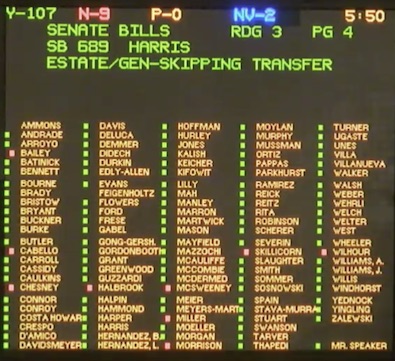
The bill moves to the Senate for final action.
*** UPDATE 1 *** SB1814 is the BIMP. Rep. Dan Caulkins (R-Decatur) announced a conflict of interest and couldn’t vote on the bill. A few more Republican “No” votes on this one and Speaker Madigan didn’t vote…
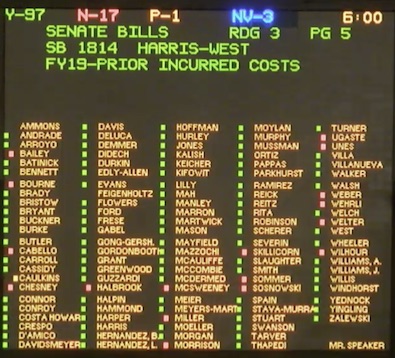
The bill moves to the Senate for final action.
*** UPDATE 2 *** HB142, the bond authorization bill, also passed easily…
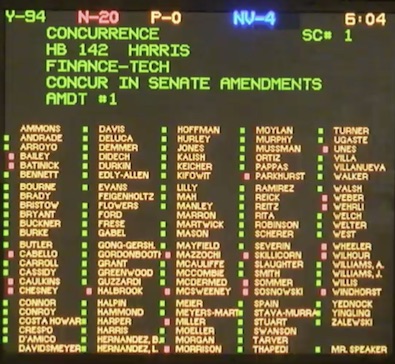
That was final action. It goes to the governor.
*** UPDATE 3 *** SB690 is the revenue package for vertical capital. It includes more casinos, legalized sports betting, higher taxes on video gaming and an expansion of video gaming, a tax hike on cigarettes and vaping, a new tax on parking garages, removes a tax exemption on traded-in properties and imposing a traditional sales tax model for “remote sellers” (online). The bill also includes state incentives for large data centers, which was requested by Leader Durkin.
Rep. Michael Unes (R-East Peoria) was upset because the bill allows the Gaming Board to approve the East Peoria riverboat’s move to the City of Peoria as a land-based casino. The boat is his town’s largest employer. “This language is specifically designed to damage my district,” Unes said. Rep. Ryan Spain (R-Peoria), however, pointed to a 1991 agreement between the two cities that would move the East Peoria boat to Peoria if the General Assembly authorized land-based casinos.
Rep. Kelly Cassidy (D-Chicago) asked the sponsor Rep. Bob Rita (D-Blue Island) if sports betting establishments could open multiple locations within a five-block radius of Chicago sports stadiums. Rita said the bill would not do that. This line of questioning was the result of the deal struck by Gov. Pritzker with Mayor Lightfoot, who worried about sports books springing up all over neighborhoods near stadiums.
Speaker Madigan didn’t vote on this one, either. Democratic Reps. Bristow, Costa Howard and Pappas voted “No.” Leader Art Turner also didn’t vote…
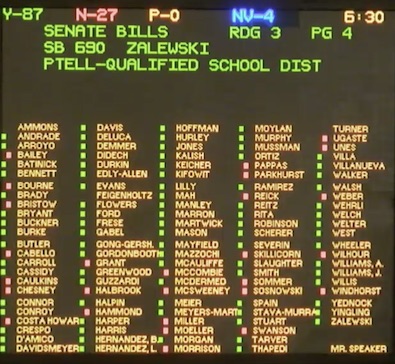
The bill now moves to the Senate for final action.
…Adding… Gov. Pritzker…
“Legalizing sports betting and expanding gaming will create jobs up and down the state, from Rockford to Chicago to Walker’s Bluff, where communities hungry for employment will see 10,000 new jobs. After the Supreme Court legalized sports betting, I promised the people of Illinois that sports wagering would be a key element of my legislative agenda, so that we are competitive with our neighboring states and can create more revenue for communities around Illinois.
“Gaming expansions in this state have been attempted and failed for years; this effort succeeded because of talented and dedicated public servants like Leaders Terry Link and Tony Munoz and Representatives Bob Rita and Mike Zalewski. Today is a win for the whole state.”
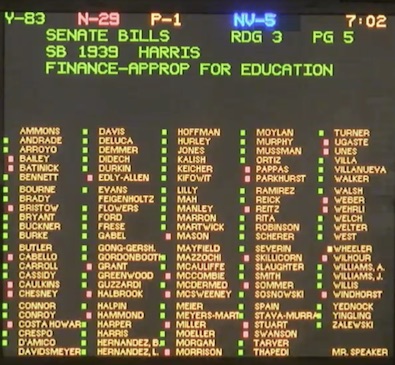
*** UPDATE 4 *** SB1939 contains the revenues to fund the horizontal capital plan, including doubling the Motor Fuel Tax. Rep. Steve Reick (R-Woodstock) said he hates taxes, but “we don’t have a choice” on this vote. “It’s the right thing to do in every community in this state,” he said, and took a mild shot at those who want the spending but don’t want to fund it.
Rep. Will Davis (D-Homewood) has been an outspoken critic of trade unions, particularly in road construction, for a distinct lack of diversity. But Davis said the bill “starts moving us in the right direction” to get training to put people to work. “It’s something we’re extremely, extremely proud of,” Davis said. Davis also called for annual capital bills instead of waiting every ten years “when we struggle.”
Rep. Allen Skillicorn (R-East Dundee), who is running for Congress, said the Democratic arguments against a flat tax “are not true” because of their support for an increase in the Motor Fuel Tax. “Nothing is more regressive than this gas tax,” he said. “Think about your constituents that can’t afford this!” he roared.
Rep. Tim Butler (R-Springfield), who has shied away from controversy since a (weak) primary opponent surfaced, nonetheless spoke on behalf of the bill. He focused mainly on a $315 million high speed rail project for Springfield, which, he said, would make downtown a “quiet zone” by moving trains to a track several blocks east. Lots of legislators have apartments near the 3rd St. rail line, which can keep them up at night.
This was probably the toughest vote of the night because of the MFT increase. But it still got 83 votes. Speaker Madigan didn’t vote again. Democratic Reps. Bristow, Costa Howard, Edly-Allen, Mason, Pappas, Reitz and Stuart voted “No.” There’s your Tier One target list, if you’re keeping score. Republicans voting “Yes” included Reps. Bennett, Bourne, Brady, Bryant, Butler, Demmer, Durkin, Frese, Keicher, Marron, Mazzochi, McAuliffe, McDermed, Meier, Murphy, Reick, Severin, Sosnowski, Spain and Welter. That’s the 20 Leader Durkin promised to deliver…
The bill now moves to the Senate for final action.
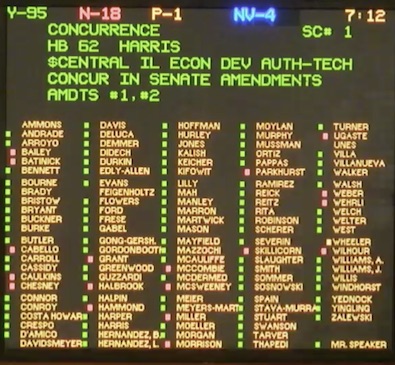
*** UPDATE 5 *** HB62 is the capital appropriations bill…
That was final action. The bill goes to the governor.
…Adding… Press release…
“We believe that Senate Bill 1939 is a responsible investment that will help modernize our transportation system, increase safety on our roads, decrease congestion, and spur economic development in our communities,” said Illinois Chamber of Commerce President and CEO Todd Maisch.
“We are thankful to Leaders Brady and Durkin for fighting to include some of the most pro-business reforms we have seen in recent years. We are also grateful to Governor Pritzker and Democrat leaders for supporting transportation investment to grow our economy and help create future financial stability in Illinois.
“Finally, we applaud the members who came together to move a bipartisan package forward that is sustainable, constitutionally protected and ensures that all taxes paid at the pump will go towards transportation.”
…Adding… Gov. Pritzker…
“After years of neglecting our state’s roads, bridges, mass transit, and buildings, Illinoisans’ health and safety have been jeopardized, and job creation has been hindered. I’m proud that the state is on the verge of adopting a bipartisan infrastructure plan for the first time in a decade. Our plan to rebuild our roads, bridges and communities will create hundreds of thousands of jobs throughout our state. The Rebuild Illinois plan will reinvigorate our economy and strengthen our rightful status as the transportation and supply chain hub of the nation. This historic step forward wouldn’t be possible without the leadership of Senators Sandoval, Manar, Hutchinson, DeWitte, Tracy and McConchie, and Representatives Hoffman, Arroyo, Gordon-Booth, Spain, McDermed and Butler, and countless advocates. I look forward to signing Rebuild Illinois into law to create jobs and make it easier to do business across our state.”
…Adding… IMA…
“Businesses across Illinois need stability, and we applaud Gov. JB Pritzker and lawmakers for coming together in a bipartisan fashion to pass a balanced state budget and enact a jobs program to rebuild our infrastructure including roads and bridges,” said Mark Denzler, president and CEO of the Illinois Manufacturers’ Association. “Manufacturing is our state’s leading economic engine, employing more than 592,000 people. This package will encourage industrial investment by reinstating the Manufacturers Purchase Credit, phasing out the Corporate Franchise Tax, and stopping onerous and costly regulations that would have dictated hiring and pay for energy and chemical companies. These measures, combined with previous legislation extending the Research and Development Credit and creating a new apprenticeship credit, will help manufacturers grow in Illinois.”
30 Comments
|
* Background is here. Statement from Gov. JB Pritzker…
I have spoken to Mayor Lightfoot about her concerns with regards to sports betting, and we have collaboratively worked with the bill sponsors to make clear that the legislative intent will reflect that there are limits on both the number of and locations for sports betting venues. I’m pleased that we have reached this understanding. Working together we remain on track for a strong proposal to improve the economy while protecting all communities in Chicago and Illinois.
*** UPDATE *** More progress. From the mayor’s office…
After productive discussions with the Governor, we have agreed to allow a limited amount of betting at sports venues subject to local oversight and control. These enhancements to the gaming proposal will allow us to maximize revenue capabilities of a new casino for the City of Chicago and ensure a good quality of life for our neighborhoods that might otherwise be affected. As such, I urge the passage of SB 690 as amended. We will remain engaged with the Governor as well as Speaker Madigan and President Cullerton to ensure a fair outcome for all of Chicago this session.
25 Comments
|
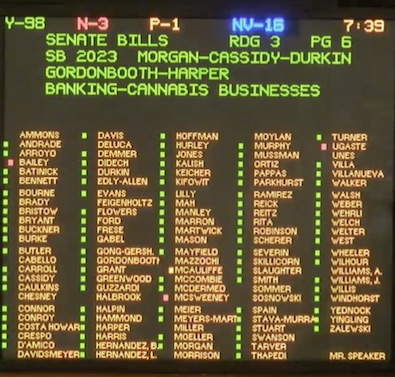
* Two medical cannabis amendments to Rep. Bob Morgan’s SB2023 are being teed up today. House Amendment 1 would allow advanced practice registered nurses and physician assistants to certify patients’ medical conditions. That role is currently limited to doctors.
The amendment would also add “chronic pain” to the list of qualifying conditions. It’s part of this list of new conditions…
autism, chronic pain, irritable bowel syndrome, migraines, osteoarthritis, anorexia nervosa, Ehlers-Danlos Syndrome, Neuro-Behcet’s Autoimmune Disease, neuropathy, polycystic kidney disease, superior canal dehiscence syndrome
Needless to say, adding chronic pain and these other ailments will greatly increase the availability of medical cannabis.
This proposal was held until after the recreational cannabis legalization bill passed so as not to undermine its passage.
Rep. Morgan ran the state’s medical cannabis program under Gov. Pat Quinn. The amendments are scheduled to be heard this afternoon in the House Human Services Committee.
Amendment 2 would allow municipalities in non-home rule counties to put a 3 percent sales tax on medical cannabis sales, up from the current 0.75 percent, to make it equal to the current cap on municipalities within home rule counties.
*** UPDATE 1 *** Whoa. Check out this roll call…
The bill now moves to the Senate.
…Adding… Press release excerpt…
While the Illinois Medical Cannabis Program has been lauded as a model for effective regulation, it is clear that a lack of equal opportunity is a weakness in the current cannabis industry in Illinois. SB 2023 takes steps to address inequities by including the same social equity standards that will be enforced under the adult use legislation that will come into effect in 2020. The 5 remaining dispensary licenses will be awarded with social equity being a significant factor.
“The first five years of this important program have provided valuable patient feedback. This legislation will address many of these patients’ concerns and will ensure the program can support patients with lifelong illnesses,” said Representative Morgan. “As Illinois legalizes the use of recreational cannabis, it is important to maintain a strong program that is focused on helping people with serious illnesses find relief,”
A summary of the bill can be found here.
17 Comments
|
Ives: “Stop this bill from being Bi-Partisan”
Saturday, Jun 1, 2019 - Posted by Rich Miller
* Former Rep. Jeanne Ives tried to gin up her e-mail contacts this morning…
Yesterday, 10 Republicans voted for the Democrat spending plan. They are most likely cued up to vote for a gas tax increase today. Call them: Brady, Bryant, Davidsmeyer, Demmer, Durkin, Hammond, Keicher, Meier, Murphy, Severin.
Republican leadership is asking for Republican state reps to vote TODAY for a doubling of the gas tax and massive gambling expansion to pay for Pritzker’s capital bill which is full of goodies like money for the Obama center and other capital projects local governments and higher education refused to budget for over the years.
CALL YOUR STATE REP, especially if they are a Republican, and shut this down. The Democrats need to completely own this disaster.
The House convenes at noon so call now. If you have their cell number personally text them.
I am told they have negotiated to get 20 Republican votes on these bills. Stop this bill from being Bi-Partisan.
No links, no phone numbers or other contact information, not even any first names or where they’re from in that e-mail blast. I’m thinking it ain’t gonna work too well.
She is right, though, that the House Republicans have pledged to put 20 votes on these bills. That’s a very heavy lift. It’s a caucus of 44 members and many of them are about as tax-averse as you can get, even though most will love the infrastructure spending.
* Meanwhile, here’s Greg Bishop…
Republican state Rep. Mike Murphy signals he’s looking at an infrastructure plan that includes doubling the state’s gas tax. While he didn’t divulge his position, he reacted to concerns from others in his party that say Republicans voting on tax increases gives cover to Democrats in conservative-leaning districts heading into the 2020 election.
Or maybe Republicans should hold up their end? The projects are being distributed throughout the state. Some of them should vote to pay for all that construction.
Video…
23 Comments
|
* IEA…
Today, the state legislature passed the $40,000 minimum teacher salary, ensuring no teacher in Illinois will be able to make less than that amount by 2025 and helping to strengthen the future of the profession.
Currently, the state school code sets the minimum salary for teachers in Illinois at $10,000 a year for those with a bachelor’s degree and $11,000 for those with a master’s degree. In addition, Illinois is in the midst of a teacher shortage and last year, more than 1,500 positions went unfilled and more than 2,000 went unfilled the year before.
Rep. Katie Stuart, D-Collinsville, is a former teacher and sponsored the bill in the House and Sen. Andy Manar, D-Bunker Hill, who pushed the revamp of school funding in Illinois, sponsored the Senate version.
In both, the increase would be phased in over five years, giving districts time to plan financially for the change. Similar legislation passed last year but was vetoed by Gov. Bruce Rauner.
“In our recently released State of Education in Illinois survey, we asked Illinoisans what words they most associated with teachers. The two most common words were underpaid and undervalued,” said Kathi Griffin, president of the Illinois Education Association.
“This legislation shows that lawmakers recognize this. They can see that salary is one of the main factors that prevents people from going into the profession. There is a teacher shortage and it has a detrimental impact on our children, our state’s most important asset. This will help districts across the state attract and retain the best and brightest and that’s what best for students.”
Manar, the sponsor of the bill, said it’s important that educators feel valued.
“Teachers don’t go into the profession for the money, but they have to be able to earn a living. We can’t on one hand say that education is a priority in the state and on the other hand not be willing to pay for it. Investing in educators is investing in education and it benefits students,” Manar said.
An analysis of Illinois State Board of Education data shows that fewer than 8,000 of the state’s 130,000 teachers make less than $40,000. Illinois could bring all of the teachers currently being paid less than $40,000 up to the $40,000 mark this year and only use 10 percent of the evidence-based funding formula dollars. However, the bill does not make that proposition, instead phasing it in over five years. And, the new evidence-based funding formula is designed to funnel money to the school districts with the most need, helping to ensure every district can meet its financial obligations.
* Background…
The bill would increase salaries gradually over a period of five years to reach a $40,000 minimum. As part of a phase-in period, the salary would increase to a $32,076 minimum in the 2020-21 school year, $34,576 in 2021-22 and $37,076 in 2022-23.
14 Comments
|
RHA roundup
Saturday, Jun 1, 2019 - Posted by Rich Miller
* Tribune…
A bill that establishes a “fundamental right” for women to get an abortion in Illinois cleared the state Senate late Friday night, sending the sweeping measure to Gov. J.B. Pritzker, who already has signaled his support.
As the clock approached midnight Friday, the Senate voted 34-20 in favor of the abortion legislation, which comes amid an increased sense of urgency among advocates looking to protect abortion access as a series of states have passed laws essentially banning the practice.
“I believe, frankly, there’s a war against women’s rights going on,” Sen. Melinda Bush, the Grayslake Democrat who sponsored the bill in the Senate, said about the restrictive laws other states have passed.
The bill establishes the “fundamental right” of a women to have an abortion and states that a “fertilized egg, embryo or fetus does not have independent rights.” It repeals the Illinois Abortion Law of 1975, doing away with provisions for spousal consent, waiting periods, criminal penalties for physicians who perform abortions and other restrictions on facilities where abortions are performed.
* Center Square (or, if you prefer, the artist formerly known as INN)…
Republicans warned that the bill would adopt language that would allow otherwise viable fetuses to be aborted.
“It’s about radically expanding what is allowed under law,” said Sen. Sue Rezin, R-Morris. “If there’s a line, we’ve definitely crossed it here in Illinois with this proposal.”
The matter now heads to Gov. J.B. Pritzker, who campaigned on the promise to make Illinois the most progressive state in the nation for reproductive rights.
Pritzker met Democrats on the Senate floor late Friday night to congratulate them after the vote.
The bill would take away reporting requirements regarding the reason an abortion procedure was performed, including restrictions Republicans insisted would keep coroners from investigating potentially botched abortions.
Just to be clear, the idea here is to treat abortion like all other medical procedures. Coroners aren’t automatically notified after botched heart surgeries, for example (or, as a commenter pointed out, when a mother or child dies during birth).
* Capitol News Illinois…
The measure received 34 Democratic yes votes. Twenty senators voted no, including lone Democrat, Bunker Hill Democrat Andy Manar. Three Democrats voted present. […]
McConchie sought clarification on whether any provisions of the legislation would render toothless the Parental Notification of Abortion Law, which requires a minor to consult her parents before getting the procedure. Bush said no part of her bill would impact that statute.
* SJ-R…
″(Abortion) is not a medical procedure,” she said. “What we’re talking about today isn’t simply protecting women’s reproductive health choices. … If there’s a line, we definitely crossed it here in Illinois with this proposal.”
“The one bill that will be most detrimental, and the one that we will be talking about 40 years from now, is this bill right here,” Rezin added. […]
With a group of mostly female state representatives, who had come to the Senate floor to watch the debate, standing behind Bush, holding hands, Bush described the “ungodly hate” she and other proponents of the Reproductive Health Act have faced, including death threats.
“To make that decision, (to have an abortion) that is not an easy decision,” she said. “That is not something that any woman makes without tremendous difficulty and pain. Nor something she ever forgets … (but) it’s her right to make that choice.”
15 Comments
|
Updated cheat sheet on the big stuff
Saturday, Jun 1, 2019 - Posted by Rich Miller
* I’ve updated yesterday’s list…
SB690 — Revenue (gaming, cigarette tax hike, etc.) for vertical (universities, etc) construction [Passed the House 87-27, pending in the Senate]
HB3096 — FY20 operating revenue [Passed by Senate, pending in the House]
Added: SB 689 (HA3) — FY20 operating revenue with Leader Durkin’s pro-business requests. [Passed the House, Senate awaiting House action]
HB142 — Bond authorization [Passed the Senate, passed the House]
SB1814 — Budget Implementation Act (BIMP) [Passed the House 97-17-1, pending in the Senate]
HB62 — Construction appropriations/spending [Passed both chambers]
SB262 — FY20 operating appropriations/spending [Passed both chambers.
SB75 — Comprehensive anti-sexual harassment proposal [Passed the House 114-0, pending in the Senate]
SB25 — Reproductive Health Act [Passed both chambers]
SB1966 — Fix the FOID [Passed House, stalled in Senate]
Added: SB1939 — Capital taxes/fees. [Passed the House, pending in the Senate.]
Added: SB2023 — Expand medical cannabis program. [Passed the House, pending in the Senate.]
If I’ve missed something, please let me know in comments and I’ll add it.
…Adding… There was a change overnight and I didn’t catch it. HB3096 became the revenue plan for the operating budget. Change is reflected above.
14 Comments
|
“Fix the FOID” stalls in Senate
Saturday, Jun 1, 2019 - Posted by Rich Miller
* The quiet failure of the “Fix the FOID” bill in the Senate caught some off guard. That chamber, with its 40 Democrats, is not exactly known as a gun-lovers paradise…
(T)he legislation faced strong opposition, with detractors calling the proposed new regulations among the most “onerous” in the nation and an infringement on their constitutional rights. […]
On Friday, Democrat Julie Morrison, the Senate sponsor of the bill, spoke strongly in support of it but said she ran out of time to explain to fellow senators the significant changes it proposed. […]
Kathleen Sances, president of the Gun Violence Prevention PAC, which was involved in drafting the legislation, is holding out hope the proposal will come for a vote before the Senate at a later date.
“We’re really thrilled that we were able to get the bill out of the House, and I really have to give credit to Rep. (Kathleen) Willis,” Sances said of the bill’s House sponsor. “We ran out of time in the Senate. … So moving forward we’ll just be talking with both chambers and we’ll see what we can do to get enough votes to pass it in the Senate.”
The Illinois State Rifle Association was ready to deal on this topic and has a bill to address it. The Democrats could’ve had a bipartisan proposal to address the FOID issue, but they went their own way in the House and it apparently spooked the Senate Democrats, who aren’t normally spooked. That caucus will pass just about anything.
* Related…
* Ammons’ ‘Democrat judge’ bill on pause in state Senate: “HB 97 is a piece of legislation that can start the very real conversation about diversity on the judicial benches of downstate Illinois,” Koehler said. “I do not plan on running this legislation this session. I look forward to having conversations this summer with (Supreme Court) Justice Tom Kilbride and others about the best path forward.”
26 Comments
|
Goodbye and good riddance to this debate
Saturday, Jun 1, 2019 - Posted by Rich Miller
* I’m really happy that I don’t have to write about this bill any more…
Illinois is likely to become the 11th state to allow small amounts of marijuana for recreational use after the Democratic-controlled House on Friday sent a legalization plan to Democratic Gov. J.B. Pritzker, who campaigned on the issue.
* I’m elated that I no longer have to endure silly arguments like this…
State Rep. Anthony DeLuca, D-Chicago Heights, talked about the negative health effects of the drug. He brought out props to the House floor: An egg and a pan.
“This is your brain,” DeLuca said as he cracked an egg into a frying pan. “There it is folks. This is your brain on drugs. So today for my family, for my children, for your family, of your children, and especially for African American and Hispanic communities, vote no.”
State Rep. Bob Morgan, D-Deerfield, immediately stood in support of the measure and to “refute some of the what I call nonsense that we heard including wasting eggs that should have been used to make a souffle or something instead of making a ridiculous point that has been outdated for over 30 years.”
* I defintely won’t miss the over-hyped nonsense…
“If this bill passes, a giant, big-money industry will commercialize another harmful, addictive drug in our state,” said Rep. Marty Moylan, a Des Plaines Democrat and outspoken opponent of legalization.
* And the “I’m not saying, I’m just saying” crud…
Violent crime has increased in Colorado, Alaska, Oregon and Washington state at rates higher than the national average since those states legalized recreational use, said Rep. Patrick Windhorst, R-Metropolis.
He said it’s unclear whether marijuana played a role in violent crime rising in those states. But he said Illinois should delay legalization until more is known.
* And the “We just need more time” pleas…
State Rep. Tom Morrison, a Republican who opposed the legislation, said the state isn’t prepared.
“Our law enforcement agencies do not support this. They are not ready for this and don’t have the capabilities to enforce this,” he said in a statement.
* “We need more studies”…
“The idea that there’s no studies out there on this stuff or that we think we have the answers on this stuff, is pretty appaling that we’re rushing into this,” said state Rep. Mark Batnick (R-Plainfield). “I know this has been out there for a while. I know the sponsor has worked on it for a long time, but my goodness there seems to be a lot of red flags on this issue.”
-30-
35 Comments
|
Budget, capital, gaming roundup
Saturday, Jun 1, 2019 - Posted by Rich Miller
* The tone completely changed on the House floor last night after the leaders and the governor finally came to an agreement. Illinois Public Radio…
Democratic state Rep. Will Davis, from Homewood: “We know that as we continue to work collaboratively — if that is what we indeed want to do — when we work collaboratively, there are a lot of things that we can indeed get done.”
House Republican Leader Jim Durkin echoed those remarks.
“It’s amazing what we can do around in just a few hours if people are willing to work together, and we just started doing that,” Durkin told his colleagues. “So I feel we’re on a good path, and I’m pleased to put my vote on the board tonight, and let’s get our work done by tomorrow.”
* More on the budget…
Action on the budget came after hours of negotiations with Pritzker and the four partisan leaders of the House and Senate. Republicans, though a minority party in the legislature, sought concessions from Pritzker aimed at helping the business community in future legislation.
“I am very glad these matters are being taken into consideration,” said House Republican leader Rep. Jim Durkin of Western Springs, citing several business credits and tax incentives in the plan. “Tonight is the start of us finishing up this year working on a budget that is balanced and fair to Illinoisans.”
State Rep. Greg Harris, the Chicago legislator who headed up budget talks for majority House Democrats, said the plan also allows for borrowing $1.2 billion to help pay down a multibillion-dollar backlog of overdue bills to providers of state services that grew exponentially during the budget impasse.
* And progress was evident after both chambers approved the state’s operating budget…
The Illinois Senate made the first move to get a $45-billion infrastructure plan approved early Saturday morning. Senators approved billions of dollars in bonding authorization for some capital projects, as well as paying down backlogged bills.
It also ok-ed billions of dollars in a long list of projects — from development near Soldier Field in Chicago to new libraries and updated residence halls at universities to overhauled water infrastructure in cities across the state.
* Finke…
At one point Friday, it appeared that partisan acrimony could threaten to derail things like a gambling expansion bill and a capital plan, major components of Gov. J.B. Pritzker’s first legislative session.
However, a series of meetings Friday night between Pritzker and various legislative leaders led to a thaw in tensions. House Republican Leader Jim Durkin of Western Springs left a meeting with the governor, Senate President John Cullerton, D-Chicago and House Speaker Michael Madigan, D-Chicago, saying he believes the Democrats are willing to consider some pro-business issues.
“Our caucus for the past few weeks has been very insistent that if we are going to participate there have to be some meaningful business reforms,” Durkin said. “I finally get the impression tonight that the governor and Democrat leaders are going to take those under consideration.”
Several business leaders sent a letter to Pritzker earlier this week outlining changes they want to see on business issues. They want tax incentives to locate data centers in the state, elimination of the state franchise tax, reinstatement of a tax credit to help manufacturers and no further action on a pro-labor bill affecting jobs at refineries, ethanol plans and chemical facilities.
* More niceties…
State Rep. Tom Demmer, R-Dixon, said a bipartisan agreement was reached to get some Republicans to support the $40.3 billion spending plan. The agreement includes finding some reforms to grow the economy “that we think will strike the right balance and be a fair compromise to be a stable budget of the state, one that addresses the pressures that we face while also addressing some important policies that help us grow our economy.”
House Minority Leader Jim Durkin said there’s a willingness for bipartisanship, but only when each side’s priorities are recognized. Durkin laid out Republicans’ priorities.
“Things that we think are important for the business community,” Durkin said. “By enhancing our ability to local data centers in Illinois with tax incentives, eliminating the retailers discount which we’ve talked about before, eliminating the antiquated Illinois franchise tax, reinstating a manufacturer’s purchase credit, enacting a blue collar jobs act and others.”
“That strikes the right balance of what we need in this state,” Durkin said.
Durking heaped praise on Demmer later for being a key player in putting this together.
* Not everything is rainbows and ponies, however…
And during a House Executive Committee, lawmakers cleared a gambling proposal that would add six casinos in Chicago, Waukegan, the south suburbs, Williamson County in southern Illinois, Rockford in northern Illinois and Danville in the state’s east-central region.
The Chicago casino would be able to have up to 4,000 gambling positions — three times more than any other casino in the state currently has — and slot machines would be allowed at O’Hare and Midway airports. Bill sponsor State Rep. Bob Rita said money from the proposed Chicago casino would be split in thirds among the city, state and the private owner.
But Lightfoot issued a statement saying that while she wants a Chicago casino, she doesn’t support sports wagering at place like Soldier Field.
I’m still not sure how they’re going to deal with Lightfoot’s late demand.
12 Comments
|
|
Comments Off
|
* The House had been scheduled to convene at 10 this morning. Then came this e-mail from the House Speaker’s office…
Session will be delayed until noon today
Go back to bed.
*** UPDATE *** From the Senate President’s office…
The Senate anticipates returning to session at 3 p.m. on Sunday, June 2.
7 Comments
|
|
 Support CapitolFax.com
Visit our advertisers...

 ...............
 ...............
 ...............


|
   
|
Hosted by MCS |
SUBSCRIBE to Capitol Fax |
Advertise Here |
Mobile Version |
Contact Rich Miller
|



