* J.P. Harris and The Tough Choices are playing at 8 tonight at the Hoogland Center. From WUIS…
When The Tough Choices began, there were only two rules: keep it country, and keep it simple. They have done both, yet still weave burning pedal steel leads and painfully genuine guitar solos with the cool calm of a Spaghetti-Western Clint Eastwood. The Tough Choices have been described as such: “…imagine that somehow, defying the laws of nature, Hank Williams and Lemmy Kilmister hatched an egg…this egg was incubated under a neon light for twelve years (which is approximately the time Wild Turkey ages in the bottle), and were hatched in a juke joint…” These ruffians draw on influences ranging from early Western Swing to rough-edged Truck Driving ballads; Bob Wills all the way to Merle Haggard 15 or so years after that funny album cover with the Chihuahua in his arms. Think of them as the perfect gentlemen to bring home for Christmas, if only you could get the stains off their Wranglers and the cheap whiskey off their breath.
In voting completed yesterday, frontline employees of the state of Illinois represented by the American Federation of State, County and Municipal Employees (AFSCME) Council 31 elected to implement their new collective bargaining agreement with the state.
It was the second time that state workers have voted on the agreement. The re-vote was necessary because a condition of the first ratification vote—that the state would drop its appeal of a court ruling on the matter of back wages owed to employees since July 2011—has not yet been met. While the Quinn Administration sought to drop the appeal, Attorney General Lisa Madigan holds final authority on such matters and has indicated she will not yet do so.
“Frontline state employees have done their part,” AFSCME Council 31 executive director Henry Bayer said. “They work, often without adequate staff, in state parks and prisons, to care for the most vulnerable and protect children from abuse.
“We urge legislators to act now to pass House Bill 212, House Amendment 2, to pay state workers the back wages they are owed.”
* If you’ve been watching the live session coverage post, you already know that the medical marijuana bill (HB 1) just passed the Senate on a vote of 35-21. The bill now goes to the governor.
* The Question: Your thoughts on this bill passage?
* Ever since the Tribune poll came out last week which showed Mayor Rahm Emanuel’s poll numbers slipping, particularly with African-Americans, the Chicago media has seemed to really amp up the criticism.
Down was up and up was down as Emanuel joined business and labor leaders at McCormick Place to begin the formidable job of selling the concept of using more than $100 million in public money to bankroll a 10,000-seat arena near McCormick Place. It will become the new men’s and women’s basketball home of the DePaul Blue Demons.
It’s a tough sell. Aldermen, union leaders and local residents have questioned the mayor’s priorities at a time when Emanuel is closing 53 elementary schools, phasing out the city’s 55 percent subsidy for retiree health care and using millions in overtime to mask a shortage of police officers.
Aldermen, have your heads stopped spinning over all the details in that McCormick Place/Navy Pier megadeal announced Thursday?
If so, we have some questions for you. No, not about that megadeal. About the last megadeal. The one on revising the parking meter contract that was announced 19 days ago.
The Elevate finance scheme may be quite different from the Soldier Field deal, but the question is the same: Who, exactly, would be responsible in the event of cost overruns, or runaway operating expenses, or insufficient hotel tax revenue, or the financial collapse of one of the players in this project — or if the facility just turns out to be a white elephant nobody patronizes?
There’s nothing inherently wrong about public-private partnerships. But tell us now: If this thing flops, who is the ultimate guarantor? Because if it’s Tommy and Tammy Taxpayer, they’re already partners in one risky financing deal on the lakefront.
We’re not convinced that his big, new addition to McCormick Place — a 10,000-seat sports arena where the DePaul Blue Demons would play basketball — makes sense. Especially when $103 million in taxpayer dollars is involved. If DePaul were to use it 18 nights a year, who are these corporations, schools and conventions just dying to use it the other 347 days?
Mayor Rahm Emanuel on Thursday defended his decision to save $108.7 million-a-year by phasing out the city’s 55 percent subsidy for retiree health care and forcing 30,000 retired city employees to make the switch to ObamaCare.
hey
“There’s another way to upset people, which is saddle `em with a half-billion dollars worth of costs with no way to pay it. That, too, will have a lot of other people upset,” Emanuel said.
Cook County Board President Toni Preckwinkle broadly criticized Mayor Rahm Emanuel’s education agenda Thursday, saying the Chicago Public Schools teachers’ strike last year had provided the excuse for a sweeping school-closure plan that “weakens our public schools.”
In an exclusive interview with the Chicago Sun-Times, she suggested the mayor and his handpicked schools officials refrain from shuttering 13 of the 54 schools marked for closure. She noted that hearing officers hired to oversee the process recommended that those schools stay open. […]
“I think he came into office critical of the teachers,” she replied. “If you spend the whole year before you have to negotiate a contract insulting your teachers, I don’t know what you expect. They had a contract that said they were entitled to a raise, and then the Board of Education that he appointed refused to give it to them. That was the first summer that he came into office.”
Asked if she expected closing so many schools would trigger teacher layoffs, Preckwinkle replied, “How could it not? How could it not? It weakens the teachers’ union and I would argue it weakens our public schools. You know, one of the people in the public schools who I admire most talked to me a couple months ago — it was so depressing — the comment was, ‘I think they’re deliberately trying to destroy our public schools.’ ”
The Chicago Teachers Union’s decision to go to court to try to stop the city from closing 53 elementary schools, while not unexpected, makes clear that the Board of Education’s vote on the proposal next week will not put an end to the controversy.
The two lawsuits, filed on behalf of parents and their special needs children, say the proposed school closings are unfair, will harm students with disabilities and are discriminatory because almost all the students affected are African-American.
Making the case to close Ericson Academy on the West Side, Chicago Public Schools officials stressed that it would cost $9.6 million to fix the 51-year-old building. What they didn’t point out in materials provided to parents was that they planned to spend nearly as much this summer on repairs to Sumner Elementary, where Ericson students would be reassigned.
District officials said one downside of Calhoun Elementary, also slated for closing, was its lack of air conditioning in every classroom. Yet records that were not part of the district’s presentation on closings show the designated replacement school, Cather Elementary, would require the installation of 33 window units to bring cooling to every room.
Mayor Rahm Emanuel has returned a $10,000 campaign donation from a lobbyist for a tech firm disqualified from a city program this week after the Tribune raised questions about potential violations of the mayor’s self-imposed limits on political fundraising, an Emanuel spokeswoman confirmed Thursday.
The action by Emanuel came a day after he announced he would return $15,000 in donations from several key figures behind the CityScan tech firm that potentially violated the mayor’s executive order banning contributions from vendors seeking city business. The company was also removed from the list of firms prequalified to get a city contract under Emanuel’s municipal marketing program.
* The truly big state money is spent on employer pension costs at the Teachers Retirement System. Higher education pension costs are a relative drop in the bucket…
Illinois’ public colleges and universities will gradually begin picking up the costs of their employees’ pensions starting next year under an agreed plan announced Thursday by House Speaker Michael Madigan and higher-education representatives.
“It’s only the right thing to do,” Madigan (D-Chicago) told reporters after the open meeting. “Whenever one person spends money and another person pays the bill it’s a bad policy, especially for government.”
Madigan’s long-sought pension ‘cost-shift’ bargain - an idea not contained in either of the two major pension reform bills floating in the Legislature - comes in the second week of his formal discussions with higher education institutions.
Under the plan, the state’s public universities and community colleges would pay an additional one-half percent of payroll costs into the pension system each year starting in fiscal year 2015 until the colleges cover all costs. Madigan indicated similar changes to elementary and secondary school districts were coming but did not discuss details.
Universities and colleges privately signed on to this concept months ago. So this isn’t completely “new.”
The proposal also allows community colleges and universities to opt out of future pension enhancements that might be approved by the General Assembly, since they would be responsible for picking up any additional costs associated with it.
* While this initial agreement won’t save a ton of money for the state, it will cost the colleges and universities a noticeable sum…
Republicans opposed to the change contend the move could drive up property taxes as community colleges seek to offset the extra burden. Representatives for the state’s universities and community colleges acknowledged they will have to reduce positions, cut programs, and raise tuition and fees to make ends meet.
Tuition across the state already has been on the rise in recent years. The base annual tuition for new students at the University of Illinois’ flagship Urbana-Champaign campus starts at $11,834 — a 112 percent increase from 10 years ago. With fees and housing costs, the yearly price tag grows to at least $24,729.
The pension shift will cost the U. of I. an estimated $5 million to $6 million each year, President Robert Easter said. Southern Illinois University would need to set aside a projected $3 million to $3.5 million each year, President Glenn Poshard said.
But the two leaders contended that they would rather be forced to make tough spending decisions than face additional cuts to general state spending. Those cutbacks have been the norm in recent years as the state struggles to get its finances in order.
Rep. Elaine Nekritz, D-Northbrook, said the plan for universities and community colleges will be discussed with public school districts.
“We want to have a discussion with the local districts and those representing the local districts here to see whether this program works for them, doesn’t work for them,” Nekritz said.
* Caterpillar’s CEO Doug Oberhelman sat down for an interview with Business Week…
Oberhelman paid his way through Millikin University, a small private college in Decatur, “by working at a bank, where he did everything from sign home mortgages to repossess cars.”
“It was a fabulous experience,” he told Businessweek. “You knock on the door, and you tell somebody you’re gonna take their car away — and usually they’re down on their luck, and their car is the last thing they have. So I learned to deal with that.”
I prefer to charitably interpret that remark as meaning the experience gave him the ability to “deal with” human suffering. Others may not be so charitable.
* It’s been a very long, difficult week and it ain’t over yet, but let’s lighten it up a little.
My former intern Barton Lorimor and his wife Jen came over to the Capitol Fax International Headquarters (my house) Monday night and met Oscar the Puppy. Oscar loved them both, but he was particularly fond of Barton. Watch that little tail wag…
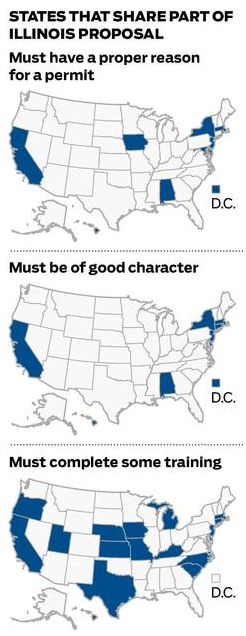
Sponsoring Sen. Kwame Raoul said he believes the restrictions in HB 183 are needed to protect public safety by keeping guns out of the wrong hands and out of sensitive places.
But many lawmakers expressed concerns over a provision that requires a person to have “good moral character” — the basis on which local law enforcement could object to a person’s application — and “proper cause” to carry a weapon in Illinois.
“What are you looking for? The guy didn’t go to enough of his kids’ softball games …? That someone drank too much, that they didn’t spend enough time at home? … What is it that you’re looking for in that?” asked Sen. Dale Righter, R-Mattoon.
Illinois State Police Lt. Darrin Clark cited as an example a person who has had repeated run-ins with police despite never having been charged with a crime.
“There’s a number of individuals that are ‘on the bubble,’ so to speak, that are not a risk at this point, but there’s just something not quite right,” Clark said. “There would have to be a pattern of behavior that had been documented.”
But Righter argued the bill’s language is too vague and could lead to law enforcement denying permits to basically anyone they wish.
By Thursday night, however, Raoul said he was drafting an amendment to be considered Friday that would remove the “good moral character” criterion.
Raoul said he would keep intact the consideration of a “proper reason for carrying a firearm” because it has been tested in Indiana and gives leeway to reject an applicant whose desire to carry a gun is “inconsistent with public safety.”
In addition, Raoul said, he plans to amend phrasing to tighten up the language so that “there would be less fear of an arbitrary objection from a local sheriff.”
After Thursday’s committee vote, Senate President John Cullerton (D-Chicago) said the concealed-carry legislation could surface for a floor vote as early as Friday, but the top Senate Democrat stopped short of predicting its passage.
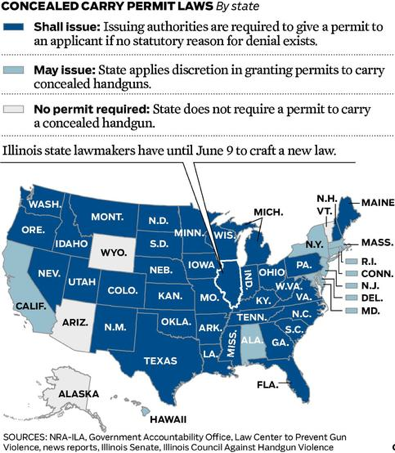
If it’s adopted and moves to the House, it will compete with an NRA-backed plan that fell seven votes short of passage last month but could resurface. That plan got significantly more support than a more restrictive measure, more in line with Raoul’s, that also failed last month.
House Speaker Michael Madigan, D-Chicago, said he discussed the issue with Raoul and acknowledged large differences among various proposals.
“It won’t be easy,” Madigan told reporters Thursday. “People are going to be asked to compromise, they’re going to be asked to do some things they really don’t want to do.”
No one is happy with a bill permitting the concealed carrying of weapons that passed out of the Illinois Senate Executive Committee Thursday by a 10-4-1 vote.
But the bill — the result of a months-long effort by state Sen. Kwame Raoul to find a middle ground — is the best option on the table for resolving this issue. It could come to a vote as early as Friday in the Senate, and the vote is expected to be close.
* And the Tribune has a good infographic that breaks down the components of Raoul’s bill. Check it out. From that page…
Legislation lowering Illinois’ voting age to 17 for primary elections has passed the Democrat-controlled state legislature and is on its way to Gov. Pat Quinn (D) for his signature.
Many believe the law is designed to create a permanent Democrat majority in Illinois using young Hispanic voters.
Illinois is home to two million Latinos and 773,000 Hispanic eligible voters. More than a third of that are between the ages of 18 and 29.
Um, OK.
I’m not gonna take a position on this particular bill either way because I really don’t care one way or the other. But the measure only applies to primary voters. If somebody is 17 at the time of the primary, but will be 18 at the time of the general election, then that person can vote in the primary. I really don’t see how this is some sort of “brown people conspiracy.” C’mon, man.
And secondly, even if it is a vast and nefarious conspiracy, why not start competing for those votes instead of complaining? Didn’t most of the voting restrictions that the GOP tried to put in place in other states before last year’s presidential election backfire? How about just getting out there with a winning message?
…Adding… Apparently, lots of Republicans are participating in this alleged conspiracy…
The Senate recently approved the bill 43-9. The House approved the bill 95-22 in April.
A controversial measure that would change how the U.S. Census counts Illinois prison inmates is advancing in Springfield.
The census counts Illinois’ prison inmates as residents of the town the prison is in, not the town they came from.
That population can affect a region’s eligibility for government money.
State House members narrowly approved a bill Wednesday saying the state will start keeping track of an inmates’ last known address for census purposes.The measure passed with the bare minimum of favorable votes, 60-55.
The bill’s passage upset Republican State Rep. Chad Hays from Danville, which has a prison that currently holds about 1,800 inmates, according to the Illinois Department of Corrections.
“I just lost 2,000 residents,” Hays said after the vote.
* The Question: Should prisoners be counted by the Census at their current prison address or at their last known home address? Take the poll and then explain your answer in comments, please.
Um, actually, that’s not true. Retirees are most definitely impacted. They’d have to choose between continuing with subsidized government health insurance or taking a reduced COLA.
How the heck did she not know that retirees would be impacted before she trumpeted her own support?
*** UPDATE *** I had the following e-mail exchange with an AFT spokesperson today…
AFT: Rich- I wanted to make sure you saw that Randi sent Fred Klonsky a longer comment off twitter to clarify why she and IFT support the pension proposal. He made it a separate post.
Miller: Yes, I saw that. She doesn’t address the issue about how she got her facts wrong. Can you?
AFT: She quickly corrected her tweet. Then she sent Fred that longer message since she didn’t feel like twitter’s 140 characters was sufficient to detail her thoughts on the bill
Miller: But why was she wrong in the first place?
AFT: 140 characters is an art, not a science and didn’t effectively capture her thoughts—hence the longer blog comment.
I was told by somebody else that Weingarten has been in transit and tweeting on the go. She knew that retirees were in the bill, but that the inclusion wasn’t unreasonable.
The Senate’s Assignment Committee has just assigned Amendment 1 sponsored by Sen. Raoul to House Bill 183 to the Senate’s Executive Committee.
Earlier this session, Senate President John J. Cullerton designated Senate Judiciary Chairman Kwame Raoul to negotiate a legislative proposal for concealed carry.
Senate President Cullerton issued the following statement regarding House Bill 183:
“I want to commend Sen. Raoul for negotiating another tough issue on behalf of our caucus. The framework of this proposal acknowledges the diversity of our state, embraces local control, and provides for sensible safeguards.”
The Senate’s Executive Committee will take up that proposal today. Once amended, House Bill 183 does the following:
· Directs State Police to give concealed carry licenses to people who meet certain qualifications
· Allows local law enforcement to object to a local resident’s application
· Allows a gun owner to carry a concealed weapon in Chicago only with a special endorsement; while applicants are subject to the same qualifications, Chicago police can conduct their own investigation
· Prohibits loaded weapons in certain kinds of places, e.g. schools, hospitals and public transit
· Allows home rule municipalities to ban guns in other kinds of places by ordinance
· Requires applicants to pass a firearm training course
· Closes the private sale and transfer loophole by requiring a seller to verify that the buyer’s FOID Card is still valid
· Strengthens mental health reporting requirements
· Requires a gun owner to report a lost or stolen gun within three days of realizing it is missing
* Reboot Illinois has a pretty good side-by-side comparison of House Speaker Michael Madigan’s pension reform bill and Senate President John Cullerton’s bill. Click the pick for a much larger image…
* The AP has a story up which breaks no new ground on the potential gubernatorial candidacies of Lisa Madigan and Bill Daley. Adlai’s quote at the end, however, is worth an excerpt…
While the all-in-the-family field of potential candidates may seem to some like yet another Illinois political oddity, it isn’t so striking to former U.S. Sen. Adlai Stevenson III, whose own Illinois family tree includes a vice president, secretary of state and a governor.
“My father used to say he was born with an incurable, hereditary case of politics,” Stevenson said. “You’re born into a life of service, and sometimes you’re just conditioned to carry on.”
Provides that if expenditures are incurred for hosting receptions, benefits, and other large gatherings held for purposes of goodwill or otherwise to influence executive, legislative, or administrative action and if the total number of State officials invited to such an event is equal to or greater than the number of State legislators in the smaller minority caucus of either the House of Representatives or the Senate, as defined in the rules of those chambers, then only the total amount of the expenditure, the date of the event, and the estimated number of officials in attendance shall be reported.
That language is specifically designed to help out the Senate Republican caucus. The existing statute allows the limited disclosure for events when there are “25 or more State officials invited.” Before last year’s elections, the Senate Republicans had 24 members, so lobbyists would invite another Republican official to make it 25.
But now the Senate Republicans have just 19 caucus members. That makes things a bit tougher, and any event with just the SGOPs requires full disclosure for each member. Something needed to be done, and it was. At least in the Senate.
Well, at least the vote didn’t end in a fistfight.
But the Illinois Senate did give state Sen. Mike Jacobs, D-East Moline, a good punch in the snout when it voted 52-1 last week to require that all lawmakers disclose relatives who are lobbyists.
Two years ago, Jacobs and state Sen. Kyle McCarter, R-Lebanon, got into an altercation after McCarter made an issue of Jacobs sponsoring a bill that Jacobs’ father, a lobbyist, was pushing.
During the scuffle, McCarter said he got punched.
Jacobs said he didn’t do it.
One thing is certain: it was an in-your-face confrontation seldom seen on the floor of the Illinois Senate.
The issue of lawmaker relatives lobbying re-emerged last Thursday when the Senate approved Senate Bill 1361. Jacobs was the only person in the chamber to vote against the measure that requires all lawmakers to disclose any relatives who are lobbyists.
“This is really just a baby step in the area of ethics, but it’s a step in the right direction,” said state Sen. Darin LaHood, R-Dunlap.
McCarter added, “It’s essential that everyone in government be transparent – even Mike Jacobs.”
For his part, Jacobs says he is the most transparent person in the state Senate.
“This is just a case of politicians trying to make themselves look better than they really are,” he said. “I refused to play along. This is just a game of Gotcha!”
Jacobs is up for reelection next year. He should’ve voted for that bill.
* Bloomington and Normal haven’t yet started talking about what could happen if home rule units are given the power to add areas to the state’s concealed carry off-limits list, as has been proposed by Sen. Kwame Raoul…
Bloomington Mayor Tari Renner said it’s premature to comment on Raoul’s idea.
“As a city, as a community, we haven’t even begun to have this conversation yet,” he said. “We don’t know what the repercussions of this would be.”
Normal Mayor Chris Koos said he couldn’t comment without having discussed the issue with the City Council or seeing the context of it within the overarching legislation.
* But the Springfield city council discussed last night what might happen if the General Assembly fails to act by June 9th and the state’s public carry laws are struck down as unconstitutional. From an e-mail sent to me by Springfield Ald. Sam Cahnman…
I along with a number of other Alderman plan to introduce an ordinance to regulate concealed carry in the event the General Assembly fails to act by the June 9th deadline.
As you know, we are a home rule unit. The ordinance would probably honor concealed carry permits from other jurisdictions and allow other Illinois residents to carry if they have a FOID card. It will probably allow business to prohibit carry in their establishment if they got on a computer list and posted the appropriate sign.
It may exclude certain public buildings from the right to carry, like the courthouse and maybe the Capitol Building, or we may just leave it up to the governmental entity that occupies the building, State or County.
We discussed this at our meeting last night of the Committee of the Whole of the City Council.
* By the way, Sen. Raoul penned a Sun-Times op-ed about his bill…
I have spoken with both victims of gun violence and Second Amendment advocates, and this week I will introduce the Gun Safety and Responsibility Act. This bill satisfies the court order, while meeting the critical need for reasonable gun safety laws in the communities most affected by violence.
In Chicago, where we experience the bulk of gun violence, this law would put in place additional layers of security before a person could receive a concealed-carry permit. Not only would the Illinois State Police have to approve the application, but the Chicago Police superintendent also would have to sign off on it.
This system would pose no threat to law-abiding citizens. People with criminal records or a history of mental illness still would be barred from owning firearms. People with licenses would be prohibited from carrying guns in sensitive areas such as schools, child-care centers, hospitals, sports arenas and establishments that serve alcohol. Private businesses and property owners could prohibit people from carrying guns on their property. […]
But the recent showdown in Washington over universal background checks has exposed the intransigence of extremist opponents of common-sense legislation. They stand in the way of any firearm regulation, no matter how reasonable. They count on an energized minority to thwart the will of the rest of us, but it won’t happen here.
Thursday, May 16, 2013 - Posted by Advertising Department
[The following is a paid advertisement.]
As financial cooperatives, credit unions function as economic democracies. Every customer is both a member and an owner. Each member has the opportunity to vote in electing board members and members also run for election to the board. A credit union’s board of directors consists of unpaid volunteers, elected by and from the membership – everyday people like you. Unlike most other financial institutions, credit unions do not issue stock or pay dividends to outside stockholders. Instead, earnings are returned to members in the form of lower loan rates, higher interest on deposits, and lower fees. Board members serve voluntarily. Speaking of volunteering, the credit union “People Helping People” philosophy motivates credit unions to get involved in countless community charitable activities and worthwhile causes. A credit union’s goal is to serve all members well, including those of modest means - every member counts. Credit unions exist solely for this reason, not to make a profit. Members know their credit union will be there for them in challenging times, as well as good – which is the reason why members are so fiercely loyal.
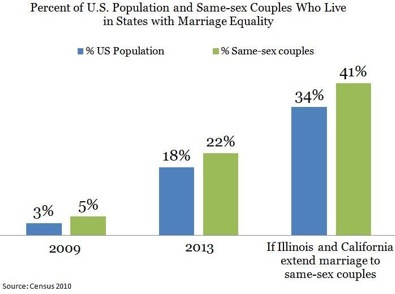
* From UCLA’s Williams Institute, which used US Census data in its estimates…
With the passage of marriage equality legislation in Minnesota, 18% of the entire U.S. population and 22% of same-sex couples now live in the 12 states, and the District of Columbia, where same-sex couples can legally marry. In 2009, only 3% of the U.S. population and 5% of same-sex couples lived in marriage equality states.
If Illinois extended marriage to same-sex couples, and the U.S. Supreme Court overturned Prop. 8 in California, more than 4 in 10 same-sex couples (or 41%) would live in the 14 states and the District of Columbia where they could legally marry. Thirty-four percent of the entire U.S. population would also live in marriage equality states.
Just like with abortion, we now see Catholic and Protestant politicians alike who defy the tenets of their own faith to pander to the well-funded Homosexual Lobby. Oh yes, when it’s campaign season, they’re “religious.” But down in Springfield, it’s another matter. Some day these phony-baloney politicians like Mike Madigan will learn the hard way that God is not mocked.