Four country music stars are announcing their support for legislation that would legalize same-sex marriage in Illinois.
“Big” Kenny Alphin of the musical duo Big & Rich, Mary Chapin Carpenter, Emmylou Harris and Rodney Crowell signed an open letter released Thursday.
They say “gay or straight, when two people are lucky enough to find each other and want to commit their lives to one another, it is nothing less than a blessing to us all.”
* From a Gov. Pat Quinn press release announcing various appointments…
Dr. David Gill, of Bloomington, received his bachelor’s and medical degrees from the University of Illinois and has served as a family practice doctor and emergency room physician for more than 20 years. Most recently an emergency room doctor at Advocate BroMenn Medical Center in Normal, Gill has been named Assistant Director of the Illinois Department of Public Health.
Gill is just one of several failed Democratic candidates to land a gig in the Quinn administration. Two 10th Congressional District candidates - Dan Seals and Julie Hamos - got state jobs after their 2010 defeats. 2010 US Senate candidate Alexi Giannoulias was appointed chairman of the Community College Board. And then there were all the legislators who got slots after voting “right” during the lame duck session.
But this appointment, as with Seals before him, may take the perennial candidate Gill out of the 2014 congressional race, which would be good news for Democrats. He’s just not a good candidate.
David Hylla is the new chief judge for the Third Judicial Circuit. He replaces Ann Callis, who broke the news Friday morning at the Madison County Judiciary Committee.
Callis also announced at the meeting that she is stepping down to run for a seat in the new 13th Congressional District. She will make a formal announcement on Monday.
As we’ve already discussed, the DCCC has courted Callis to challenge Republican freshman Rodney Davis. Their work paid off, and Gov. Quinn looks to have gotten Gill out of the way.
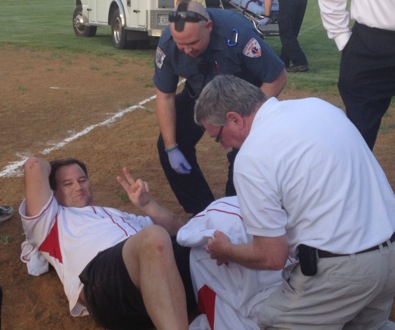
State Senator Matt Murphy (R-Palatine) is going into surgery this morning for a dislocated knee cap; Murphy was injured during the annual softball game between Illinois house and senate members on Wednesday in Springfield.
“Senator Murphy sustained the injury and was taken away from the field by ambulance,” said Patty Schuh, press secretary for Illinois senate Republicans. “We’ve had injuries before, but it was clear to bystanders and folks at the game his injury was serious.”
Murphy had an MRI on Thursday, which determined he would need surgery, Schuh said.
Murph’s knee cap ended up a few inches above his knee. This was no little injury.
*** UPDATE *** From the Senate GOP…
Sen. Murphy had surgery today at Northwest Community Hospital in Arlington Heights. He had extensive surgical repair for a torn patellar tendon. He is recovering at home and plans to be back at work as soon as possible.
* Earlier this week, state Rep. LaShawn Ford’s attorney filed a response to the charges against him. Ford has been indicted for fraud and lying to a bank…
Ford’s attorney, Tom Durkin, said in a new court filing that Ford was indicted because he was elected.
“He is the only person, to my knowledge, to ever get charged with anything out of the whole ShoreBank collapse,” Durkin said in a phone interview Tuesday. “Which I find odd.”
ShoreBank provided loans to low income parts of Chicago, Detroit and Cleveland. It shuttered after the housing collapse.
Durkin wrote in his court filing that Ford was a long-time customer of ShoreBank. The former head of the bank’s loan committee once said of Ford, “when an individual [like LaShawn Ford] is a well known customer of the bank, the paperwork may be more relaxed and not completed as thoroughly as by newer customers.”
Durkin also requested that prosecutors identify the expenses that were allegedly unrelated to the rehabilitation of Ford’s properties before trial.
Durkin said prosecutors wrongly charged Ford with 17 counts. He said some of those counts are duplicative, and could be in violation of double jeopardy standards.
* Back in January, KPLR TV in St. Louis led off a report with this…
It would be hard to find anybody against the idea. Missouri U.S. Senator Claire McCaskill and Illinois U.S. Senator Dick Durbin are behind the move in Washington to get the bridge named after the late Cardinal hall of famer [Stan Musial].
Not so fast. There have been a large number of disagreements over a new bridge between Illinois and Missouri over the years, and naming it is no different. KMOV TV St. Louis was indignant this week…
Illinois lawmakers turned their backs on the wave of support to name the new Mississippi River Bridge after Stan “The Man” Musial.
Instead the Illinois House unanimously voted this week in favor of a resolution to dub the Interstate 70 span the Veterans Memorial Bridge.
[Rep. Jay Hoffman’s] resolution… is co-sponsored by Rep. Jerry Costello II, D-Smithton; Rep. Dan Beiser, D-Alton; and Rep. Eddie Lee Jackson, D-East St. Louis.
“By naming this bridge in memory of the men and women who have served our nation, we are honoring them on a daily basis. I thank my colleagues on both sides of the aisle for supporting this measure to honor the sacrifices our military veterans have made,” Hoffman said. “I look forward to continuing to advocate on behalf of veterans across our state.”
* Back in April, the Missouri legislature voted unanimously to name the bridge after Musial. The US Senate did the same in March…
Matching legislation is now pending in the U.S. House, sponsored by Rep. Rodney Davis, R-Taylorville, and co-sponsored by Rep. John Shimkus, R-Collinsville.
* Hoffman, who has been a Cardinals season ticket holder, explains…
Hoffman was asked by KMOX’s Mike Kelly that since Stan Musial was a veteran, why not name the bridge after veterans and Musial?
“There are some that have suggested that. I can tell you that, personally, I’m not totally opposed to doing that. However, we here have given our word that we’re going to name it the Veterans Memorial Bridge but if that’s what comes of it, I could certainly be in support of it,” he said.
As part of a lingering squabble over how to finance the bridge, Missouri insisted that it be a tollway - a notion flatly rejected by Illinois as potentially onerous for tens of thousands of its residents who commute daily to St. Louis and its Missouri suburbs.
Illinois later proposed a sister bridge to an existing span, calling it affordable at $450 million. Missouri said it wasn’t a long-term solution.
Both states ended the impasse in early 2008, announcing a compromise after Missouri relented on the tolls.
The bridge naming has not come without some controversy. The widow of a worker who fell from the bridge wants it named after him. Andy Gammon, 35, fell off the bridge in March 2012. “We love Musial, but we would like Andy to be remembered, ” Tracy Gammon said.
Q: Did you have a harder time getting members to come on board as Senate President John Cullerton was working on a separate plan with union leaders?
A: “That wasn’t our experience as we worked through the roll call. It was a difficult roll call to work but not because of action in the Senate. The difficulty would relate to opposition from unions and from teachers unions and from citizens who have already retired and are drawing their pension. But none of it related to the Senate.”
Q: You vowed to do whatever you can to get the bill to Gov. Pat Quinn’s desk. What does that mean now that it’s in the Senate?
A: “Well, I’m committed to the bill. I’m committed to solving the issue. I’ve spoken to this publicly that the state’s fiscal problems are so bad that they require radical surgery, and this is the first step. We’ve taken that first step in the House. My expectation is that the Senate will approve this bill.”
Q: Have you been briefed at all on Cullerton’s negotiations with the unions?
A: “I could clearly see the fine work of Mr. Henry Bayer, who is an expert at delay. I think this is a continuation of what we experienced a year ago from Henry Bayer and the We Are One coalition where day to day they simply want delay. Delay. Delay. Because maybe the problem will go away. It’s precisely what they did on the collective bargaining. And they only came to a conclusion on the collective bargaining because they knew there would be action in the Legislature.”
Q: Will this action in the House spur unions to greater heights with the Senate?
A: “I really don’t know what they’ll do, but I don’t expect that they’ll be able to come to an agreement such that people would be prepared to back away from this bill. There’s two chambers here, and both chambers have to pass the same bill. The House has passed a bill and so whatever the Senate does, I don’t think it will achieve the cost savings that the House bill will achieve.” […]
Q: What was the tipping point in passing today’s pension reform bill?
A: “I think it was the vote that we took about two weeks ago simply on the COLA adjustment where it got 66 votes. I think that told the tale, and then we put the bill together. Today, we were four votes short of that, but it was a good roll call.” […]
Q: What are the bill’s chances in Senate?
A: “My expectation is the bill will pass the Senate.”
Q: Have you spoken to Cullerton about it?
A: “I have. On several occasions.”
Q: Cullerton hasn’t committed to working a roll call though. So what makes you so confident?
A: “Maybe it’s that 43 years around this building.”
Twenty-two House Republicans sided with Madigan’s push, with Democrats accounting for the rest of the “yes” votes. Among the Republicans backing the plan was House Minority Leader Tom Cross (R-Oswego), who signed on to Madigan’s legislation as a co-sponsor.
* Public Pensions’ Fate Rests Largely With Divided Democratic Leaders: CULLERTON: “The fact that the president of the Senate and the unions are putting their full weight behind something means something too. So if we’re able to get our caucus to support a position the unions are for, that would be significant as well.”
* Madigan’s Pension Bill Passes A Full House Vote: The We Are One Coalition has released the following statement in response to the House’s passage of the bill: Senate Bill 1 is unfair to the active and retired teachers, nurses, police, and other employees who paid out of every paycheck to fund their pensions, even as the state shorted its share. On top of that, it is blatantly unconstitutional and thus saves nothing. It simply exacerbates Illinois’ fiscal problems. In contrast, our coalition had a productive meeting today with President John Cullerton, and we hope to be able to continue the dialogue.
* House passes comprehensive pension changes: Senate Minority Leader Christine Radogno said she expects Republicans to support SB 1 if it is called for a vote in the Senate.
Apr 26 2013 Application (12A1053) to extend the time to file a petition for a writ of certiorari from May 23, 2013 to June 24, 2013, submitted to Justice Kagan.
May 2 2013 Application (12A1053) granted by Justice Kagan extending the time to file until June 24, 2013.
More in a bit.
* Illinois State Rifle Association Executive Director Richard Pearson recently had this to say about Attorney General Lisa Madigan’s request…
I have had several calls and emails asking what I think the result of Lisa Madigan’s request for an extension of the deadline to appeal the Seventh Circuit’s decision to the United States Supreme court will be. In my opinion it does nothing. The clock is ticking toward the June 9th deadline.
* 10:29 am - Response from AG Madigan’s office…
The extension allows for additional time to prepare a draft petition to allow the Attorney General to make a final decision on whether to seek cert, as the legislature continues to work toward the June 9 deadline set by the 7th Circuit Court of Appeals.
The 180-day clock does not stop as a result of this extension.
It also doesn’t delay or impact when the case might be considered by the U.S. Supreme Court, if the Attorney General ultimately decides to seek cert.
* One of the arguments being made in support of Speaker Madigan’s pension reforms is that the General Assembly has certain “police powers” in the event of a crisis. The GA has long had the latitude to pass bills which, um, stretch the limits, shall we say, of the Constitution when a crisis is at hand.
The Illinois Supreme Court has addressed police powers in quite a few cases, and talked about that history just three years ago when ruling on a lawsuit that sought to overturn a comprehensive medical malpractice reform law…
In a related vein, the Attorney General posits that section 2–1706.5 is but one part of a massive “multidimensional” response to the health-care crisis which requires all interested parties–insurers, medical professionals and health-care consumers–to make tradeoffs and sacrifices. According to the Attorney General, the Act, through a number of interrelated measures, constitutes an equitable means of ensuring that everyone who stands to benefit from a resolution of the health-care crisis contributes to its resolution.
The Attorney General cites to the Workers’ Compensation Act (820 ILCS 305/1 et seq. (West 2008)) as an example of a multidimensional exercise of the General Assembly’s police power which, although modifying the common law, has been upheld by this court in a long line of cases. See Duley v. Caterpillar Tractor Co., 44 Ill. 2d 15 (1969); Moushon v. National Garages, Inc., 9 Ill. 2d 407 (1956); Grand Trunk Western Ry. Co. v. Industrial Comm’n, 291 Ill. 167 (1919); Matthiessen & Hegeler Zinc Co. v. Industrial Board, 284 Ill. 378 (1918). The Attorney General argues that section 2–1706.1, like the Workers’ Compensation Act, constitutes a legitimate exercise of the General Assembly’s police power.
* But the Supreme Court ruled against the police powers argument in the med-mal case. A couple of prominent medical malpractice defense attorneys penned this analysis…
The Lebron Court also addressed the argument posited by the State Attorney General in an amicus curiae brief that the legislation amounted to a proper exercise of the state’s police power because it appropriately balanced the benefits and burdens of resolving the health care crisis among multiple stakeholders, including insurers, health care providers and patients.
The Court was not persuaded. Instead, the Court noted that because it was not resting its decision on the special legislation analysis of Best, the fact that the act may have served to address a legitimate legislative goal or may have addressed that goal in a balanced and equitable manner would not cure the statute of the constitutional infirmity.
The Court also noted that while the legislature is permitted to alter the common law and change or limit available remedies, that power is not absolute and must be exercised within constitutional bounds. [Emphasis added.]
This is just one more reason to exclude judges from the pension bill because including them could easily prompt a separation of powers argument similar to the med-mal case.
But, more importantly, the Lebron decision gives opponents of Madigan’s pension bill a very powerful argument.
Governor Pat Quinn is expected to fill a couple of empty seats on the board of trustees for Southern Illinois University. Quinn is reportedly expected to name former Illinois National Guard chief Randal Thomas and former SIUE history professor Shirley Portwood as early as today. The Illinois Senate rejected three of Quinn’s earlier appointees who were expected to support the naming of trustee Roger Herrin as board chairman.
Herrin has clashed repeatedly with SIU President Glenn Poshard. Controversy has surrounded the board recently, as three members with ties to Edwardsville - Edwardsville School District Superintendent Ed Hightower, Alton attorney John Simmons, and businessman Mark Hinrichs of O’Fallon - were not retained by Quinn in February.
This was the most easily avoidable problem Quinn has ever created for himself. All he had to do was work with the Senate from the beginning. He refused to even meet with Senators.
So, not only did Quinn damage himself in the Senate, he hurt himself politically in the Metro East, which views SIU-E as its crown jewel. I’ll never understand this as long as I live.
State Sen. Bill Haine, D-Alton, praised the nominees, saying he worked with the governor to find new members after threatening to push legislation through the Senate that would have limited who Quinn could have appointed.
“I appreciate very much the governor engaging in a colloquy with us in the legislature,” Haine said.
State Sen. Dave Luechtefeld, R-Okawville, who represents the university’s Carbondale campus, said he is anxiously awaiting Quinn’s pick to fill the final vacancy on the board.
“SIU-Carbondale is the most important entity in my district. If it succeeds, then Carbondale succeeds. And it has struggled lately,” Luechtefeld said. “We have to get this thing fixed. The board has to work with the administration. The sooner that happens the better.”
Thomas and Portwood are expected to join the board at its meeting on Wednesday.
Haine praised the nominees because his chamber’s chief of staff is the one who first floated the idea. That chief of staff, by the way, used to work for Glenn Poshard as his legislative liaison - just one more reason why this was a stupid, stupid move by Quinn.
* From the Commission on Government Forecasting and Accountability…
Monthly income tax revenues leaped in April, growing by $1.521 billion. The infusion of cash into the State’s coffers allowed for the repayment of a voluminous amount of overdue Medicaid bills. That action subsequently generated a massive amount of federal sources over $1 billion during a single month.
(P)reliminary Commission assumptions are that gains are strongly related to final and estimated payments stemming from actions taken by taxpayers in efforts to minimize the tax consequences of the higher 2013 federal tax rates. As such, they are not repeatable in future fiscal years, and should be viewed more in terms of a “one-time” event.
As will be discussed in a following section, Illinois’ employment situation is dominated by less than positive news, offering little in the way of argument for sustainable higher expectations.
“We do not have a real guarantee,” said Rep. Michael Fortner (R-West Chicago), who voted against Madigan’s legislation. “The fact we can change it through our budget implementation process gives me concern a future Legislature will do very much the same things we’ve seen happen all too many times during the past decades under a variety of different administrations.”
There are no absolute guarantees in life, and that’s particularly so when you’re talking about the General Assembly.
The guarantee in the Madigan bill is pretty darned solid. But Fortner is right that it could simply be undermined.
* So, I suppose that Madigan could propose a constitutional amendment guaranteeing that the state funds the pension systems.
Membership in any pension or retirement system of the State, any unit of local government or school district, or any agency or instrumentality thereof, shall be an enforceable contractual relationship, the benefits of which shall not be diminished or impaired.
That benefits guarantee was thought by the framers to be etched in stone. Not so, according to Madigan and everyone else who voted for (or cheered on) the pension bill yesterday.
* There really is no way to forever guarantee anything. Using the lack of a guarantee as a reason to vote against the bill is just as illogical as claiming that the guarantee will definitely lead to assured state fiscal disaster if and when Wall Street crashes again. So, Bruce Rauner is wrong as well.
…Adding… Eden Martin uses the “The guarantee will ruin Illinois” argument in the Sun-Times today. It’s just not a very good argument at all.
All you can ever do to deter human beings is construct a high wall and hope they don’t decide to build a longer ladder.
The Illinois Senate has approved a measure that would protect consumers who buy a dog or cat at a pet store and then find out that the animal is seriously ill.
Lawmakers voted 31-18 Wednesday to send to the Illinois House the bill described as a “puppy lemon law.”
The legislation would allow buyers to get a replacement or a full refund for the pet if the animal dies within 21 days of the purchase. Consumers also could seek damages for the cost of veterinary care.
Illinois now requires pet stores to provide information about a pet’s health history but gives consumers no remedy if they unknowingly buy an ill animal. Nor is there any way in which someone can be reimbursed for veterinary bills if the pet they bought was ill when it was bought.
Opponents argued that Kotowski’s bill didn’t cover the majority of pet purchases, which come from breeders or animal shelters. By one estimate made during floor debate Wednesday, as few as 15 percent of pet purchases occur at pet shops.
“It’s a little like we’ll have a speed limit on 30 percent of the state’s highways and the rest of the time you can go as high as you want,” said Sen. Dale Righter (R-Charleston). “The average cost of a dog in a pet store was about $1,000. We’ll protect the consumers who have the money to pay $1,000 for a dog as a pet. What about all those consumers who can’t afford that?”
Kotowski’s bill, patterned after existing pet “lemon” laws in 17 other states, now moves to the House.
Kotowski’s bill addresses pets that are bred for retail and sold for a profit. Like it or not, they’re a product. Customers pay a premium for them and expect the merchant to stand behind its goods.
Shelters and rescues are in the business of finding homes for stray or abandoned animals that might otherwise be destroyed or spend their lives in a kennel. When you adopt a shelter pet, you typically pay only for its shots, a spay or neuter, and maybe a fee to help keep the organization running. There’s no manufacturing cost and no retail markup. But you’re taking a leap of faith, because the animal’s background is usually a mystery.
Shelter mutts might in fact be healthier precisely because they’re not bred for sale. Selective breeding to emphasize certain traits can lead to genetic defects as well. That’s especially true when dogs are bred indiscriminately, with an eye for profit.
Like any business, commercial breeders make money by keeping costs as low as possible. Dogs are breeding stock, not pets. The bad actors in the business are the puppy mills, where animals live in cramped, unsanitary conditions without adequate food, water, exercise or veterinary care. Puppies bred in those surroundings might not be healthy, socialized or genetically sound.
Puppy lemon laws — at least 20 states have one — target the puppy mills by holding the sellers responsible if an animal turns out to be sick or to have a congenital defect. Sure, it’s a protection for the consumer, but it also puts the squeeze on puppy mills by encouraging pet stores to deal with reputable suppliers.
* And, of course, as long as we’re talking about puppies, why not take this opportunity to post another Oscar the Puppy video?
I went to visit my parents a few weeks ago. My dad is in the process of selling off and giving away some of his massive collection of antiques and other stuff, so he gave me a box of goodies to take home. Included in that box was a wooden bust of John F. Kennedy.
I have a fireplace that separates the dining room from the living room. I put the JFK bust in the dining room on the lower mantle, if that’s what it’s called. I was sitting in the living room the other day and Oscar was walking toward me and then stopped cold in his tracks, turned toward the fireplace and began acting weird. I thought he’d seen a mouse or something (which would really be weird because I’ve never had a mouse in my house) so I went to look. He was freaked out by the JFK bust. I moved the statue to the living room (for better video production) and fired up my iPhone.
At first, I thought Oscar must be a Republican because he was barking and growling at the presidential bust. Then, as you’ll see at the end, he licked JFK’s face. So, maybe he’s a Democrat. I just don’t know.
* The Senate passed gaming expansion with 32 votes yesterday, four shy of a veto-proof majority, although proponents insisted they would’ve reached that mark if all their people were in the chamber. Why is a veto-proof majority important? Because the governor is not yet on board…
While signaling some encouragement for the bill, Quinn’s office stopped short of an outright endorsement of the plan, saying more “improvements” are likely necessary though not specifying them. He has vetoed two earlier gambling-expansion packages dating back to 2011.
“We’re reviewing the bill, it appears to be moving in the right direction,” Quinn spokeswoman Brooke Anderson said.
“The ultimate authority is the Gaming Board on every facility in the state, including the city of Chicago,” said sponsoring Sen. Terry Link, D-Waukegan.
That contention, however, will go under the microscope. An aide to the governor said Wednesday that the administration’s main concern is making sure the measure clearly spells out the Gaming Board’s authority. That’s still fuzzy, the aide contended.
Dot points for the gaming bill are here. Expect further changes in the House. Rep. Lou Lang was cut out of negotiations, so they’re gonna have to hear him out now.
Sen. Dale Righter, R-Mattoon, raised concerns that the campaign contribution ban could crimp the ability of small-business owners, bar owners and veterans groups to give even small political donations if they install slot machines.
“What we don’t want is these people back home, who’ve been waiting forever for these machines in their nonprofit facilities, to then write a $20, $50 check to a member of the General Assembly as a campaign contribution and the next thing you know, someone from the Gaming Board is knocking on their door saying that was against state law and, by the way, here’s the penalty,” Righter said.
It’s a good argument, but I doubt Righter would be for it even if the bill was changed.
Link said the bill would provide a financial windfall for the state. The Commission on Government Forecasting and Accountability estimated revenues from licensing fees for the slot machines at racetracks, new casinos and new gaming positions at existing casinos would bring in $1.2 billion initially, and $268 million annually after that. “It not only will save thousands of jobs, it will create thousands of jobs, and it will help our educational system for the future,” he said. […]
Link said that according to the COGFA report, of the $268 million projected proceeds, about $128.7 million is slated to go to education. He said he hoped Quinn would recognize the “huge effort” made to incorporate the governor’s suggestions into the current bill.
Representatives from existing casinos say they think the revenue potential is not that large.
Tom Swoik, executive director of the Illinois Casino Gaming Association, said most of the existing operators are not interested in new gaming positions and believe the expansion would cannibalize the 10 already-existing casinos in the state. Swoik said a lot of the money estimated to come from the expansion was already spoken for and would not be available to go to schools. “We believe that this is going to leave very little money for education,” he said.
“I have said repeatedly that if Chicago were to build a casino, all revenue would be directed toward modernizing schools in our neighborhoods and communities,” Emanuel said in a statement. “I encourage all parties in Springfield to take swift action on the gaming bill and, in so doing, create the opportunity for us to rebuild and renew our public education infrastructure in the city.”
† Unworkable deadlines that would have made it too difficult for the Illinois Gaming Board to do its oversight job adequately have been eliminated.
† Internet gambling, which was not fully vetted, has been dropped from the bill.
† Ethics measures, including a ban on campaign contributions by casino operators, have been strengthened.
† A provision that new revenues from a Chicago casino be dedicated to school construction and modernization has been added.
The bill also would create a separate inspector general for the Chicago casino. Our concern in this regard, as the legislation moves forward, is that the new inspector general position not co-op the powers of the existing — and highly vigilant — Gaming Board.
Thursday, May 2, 2013 - Posted by Advertising Department
[The following is a paid advertisement.]
The satellite television industry serves a crucial role in connecting Illinois to the rest of the world with content that informs, entertains and educates – in many instances it’s the exclusive broadcast service provider available to Illinois homes. In addition, the satellite TV industry is an important economic driver creating hundreds of jobs in our state.
Facts About Satellite TV in Illinois:
• Serves 1.3 million households in Illinois (almost a third of homes that subscribe choose satellite)
• Employs over 790 people, plus more than 1,000 technicians at 481 local retailers
• Rural Illinois depends on satellite TV since cable does not often provide service to their area
• Satellite TV offers a wider range of foreign language programming in comparison to cable
Lawmakers continue to be prodded by the cable TV industry to place a NEW 5% monthly tax on satellite TV service. Previous versions of this discriminatory tax proposal have been defeated in Springfield—and similar bills are regularly defeated in other states including three times in neighboring Indiana, Iowa and Minnesota. This revenue generator needs to be clearly labeled what it is: An unfair tax increase on the 1.3 million Illinois families and businesses who subscribe to satellite TV.
There’s a political axiom at the Statehouse that embodies House Speaker Michael Madigan’s record-setting tenure as the Illinois House’s overlord: Never bet against the speaker.
I’ve used that headline time and time again, including back in the days when Lee Daniels was Speaker. It’s a powerful office.
* But I’m not sure I go along with this second graf just yet…
And so it goes with the pension-reform package that the Southwest Side Democrat muscled out of a House committee on Wednesday — putting it on a clear track toward Gov. Pat Quinn’s desk despite anger from unions and an uncertain reception in the state Senate.
There was no muscling in that committee yesterday. The die was already cast.
And the path to Quinn’s desk isn’t totally clear yet because Cullerton is still negotiating with the unions. If Cullerton fails to convince his caucus to go along and can’t pass a bill that Madigan can and/or is willing to pass, then, yeah, that path could very well be cleared. Time will tell.
Even if Cullerton may be holding out hope for a bill that he thinks would better withstand a constitutional challenge, Madigan’s approach seemed designed to win over Senate Republicans and limit Cullerton’s options — down to using one of Radogno’s ideas.
There were 8 Senate Republican “No” votes on the Madicrossbritz bill last month, most of whom have lots of state workers in their districts. So Cullerton probably wouldn’t have to go it alone unless the SGOPs make opposition a caucus positiion.
* Then again, Madigan pretty much always gets what he wants. And if he really and truly wants his bill to become law, Cullerton may have no choice but to go along just to get something done. The unions know this, too, which is why they came up with a “credible” pension plan yesterday.
* And Madigan even went so far yesterday as to predict that the plan would attract a majority of the Supremes…
Madigan said he believes a majority of the state’s seven-member Supreme Court will sign off on the legality of the legislation.
“I think there will be at least four members of the Illinois Supreme Court that will approve the bill,” Madigan said.
“I’m still bothered by the fact that it does not involve all five of our pension systems. The judges are not in this bill. We need to be fair across the board, all five systems,” said state Rep. Dan Brady, R-Bloomington, who represents thousands of university employees, school teachers and retirees potentially affected by the changes.
Rep. Brady is using the judicial stuff as a cover. Good on Erickson.
Rep. Mike Bost, R-Murphysboro, said he doubted he would support the bill crafted by state Speaker Mike Madigan, D-Chicago. Bost said he questioned the bill’s constitutionality and wondered why individual aspects of the proposal were not given severability if challenged in the courts.
“If Madigan was real with this, and believe he’s the expert at this, he would have put a severability clause in it,” Bost said.
Bost also has “thousands of university employees, school teachers and retirees potentially affected by the changes,” but it ain’t mentioned. Just one excuse after another.
* Related…
* Illinois House showdown on pensions possible today: Among committee members from the suburbs, state Reps. Nekritz, McSweeney, Darlene Senger of Naperville, Tom Morrison of Palatine and Carol Sente of Vernon Hills voted for it. State Rep. Raymond Poe, a Springfield Republican, was the lone “no” vote. Despite his support, Morrison said he still has concerns. The Republican lawmakers has backed a plan that would move public employees to 401k-style retirement plans. “I’m still going to fight for the real reform I think is necessary,” he said.
* Subscribers have some extremely hard to come by details of organized labor’s pension proposal, but let’s start here with Senate President John Cullerton’s press release…
Since the beginning of session, I have made it clear that enacting constitutional pension reform is my top priority. Illinois faces a crisis; we owe it to our children and grandchildren to take action.
I have worked to build consensus for reform within my caucus and across the diverse factions on both sides of the aisle. In these pension discussions, I have expressed a preference for the framework that, in my view, has the best chance of holding up in court. I have also worked to include labor in these conversations.
Today, I concluded a series of meetings with representatives of teachers, nurses, police officers and other public employees. This coalition of labor leaders offered a credible and constitutional plan for consideration.
* From the We Are One Coalition…
Our coalition has consistently said that we want to work together with policymakers to address Illinois’ pension funding problem. We appreciate that, over the past several weeks, Senate President John Cullerton opened up dialogue with us, and we have worked diligently with him to find common ground. Today, we presented President Cullerton with a proposal that is both fair and constitutional, and we are heartened that he has responded positively to our efforts.
Cullerton said [yesterday] afternoon that he has not yet reached a final agreement with union leaders. But he says they have presented him a “substantial proposal” that his caucus will consider along with House Speaker Michael Madigan’s plan, if it passes Thursday.
“We’re not finished talking to them. We might want to make some proposed changes to their proposal. We just got it today,” Cullerton told reporters. “What’s significant is that they’re supportive of a major bill that saves billions of dollars, which I would say they’ve never been before. So that’s a major move. There’s still some details to work out.”
Cullerton said the union’s plan is based on the concept that workers must be offered something in exchange for pension cuts. He has maintained that without such a trade, any bill that reduces retirement benefits would be unconstitutional. “Since it’s not unilateral cuts, it doesn’t save as much money, but it’s billions of dollars,” he said of the union proposal.
When asked if he would call Madigan’s bill, Cullerton said he would consult his members. “We’re going to hopefully see what the caucus wants to do, whether they want to support that bill, or the bill that the unions are supportive [of] or a combination thereof.” He noted that the Senate has already rejected a bill similar to the one the House plans to vote on Thursday. “We’ll see if this has any differences that get more people to be supportive, but you know, it’s not like we haven’t voted on this already,” Cullerton said.
Speaker Madigan plans to call his own pension bill today. We’ll discuss that in another post. Also, make sure to keep a close eye on the session live blog post for updates on this and other issues as the day goes on.
* Henry Bayer testifying in committee yesterday against House Speaker Michael Madigan’s new pension reform bill…
“It’s good that you’re not kicking the can down the road,” said Bayer, executive director of the 40,000-member American Federation of State, County and Municipal Employees. “It’s bad that you’re kicking our members in the butt.”