* I went to the Illinois State Fair eight different this year. I think that’s a personal record. The weather was darned near perfect, but I thought the Fair was better than in years past and attendance jumped despite a price increase…
(T)his year’s attendance for the 10-day fair was 844,051, according to fair officials. That’s nearly 15 percent higher than last year’s 10-day total of 735,599.
Grandstand concert attendance also was up this year, with 51,732 seeing the nine ticketed events, compared to 49,649 people last year.
After hiding out from the heat for most of the summer, people seemed to relish the chance to get outside and enjoy the food, games, rides and other attractions at the fairgrounds, Bliefnick said.
Ticket prices jumped to $7 for adults this year from $5 last year, but that didn’t appear to hurt attendance.
Reported attendance at the Illinois State Fair was approximately 650,000 in 2003, 671,333 in 2004, 672,615 in 2005, approximately 705,000 in 2006, and 737,052 in 2008.
* Just two shows, Eric Church and Miranda Lambert, accounted for about 44 percent of the Grandstand attendance.
More like this, please.
* Meanwhile, a couple of buddies and I had another adventure with a borrowed golf cart this year. I posted one two years ago, but we made an unreleased video last year as well. I never posted it because somebody stole the cart and I figured I was in enough trouble already without adding to my woes.
Thursday’s rain got things a little muddy, so we went over to the steep hills surrounding Happy Hollow for some fun. Enjoy…
Yes, we were bad. No, you shouldn’t do this. Yes, I’m probably in trouble… again.
* Online campaign videos are different from TV ads, so keep that in mind when rating this online video from Democratic state Sen. Gary Forby’s Republican opponent Mark Minor. From the campaign…
This is going to folks who work at the Department of Corrections and supporters
* I arrived a bit too late to see her, but a Democratic “tracker” showed up at a Republican State Fair event on Wednesday. That’s not so unusual. Video trackers go pretty much everywhere these days.
What is somewhat unusual about the tracker’s presence was that the event was held in a tavern. People were drinking. I really don’t like this idea. There ought to be things that are off limits to video trackers, and taverns are one of them, unless maybe a candidate has a DUI or something.
This particular tracker apparently follows Republican congressional candidate Rodney Davis. “She’s everywhere,” said one Davis friend. And she was at DH Brown’s on Wednesday for a state party function. It was a private affair, so she was given the boot. Figuratively, of course.
* But then this same Democratic tracker reappeared Thursday evening - at a function for two Democrats. The Democrats, Rep. Elgie Sims and state House candidate Lance Tyson, were holding a joint fundraiser at an office on West Capitol Ave.
I try to attend as many State Fair political events as I can, and I showed up for that one. The tracker was on the sidewalk across the street from the building. She had been in the building’s private parking lot before she was shooed away.
* As you can see by the video, the tracker originally identified herself as working for “Coulson Research,” then said she worked for “Olson Research.” Neither of those firms show up in a Google search, nor in the candidate disbursements.
The DCCC confirmed later that she was a Democratic tracker, but denied that she works for them. The DCCC person I communicated with did not respond to my questions about why this person would be sent to a Democratic event. The Democrats involved weren’t exactly pleased, to say the least.
* The bottom line is I still don’t know why this Democratic tracker showed up at a Democratic event. I’m posting this in case somebody can help me out here. Thanks.
In politics, perception often trumps reality. Put another way: What people think they know about a politician, an issue or anything else goes a long way to determining how they feel about it — whether or not their initial perception is based in reality or not.
That perception obsession has lead us to seek out any and every tool that helps us get at how people think about their politics — and each other.
Today we happened upon an awesome map put together by Renee DiResta at her No Upside blog. What DiResta did is simple but revealing. In Google she typed in “Why is [fill in the blank state] so…” and let Google’s autocomplete function, which tracks the most common words typed after “so”, do the rest. She mapped the top four auto-completes for each state. […]
* One of the top four autocomplete terms for Alabama, Missisippi, Georgia and South Carolina is “racist”. It’s the most common autocomplete in Alabama and South Carolina and number two in Mississippi and Georgia.
* In California, Oregon and Washington State, one of the top four terms is “why is [state] so liberal?” That’s also true in Maine, Vermont and Massachusetts.
* The four top Google auto-completes for “Why is Illinois so…” are…
The data set is Google auto-complete results for “Why is [insert state] so “. I took up to four results per state - one or two states didn’t even have four results - then grouped the results by term. I categorized the terms into buckets: economic, geographic, health, history, political, population, sports, weather, and “culture/sentiment”. The latter was a bit of a catch-all for ‘judgey terms’, ranging from “awesome” to “boring” to “racist.” Sometimes the classification wasn’t immediately obvious; for example, “Why is Alabama so good?” is pretty vague, so I followed the query through to the results, and determined it was most likely sports-related. (“Why is New Jersey so bad?”, however, was not about sports.) Your search results may vary (due to past search history, region, autocomplete results changing due to news events, and other factors). I did run these in both Incognito mode and regular mode, and the vast majority of results were identical. If you’d like the raw data, contact me.
* The Question: What one word immediately comes to your own mind when asked “Why is Illinois so…”?
* Gov. Pat Quinn issued this statement Friday afternoon after the House advanced an amendment which would reform only the General Assembly’s pension system…
“I met with the legislative leaders this morning, and we discussed a number of pension proposals that could be voted on today. I asked them to vote on a proposal that reforms four of the systems and eliminates the unfunded liability, as I have repeatedly advocated.
“Republican leaders said no.
“I asked them if they would vote on a proposal that reforms three of the state’s systems. Republican leaders said no.
“I asked them to vote on SB1447, passed by the Senate, to reform two of the systems.
“Republican leaders said no.
“I asked them if they would lead by example, at the very least, and vote to reform the General Assembly pension system.
The only problem was that Biss was arguing in favor of Friday’s legislative pension charade and admonishing Republicans not to seek partisan advantage, which put him in the same boat as the rest.
After a do-nothing special legislative session Friday, Illinois remains rock bottom in pension stability. The House couldn’t even pass a sliver of reform: a bill that would affect pensions for lawmakers, a tiny fraction of the state pension system’s enrollees. The governor’s office estimates that narrow measure would save the state $43 million to $45 million right away and about $111 million by 2045. In context, not much — but too much for Illinois lawmakers to save. Thank you, members of the House, for not even tossing a thimble of water on your roaring bonfire.
The Senate adjourned before taking up the legislation at all. Without any bill on Quinn’s desk, the state realizes no immediate savings. So we are exactly where we were 11 weeks ago when the General Assembly went on summer vacation without doing anything to mitigate that “staggering” pension debt. Eleven weeks from now is the reason why: Election Day.
We could fill this page with who’s to blame. We could call them out by name.
But to keep it simple — to make it crystal clear — we’ll point the arrow here: It’s the incumbents, voters.
That was one of the more interesting editorials on this issue I read because it didn’t follow the accepted journalistic line that this vote was a complete and utter sham.
* The conservative Daily Caller is practically giddy today…
President Barack Obama could lose his home state of Illinois in November, a new poll shows.
A poll conducted by Illinois-based pollster and political strategist Michael McKeon found Obama leading Republican Mitt Romney by 49 percent to 37 percent in Cook County, the home of Chicago. That puts him ahead by a far thinner margin than expected in a county he should be winning handsomely.
Cook is the most Democratic leaning county in the state. It is also the most populous.
Those numbers do not bode well for the president. […]
In the city of Chicago itself, he retains a 60-29 lead over Romney. But the Republican challenger leads 45-38 in the surrounding areas. Across the county as a whole, Romney leads 43-31 among independent voters, a crucial voting bloc. Romney also holds a 44-38 lead among male voters, and a 53-40 lead among white voters.
Illinois is not considered a swing state by any means; it is seen as solidly blue, and has been for the past two election cycles. But McKeon pointed to the 2010 gubernatorial race when Republican Bill Brady came within a single percentage point of now-Gov. Pat Quinn because Brady won most of the downstate counties. That is a feat Romney could repeat this year, leaving Obama vulnerable if he cannot expand his lead in Cook County.
* But Lynn Sweet has some recent county-wide poll numbers from Cook County Board President Toni Preckwinkle’s campaign which shows that President Obama has high favorables and high job approval ratings in Cook…
72/27 Obama
69/26 Emanuel
67/15 Preckwinkle
54/43 Quinn
*Madigan not included [Emphasis added.]
I wouldn’t bet the farm that Romney has a shot in Illinois. He’ll do much better in the suburbs and Downstate than John McCain four years ago. But a shot at winning Illinois? Not yet.
Also, notice Gov. Quinn’s ratings. Not good at all. The person who probably should be worried is Gov. Pat Quinn, not President Obama.
A new poll of likely voters in the 17th Congressional District puts U.S. Rep. Bobby Schilling ahead of his Democratic opponent, Cheri Bustos, by 13 points.
The internal poll by the Schilling campaign surveyed 400 people between Aug. 8 and 9 and found that 50 percent would vote for Rep. Schilling, R-Colona, and 37 percent would back Ms. Bustos, of East Moline.
Ms. Bustos has increased her support by 2 points from the last poll of the district conducted by the Schilling campaign in May. Rep. Schilling had the support of 51 percent of those polled in May to 35 percent for Ms. Bustos.
Terry Schilling, Rep. Schilling’s campaign manager, released the new poll on Friday and said he was pleased with the numbers. The poll was conducted by Public Opinion Strategies and has a margin of error of plus or minus 4.9 percent.
Prompted by the release of the Schilling poll, the Bustos campaign released its own numbers from an internal poll taken in February. The poll found support of 44 percent for Rep. Schilling to 35 percent for Ms. Bustos. But when the 400 likely voters surveyed where given positive information about both candidates, Rep. Schilling’s lead narrowed to just four points. [See below for more info. The Bustos poll showed she actually led by four points after the positive pushes.]
1. Bobby Schilling continues to have a solid image in the district. Incumbent Bobby Schilling’s name ID is 84% and he has positive image ration of more than two to one (42% fav/20% unfav). These numbers are especially strong given how much of the district is new territory for Schilling.
2. Democrat challenger Cheri Bustos’ name ID is under 50%, and her image is polarized among those with an opinion of her. Cheri Bustos’s name ID sits at 49%, and just 29% of voters have an opinion of her (16% fav/13% unfav). Bustos’ image is essentially unchanged since our May survey, and she is running out of time to adequately define herself.
3. Bobby Schilling continues to lead by double digits on the Congressional ballot. Schilling leads Bustos by thirteen points on the ballot (50% Schilling/37% Bustos). Schilling’s support from Republicans is north of 90%, and he also has a significant advantage with Independent voters (50% Schilling/22% Bustos).
Public Opinion Strategies completed a survey of 400 likely voters in Illinois’ newly drawn 17Congressional District August 8-9, 2012. The survey has a margin of error of +4.9% in 95 out of 100 cases.
* The Schilling campaign also provided this polling roundup…
Schilling 44, Bustos 35 (February 2012) — The Bustos campaign released this internal poll—conducted in February—during the weekend of August 18 in response to the latest Public Opinion Strategies poll released by the Schilling campaign. Bustos was nominated in early March.
Schilling 51, Bustos 35 (May 2012) — In May, the Schilling campaign released this poll, conducted by Public Opinion Strategies. This was the first publicly released poll of the cycle.
Schilling 50, Bustos 37 (August 2012) — The Rock Island Argus and Moline Dispatch reported this new poll result on Sunday. Public Opinion Strategies also conducted this poll.
…Adding… The Bustos campaign notes that their polling memo from May showed this…
After hearing positive information on both candidates (slightly more on Bustos than Schilling), the Congressman’s lead evaporates and Bustos opens up a 45 – 41 percent lead. In other words, Bustos gains the lead before voters even hear about Schilling’s vulnerabilities.
* Doug Finke asks some good questions about AFSCME…
They can boo and shout down all the Democrats they want, but where do they go politically? To the Republicans? The GOP argued for pension reforms long before the Democrats climbed on board and for harsher ones than are being debated now. They also tend to think government should be shrunk, not expanded.
The unions can sit out the elections, which means they’ll be decided by voters who pay taxes, but don’t collect state pensions. Many of those voters might think Quinn has the right idea.
Not much of a choice, is it?
* My syndicated column is about the union’s anger…
If you were following the news last week, you already know that hundreds of AFSCME members packed the Illinois State Fair Director’s Lawn last Wednesday afternoon and booed pretty much everybody who tried to speak at the annual Democratic event.
The only person of consequence to escape most of the hostility was Secretary of State Jesse White (who is also exempted from the traditional fan booing of politicians at Chicago baseball games). But even White received a few boos at times.
“It is a great day to be a Democrat in Springfield, Illinois!” shouted Lt. Gov. Sheila Simon, the event’s emcee, over loud catcalls. “And I am happy to be here with all of you, no matter what your point of view is,” she continued, hoping to calm the angry crowd, which was far more AFSCME than Democratic.
It didn’t work.
The shouts were so loud during Gov. Pat Quinn’s brief address that nobody could listen to the speech except reporters with direct electronic access to his microphone. The governor showed some real guts by directly challenging the assembled protesters during his remarks, but it didn’t really matter because the workers (and everybody else) couldn’t hear a word of what he said.
Even President Barack Obama was heartily booed by union protesters both times his name was invoked from the stage, suggesting to some Democrats last week that many of the union protesters were actually hardcore Republicans with a political ax to grind. The fact that no AFSCME protests were planned for the following day’s Republican Day event at the State Fair was pointed to by more than one upset Democrat last week.
But there’s no doubt that the union intimidation did have an impact. Secretary White nervously joked with protesters not to “kill the messenger” when he was briefly booed. White made sure to emphatically promise the crowd that his planned closure of a Rockford facility would be addressed soon.
The fact that fewer top Democrats were willing to appear on the dais with Quinn than ever stood with former Gov. Rod Blagojevich at previous fair events also showed the power of the issue to frighten away the governor’s fellow party members. Just one congressional candidate with a serious race, Democrat David Gill, showed up. Gill was lightly booed at times, but the experience as the event’s first speaker appeared to shake him up a bit. He looked upset after his speech and nervously wiped his brow before sitting down.
Illinois House Speaker Michael Madigan laughed heartily and smiled wide when his own introduction was loudly booed. Madigan chose not to speak, however. Senate President John Cullerton and Attorney General Lisa Madigan did not appear on the podium.
Blagojevich gave AFSCME some of the best union contracts in the nation. But even he was subjected to an AFSCME State Fair protest when he attempted to make union members pay more for health insurance in 2008. Workers only briefly interrupted Blagojevich’s speech before marching out of the event. Quinn didn’t get so lucky.
A much stronger message had to be sent last week. Quinn is not only attempting to reduce union worker pensions and health benefits, but word from inside the contract negotiations is he’s demanding that every union member take a two-grade reduction in their pay, which would amount to at least a 10 percent pay cut for employees. He’s also demanding a ton of other concessions and closing several state institutions. Union members are fed up with the demands for givebacks from a guy they backed to the hilt last election.
Bill Brady slightly underperformed Mark Kirk in just about every downstate county in 2010, almost totally because of union opposition to Brady’s anti-labor beliefs. Those slim Downstate margins (along with the pro-choice northern suburban backlash against Brady) elected Pat Quinn governor two years ago. There are a ton of Downstate public employee union members. So, he took their votes and he took their money and now they believe that he’s totally turned against them. Rank and file union anger is completely understandable in this context.
It’s little wonder that legislative Democrats didn’t want to advance a major pension reform proposal two days after the State Fair debacle. AFSCME’s tactics may have been over the top, but the union appeared to succeed, at least for now.
We’ll have much more on the pension issue in a bit.
* Besides the fact that the Speaker couldn’t “easily” have replaced Rep. Derrick Smith since there is no legal way to force him off the ballot, I’m not sure what Kass is really getting at here…
If you want to know how cynical and corrupt Illinois politics has become, you should focus on Springfield today.
Because there in the state Legislature, Chicago machine Democrats and their feeble Republican enablers will put on a thrilling anti-corruption show.
They will beat their breasts and make solemn vows about the public trust, they will talk about honest service, and when they’re finished, they will expel one of their own, state Rep. Derrick “Leave It in the Envelope” Smith, the West Side Democrat. […]
The very next day after the primary, Democrats called on Smith to step down. Madigan could have replaced him easily. But Smith declined. So the hearings were held, and speeches were made, and now the Legislature will dump him. Democrats have already lined up a friendly third-party candidate. But once Smith is booted, he’ll need a paycheck, and maybe they’ll find him one if he agrees to withdraw his name from the ballot in November. […]
Democrats weren’t the only ones making speeches. The Republicans were equally noisy, making grand sweeping gestures with their hands, raising their voices, talking tough but helping Madigan do the heavy lifting.
He says elsewhere in his column that this is relatively low-level stuff, but allegedly soliciting and receiving a cash bribe ain’t so low level. He also talks about the big guys going about their business while the little fish are caught, but isn’t that really just an indictment of the US Attorney and the FBI?
The big question I have is does he really think that the Republicans aren’t supposed to help remove Smith from office today?
Do I have that one right?
* You can follow today’s Smith expulsion session by clicking here.
Already slim chances that Friday’s special session of the Illinois General Assembly will result in state pension changes might have vanished altogether Thursday, when Senate Republican Leader Christine Radogno revoked her support for a halfway measure GOP senators previously helped pass.
Top aides to Gov. Pat Quinn said they were stunned by Radogno’s reversal, but they still hope to salvage the pension session. They said they have received positive feedback from credit-rating agencies about the partial pension proposal.
The bill, House Bill 1447, applies only to pension systems covering state employees and legislators, not to those covering downstate teachers, university employees and judges.
Speaking before Republican Day at the Illinois State Fair, Radogno said lawmakers should act to bolster funding for all five systems. She dismissed the idea that approving HB1447 would help the state’s bond rating.
“That’s ridiculous, to think that it would somehow avert a downgrade,” Radogno said.
* Senate GOP Leader Radogno has now allied herself with House GOP Leader Tom Cross and against a couple of key members of her own caucus on pension reform…
Senate Minority Leader Christine Radogno originally voted in favor of HB1447 [which passed the Senate with bipartisan support in May] but backed away from the proposal [yesterday]. “When it was passed, we were pretty clear that we thought that it was inadequate in terms of the fact that it only covered two of the five systems,” Radogno said. She cited concerns over estimates that could put the unfunded liability pension at a higher figure than the oft-cited $83 billion. “That bill clearly is not enough.” Radogno agreed with Cross that passage of the bill in the House could stall efforts at more comprehensive proposals. “The concern is that it will stop forward progress because a lawsuit will immediately be filed, in which case probably the party in power would say, ‘Well, we’ve got to wait until that unfolds and see what happens.’ So it’s just inadequate on too many fronts at this point.”
But not all of her GOP colleagues see it that way. Sen. Bill Brady, a Bloomington Republican, called HB1447 a “half measure,” but he said that if it is the only option that can gain enough backing to pass, he would support it. “Something’s got to be done,” Brady said. “This is the only solution on the table. Rome’s burning, and we need some incremental solution for this problem.” Brady does not share Cross’ and Radogno’s concerns that passing the bill would freeze efforts to reform the other systems. “I would argue that if we pass this, it will lead to passage [of reform] in the other systems.”
Sen. Matt Murphy agreed. “For those that say that it’s not enough and passing this doesn’t qualify as real reform, I agree wholeheartedly.” However, Murphy, a Palatine Republican, said he doesn’t think passing HB 1447 would hurt the reform process, and he said he would support it. “Personally, I don’t think the fact that we pass some pension reform means anybody thinks we’re done. I don’t think we’re done with just this bill, and I don’t think it takes the pressure off to solve the rest of the problem,” he said. “I think you can take what you can get now and then don’t slow the momentum. Use it as a springboard to finishing the job on the other systems.”
Legislators wrestling with the pension problems today are getting hammered by payment increases dictated by a law passed in 1995. Back then, Republican majorities in both chambers wanted to shore up the pension system, whose assets had dipped to only 54 percent of the money required to meet its obligations. So they passed a plan to return the pension systems to a 90 percent funding level over 50 years.
But the 1995 plan laid out a gradual path, and for 15 years the state’s payment increased only slightly. The bills started growing steeper in 2010, in the immediate aftermath of the Great Recession. Kelly Kraft, a Quinn spokeswoman, says leveling out the “ramp” must be part of a comprehensive deal to get pension payments under control.
State officials have deviated from the 1995 plan several times. For example, during former Governor Rod Blagojevich’s first two years in office in 2003 and 2004, the state issued pension obligation bonds and invested the borrowed money in the market, counting its projected profits as those years’ pension contributions.
Under Quinn, the state borrowed money for two years to make the pension payment. Now it has to pay those loans back, with interest, while also finding money for the ramped up payments.
Ralph Martire, executive director of the Center for Tax and Budget Accountability, a group that advocates better services for the poor, argues that worker benefits are not the root of the problem. The normal cost of providing pensions, he says, actually decreased slightly this year.
The real problem, Martire says, is that lawmakers skimped on pension payments for decades. They kept taxes low and provided more services than they could afford by depositing IOUs instead of cash into the pension funds. Now those IOUs are coming due. “In Illinois,” Martire says, “it isn’t a pension crisis. It’s a debt crisis.”
A bipartisan report from earlier this year shows that about 44 percent of the debt is because lawmakers and governors didn’t pay enough into the retirement funds over the years — sort of like skipping payments on a 401(k).
About 22 percent of the problem comes from poor investment returns, especially recently during the recession. About 9 percent is because of increases in benefits over the years.
The other 25 percent stems from a variety of other factors.
* You can follow the special session on pensions today by clicking here.
* One of the things we always watch during the Democrat and Republican State Fair days is who shows up to float their names for higher office. Nobody did that during the Democratic affair Wednesday because of the massive AFSCME protest. But there were some hopefuls at Republican Day…
Senator Dillard and at least three other elected officials at the state party convention say Pat Quinn’s latest political trouble is another reason for them to consider running for governor in 2014.
“Certainly what happened yesterday has me even more focused on whether I will run statewide again,” Dillard said.
“Let me just say bluntly, it’s an option that’s out there,” said Illinois Treasurer Dan Rutherford.
“I’m certainly going to take a very serious look at it after the first of the year,” said Sen. Bill Brady, (R) Bloomington.
“If there’s an interest in me running, I’m interested in helping the state turnaround,” said Sen. Murphy.
But party chairman Brady said it was too early to think about 2014.
“Every Republican should concentrate on getting Republicans elected this November,” said Brady. “There’s plenty of time to think about 2014.”
Kazillionaire Bruce Rauner didn’t show up. Rauner is considered a likely gubernatorial prospect, as is Congressman Aaron Schock, who also wasn’t around.
“I haven’t heard any speaker drowned out by boos, but I haven’t heard a lot of excitement out there either,” said Rodney Davis, the party’s nominee in the 13th Congressional District, which includes part of Springfield.
“Hey, who wants Republican victories in November?” he asked. That generated a round of cheering and applause.
* Dave Dahl used dead air to craft a pretty funny intro to his report about the general lack of enthusiasm…
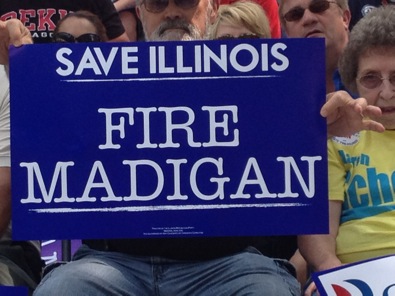
On Thursday, the state GOP put a bull’s eye on Madigan, the House speaker and chairman of the state Democratic Party. Party loyalists hoisted signs that read “Save Illinois. Fire Madigan.”
A leprechaun also wandered about during the rally, carrying a sign that said, “Madigan stole my poto’ gold.”
“The message you need to drive home to … each one of your precinct workers, to everyone you talk to in the next 83 days is that a vote for any Democrat in the state of Illinois is a vote for Mike Madigan,” Brady told the crowd. “He’s been down there 42 years. He’s taken us to the brink of financial collapse. The problems we face today are his problems, and it’s time for Mike Madigan to go.”
House Republican leader Tom Cross called on Madigan to “quit the games” that have led to deadlock on comprehensive pension legislation that would rein in costs of a state retirement system hurtling toward a $93 billion debt by next summer.
“I think Mike needs to look in the mirror and accept the fact that he’s been here for 40 years, and every single problem we have has his fingerprints on it,” said Cross, who has been in the House since 1993. “We all need to act like adults, quit the politics and get this done.”
Illinois House Minority Leader Tom Cross, R-Oswego, said GOP leaders and voters are united because of dissatisfaction with Democratic leadership, from the Illinois Capitol to the White House.
“I look at what’s going on in our races, and we’ve got a lot of folks from the far right to the middle and the left that are working with us. People are disgusted with what’s going on. This is all about finances, about the budget, about the pension,” Cross said.
* And this prediction about Democratic-leaning public employee union members staying home on election day would be more accurate if it wasn’t a presidential year. But they may skip over some down-ballot races…
“I think the protest you saw yesterday is representative of larger anger throughout the state of Illinois with the failed policies of Mike Madigan and Pat Quinn,” said Pat Brady, chairman of the Illinois Republican Party.
Party leaders acknowledged it may be difficult to get union members to vote Republican, although they promised to reach out to organized labor, but they predicted frustrated union members will stay home instead of working hard for Democratic candidates.
* Related…
* Same-sex marriage advocates seek support at state fair
Illinois’ jobless rate rose to 8.9 percent in July as the government and leisure and hospitality sectors combined to shed more than 12,000 jobs.
The July rate was up from 8.7 percent in June, but down sharply from 10.1 percent in July 2011, the Illinois Department of Employment Security said Thursday. It marked the second consecutive month that the rate has increased. […]
Over the month, the state lost a net of 7,100 jobs. The largest cuts came from governments, 7,900 jobs; and leisure and hospitality, 4,300 positions.
Those losses were partially offset by gains in trade, transportation and utilities, which added 3,000 positions; professional and business services, 2,800 jobs; and manufacturing, 1,700 jobs.
The drought may be impacting some of the unemployment numbers, according to the AP.
Although the state’s unemployment rate has been below 10 percent since October, its so-called underemployment rate has been in the double digits for nearly four years. That rate was 16.5 percent in the second quarter of this year, which is an average of the four most recent quarters of data. It was as high as 18 percent in mid-2010.
According to the U.S. Bureau of Labor Statistics, the federal office that oversees the collection and computation of the country’s labor force data, the official unemployment rate captures only those people who are out of work and have looked for a job in the last month. The underemployment rate, on the other hand, captures those people plus those who are working part-time but desire full-time work as well as those who want a job but have not looked in the last month because they are discouraged over their job prospects.
The broader measure, sometimes called the “true” unemployment rate by critics of the government’s more narrow definition, provides a better sense of what improvements still need to be made in the job market, said John Lewis, formerly an economist with Northern Illinois University who now owns a consulting firm in Sycamore.
* And suburban foreclosures are still a big issue…
In June, one of every 155 housing units in Kane County and one of every 254 housing units in DuPage County received a foreclosure filing, according to realtytrac.com. That’s higher than neighboring Cook County, where the rate was 1 in 277; the state of Illinois, where 1 in 355 units was foreclosed; or the entire country’s rate of 1 in 666.
DuPage is the state’s wealthiest county with a median household income of $76,581, according to the most recent U.S. Census. That’s more than $20,000 above the median household income in either Cook County or Illinois, and nearly $25,000 more than the median household income in the U.S. […]
Olson said DuPage County has kept a higher foreclosure rate as people lost jobs, lived off their savings and are now running out of money and going into foreclosure because they can’t find new employment.
Mary Keating, director of community services for DuPage County, also said the problem was related to employment — or lack thereof.
“Ultimately, a lot of the foreclosures are really about job loss.” she said.
Olson’s experience with the DuPage Homeownership Center supports Keating’s claim. She said 65 percent of loan modifications and re-defaults on mortgages the center has seen are due to unemployment or underemployment.
Friday, Aug 17, 2012 - Posted by Advertising Department
[The following is a paid advertisement.]
ComEd is grateful to the Illinois lawmakers who have supported a Resolution that calls upon the Illinois Commerce Commission (ICC) to stay true to the statutory directives and intent of the Energy Infrastructure Modernization Act (EIMA).
This House resolution, passed out of the Public Utilities Committee last month by a vote of 22-1, strongly urges the ICC to consider reversing its ruling on key issues in ComEd’s first Formula Rate filing under the new law. By denying the recovery of actual costs – in contradiction to the legislation — the ruling results in a revenue shortfall for ComEd that would be more than $500 million over five years and put the entire smart grid initiative in grave jeopardy.
A rehearing on these issues is under way. We commend the ICC for taking additional time to study the matter and consider new evidence. We remain hopeful that they will recognize that the EIMA was created to provide the predictability that will enable utilities to make the long-term investments required to meet the needs of customers and the demands of a digital 21st century economy.
We worked at an accelerated pace through the first half of this year, creating hundreds of new jobs and new opportunities for Illinois businesses in the process. While we remain committed to the 10-year, $2.6 billion EIMA program, the revenue reduction has already forced us to delay the deployment of key initiatives, including the installation of smart meters. We are hoping, of course, that the rehearing will enable us to get the program back on track, but to do that, the integrity of EIMA must be upheld.