Cicero voters Tuesday ignored allegations of corruption, sexual harassment and nepotism in town hall and overwhelmingly re-elected Larry Dominick for a third term as the leader of the hardscrabble western suburb.
An effective political machine that also delivers governmentally for residents and functions pretty well is almost never undone by negative media reports. And, man, was there ever a ton of negative media on Dominick. Even his own brothers jumped into the fray against him.
* It’s when things go bad for residents that the great leaders are sometimes brought down. Mayor Daley over-stayed his welcome. Things turned sour. He ran out of ideas. The city stopped “working.” His poll numbers plunged. But he wasn’t defeated. He retired. If he’d wanted to stay, he probably could’ve. Who would have challenged him? And with what?
Remember how the media pummeled Cook County Assessor candidate Joe Berrios a while back and praised Forrest Claypool up and down as a real deal reformer? Claypool got trounced. Not even close.
* Also, it was pretty apparent to anybody with eyes that the media’s attempt to make Dominick’s opponent Juan Ochoa into some sort of reformer wasn’t exactly all that honest. As “bad” as Dominick is, Ochoa was no white hat. From Ray Hanania in comments yesterday…
[Cook County Clerk David Orr] complained about signs but did nothing when we complained four weeks ago about suspicious absentee balloting by Ochoa’s campaign workers, including ballots filled from vacant lots, dead voters and gang members in prison.
Yikes.
* To give you an idea of how strong the Cicero machine is, the town is 86.6% Latino, according to the Census. Ochoa, a Latino, couldn’t oust Dominick, who is definitely not a Latino.
I’ll tell you one thing: they treat their seniors like royalty [in Cicero]. My mother-in-law was in fantastic, brand-new senior township housing with incredible service — cleaning, rides to the store, home nurses, turkeys at Thanksgiving and Christmas, etc.
And they helped her vote, too, right in the complex, lol.
That was in Betty’s day. And she loved her some Betty. They all did.
And now they love them some Dominick, no matter what journalists, columnists and editorial writers say or predict.
* As I told subscribers this morning, Speaker Madigan is calling yet another “weekly order of business” this Thursday on pension reform. From the IEA…
This means there will be floor debate on legislative amendments that, if passed into law, would reduce pension benefits for participants in TRS, SURS and the other state pension systems.
The floor debate and voting, which are expected to begin on Thursday, will focus on areas of great concern to IEA members in the affected pension systems;
The annual cost of living adjustment (COLA)
The retirement age for active members of the state pension systems
Employee contributions to the retirement systems, as well other pension-impacting proposals offered by members of the House.
This is a serious attack on your pension– Call NOW!
IEA members are urged to contact their state representatives immediately to stop these pension-cutting proposals from getting out of the House.
…House Speaker Michael Madigan, D-Chicago, has filed a package of amendments viewed by some as a “scared straight” approach that could shock government workers opposing any kind of benefit rollback into thinking about the potential alternatives.
Madigan distributed to his Democratic troops a description that says one amendment would eliminate all future cost-of-living adjustments and one would halt the adjustments until the pension plans reach an 80 percent funding level. A third proposal would raise the retirement age for full benefits to 67 and a fourth would require employees to chip in another 5 percent of their paychecks toward retirement. The changes would apply to lawmakers, rank-and-file state workers, university employees and public school teachers outside of Chicago.
Republicans this week have grumbled that they expected Madigan to put these before the full House Thursday to test each measure’s support on up-or-down votes similar to the way he rolled out more than a dozen amendments on the concealed weapons legislation on Tuesday.
*** UPDATE 2 *** Madigan’s “scared straight” amendments that will be debated tomorrow…
URGENT: Strong rumors in the state Capitol indicate that legislation stripping state employees of their right to collective bargaining over health care costs and benefits could be moved in the House of Representatives as soon as today. Your action is needed NOW to prevent its passage.
At this point there is no substantive language or a specific bill. But a shell bill that could be the legislative vehicle passed out of committee on Tuesday night, Feb. 26. Substantive language could be added to this or other legislation and called for a vote of the full House chamber at any time. If passed by the House, the bill would go to the Senate.
This is a direct attack on state workers’ fundamental right to collective bargaining. Negotiating health care benefits and coverage is just as vital as bargaining over wages and other benefits.
* House Republican Leader Tom Cross and Rep. Elaine Nekritz have filed a new pension reform bill, HB 3411. Video of the press conference, via BlueRoomStream.com, is here.
It appears to have a sorta kinda cost shift in it. From the press release…
• Creates Tier 3 defined benefit/defined contribution plan for SURS and TRS members who start work after January 1, 2014. Local Employers and employees will be responsible for funding these plans.
Members (public employees hired before 2011)
• Cost-of-living adjustments apply only to the first $25,000 of the employees’ pension
o That limit is reduced to the first $20,000 for employees eligible for Social Security
• COLAs are delayed until the employee turns 67 or five years after retirement, whichever comes first
o This applies to all employees and retirees who are currently receiving COLAs
• Retirement age is increased by:
o No increase for employees age 45 and older
o One year for employees age 40 to 44
o Three years for employees age 35 to 39
o Five years for employees age 34 and younger
• Employees would be required to contribute more toward their pensions by:
o One percent starting July 1, 2013
o Two percent starting July 1, 2014
• Pensionable salary – the amount of salary that counts toward a pension – is limited to the higher of the Social Security wage base or the participant’s salary when the legislation becomes law
• All new employees in the Teachers Retirement System and State University Retirement System are placed in a stacked hybrid plan (combination defined benefit and defined contribution plan)
o Employees are guaranteed a minimum defined benefit
o Employers and employees contribute an additional amount in to a 401(k) style benefit plan
o Local school districts can negotiate the generosity and cost of the 401(k) benefit with employees
• TRS and SURS employees hired before the effective date can choose to remain in Tier 2 or join the stacked hybrid plan (Tier 3)
• COLAs for General Assembly Retirement System members will match those of Tier 2 members in the other pension systems
• Hybrid Defined Contribution, Defined Benefit plan
• Defined Benefit component:
o Employee contribution is 4% of pay
o Final Average Salary = Highest 8 out of last 10 years
o Unreduced retirement at 67 and 5 years of service
o Reduced retirement at 62 and 10 years of service
o 1.1% annual accrual rate
o COLA is lesser of 3% or ½ CPI, simple starting at age 67
• Defined Contribution component:
o Employee contribution is 5% of pay
o Local employer can make optional matching contribution (pursuant to local contracts) of between 3% and 10% of pay
o Ability for the DC plan to be invested in existed investments in the system and managed by the system for employees.
o 5 years to vest in the employer contributions.
• Employer contributions will be on a 30-year level-funding plan to achieve 100 percent funding
• State contributions will be enforced through court action or intercept of other state funds
• Revenue currently being used to repay pension obligation bonds will be used to pay down our unfunded liability once the pension obligation bonds are paid off
Amends the General Provisions, General Assembly, State Employee, State Universities, and Downstate Teacher Articles of the Illinois Pension Code. In the Downstate Teacher and State Universities Articles, creates a Tier 3 composite defined-benefit, defined-contribution retirement plan for employees hired on or after January 1, 2014 and certain others. Makes corresponding changes in other parts of those Articles and in the Retirement Systems Reciprocal Act. Increases the retirement age for certain Tier I members and participants. Changes the conditions of eligibility for, and the amount of, automatic annual increases for Tier I retirees. Increases required employee contributions for Tier I members and participants. Limits pensionable salary for Tier I and Tier 3 participants. Changes the required State contribution to each of the affected retirement systems so that those systems are 100% funded by 2043. Adds State funding guarantees. Makes other changes. Amends the Illinois Public Labor Relations Act to provide that this amendatory Act takes precedence. Amends the State Finance Act. To the list of standardized items of appropriation, adds “State retirement contribution for annual normal cost” and “State retirement contribution for unfunded accrued liability”. Defines those terms. Amends the Governor’s Office of Management and Budget Act. Adds those terms to a list of classifications to be used in statements and estimates of expenditures submitted to the Office in connection with the preparation of a State budget. Amends the State Mandates Act to require implementation without reimbursement. Includes an inseverability provision. Makes other changes. Effective immediately.
The latest plan does not give employees a choice of retirement benefits, something Senate President John Cullerton, D-Chicago, has said is essential for a pension reform plan to be found constitutional. Cross and Nekritz said they believe the plan is constitutional anyway.
“We feel very strongly that there are legal opinions that support this as constitutional,” Nekritz said.
“Anything is going to end up in the courts,” Cross said. “The reality is nobody knows (how the courts will rule).”
* Yeesterday’s hours-long debate on concealed carry was at times brutal…
Tempers rose and ebbed as frustrated Republicans questioned the majority’s motives. Democrats booed and shouted “No!” when Rep. Jim Sacia suggested imposing gun limits across Illinois because of Chicago’s homicide problem would be like forcing statewide castration because of a population boom in the city.
“If you’re having too many kids, you want me to get castrated,” said former FBI agent Sacia, a Pecatonica Republican. “That was an analogy to show how silly this is. You bet I used Chicago as an example because you’re the folks that want this craziness.”
The House began the day with 27 separate amendments dealing with concealed carry, many of which restricted where guns could be carried. Gun prohibitions in schools, casinos, stadiums and other locales go OK’d in amendments that go so far as to include parking lots, meaning firearms couldn’t be stored in cars while gun-owners go inside.
“You’re spray-painting red circles around all these places, and at the end of the day, the whole state is going to be red and you won’t be able to carry a gun anywhere,” Phelps said.
As the day dragged on, the approach faced a series of setbacks. The House rejected successive amendments banning guns from colleges, establishments that sell alcohol, and public gatherings or rallies.
Democrats soon withdrew 12 amendments, including requirements for 40 hours of firearms training in classrooms and the field; carrying $1 million in liability insurance; and for a psychological fitness examination, moving straight to the Phelps amendment, which is language taken as a whole from a separate concealed-carry bill he’s introduced, but didn’t get a hearing Tuesday.
* House Republican Leader Tom Cross, who has introduced dozens of empty shell bills, claimed the Democrats were wasting time. But he did make some good points…
With Madigan, the state Democratic Party chairman, already picking up suburban seats in the last election, Republicans feared he was setting his sights on gaining even more ground rather than actually trying to address the concealed carry issue. Republicans questioned why Democrats were focusing on the gun issue now, in this fashion, rather than on Illinois’ budget problems and $96.8 billion pension debt.
Republican Minority Leader Tom Cross asked state Rep. Sara Feigenholtz, D-Chicago, whether her gun amendment does anything to address the state’s pension crisis. Feigenholtz said the proposal was an “attempt to save lives.”
“This bill can’t pass out of the House like it is, nor can it go to the Senate, so how does that save a life?” Cross said.
The Trib’s analysis is correct and Cross’ last quote was absolutely spot on.
Taking roll call votes on separate issues, although preliminary, did give lawmakers a chance to essentially “explain their votes” to constituents later, said Kent Redfield, emeritus professor of political science at the University of Illinois Springfield. said.
“Someone could say ‘Hey, I fought the hard fight,’ but ultimately … the choice was either to pass what was in front of me or to automatically have weapons in the street,” he said.
Tuesday’s unusual approach also could give some leverage to House Speaker Michael Madigan, D-Chicago, in negotiations over a final bill, Redfield said.
“Let’s assume a vote to exclude guns on mass transit gets 70 or 80 votes,” he said. “If you’ve got a big majority for something that (pro-gun supporters) didn’t want, then that would give you leverage in negotiations.”
Democratic Rep. Michael Zalewski of Riverside said that today’s session was useful for getting members to grasp the complexity of the issue and getting a feel for where their preferences lie. “I think we needed this particular day to ensure that people were aware of the issues that we face on this. Everyone assumes that we can just pass a bill and this will all figure itself out, but there’s so many … factors that go into this and how we balance protecting public safety with the constitutional right to carry a weapon, so we needed this for people to start thinking about the issue.” He said the votes on the amendments banning guns were instructive about what proposals could receive support in a final bill. “We may not be able to put a restriction on what people do in a public way. We may only be able to regulate schools and mass transit and parks and things. So that’s my takeaway.”
In a key test vote, Chicago-area mass-transit users couldn’t take concealed weapons on public trains or buses under legislation that moved forward in the Illinois House Tuesday during a more than a seven-hour session on guns.
But in later action, the House went on record supporting a broad concealed-carry amendment written by gun-rights advocates, an initiative that was adopted shortly before 9 p.m. by a 67-48 margin. It explicitly permitted guns on public transportation.
The mass-transit amendment by Rep. Deb Mell (D-Chicago) and backed by gun-control advocates advanced 65-45 with four voting “present.” It represented one of the biggest of more than a dozen votes the House took Tuesday that could help shape a broader concealed-carry bill that likely will surface in the chamber this spring. […]
An amendment pushed by Rep. Brandon Phelps (D-Harrisburg), the leading House champion of concealed-carry, won a majority in the House but fell short of the 71-vote supermajority that could be required in the House once a final concealed-carry package gets voted on. That supermajority also would be needed to fend off a possible veto by Gov. Pat Quinn.
Backed by the National Rifle Association, Phelps’ amendment dictates that the State Police “shall” issue $80 concealed-carry permits to those who undergo training and haven’t been adjudicated as mentally ill. His plan would bar concealed weapons in government buildings, bars, airports, schools, child-care centers, casinos, amusement parks, stadiums, arenas, community colleges and universities.
* As if Aaron Schock doesn’t enough trouble with some shadowy super PAC funding negative ads and mailers against him. Now, the Club For Growth has him in the crosshairs. From Illinois Review…
The conservative political action group Club for Growth has a low tolerance for Republican Congress members that score low on their annual scorecard. Wednesday Club for Growth announced a new website, “PrimaryMyCongressman.com” in which they will feature two Illinois GOP Congressmen - Adam Kinzinger and Aaron Schock - now in the group’s crosshairs for 2014.
Aaron Schock likes to portray himself as a defender of economic freedom, but his record is not consistent with that portrayal. His website claims that he’s focused on “fighting the massive expansion of government spending and debt.” However, one of the first votes Schock took in the House was against cutting all of the spending projects from Obama’s failed $800 billion stimulus bill, joining only 43 Republicans. He voted for the August 2011 debt limit deal that gave Obama a $2.1 trillion increase in the national debt, and he’s been a consistent supporter of keeping Davis-Bacon wage requirements for federal projects, nothing but an anti-free market giveaway to big labor.
Schock has a 61 percent lifetime rating with the Club For Growth, but apparently that’s not good enough.
* As I’ve told you before, Adam Kinzinger has been traveling the state and talking about how the Republican Party needs to moderate its message. He was in Quincy recently and delivered the same message, along with a plug for Schock…
n his speech, Kinzinger primarily focused on the idea that Republicans should calm themselves in their interactions with others in order to advance the message. He alluded to other Congressman who “go on Fox News and see who can scream the loudest.” However, he didn’t name any names.
He also criticized the use of the term “RINO”, which stands for “Republican in Name Only” and is typically used to describe a Republican who either isn’t conservative or has recently voted with the Democrats. Kinzinger said that anybody who was with him a majority of the time was good enough to be in the party.
He said that Democrats would never kick somebody out of their party who wasn’t ideologically pure and that Republicans shouldn’t either if they wanted to build the party.
The message received mixed reactions from the audience.
However, the most interesting part of Kinzinger’s speech came at the beginning when he called out potential gubernatorial candidate Bruce Rauner, directly accusing him of being behind recent radio and TV ads targeting Rep. Aaron Schock.
Rauner had been in attendance and gave a short speech but had ducked out just prior to Kinzinger’s speech.
Kinzinger said that “a million dollars spent by a Republican against a Republican is as good as two million spent by a Democrat.”
Kinzinger zinged Congress at a 2010 Homer/Lockport Tea Party Rally as a candidate, saying “We should have been talking about our belief in the private sector. We should have been talking about what it takes to allow entrepreneurs and small business owners to create jobs. We should have been talking about tightening our belts…” But as a member of Congress, Kinzinger voted against cutting $15 million the Preisidio Trust Fund, leaving him as one of just 10 Republicans in favor of a subsidy for a national park in San Francisco that is a pet project of former Speaker Nancy Pelosi’s.
* The House Executive Committee has always been tightly controlled. Leadership sends bills there to pass, or fail, depending on what leadership wants. And while gay marriage passed Exec yesterday, it was a close, 6-5 vote, with one Democrat voting against it and another voting for it just to advance it to the floor. That vote shows the problems the bill faces in the full chamber…
The Religious Freedom and Marriage Fairness Act advanced out of the House Executive Committee by a 6-5 vote with the panel’s four Republicans voting against the plan. State Rep. Eddie Jackson (D-East St. Louis) also voted “no,” the lone Democrat on the panel to do so. […]
Harris assembled a pair of high-powered black ministers in a bid to help shore up shaky support among some African-American legislators like Jackson. The legislation is backed by Gov. Pat Quinn and Mayor Rahm Emanuel and already has passed the Senate.
Testifying in support of the bill were the Rev. R. Herbert Martin, former Mayor Harold Washington’s minister, and the Rev. Otis Moss III, pastor of Trinity United Church of Christ, which is President Obama’s former church on the South Side. […]
Beyond Jackson, there were other fissures within the Democratic Party. Harris’ bill drew opposition from state Rep. Luis Arroyo (D-Chicago), who voted to let the legislation move to the House floor but said he likely wouldn’t be a supporter once it’s called for a final vote.
“I don’t think I could vote for this bill on the floor of the House because of my religious beliefs and because of the churches in my district I represent and support,” Arroyo said.
Disgraced former Congressman Jesse Jackson Jr., who pleaded guilty last week to misusing $750,000-plus in campaign money, is writing a memoir, two sources familiar with the project told the Tribune.
Jackson, 47, will be sentenced June 28 after a seven-year spree in which he used the illicit money for a Rolex watch, celebrity memorabilia, furs, a cruise and two stuffed elk heads, among other purchases. […]
One of the Tribune’s sources, who has seen drafts of portions of the memoir, said Jackson was trying to “clear up his legacy.”
“He has nothing else to do right now,” the source said. “He’s desperately trying to change the narrative of his life story.”
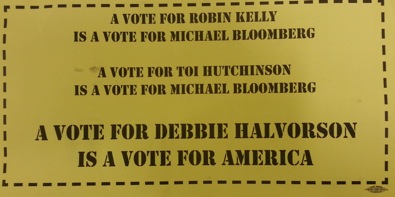
* As you already know, Robin Kelly won the 2nd Congressional District special primary yesterday with 52 percent of the vote. Debbie Halvorson received 25 percent and Anthony Beale got 11 percent.
The campaign of 2nd Congressional District candidate Debbie Halvorson got a boost today with the results of a new poll of 500 voters likely to cast a ballot in the upcoming election.
The former congressman, D-Crete, now leads with 21 percent of the vote, with former front-runner Robin Kelly polling 17 percent. […]
Conducted Feb.17-19, the poll was conducted by Victory Research for WCKG AM Radio.
Pollster Rod McCulloch said that Halvorson’s opponents’ negative advertising about Halvorson regarding issues involving gun control may have backfired.
We Ask America ran two polls for me in the days leading up to the election, which I shared with subscribers. Both showed Robin Kelly with large leads and the second poll showed she was most definitely surging upward.
With my own current polling, it seemed to me that the pro-Halvorson poll was just not credible, so I didn’t run it.
* Speaking of Halvorson, a whole lot of commenters predicted yesterday that the black vote would be divided and Halvorson would win.
Here’s the thing, folks: Chicago-area black people vote in higher numbers than anybody else in the region. Black wards pretty much always have the highest turnout. And, in this instance, the voters knew enough about the campaign to know who was who and went with Kelly. She even won Ald. Anthony Beale’s 9th Ward with over 50 percent of the vote. That is quite a feat.
* And speaking of Beale, his concession speech was bitter and way over the top, perhaps to mask his humiliating defeat in his own back yard. Watch…
Beale ran a terrible race. He didn’t raise money, claimed he had a field operation when he really didn’t, and could never focus on an issue that would resonate with voters. I’m almost positive he would’ve lost even without Mayor Bloomberg’s intervention.
The race among Republicans to replace former U.S. Rep. Jesse Jackson Jr. is too close to call.
Chicago resident Paul McKinley was leading fellow Republican Eric Wallace by about two dozen votes as of late Tuesday night. But with a handful of precincts outstanding, no winner was declared.
Paul McKinley calls himself an “ex-offender” who wants to get other ex-offenders to work. That’s why he ran as a Republican candidate in the special primary to replace Jesse Jackson Jr.
McKinley served prison time for robbery, he says. Now he’s on a mission to offer “street repentance.”
“Street repentance means to help a young man to not go in the same direction that I went,” McKinley says in this campaign video.
With 99 percent of the precincts reporting late Tuesday, McKinley was in the lead with just a couple of dozen of votes over Eric Wallace.
If voters in Cicero have a hard time distinguishing between Larry Dominick, the candidate, and Larry Dominick, the incumbent town president, it’s probably because Dominick himself doesn’t seem to know the difference.
Town spokesman Ray Hanania confirmed last week that uniformed community service officers driving official town vehicles have gone door to door, questioning residents about whether they had applied for mail-in ballots for Tuesday’s municipal primary election.
Dominick’s opponent, former McPier executive Juan Ochoa, has encouraged voters to use the ballots, widely available since 2010. Ochoa’s campaign says the Cicero officers were dispatched to suppress those (mostly Latino) votes.
In a letter to the town attorney, Cook County Clerk David Orr said the visits “could easilybe construed as an attempt at voter intimidation.” […]
In a separate letter to Dominick on Tuesday, the clerk noted complaints about electioneering at early voting sites, including the Cicero Community Center, where a large banner reads “Cicero Town President Larry Dominick Welcomes You.” Two other signs flank the stage.
“Since you are on the ballot, it is inappropriate for these signs to be on display with voting nearby,” Orr said in a letter to Dominick on Tuesday. “Please take down the signs immediately.”
Tuesday morning, a lot of Cicero will be getting a lot of extra attention.
Not just by voters electing their town president, but by investigators with several departments, including the Cook County sheriff, and the county clerk.
In Cicero, current President Larry Dominick is in a bitter fight against contender Juan Ochoa. […]
To ensure no fraud occurs, the state’s attorney will provide manpower, as will the sheriff’s office. The county clerk will pony up 11 election attorneys, when two would be typical.
“I just want it to be prepared,” Clerk David Orr says. “I just hope things are smooth and people behave themselves.”
* Which leads us to this press release from Sen. Marty Sandoval…
Sandoval Calls for Orr’s Recusal from Cicero Elections
Cicero, Illinois – State Senator Martin Sandoval, joined by 16th District Cook County Commissioner Jeffrey Tobolski, today called on Cook County Clerk David Orr to immediately recuse himself from the Cicero elections charging that Orr has openly taken a partisan political position in an election in which he is supposed to be objective and non-partisan.
Sandoval said he sent a letter urging Cook County State’s Attorney Anita Alvarez, the chief law enforcement officer on election day, to order David Orr to immediately recuse himself for conflict of interest due to his political bias in the Cicero elections due.
Sandoval charged that Orr has played a political and partisan role in the municipal elections in the Town of Cicero, aiding and supporting his political allies, candidate Juan Ochoa and his endorsed cohorts including Chicago Alderman Ricardo Munoz, Cook County Commissioner Jesus Garcia and U.S. Representative Luis Gutierrez. Sandoval charged that Orr has donated thousands of dollars to candidates actively involved in the Ochoa campaign, which creates a direct conflict of interest. Additional instances of bias include David Orr’s physical appearance at rallies with Ochoa and his supporters (which included convicted felon and former Cicero President Betty Loren-Maltese).
Sandoval, who is Vice Chairman of the Illinois Senate Committee on Local Government, said he will call for public hearings to examine Orr’s conduct in this election and in past elections, and will be filling legislation to eliminate the elected office of Cook County Clerk, making it a separate, non-partisan agency similar to the Chicago Board of Elections.
“David Orr’s conduct and conflict of interest has tainted this election in Cicero. David Orr is politically partisan and has and continues to use public resources to support his political allies to work against those he opposes,” Sandoval said. […]
Sandoval said that Orr has in the past donated directly to many of the people supporting Ochoa in his battle against incumbent Town President Larry Dominick. Orr’s office employed Alderman Munoz’s spouse in the past, and his decade’s long relationship with Ochoa supporters, County Commissioner Garcia and US Rep. Gutierrez has been well known and dates back to the Harold Washington era.
“There is no doubt that David Orr has been a political clerk and not an objective, independent guardian of Cook County’s voting system. Instead of protecting the rights of voters, he has been using his influence to harass one campaign while ignoring allegations of obvious voter fraud by workers supported by his allies. That is an outrageous abuse of David Orr’s powers and clearly a violation of his responsibility to insure fair, balanced and non-partisan elections,” Sandoval said.
Sandoval, who is Vice Chairman of the Illinois Senate Committee on Local Government, said he will call for public hearings to examine Orr’s conduct in this election and in past elections.
“David Orr’s political activism in this election has compromised his judgment,” said Sandoval. “The voters of Cook County deserve better.”
Oh, c’mon, man.
* Anybody hearing anything about what’s going on in that town today?
* Related…
* Street gangs, racial discord, gropes and gas — all standard Cicero campaign fare
* With all the goofy bills being proposed these days, here’s some real food for thought…
Illinois should stop automatically treating 17-year-olds charged with felonies as adults, a state juvenile justice advisory group recommended Tuesday.
The Illinois Juvenile Justice Commission, a 24-member advisory group chaired by retired chief judge George Timberlake of Mount Vernon, issued its report after examining the impact of a 2010 change in state law.
Before 2010, anyone older than 16 charged with any type of crime was treated as an adult and went through the adult court system.
In 2010, the General Assembly reached a compromise — 17-year-olds charged with misdemeanors would be handled in the juvenile justice courts, and 17-year-olds charged with felonies would be prosecuted as adults.
Most states set 18 as the default age when criminal defendants will be treated as an adult. Illinois is one of 12 states with a lower age, the commission reported.
The report is here. Go take a look at it and tell us what you think.
The debtor would have as few as 24 hours to pay up or the city would be allowed to sell or auction the vehicle, using the proceeds to pay off the debt.
The measure, which is being proposed as the city ramps up enforcement of its newly expanded red-light camera network, would apply to all debts and judgments, from overdue water bills to unpaid permit fees, housing court fines and other IOUs.
A spokesman for Mayor Rahm Emanuel says the city is reviewing the legislation and has taken no position on it. Mr. Silverstein says he has not spoken with the city and introduced the bill at the request of a lobbyist friend whose clients include a law firm with a large collections practice.
On Tuesday, Silverstein acknowledged that the language in his booting bill is a little harsh and needs to be softened.
It would give deadbeats just 24 hours to pay up before the boot is applied. It would further empower municipalities to sell or auction the vehicle and use the proceeds to pay the debt.
“The 24-hour rule probably needs to be changed” and extended, the senator said.
“This came to me from Adam Braun, a lobbyist representing some of the collection firms. Collection firms are trying to find a better avenue to collect money to help municipalities.”
[ *** End Of Update *** ]
* Meanwhile, according to Stateline, we’re number two in red light cams…
There are 543 communities in the United States that use red-light cameras. More than half of them are located in just four states. This list shows states with the highest number of communities using red-light cameras.
* The House Executive Committee is scheduled to begin at three o’clock, so you can watch the gay marriage debate online here. You should also, of course, keep a close eye on our live session coverage post for updates from the hearing.
An Illinois House committee could vote Tuesday on a measure allowing same-sex couples to marry.
Chicago Democratic Rep. Greg Harris says he expects the House Executive Committee to approve his legislation and send it to the full body.
* I agree with Gov. Quinn. This thing isn’t soup yet in the House…
Gov. Pat Quinn, during a stop in Normal on Thursday, acknowledged that the measure lacks the necessary 60 votes for passage. But he told reporters he plans to contact members of the House individually seeking their support, similar to what he did when he lobbied members to approve the civil unions law in 2010.
“There’s still persuasion to do in the House,” Quinn said.
One reason is that the House’s freshmen class tends to lean conservative in both parties…
Rep. Sue Scherer, D-Decatur, said she thinks legalizing same-sex marriage is premature.
“We’ve had civil unions, and it hasn’t even been two years,” Scherer said. “The purpose of the civil union was to give people in this situation the rights they felt they deserved. I think that needs to have time to go through the system before we go further.”
A date has not ben set for a full House vote yet, said Bernard Cherkasov, CEO of Equality Illinois.
“There’s not clear sense yet of when the full House vote will be,” Cherkasov said.
Cherkasov added that a vote on the bill on March 1 was possible but unlikely. LGBT leaders are eying a possible mid-week vote the following week. That could mean a vote on March 6 or 7.
State Rep. Toni Berrios has clarified her stance on same-sex marriage, after reports that she was wavering the equal marriage bill currently in the Illinois House.
www.DNAinfo.com had reported Feb. 21 that a Berrios spokesperson said that Berrios would not disclose her stance on the measure until it was out of committee and she could review the final language.
That statement likely came as a surprise to many LGBT people. Berrios previously told Windy City Times that she backed equal marriage, and she has been supportive Chicago LGBT groups in the past.
Contacted by Windy City Times, Berrios said she stands firmly in support of the bill.
“I’m not undecided,” she said. “I’m definitely a yes vote.”
As the battle over redefining marriage moves to the Illinois House this week, pro-family groups are taking aim at Republican State Rep. Ron Sandack.
Calls recorded by conservative activist Sandy Rios, and paid for by Illinois-based Family PAC (listen below), are being made to Sandack’s constituents. Pro-family organizations are concerned that Sandack is preparing to break his campaign promise to oppose same sex marriage in Illinois. According to sources, Sandack has told colleagues he now intends to vote for bill, which has already been approved by the Illinois Senate.
*** UPDATE *** From the Chicago Board of Election Commissioners…
Election judges in a representative sampling of Chicago precincts in the 2nd Congressional District reported that 11% registered voters had turned out as of 1:45 p.m. These numbers included election day voting, early voting and absentee ballots returned in those precincts.
This puts us on course for turnout in the mid-teens. This is to be expected with a special primary and special election. It is shaping up to be among the lowest turnouts in recent decades.
Some slightly good news on the weather front is that we’re also receiving reports that the snow is turning to rain on the South Side.
[ *** End Of Update *** ]
* There are those who actually expect us to believe that the 2nd Congressional District special Democratic primary represents some sort of national referendum on the NRA. For instance, the Reuters lede…
Today offers the first ballot box test of how significantly the politics of gun violence have changed since Sandy Hook.
Mayor Bloomberg is poised for a major anti-guns victory Tuesday with national resonance, after spending millions of dollars to influence a special election here to replace former Rep. Jesse Jackson Jr.
And here’s a statement from Becky Bond, President of CREDO Super PAC, which has spent about $20K $100K on the race…
“This is a national referendum on the political power of the NRA,” said Becky Bond, President of CREDO Super PAC. “CREDO is knocking on doors and talking to local voters to let them know that Debbie Halvorson will do the bidding of the NRA – not represent the needs of Chicago-area voters. If Halvorson loses the race – it will send a clear message to every candidate who takes the NRA’s blood money – you will be held accountable come Election Day.”
Oh, please.
That area has been mostly anti-gun forever. The only national implication of this contest is that it’s now clear that Mayor Bloomberg intends to spend a bunch of money attacking the NRA.
Debbie Halvorson’s campaign has been a joke. She’s raised almost no money, she stumbles whenever she talks, she hasn’t put together squat for a campaign apparatus. Nobody of any consequence has come to her aid or spent cash on her behalf or put bodies in the streets.
So, beating Halvorson is supposed to signal something? Get real.
Yes, Bloomberg spent a lot of money, much of it on Robin Kelly. But winning this district isn’t exactly something to write home about. Pretty much anyone with a decent message and $2 million could do it.
* Jessica Taylor, senior analyst and reporter for the Rothenberg Political Report used a lot of jargon, but had it mostly right on CNN…
“While it’s very easy for a special election to become an incubator for the national issue of the day, it is less clear the issue will resonate on a national scale in 2014,” adds Taylor.
…Adding… From CREDO…
(T)his is the first-ever election where outside groups are jumping in to defeat candidates based on their opposition to gun control legislation so I’m surprised that you don’t think this race has national implications. Especially considering gun control and the NRA have emerged as a key issue in the race at the same time that Congress is debating gun control legislation. It’s also the first election I’m aware of where candidates are being held accountable for cozying up to the NRA.
* The only real news will be if Halvorson somehow wins. It might happen, although I doubt it. Tons of crossover votes by white Republicans and a dismal Democratic turnout made worse by today’s lousy weather…
* Snow could affect voter turnout in 2nd Congressional District primary
Tom Bowen, a former top political adviser to Chicago Mayor Rahm Emanuel, projected that Halvorson would need to win at least 60 percent of the vote in Will and Kankakee counties to make up for the huge deficits she is expected to face in Chicago and its suburbs, the district’s more heavily black areas.
“For Halvorson to have a fighting chance, she needs to be blowing it out of the water in these two counties,” Bowen said. “They’re not only areas she used to represent, but they have pockets of white voters who might not be as focused on guns as the city and south suburbs.”
She probably needs to win more than 60 percent.
* Here’s a local update e-mailed from a Robin Kelly worker…
Raining hail. But Robin’s HQ has been hoping. They asked a group of 40 who wanted to provide rides to the polls instead of knocking on doors in the rain and no one wanted out. We have too many vols for the amount of turf we have (almost 20,000 pluses).
Multiple reports of people declaring that they are Republicans but then refusing a Republican ballot to vote in the Dem primary
* If you’re in the district, make sure to let us know what’s going on in comments. NBC5 has a live blog…
In a pivotal showdown on guns, the Illinois House plans Tuesday to begin a marathon series of politically divisive votes to lay down limits on where exactly gun owners can legally carry their weapons in public.
The unusual maneuver orchestrated by House Speaker Michael Madigan (D-Chicago), a traditional proponent of gun-control measures, will focus on 27 different tweaks to pending concealed carry legislation bearing his name.
Nearly a dozen different legislators filed amendments Monday to Madigan’s bill, laying out specifically where gun owners could take their weapons once the state answers a December federal court order to end Illinois’ outright ban on carrying concealed weapons.
Some of the places the amendments would bar gun owners from taking their weapons include government buildings, child-care facilities, casinos, hospitals, stadiums and arenas, protest, museums, universities, public transit, amusement parks and churches. […]
“It gives every member of the House a chance to participate,” Madigan spokesman Steve Brown said of the unusual approach in debating such a huge array of amendments one by one.
“I think the biggest sticking point is going to be “shall issue” against “may issue” more than anything,” explains Representative Brandon Phelps of Harrisburg.
Phelps is sponsoring the current right to carry legislation, co-written by the National and Illinois Rifle Associations. It says that a license to carry “shall” be issued.
Phelps explains, “If you meet the qualifications and you pass the background check, I think you ought to be able to be awarded a concealed carry permit.”
But “shall” doesn’t cut it for many northern lawmakers. They want language that says a license to carry “may” be issued, depending on the judgement of local authorities. They argue that language works well in a handful of states, including New York.
“Many local law enforcement officials in smaller and rural communities know their citizens personally. These local officers are well aware of who stumbles out of the bar,” explains Mary Kay Mace, who lost her daughter in the shooting at Northern Illinois University in 2008.
Madigan spokesman Steve Brown said that Tuesday marks the “first of probably several sessions” on the topic. The goal is to give lawmakers the chance to “speak to and vote on” numerous gun issues, Brown said.
The motivations of the state’s longest-serving speaker, however, are not always clear in a Capitol where he has largely controlled the agenda year after year. Hot-button legislation often is worked on behind closed doors among competing interest groups and heard at the committee level; then a single bill that lawmakers can take or leave is voted on. Madigan also sometimes will survey his Democratic members privately to see what they could support on issues such as tax increases. […]
Rep. Brandon Phelps, who has pushed for allowing concealed carry in Illinois, has added his own question to the Tuesday mix, an amendment that would legalize the practice but require training and prohibit guns from being taken into schools, stadiums and bars.
Phelps suggested the speaker’s Tuesday debate is an attempt to find out where every lawmaker stands on the various issues that have come up in hearings before the House Judiciary Committee.
“A lot of people across this state and nation will be watching,” said Phelps, a Democrat from Harrisburg in far southern Illinois, of Tuesday’s action.
Doing it this way will leave individual lawmakers less political cover to run away from a bill by simply arguing they didn’t have a chance to add an element, such as certain restrictions for a firearms bill. The approach also puts many freshman lawmakers as well as some squeamish veterans on the spot, requiring them to take clear positions on politically difficult issues.
The speaker’s approach allows political protection, said Kent Redfield, a former House staff member and retired political scientist at the University of Illinois at Springfield.
A comprehensive “clean bill,” such as one Phelps has introduced, would require a single yes or no, without nuances that can be explained away at election time. Redfield said the Madigan process allows Democrats, who understand the state must adopt gun legislation, to nonetheless vote against provisions they find particularly distasteful and politically risky.
“An up-or-down vote on a clean bill, you either voted for or against,” he said. “If you allow a bunch of votes, then people can be on specific roll calls for specific provisions and he can give them some cover” from outraged voters.
I’ll post a live blog later this morning. Make sure to watch it.
* Chicago Police Superintendent Garry McCarthy testifying to a House committee last week about state gun laws…
“I have not seen an illegal gun offender who possesses a FOID card. It just doesn’t happen. The gang members are criminals. They’re not eligible to receive those cards… I have no concern with legal guns. I have a great concern with illegal guns.”
Superintendent McCarthy’s comments start at the 2:01:44 mark.
* It’s been my experience in Illinois that environmentalists have long been divided between the screamers and the doers. It’s a symbiotic relationship. The far more radical screamers make sure that the doers don’t give away too much, but in the end the screamers are nudged aside and the doers cut the deal. The deals are never perfect, which upsets the screamers to no end, but after the deal is done the screamers are marginalized.
It’s probably going to happen again now that there’s a fracking deal…
A coalition of Illinois residents opposed to high-volume gas and oil drilling is criticizing Gov. Pat Quinn for supporting a bill that would establish regulations for the practice.
A group called “Stop the Frack Attack” issued a statement Friday urging Quinn to instead support a 2-year moratorium on high-volume hydraulic fracturing, or “fracking.”
On Thursday, two downstate lawmakers introduced a regulatory bill drafted with the help of industry and some environmental groups. The governor released a statement hours later, praising the bill and saying it could help create jobs.
Fracking uses high-pressure mixtures of water, sand or gravel and chemicals to crack open rock formations and release oil and gas. The industry is eyeing southern Illinois’ New Albany shale.
Some in the environmental movement are confused, they seem to think that fracking can somehow be made safe by “stricter” regulations.
* From the Illinois Sierra Club, which has tried to walk a line between the antis demanding a moratorium and the realistic expectation that fracking is coming one way or the other…
Can we stop the industry from bringing fracking to Illinois? When legislators proposed a two-year moratorium on the practice last year, we strongly supported that proposal, and we support continued calls for a moratorium today. However, we also need to acknowledge that fracking is legal today in Illinois, and for all we know, may already be occurring as you read this. We also need to recognize that our current laws regulating oil and gas drilling, originally passed in 1941, are totally inadequate to deal with the range of issues raised by injecting millions of gallons of chemical-laced fluid deep into the earth only to come surging back with gas and potentially oil. In short, Illinois citizens and our environment, at the moment, are virtually defenseless against against the problems experienced in other states.
That’s why it is essential that Illinois move quickly to get the strongest possible safeguards in place to protect citizens and their water supplies. Fortunately, discussions in Springfield have produced a basic agreement on what would be the strongest set of protections of any state in the country. The open pits for wastewater in use in other states will be banned here, and there will be none of the dumping the water into wastewater treatment plants, which has overwhelmed sewage plants elsewhere. The discharge of any fracking wastewater into surface water will be a felony offense. The industry must disclose what chemicals are used, and the most toxic ones will be banned. Ann Alexander from the Natural Resources Defense Council, who helped represent environmental groups in the negotiations that produced the proposal, has a good rundown on the major provisions of the bill here.
This legislation is the product of an unprecedented stakeholder process that brought together representatives from all of the concerned state agencies, the drilling industry, and the environmental community, as well as legislators from both sides of the aisle. No compromise is ever perfect, and this bill is certainly no exception. But in its current form, it would represent the strongest and most comprehensive law governing hydraulic fracturing – or “fracking” – in the nation. While some other states have put in place bits and pieces of the kinds of protections that are essential to protect the public, no state has yet put together as many of the essential elements of a strong regulatory scheme. In most other states where this problematic process has taken off, regulators have been swamped by a gold rush mentality, convinced by the extortionist rhetoric of industry lobbyists that even modest attempts to protect the public will drive away their chance of prosperity.
“The gas industry got just about everything they wanted,” said Rau. “Please, everyone: label this monstrosity properly. It’s a DE-regulation bill.”
* To the NRDC, which compiled a list of the bill’s benefits…
* Extensive regulation of the drilling process, mandating numerous best practices.
A requirement that all waste – which includes “flowback” of all the chemical-laced water pumped into the ground – be stored in closed tanks, rather than the pits that chronically leak and overflow elsewhere.
* Restrictions on venting and flaring of natural gas (which contains the potent greenhouse gas methane, as well as other harmful constituents, and turns to smog).
* A ban on the dangerous practice of injecting diesel (which contains carcinogenic hydrocarbons).
* Required disclosure of all fracking chemicals to the public before operations commence (and limits on industry’s ability to claim that this information is a trade secret).
* Citizen rights to public hearings concerning proposed permits, and to appeal permits that are granted.
* Citizen enforcement against violations of law or permits.
* Provisions to protect the state’s water supply, including authority to deny permits as necessary during drought conditions.
* Baseline and post-frack testing of potentially affected waters to help identify instances in which contamination may be associated with fracking.
* A presumption of liability for contamination that appears post-fracking in proximity to operations.
* A detailed application, containing information about planned operations, that must be posted on a state web site.
* Setbacks (albeit not always as large as we believe are necessary) from population centers – including schools, residences, and nursing homes – as well as water resources and nature preserves.
* Mandatory plugging of nearby abandoned wells that can serve as pathways for contamination.
* Regulatory authority to address the problem of earthquakes induced by underground waste injection.
* Bonding and insurance requirements to enhance financial accountability.
I don’t have the scientific background to judge who is right on this, but I’ll take the Sierra Club and the Natural Resources Defense Council over a group of local NIMBYs any day of the week. And to call this, as the screamers are doing, a “de-regulation” bill is utter nonsense on its very face. Screamers never understand why they’re not taken seriously, even when they make goofy comments like that one.
Provides that a law enforcement agency may not use a drone to gather information.
Permits the use of a drone by a law enforcement agency: (1) to counter a high risk of a terrorist attack by a specific individual or organization if the United States Secretary of Homeland Security determines that credible intelligence indicates that there is that risk; (2) if a law enforcement agency first obtains a search warrant signed by a judge authorizing the use of a drone; or (3) if a law enforcement agency possesses reasonable suspicion that, under particular circumstances, swift action is needed to prevent imminent harm to life or serious damage to property, or to forestall the imminent escape of a suspect or the destruction of evidence.
Provides that a law enforcement agency may not own or use a drone that is equipped with any kind of lethal or non-lethal weapon.
Provides that information obtained or collected in violation of the Act is not admissible as evidence in any criminal, civil, administrative, or other proceeding. Establishes certain information retention and reporting requirements concerning drone ownership and use.
The Illinois National Guard and the Champaign County Sheriff have tested drone technology in Illinois airspace. And, the Cook County Sheriff is now exploring whether to acquire and utilize the technology. […]
“When government knows where we are, they know who we are,” said Adam Schwartz, senior staff counsel for the ACLU of Illinois. “Our nation is in the midst of a technological revolution. Many of these technologies permit the massive gathering of information and data about individuals and groups and can undermine our freedoms.”
“We must adopt appropriate guidelines now to insure that these technologies do not become overly intrusive.”
* The Urbana-Champaign Independent Media Center has been FOIAing the local county sheriff to see what he’s up to with his drone…
From the documents provided, it looks as if the Sheriff’s drone has been downed by mechanical failures as much as it has been in the air. According to a flight log obtained, the Sheriff’s drone was flown four times between November 2011 and May 2012, all for training purposes only. Two of the flights were “Non-Successful,” with the most recent one ending in a crash.
More than 20 states are pursuing similar legislation, according to the National Conference of State Legislatures. While some states are trying to regulate unmanned aircraft use, others are trying to impose moratoriums that ban them, Biss said.
Virginia lawmakers approved a two-year moratorium on the aircraft in the state last week to allow time for a study. The legislation awaits the governor’s signature. […]
[Cook County Sheriff Tom Dart’s] thinking is that drones would be cheaper to use and cost less taxpayer money than using helicopters for aerial operations, Bilecki said. A small, unmanned aircraft used for search and rescue can cost on average between $38,000 and $50,000, much less than in years past, said James Hill, president of AirCover Integrated Solutions, a California-based drone manufacturer.
To gain traction at the Capitol, Biss potentially might have to overcome resistance from law enforcement leaders. To that end, Biss said he’s talking with police chiefs, the Illinois State Police and other police agencies to iron out any wrinkles.
* The Question: Should the state ban unarmed local police drones or regulate them? If your answer is “regulate” then what would be your regulations? Take the poll and then explain your answer in comments, please.
Illinois’ massive stack of unpaid bills will nearly triple to $22 billion within five years unless lawmakers act to curb pension and Medicaid costs, according to an analysis released by the Chicago-based Civic Federation. […]
While still in the red, the state’s five-year fiscal outlook has significantly improved since last year when the same watchdog group projected a $35 billion backlog. The better forecast this year is largely due to $1.6 billion in Medicaid cuts signed into law by Gov. Pat Quinn last June. […]
The potential explosion in unpaid bills would represent a roughly 178 percent increase from the state’s current level of $7.8 billion and would mean funding for already suffering programs in areas like education and health care would likely be strained further. […]
Without meaningful reform, pension costs will continue to overwhelm the state’s budget. Total pension payments – including contributions and debt service on pension bonds – would increase nearly 30 percent from $6.7 billion this year to $8.6 billion in fiscal year 2018, the Civic Federation warns.
If that scenario were to play out over the next half-decade, the state’s total pension payments would eat up nearly one-third of state-generated revenue, whereas today the payments consume about 22 percent.
Not mentioned in that above excerpt is the impact of the income tax hike expiring. From the Civic Federation’s press release…
Illinois is headed for a substantial loss of revenue beginning in 2015, after the partial rollback of the temporary income tax increase enacted in 2011. On January 1, 2015 the personal income tax rate is scheduled to decline from 5.0% to 3.75% and the corporate rate will decline from 7.0% to 5.25%. The first full budget year under the lower rates will be FY2016. With the resulting decline in revenues and growing annual pension costs, the State’s operating deficit is projected to increase dramatically to $4.2 billion in FY2018, compared with a modest surplus in FY2013.
* The Sun-Times tries to connect the dots between a handful of contributions to Speaker Madigan and his support for the United Neighborhood Organization’s charter school explosion…
With support from Springfield and City Hall, UNO has grown in less than a decade from what was primarily a Latino activist organization into one of the largest charter-school operators in the city. In 2005, it had one school. Now, it has 13 locations with about 6,500 students.
UNO’s close ties to Mayor Rahm Emanuel, whose campaign he co-chaired, and former Mayor Richard M. Daley are well known. But Madigan quietly has provided the group with perhaps its most valuable assistance.
Madigan introduced the amendment that yielded the $98 million grant to UNO in 2009. That’s believed to be the largest government investment in charter schools anywhere in the country. The Madigan breakfast fund-raiser took place shortly before the state legislative elections in November, at Petterino’s Restaurant in downtown Chicago. In addition to Rangel and Reyes, its hosts included Federico “Fred” d’Escoto, president of d’Escoto Inc. and Miguel d’Escoto’s brother.
The Sun-Times reported Feb. 4 that d’Escoto Inc. and a company owned by another d’Escoto brother were among the contractors UNO paid with money from the state grant. Six days after the story was published, d’Escoto Inc. was suspended from getting any work from UNO pending an internal review of the organization’s contracting process. Two days later, on Feb. 12, Miguel d’Escoto resigned as UNO’s senior vice president of operations and chief of staff.
The October 30th fundraiser raised $24,000 for Madigan’s various committees, the Sun-Times reported.
That’s only about ten percent of the money MJM’s three committees raised from October 27 through November 1st last year.
It’s not necessarily the money they’ve raised. It’s the precinct workers they’ve supplied to Madigan’s operation. And they’ve supplied a lot of those.
The United Neighborhood Organization, which operates 13 charter schools in Chicago, wants to build two new schools in Bedford Park, records show.
But it isn’t looking to extend its growing network of charter schools beyond the city’s borders. Instead, the influential group has approached Bedford Park officials with plans to get property in the southwest suburb annexed into the city of Chicago’s 13th Ward. That’s the power base of UNO’s angel in the Illinois Legislature — House Speaker and state Democratic Party leader Michael Madigan, who helped UNO get a $98 million state school-construction grant four years ago. […]
Juan Rangel, UNO’s chief executive, has told Bedford Park officials the group wants to buy 30 acres of vacant industrial property at 6401 W. 65th St. […]
The 13rd Ward sits just across 65th Street from where the new schools would rise. Madigan and Marty Quinn, who won election as 13th Ward alderman with the speaker’s backing, have been involved in the discussions about the UNO plan, according to Bedford Park Village President David Brady.
Beale had seven restaurants, four churches, a synagogue and a shopping mall on his schedule. Kelly, a former state lawmaker from Matteson, visited churches, but her only public appearance was scheduled this afternoon at a restaurant in her hometown.
Halvorson’s only public appearance was before a few dozen diners Sunday afternoon at Ted’s Family Restaurant in Calumet City.
Apparently, Beale=frenzied. while others=not so much.
* As I’ve told you before, the Illinois State Rifle Association has sent a mailer to its 2nd Congressional District members urging a vote for Debbie Halvorson. It’s a postcard. Front…
The head of the Illinois Republican Party says a special meeting of GOP leaders has been called to consider firing him over his support for legalizing gay marriage.
Pat Brady, chairman of the state GOP, said he was informed this afternoon that five members of the party’s state Central Committee have signed a letter calling the session on March 9 in Springfield.
The out-Brady group had been one short of what it needed in an effort that had been led by state Sen. and 14th District Committeeman Jim Oberweis. But Mr. Brady said he was informed by 13th District Committeeman Jerry Clarke that Mr. Clarke has signed, too.
Mr. Brady said he believes he has the votes to keep his job — an unpaid position — but that even if he doesn’t, he has “no regrets” about supporting a bill to allow same-sex marriage in Illinois. The measure has cleared the Senate and is awaiting a House vote.
* The Daily Herald reports that Brady has canceled a fundraiser featuring RNC Chairman Reince Priebus to honor gay marraige supporter former Exelon Corp. CEO John Rowe that was scheduled for ten days after the special central committee meeting. Brady had hoped to raise $250,000. Gay marriage opponents including Sen. Jim Oberweis and Gene Dawson don’t have any regrets…
“I think it’s important that this is dealt with,” he said. Yet, he said, “I don’t think it needs to be as public as it has been.”
Dawson, asked if the postponed event was an embarrassment for the party, answered “No.” Instead, he called it “a good move.”
“With this issue being so up in the air, it would be hard to have Pat be the sponsor, if he is promoting this now as chairman and may not be chairman in a few weeks.”
, House Speaker Mike Madigan, the Attorney General’s father, announced that next Tuesday, the Illinois House will meet to discuss “gun safety and unlawful use of weapons”. A concealed carry proposal is among the items to be discussed.
* The response by the Illinois State Rifle Association…
MIKE MADIGAN READY TO INSULT YOUR INTELLIGENCE ONCE AGAIN
Mike Madigan is ticked off…
Why is Mike Madigan so ticked off? Quite simply, he’s ticked off because the 7th District Court of Appeals has told him plainly that the legislature must bow to constitutional authority – not to the whims of Mike Madigan. And we all know what a control freak Mike Madigan is.
No, Mike Madigan is no longer in control of the concealed carry debate. The courts have said once and for all that Illinois will join 49 other states in allowing citizens to carry defensive firearms.
The court has really ticked Madigan off…
Mike Madigan is so ticked off that he plans to introduce his own version of a concealed carry bill early next week. Of course, under Madigan’s carry bill, the only people who would be allowed to carry would be… um… nobody.
Although the details of Madigan’s concealed carry bill (HB1155) have not yet been released, those close to Madigan are saying that it will be the most restrictive concealed carry bill in the nation.
One insider termed Madigan’s proposal, “…the closest thing to no-carry at all.”
That’s not what’s gonna happen, as subscribers already know. And this hardline stance portrayed to its own members is not what ISRA is saying elsewhere. For instance…
Richard Pearson, the executive director of the Illinois State Rifle Association which advocates for gun ownership, said Illinois might be able to keep some restrictions on concealed carry.
“But they have to be reasonable,” Pearson said. “They can’t make it so restrictive that average people can’t do it.”
Illinois House Democrats were told during a private caucus meeting in Springfield last week that, despite what Cook County State’s Attorney Anita Alvarez says, inaction on concealed carry would have serious consequences.
As you most assuredly know, a three-judge panel of the federal appeals court in Chicago gave the General Assembly until June 8 to pass a law allowing some form of carrying a loaded gun in public. The full appeals court upheld that ruling by a 5-4 vote on Friday in an appeal by state Attorney General Lisa Madigan.
After the June 8 deadline, Illinois’ law against carrying a loaded gun will no longer apply. Illinois is the only state in the nation that totally bars concealed or open carry by citizens.
However, an aide to Alvarez told the House Judiciary Committee last week that the federal appeals court’s position means nothing to the state.
Paul Castiglione, a representative of Alvarez, dropped a bomb during a hearing by the committee that was called to discuss concealed carry when he declared that until the U.S. or Illinois Supreme courts rule, the appellate court decision is “not binding” on the state.
“Only the Illinois Supreme Court can declare a statute from this body to be unconstitutional,” Castiglione told the committee members.
He also took aim at warnings by the National Rifle Association that if no new concealed-carry law is put into place before the deadline, then gun owners would be free to carry assault rifles down Michigan Avenue.
Castiglione insisted that his office would continue to enforce the current law.
“Anyone who decides, for example, to walk down Michigan Avenue in Chicago carrying an AK-15 (sic) would be subject to arrest and prosecution,” he said.
But that’s not how the House Democrats’ legal staff sees the world.
At one point during that closed-door Democratic caucus meeting, Rep. Ken Dunkin (D-Chicago) rose to ask whether the staff was saying that if the Legislature does not pass a concealed-carry law, he could legally carry a loaded semi-automatic rifle into the Statehouse after June 8.
“Yes,” he was told.
A stunned silence fell over the caucus meeting, said several House Democrats who attended.
“I think they finally get it now,” one pro-gun House Democrat said of his colleagues.
Some historically anti-gun members talked after the committee meeting about how they need to vote for a concealed-carry bill. So, Dunkin’s question and the answer given appear to have worked.
At least for now, a lot of House members are not willing to kick this particular can down the road.
Meanwhile, Secretary of State Jesse White’s office says no way will it allow people to walk into the statehouse with a gun, regardless of what legislators do this spring. They believe state law backs them up, and White controls access to the Capitol, so he should know.
White long has been a gun control proponent. In fact, according to a recent poll by the Paul Simon Public Policy Institute, he’s in the mainstream of Illinois thought on this controversial topic.
The survey found that 72 percent of Illinoisans believe that “laws covering the sale of firearms should be made more strict,” while just 2.2 percent said they should be less strict, 21 percent said they should remain the same and 4 percent didn’t know.
The poll also found that 66 percent of downstate voters, 55 percent of conservatives and 55 percent of Republicans favor stricter gun control in Illinois, according to the institute’s poll.
One issue pushed by liberals is banning high-capacity ammunition magazines of more than 10 rounds. The poll found that 63 percent agree that’s desirable while 33 percent oppose the idea.
Its results show that 52 percent of downstaters support the ammo limit (42 percent oppose) as well as 46 percent of conservatives (46 percent against) and 44 percent of Republicans (50 percent oppose). Also, 68 percent of women and 58 percent of men favor such a restriction, according to the poll.
And 49.7 percent of those polled said they believed the Second Amendment does not include the right to carry a concealed weapon in public, while 39.5 percent said it does and 11 percent didn’t know.
Among those downstate, 50 percent said the Second Amendment specifies such a right, while 36 percent said it doesn’t. By party, 68 percent of Democrats say there’s no such constitutional right, while 62 percent of Republicans believe there is, a very significant partisan divide.
Under the federal appeals court rulings, a concealed-carry law has to be passed by lawmakers, but as that poll clearly shows, it ain’t gonna be easy.
* Freshman state Rep. Sue Scherer (D-Decatur) is opposed to the so-called pension “cost shift” because it could raise local property taxes. But, the SJ-R editorial page points to Scherer’s recent teacher retirement package as proof that at least a limited cost-shift is needed…
Scherer made $72,538 in 2008-09, an amount that grew to $89,270 when she retired at the end of the 2011-12 school year. Those raises allowed her to receive a pension starting at $61,018 per year.
If Scherer had instead received 3 percent raises during her final four years of teaching — most private sector workers would have been overjoyed to get that kind of raise during the Great Recession — her pension would have started at $58,608.
When you include the annual, 3 percent compounded COLA, the difference between those two starting pensions to state taxpayers, assuming Scherer lives to age 79, is nearly $83,000.
Keep in mind, those amounts are based on Scherer receiving the maximum pension — 75 percent of her final average salary — at age 56. She would have been short two years of credit and received a reduced pension had the district and state law not allowed her to accumulate and use 340 days of unused sick time to further sweeten her pension.
Right now, state taxpayers have to pick up the tabs run up by local school districts. It’s doubtful that the schools would be devising retirement plans like this if they had to pay some or all of it themselves.
Scherer did not enroll in the General Assembly Retirement System. But, apparently, she didn’t really need to.
* Meanwhile, in a somewhat related story, the Illinois Historic Preservation Agency has hired a legislative liaison for the first time ever…
The first legislative liaison for the Illinois Historic Preservation Agency should have an in with at least one member of the General Assembly.
SARA MEEK, who began the new job on Feb. 18, is the daughter of state Rep. SUE SCHERER, D-Decatur.
Meek, 29, of Springfield, will be paid $81,972 annually in the job. That’s the same amount she was making in a similar post at the Illinois Department of Labor. She’s been with the state since 2006.
CHRIS WILLS, spokesman for the agency, said Meek’s mother, whose 96th House District includes part of Springfield, had nothing to do with her getting the new job.
Meek, however, did have another liaison job before she moved over to IHPA.
llinois would lose more than $58 million in federal education funding this year, about 14,000 of the state’s civilian Defense Department workers face furloughs and O’Hare International Airport could see customs delays of four hours or more unless Congress acts soon to avert mandatory budget cuts, according to the White House.
As part of its public relations effort to turn up the heat on Republicans in a standoff with President Barack Obama over taxes and spending, the White House on Sunday spelled out dire state-by-state impact of spending cuts now mandated by law to start March 1.
From a military air show scheduled for Rockford to Head Start services for about 2,700 children across the state, Illinois will see a wide array of fallout if almost all federal spending goes on the chopping block.
Last year’s “fiscal cliff” negotiations resulted in a two-month delay of the broad spending cuts, known as sequestration, but the two sides appear to be further apart than ever in reaching a compromise. Barring a last-minute breakthrough this week, Illinois and other states will see a 13 percent cut in defense programs and a 9 percent cut in civilian programs for the remainder of the federal fiscal year, which ends Sept. 30.
After agreeing last year to end payroll tax breaks and let income tax rates rise for the richest Americans, Republicans are refusing to consider White House demands for a combination of tax hikes and spending cuts to reduce the deficit.
Other than the large number of furloughs, these don’t appear to be absolutely wrenching cuts, but Illinois just doesn’t have the money to patch any of these holes. More on that later today.
* Teachers and Schools: Illinois will lose approximately $33.4 million in funding for primary and secondary education, putting around 460 teacher and aide jobs at risk. In addition about 39,000 fewer students would be served and approximately 120 fewer schools would receive funding.
o Education for Children with Disabilities: In addition, Illinois will lose approximately $24.7 million in funds for about 300 teachers, aides, and staff who help children with disabilities.
* Work-Study Jobs: Around 3,280 fewer low income students in Illinois would receive aid to help them finance the costs of college and around 2,650 fewer students will get work-study jobs that help them pay for college.
* Head Start: Head Start and Early Head Start services would be eliminated for approximately 2,700 children in Illinois, reducing access to critical early education.
* Protections for Clean Air and Clean Water: Illinois would lose about $6.4 million in environmental funding to ensure clean water and air quality, as well as prevent pollution from pesticides and hazardous waste. In addition, Illinois could lose another $974,000 in grants for fish and wildlife protection.
* Military Readiness: In Illinois, approximately 14,000 civilian Department of Defense employees would be furloughed, reducing gross pay by around $83.5 million in total.
o Army: Base operation funding would be cut by about $19 million in Illinois.
o Air Force: Funding for Air Force operations in Illinois would be cut by about $7 million.
o Navy: Four planned Naval Station Great Lakes demolition projects ($2 million) could be canceled and a scheduled Blue Angels show in Rockford could be canceled.
* Law Enforcement and Public Safety Funds for Crime Prevention and Prosecution: Illinois will lose about $587,000 in Justice Assistance Grants that support law enforcement, prosecution and courts, crime prevention and education, corrections and community corrections, drug treatment and enforcement, and crime victim and witness initiatives.
* Job Search Assistance to Help those in Illinois find Employment and Training: Illinois will lose about $1.4 million in funding for job search assistance, referral, and placement, meaning around 50,780 fewer people will get the help and skills they need to find employment.
* Child Care: Up to 1,100 disadvantaged and vulnerable children could lose access to child care, which is also essential for working parents to hold down a job.
* Vaccines for Children: In Illinois around 5,230 fewer children will receive vaccines for diseases such as measles, mumps, rubella, tetanus, whooping cough, influenza, and Hepatitis B due to reduced funding for vaccinations of about $357,000.
* Public Health: Illinois will lose approximately $968,000 in funds to help upgrade its ability to respond to public health threats including infectious diseases, natural disasters, and biological, chemical, nuclear, and radiological events. In addition, Illinois will lose about $3.5 million in grants to help prevent and treat substance abuse, resulting in around 3,900 fewer admissions to substance abuse programs. And the Illinois State Department of Public Health will lose about $186,000 resulting in around 4,600 fewer HIV tests.
* STOP Violence Against Women Program: Illinois could lose up to $273,000 in funds that provide services to victims of domestic violence, resulting in up to 1,000 fewer victims being served.
* Nutrition Assistance for Seniors: Illinois would lose approximately $764,000 in funds that provide meals for seniors.