* As state party chairman, Michael Madigan also runs the state delegation’s morning meetings at the Democratic National Convention. Apparently, the delegates don’t obey as much as his House members do…
Illinois House Speaker Michael Madigan, who is also heavily involved in talks to cut pensions for teachers and others, sounded like a teacher himself at many of the crowded delegation breakfasts.
“Please suspend the side conversations,” Madigan often reminded the crowd.
* The Question: Can you add a thought bubble to Madigan’s constant reminders? Snark is heavily encouraged, of course. Have fun.
* Twice in this new 60-second ad, Republican Congressman Bobby Schilling says “it’s not a Democrat or Republican issue,” and then says “It doesn’t matter if you’re a Democrat or a Republican.” The former Tea Party darling is obviously trying to run hard to the center. Rate it…
* Meanwhile, in other campaign news, the Illinois Republican Party has highlighted two recent pieces by central Illinois columnists about claims made by in a DCCC TV ad that 13th Congressional District Republican nominee Rodney Davis worked for “Gov. George Ryan”…
Tom Kacich, Champaign News-Gazette, 9/2/12:
“The truth is that Davis never worked for Ryan while he was Governor. The DCCC’s own opposition research (still available online last week) said that Davis worked for Secretary of State Ryan from June 1, 1993 to January 2, 1997. Ryan, now in federal prison, didn’t become governor until 1999.”
“Gill can claim that he had nothing to do with the spot produced and paid for by the Democratic Congressional Campaign Committee, but he could also distance himself from the misleading attack ad and even ask that it be pulled. So far he hasn’t done either.”
Bernie Schoenburg, Springfield State Journal-Register, 9/2/12:
“…Davis never worked for Ryan as governor. He left the secretary of state’s office in 1997, while Ryan became governor in 1999.”
* But Will Reynolds reminds us that Davis took a paid leave of absence from George Ryan’s Secretary of State office to run for the Illinois House…
*** UPDATE *** Comptroller records show that Davis actually took an unpaid leave of absence, so the Alton Telegraph article linked to by Reynolds was incorrect. I’ve left Reynolds’ post up (with a strike-through on the untrue part) because he still asks some decent questions.
[ *** End Of Update *** ]
In 1996, Rodney Davis was given paid leave from his Secretary of State job to run for State Representative. Getting paid to not work at your government job while you run for political office is a pretty big favor!
For a little historical context, it’s important to remember John Shimkus’ connection to the George Ryan scandals. Deb Detmers, who would later work on staff for John Shimkus, testified that Secretary of State employees under George Ryan were expected to raise funds and do political work, often during state taxpayer-funded time.
Some Secretary of State employees helped John Shimkus with their “volunteer” time and major fundraising efforts during his 1996 race for Congress. The George Ryan political machine got Shimkus elected to Congress. Even after Ryan was convicted, Shimkus expressed appreciation for “everything that George Ryan did for me in the past and his support.”
Several Ryan employees went to work for Shimkus after his election, including Deb Detmers and Rodney Davis, who spent 15 years with the Congressman.
This raises all sorts of questions I’d like to hear a reporter ask Davis. Did he see the same corruption in the office that others saw? Did he object to it? Was he asked to do political work or raise money on state time?
* And Democrat David Gill is taking some heat for his past remarks…
Democrat David Gill has made it a point to emphasize he will not accept money from corporate PACs as he attempts for the fourth time to win a seat in Congress representing Illinois’ 13th district.
In January, he even went as far as to accuse his Democratic primary election opponent of being “indirectly corporate funded” because the Democratic Congressional Campaign Committee was supporting him.
“Wall Street banks will not buy David Gill,” the emergency room doctor from Bloomington said at the time.
Flash forward to last week when the DCCC unveiled an ad blasting Gill’s opponent, Republican Rodney Davis of Taylorville.
And the Republican Party is attempting to rebut the claim via a barrage of press releases, including this one…
Last week, Democratic Congressional Candidate David Gill released a radio ad filled with misleading claims and hypocrisy. Here are some of the those claims:
Misleading Claim #1: “David Gill doesn’t take a penny from Wall Street lobbyists or corporate PACs.”
Fact: The Democratic Congressional Campaign Committee (DCCC) is spending hundreds of thousands of dollars on TV ads in the 13th Congressional District on behalf of David Gill. Just this year, the DCCC has received contributions from Wall Street PAC’s like Bank of America, US Bancorp, and ING.
Gill should refuse assistance from the DCCC and their corporate money to maintain any ounce of credibility.
Misleading Claim #2: “Dr. David Gill will demand that millionaires and billionaires pay their fair share of taxes just like teachers, cops and nurses.”
Fact: David Gill supports a tax increase that will force small businesses to pay higher taxes and will make it harder for small businesses to hire new workers. Gill also supports increasing billions of dollars in income taxes on families and businesses, capital gains, and gasoline, and he opposes the elimination of the “Death Tax.” The “teachers, cops and nurses” Gill claims to support would all be hit with tax increases under his plan.
Unlike Gill, Rodney Davis opposes tax increases and will work aggressively to curtail federal spending and reduce our national debt.
Misleading Claim #3: “And David Gill will make it his top priority to protect the Medicare and Social Security we’ve earned.”
Fact: David Gill supports the Obama health care law that cuts $741 billion dollars from Medicare spending, gives fifteen unelected bureaucrats the power to restrict seniors’ access to medical treatments and care, and raises taxes on the middle class.
Gill also supports a government-run health care system that goes even further than President Obama’s health care law and that would require tax increases to pay for it.
Rodney Davis believes that we have made a promise to our seniors that Medicare will be there for them to assist with their health care needs in retirement.
Misleading Claim #4: “Dr. David Gill, not a penny from Wall Street.”
Fact: The DCCC is spending hundreds of thousands of dollars on TV ads in the 13th Congressional District on behalf of David Gill. Just this year, the DCCC has received contributions from Wall Street PACs like Bank of America, US Bancorp, ING.
Gill should refuse assistance from the DCCC and their corporate money to maintain any ounce of credibility.
* The 11th CD is a Democratic leaning district, which was basically drawn to elect one-term Congressman Bill Foster. Yet, he’s still trailing Republican Judy Biggert according to Foster’s own polling. From a press release…
After more than 30 years in politics, Congresswoman Judy Biggert is struggling to hold on to her seat in Congress, according to a recent survey of 401 likely voters in Illinois’ 11th Congressional District conducted by Global Strategy Group. The results showed that Congresswoman Biggert and Bill Foster are locked in a dead heat, with Biggert at 43% and Foster at 42%, a statistical tie. It’s evident that voters are fed up with Washington and are hesitant to support longtime incumbent Congresswoman Biggert.
“It’s clear that voters in the 11th district are ready for a better voice in Washington, one that puts the interests of middle class above Wall Street profits and special interests,” said Patrick Brown, Campaign Manager for Bill Foster. “Congresswoman Biggert has a long history in politics and a long history of voting for policies that protect tax cuts for corporations and billionaires instead of looking out for ordinary Americans. Our campaign has tremendous grassroots support and as we enter the last two months of the race we remain confident that voters will continue to see Bill’s dedication to fighting for middle class families.”
Um, it’s not clear at all that voters are ready to change their congresscritter.
* And Foster even admits that he’s badly underperforming the generic ballot and President Obama. From his pollster…
Biggert sits well below the 50% mark: Judy Biggert sits well below the 50% mark, a real sign of vulnerability for incumbents. Biggert (43%) and her challenger, Bill Foster (42%), are locked in a dead heat with just 15% of voters still undecided at this time.
Biggert’s unfavorable ratings are two times higher than Foster’s: At a time when Republicans in Congress are very unpopular, Biggert’s own unfavorable ratings (29% unfavorable) are nearly twice as high as her challenger, Bill Foster’s (15% unfavorable). This dynamic suggests Biggert may be forced to run a more negative campaign, a theory that is supported by the fact that she has already dropped negative mail against Foster.
The partisan environment in the district favors Democrats: Voters in the district self identify as Democrats by a 7-point margin and a generic Democratic candidate for Congress leads a generic Republican candidate for Congress by 5 points, 46% to 41%.
The top of the ticket is a drag on Biggert: While voters in the district view Mitt Romney unfavorably (net -7 points), Barack Obama receives a positive favorability rating (net +10 points) and leads the Presidential contest by 8 points.
Since Foster also served a term, he’s kinda considered a sorta incumbent, so sitting below 50 is bad for him as well.
It’s no surprise that Biggert is trying to run up Foster’s negatives, since hers are higher than his.
Foster probably needs to tie himself closer to Obama. The President won’t do as well as last time, but that polling shows he’s still leading in that particular district. From the Daily Herald…
In a Daily Herald survey, 71 percent of Illinois Democratic delegates who responded thought Obama could fall short in at least some suburban areas. Twenty-nine percent said the president can sweep the collar counties once again.
More than 91 percent expect an overall Obama victory on Nov. 6, with 7 percent calling his chances 50-50 and 2 percent saying it’s an uphill battle. Fifty-one Democrats responded to the survey out of 214 total delegates. […]
In 2008, Obama won the Democratic stronghold of Cook County easily, but also carried DuPage, Kane, Lake, McHenry and Will counties.
In both 2000 and 2004, all of the collar counties voted for Republican President George W. Bush. And in 1996, for the re-election of popular Democratic President Bill Clinton, DuPage, Kane and McHenry counties went for his Republican opponent, Sen. Bob Dole. Lake and Will counties went for Clinton — Lake by just 166 votes.
* Methodology…
401 likely voters in Illinois’ 11th Congressional District conducted by Global Strategy Group between August 27 and August 29, 2012. The margin of error at the 95% confidence level is +/- 4.9%.
* Related…
* Voters get rare opportunity in Foster, Biggert race - You can see how both Foster, Biggert actually voted
* Biggert, Foster sit down for first debate of new 11th district
* About the only thing that national conventions are good for these days are stories about people who are floating their names for office, or people who are taking themselves out of contention…
Quinn’s low approval ratings and his ugly rift with organized labor have some Democrats buzzing about a primary challenge. But, Hynes said Wednesday you can count him out.
“I’ve not given thought to that at all. Right now, my thoughts are on re-electing the President,” Hynes said before the Il. delegation’s breakfast.
“I’ve got a young family and a new job with Ariel Investments. So, that’s pretty much my focus.”
Asked if he has ruled out a race completely, Hynes said, “Yeah. I’m not really thinking about that….I don’t have any political plans right now.”
But, that doesn’t mean that Quinn will get a pass. Hynes warned the govenor to make amends with labor or risk a damaging backlash.
“We have to recognize that organized labor is a critical ally of the Democratic party. We have some opportunities to, not only strengthen that alliance, but create jobs for our people. And he would be advised to listen” to them.
“Oh, I think clearly that Rahm Emanuel has the potential to be the president of the United States,” said Rep. Mike Madigan (D) Ill. Democratic chairman.
Madigan points to the Emanuel resume: prolific fundraiser, senior adviser to President Clinton, U.S. Congressman, Democratic Congressional campaign committee chairman, White House chief of staff and mayor of the nation’s third largest city.
“If he chooses to run for president of the United States, that clearly is a possibility for him,” Madigan said. […]
The 51-year-old father of three children insists he has no interest in returning to Washington. And many Chicago Democrats take him at his word:
“He loves the job. I don’t believe he has national ambitions. I hope not. I hope he stays in Chicago as the mayor,” said John Cullerton (D) Illinois Senate president.
* I’m sure people will be talking up Duckworth as well…
But it was Iraq war veteran and Illinois congressional candidate Tammy Duckworth who brought down the house, when she said crewmates had her back when her Blackhawk helicopter was shot down in Iraq.
“Even though they were wounded themselves, and insurgents were nearby, they simply refused to leave a fallen comrade behind. Their heroism is why I’m alive today. And, ultimately, that is what this election is about,” Duckworth said.
Afterward, Duckworth said her speech was “electric, it was energizing, and it was great that we had a moment tonight to talk about veterans, and supporting our military men and women.”
As Republicans make her last name a dirty word, Attorney General Lisa Madigan played coy Tuesday about whether she might challenge a politically weakened Gov. Pat Quinn in the 2014 governor’s race.
“You know what? I am here at the Democratic convention focused on one race, and that’s the race for the White House,” Madigan told reporters Tuesday when asked if she intended to run for governor. “We have to make sure that Barack Obama is re-elected, and we move forward on the path to recovery.” […]
“Pat Quinn, like President Obama, has been in a situation when things are very difficult in our state and in our nation. And so you’re going to have difficulties. You’re going to have tough decisions, and you’re going to have disgruntled people. I think that’s what you see at the state and the national level,” Madigan said.
Madigan and her husband, Pat Byrnes, have two young children, ages 7 and 4. She was asked whether she could serve as governor and still raise her kids the way she wants to.
“Wow. Does anybody ever ask that question?” she said. “I’m very lucky to have the support of my family. My husband helps take care of our kids. But, I think more people should ask that of men running for office as well.”
Pressed further on whether she could simultaneously hold both jobs — governor and mom — she said, “I can be the attorney general and do that. There are plenty of women who juggle.”
Reminded that being governor is a lot more demanding than attorney general, she said, “All of these jobs are very demanding. And people who, unfortunately, have to work three jobs and don’t necessarily have health-care coverage — they’re even in a worse situation. So nobody needs to give any pity on what elected officials have to endure.”
First Lady Michelle Obama delivered such a powerful and poignant testimonial on behalf of her husband, it just might be enough to launch her political career, an Illinois Congressman said Wednesday.
On the morning after the native Chicagoan’s speech, Illinois delegates were still buzzing about, what they hope might be a Hillary Clinton in the making–a First Lady who follows her husband, the President, into politics.
“Ann [Romney’s] was a good speech. But, Michelle Obama’s was a memorable–almost a Barack Obama 2004 speech,” said U.S. Rep. Jan Schakowsky (D-Il.)
“Honestly, I got the feeling. People in the hall were talking afterwards about Michelle Obama in 2016. That’s how moved I think people were by that speech. I have no idea if she would actually be interested. But, she showed the capacity to move people, inspire people in a way that certainly was reminiscent to that [2004] Barack Obama speech. “People were saying, `That’s as good as Barack Obama as an orator.’ It was amazingly moving and eloquent and poignant,”
* I was on the road last night, so I listened to the First Lady’s speech on the radio. I thought she did well, although her mimicking of her husband’s famous stutter did grate on me a bit.
During her speech, I also thought about Michelle 2016, but not for president. I was thinking maybe she might take a page out of Hillary Clinton’s playbook and run for US Senate against Mark Kirk. It’s not a prediction, by any means. She doesn’t seem to be all that interested in running for office herself and Kirk won’t be easy to defeat. But she would probably be courted heavily by at least some Democratic bigwigs.
Delegates and fellow Americans, it is an honor to be with you this evening. And it’s an honor to represent the great state of Illinois, the home of President Barack Obama.
I want to talk to you about a scary subject for many, many Republicans. I want to talk about facts. You know, I watched the Republican National Convention last week, and I heard a lot of things that are simply not true.
One of our founding fathers, President John Adams of Massachusetts, once said that “facts are stubborn things.” But last week, as they nominated a very different man from Massachusetts, Republicans stubbornly smeared President Obama’s excellent record of reforming welfare. They went on and on, pretending that he weakened its work requirement. Everyone knows that is a ridiculous charge. Even the Republican author of “Welfare Reform” says Romney is wrong. Fact-checkers have called this talking point “blatantly false, a drastic distortion and widely debunked,” and “a mind-boggling act of untruth telling.”
In Illinois, we know President Barack Obama. We know his record. And we know that President Obama has made sure that work is always part of welfare. As an Illinois State Senator, Barack Obama spearheaded welfare reform in the Land of Lincoln. And the fact is, under President Obama, states can get flexibility only if they move 20 percent more people to work.
Let me repeat that for our Republican friends: more people working, not less. Then there’s Medicare. Mitt Romney and Paul Ryan want to take away the promise that makes Medicare, Medicare. They want to give seniors a voucher that caps what Medicare will cover and then tell seniors they’re on their own for what’s left. That would cost seniors thousands of dollars a year. And if they don’t have the money, it could cost them their lives. But that didn’t stop Romney and Ryan from telling the American people that their plan won’t hurt seniors. The fact is, it will. President Obama’s plan will protect Medicare and protect our seniors.
Facts are stubborn things. Now, when Paul Ryan got his turn, he blamed President Obama for a plant that closed under President George W. Bush. Here’s a fact: when President Obama took office in January 2009, the Chrysler plant in Belvidere, Illinois employed just 200 people. Today, because President Obama saved the auto industry, that same Chrysler plant is employing more than 4,000 American workers.
There’s something else the Republicans left out of their convention: any explanation of why they call Mitt Romney “Governor Romney.” We already knew this extremely conservative man takes some pretty liberal deductions. Evidently that includes writing off all four years he served as Governor of Massachusetts.
And if you want to know how someone’s going to govern the country, look at how he governed his state.
Mitt Romney promised Massachusetts three things: more jobs, less debt and smaller government. Then he left his state 47th out of 50 in job growth, added $2.6 billion in debt and on his watch, government jobs grew six times faster than private-sector jobs. What does Romney promise today? More jobs, less debt and smaller government. But he didn’t do it then, and he won’t do it now.
From day one, President Obama has told you where he stands, what he believes and what he is doing to make our middle class strong again. America is moving forward under President Obama’s leadership—and that’s a fact. Now it’s our job in the next nine weeks to make sure that the American people know the facts.
Your vote is a valuable thing. Entrust it to someone who respects you enough to tell you the truth. Join me in voting for President Obama and together let’s make the will of the people the law of the land.
* The chairman of the Illinois GOP issued a statement afterward entitled “Fact Check: Pat Quinn Lecturing Us?” Here’s part of it…
“With a failed record of higher taxes, spiraling debt and high unemployment, Pat Quinn is the wrong politician to lecture Americans on who should lead our nation over the next four years. Governor Quinn says Americans should look at how Mitt Romney governed his state. Maybe Americans should look at how Pat Quinn has governed Illinois – pushing forward a 67% tax increase, forcing businesses to leave our state and failing to address the worst credit rating in the nation.”
GWEN IFILL: And we go back to Shields and Brooks. That’s syndicated columnist Mark Shields and New York Times columnist David Brooks.
You seemed to be — you were chuckling at different points during that, Mark.
MARK SHIELDS: Well, Pat Quinn has escaped the curse of Illinois governors up to now, Otto Kerner, Rod Blagojevich, George Ryan, so many of his predecessors.
GWEN IFILL: He likes to point out that two of his predecessors are in jail.
MARK SHIELDS: Yes. Well, and others even before that.
No, I thought it was — the writing-off of this four years as governor of Massachusetts was the first attempt at humor I have heard of the convention. We have been really spared any humor in this entire campaign. And it was just welcome. It wasn’t a thigh-slapper, but I thought it was a pretty cute line.
DAVID BROOKS: Funny.
One thing I noticed is the stage is gigantic and the speakers are very far away.
MARK SHIELDS: Yes.
DAVID BROOKS: And so they have a tendency to shout to the hall, rather than talk to the camera.
GWEN IFILL: How is that different than from Tampa?
DAVID BROOKS: Well, in Tampa, first of all, the stage was in the middle of the arena. Here, it is at one end. And they were closer. And so it was natural to take a more conversational tone. I think it’s fine for these short speeches.
But if you get out there and start shouting for 40 minutes or 25 minutes, it will begin to wear I think on TV audiences. As for Pat Quinn’s facts, I would say he’s absolutely right about welfare reform. The Republicans were inaccurate about that.
I think he’s slightly inaccurate about the Romney-Ryan Medicare plan, where you would have the option to stay in Medicare. And the government — for the people who decide to go away from the premium support, the government sets the Medicare standard there. So I think he’s fudging a little there. He’s right on Medicare — on…
JUDY WOODRUFF: How much of a liability, Mark, is it for the Republicans that they have gotten so much attention about facts that they didn’t quite get right?
MARK SHIELDS: Well, when Paul Ryan is still answering questions on a very tough forum like “The Today Show,” when Matt Lauer is confronting him about what he said in his acceptance speech, and he finally today acknowledged that, in fact, President Obama wasn’t responsible in any way and he didn’t mean to suggest that and it was an erroneous reading of his speech to suggest that — President Obama isn’t responsible for the closing of the Janesville General Motors plant, but it was an impression left in his speech.
So, no, I think it is a problem. But let’s be very frank about it. We have got people going through stop signs on facts on both sides of this campaign. And I just think that the campaigns must have concluded, Judy, that there isn’t a big price to pay, that people’s level of expectation about the candor and integrity of the political debate is pretty low.
JUDY WOODRUFF: On either side.
DAVID BROOKS: Yes. I think that’s exactly right.
They clearly — one of the things the parties do really well is fact-checking. There are people in this building for Democrats, there are people for the Republicans that do meticulous fact-checking. And every speech is run through very carefully. When they lie, they do it intentionally. And they’re doing it because they think there’s absolutely no price to pay.
Those two guys don’t know Illinois, so maybe you can fill them in on what the speech meant to you.
* VIDEO: Platform politics and religion - Sen. Dick Durbin and Gov. Pat Quinn join The Daily Rundown to talk about the 2012 Democratic platform language concerning faith, Jerusalem, and God verse the language used on these topics in years past.
* Aurora’s Chapa LaVia chosen again as whip at DNC
* Whip it good: Chapa LaVia arrived at breakfast wearing a Cubs jersey with her name and the number 83 - the number of her House district. “I think the only reason I wear this is because (House Speaker Michael Madigan) is a Sox fan,” she said.
* Surprisingly enough, former Gov. Jim Edgar says that he would’ve also backed a bill pushed by the Democrats last month that would apply pension reforms only to legislators. Greg Hinz explains why…
The reason is that the wider bill being pushed by many Democrats, particularly Senate President John Cullerton, may well be unconstitutional because it slashes benefits for those already on the state payroll. Passing the legislators-only bill would have allowed an immediate, low-complications means to begin the inevitable court challenge and see what the judges will allow, he said.
I took that as a shot at Springfield Republicans and the Civic Committee of the Commercial Club, both of which have been pushing an “all or nothing” approach with much deeper cuts in benefits.
Mr. Edgar said he wouldn’t have called that late-August special legislative session that Mr. Quinn called — not without some reason to think that something was likely to happen. All that did is rile up the various factions, he said. Illinois House Speaker Michael Madigan “is a smart guy. But he can’t govern the state. Only the governor can.”
Madigan will always try to govern when he believes that the sitting governor can’t or won’t. He was content to sit back and let Edgar do his thing after the first couple of years. He deferred to George Ryan pretty much the whole time, and he let Rod Blagojevich have his way on almost everything the first year of Rod’s first term, and then for the third and fourth years of that term.
If he thinks you’re weak or ineffective, he’ll flex his muscles hard. And that’s what he’s been doing with Quinn.
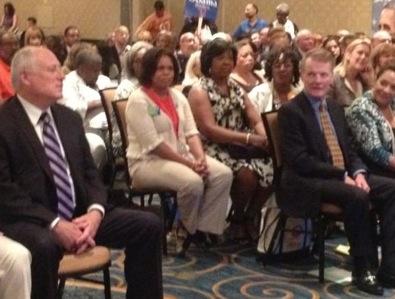
* It’s a bit blurry, but here’s a photo taken by Amanda Vinicky of Gov. Pat Quinn and House Speaker Michael Madigan. “So close, yet so far away,” is Vinicky’s caption. A larger version is here…
*** UPDATE 1 *** The Illinois Republican Party charges media companies for access to their convention events. So, for instance, this is from the IL GOP’s 2008 campaign finance report…
Chicago Tribune
435 N Michigan Ave Ste 250
Chicago, IL 60611 $600.00
8/28/2008 Other Receipt
Illinois Republican Party
Registration Fee […]
NBC-WMAQ
454 N. Columbus Drive
Chicago, IL 60611 $1,200.00
9/2/2008 Other Receipt
Illinois Republican Party
Registration Fee […]
WLS-Radio
190 N State St
Chicago, IL 60601 $600.00
8/27/2008 Other Receipt
Illinois Republican Party
Registration Fee
The Democrats historically have not offered that option.
Pay to, um, play?
Just sayin…
*** UPDATE 2 *** From the IL GOP…
The Illinois Republican Party provides media access to convention events at no charge. The receipts you highlighted were from media that opted to pay for ILGOP-arranged meals and transportation - not for access to the events.
*** UPDATE 3 *** This was sent to media members before the 2004 GOP convention…
Illinois Delegation Service Fees– It has come to our attention that some of you have not received the information regarding the Illinois Service Fee. Toward that end, there is a $500 per person fee that is required for anyone participating in the Illinois Convention activities schedule for convention week. Those who have paid the service fee will receive a special credential will allow them access to all the activities.
What does it include?
· Access to daily delegation breakfast
· Access to evening “night cap” party
· Luncheon aboard the Bateaux on New York Harbor
· Cocktail reception prior to convention
· Convention staff office
· Taste of Illinois goodie bag, commemorative lapel pin, delegation golf shirt and much more.
If you do not have a service fee credential, you will not be admitted.
[ *** End Of Updates *** ]
* A press release from the Illinois Republican Party arrived in my in-box at 4:39 yesterday morning…
Last night, a flurry of reporter tweets alerted the public that Illinois Democrats were banning media coverage of their events in Charlotte:
Mary Ann Ahern @MaryAnnAhernNBC:
First impressions: #ILGOP more accessible than #ILDEMS
We just got kicked out of Omni Hotel interviewing Rev Jackson #DNC #Demsdontlikeus
We made it to Charlotte, but Spkr Madigan says no media allowed at party #DNC #Madiganpartypooper http://yfrog.com/h4n5vsmj
Charles Thomas @CharlesThomas7
Now IL Dems ban reporters from delegate reception. @ilgop is party of transparency? #Madigan #DNC2012 pic.twitter.com/oSjKUEX5
Interviewed @GovernorQuinn on street ’cause IL Dem hotel bans newsies. #Madigan #DNC2012 pic.twitter.com/04rC2fo8
TV news media banned from IL delegation hotel. Can’t be serious. #DNC2012 #Madigan pic.twitter.com/qbomVei1
Carol Marin @CarolMarin
Madigan’s party closed to press. Can you imagine?
“It’s sad but not at all surprising that Mike Madigan and his corrupt cronies brought their Chicago tradition of secret backroom meetings all the way to Charlotte,” Illinois Republican Party Chairman Pat Brady said. “Voters face a clear choice in the coming election. Republicans want to make sure as many people as possible hear our ideas to lower taxes, cut spending and put our economy back on track. Democrats want to kick out the media, lock the door and make sure voters can’t hear their plans to raise taxes, increase spending and keep our country moving in the wrong direction.”
Here are today’s key questions for Illinois Democrats – in case anyone spots one sneaking out of Mike Madigan’s secret, closed-press meetings:
1) Why are you banning Illinois reporters from access to your events at the DNC?
2) What are you hiding from Illinois voters that you can’t allow reporters into your events?
3) Are you afraid of your candidates being quoted speaking about unpopular far-left economic policies like higher taxes, increased spending and exploding debt?
4) Are you afraid of voters learning about your sponsors and SEIU union bosses that may be in attendance?
5) Why do you think the Illinois Republican Party is more transparent than you are?
A bit over the top by everybody involved, apparently.
* Several state legislators have filed an amicus curiae brief defending the constitutionality of the state’s law defining marriage as between a man and a woman. As you already know, a suit has been filed claiming that the state’s civil unions law creates an unconstitutional “separate and unequal” status for gay and lesbian couples.
The brief was filed by Republican state Senators Kirk Dillard, Matt Murphy, Darrin LaHood, Bill Brady, Democratic state Senator William Haine, Republican state Representatives David Reis, Michael Connelly, Richard Morthland, Patti Bellock and Paul Evans, and Democratic state Representative Joseph Lyons.
Led by Senator Kirk Dillard (R-Westmont) and Senator Bill Haine (D-Alton), the legislators’ brief supports a motion to dismiss the ACLU and Lambda Legal lawsuits filed by Thomas More Society attorneys, on behalf of downstate county clerks who were allowed into the case to defend the law.
“We welcome the bipartisan support for Illinois’ marriage law offered by this respected group of legislators,” said Peter Breen, executive director and legal counsel for the Thomas More Society. “They rightly point out that under our constitutional system, the issue of how the government treats domestic relationships is reserved to the General Assembly.”
The legislators assert that the judicial branch should not rewrite the state’s marriage laws, stating that “to do so would be to place the court in a position of acting as a super-legislature, nullifying laws it does not like. That is not our proper role in a democratic society.” They also claim that such action would, “Dramatically interfere with the constitutional guarantee of separation of powers by which the general assembly is empowered to make public policy….”
The legislators also cite several sociological arguments stating that “… the marriage structure that helps children the most is a family headed by two biological parents ….” The legislators also supported the religious liberty concerns raised by the amicus brief of the Catholic Conference of Illinois, also filed this week, indicating that “of great concern to us is hostility that may be shown to Illinois’ religious minorities” who oppose same-sex marriage.
* The Question: In your opinion, does the state civil unions law create a “separate and unequal” status for gays and lesbians? Take the poll and then explain your answer in comments, please.
California debt is beating Illinois bonds by the most in three months as investors choosing between the two lowest-rated U.S. states reward efforts to bolster the finances of the nation’s biggest pension.
Illinois lawmakers failed to advance any measures in a special session Aug. 17 aimed at addressing the nation’s worst- funded pensions. Standard & Poor’s last week cut the state’s credit one level to A, sixth highest. That’s one step above California, where the Legislature passed a plan last week that is projected to curb pension liabilities by as much as $55 billion.
The two states are “a study in contrasts in what they’ve done recently, especially as it relates to pensions,” said James Dearborn, managing director in Boston at Columbia Management Investment Advisers, which oversees $16 billion in munis. “Illinois continues to be the poster child for pension issues.”
Um, huh? Most of the changes approved by California legislators apply only to future employees…
Assembly Bill 340, authored by Assemblyman Warren Furutani, D-Gardena, would apply immediately to state or local government employees hired after Jan. 1, 2013. The measure sets caps on how much of their pay can be counted toward their pensions, rolls back the formulas used to calculate those benefits and pushes back the retirement age.
Those new workers would also share half the normal cost of their pensions with employers. Current employees also would pick up at least half of that cost within five years through collectively-bargained agreements. After that, employers could impose the 50-50 split.
In a Daily Herald survey, Illinois convention delegates gave him passing grades, with 80 percent saying he should be the party’s 2014 nominee and 20 percent suggesting someone else. […]
In the Daily Herald survey of party faithful attending this week’s convention in Charlotte, 40 percent of respondents gave Quinn a “B” grade for his time in office. Another 25 percent assigned him an “A” and more, 28 percent, gave him a “C.”
Fifty-one Democrats responded to the survey, out of 214 total delegates.
On the question about Democrats’ 2014 nominee, several among the 20 percent who want an alternative to Quinn named names, listing Illinois Attorney General Lisa Madigan and Lt. Gov. Sheila Simon.
Twenty-one respondents skipped that survey question, compared to 30 who answered it.
Most people looked at last week’s veto by Gov. Pat Quinn of the gambling expansion bill and saw nothing except defeat for the issue. But the governor appeared to deliberately leave open some doors that you could drive a riverboat through.
For instance, nowhere in his veto message did Quinn mention slot machines at horse tracks.
Quinn had been an adamant foe of allowing the horse racing industry to set up “mini casinos” at their tracks, believing it would mean an oversaturation of the gambling market. He cited the inclusion of slots at tracks in last year’s gambling bill as a major reason why he opposed the legislation.
But Quinn subtly began to back away from his opposition, which was included in his “Framework for Gambling in Illinois” plan in October that he wrote in response to criticisms that he wasn’t making his positions known to negotiators.
In May, during a meeting with gambling proponents, Quinn refused to say whether he would agree to slots at tracks if legislators included a ban on campaign contributions from casino operators. That refusal was taken as a big hint that Quinn had backed off, and governor’s office insiders confirmed that was the direction he was heading.
Reporters then tried for days to get Quinn to say in public if he still opposed slots at tracks, and he would always refer them to his “framework” in response.
Quinn’s veto message last week outlined his main opposition to the bill, which mostly followed his “framework” from last year. He strongly highlighted his demand that casino companies not be allowed to make campaign donations (although he didn’t mention contributions from immediate family members of casino operators, who generously pumped up his campaign fund during the 2010 cycle).
Quinn also sharply criticized what he considers to be a lack of oversight of a new Chicago casino. The governor repeated his assertions from his October framework that the bill doesn’t give the Illinois Gaming Board adequate time to “make critical licensing and regulatory decisions.” And he said again that money from expanded gambling needs to go to education.
Chicago Mayor Rahm Emanuel has fought hard against too much state oversight of a city casino. But Quinn made clear last week in his veto message that Emanuel will have to give in on that, and, to his credit, the mayor seems to be willing to do so.
It’s also clear that some sort of contribution ban will have to be put in place for the governor to be convinced. The ban won’t really work all that well. The casinos could just contribute to other funds, which would wash their money back into the system.
For example, Indiana prohibits contributions from casino operators, but the Republican Governors Association’s “super PAC” gave $1 million to Indiana’s GOP gubernatorial candidate last month, and the RGA has received at least $1 million from a single casino owner.
Money will always find a way into the political process. Quinn received several large campaign contributions from an immediate family member of the Des Plaines casino owner in 2010.
Even so, word is that Dick Duchossois is open to a contribution ban. Duchossois owns Arlington Park racecourse via his interest in a big corporation. His son’s massive contributions to Republicans in 2010 reportedly sparked Quinn’s ire. And some of Quinn’s Democratic friends who have casino ownership are major Duchossois haters.
But if Duchossois agrees to a contribution ban, even implicitly, then that particular issue might see some progress — although we could probably expect a vigorous court challenge from other casino owners on 1st Amendment grounds.
In May, insiders said Quinn wanted to wait until the Legislature’s November veto session to deal with gambling expansion and then use the future tax revenue to heroically fix a gaping budget hole. The second part of that is coming to fruition with Quinn’s demand that much of the tax money from more gambling go to education.
The General Assembly cut the education budget by $210 million this spring, and the gambling expansion is expected to bring in about $200 million a year. Quinn could, therefore, claim that he had “saved” the education budget with gambling growth.
The veto session part is a bit more tenuous, however. Quinn wrote in his veto message that the state cannot “gamble its way out of our fiscal challenges.” The governor claimed that “even a casino on every street corner cannot repair the state’s $83 billion unfunded pension liability.”
The governor’s message was pretty emphatic. There will be no gambling expansion until pension reform is in place.
* House Speaker Michael Madigan was asked about the “Fire Madigan” campaign being run by the Illinois Republican Party…
“Let’s remember, Illinois Republicans are standing in opposition to the retention of a son of Illinois as president of the United States,” Madigan told reporters.
“They don’t want to talk about Romney and Ryan and their destruction of Medicare, so they want to create a diversion,” he said. “I don’t think it’s going to work. I think the people of Illinois know that Illinois Republicans just want to sit on the sidelines and say, ‘Well, the Democrats have a majority. They should solve all the problems.’”
* The Republican Party chairman responded via press release…
Illinois Republican Party Chairman Pat Brady responded, “Illinois voters can’t afford anyone sitting on the sidelines while Mike Madigan and his rubber stamps drive our state into the ditch. If Illinois voters want to save Illinois, they need to fire Madigan and his cronies in November.”
Now the strongest words yet from House Speaker Mike Madigan indicating a pension overhaul will wait, at least until November: “I’m not planning on being in Springfield before the election, now I’m only one person down there but I don’t plan to be down in Springfield before the election.”
* He also hinted that the Democrats might try to go it alone on pension reform…
Madigan for the first time suggested he might be willing to pass a pension package strictly with Democratic votes rather than rely on non-existent GOP support. […]
“What we’re learning in recent years is on these major issues, you do them when you’re able to do them. We repealed the death penalty in Illinois. We raised the income tax in Illinois. Those were all done after a general election,” Madigan said, referring to two hot-button matters the Legislature passed during a January 2011 session.
“The better question is when are you able to put together 60 and 30 votes to pass a major piece of legislation,” he said.
Madigan had insisted on at least 30 Republican votes in his chamber to pass a pension deal, but he appeared to back off that demand Monday during a question-and-answer session with reporters following a breakfast of Illinois delegates at the Democratic National Convention.
“That’s always a possibility. That’s always a possibility,” he said. “Again, you have to be there. You have to work to find 60 and 30 votes. Sometimes they’re there. Sometimes they’re not,” Madigan said when asked about a Democratic-only roll call on pensions.
Right now, the votes aren’t there. It’ll be extremely tough to get them as well. We’ll see.
* Schock to Illinois delegates: GOP can learn from Madigan: While he cut at Democrats for fiscal mismanagement and a tax increase, he noted Madigan has “done a very good job with candidate recruitment. One thing I’ve learned is if you have all the money in the world and you have a bad horse, you don’t win on race day.”
* From an AFSCME press release, sent yesterday afternoon…
Just two weeks after a huge crowd of working men and women booed him off the stage on Governor’s Day at the Illinois State Fair, Pat Quinn found that he couldn’t escape responsibility for his anti-labor record even in Charlotte, NC.
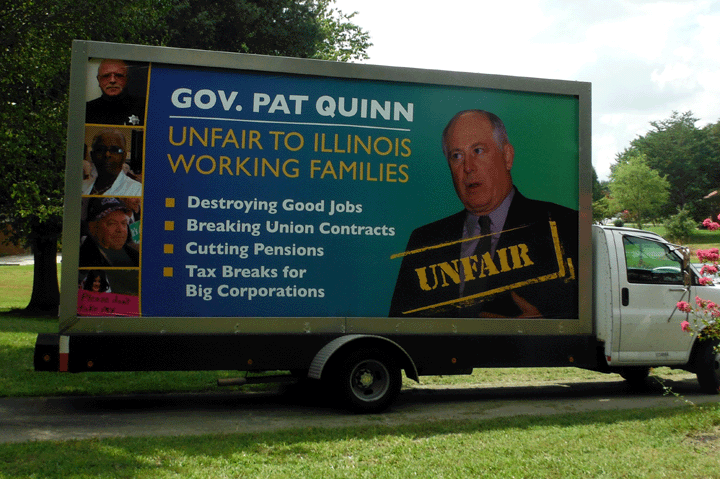
Starting today at the Democratic National Convention, the state’s largest union of public-service workers — the American Federation of State, County and Municipal Employees (AFSCME) Council 31 — announced it will publicize Governor Quinn’s push to lay off 4,000 state employees, slash retiree pensions and break union contracts while giving away hundreds of millions of dollars in new corporate tax loopholes.
The union will debut a new mobile billboard near Governor Quinn’s campaign fundraiser this evening at the Capital Grille, 201 N Tryon St., and will bring it to many events in Charlotte this week.
A letter sent this afternoon to the entire Illinois delegation laid out the governor’s record.
The letter is here. And here’s the mobile billboard referenced in the press release…
* Gov. Quinn talked about being pro-labor during a speech to Illinois delegates yesterday…
“Today is a very special day in American history — it’s Labor Day and every day should be Labor Day. … It’s so important that we honor labor all the time,” the governor said. Quinn touted support for increasing the state’s minimum wage, which currently stands at $8.25 an hour, $1 above the federal minimum wage.
The misgivings of organized labor toward Quinn were muted somewhat by improvements in manufacturing jobs in the state as well as new United Auto Workers union jobs at the Chrysler Corp. plant in Belvidere, the Ford Motor Co. plant on Chicago’s South Side and the Mitsubishi Motors Corp. plant in Normal — successes Quinn readily touted to the delegates.
“I’m a friend of labor and I will always be friends to labor because they helped me,” Quinn told reporters later. “Governors have to make tough decisions. Sometimes they upset some people. But I think I’ll do well with ordinary working people in Illinois across our state because they know I fight hard for them every day.”
“I haven’t forgotten (Quinn) won by 32,000 votes (in 2010), and I think a few other people haven’t forgotten that either. I don’t know how he could win re-election again without making peace with labor. But we’re ready. We’ll be at the table. All it will take is a phone call,” Carrigan said.