* From the governor’s press conference today…
On March, 22, the rate at which are COVID positive case count was doubling was just about two days. By April 1, that rate had increased to around 3.6 days. As of this Sunday, April 12, our case doubling rate had reached 8.2 days.
Similarly, our mortality, doubling rate has increased. At the beginning of April it was at 2.5 days, and it is now at 5.5 days.
To be clear, there is nothing good about twice as many people having this virus, or worse, dying from it. No matter how long the increase takes. But we won’t get to zero cases overnight. The fact that our doubling rate continues to increase in every metric is a clear demonstration that there is a deceleration of virus transmission. We are in fact, bending the curve.
* Hospitalization-related numbers…
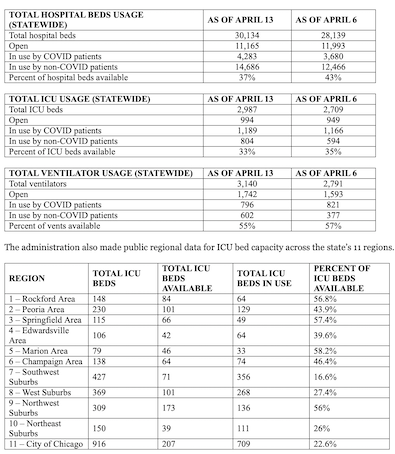
Perhaps the most accurate leading indicator of our progress is our hospitalization data. Right now, if someone is sick enough with a respiratory illness to need hospital care, then it’s likely that that person has COVID-19, whether or not they have been tested.
On April 6, the number of known COVID patients and suspected COVID patients totaled 3680. On April 10, that number was 4020. On April 11, it was 4104. On April 12 4091. As of today, it was 4283.
As you can see these numbers are increasing. However, so too is our overall hospital capacity. Our hospitals are working every day to add beds. In August of 2019 just to give you a number, way before COVID-19 came to us, our state averaged about 25,500, total beds. As of this weekend, our total bed count is about 30,002.
Other important metrics are ICU beds and ventilators. A week ago, COVID patients as a percentage of ICU beds increased from 35% to 43%, an eight percentage point jump. COVID patients today occupy 40% of our total ICU beds, that’s down from the 43% a week ago.
In the same timeframe, COVID patients as a percentage of total ventilators grew from 24 to 29% of five point jump in a week. COVID patients today occupy 25% of our total ventilators both of those numbers are evidence of positive trends, a declining number percentage of ICU beds, occupied by COVID patients, and the declining number of ventilators occupied by COVID patients. Additionally, our total ventilator numbers are starting to reflect the additional ventilators that we’ve acquired now totaling more than 3000 across the state. Overall these numbers are indicators of our growing ability to manage capacity within the healthcare systems across Illinois.
Remember to pardon all transcription errors.
* More on hospitals…
No region is currently below 15% availability in any of these metrics, but there are individual hospitals that are operating at or near max capacity. Right now hospitals are by and large doing a great job of directing patients, amongst themselves, but if it becomes necessary I will not hesitate to step in to direct ICU patients to hospitals that are more available.
…Adding… From a press release…
* Lots of people coming in…
I am so deeply thankful for the now 3600 retired and out of state healthcare professionals who have applied to join the Illinois fight against COVID-19.
* Dr. Ezike then talked about recoveries…
We sent out these electronic surveys to people to catch their recovery rate at seven days, 14 days, 21 days and 28 days. As you can imagine people are getting better with time.
For people who don’t respond to this survey, we have a staff of 23 individuals who are calling to follow up. We’re making about 300 calls a day to people who didn’t respond, of which approximately half of those results in a successful interview.
So to share those results, I am happy to report that of the people who were surveyed at seven days, 44% have indicated recovery. At 14 days, the number increases to 50%. At 21 days after testing positive, we have 61% of people who responded, either to the initial electronic survey or the follow up telephone call, that they no longer have symptoms. And at 28 days, 69% of people reported no COVID-19 symptoms, and feeling much better. So again, people are getting better people recover from this disease.
It is important to note that not everyone responded to the survey so potentially the averages could be higher.
* On to questions for the governor. Asked about regional cooperation agreements with other governors…
I began this conversation really late last week with some of the East Coast governors. And then, over the last few days with my counterparts in Midwest states surrounding us.
Our goal of course for this is to start to think about what are the preconditions for beginning to allow certain kinds of businesses to open their doors again, to expand the definition of those who can work are those businesses they can have their doors open.
And again, as I’ve said the preconditions that I think are appropriate are a lot testing, tracing and treating. And then I would add to that the availability of PPE to the entire population, even those who might not be able to afford their own PPE so those things together I think are the preconditions and you know there are a lot of other things to discuss.
The governors that I’ve spoken with have been very frankly very positive about this idea. They’ve all been thinking about it individually for their states and understand that speaking with a common voice might be a positive move.
* Is this in part in response to the president saying that he’s going to be the one to dictate everything and he’s in control, if you will…
No. I in fact we’ve been all of us thinking about what’s next. We have our stay at home order in place that the closing of schools and so on. What comes next, what are the things that trigger a change. And you know how much you know how much can we do and how fast can we do it all of that I might add is going to be dependent upon what we hear from the epidemiologists and the doctors.
The governor was asked yet again why he didn’t shut down the primary election and he responded yet again that he had no constitutional authority to do so.
* Another part of that question was poll workers reporting that they had no sanitation supplies or related on primary day…
We were assured by the boards of elections that in fact they had the PPE or the sanitary devices that they needed. And we were willing to provide them. Indeed we were even willing to provide poll workers for them … At least in Chicago, that was rejected. And so, you know, that was their choice. They felt like they had a handle on it.
* Wondering if you can break it down by infection rate relative to the number of residents in Illinois…
I mean, it’s very hard to say because we aren’t testing everybody in the state of Illinois. What we know is that the percentage of people who are tested.
Let me back up just for everybody who hasn’t followed this. We’re testing people who show some symptoms of COVID-19. […]
It might be more useful to look at the broad global data that’s available and I’ll just share that with you as well. About 80% of people who get COVID-19, and by the way we believe everybody is susceptible to COVID-19. Period. End of sentence. You either have had it already, or you’re going to get it, unless we have a vaccine that prevents you from getting it which we don’t currently. So 80% of people who get COVID-19 recover just fine, don’t require hospitalization or anything of a significant medical intervention nature. About 19% require some further hospitalization or other intervention. And then about 1% unfortunately about point seven to 1% pass away, in, in many cases because they have either a comorbidity or they’re in an age bracket that is most susceptible.
* Another question about regional cooperation…
Look the conversations are very much, very similar that each of us might have, a slightly new idea to offer in the conversation. But when I talk about testing tracing and treating everybody understands exactly what that means. And that we in fact need to do that so widespread testing. So for example I talked to a governor, who’s talking about buying a commercial lab that exists in their state and converting it entirely to testing for COVID-19, and it would yield for that Governor 10s of thousands of tests on a daily basis. So that’s something they’re looking at to deal with the testing part. I am looking significantly at not only the increases in testing that we’ve begun to, to see at our seat labs and working with our hospitals, but on the tracing part, looking at models like what they are doing in Massachusetts, where they have a, you know, a case tracing collaborative that exists or at least that they’ve stood up but you know it’s just getting going where they’re just using good old fashioned shoe leather, to make sure and call every single person that may have come in contact with somebody who has COVID-19.
* Asked about Leader Brady’s request for a leaders meeting…
First of all I speak with the leaders all the time. I think every one of the leaders would tell you that I’ve had multiple conversations with them. And I’m always happy to have a, you know, we can convene a zoom conference or teleconference all of that. I’m happy to do any of that anytime with any of them. But I have been very communicative with each and every one of them. I’ve spoken with every leader probably, on average, once a week, maybe, maybe once every two weeks it’s hard to tell, but it’s usually we have an agenda of things that we’re discussing each of us, and we’re trying to make sure that we can keep things moving forward, those who might suggest that we haven’t been having those conversations or not paying attention to the fact that the leaders and I and the fact that I pick up the phone, virtually every day I call multiple legislators on both sides of the aisle to make sure that I’m communicating with them but even more importantly listening to them about concerns that their constituents may have and what we could do in the executive branch to make their their lives easier.
* Now on to a few questions from reporters trying to get him to whack the president. Do you worry that the criticism of the Trump administration could come with retribution that prevents Illinois from getting PPE and other help in the COVID battle?…
Well I compliment the administration when they do things right, when they deliver on their promises, and I’ve been critical when they don’t. And I think that is the proper way for me to operate I’m defending and working on behalf of the people of Illinois. And each time I have been critical we’ve actually received more from the federal government. And each time I’ve been complimentary it’s because they delivered on a promise to us and I was glad that I wanted people to know that.
* There’s a lot of talk about the president reopening the country. Are you going to be working with the white house as the president claims, or do you want to work mostly with state experts…
Well I’ll listen to anybody. But I what I won’t do anything that will jeopardize the safety and health of people here in Illinois.
* What is your administration heard about hydroxychloroquine? The President has said it should be used as a coronavirus cure. Do you think that’s good advice?…
Dr. Ezike: There are multiple different treatments that people are trying off label. Off label means that there’s a medicine that’s approved for a different cause but is now being tried for COVID-19 patients. So there are many, there’s antibiotics, there are antimalarials, which are anti parasitics, there are anti virus medicines. So, all different types of medicines are being employed. And then what we need to really figure out if it’s the right way forward and now it would go on to get FDA approval for a specific indication is to have these randomized controlled trials randomized controlled double blind trials, as the governor already described and so when you get these large scale trials and then you prove scientifically with sufficient power that there is one treatment is either better than placebo or better than an alternate treatment. Then that’s how it goes on to move for FDA approval.
So, again, anecdotally that’s where it starts where you get, as I hear stories that we tried this at work, we tried this work and the next step is to take it into trials. And so, again, people in terms of what recommendations are officially put out are usually based not on anecdotes, but more so on trials and the results of trials and so we’re looking forward to getting some of those results of some trials that might be going on so that we can spread on if some of these anecdotes actually proved to be factual and work great.
* With multiple projections showing billions of dollars in lost revenue due to COVID-19 and the Comptroller’s office showing nearly $200 million in cost What is your plan to close the gap in this year’s budget and when will you present a new FYI 21 plan?…
We’ll be talking about that later this week. It’s obviously been very much on our minds.
I spend an awful lot of time every day focused on trying to reduce the infections across the state and reduce the hospitalizations and the need for ventilators and of course reduce the death rate.
I have also had my budget and economy team working hard on exactly how big the hole will be from a revenue perspective as well as obviously the expanding that we’ve had to do to protect people in the state, and then try to project forward what does this mean for a budget in 2021.
And then ultimately we’re going to present our best ideas, and our best estimates to the legislature, who is finally responsible for passing a budget. But we’ll be presenting that going forward.
I think no one should mistake the fact that this is going to be a very, very difficult fiscal financial challenge for the state of Illinois. It’s one of the reasons why I think all of us should be communicating with our federal representatives here to work hard to get the government in Washington DC to help all of the states because we really have this problem in common with all the states you hear Governor’s say this all the time. We have big holes in our budgets as a result of what’s happened with COVID-19 it’s nobody’s fault it just is where it is and we’re going to have to deal with it.
* Given your concerns about summer events do you think the Illinois State Fair should proceed as scheduled?…
Well, we’re going to have to make decisions relatively soon because contracts have to be signed. And I think that was really the point I was making a few days ago when I talked about summer festivals was more or less just a lot of planning goes into these things and decisions have to be made.
So, yeah, I mean we’re gonna have to make some decisions. And I have as much fun as anybody does at the state fairs and I’m hopeful that we could have both our state fairs the one in DuQuoin and the one in Springfield. But I am also just going to listen to the experts and make sure that we do the right thing so that we don’t spread this COVID-19, and that we don’t have a spike in you know all the hospitalizations and ultimately and people passing away.
-30-
35 Comments  
|
* Press release…
he Illinois Department of Public Health (IDPH) today announced 1,222 new cases of coronavirus disease (COVID-19) in Illinois, including 74 additional deaths.
Cook County: 1 male 30s, 3 males 40s, 2 females 50s, 3 males 50s, 1 unknown 50s, 1 female 60s, 5 males 60s, 5 females 70s, 3 males 70s, 2 females 80s, 5 males 80s, 3 females 90s, 1 female 100+
DuPage County: 1 male 30s, 1 female 70s, 1 male 70s, 2 females 80s
Jackson County: 1 male 70s
Kankakee County: 1 male 80s
Lake County: 1 male 50s, 3 males 60s, 1 unknown 60s, 1 female 70s, 2 males 70s, 1 female 80s, 4 males 80s
McHenry County: 1 male 50s
Monroe County: 1 female 80s, 1 female 90s
Sangamon County: 1 female 70s
Tazewell County: 1 male 80s
Whiteside County: 1 female 90s
Will County; 1 male 40s, 1 female 60s, 1 male 60s, 1 female 70s, 2 males 70s, 4 males 80s, 2 females 90s, 1 female 100+
Clay County is now reporting a case. Currently, IDPH is reporting a total of 23,247 cases, including 868 deaths, in 88 counties in Illinois. The age of cases ranges from younger than one to older than 100 years.
6 Comments
|
Question of the day
Tuesday, Apr 14, 2020 - Posted by Rich Miller
* Rep. Mike Zalewski (D-Riverside) gave himself a “co-hawk” (get it?) haircut to raise money to help local servers and waitstaff who lost their jobs. You can find out how to contribute by clicking here. This is a photo he sent me…

Um.
* The Question: Caption?
49 Comments
|
* From Senate Republican Leader Bill Brady…
Today, I am calling on Governor Pritzker to convene the four legislative leaders to share what planning is underway as it relates to the reopening of our state. As no official notice has been made about extending the current stay-at-home order, I believe we need to begin discussions on an eventual, responsible opening of our state’s economy. And while I appreciate the governor’s willingness throughout this crisis to talk with me one-on-one, it is important for the leaders to meet.
Looks like member management to me. I’ve inquired as to whether he’s privately asked the governor for a leaders meeting before issuing this press release and am awaiting a response. I’ve also asked the same question of the governor’s office and asked the two Democratic leaders if he had talked to them about this. Madigan’s spokesperson said he wasn’t aware of any such request.
…Adding… From the SDems…
The Senate President talks with Leader Brady regularly and is always willing to talk with the governor and other leaders.
*** UPDATE *** The governor was asked about it today…
First of all I speak with the leaders all the time. I think every one of the leaders would tell you that I’ve had multiple conversations with them. And I’m always happy to have a, you know, we can convene a zoom conference or teleconference all of that. I’m happy to do any of that anytime with any of them. But I have been very communicative with each and every one of them. I’ve spoken with every leader probably, on average, once a week, maybe, maybe once every two weeks it’s hard to tell, but it’s usually we have an agenda of things that we’re discussing each of us, and we’re trying to make sure that we can keep things moving forward, those who might suggest that we haven’t been having those conversations or not paying attention to the fact that the leaders and I and the fact that I pick up the phone, virtually every day I call multiple legislators on both sides of the aisle to make sure that I’m communicating with them but even more importantly listening to them about concerns that their constituents may have and what we could do in the executive branch to make their their lives easier.
10 Comments
|
* Center for Illinois Politics…
Ernie Tedeschi, a former economist for the U.S. Treasury, told The New York Times that it is the coronavirus itself – and not state orders to shut down businesses – that is the driving force behind the apparent recession now.
“States that haven’t yet closed businesses or put their populations on some sort of lockdown aren’t escaping enormous spikes in unemployment,” he said. “The pain is not just deep, it’s wide. This punctuates that the fundamental problem with the economy right now is the pandemic.”
That is my thinking as well. First fix or at least significantly mitigate the underlying problem and the economy will hopefully come back. It ain’t gonna come back if the problem is not fully addressed.
* WalletHub…
As the U.S. has embraced social distancing policies in order to minimize the spread of COVID-19, many businesses have shut their doors either voluntarily or by government order. […]
In order to find out the states whose unemployment percentages are most and least affected, WalletHub compared the 50 states and the District of Columbia across two key metrics. These metrics compare unemployment claim increases for the week of March 30 to both the same week in 2019 and the first week of 2020.
WalletHub also looked at this…
In order to find out where the pandemic has caused businesses to struggle most, WalletHub compared the 50 states and the District of Columbia across 12 key metrics. Our data set ranges from the share of small businesses operating in high-risk industries to small-business credit conditions and the state’s small-business friendliness.
* Here are a few states with their stay at home order dates, their rankings for unemployment insurance (UI) application increases and WalletHub’s small business rankings. In both instance, the higher the number, the better off the states are. Illinois stacks up well in both counts, even though it was one of the first states to adopt a stay at home order…
March 21: Illinois - Rankings: UI 42nd, Biz 45th;
March 30: North Carolina - Rankings: UI 7th, Biz 9th;
March 31: Arizona - Rankings: UI 12th, Biz 7th;
April 2: Georgia - Rankings: UI 4th, Biz 12th;
April 2: Maine - Rankings: UI 23rd, Biz 19th;
April 3: Florida - Rankings: UI 18th, Biz 16th;
April 3: Mississippi - Rankings: UI 5th, Biz 4th;
April 4: Alabama - Rankings: UI 24th, Biz 27th;
Still no order: Iowa - Rankings: UI 31st, Biz 31st
This isn’t a perfect metric by any means, but it does show you that economies shut down because of the virus. People essentially voted with their feet.
Until governments at all levels take a serious and effective approach to this virus, people are not going to feel safe.
24 Comments
|
COVID-19 roundup
Tuesday, Apr 14, 2020 - Posted by Rich Miller
* I’m told that Pritzker and his staff started reaching out yesterday. Here’s Greg Hinz…
With an eye on what’s happening on the coasts, Illinois Gov. J.B. Pritzker has begun talking with his peers in other Midwestern states about adopting a joint policy on reopening the Midwest economy as the COVID-19 pandemic curve appears to be flattening.
Pritzker’s office is confirming that both he and key staff members have been on the phone as governors in the Northeast and Pacific Coast areas step up regional coordination in advance of an expected national move by President Donald Trump that may or may not fit local priorities.
“The governor is interested in exploring something like what’s happening on the East and West Coasts for the Midwest,” spokeswoman Jordan Abudayyeh told me in a phone call. “It would be some sort of regional cooperation.”
“The conversations are being had,” she said, while declining to confirm whether Pritzker has spoken directly with his counterparts in Indianapolis, Madison or elsewhere. “I think our goal is to work together on things such as what do you do about stay-at-home orders, legalities and so forth.”
* Meanwhile, business interests were completely surprised by the governor’s workers’ comp move yesterday. Here’s Hannah Meisel…
Illinois Manufacturers’ Association President and CEO Mark Denzler told The Daily Line on Monday that he last spoke to Workers’ Compensation Commission members on Friday afternoon, and was not warned of the emergency rule coming down the pipeline.
Instead, Denzler said he thought commission members were on the same page as him in believing the Illinois Workers’ Occupational Diseases Act would cover any situation that arose if an essential worker were infected with Covid-19.
According to the law, “a disease shall be deemed to arise out of the employment if there is apparent to the rational mind, upon consideration of all the circumstances, a causal connection between the conditions under which the work is performed and the occupational disease.”
Denzler said he understood the rationale of assuming a nurse, for example, would most likely be exposed to Covid-19 at work, but said employees in manufacturing, retail or hospitality could still be able to claim workers’ compensation if they came down with the virus even if they were not exposed at work.
“It’s going to make it very difficult for employers to defend against [workers’ compensation] claims,” Denzler said. “I’m disappointed that the commission did not reach out to the employer community to have a discussion about this and the governor’s office didn’t reach out to employer community to see if there could be a compromise…as opposed to a dictate coming down on a Monday morning.”
The governor initially said yesterday that the new rules would allow workers to receive workers’ comp if they got COVID-19 on the job. But that’s definitely not what the new rules actually say. It’s now automatically presumed workers got the virus on the job.
* On to selected headlines from the Tribune’s live blog…
Illinois National Guard opens drive-up COVID-19 testing site in Markham
South suburban first responders to get distribution of N95 protective masks
As Chicago, other cities report racial disparities in COVID-19 cases, Illinois Democrats call on Trump administration to collect nationwide data
More than 360 retired teachers offer free virtual tutoring to Illinois students as schools remain closed
The number of background check requests for gun transactions breaks records in March as coronavirus lockdown took effect
200 residents of Aurora homeless shelter bused to Schaumburg hotel to help prevent spread of coronavirus
* From the Sun-Times’ live blog…
At Chicago shelter for immigrant kids, more than half test positive for COVID-19
Infectious disease expert awaiting murder trial requests release to research COVID-19
Things to do with your kids while self-quarantining at home
Why Blacks are hit hardest by COVID-19 — and what that says about health care in America
The Cook County medical examiner’s office Monday confirmed 55 additional COVID-19 deaths, bringing the total in the county to 581.
A 16th employee at the Cook County Circuit Court clerk’s office has tested positive for COVID-19.
Chicago police Monday announced 30 more confirmed case of COVID-19, bringing the number of cases in the department to 200.
* Roundup…
* WHO officials say it’s unclear whether recovered coronavirus patients are immune to second infection
* Illinois business climate better than most states amid pandemic, study shows - Illinois has the 7th least affected small business marketplace
* States largely have authority over when to shut down, reopen during coronavirus pandemic
* ‘There is no downtime’: What it’s like for ER doctor dealing with COVID-19 during a 10-hour shift
* As demand grows, association says Illinois Secretary of State not helping license new truck drivers
* Five inmates that tested positive for COVID-19 in the state prison system have died: Rice had been in prison since the early 1980s on charges related to child molestation when he admitted he earlier had kidnapped, raped and killed an 11-year-old Oak Forest boy. Rice received an additional 80-year term for the murder.
* Chicago primary voters notified of possible virus exposure
* At least 2,300 nursing homes have coronavirus cases — and the reality is likely much worse: The new coronavirus is racing through America’s nursing homes, and the impact has been far greater than the federal government has said.
* Microsoft, UPS and health care companies create app so you can donate masks to hospitals
* John A. Logan, SIU classes to continue online only into summer semester
* Responding to Blaine Wilhour’s questioning of safety measures
* Shutdown could cost Quincy more than $2.3 million in lost tax revenue
* How Macon County’s local governments are operating in a socially distant world
* Little Village coal plant smokestack implosion sparks outrage, plans for class action lawsuit
* As Cook County grapples with climbing death count, pop-up morgue troubles neighbors
6 Comments
|
Today’s quotable
Tuesday, Apr 14, 2020 - Posted by Rich Miller
* From the Atlantic…
During the Vietnam War, Vice Admiral James Stockdale spent seven years being tortured in a Hanoi prison. When asked about his experience, he noted that optimistic prison-mates eventually broke, as they passed one imagined deadline for release after another. Stockdale’s strategy, instead, was to meld hope with realism—“the need for absolute, unwavering faith that you can prevail,” as he put it, with “the discipline to begin by confronting the brutal facts, whatever they are.”
Do yourself a favor and read the rest of that article. Lots of sobering stuff in there about tests, drug shortages, the limitations and serious shortcomings of antibody tests and plenty more.
And, by the way, “brutal facts” does not mean twisted facts. It means real actual honest to goodness facts, which seem to be in short supply.
Also, it’s not been widely reported, but Abbott’s much acclaimed ID Now rapid test, which provides results in 5-13 minutes, can only process one sample at a time.
That means running the machine 24 hours without pauses or glitches, produces between 111 and 288 results. That’s fine for an individual hospital, but it’s not so great for widespread testing.
Stay frosty.
15 Comments
|
* This looks quite useful…
The Office of Illinois Comptroller has established an online portal showing the state’s COVID-19 coronavirus-related purchases and amounts spent on necessary supplies for the ongoing fight against the deadly virus.
The portal can be found at https://illinoiscomptroller.gov/covid19-information/.
As of April 10, Illinois has spent more than $174 million on purchases related to COVID-19, including such supplies as ventilators, masks, gloves, gowns, protective eyewear, hand sanitizer, swabs and more.
The site will be updated daily.
This effort is part of Illinois State Comptroller Susana Mendoza’s transparency initiative to make state spending, revenues and other public data easily accessible to taxpayers, the media and elected officials.
“As long as this unprecedented public health crisis continues, my office will prioritize payments for the tools and supplies our frontline health care workers need to protect themselves, their patients and our communities,” Mendoza said.
“I hope our online portal showing Illinois’ investment in fighting this deadly virus will help drive home the message that none of this should be taken lightly and that people need to stay home and stay safe.”
9 Comments
|
* Chicago Magazine is out with its list of 50 most powerful women in the city. Frankly, many if not most would be on my list of the city’s most powerful people, regardless of gender.
Anyway, Number 1 is Mayor Lightfoot, of course. Their Number 5 is the governor’s chief of staff Anne Caprara…
Before her 30th birthday, Caprara had served as chief of staff to two different members of Congress. She has since overseen Hillary Clinton’s $190 million PAC — the largest in presidential campaign history — and, without the benefit of membership in the Illinois old boys’ network, run the campaign that beat Republican governor Bruce Rauner by almost 16 points. Now Governor Pritzker’s chief of staff, she’s been his point person for the state’s massive coronavirus response. And she’s funny on Twitter, too.
Just about anyone who knows her will read that last sentence and likely think of this…
You mean, let me understand this ’cause, ya know maybe it’s me, I’m a little #@&%*$ up maybe, but I’m funny how? I mean, funny like, I’m a clown? I amuse you? I make you laugh? I’m here to #@&%*$ amuse you? What do you mean funny? Funny how? How am I funny?
She’s quite something. And she more than earned that place on the list.
Anyway, congrats to all!
Any additions you’d make to their list?
35 Comments
|
* Multiple reporters ask the governor multiple questions every day about when and how he plans to ease or even lift his stay at home order, which is a little more than three weeks old. It’s like they don’t listen to what he said the day before or even five minutes before. And many of their stories don’t really inform readers/viewers about what the answers actually were, which then prompts more questions because the public is confused.
NBC 5 actually listened yesterday…
While the state of Illinois’ stay-at-home order currently runs through April 30, Governor J.B. Pritzker says there are at least three things that will need to happen before restrictions can be significantly eased.
During his press conference Monday, Pritzker said that there is a chance that the stay-at-home order could be modified after it expires on April 30, but cautioned that there is still a long way to go before all businesses can re-open and gatherings can once again be held.
Barring a vaccine, Pritzker says that the lack of herd immunity leaves a three-fold path toward a significant move toward normalcy.
To sum up the meat of the story…
1) Widespread testing (at least 10,000 test results each and every day);
2) A contact tracing system must be in place;
3) “We need a treatment to lessen the severity of the symptoms, so that fewer people go to the hospital, fewer move from a regular hospital bed to an ICU bed, and fewer go from an ICU bed to a ventilator.”
This answer isn’t new, by the way. He’s been saying the same thing for days and days.
* But Pritzker opened himself to more questions when he briefly mentioned possible changes. Here’s Doug Finke…
Pritzker again declined to speculate on whether K-12 schools will reopen this school year or whether they will remain closed as they are in some other states.
“I promise I will tell you as soon as I know the answer to that question,” he said.
However, when the governor was asked if he might lift his stay-at-home order by May 1, he indicated changes were coming.
“I think it’s likely that there will be adjustments to the orders that we have put in place,” he said without specifying what they may be or timing of an announcement.
“I promise I will tell you as soon as I know the answer to that question,” is a good response. I mean, it’s not like he’s gonna wait for a reporter to ask a question about schools before announcing his decision.
But then he went beyond that response and now we’d like to know what sort of changes might be in store.
60 Comments
|
* Rep. Mark Batinick (R-Plainfield) has written an open letter to the governor. This is just one excerpt and, in context, he is also calling for limited openings of some retailers, which I’m not sure I agree with since the peak has not yet arrived. But, anyway, here you go…
New studies are showing that wearing a covering of any kind on the face can significantly slow the spread of the disease. Even today, I still see many store employees and customers in a busy grocery store without any protective equipment. Restaurants offering carry-out and delivery are also not requiring staff to wear PPE.
It should become a requirement for all employees and customers to wear face coverings inside stores and restaurants.
59 Comments
|
|
 Support CapitolFax.com
Visit our advertisers...

 ...............
 ...............
 ...............


|
   
|
Hosted by MCS |
SUBSCRIBE to Capitol Fax |
Advertise Here |
Mobile Version |
Contact Rich Miller
|



