The constitution provides that only three constitutional articles can be put on the ballot for voter approval at one time. One of those spots already is taken by a proposed amendment allowing recall for future governors, which was approved last year.
House Minority Leader Tom Cross, R-Oswego, says [House Speaker Michael Madigan’s] judicial experience amendment could be used to keep other ideas from reaching the ballot – such as changing how lawmakers draw their own districts, an effort Republicans are pushing this year.
“We believe it is a tactic by the Speaker,” said House Minority Leader Tom Cross.
From the Constitution…
The General Assembly shall not submit proposed
amendments to more than three Articles of the Constitution at any one election.
Madigan’s judicial reform amends Article VI. The Speaker’s amendment to abolish the lt. governor’s office amends Article V. The already ballot-approved recall measure amends Article III.
So, if the two Madigan amendments are approved, no further amendments could be submitted to voters by the GA.
No one has suggested consolidating governmental units to make operations more efficient and reduce the burden on taxpayers. […]
So, one of the first steps has to be taken by the General Assembly to change the statutes that stand in the way of consolidation. Our lawmakers should be embarrassed that while the state is facing a monumental budget crisis, there has been no serious discussion that government in Illinois is simply too big and bureaucratic.
OK, government is too big, but you want to make local governments bigger? I’m not quite following.
* Dear Chicagoland judges,
I own a sports car (it’s 13 years old, but I like it) and I admit to driving very, very fast on occasion, but giving supervision to most of the people who get popped for doing over 100 mph is absurd…
A Tribune analysis of state police tickets, license data and court records shows that since 2006, Chicagoland courts have given supervision to nearly two-thirds of those found guilty of driving 100 mph or faster.
For hundreds of motorists caught driving that fast every year, court supervision helps keep their insurance rates low while stopping officials from using the tickets as a reason to suspend their licenses.
* Dear pundits,
Basing predictions on the bizarre musings of Rod Blagojevich is a bad idea. Blagojevich said on WLS a couple weeks ago that he thought the White House would push Alexi Giannoulias out of the race and replace him with Rahm Emanuel. Since then, a slew of folks have fanned the flames, including Laura Washington…
So who can sit in for Obama’s beleaguered basketball buddy? In this March Madness, the two best candidates could compete in a political jump ball. They’re two short guys with big political stories. White House Chief of Staff Rahm Emanuel is headed back home sooner than later. Chase executive and political powerhouse William Daley has been a major mouth for Obama.
And, Bill Daley? C’mon. Really? The guy has floated his name for tons of offices and never once pulled the trigger. And the Daley name ain’t so great these days.
* Dear Caterpillar,
I really hope you build that new plant in Illinois, but your whining about a new tax on your truly gigantic federal subsidy isn’t making me love you much. The background, which has been repeatedly cited by opponents of the health-care reform bill…
Caterpillar Inc. said the health-care overhaul legislation being considered by the U.S. House of Representatives would increase the company’s health-care costs by more than $100 million in the first year alone.
The company said the potential extra costs would primarily come from provisions to tax the federal subsidies the company now receives for providing prescription-drug benefits to retirees and their spouses.
Since the Medicare drug program was enacted in 2003, Caterpillar and more than 3,500 companies that already provided drug benefits for retirees have received tax-free subsidies from the federal government as an incentive to maintain their drug programs.
The subsidies average $665 per person covered under a company-sponsored prescription program, according to benefits consultant Towers Watson, which recently completed a study on the health-care legislation’s effects.
Watson Towers estimates federal taxes on the drug subsidies would amount to $233 per person receiving drug benefits under such programs.
Also, this will be a non-cash charge by Caterpillar, according to that story.
Axelrod also made it clear that Dems will play hardball: “I heard Congressman [Mark] Kirk in Illinois — running for the Senate — say he was going to lead the fight to repeal this health-insurance reform. So the question is: Is he going to look young people in the eye who now are [going to get coverage despite] preexisting conditions and say, ‘You know, I don’t think you should get that’? Is he going to look the small businessman in Illinois in the eye and say, ‘You know what? I don’t think you should get those tax credits to help you cover your employees.’ It’ll be interesting to see if they’re willing to do that — whether they’re willing to say, ‘We want to put the insurance companies back in the driver’s seat,’ or not.”
The Supreme Court has turned down a second request to immediately close shipping locks to prevent invasive Asian carp from infesting the Great Lakes.
The court on Monday refused a renewed request by Michigan to issue a preliminary injunction that would order the locks closed. The justices turned down the original request in January.
* Dear Rep. Bassi,
I think you might be about to get those calls you say you haven’t received…
Bassi says she has had very few, if any, phone calls from teachers or parents about school cuts in her Northwest suburban district.
A supporter and sponsor of a House bill that would create sales tax revenue bonds in Illinois now opposes the proposal.
State Rep. Tom Holbrook, D-Belleville, announced Monday that he was joining fellow state lawmakers Rep. Jay Hoffman, D-Collinsville, Sen. Bill Haine, D-Alton, and Sen. Kyle McCarter, R-Decatur, in officially opposing “STAR” bonds.
The local mayors are lining up against the project, so its prospects are looking worse by the day. I once called the STAR bonds proposal the “Worst. Bill. Ever.” and I meant it. Still do.
* Before we begin, just a quick thanks to everyone who commented on Friday’s QOTD. Dad really got a kick out of it.
* To the question: Last night, the president cautioned against making snap political judgments on how his healthcare bill will play out in November, but let’s do it anyway.
Will the new law (assuming the Senate follows suit) be a net positive or net negative for Illinois Democrats and Republicans this fall? Explain.
* I’m old enough to remember when the state passed the Gift Ban Act. Lobbyists could no longer buy gifts for legislators, or take them out for expensive dinners.
The people who grumbled most about that law belonged to a handful of legislative mooches - members who existed mainly to mooch goodies off of lobbyists. Most lobbyists I knew (and since they’re almost all subscribers I know most of them) actually favored the law. Many even wanted to go further. A ban on all meals and drinks, for instance, would mean they could go home to their families a whole lot earlier and avoid being strong-armed by politicians who didn’t want to pay their own freight.
The above may sound counter-intuitive, even unbelievable, but most political reporting and punditry is cartoon-based. It’s cynical stuff and cynicism in most cases is just a cover for intellectual laziness (Rod Blagojevich excepted, of course).
People just aren’t nearly as bad as they are portrayed. Yes, they’re human, yes, there are some bad ones out there, but I don’t think I’ll ever get over my reaction when I first began covering the Statehouse. I was so surprised at how meticulously ethical the vast majority of the lobbyists were.
That’s a big reason why I was glad to see David Kelm’s op-ed piece the other day. Kelm was writing about the ridiculous new fee imposed on lobbyists that has been ruled unconstitutional by a judge…
We all hate lobbyists. We all have an image of a whiskey-swilling, cigar-munching, three-piece-suit-wearing lobbyist palling around with legislators in dimly lit bars in quiet corners of Springfield. Lobbyists, we cynically believe, exist to prevent government from being “for the people” and instead use their influence and money to make government serve the “special interests.”
However, the advocacy that lobbyists perform in Springfield on behalf of the elderly and poor, sportsmen and conservationists, small businesses and large corporations, and so many others, is the natural extension of our collective guaranteed First Amendment rights. When a lobbyist speaks before a committee or button-holes a legislative staffer in a Capitol elevator or speaks to the governor at the James R. Thompson Center, they are speaking on behalf of those they represent. […]
Lobbyists make for easy villains. The truth of the matter, though, is that we are all part of a special interest that represents our interests in Springfield. Parents with autistic children, CTA riders, teachers, farmers and birdwatchers are all guaranteed the right to freely speak without the burden of a lobbyist tax. You may not like the ACLU or lobbyists, but the courts have recognized that the basic right to speak freely extends to those who advocate in the Capitol on our behalf. Constitutional liberties should not be so easily eroded in the General Assembly’s pursuit of a shallow revenue stream for the state’s budgetary woes.
Again, I’m not so naive as to think that all lobbyists are the greatest people on Earth. If they were, we wouldn’t need reforms. But I’m also clear-headed enough to not always let cynicism rule.
* If you watched the Pat Quinn vs. Bill Brady debate at the IEA conference on Friday, you saw this jab by Quinn…
In the first debate of the campaign for governor Friday, state Sen. Bill Brady told a packed hall of anxious teachers that he knows the tough choices needed to solve the state’s financial crisis because he laid off 25 workers and withheld raises at his business.
Gov. Pat Quinn saw his opening.
“That is not a very good record in job creation,” he shot back movements later.
The dig drew laughs and howls from the nearly 1,500 union members at the Illinois Education Association banquet in Rosemont - naturally not a friendly environment for Brady, a Republican conservative who has called for the abolition of the state education board and expansion of charter schools.
Too much? Probably.
Brady seemed to hold his own, and got in his licks when speaking to the teachers’ union, however…
“I think Governor Quinn dealt with you in an unfair way. He used the word ‘heartless’ to refer to my plan. I think it’s heartless to make you the scapegoat for this,” Brady said.
Republican gubernatorial candidate Bill Brady stepped in some deep political do-do with his short-lived sponsorship of legislation that would allow for the mass gassing of stray dogs and cats.
But the state senator now appears to be making amends with pro-pet voters by supporting a measure busting neglectful dog owners who keep their animals chained outside inhumanely or in unsafe conditions.
Brady broke ranks with some of his Downstate GOP colleagues by voting Thursday for anti-tethering legislation pushed by the Humane Society of the United States and backed by the Illinois Farm Bureau.
“He voted for this because it was a humane thing to do,” Brady campaign spokesman John Hoffman said. “One of the aspects of tethering is often it’s related to dog-fighting, and he felt it was important to protect dogs.”
Not enough, but at least he’s listening now. The Quinn campaign responded…
“The governor has never wavered as a leader for animal care and against animal cruelty, while others seem to flip flop on their positions regarding animal welfare,” Quinn spokeswoman Mica Matsoff said.
* And the Sun-Times connected the dots over the weekend on the seemingly contradictory Forrest Claypool rumors. Turns out, the contradictions may have been part of a wider plan…
According to some committeemen and elected officials close to [Cook County Commissioner Forrest Claypool], Claypool tried the unusual tactic of threatening to run as an independent candidate for Cook County Assessor against the Democratic nominee for that office, Joe Berrios, the chair of the Cook County Democratic Party, if Madigan would not support him for lieutenant governor. Berrios is a close ally of Madigan.
But Claypool’s threat —some Democratic voters got polling calls asking if they would support Claypool in such a race — did not result in Madigan throwing his support to Claypool, so it’s unclear whether Claypool will now follow through on the threat to run for assessor. Claypool was not on the list of lieutenant governor candidates scheduled to appear today. He has not returned calls on the issue and Madigan’s spokesman would only say that Madigan is following the public process for lieutenant governor candidates.
However, Berrios warned that Claypool better get more than the required 25,000 signatures to run for assessor as an independent because he planned to go over them closely.
I bet he will.
* Related…
* Illinois GOP announces “I Give Republican Red” blood drive in June
Three weeks ago in this space, we offered “A no-tax-hike option,” a list of financial proposals for Medicaid, education, pensions, capital improvements, subsidies to local governments, privatizing internal services, selling surplus assets and so forth. The minimum $6.4 billion in annual savings would eliminate the state’s budget shortfall — in truth, it has accumulated over several years, not just one — in two years. In year three, Illinois would turn a surplus.
What they’re doing is saying, “OK, we have a $12.8 billion deficit, so cut that in half one year and those cuts will wipe out the remaining deficit in the second year.”
That doesn’t make any sense.
The governor’s proposed FY 2011 budget slashes appropriated spending by $3.2 billion over what was actually spent in FY 2009, and almost two billion under the current fiscal year. But, pension contributions will rise by $1.4 billion over FY09 and a whopping $3.9 billion over the current fiscal year (the state borrowed rather than digging into revenues to make much of the payment this FY). Debt service (including pension bond debt service) and other required-by-law payments (entitlements, worker pay and health insurance, etc.) increases by about a billion dollars over FY09 and $710 million over the current fiscal year.
Total all that up and you’ve got an operating deficit of $4.7 billion - and that includes all the governor’s hugely unpopular proposed cuts to schools, local governments, human services, etc.
However, even with this, the state still can’t pay past due bills totaling about $6.3 billion.
Now, back out all the governor’s proposed cuts and substitute them with the Tribune’s proposed cuts and pretty much all of that $6.3 billion in unpaid bills will still remain.
What the Tribune purports to do (and some of their alleged cuts aren’t really cuts - like reducing capital spending that’s already been spent or that can’t be transferred out of the Road Fund for operating expenses) is match revenues to spending and eliminate the structural deficit.
That’s a very good, laudable idea, but then they count the savings twice. If state spending is reduced to around $27 billion or so (about where the Trib’s target is), we still have to spend that $27 billion the following year with pretty much the same revenues coming in the door. There’s no huge pile of “extra” money to pay off that bill backlog in a year. It just doesn’t exist.
Not to mention that fixed costs like wages, health insurance, transportation and pension payments will continue to rise above that $27 billion.
So, while the Tribune’s proposal slows the state down from digging the hole ever deeper, it does nothing to get us out of the hole that’s already been dug. This two-year “solution” relies on magic beans.
* In that same editorial, the Tribune also threatened Democratic members who toe the Madigan/Cullerton line…
Parents of schoolchildren, university students, families of people who rely on health, disability and other social services: If your current legislature won’t reform how Illinois spends money, you have a choice. You can re-elect lawmakers who, for two decades, have grown state obligations at twice the rate of inflation. Or you can mobilize en masse and elect a responsive new legislature.
Because if Madigan and Cullerton, with those 72 years in Springfield, continue to fail at responding boldly to this epic moment, you need to curtail their clout.
Strange, but when the Tribune made Democratic primary endorsements, it backed the incumbent Democrats or preferred Democrats almost half the time. Now that we get to the general election, it’s all about beating incumbent Democrats.
* Related…
* Illinois House takes small ‘first step’ on pensions
* Illinois’ public schools hit by ‘double whammy’ of economic pain: The Illinois comptroller’s office has a $4.3 billion backlog of bills that haven’t been paid, and some of those date back as far as Sept. 1, spokesman Alan Henry said.
I’m going to tell you right up front that this is a column about the state budget and involves a little math.
Wait! Don’t move on to the next story. I know this can get a bit tedious. But the math is easy and the story itself tells us a lot about how this state is being governed.
I decided to write about this when Gov. Pat Quinn appeared on public television’s Chicago Tonight show last week and was grilled hard by hosts Phil Ponce and Carol Marin.
The governor did his best to deflect some very tough questions about his budget and other topics (many of the questions seemed to come right from one of my previous columns, by the way).
One thing the interviewers returned to again and again was how Quinn’s proposed budget cuts more than a billion dollars from education spending. The governor wants to stop those cuts with a one percentage point income tax surcharge. Quinn has warned that, without a tax hike, the schools would suffer. Thousands of teacher layoffs would result. Kids would be put into ever-more crowded classrooms.
The governor kept explaining that the federal government was primarily to blame. The state got about a billion dollars from the U.S. government’s stimulus program last year to fund schools, but that cash won’t be forthcoming again this year, and now there’s a crisis.
Blaming Washington, D.C., is always fun, but his comments were misleading at best. Quinn and the General Assembly actually did cut state education funding last year, and that’s why we have a problem now.
The truth is that federal education dollars were used to replace existing state funding last year.
Here’s what they did.
First, the schools budget was cut by about a billion state dollars and then the hole was immediately refilled with about a billion federal dollars. Quinn and the General Assembly essentially put that federal money into the state’s permanent spending base, instead of using it to supplement what the state already was spending.
And now, with the federal school program ending, that billion-dollar education budget hole has reappeared.
The absolute worst part about this whole thing is Quinn and everybody else knew last year that the federal stimulus program was a temporary, one-shot deal. They knew what the consequences would be if the economy didn’t turn around quickly and state revenues began to grow again. Instead, the economy may have since bottomed out, but unemployment still is rising and state tax revenues have continued to plunge.
This time, Quinn’s plan is to fill that hole yet again with a one percentage point income tax surcharge.
What they did last year is pretty much what the state does with lottery proceeds. Instead of increasing dollars to schools, lottery cash (which is about $650 million a year) just frees up money so it can be spent on the rest of the budget.
Despite all this, it’s tough not to blame Quinn for pulling that little fiscal trick last year. The budget was such an intense, unprecedented disaster, and not enough political will existed to increase taxes, that Quinn and the other leaders - Democrats as well as Republicans - were looking for anything they could do to keep the government afloat.
While some did call for big cuts last year, particularly the Republicans, even they blinked when reality started hitting home. It was the Senate Republican Leader, after all, who demanded that money be found somehow, some way (without a tax increase, of course) to fund human service providers last summer when the prospect of providers going out of business became an all-too-clear reality. So, pulling the switcheroo with that federal school money was an easy target. They did what they had to do to get through the crisis.
No matter the reasons or the excuses, this year’s education hole is the governor’s fault, shared with the General Assembly. And it’s entirely misleading to blame the feds for this current calamity with school funding. They did it to themselves.
* Daley won’t discuss specifics of 2008 FBI interview
Mayor Richard Daley on Saturday refused to discuss specifics of his 2008 interview with FBI agents investigating a West Side land deal, saying he was simply cooperating in a federal attempt to root out corruption.
The mayor said developer Calvin Boender’s conviction last week following a probe into the Galewood Yards development is an isolated incident, not an indication of a broader problem of pay-to-play relationships between real estate developers and Chicago elected officials.
It’s one of City Hall’s busiest woman- and minority-owned contractors. And, for the last two years, Azteca Supply Co. has been the target of a federal investigation that led to charges last month that the company is a sham “front” that fraudulently was awarded millions of dollars in government contracts.
This is the story of a Hispanic woman who found she could make millions by selling goods to government agencies eager to do business with women and minorities — and did so with the help of some of Chicago’s most well-connected Hispanic leaders, including a former chief of staff to Mayor Daley.
* Former news reporter gets home detention for union theft
A federal judge on Thursday sentenced a former Post-Tribune reporter to six months of home detention and three years’ probation for stealing $18,100 from a newsroom employee union.
It’s not just state aid cuts that has districts worried. Property values are dropping, and the state used stimulus funds to pay for some school funding, which won’t be available in the next fiscal year.
Prairie Crossing’s teachers became eligible for union representation through a law Gov. Pat Quinn signed last July, which also allows the number of charter schools to grow from 60 to 120 statewide. Charter school instructors had not been allowed to organize under state labor laws.
* Word on the Street: Councilman knows stress of startup loans
Jacobs said in 1994, Illinois provided about 40 percent of DACC’s operating budget. By next year she expects that percentage to be cut in half, while local property taxes continue to fund approximately one-third of the budget.
* ICC officials say recession likely cause of app increase
* Some Illinois program regulations make trying to go green a lot harder
[Posted by Barton Lorimor. Most of the videos taken by Dan Weber.]
* Two state legislators and the daughter of a US Senator from downstate Illinois were chosen by seven members of the Democratic State Central Committee in Springfield to go before the full committee next weekend…
State Rep. Mike Boland of East Moline, Sen. David Koehler of Peoria and Sheila Simon of Carbondale were chosen from the 16 people who gave brief presentations to members of the Democratic State Central Committee at the State House Inn downtown.
* In all, 17 applicants were chosen by the DSCC. NBC5 has the full list…
* Rep. Mike Boland
* Thomas Carroll
* Megan Drilling
* Dirk Enger
* James Farrell
* Sen. Susan Garrett
* Sen. David Koehler
* Dean Koldenhoven
* Raja Krishnamoorthi
* Lori Koziana
* Sen. Iris Martinez
* Spiridoula Mavrothalasitis
* Paul Park
* Jay Rehak
* Jasper St. Angel
* Sheila Simon
* Rep. Art Turner
* Rep. Jay Hoffman of Collinsville chaired the Springfield session while other party leaders conducted interviews in northern Illinois. Following the Springfield interviews, Hoffman said those not selected should not allow themselves to fade away…
* Moments after she made a roughly seven-minute presentation on why she should advance, Sheila Simon said there’s nothing she can do about her name…
* Rep. Mike Boland said he mustered the most votes outside of Cook County, which could be useful to Gov. Quinn later on…
* Sen. David Koehler said he has not been lobbying to become his party’s candidate…
* The videos below are fourteen of the sixteen Springfield presentations and central committee interviews…
* Sheila Simon said she actually learned more about how to run a successful campaign by losing to Republican Brad Cole in the 2007 Carbondale mayoral election.
* Sen. David Koehler, whose district is adjacent to GOP gubernatorial contender Bill Brady, has been one of the more recent Springfield regulars to have his name thrown into the pool.
* Rep. Mike Boland was in full campaign mode during his presentation to win over the panel, which included his wife, Mary Boland.
* Environmentalist Robert Nelson talked about how he had created his own design of a bat house and allowing some of his land go unattended for wildlife.
* Springfield radio personality Clarence Davis decided not to lose his mohawk for the interview, but no one on the panel asked him about it.
* Mayor Larry Tish of St. Elmo was working the room and his fellow applicants before and after the interviews. After the finalists were announced, the young Democrat said he still has higher political ambitions.
* Kevin Kious celebrated his birthday by presenting to the Springfield panel. At 51, Kious said compared to Jason Plummer, the GOP lieutenant governor candidate, he’s a grizzled veteran.
* Rayne DeVivo tried the Mom angle on the committee seeing as how Brady has led Quinn in the polls for suburban women support. It didn’t work this time.
* Springfield native Larry Lawrence was one of two presenters to admit he may have some strings attached if chosen to be Quinn’s running mate. In Lawrence’s case, the strings are his son’s run-ins with the law.
* Democrats pick 17 finalists for lieutenant governor
* Eclectic group auditions for Democratic lieutenant governor nomination
Nearly 250 would-be running mates applied online, of which 116 prospective political second bananas— displaying a combination of ego, idealism, activism and some quirkiness–showed up today for judging in Chicago, Hoffman Estates, Schaumburg, Bolingbrook and Springfield to narrow down the field.
Audition day in the Democratic Party brought out a used-car salesman, veteran legislators, an expert on bat houses and a political legend’s daughter - all hoping to become the party’s nominee for lieutenant governor of Illinois.
* We’ll have some video from the Springfield interviews of lt. governor candidates tomorrow, but other than that I’m done.
* This one’s for Daddio. The embedding on this song has been disabled, but it’s by far the best version on YouTube, so click here or on the pic for the tune…
Mama cookin’ chicken fried in bacon grease
Come on along, boys, it’s just down the road apiece
*** UPDATE *** This is turning into a pretty raucous debate. The governor and Brady are going at it and the crowd is also getting into the spirit. This is a must-watch event, so click the play button if you can.
[ *** End of Update *** ]
* Starting at about 2 o’clock today, Gov. Pat Quinn and state Sen. Bill Brady will address the Illinois Education Association [UPDATE: they are actually debating, which is pretty cool]. Both will take questions from the audience. Watch it and live-blog in comments if you want…
[As of 2:17 pm, the sound isn’t working. Hopefully, they’ll fix this problem soon.]
[Sound is back on as of 2:23 pm.]
[End. Feed conked out during the governor’s closing statement.]
[OK, not the end. Feed’s back on.]
[Now it’s over. They should be posting the recorded video soon and I’ll put it up when it’s available.]
* One of the goofier campaign items I’ve seen this week was in the Weekly Standard…
[Democratic US Senate nominee Alexi Giannoulias] owns stock in his family’s Giannoulias Enterprises, a limited partnership that owns several properties in Chicago. Giannoulias’s brother, Demetris, serves as the president.
In April 2007, Giannoulias Enterprises refinanced its real estate portfolio, taking out a $21.5 million, 10-year loan on six properties – four of them being the locations of the family’s Broadway Bank. With all the banks in the world to choose from, Giannoulias Enterprises selected the French investment bank Natixis – an institution with a long and public history of doing business in Iran.
A Kirk campaign press release was issued soon after…
“Once again, Alexi Giannoulias demonstrates a pattern of reckless decisions and questionable relationships,” campaign spokesman Richard Goldberg said. “Alexi Giannoulias pushed risky ‘hot money’ lending schemes at Broadway Bank and loaned millions of dollars to organized crime figures like Michael ‘Jaws’ Giorango. Now it appears Mr. Giannoulias’ family real estate portfolio is financed by a French bank known for its investments in Iran’s energy sector and connections to Iran’s Central Bank. As a Senate candidate, Alexi Giannoulias says he supports divestment from companies doing business with Iran’s energy sector; the State Treasurer should do the same with his personal finances.”
Asked about the loan refinancing, the Giannoulias campaign replied…
The loan referenced in the Weekly Standard
article was originated after Alexi became Treasurer.
As with any loan of this type, the borrower uses a broker to secure the loan. The borrower usually doesn’t know where the loan originates, and in many cases the loan is quickly split up and sold off to various investors. The borrower is not involved in this process.
The campaign added that the family did not know where the loan originated.
What a silly oppo dump that was by the Kirk campaign.
* Kirk is having yet another unannounced event today. This time it’s a fundraiser with RudyGiuliani.
…Adding… The Kirk campaign says the congressman is in DC, not at the event.
* From what I’ve been getting, one of Gov. Quinn’s plans is to use Sen. Susan Garrett to attack Sen. Bill Brady on social issues while he focuses on economic issues.
That makes plenty of sense. Quinn has had huge problems with women voters for months. It’s not just the early prisoner release scandal, either. “They just don’t connect with him,” sighed one Quinnster this week. Garrett might help him win their confidence while he cuts capital project ribbons and talks about jobs.
* One thing that went through my mind yesterday about picking Garrett as Quinn’s running mate is that I don’t ever recall her ever voting for a tax hike. The Daily Herald has a story up about Garrett this afternoon and takes a look at the issue…
Should she be selected, Garrett would offer somewhat of a contrarian view to Quinn’s on taxes. While Quinn has made an income tax increase the cornerstone of his campaign, Garrett voted against the income and sales tax increase the Senate passed last year that had Quinn’s backing.
She was noncommittal regarding Quinn’s latest push for a 1 percentage point increase in the state income tax to fund education and prevent more than $1 billion in cuts and pay down millions more in unpaid payments to school districts, colleges and universities.
“I’m a step-by-step person,” Garrett said when asked whether she’d vote for Quinn’s income tax increase.
She said she wanted to see pension reform and other efforts before considering tax increases.
While her public position is understandable, that’s the usual line legislators use when they are actually planning to vote “No.” And, at least as far as I can remember, she’s pretty much always a “No” on this stuff. She started legislative life in the House, where she was constantly targeted for defeat. So, she (and staff) watched her voting record pretty closely. That habit continued when she moved to the Senate, much to the chagrin of some of her colleagues.
The Republicans could use the tax issue to ridicule the governor, of course. “Your own running mate won’t even back your tax hike.” Then again, having someone on the ticket who isn’t supporting a tax hike can’t be all bad.
* My dad had a minor stroke this week. He’s been in the hospital for a couple of days. There aren’t any outward appearances of damage - no paralysis, no sight loss, no nothing. They’re still running tests, but he will hopefully be released today.
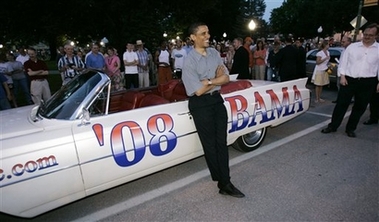
I bring this up because many longtime blog readers will remember the Obamallac. That’s Dad’s 1963 Cadillac convertible which he altered by attaching gigantic “Obama ‘08″ stickers. He then drove it around Iowa in the months leading up to the caucuses…
Dad drove his car to Chicago and paraded up and down Michigan Ave. on election night that year. Several people recognized the car from the blog and shouted greetings. It even happened while I was talking to him on the phone. “Hey! Are you Rich Miller’s dad?” I heard someone yell. We both got a kick out of that one.
He’s also an occasional commenter here and he’s an avid blog reader.
* Anyway, to the question, which isn’t really a question: Help me send best wishes and cheer him up.
* Scott Lee Cohen told Chicago Magazine that he believes his religion was one reason he was booted from the ticket…
Anything else?
Only how much of an effect my religion had on being part of the party. Listen, I’m Jewish. I’m only the third Jewish person to ever win the nomination for a statewide office. And I believe that that had some influence on the party not wanting me.
What gave you that impression?
The elected officials would never say that they don’t want me because I’m Jewish. But it did come up in chatter and in backroom meetings.
And a lot of the papers kept using the word “pawnbroker.” You know, being a pawnbroker is predominantly a Jewish business. My opponents kept attacking, kept saying, “the millionaire pawnbroker,” which a lot of people took as saying, “the millionaire Jew.” Jewish people, you know, have been persecuted our whole existence, and again, this is 2010, and maybe I’m naive, but I don’t believe it was an issue with the people as much as it was with the party.
I didn’t realize that pawnbroker was still code for “Jewish.” Either way, Cohen is a pawnbroker, so I’m not sure what he wanted to be called. If he was a firefighter, the stories would’ve called him that. Also, he ought to out the political types who made anti-Semitic remarks about his candidacy in “backroom meetings,” if they actually do exist.
* In related news, the vetting process for prospective lt. governor candidates is pretty darned intense…
In what could possibly produce the most well vetted candidate in Illinois political history, Democratic leaders are asking prospective nominees for lieutenant governor to fill out an 11-page questionnaire that covers an array of topics, asking applicants to detail traffic tickets, real estate tax exemptions, code violations and if they’ve ever used performance-enhancing drugs.
Applicants are asked to name spouses and where they work and whether anyone in their family is a lobbyist and if so whom they lobbied and when. Sitting lawmakers are told to list everyone who’s ever received a legislative scholarship and whether the recipient’s family ever donated or volunteered for their campaigns. A total of 45 questions cover personal, professional, political and legal issues. Interviews begin Saturday in sites across the state, including local sessions in Schaumburg and Hoffman Estates. The state Democratic Party’s central committee meets March 27 in Springfield to pick a winner. […]
Among the questions hopefuls now face is whether they are divorced, where it was filed and on what grounds it was granted. The divorce question includes this provision: “Do you believe anything could be found in your divorce papers that would disqualify you in the minds of voters from being on the ticket?”
Since the Cohen debacle, the media and the Republicans will probably try to comb through the past of whomever has been chosen.
* The Daily Herald editorial board is now griping about bill negotiations…
Cullerton also hosted a closed-door meeting on the public policy. In the meeting were camera critics, camera supporters and camera company lobbyists. How much sway did the lobbyists with a clear profit motive have on the compromise? We don’t know because the public wasn’t included. This is outrageous, especially coming on the heels of the outcry over the closed Senate session Cullerton convened to hear about the state budget crises a few weeks ago.
The editorial was about red-light camera reform legislation proposed by Senate President John Cullerton.
It’s pretty difficult to take an editorial page seriously when they print stuff like this. Private meetings to hash out differences on bills are as old as the Republic.
…Adding… I wrote this in comments, so I’m gonna frontpage it…
Believe it or not, when legislators are trying to regulate an industry, they usually bring industry representatives in for a meeting so they can understand how their actions might impact said industry. They don’t always have to agree with the industry, but it helps to know how a law will work in the world outside the capitol.
* The Champaign News-Gazette also editorialized about the red-light camera issue this week. They based their opinion on Daily Herald reporting…
Camera manufacturers want to sell them and make money. So they hired big-shot Chicago lobbyist Al Ronan, who spread campaign donations around to certain powerful legislators.
Presto, suddenly red light camera legislation was introduced and approved by the General Assembly.
RedSpeed, which is the big suburban player, has been making relatively small campaign contributions since 2006. Senate President Cullerton’s personal committee has received all of $3500 since 2008. Speaker Madigan has received just $1000. The company’s total since ‘06 is $53,215.00. That’s not inconsequential, but it’s not particularly big Statehouse money.
The real force behind this issue are municipal leaders like Mayor Daley who want the cash cows.
A leading Senate Democrat Tuesday used the birthdays of two colleagues to encourage Comptroller Dan Hynes to begin issuing expense checks to Illinois lawmakers, who are owed more than $665,000 in unpaid reimbursements for food, lodging and mileage dating back to last July.
“Perhaps because it’s their birthday, someone could call the comptroller and have him release their seven or eight months of past-due per diems for their birthday,” said Sen. Rickey Hendon (D-Chicago) to a smattering of applause as he feted Sen. Michael Bond (D-Grayslake) and Sen. Linda Holmes (D-Plainfield).
The wisecrack ginned up a little blowback…
But the No. 2 Senate Republican said Hendon’s focus on unpaid legislative expense checks, while perhaps not ill intended, won’t go over well with social-service providers awaiting state payments who have a lot more at risk financially than rank-and-file lawmakers.
“For those people who are watching state government very closely because they have a lot at stake, like providers waiting forever to get their checks, that’s probably not very funny,” said Sen. Dale Righter (R-Mattoon), the Senate deputy minority leader. “I’m not sure that I’d want to be joking about that.”
The joke was probably inappropriate, but Righter is totally against a tax hike to help make those provider payments, and most groups representing the providers are for a tax hike. Stones, glass houses, etc.
* Until a few weeks ago, I thought K2 was the name of a ski-maker…
The Illinois House moved Thursday to ban a little-known drug that legislators warn is quickly becoming a problem across the state.
Known as K2, the drug is similar to marijuana, only 10 times as potent, warns sponsor state Rep. Raymond Poe, R-Springfield. His bill banning the substance cleared the House on a vote of 112-0.
Nicknamed “fake weed,” the substance has been sold as incense or potpourri since 2006 and causes marijuana-like highs. It is synthetic chemical that is burned and smoked, causing hallucinations, vomiting, agitation and other effects.
“Now a 6-year-old or 10-year could go to the store and buy incense, really, over the counter,” said state Rep. Ken Dunkin, D-Chicago. “I think this a tool we are going to need in the future.”
Ten times as potent? I haven’t been able to find any verification of that online as of yet. Perhaps you can help. There just isn’t much information out there. While I am no fan at all of criminalizing substances used to alter consciousness, I will admit that this K2 thing is a bit weird because it’s a synthetic substance and so relatively new that nobody knows what sort of damage it could do.
But, if they’re worried about kids getting it, why not just ban the sale to anyone under 18? Or 21, like booze?
And Rep. John Fritchey makes a good point…
“Because it is a synthetic, all you got to do is make a very minor tweak to it, and it’s no longer a banned substance,” Fritchey said.
* Proposed legislation would ban sex offenders from Illinois parks: In Illinois, child sex offenders are already prohibited from being within 500 feet of a public park when children are present. State Sen. Kirk Dillard, R-Hinsdale, under the provisions of new legislation he proposing in the General Assembly, wants to ban all convicted sex criminals from stepping foot in any Illinois recreational area.
Robert B. Swaim, 61, who has lobbied on behalf of riverboat gambling and telecommunications interests in Illinois, owes nearly $400,000 to the Internal Revenue Service, according to an indictment handed down March.
Prosecutors presented evidence that Boender paid for nearly $40,000 in home repairs to Carothers’ home in exchange for Carothers pushing through a zoning change for Boender’s Galewood Yards project, a residential and retail development that now includes apartments, a movie theater complex and a union training facility on property that previously had been zoned for industrial uses.
The jury, which deliberated for a day, found Boender guilty on all counts: one count of bribery, two counts of illegal campaign contributions and two counts of obstructing justice. He is free on $500,000 bail but will now be placed on electronic monitoring.
Citizens tired of paying for City Hall corruption are sure to remember which aldermen feel comfortable being policed like everyone else — and which ones would rather be the law unto themselves.
* McPier’s chairman expected to head up interim board
Mayor Richard Daley on Friday is expected to appoint John S. Gates Jr., chairman of the Metropolitan Pier and Exposition Authority, to the same position leading the smaller interim board, a City Hall source said Thursday evening.
The mayor will appoint three other board members, including two with financial backgrounds. They are expected to include Bruce Rauner, who heads private-equity firm GTCR Golder Rauner, and Andre Rice, president of Muller & Monroe Asset Management, a private-equity firm that manages accounts for institutional investors, the source said.
The road would connect Interstate 65 in Indiana with Interstate 57 or Interstate 55 in Illinois, but the exact route hasn’t been determined.
A private company would operate the expressway as a toll road, but the state would retain ownership of the land. Illinois-based investment and insurance company Ullico has expressed interest at financing the construction of the road.
Starting next month, inmates who have long had their meals delivered to them at 4:30 every morning will have to come and get it at the dining hall — a change Sheriff Tom Dart said could save the county about $1 million a year because he expects many inmates will choose to sleep rather than eat.
Long allegedly told investigators he had come to the Daley Center to visit the law library and had forgotten about the knives, which he said he bought earlier in the day as a gift for his brother-in-law.
Holt spoke of what the loss of a child means. Her son, Blair, was shot and killed in May of 2007. The proposed federal legislation is named in his honor.
It would require a driver’s license, social security number and fingerprints in order to purchase a handgun.
* State begins new trend of late payments to Kane County
The county hasn’t seen a dime of income tax revenue from the state in nearly six months, Finance Director Cheryl Pattelli told the county board’s Finance Committee Thursday.
* Will County Board freezes pay of elected officials
Earlier this month, county board chairman Jim Moustis (R-Frankfort) told members of the board’s executive committee that the salaries of those elected Nov. 2 should not be raised.
But Village Manager Ron Moser warned the deficit will grow should legislators approve Gov. Pat Quinn’s proposal to reduce municipalities’ share of state income tax revenue by 30 percent - or about $950,000 to Hanover Park.
* Subscribers were told about this a couple of days ago…
State Sen. Susan Garrett, a reform-oriented North Shore lawmaker, has emerged as a top candidate to become Gov. Quinn’s running mate.
She didn’t cop to the Madigan thing to me, however…
Garrett (D-Lake Forest) told the Sun-Times she was approached about the party’s vacant lieutenant governor slot by Quinn’s chief of staff Jerry Stermer and encouraged to apply for the position by state Democratic Party Chairman Michael Madigan’s political operation.
The 60-year-old from Lake Forest shares Quinn’s liberal views, and the governor believes she could help articulate his message as the lieutenant governor candidate in what’s already a contentious general election battle, said the sources, who asked not to be named so they don’t pre-empt Quinn. […]
The senator said she would bring an independence to the office, along with her promotion of ethics reforms at the Illinois Toll Highway Authority, clean water issues, health care and job creation. […]
Garrett also has been an outspoken advocate on women’s issues, a demographic in which Quinn suffered some problems in his narrow primary in over Comptroller Dan Hynes for the Democratic governor nomination. A Tribune poll before the primary found Quinn with only a 38 percent job approval rating among female voters.
Republican governor candidate Sen. Bill Brady of Bloomington is a conservative who has opposed abortion rights and expanded health coverage for women. Those views are considered a potential liability, particularly among moderate women in the still heavily Republican suburbs.
“He and I are fighters. We share a lot of the same type of get-up-and-go independence,” said Garrett, who is part of Senate President John Cullerton’s leadership team