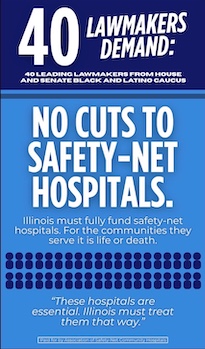
* Issuing an official opinion about whether the House and Senate’s pension reform proposals are constitutional would pose a conflict of interest for the AG because she’d be defending whatever passed. But such legal guidance would obviously be of enormous help to the General Assembly as it thrashes out the contentious issue going forward.
* The Question: Should Attorney General Lisa Madigan issue a formal opinion on the constitutionality of both proposed pension reform plans? Take the poll and then explain your answer in comments, please.
With college tuition on the rise, Illinois House Republicans say they want to give working class families a break, and an incentive to go to a school in state.
Rep. Adam Brown graduated from the University of Illinois Urbana Champaign in 2007, but in that short time, tuition’s steadily gone up.
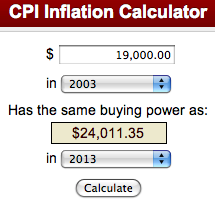
BROWN: “The average cost for tuition, fees and books right now – $26,000 and ten years ago that was $19,000.”
* OK, so I went to the CPI inflation calculator page and plugged in the numbers for 2003 and 2013 and found this…
So, the school cost numbers ain’t a whole lot higher than inflation.
* Word from today’s leaders meeting in Chicago is that after some vitriol between himself and House Speaker Michael Madigan, Gov. Pat Quinn has decided to back away from his stance that the “A-B” combo pension reform proposal should be passed. The proposal would’ve combined Madigan’s pension bill with Senate President John Cullerton’s bill, with Madigan’s taking effect first. If it was struck down, Cullerton’s bill would then become law.
“I kind of felt like I was witnessing an awkward family fight,” Senate Republican Christine Radogno of Lemont said following Friday’s closed-door meeting. “It was uncomfortable and it’s clear there is not even close to an agreement between the Democrats. It was them sort of dancing around the problems they have.”
House Bill 1907, sponsored by Sen. Tony Munoz (D-Chicago) and Rep. Mike Zalewski (D-Chicago), is modeled off the federal Racketeer Influenced and Corrupt Organizations (RICO) Act that was designed to help law enforcement fight organized crime by treating criminal acts committed by members of the group as part of an ongoing criminal enterprise. Under this legislation, law enforcement in Illinois can more effectively target the street gang leaders who order and benefit from the crimes of lower-ranking members.
The bill is here. It had bipartisan support in both chambers. Just one Senator voted against it (Annazette Collins) and 18 House members did so (mostly members of the Black Caucus, but also some white liberals).
* The new law is apparently working well so far. Tribune…
Local authorities, armed with a powerful new state RICO law, said they charged dozens of leaders and senior members of a notorious West Side street gang with operating a violent, $11 million-a-year heroin and cocaine operation responsible for seven murders and untold violence since the 1990s.
In unsealing the charges Thursday, authorities said the probe began after a victim of violence at the hands of the Black Souls gang was shot to death in a daylight street attack in October after he had refused a bribe of $3,000 to drop charges against several gang leaders for his earlier beating and robbery.
Before sunrise Thursday, Chicago police gang specialists and FBI agents armed with “no knock” search warrants fanned out across the Chicago area to arrest suspects accused of being high-ranking leaders of the gang as well as “top runners” and supervisors who authorities said control its street operations. In all, 23 people were charged with racketeering conspiracy and criminal drug conspiracy in the first use of the tough new state RICO law, while 18 others face more traditional drug or weapons charges, authorities said. […]
The Black Souls operation is centered near West Madison Street and Pulaski Road and is thought to have a half-dozen factions with about 750 members, a fraction of the size of gangs like the Latin Kings or Gangster Disciples, according to law enforcement.
“They’re small, violent and hard to infiltrate,” said Chicago police Sgt. Charles Daly, who helped run the investigation. “Tightknit. We never had any luck infiltrating this group.”
The leaders of a West Side gang accused of ruthlessly enforcing a “no-snitch” code — and shooting two Chicago Police officers in the head in 2011 — were arrested Thursday in a massive roundup under a new state racketeering law.
The Black Souls are accused of at least six murders, kidnapping, gunrunning and drug dealing. The investigation, called Operation .40-Cal, began in October after the gang allegedly killed a West Side man who complained to the police about illegal activity on his block.
Authorities said the gang is among the most difficult to infiltrate because the leaders use murders to keep witnesses from testifying against them.
Secret recordings earlier this year captured reputed Black Souls chief Cornel “Corn” Dawson saying he held meetings with younger Black Souls to warn them not to cooperate with the police — and was worried he was under investigation for murder, prosecutors said.
“These leaders tend to insulate themselves and this law helps law enforcement penetrate the veil of secrecy,” Chicago Police Supt. Garry McCarthy said.
Dawson, 38, was among the 41 reputed members charged in Operation .40-Cal. […]
The racketeering case accuses the gang of at least six killings dating to 1999. The June 24, 2002, murder of Charles Watson highlights the gang’s use of violence as a disciplinary tool, authorities said.
* Phil Kadner follows up on his story about the disappearing House staffer during the gaming negotiations. Let’s go back a few days to Kadner’s earlier column…
[Gov. Pat Quinn] said he had reached agreement on “language I could live with” with state Rep. Robert Rita (D-Blue Island), the chief House sponsor, and it was given to the Legislative Reference Bureau to be placed in the bill.
But the night the legislation was supposed to be written, Quinn said, “the LRB staff member got himself lost.” I asked what that meant, and Quinn repeated, “he got lost. He couldn’t be found.”
* But Rep. Bob Rita, the gaming bill’s sponsor, tells Kadner that the governor’s story isn’t true (although I heard the same thing the night session ended). The governor’s office stands behind the contention that the staffer went missing with the negotiated gaming language…
During an interview this week in his Blue Island office, Rita rejected as “ridiculous” a contention by Gov. Pat Quinn that the gambling bill, which would’ve created five casinos, was not called for a vote this spring because a House staff member who was writing the bill “got lost.” But Quinn spokeswoman Brooke Anderson called me to say that despite what Rita says, the House staffer “did get lost.”
Rita said there were several staff members working on the bill, that his amendment to a Senate gambling bill was eventually filed, but that he decided not to call the measure for a vote because “I still had a lot of questions I wanted answered.”
Rita said Quinn telephoned several times in the final days of the session, urging him to call the measure for a vote.
That seems strange because Quinn opposed gambling expansion in each of the past two years — once by simply letting it be known he didn’t like the bill and the second time by actually vetoing the measure.
In addition, the governor told me (and Rita) that he would not have signed a gambling expansion bill unless the General Assembly passed pension reform, which it did not.
I think Quinn believed he was gonna get a pension deal by the end of session. He also wanted to get Mayor Emanuel off his back.
* Earlier this week, the Chicago Tribune editorial board surmised that the pension reform impasse was really just a ruse…
And there’s plenty of suspicion that good buddies Madigan and Cullerton aren’t really at impasse, they’re just gaming everybody; failure, for some reason, suits them.
At a meeting this week, House Speaker Michael Madigan urged Gov. Pat Quinn to help get pension reform out of the Senate.
“Let me say it again: The best pension bill passed so far, and the one that does the most cost savings, is the House bill, and that’s in the Senate,” Madigan said. “The governor ought to work to get that passed.”
Mind if we make a suggestion, governor, on an arm that merits twisting?
Madigan’s more aggressive pension bill — the one that would help dig Illinois out of debt more quickly — went down in flames. So-called tea party conservatives who preach fiscal responsibility voted against it, along with Democrats who allowed the pension system to blow out of control in the first place. Senators in both categories should have been on board.
So let’s review the roll call. Over the next few days, leading up to the Wednesday special session called by Quinn, we’ll write about some of the rank-and-file Democrats and Republicans who ignore their constituents’ best interests and stand in the way of saving Illinois.
Well, hmm. Lemme see. If the pension reform stalement is a ruse concocted by the leaders, then trashing the Madigan bill opponents ain’t really gonna help, is it?
Several months ago, I offered Bill Daley some unsolicited advice.
Before you decide whether to run for governor, I suggested to Daley during a phone call, you should take some time off and drive around Illinois.
Cairo, in deep Southern Illinois, is 370 miles from Chicago. It’s a whole other world down there.
Maybe take a day and head out to Quincy, which is about as far west as you can go in Illinois and where the economy usually thrives even during recessions. Quincy is almost 100 miles closer to Kansas City than it is to Chicago.
Tuscola is a 150-mile straight shot down Interstate 57, where Amish restaurants and shops abound. Peoria is home to thousands of Lebanese-Americans whose ancestors arrived 100 years ago.
This is a great big beautiful and weirdly diverse state, I told Daley. You gotta go see it and at least try to get your mind around it before you decide you really want to govern it.
Daley wasn’t interested. The votes needed to win the Democratic primary are in Cook County, and that was where he was staying.
Not long after I talked to Daley, another wealthy Chicagoan began traveling the state on a “listening tour.” Republican Bruce Rauner probably talked a lot more than he listened, but he spent over two months on the road and visited 50 Illinois towns and cities.
I give Rauner a lot of credit for his tour. Yeah, it was something of a stunt, but at least he tried to see a good chunk of Illinois.
Rauner and Daley both jumped into the governor’s race this week. They travel in many of the same circles, so their lists of fantastically monied campaign donors probably overlap more than not. Rauner criticized Daley this week for being part of “the same old political dynasties,” but Rauner gave $200,000 to the campaign fund of Daley’s brother Rich.
Both men have long enjoyed lives of privilege. Rauner made himself super rich with an investment company and helped make Rahm Emanuel a member of the “one percent” with some sweet deals. He has a house in Winnetka, a nice spread in Montana and some expensive Chicago condos. He used one of those condos to establish city residency for himself (but not his spouse) and then allegedly took advantage of his political connections to get his kid into the ultra-exclusive Walter Payton College Prep.
But that bit of alleged graft would be small potatoes for a guy like Daley, the son of a mayor and brother of another, who has had careers in big-time banking, AT&T and the White House under two presidents.
Their messages are remarkably similar. Despite a lack of hands-on experience dealing with state government, they’re both completely confident that their record of lifetime success, superior abilities and exceptional intellects will allow them to forcibly drag Illinois kicking and screaming toward prosperity.
They are, in sum, the embodiment of entitled, wealthy white male rage. Daley freely admits that his anger pushed him into the campaign against Gov. Pat Quinn. It’s a decision he may live to regret.
Rauner obviously has a better chance of winning with an angry rich white guy message in a Republican primary than Daley does in a Democratic contest, even against the unpopular Quinn. And thanks to his “listening tour,” at least Rauner now knows what downtown Effingham looks like. Daley might not be able to find it on a map.
Many Illinois Democrats in Congress are staying far away from the gubernatorial primary, according to a survey of the delegation by CQ Roll Call. The primary could prove pivotal for some Illinois Democrats, whose political future will depend on the gubernatorial race topping their ticket.
But even members who know both candidates, such as freshman Rep. Tammy Duckworth, declined to choose sides. […]
Other Democrats echoed Duckworth, including Senate Majority Whip Richard J. Durbin. His spokesman said via email that Durbin “isn’t going to get involved in the primary.”
Rep. Danny K. Davis proved the exception by saying he backed Quinn for re-election. But many of his Illinois colleagues said they were staying out of the race for now.
Freshman Rep. Bill Enyart “doesn’t plan on any primary endorsements in the foreseeable future,” according to his spokesman. The same goes for Reps. Bill Foster and Cheri Bustos, both of whom could face tough races in 2014.
“Congresswoman Bustos plans to stay neutral in the primary and has exactly one focus right now and that is serving the people of Illinois’ 17th congressional District,” Bustos spokesman Colin Milligan said.
Three more Illinois Democrats declined to comment about the race through their respective offices: Reps. Bobby L. Rush, Robin Kelly and Mike Quigley.
I will forward additional information once final arrangements are available later today. At this time, we do know that the visitation will be tomorrow, from 3:00 pm to 9:00 pm, at the Cuneo-Columbian Funeral Home (located one block east of Manheim Road on West Grand Avenue). The funeral will take place on Saturday morning at the funeral home chapel.
Dan’s death came as a surprise to all, and he obviously leaves behind a young family. Dan’s many friends at DPR have decided to make contributions to the family in lieu of flowers, and our firm is doing the same. If any of you wish to join us in this regard, contributions may be sent to:
The Bluthardt Family
1924 Stonehaven Drive
Chatham, IL 62629
For those of you who wish to express condolences to the family, the funeral home website will have a space to do so later today. Simply login to the website (http://www.cuneocolumbian.net/index.php) and go to the “obituaries page,” click on Daniel E. Bluthardt, and then click on “condolences” tab.
I’ll update when I know more. Our post on Dan is still open for comments, by the way. Click here.
* Attorney General Lisa Madigan has been busily playing down connections to her father these days. Not so with Lt. Gov. Sheila Simon, who has been working hard to play up her father’s legacy in her statewide bid. From a campaign e-mail…
With Fathers Day coming up, many of us are thinking about our dads. And even though my dad has been gone for many years, I still think about him every day.
Folks around the state remember my dad as well. I hear stories of how Dad, as a Congressman or Senator, advocated for civil rights across our state, or they remember his days as a crusading journalist calling out corruption. And I hear about his appetite for cheeseburgers at places like the Red Barn, a Springfield eatery that long ago served its last fries.
But the one thing I hear most often goes something like this, “I didn’t agree with your dad on everything, but I appreciated his honesty.”
I’ll never get tired of that message.
It’s a reminder that honesty is a value that we all share, no matter what disagreements we might have on issues. And it’s a standard I aspire to uphold in my own public service.
So when we see each other next time, or the next time we talk on the phone, don’t be shy about telling me your stories about my dad. I love those stories.
* We haven’t yet held a caption contest on Illinois’ newest state Republican Party Chairman, Jack Dorgan. So, how’s about we correct that oversight right now?…
If Urbana attorney Erika Harold is successful in her GOP primary attempt to oust Congressman Rodney Davis after his freshman term, she’ll have to win without the help of influential downstate House Republicans. Altogether, 29 endorsed Davis for re-election next year.
A week after Harold’s announcement that she’s challenging Davis in the 2014 primary, State Rep. Wayne Rosenthal (R-Morrisonville), Chairman of the Downstate GOP Caucus, announced they are endorsing the incumbent.
The Downstate GOP Caucus consists of 29 House Republican members, including Rosenthal and state Reps. Adam Brown (R-Champaign), Dan Brady (R-Normal), Rich Brauer, (R-Petersburg), C D Davidsmeyer (R-Jacksonville), Chad Hayes (R-Catlin), Dwight Kay (R-Glen Carbon), Charlie Meier (R-Okawville), Bill Mitchell (R-Forsyth), Raymond Poe (R-Springfield) and Keith Sommer (R-Morton).
“Rodney Davis has been a great friend and ally to the families of the 13th District,” said Rosenthal. “In just 150 days he has proven that he has what it takes to make a difference in Washington. The Downstate GOP Caucus proudly stands as one to endorse Rodney’s re-election.”
* But elections are not won or lost via cable TV appearances or blog posts. They’re won in the trenches, and so far, she hasn’t been impressive…
She really didn’t look the part last week, drawing meager crowds at her campaign appearances. There also were newspaper and TV stories quoting central Illinois Republicans who said they had hoped Harold wouldn’t challenge Davis and would seek another office instead.
As campaign rollouts go, this one could have been better.
* Meanwhile, I haven’t really heard any rumors that any of these retirements are imminent, but Roll Call has a list of possible replacements…
“There are ambitious, powerful politicians who have been around for a long time who have deep, deep Chicago relationships, and when the dominoes fall in any of these seats, they will be free-for-alls,” one Democratic consultant said. “The Chicago races are the ones to look at.”
Local operatives rattled off a number of candidates likely to run when Democratic Rep. Bobby L. Rush, who has represented the 1st District for 11 terms, decides to retire.
• State Sen. Kwame Raoul has served in the state Senate since 2004, when he was appointed to fill the vacancy that President Barack Obama left after he won his bid for the U.S. Senate. Operatives say Raoul’s state Senate district is “tailor-made for advancement” because it includes the downtown Chicago and Hyde Park areas, which are filled with wealthy and influential Democrats.
• Operatives describe first-term Chicago Alderman Will Burns, who helped run Obama’s state Senate races, as someone with close ties to the president’s political machine.
• Alderman Michelle Harris is an influential member of Chicago’s city council.
Local Democrats are also watching 11-term Rep. Luis V. Gutierrez in the 4th District. Democratic consultants speculate that if an immigration bill is passed this Congress, Gutierrez could decide to retire.
The subsequent primary to replace him would be crowded, likely pitting South Side Chicago politicians of Mexican descent and North Side politicians of Puerto Rican and South American descent against each another.
Potential candidates in the 4th District include:
• Former 1st Ward Alderman Manny Flores, who now serves as the director of the Illinois Department of Financial and Professional Regulation.
• First-term state Rep. Silvana Tabares, who defeated a highly touted labor candidate last cycle.
• State Sen. Iris Martinez, who currently serves as chairwoman of the Latino Caucus in the state Senate.
• State Sen. Martin Sandoval.
Finally, local operatives say if Democratic Rep. Danny K. Davis ever retires from the 7th District, it would spark a battle royal between four Democratic hopefuls:
• Cook County Recorder of Deeds Karen Yarbrough. She has also served in the state House.
• Alderman Bob Fioretti.
• Alderman Brendan Reilly.
• State Sen. Don Harmon.
So far, it’s just wishful thinking among possible replacements. Sid Yates outlived a couple generations of would-be successors. That’s been the case with those three so far.
* Related…
* Rodney Davis: NSA records might be too much information, distraction: Davis said after sitting in on a classified briefing Tuesday, he doesn’t questions the NSA’s intent, but said some might fear a ‘government of intimidation’ in light of the IRS and leak investigation controversies. “I disagree with the process. We need to be sure that we just don’t dig up too much information to where it clogs up our ability to get to those who are trying to hurt Americans,” Davis said.
* Cook County Sheriff Tom Dart sent the following letter to Gov. Pat Quinn pointing out the defects in what he believes is a “fatally flawed” concealed carry bill…
Every day, we are reminded of the tragic toll gun violence takes on our communities, here in Cook County, throughout Illinois and across the country. On June 5th, HB183 was sent to you for action. As you know, this bill sets forth the requirements and process by which a person, if eligible, could carry a concealed weapon in Illinois.
While I applaud the General Assembly’s commitment to meet the June 9th deadline imposed last December by the 7th Circuit Court of Appeals, this bill creates a process that is designed to fail and will put Illinois communities at increased risk. The bill is fatally flawed and creates the illusion of public safety.
Section 15, Objections by law enforcement agencies, authorizes law enforcement agencies to object to an applicant if they have a “reasonable suspicion that the applicant is a danger to himself or herself or others, or a threat to public safety.” It appears that this section is designed to identify people who may be unfit to possess a conceal carry license, but who otherwise meet the criteria set forth under the bill and requires this determination to be made within an impossibly short time frame.
As drafted, the bill would require federal, state and local law enforcement agencies, as well as state’s attorney’s offices and the Office of the Attorney General to monitor a database of applicants for those who reside in their jurisdiction at the time of the application, who resided in their jurisdiction in the past or for those who they may have had any contact with and to assess whether they have a reasonable suspicion the individual is a risk to themselves or the public.
In Cook County alone, over 358,000 residents have been issued a Firearm Owners Identification (“FOID”) card from the Illinois State Police. Statewide, the number of FOID card holders is over 1.5 million. Under the requirements of section 15, assessments of each and every applicant would be required by law enforcement and prosecutors throughout Illinois.
While the public dialogue has focused on gun violence, we must also acknowledge the connection between guns and suicide. Suicides by gun account for approximately 6 of every 10 firearm deaths and in 2010, over 19,000 Americans killed themselves with a gun, amounting to 61 percent of all firearm deaths that year.
I strongly believe it is imperative to identify applicants who may be a risk to themselves or others. Unfortunately, the process set forth in this bill will not accomplish that critical objective. Without a crystal ball, the objection process is unworkable and creates a shockingly false sense of security.
However, of even greater concern is that the bill lacks any process by which law enforcement could object to a person for whom they have reasonable suspicion is a risk to themselves or a threat to public safety after they are issued a license to carry a concealed handgun.
We have a seemingly endless list of tragic examples of the devastating harm and loss of life that occurs through gun violence, including when guns are in the hands of those with undiagnosed or unrecognized serious mental illness. We must work to ensure Illinois’ regulation of the concealed carrying of weapons is strong, thoroughly vetted and capable of successful implementation.
Most importantly, our law and process must ensure that those who are a risk to themselves or the public will be identified and determined ineligible to carry firearms as long as the risk they pose remains.
In an interview, Dart told the AP that small counties may be able to keep up with the with permit applications - but that in Cook County, home to Chicago and more 358,000 Firearm Owners Identification cardholders, that would be impossible. He said the job would be even more difficult because there appears to be no requirement that applicants reveal if they’ve received mental health counseling or any other information that might raise concerns among law enforcement.
“All we are given is a name, that’s it,” Dart said.
The sheriff said he was particularly troubled that the legislation appears not to allow law enforcement to do anything if they come across information after applicants are granted concealed-carry permits.
“If we find out later there is a well-known Gangster Disciple (gang member) who got a permit and everyone agrees that it should have been prevented, there is nothing we can do about it,” Dart said.
Thoughts?
* Related…
* Pat Gauen: Illinoisans armed with guns but not legal clarity: In Missouri, which endorsed concealed carry in 2003, it took until 2005 before permits were available everywhere. While waiting, some people obtained non-resident permits from Florida to use in Missouri, which honors them. Illinoisans wouldn’t be able to do that, since the pending statute recognizes no reciprocity with other states.
* Evanston plans assault weapons ban: City Attorney Grant Farrar said HB183, now awaiting Gov. Quinn’s signature, largely preempts the power of cities to regulate guns. But the bill contains an unusual provision regarding assault weapons — which would let a local ban on them stand, provided it was adopted within 10 days after the bill is signed.
* State’s attorney won’t issue new concealed-carry decree: St. Clair County State’s Attorney Brendan Kelly said Wednesday he’ll use “prosecutorial discretion” in determining whether a person carrying a gun in public should be charged with a crime, but it’s too early to issue any policy changes on the concealed-carry issue. Kelly said he’s a supporter of a person’s right to carry a gun, but issuing a concealed-carry protocol for St. Clair County at this point would only create confusion, especially while the law is in a state of flux.
* Area prosecutors not ready to forgo concealed carry charges: “I support concealed carry, we need a concealed-carry law, and we’re going to have a concealed-carry law,” said Sangamon County State’s Attorney John Milhiser. “But until we have one, I can’t come out and say I’m not going to enforce the law.” Milhiser said a blanket announcement “doesn’t make sense.”
Turns out those feared 75-mph derecho winds might have been just a lot of hot air.
Although the National Weather Service logged reports of a funnel cloud in Will County and a possible tornado touchdown west of Chicago, most of the metropolitan area was spared from severe storms. […]
Severe-storm warnings sent fearful commuters home from work early, canceled classes for high school and college students and scratched a concert at Millennium Park.
“The Chicago area didn’t get hit because the cool air off Lake Michigan weakened the hot moist air that fuels thunderstorms,” [National Weather Service meteorologist Ben Deubelbeis] said. […]
Suburbs to the south and west were not as lucky. There were reports of golf-ball size hail in Naperville, Bourbonnais and Aurora. Winds topping 62 mph were reported in Lowell, nearly 100 miles southwest of the Chicago.
Closer to Chicago, nickel-size hail was reported in Schaumburg and Hoffman Estates.
At its height, storms left about 54,000 ComEd customers in the Chicago area without power, mostly to the south and southwest. About 6,800 customers were still without power Thursday morning.
All inbound and outbound trains on Metra’s Burlington Northern Santa Fe and Union Pacific lines were temporarily halted about 5:30 p.m. due to the severe weather, along with some stoppages on other service, according to a Metra spokesman.
Of Metra’s 11 train lines, eight were moving again by a little before 7 p.m. Trains on the Burlington Northern Santa Fe line had resumed service around 6 p.m. after being halted due to safety concerns earlier in the evening.
Trains on the Union Pacific lines remained stopped from about 5:30 p.m. until about 7:05 p.m., said Metra spokesman Tom Miller, but all service had resumed after that time. Delays were spread throughout the system.
The delays were a particular nuisance for Blackhawks fans who were eager to get home to catch the first game of the Stanley Cup Final.
* AAA’s research unit has finished studying various forms of distracted driving. The methodology…
The first experiment served as a control in which participants performed eight different tasks without the concurrent operation of a motor vehicle. In the second experiment, participants performed the same eight tasks while operating a high fidelity driving simulator. In the third experiment, participants performed the eight tasks while driving an instrumented vehicle in a residential section of a city.
In each experiment, the tasks involved 1) a baseline single-task condition (i.e., no concurrent secondary task), 2) concurrent listening to a radio, 3) concurrent listening to a book on tape, 4) concurrent conversation with a passenger seated next to the participant, 5) concurrent conversation on a hand-held cell phone, 6) concurrent conversation on a hands-free cell phone, 7) concurrent interaction with a speech-to-text interfaced e-mail system, and concurrent performance with an auditory version of the Operation Span (OSPAN) task. Each task allows the driver to keep his or her eyes on the road and, with the exception of the hand-held cell phone condition, hands on the steering wheel, so any impairment to driving must stem from cognitive sources associated with the diversion of attention from the task of operating the motor vehicle. […]
The OSPAN task is a complex span task developed by Turner and Engle (Turner & Engle, 1989) that requires participants to simultaneously perform a math and memorization task. It was chosen to anchor the highest level of cognitive workload.
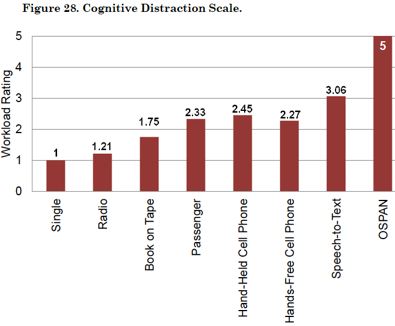
* AAA then developed a rating system. Non-distracted single-task was at one end and the OSPAN was at the other. The results…
In-vehicle activities such as listening to the radio (1.21) or an audio book (1.75) were associated with a small increase in cognitive distraction, the conversation activities of talking to a passenger in the vehicle (2.33) or conversing with a friend on a hand-held (2.45) or hands-free cell phone (2.27) were associated with a moderate increase in cognitive distraction, and the speech-to-text condition (3.06) had a large cognitive distraction rating.
But talking on a hands-free phone isn’t significantly safer for drivers than talking on a hand-held phone, and using hands-free devices that translate speech into text is the most distracting of all, researchers reported in a study released Wednesday. Speech-to-text systems that enable drivers to send, scroll through, or delete email and text messages required greater concentration by drivers than other potentially distracting activities examined in the study like talking on the phone, talking to a passenger, listening to a book on tape or listening to the radio.
The greater the concentration required to perform a task, the more likely a driver is to develop what researchers call “tunnel vision” or “inattention blindness.” Drivers will stop scanning the roadway or ignore their side and rearview mirrors. Instead, they look straight ahead, but fail to see what’s in front of them, like red lights and pedestrians.
“People aren’t seeing what they need to see to drive. That’s the scariest part to me,” said Peter Kissinger, president and CEO of the AAA Foundation for Traffic Safety, the group’s safety research arm. “Police accident investigative reports are filled with comments like the ‘looked, but did not see.’ That’s what drivers tell them. We used to think they were lying, but now we know that’s actually true.”
There are about 9 million cars and trucks on the road with infotainment systems, and that will jump to about 62 million vehicles by 2018, AAA spokeswoman Yolanda Cade said, citing automotive industry research. At the same time, drivers tell the AAA they believe phones and other devices are safe to use behind the wheel if they are hands-free, she said.
“We believe there is a public safety crisis looming,” Cade said. “We hope this study will change some widely held misconceptions by motorists.”
* If this study is accurate, then legislators who voted this spring to ban hand-held cell phone use in cars might also want to ban drivers from talking to their passengers.
All snark aside, I personally find talking on the phone far more distracting than conversing with a passenger. And with a hands-free device, I don’t have to worry about dropping the phone mid-conversation, which can be a huge distraction.
And voice-enabled texting/e-mailing ain’t all it’s cracked up to be. Siri often screws up my texts, so I find myself trying to correct them by hand, which may actually be more dangerous than just typing the texts myself from the start.
Many people already comply with the pending law, but you don’t spot the legal crowd as easily as scofflaws. For those smokers who just don’t get it, cigarette butts would be added to the list of items in which a person can be charged with a Class B misde-meanor for littering.
As we recently reported, the legislation was sponsored by State Rep. Iris Martinez, a Chicago Democrat.
“There has been a big push around the country to have designated areas to dispose of cigarette butts, but since smoking is a mo-bile habit, it’s easy to just drop a butt wherever you’re at without a second thought,” Martinez said. “And, not only are we looking to combat a litter problem, but also a potential fire hazard from lit cigarette butts being thrown on the ground.”
Under the pending law, a careless smoker convicted of littering could be fined a maximum of $1,500 and sentenced to as much as 180 days in jail. A judge also could require those who are convicted to pick up litter along a designated stretch of road for up to 30 days.
Those are the maximum penalties. We can’t imagine judges throwing the book at first-time offenders of a brand new law. But for those with past littering convictions, for even as small an item as a cigarette butt, the sentencing possibilities should discourage future transgressions.
It’s a sad reflection on the human condition that the possibility of punishment is the only way to ensure proper behavior. Once violators take a hit to their pocketbooks, they are more likely to obey the law in the future.



 concurrent performance with an auditory version of the Operation Span (OSPAN) task. Each task allows the driver to keep his or her eyes on the road and, with the exception of the hand-held cell phone condition, hands on the steering wheel, so any impairment to driving must stem from cognitive sources associated with the diversion of attention from the task of operating the motor vehicle. […]