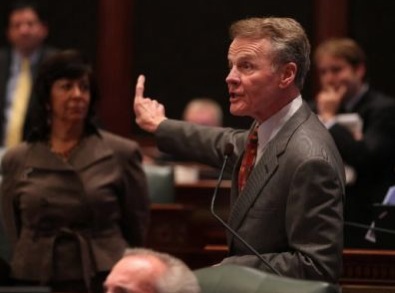
* Chicago Police Superintendent Garry McCarthy testifying to a House committee last week about state gun laws…
“I have not seen an illegal gun offender who possesses a FOID card. It just doesn’t happen. The gang members are criminals. They’re not eligible to receive those cards… I have no concern with legal guns. I have a great concern with illegal guns.”
Superintendent McCarthy’s comments start at the 2:01:44 mark.
* It’s been my experience in Illinois that environmentalists have long been divided between the screamers and the doers. It’s a symbiotic relationship. The far more radical screamers make sure that the doers don’t give away too much, but in the end the screamers are nudged aside and the doers cut the deal. The deals are never perfect, which upsets the screamers to no end, but after the deal is done the screamers are marginalized.
It’s probably going to happen again now that there’s a fracking deal…
A coalition of Illinois residents opposed to high-volume gas and oil drilling is criticizing Gov. Pat Quinn for supporting a bill that would establish regulations for the practice.
A group called “Stop the Frack Attack” issued a statement Friday urging Quinn to instead support a 2-year moratorium on high-volume hydraulic fracturing, or “fracking.”
On Thursday, two downstate lawmakers introduced a regulatory bill drafted with the help of industry and some environmental groups. The governor released a statement hours later, praising the bill and saying it could help create jobs.
Fracking uses high-pressure mixtures of water, sand or gravel and chemicals to crack open rock formations and release oil and gas. The industry is eyeing southern Illinois’ New Albany shale.
Some in the environmental movement are confused, they seem to think that fracking can somehow be made safe by “stricter” regulations.
* From the Illinois Sierra Club, which has tried to walk a line between the antis demanding a moratorium and the realistic expectation that fracking is coming one way or the other…
Can we stop the industry from bringing fracking to Illinois? When legislators proposed a two-year moratorium on the practice last year, we strongly supported that proposal, and we support continued calls for a moratorium today. However, we also need to acknowledge that fracking is legal today in Illinois, and for all we know, may already be occurring as you read this. We also need to recognize that our current laws regulating oil and gas drilling, originally passed in 1941, are totally inadequate to deal with the range of issues raised by injecting millions of gallons of chemical-laced fluid deep into the earth only to come surging back with gas and potentially oil. In short, Illinois citizens and our environment, at the moment, are virtually defenseless against against the problems experienced in other states.
That’s why it is essential that Illinois move quickly to get the strongest possible safeguards in place to protect citizens and their water supplies. Fortunately, discussions in Springfield have produced a basic agreement on what would be the strongest set of protections of any state in the country. The open pits for wastewater in use in other states will be banned here, and there will be none of the dumping the water into wastewater treatment plants, which has overwhelmed sewage plants elsewhere. The discharge of any fracking wastewater into surface water will be a felony offense. The industry must disclose what chemicals are used, and the most toxic ones will be banned. Ann Alexander from the Natural Resources Defense Council, who helped represent environmental groups in the negotiations that produced the proposal, has a good rundown on the major provisions of the bill here.
This legislation is the product of an unprecedented stakeholder process that brought together representatives from all of the concerned state agencies, the drilling industry, and the environmental community, as well as legislators from both sides of the aisle. No compromise is ever perfect, and this bill is certainly no exception. But in its current form, it would represent the strongest and most comprehensive law governing hydraulic fracturing – or “fracking” – in the nation. While some other states have put in place bits and pieces of the kinds of protections that are essential to protect the public, no state has yet put together as many of the essential elements of a strong regulatory scheme. In most other states where this problematic process has taken off, regulators have been swamped by a gold rush mentality, convinced by the extortionist rhetoric of industry lobbyists that even modest attempts to protect the public will drive away their chance of prosperity.
“The gas industry got just about everything they wanted,” said Rau. “Please, everyone: label this monstrosity properly. It’s a DE-regulation bill.”
* To the NRDC, which compiled a list of the bill’s benefits…
* Extensive regulation of the drilling process, mandating numerous best practices.
A requirement that all waste – which includes “flowback” of all the chemical-laced water pumped into the ground – be stored in closed tanks, rather than the pits that chronically leak and overflow elsewhere.
* Restrictions on venting and flaring of natural gas (which contains the potent greenhouse gas methane, as well as other harmful constituents, and turns to smog).
* A ban on the dangerous practice of injecting diesel (which contains carcinogenic hydrocarbons).
* Required disclosure of all fracking chemicals to the public before operations commence (and limits on industry’s ability to claim that this information is a trade secret).
* Citizen rights to public hearings concerning proposed permits, and to appeal permits that are granted.
* Citizen enforcement against violations of law or permits.
* Provisions to protect the state’s water supply, including authority to deny permits as necessary during drought conditions.
* Baseline and post-frack testing of potentially affected waters to help identify instances in which contamination may be associated with fracking.
* A presumption of liability for contamination that appears post-fracking in proximity to operations.
* A detailed application, containing information about planned operations, that must be posted on a state web site.
* Setbacks (albeit not always as large as we believe are necessary) from population centers – including schools, residences, and nursing homes – as well as water resources and nature preserves.
* Mandatory plugging of nearby abandoned wells that can serve as pathways for contamination.
* Regulatory authority to address the problem of earthquakes induced by underground waste injection.
* Bonding and insurance requirements to enhance financial accountability.
I don’t have the scientific background to judge who is right on this, but I’ll take the Sierra Club and the Natural Resources Defense Council over a group of local NIMBYs any day of the week. And to call this, as the screamers are doing, a “de-regulation” bill is utter nonsense on its very face. Screamers never understand why they’re not taken seriously, even when they make goofy comments like that one.
Provides that a law enforcement agency may not use a drone to gather information.
Permits the use of a drone by a law enforcement agency: (1) to counter a high risk of a terrorist attack by a specific individual or organization if the United States Secretary of Homeland Security determines that credible intelligence indicates that there is that risk; (2) if a law enforcement agency first obtains a search warrant signed by a judge authorizing the use of a drone; or (3) if a law enforcement agency possesses reasonable suspicion that, under particular circumstances, swift action is needed to prevent imminent harm to life or serious damage to property, or to forestall the imminent escape of a suspect or the destruction of evidence.
Provides that a law enforcement agency may not own or use a drone that is equipped with any kind of lethal or non-lethal weapon.
Provides that information obtained or collected in violation of the Act is not admissible as evidence in any criminal, civil, administrative, or other proceeding. Establishes certain information retention and reporting requirements concerning drone ownership and use.
The Illinois National Guard and the Champaign County Sheriff have tested drone technology in Illinois airspace. And, the Cook County Sheriff is now exploring whether to acquire and utilize the technology. […]
“When government knows where we are, they know who we are,” said Adam Schwartz, senior staff counsel for the ACLU of Illinois. “Our nation is in the midst of a technological revolution. Many of these technologies permit the massive gathering of information and data about individuals and groups and can undermine our freedoms.”
“We must adopt appropriate guidelines now to insure that these technologies do not become overly intrusive.”
* The Urbana-Champaign Independent Media Center has been FOIAing the local county sheriff to see what he’s up to with his drone…
From the documents provided, it looks as if the Sheriff’s drone has been downed by mechanical failures as much as it has been in the air. According to a flight log obtained, the Sheriff’s drone was flown four times between November 2011 and May 2012, all for training purposes only. Two of the flights were “Non-Successful,” with the most recent one ending in a crash.
More than 20 states are pursuing similar legislation, according to the National Conference of State Legislatures. While some states are trying to regulate unmanned aircraft use, others are trying to impose moratoriums that ban them, Biss said.
Virginia lawmakers approved a two-year moratorium on the aircraft in the state last week to allow time for a study. The legislation awaits the governor’s signature. […]
[Cook County Sheriff Tom Dart’s] thinking is that drones would be cheaper to use and cost less taxpayer money than using helicopters for aerial operations, Bilecki said. A small, unmanned aircraft used for search and rescue can cost on average between $38,000 and $50,000, much less than in years past, said James Hill, president of AirCover Integrated Solutions, a California-based drone manufacturer.
To gain traction at the Capitol, Biss potentially might have to overcome resistance from law enforcement leaders. To that end, Biss said he’s talking with police chiefs, the Illinois State Police and other police agencies to iron out any wrinkles.
* The Question: Should the state ban unarmed local police drones or regulate them? If your answer is “regulate” then what would be your regulations? Take the poll and then explain your answer in comments, please.
Illinois’ massive stack of unpaid bills will nearly triple to $22 billion within five years unless lawmakers act to curb pension and Medicaid costs, according to an analysis released by the Chicago-based Civic Federation. […]
While still in the red, the state’s five-year fiscal outlook has significantly improved since last year when the same watchdog group projected a $35 billion backlog. The better forecast this year is largely due to $1.6 billion in Medicaid cuts signed into law by Gov. Pat Quinn last June. […]
The potential explosion in unpaid bills would represent a roughly 178 percent increase from the state’s current level of $7.8 billion and would mean funding for already suffering programs in areas like education and health care would likely be strained further. […]
Without meaningful reform, pension costs will continue to overwhelm the state’s budget. Total pension payments – including contributions and debt service on pension bonds – would increase nearly 30 percent from $6.7 billion this year to $8.6 billion in fiscal year 2018, the Civic Federation warns.
If that scenario were to play out over the next half-decade, the state’s total pension payments would eat up nearly one-third of state-generated revenue, whereas today the payments consume about 22 percent.
Not mentioned in that above excerpt is the impact of the income tax hike expiring. From the Civic Federation’s press release…
Illinois is headed for a substantial loss of revenue beginning in 2015, after the partial rollback of the temporary income tax increase enacted in 2011. On January 1, 2015 the personal income tax rate is scheduled to decline from 5.0% to 3.75% and the corporate rate will decline from 7.0% to 5.25%. The first full budget year under the lower rates will be FY2016. With the resulting decline in revenues and growing annual pension costs, the State’s operating deficit is projected to increase dramatically to $4.2 billion in FY2018, compared with a modest surplus in FY2013.
* The Sun-Times tries to connect the dots between a handful of contributions to Speaker Madigan and his support for the United Neighborhood Organization’s charter school explosion…
With support from Springfield and City Hall, UNO has grown in less than a decade from what was primarily a Latino activist organization into one of the largest charter-school operators in the city. In 2005, it had one school. Now, it has 13 locations with about 6,500 students.
UNO’s close ties to Mayor Rahm Emanuel, whose campaign he co-chaired, and former Mayor Richard M. Daley are well known. But Madigan quietly has provided the group with perhaps its most valuable assistance.
Madigan introduced the amendment that yielded the $98 million grant to UNO in 2009. That’s believed to be the largest government investment in charter schools anywhere in the country. The Madigan breakfast fund-raiser took place shortly before the state legislative elections in November, at Petterino’s Restaurant in downtown Chicago. In addition to Rangel and Reyes, its hosts included Federico “Fred” d’Escoto, president of d’Escoto Inc. and Miguel d’Escoto’s brother.
The Sun-Times reported Feb. 4 that d’Escoto Inc. and a company owned by another d’Escoto brother were among the contractors UNO paid with money from the state grant. Six days after the story was published, d’Escoto Inc. was suspended from getting any work from UNO pending an internal review of the organization’s contracting process. Two days later, on Feb. 12, Miguel d’Escoto resigned as UNO’s senior vice president of operations and chief of staff.
The October 30th fundraiser raised $24,000 for Madigan’s various committees, the Sun-Times reported.
That’s only about ten percent of the money MJM’s three committees raised from October 27 through November 1st last year.
It’s not necessarily the money they’ve raised. It’s the precinct workers they’ve supplied to Madigan’s operation. And they’ve supplied a lot of those.
The United Neighborhood Organization, which operates 13 charter schools in Chicago, wants to build two new schools in Bedford Park, records show.
But it isn’t looking to extend its growing network of charter schools beyond the city’s borders. Instead, the influential group has approached Bedford Park officials with plans to get property in the southwest suburb annexed into the city of Chicago’s 13th Ward. That’s the power base of UNO’s angel in the Illinois Legislature — House Speaker and state Democratic Party leader Michael Madigan, who helped UNO get a $98 million state school-construction grant four years ago. […]
Juan Rangel, UNO’s chief executive, has told Bedford Park officials the group wants to buy 30 acres of vacant industrial property at 6401 W. 65th St. […]
The 13rd Ward sits just across 65th Street from where the new schools would rise. Madigan and Marty Quinn, who won election as 13th Ward alderman with the speaker’s backing, have been involved in the discussions about the UNO plan, according to Bedford Park Village President David Brady.
Beale had seven restaurants, four churches, a synagogue and a shopping mall on his schedule. Kelly, a former state lawmaker from Matteson, visited churches, but her only public appearance was scheduled this afternoon at a restaurant in her hometown.
Halvorson’s only public appearance was before a few dozen diners Sunday afternoon at Ted’s Family Restaurant in Calumet City.
Apparently, Beale=frenzied. while others=not so much.
* As I’ve told you before, the Illinois State Rifle Association has sent a mailer to its 2nd Congressional District members urging a vote for Debbie Halvorson. It’s a postcard. Front…
The head of the Illinois Republican Party says a special meeting of GOP leaders has been called to consider firing him over his support for legalizing gay marriage.
Pat Brady, chairman of the state GOP, said he was informed this afternoon that five members of the party’s state Central Committee have signed a letter calling the session on March 9 in Springfield.
The out-Brady group had been one short of what it needed in an effort that had been led by state Sen. and 14th District Committeeman Jim Oberweis. But Mr. Brady said he was informed by 13th District Committeeman Jerry Clarke that Mr. Clarke has signed, too.
Mr. Brady said he believes he has the votes to keep his job — an unpaid position — but that even if he doesn’t, he has “no regrets” about supporting a bill to allow same-sex marriage in Illinois. The measure has cleared the Senate and is awaiting a House vote.
* The Daily Herald reports that Brady has canceled a fundraiser featuring RNC Chairman Reince Priebus to honor gay marraige supporter former Exelon Corp. CEO John Rowe that was scheduled for ten days after the special central committee meeting. Brady had hoped to raise $250,000. Gay marriage opponents including Sen. Jim Oberweis and Gene Dawson don’t have any regrets…
“I think it’s important that this is dealt with,” he said. Yet, he said, “I don’t think it needs to be as public as it has been.”
Dawson, asked if the postponed event was an embarrassment for the party, answered “No.” Instead, he called it “a good move.”
“With this issue being so up in the air, it would be hard to have Pat be the sponsor, if he is promoting this now as chairman and may not be chairman in a few weeks.”
, House Speaker Mike Madigan, the Attorney General’s father, announced that next Tuesday, the Illinois House will meet to discuss “gun safety and unlawful use of weapons”. A concealed carry proposal is among the items to be discussed.
* The response by the Illinois State Rifle Association…
MIKE MADIGAN READY TO INSULT YOUR INTELLIGENCE ONCE AGAIN
Mike Madigan is ticked off…
Why is Mike Madigan so ticked off? Quite simply, he’s ticked off because the 7th District Court of Appeals has told him plainly that the legislature must bow to constitutional authority – not to the whims of Mike Madigan. And we all know what a control freak Mike Madigan is.
No, Mike Madigan is no longer in control of the concealed carry debate. The courts have said once and for all that Illinois will join 49 other states in allowing citizens to carry defensive firearms.
The court has really ticked Madigan off…
Mike Madigan is so ticked off that he plans to introduce his own version of a concealed carry bill early next week. Of course, under Madigan’s carry bill, the only people who would be allowed to carry would be… um… nobody.
Although the details of Madigan’s concealed carry bill (HB1155) have not yet been released, those close to Madigan are saying that it will be the most restrictive concealed carry bill in the nation.
One insider termed Madigan’s proposal, “…the closest thing to no-carry at all.”
That’s not what’s gonna happen, as subscribers already know. And this hardline stance portrayed to its own members is not what ISRA is saying elsewhere. For instance…
Richard Pearson, the executive director of the Illinois State Rifle Association which advocates for gun ownership, said Illinois might be able to keep some restrictions on concealed carry.
“But they have to be reasonable,” Pearson said. “They can’t make it so restrictive that average people can’t do it.”
Illinois House Democrats were told during a private caucus meeting in Springfield last week that, despite what Cook County State’s Attorney Anita Alvarez says, inaction on concealed carry would have serious consequences.
As you most assuredly know, a three-judge panel of the federal appeals court in Chicago gave the General Assembly until June 8 to pass a law allowing some form of carrying a loaded gun in public. The full appeals court upheld that ruling by a 5-4 vote on Friday in an appeal by state Attorney General Lisa Madigan.
After the June 8 deadline, Illinois’ law against carrying a loaded gun will no longer apply. Illinois is the only state in the nation that totally bars concealed or open carry by citizens.
However, an aide to Alvarez told the House Judiciary Committee last week that the federal appeals court’s position means nothing to the state.
Paul Castiglione, a representative of Alvarez, dropped a bomb during a hearing by the committee that was called to discuss concealed carry when he declared that until the U.S. or Illinois Supreme courts rule, the appellate court decision is “not binding” on the state.
“Only the Illinois Supreme Court can declare a statute from this body to be unconstitutional,” Castiglione told the committee members.
He also took aim at warnings by the National Rifle Association that if no new concealed-carry law is put into place before the deadline, then gun owners would be free to carry assault rifles down Michigan Avenue.
Castiglione insisted that his office would continue to enforce the current law.
“Anyone who decides, for example, to walk down Michigan Avenue in Chicago carrying an AK-15 (sic) would be subject to arrest and prosecution,” he said.
But that’s not how the House Democrats’ legal staff sees the world.
At one point during that closed-door Democratic caucus meeting, Rep. Ken Dunkin (D-Chicago) rose to ask whether the staff was saying that if the Legislature does not pass a concealed-carry law, he could legally carry a loaded semi-automatic rifle into the Statehouse after June 8.
“Yes,” he was told.
A stunned silence fell over the caucus meeting, said several House Democrats who attended.
“I think they finally get it now,” one pro-gun House Democrat said of his colleagues.
Some historically anti-gun members talked after the committee meeting about how they need to vote for a concealed-carry bill. So, Dunkin’s question and the answer given appear to have worked.
At least for now, a lot of House members are not willing to kick this particular can down the road.
Meanwhile, Secretary of State Jesse White’s office says no way will it allow people to walk into the statehouse with a gun, regardless of what legislators do this spring. They believe state law backs them up, and White controls access to the Capitol, so he should know.
White long has been a gun control proponent. In fact, according to a recent poll by the Paul Simon Public Policy Institute, he’s in the mainstream of Illinois thought on this controversial topic.
The survey found that 72 percent of Illinoisans believe that “laws covering the sale of firearms should be made more strict,” while just 2.2 percent said they should be less strict, 21 percent said they should remain the same and 4 percent didn’t know.
The poll also found that 66 percent of downstate voters, 55 percent of conservatives and 55 percent of Republicans favor stricter gun control in Illinois, according to the institute’s poll.
One issue pushed by liberals is banning high-capacity ammunition magazines of more than 10 rounds. The poll found that 63 percent agree that’s desirable while 33 percent oppose the idea.
Its results show that 52 percent of downstaters support the ammo limit (42 percent oppose) as well as 46 percent of conservatives (46 percent against) and 44 percent of Republicans (50 percent oppose). Also, 68 percent of women and 58 percent of men favor such a restriction, according to the poll.
And 49.7 percent of those polled said they believed the Second Amendment does not include the right to carry a concealed weapon in public, while 39.5 percent said it does and 11 percent didn’t know.
Among those downstate, 50 percent said the Second Amendment specifies such a right, while 36 percent said it doesn’t. By party, 68 percent of Democrats say there’s no such constitutional right, while 62 percent of Republicans believe there is, a very significant partisan divide.
Under the federal appeals court rulings, a concealed-carry law has to be passed by lawmakers, but as that poll clearly shows, it ain’t gonna be easy.
* Freshman state Rep. Sue Scherer (D-Decatur) is opposed to the so-called pension “cost shift” because it could raise local property taxes. But, the SJ-R editorial page points to Scherer’s recent teacher retirement package as proof that at least a limited cost-shift is needed…
Scherer made $72,538 in 2008-09, an amount that grew to $89,270 when she retired at the end of the 2011-12 school year. Those raises allowed her to receive a pension starting at $61,018 per year.
If Scherer had instead received 3 percent raises during her final four years of teaching — most private sector workers would have been overjoyed to get that kind of raise during the Great Recession — her pension would have started at $58,608.
When you include the annual, 3 percent compounded COLA, the difference between those two starting pensions to state taxpayers, assuming Scherer lives to age 79, is nearly $83,000.
Keep in mind, those amounts are based on Scherer receiving the maximum pension — 75 percent of her final average salary — at age 56. She would have been short two years of credit and received a reduced pension had the district and state law not allowed her to accumulate and use 340 days of unused sick time to further sweeten her pension.
Right now, state taxpayers have to pick up the tabs run up by local school districts. It’s doubtful that the schools would be devising retirement plans like this if they had to pay some or all of it themselves.
Scherer did not enroll in the General Assembly Retirement System. But, apparently, she didn’t really need to.
* Meanwhile, in a somewhat related story, the Illinois Historic Preservation Agency has hired a legislative liaison for the first time ever…
The first legislative liaison for the Illinois Historic Preservation Agency should have an in with at least one member of the General Assembly.
SARA MEEK, who began the new job on Feb. 18, is the daughter of state Rep. SUE SCHERER, D-Decatur.
Meek, 29, of Springfield, will be paid $81,972 annually in the job. That’s the same amount she was making in a similar post at the Illinois Department of Labor. She’s been with the state since 2006.
CHRIS WILLS, spokesman for the agency, said Meek’s mother, whose 96th House District includes part of Springfield, had nothing to do with her getting the new job.
Meek, however, did have another liaison job before she moved over to IHPA.
llinois would lose more than $58 million in federal education funding this year, about 14,000 of the state’s civilian Defense Department workers face furloughs and O’Hare International Airport could see customs delays of four hours or more unless Congress acts soon to avert mandatory budget cuts, according to the White House.
As part of its public relations effort to turn up the heat on Republicans in a standoff with President Barack Obama over taxes and spending, the White House on Sunday spelled out dire state-by-state impact of spending cuts now mandated by law to start March 1.
From a military air show scheduled for Rockford to Head Start services for about 2,700 children across the state, Illinois will see a wide array of fallout if almost all federal spending goes on the chopping block.
Last year’s “fiscal cliff” negotiations resulted in a two-month delay of the broad spending cuts, known as sequestration, but the two sides appear to be further apart than ever in reaching a compromise. Barring a last-minute breakthrough this week, Illinois and other states will see a 13 percent cut in defense programs and a 9 percent cut in civilian programs for the remainder of the federal fiscal year, which ends Sept. 30.
After agreeing last year to end payroll tax breaks and let income tax rates rise for the richest Americans, Republicans are refusing to consider White House demands for a combination of tax hikes and spending cuts to reduce the deficit.
Other than the large number of furloughs, these don’t appear to be absolutely wrenching cuts, but Illinois just doesn’t have the money to patch any of these holes. More on that later today.
* Teachers and Schools: Illinois will lose approximately $33.4 million in funding for primary and secondary education, putting around 460 teacher and aide jobs at risk. In addition about 39,000 fewer students would be served and approximately 120 fewer schools would receive funding.
o Education for Children with Disabilities: In addition, Illinois will lose approximately $24.7 million in funds for about 300 teachers, aides, and staff who help children with disabilities.
* Work-Study Jobs: Around 3,280 fewer low income students in Illinois would receive aid to help them finance the costs of college and around 2,650 fewer students will get work-study jobs that help them pay for college.
* Head Start: Head Start and Early Head Start services would be eliminated for approximately 2,700 children in Illinois, reducing access to critical early education.
* Protections for Clean Air and Clean Water: Illinois would lose about $6.4 million in environmental funding to ensure clean water and air quality, as well as prevent pollution from pesticides and hazardous waste. In addition, Illinois could lose another $974,000 in grants for fish and wildlife protection.
* Military Readiness: In Illinois, approximately 14,000 civilian Department of Defense employees would be furloughed, reducing gross pay by around $83.5 million in total.
o Army: Base operation funding would be cut by about $19 million in Illinois.
o Air Force: Funding for Air Force operations in Illinois would be cut by about $7 million.
o Navy: Four planned Naval Station Great Lakes demolition projects ($2 million) could be canceled and a scheduled Blue Angels show in Rockford could be canceled.
* Law Enforcement and Public Safety Funds for Crime Prevention and Prosecution: Illinois will lose about $587,000 in Justice Assistance Grants that support law enforcement, prosecution and courts, crime prevention and education, corrections and community corrections, drug treatment and enforcement, and crime victim and witness initiatives.
* Job Search Assistance to Help those in Illinois find Employment and Training: Illinois will lose about $1.4 million in funding for job search assistance, referral, and placement, meaning around 50,780 fewer people will get the help and skills they need to find employment.
* Child Care: Up to 1,100 disadvantaged and vulnerable children could lose access to child care, which is also essential for working parents to hold down a job.
* Vaccines for Children: In Illinois around 5,230 fewer children will receive vaccines for diseases such as measles, mumps, rubella, tetanus, whooping cough, influenza, and Hepatitis B due to reduced funding for vaccinations of about $357,000.
* Public Health: Illinois will lose approximately $968,000 in funds to help upgrade its ability to respond to public health threats including infectious diseases, natural disasters, and biological, chemical, nuclear, and radiological events. In addition, Illinois will lose about $3.5 million in grants to help prevent and treat substance abuse, resulting in around 3,900 fewer admissions to substance abuse programs. And the Illinois State Department of Public Health will lose about $186,000 resulting in around 4,600 fewer HIV tests.
* STOP Violence Against Women Program: Illinois could lose up to $273,000 in funds that provide services to victims of domestic violence, resulting in up to 1,000 fewer victims being served.
* Nutrition Assistance for Seniors: Illinois would lose approximately $764,000 in funds that provide meals for seniors.
Statement from Mayor Emanuel on the Loss of Chicago Blues Legend Magic Slim
“We have lost a blues legend, Magic Slim. Like the story of Chicago itself, Magic Slim’s life was defined by persistence and perseverance. Born in Mississippi to sharecroppers, Slim lost his right pinky finger in a cotton gin, forcing him to give up on piano, but never on music, and he taught himself to play guitar on a one-string instrument he made by nailing a piece of wire to the wall. From that one string he developed a sound that would help define the blues forever. A member of the Great Migration, Slim came to Chicago for a new life and a career in music. And what a career he had. Ultimately he would become a legend of Chicago Blues, finding his place among names like Muddy Waters and Howlin’ Wolf. Chicago has lost a dear friend today; but we are grateful for the decades of music we gained from Magic Slim’s life.”
* Check out this hot jam from 1974 at Chicago’s 1125 Club, which was at 59th & May. Yeah, baby…
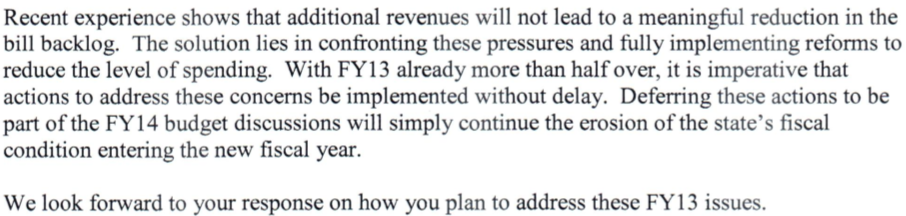
* I’m really not sure why the two legislative Republican leaders sent a letter to the governor and the Democratic leaders outlining what they see as the budget pressures facing the state, demanding immediate action and then ending it this way…
Burdened by a wave of murders, dissension over proposed school closings and perhaps his own hard-ball image, Mayor Rahm Emanuel’s job-approval rating has taken a big hit in recent months, according to a new Crain’s/Ipsos Illinois Poll.
Negative attitudes toward the mayor are significantly higher in suburban and downstate areas than in Chicago proper. That may not be surprising, given Mr. Emanuel’s fierce focus on his extensive agenda for Chicago. But there is slippage among city voters, too.
Overall, according to the survey of 600 voting-age Illinois residents, 50 percent say they at least lean toward disapproval of his performance as mayor, versus only 19 percent who somewhat or strongly approve, or lean toward approval. That’s a margin of 31 percentage points. […]
Specifically, just 2 percent of Chicagoans surveyed said they strongly approve of the mayor’s job performance, with 12 percent somewhat approving and 5 percent leaning that way. At the opposite end, 13 percent strongly disapprove, 9 percent somewhat disapprove and 13 percent lean toward disapproval.
* OK, first, this is a poll of residents, not even registered voters.
* Second, while the statewide results may actually be valid, the Chicago subset is just way too small to make any sort of claim about the mayor’s poll ratings.
Chicago’s population is 21 percent of the state’s. So, if the poll was properly balanced, that would mean only about 126 people were polled. That’s a margin of error of about 9 percent.
There’s just no way to make a realistic judgment about a situation based on that small of a polling universe. Period.
* From Crain’s…
The Crain’s/Ipsos poll is a representative survey of voting-age Illinois residents conducted over the Internet. Ipsos validates the sample against offline data sources such as telephone surveys to ensure the accuracy of its weighting. The survey has an accuracy margin of plus or minus 4.7 percentage points statewide, with higher margins in sub-regions, such as Chicago or its suburbs.
Internet polling gets a bad rap, but it is picking up some admirers. Even so, a purely Internet poll is kinda radical.
* A coverage sample…
* Rahm Emanuel: Liked by Few, Loved by Fewer: Labor insiders call the drop in Emanuel’s numbers “horrendous.”
* Poll: Mayor Rahm Emanuel’s approval rating slipping
* Emanuel Struggling With Approval Ratings In IL & City Proper
* Rahm Emanuel’s allies dismiss negative Internet poll on mayor: John Anzalone, a political pollster who has done work for state Senate Democrats and President Barack Obama, said when Crain’s internet poll last fall showed Emanuel with an approval rating of 37 percent in Chicago, Anzalone’s firm had the mayor at over 52 percent.
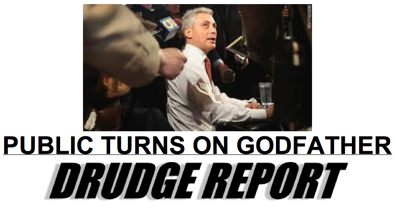
*** UPDATE *** I should’ve known to check Drudge. So, with a hat tip to a commenter…
Kelly boasted a double-digit lead over the field in Hutchinson’s internal polling — an automated survey taken before she exited the race, according to a source familiar with it.
Subscribers know more about recent polling.
Also…
Kelly has been on the air as well, and Halvorson’s fundraising has not been strong enough to answer on the airwaves. But while television is central to any modern campaign, this race is about getting bodies to the polls in the middle of the Chicago winter.
Beale’s team is counting on his Chicago base as the only candidate hailing from the urban part of the district. His team is betting on loyalty and turnout from a base of senior citizens — but local strategists say it’s unlikely he can win.
“They [voters] have to have a compelling reason to turn out for you, and that’s a totally different campaign model than a presidential year or any year when there’s anything else on the ballot,” a Chicago Democratic strategist said. “You have to take a different approach when you’re the only race on the ballot.”
But even luck has been on Kelly’s side. She drew the top slot on the ballot. Halvorson will be third from the bottom.
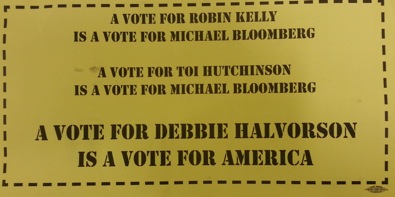
* Meanwhile, there’s been an attempt to try to link Mayor Emanuel to Kelly’s race. For instance…
The mayor was asked why he’s “giving the appearance” that he’s not involved in the race to succeed Jackson, who plead guilty Wednesday to years of illegal campaign spending.
“Because I’m not endorsing anybody. That’s why. Because it’s not an appearance,” Emanuel said.
Pressed on whether he’s making phone calls on Kelly’s behalf, the mayor said, “No. … I said upfront I was gonna stay out of this race. The voters will pick. But I want to be clear about one thing: Whoever wins has to be on Team Chicago.”
Delmarie Cobb, a political consultant to Ald. Anthony Beale (9th), doesn’t buy it. She thinks there’s a wink-and-a-nod between Emanuel and Bloomberg.
“I don’t think Mayor Rahm Emanuel would be running congressional campaign ads for someone in New York and dictating who should be the next congressman in New York City without the permission of Mayor Bloomberg,” Cobb said.
“It’s hard to fathom that Mayor Bloomberg is inserting himself into this campaign and he’s meeting with no resistance from City Hall.”
As evidence of Emanuel’s behind-the-scenes involvement, Cobb pointed to the tangled web of relationships among the players in the 2nd District.
Cheryl Whitaker is the wife of Obama pal, Dr. Eric Whitaker. Former Illinois Treasurer Alexi Giannoulias, one of the first politicians to endorse Kelly, who served as Giannoulias’ chief of staff, is one of Obama’s basketball buddies.
Obama’s former campaign strategist David Axelrod, who is tweeting on Kelly’s behalf, is Emanuel’s former White House colleague and friend of 30 years. And Bloomberg is a close friend of Chicago’s mayor.
“If Robin Kelly were in the middle of the circle, you would have the White House, Giannoulias, Axelrod, Mayor Bloomberg, Mayor Emanuel — all these people with an ongoing relationship. It just defies logic that, somehow, all of these people are involved in the race, but they’re not talking to each other” about it, Cobb said.
That’s some conspiracy theory. Bloomberg spent money all over the country last year. I doubt he asked permission to do so anywhere else.
This, by the way, is Axelrod’s alleged tweet on behalf of Kelly…
In IL-2, wonder if Debbie Halvorson would be cryingfoul if Toi Hutchinson had gotten out and backed HER? Very doubtful!
* You can watch today’s House hearing on concealed carry live right here…
…Adding… I’ve put together a ScribbleLive thingy. Blackberry users click here…
* Scheduled to testify today…
Dr. Karen Sheehan Lurie Children’s Hospital
Illinois Restaurant Association
Alderman Willie B Cochran
Rev. Michael Pfleger Ceasefire
Toni Preckwinkle Cook County
Dr. Paula Bradich Second Amendment Sisters
NRA Lawyer NRA
Garry McCarthy City of Chicago
Paul Castiglione Cook County State’s Attorney
Camiella Williams Illinois Council Against Handgun Violence
Val Rendel Illinois Council Against Handgun Violence
Forrest Claypool CTA
Jeanna Wrenn PACE
Jordan Matyas RTA
Laura Calderon Illinois Public Transportation Association
Rob Hoffman River Valley Metro
Sui Moy Chicago Citizens for Change
Maria Pike Chicago Citizens for Change
Yolan Henry Chicago Citizens for Change
Christine Fenno Moms Demand Action
Nicole Moms Demand Action
Amy Moms Demand Action
Todd Vandermyde NRA
For well over 30 years, whenever the subject of gay rights came up in the Illinois General Assembly, legislators ran away in droves.
The excuses were always the same.
Homosexuality is immoral, so religious businesses owners shouldn’t have to hire a gay person, or serve a lesbian in his restaurant, or sell one of “those people” a home. The state shouldn’t “condone” this immoral act by passing such a law.
Besides, they said, Illinois just wasn’t ready to provide the same protection for gays as everybody else.
It’s been a long road.
Way back in 1819, a year after Illinois became a state, a law was passed setting the criminal penalty for sodomy between two males at 1 to 5 years in prison, plus 100 to 500 lashes with a whip and a fine of up to $500.
In 1845, the state kind of evolved a little and removed the flogging and the fine. But the Legislature also increased the prison term to one year to life.
Yes, life.
That penalty was “softened” in 1874 to 10 years maximum behind bars, with no minimum imprisonment specified.
In 1919, a minimum of one year in prison was added to the penalty, where it remained in the statute books until 1961, when Illinois finally repealed its sodomy laws, the first state in the union to do so.
And the world did not end.
The issue of gay rights didn’t surface in the General Assembly until the late 1970s. But no gay-rights bill ever received more than 15 percent of the vote in the Illinois Legislature until 1991, when 40 House members and 21 senators voted for a bill. That was far short of the 60 and 30 needed to pass both chambers, but times were starting to change.
By 1998, things had progressed so far that Republican gubernatorial candidate George Ryan won some liberal Chicago wards because his Democratic opponent Glenn Poshard opposed gay rights.
Even so, no gay-rights bill ever made it to Ryan’s desk.
Conservative Republicans controlled the state Senate and the bill went nowhere. They did pass a bill protecting motorcyclists against discrimination, which Ryan used his amendatory veto powers to rewrite into a gay-rights bill. His proposal died.
When the Democrats won control of the Senate in the 2002 election, gay-rights proponents thought their path to victory looked clear. But it took more than two years before the Senate went along with the House and approved a gay-rights bill.
And the world did not end.
Not only that, but not a single legislator lost a re-election campaign based on a vote for that gay-rights bill.
Six years later came the civil unions bill.
Oh, how our world would surely crash if gays were allowed to legally consummate their relationships, we were told.
The bill passed in January of 2011 and was signed into law. No legislator who voted for civil unions lost in the next election.
The only serious consequence of the civil unions law was that the state stopped giving Catholic Charities’ adoption program any taxpayer funds after the group refused to place children in the homes of gay civil union couples. Otherwise, the world kept spinning.
Now, it’s gay marriage. And the gnashing of teeth and predictions of imminent demise are all around us.
The Senate passed the bill with one Republican vote. The House will likely pass it this spring sometime.
Facing a free-speech outcry, an Illinois lawmaker decided Thursday to pull the plug on anti-bullying legislation he introduced to require website managers to pull down anonymous, hate-filled Internet posts if they were requested to do so.
A measure sponsored by state Sen. Ira Silverstein (D-Chicago) would have made website administrators, upon request, to remove comments by any anonymous posters unless those people attached their names to their posts and confirmed their Internet Protocol addresses and home addresses.
The plan called the Internet Posting Removal Act, which Silverstein introduced earlier this month, was inspired by anti-bullying legislation that surfaced in New York but died in that state’s legislature last June.
“I’m going to kill the bill,” Silverstein said Thursday afternoon after the legislation drew national attention and provoked criticism from Internet free-speech advocates like the Electronic Frontier Foundation.
Earlier in the day, before deciding to mothball his legislation, Silverstein explained its motivation.
“It really has to do with cyber-bullying,” he told the Chicago Sun-Times. “The Internet is a great thing, and everyone is for it. Saying something is one thing; but once you put it on the Internet, it’s there forever.”
Silverstein said his intention wasn’t to clamp down on free-speech rights and that he merely was looking for a way to stop hate speech, particularly if it was directed at children or teen-agers.
Ignoring that the bill makes no attempt to avoid the obvious dormant commerce clause issues inherent when a state tries to regulate what has to be on all Internet websites, and ignoring that New York tried the same thing last year with nothing to show for it, and ignoring that the average Internet user probably doesn’t know how to find their IP address (you can here), and ignoring that IP addresses are dynamically assigned on most ISPs and therefore one’s presence at a given IP address does not actually help to identify a person, and ignoring that the definition of "anonymous poster" does not include the critical ingredient that a poster be anonymous, and ignoring that the same State Senator also sponsored a bill to prevent disclosure of identities of firearm owners in Illinois (leading to the pithy critique "guns don’t kill people; comments do") – the entire premise of this bill is fundamentally repugnant to the First Amendment and may actually harm those that it is likely intended to help protect.
This is hardly the first battle in the "nymwars," and the obvious unconstitutionality of this bill will come as no surprise to those that have been following along. First Amendment doctrine has long held that, in the words of the Supreme Court, "[a]nonymous pamphlets, leaflets, brochures and even books have played an important role in the progress of mankind," and that "an author’s decision to remain anonymous, like other decisions concerning omissions or additions to the content of a publication, is an aspect of the freedom of speech protected by the First Amendment." The courts that have looked at this in the context of anonymous posting online have rightly noted that First Amendment concerns play with equal force on the Internet, and that "[a]nonymous internet speech in blogs or chat rooms in some instances can become the modern equivalent of political pamphleteering." To force identification of the originator of a comment “upon reques” without any limitation is just the Talley v. California case replacing each instance of the word "pamphlet" with the word "blog;" it is painfully unconstitutional.
But more importantly, there are very, very good reasons for opposing forced identification for all online speech. As danah boyd noted in one very influential blog post, the "real names policies" that are imposed on platforms like Facebook and Google Plus (with some qualifiers) – while usually done with the intent of increasing civility by forcing identification – can actually levy the greatest harm against the vulnerable persons and groups that such policies are intended to help. There are many people who have a desire to speak out on issues affecting their lives that simply cannot do so under their real names out of fear of harassment, abuse, or physical harm: think of a high school student who secretly gay, a victim of domestic abuse, a whistleblower at a government or corporation, or the victim of an oppressive government. We desperately need these people speaking out as much as they need to speak, and the thought of forcing them to provide their names and address or face deletion is unconscionable.
* 9:13 am - I just got a call from the NRA claiming that the full Seventh US Circuit Court of Appeals has denied Attorney General Lisa Madigan’s request for an en banc hearing of the recent ruling by a three-judge panel that Illinois’ public gun carrying laws are unconstitutional. Madigan wanted all of the appellate judges to hear the case. Not gonna happen.
AG Madigan’s next step - if she decides to take it - would be to appeal to the US Supreme Court.
More when I know more.
* 9:18 am - The order denying Madigan’s en banc rehearing motion is here, including a dissent by four out of the circuit’s ten presiding judges.
In so many public settings, carrying and using firearms present lethal risks to innocent bystanders. Yet when people go about their daily lives in public places, they have no choice about whether to consent to the dangers posed by firearms in public. We can all choose whether to visit homes where firearms are present.
To illustrate the dangers posed by lawful use of firearms in public, consider a deadly confrontation on the streets of New York City in August 2012, when police confronted an armed man who had just shot and killed another man. The police officers were well trained in both how to shoot and when to shoot and not shoot. The officers fatally shot the gunman, but the officers’ many shots also wounded nine bystanders.
I intend no criticism of the officers, who confronted an urgent, dangerous situation that few have experienced first-hand. We will always need armed police officers, and some harm will be unavoidable despite their training, skill, and experience. But consider how much worse the situation on the crowded streets of New York might have been if several civilians, without the officers’ training but carrying firearms lawfully, had tried to help with their own firearms.
Unless the Supreme Court is prepared to embrace the view attributed to it by the panel majority, that the Second Amendment right to bear arms does not depend on “casualty counts,” 702 F.3d at 939, we should not assume that the logic of Heller extends naturally and without qualification to firearms in public.