* I’ve been thinking that it was a pretty smart move by the NRA not to get involved in the 2nd Congressional District on behalf of Debbie Halvorson.
Why? Well, the group has been assiduously courting African-American state legislators to vote for a concealed carry bill. Helping nominate a white Democrat in a black-majority congressional district might not go down too well with the Legislative Black Caucus, after all.
Besides, Mayor Bloomberg’s millions of dollars worth of TV ads have made it pretty clear that Halvorson is pro-gun. He’s educating the NRA’s base without the NRA spending any money.
* But the Illinois State Rifle Association has decided to jump into the race at the last minute…
“Just because I want to have an honest discussion of how we deal with the entire culture of violence, I’m being attacked,” added Ms. Halvorson, who does support universal background checks for gun buyers. “To ban one more firearm, all that’s going to do is harm the law-abiding citizen.”
Forced into an awkward spot between not feeding the fire against her and keeping Second Amendment-supporting voters engaged, Ms. Halvorson has said that she has not sought support from any gun groups in this election, despite holding steadfast on her positions.
Still, the Illinois State Rifle Association started fighting back on her behalf on Wednesday, sending out a direct mailer to thousands of its members living in the district asking them to vote for Ms. Halvorson, according to Richard A. Pearson, the association’s executive director.
“We can’t let that go unanswered,” he said of the advertising campaign against her. His group had planned to endorse Ms. Halvorson in a news release on Thursday, but decided not to at the last minute, Mr. Pearson said, though he would not explain why.
Discuss.
* Related…
* Kelly defends against ethics allegations in Jackson Jr. race
* As I’ve often said, a bill is just a bill, particularly at the start of session, when all sorts of weird ideas are introduced. There’s no sense in getting all fired up about silly legislation which is obviously going nowhere. I try to avoid posting articles about particularly goofy bills because I know doing so is mostly an empty exercise.
A recently introduced bill in the Illinois state Senate would require anonymous website comment posters to reveal their identities if they want to keep their comments online.
My initial response…
What?
Are you freaking kidding me?
* So, before I knew it, I was surfing frantically to the General Assembly website.
A web site administrator upon request shall remove any comments posted on his or her web site by an anonymous poster unless the anonymous poster agrees to attach his or her name to the post and confirms that his or her IP address, legal name, and address are accurate.
All web site administrators shall have a contact number or e-mail address posted for such removal requests clearly visible in any sections where comments are posted.
I eventually took a deep breath and reminded myself of my own advice. But I still couldn’t stop myself from posting about this legislation.
Sorry for breaking my rule here. But, man, if this isn’t the most intrusive Internet bill ever introduced in Illinois, I don’t know what is.
I normally wouldn’t write much about the retirement of a Springfield lobbyist. But I’m going to make an exception in the case of Dave Vite, who announced this morning that he’s retiring on Dec. 31 after 36 years as president and CEO of the Illinois Retail Merchants Association.
He’ll be succeeded by Rob Karr, IRMA’s current executive vice president.
Mr. Vite is one of those guys who nicely maneuvered on both sides of the aisle in the Capitol. Earlier than most — and I’d put Illinois Manufacturers’ Association chief Greg Baise in the same category — he realized that even business groups would have to move a little bit as the state steadily became more Democratic.
It worked. Even though IRMA’s campaign war chest was a lot smaller than those of other groups.
* Some of the accolades in the press release announcing Vite’s retirement…
“The retail community in Illinois has had no greater champion than David Vite over the past 36-years. His poise, intelligence and persistence made him that rare forceful, yet likeable advocate, whose effectiveness was incomparable. The retail community in Chicago is so important to our economy and IRMA will always have a voice in Chicago on these issues.” - Chicago Mayor Rahm Emanuel
“IRMA has been a great partner with me in rolling back the sales tax hike. Dave Vite and his team are tireless advocates for retailers in Cook County. I’m proud to call Dave a friend and they are in good hands with Rob Karr and Tanya Triche.” - Cook County Board President Toni Preckwinkle
“I wish to congratulate David Vite on his retirement. In the 30-years I’ve known him, David has always handled himself with the utmost professionalism demeanor and his knowledge and expertise is why IRMA has the high-quality reputation it has in this state. Without a doubt, IRMA will continue to be the voice for retailers in this state with Rob Karr leading the way. Our door will always be open to retailers because of IRMA.” - House Speaker Michael J. Madigan
“I’m proud to call David Vite a good friend, ally and fierce campaigner. Retailers in this state have been fortunate to have Dave Vite as their advocate as he has built an industry model of how to do it right. We’ve worked with IRMA on countless issues at the capitol that have improved the business climate for retailers in this state. IRMA is a force to be reckoned with and that won’t change when Rob Karr takes over next year.” - Senate President John Cullerton
“We’ll miss David Vite and his advocacy for retailers, but I wish him and his family the best in his much deserved retirement. IRMA is one of the most impactful organizations in the state and that won’t change with Rob Karr leading them next year. I’ve been proud to work with them on so many critical issues in this state and I look forward to continued collaboration with IRMA in years to come.” - Senate Republican Leader Christine Radogno
“David Vite has been a friend for a number of years and I congratulate him on his retirement. IRMA is one of the most vocal and active business groups in the state and they are a difference maker. Rob Karr’s selection as President is the perfect choice as he’s spent the past 20-years learning from the best. Retailers are lucky to have IRMA championing their issues in Springfield.” - House Republican Leader Tom Cross
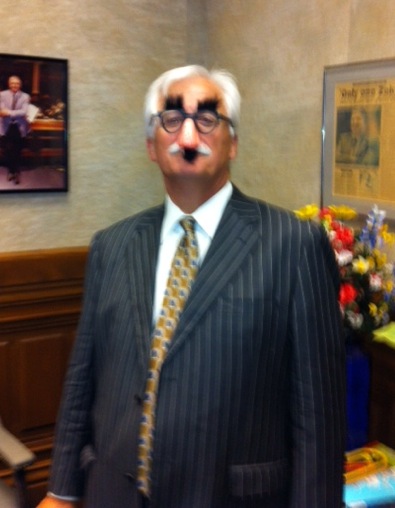
* And a photo of Vite sent in by one of his “friends”…
About 1,500 unionized workers at the Illinois Department of Transportation and other agencies received raises last month, even though their union is still negotiating a new contract with the state.
The workers, members of General Teamsters/Professional & Technical Employees Local 916, received 3 percent wage increases Jan. 1, Gov. Pat Quinn’s administration confirmed.
The raises were awarded even though the contract covering the workers expired June 30 and a new agreement has not been negotiated. The Teamster raises were awarded at the same time as negotiations with the largest state employee union, the American Federation of State, County and Municipal Employees, have ground to a halt and the union has advised members to prepare for the possibility of a strike.
Abdon Pallasch, spokesman for Gov. Pat Quinn’s budget office, said there is a different climate surrounding negotiations with the Teamsters.
“With the Teamsters, productive bargaining continues,” Pallasch said. “In AFSCME, negotiations continue, but it’s been our argument all along that they really haven’t made many meaningful concessions.” […]
Although the Teamsters contract expired June 30, the same time as AFSCME’s contract, Pallasch said it has been renewed through April.
Rank-and-file members of the state’s largest employee union packed a conference room in a state office building Wednesday to hear the latest update on stalled contract talks.
With the possibility looming of a strike by 40,000 members of the state workforce, the hour-long session was among dozens being held around the state in recent days by members of the American Federation of State, County and Municipal Employees union. […]
On Wednesday, Gov. Pat Quinn, who terminated the state’s contract with AFSCME in November, told reporters he hopes to avert a walkout.
“We’re negotiating. Everybody understands it’s a tough time economically for our state. I’m hopeful that we can get a good agreement that’s good for the taxpayers and good for the workers who work so hard for the public,” the governor said at an event in Springfield. […]
The governor said Wednesday that he has not told top aides to begin preparing for the possibility of a work stoppage. But, he said the state will be ready if a strike is called.
Premium-free health insurance for retired state workers is not a protected pension benefit, lawyers for the state argued in court Wednesday.
As a result, they said four lawsuits challenging a state law imposing such premiums should be dismissed.
Attorneys trying to overturn the law said the benefit is protected.
“The constitution prohibits the state from welshing on deals with its employees,” said Springfield attorney John Myers.
A ruling in the case is not expected for several weeks.
* And despite the criticism, I don’t think the governor meant what some think he meant…
Gov. Pat. Quinn said Wednesday that a long-awaited early inmate release program is starting “right now.”
“We’re carrying it out right now,” Quinn told reporters during a news conference in Springfield. “We had to follow the blueprint that’s outlined in the law, and I think we will do very well if we go forward right with that.”
The governor, however, may have spoken too soon.
The agency in charge of implementing the program still has not begun awarding credits for reduced prison time and does not have a set timetable to begin letting nonviolent inmates out of Illinois’ overloaded prison system. Illinois Department of Corrections spokeswoman Stacey Solano said officials continue to review inmate files.
Actually, they have started implementing the bill. Reviewing the files is the beginning of that implementation.
Citing studies confirming tanning beds are medically-proven to be carcinogenic to humans, State Sen. Christine Radogno (R-Lemont) introduced legislation Feb. 15 to protect minors from the potentially deadly effects of sunless tanning beds.
“According to the Centers for Disease Control and Prevention, the risk of developing melanoma due to tanning bed use increases by 75 percent for people under age 35, and the British Medical Journal agrees the earlier people start tanning, the greater the risk they will develop skin cancer,” Radogno said. “There are plenty of safe tanning alternatives available, and there is absolutely no need for young people to take this unnecessary health risk.”
Senate Bill 2244 would prohibit minors age 17 and younger from tanning in sunless tanning beds. Currently minors 14 to 17 are allowed to tan if they can provide a parental signature. However, this would be restricted if Radogno’s legislation is signed into law.
“Just as we don’t give children the option to smoke, they shouldn’t be allowed to tan indoors—which medical studies show is a dangerous, and even deadly, practice,” said Radogno, who noted that in 2009 experts at the International Agency for Research on Cancer in Lyon, the cancer arm of the World Health Organization, moved tanning beds and other sources of ultraviolet radiation into the top cancer risk category—the same classification given to arsenic and mustard gas. “The light from indoor tanning beds is considered a Class 1 carcinogen, and many respected medical experts agree sunless tanning does increase the risk of cancer.”
A proposal to ban the use of hand-held cellphones while driving a car was endorsed in a House committee Wednesday.
“A hand-held cellphone is a huge distraction while driving a car,” said state Rep. John D’Amico, D-Chicago, who sponsored the legislation.
Drivers using a hand-held cellphone are eight times more likely to be in an accident, he said, and California experienced a “dramatic” drop in accidents when that state adopted a similar ban.
Illinois already bans texting while driving, and 76 communities across the state have some restrictions on use of hand-held cellphones while driving, which was one reason a Verizon representative testified in favor of the measure. In the current situation, Illinois cellphone customers do not know where they might get ticketed, the Verizon representative said.
In 2007, the United States suffered some 15,000-19,000 accidental shootings. More than 600 of these shootings proved fatal. Is that “very rare”?
The total number of Americans killed and wounded by gun accidents exceeds the total number killed or injured in fires.
The number killed in gun accidents is 20% higher than the total number killed in all U.S. civil aviation accidents.
In 2011, the Consumer Product Safety Commission voted to ban drop-side baby cribs because these cribs have been blamed for “dozens” of infant deaths over the entire previous decade. The 600+ accidental gun deaths in any single year amount to 50 dozen.
Back when the Centers for Disease Control were allowed to do gun research, they found that American children under age 15 were nine times more likely to die of a gun accident than children in other advanced wealthy countries.
The Centers for Disease Control reserve the term “very rare” for accidental deaths from vaccines, the number of which is zero, or close to it. If more than 600 people a year were dying from vaccines, we’d have a national uproar, if not a revolution.
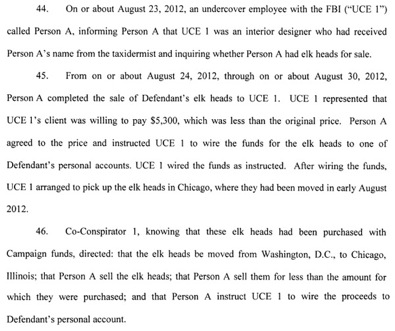
In one of the more unusual expenditures, Jackson Jr. also used campaign money in part to buy two mounted elk heads for about $8,000 from a Montana taxidermist.
The elk heads were later sold to an undercover FBI agent posing as an interior designer, and the money from the sale was wired to Jackson Jr.’s personal account, according to the court documents. Sandi Jackson oversaw the transactions in August last year, according to the court documents.
In March 2011, Jackson Jr. traded emails with a Montana taxidermist about a pair of mounted elk heads. Over the next several weeks, a person identified in court papers only as Person A received money with which to purchase the elk heads for Jackson Jr. (Person A has been identified by Crain’s Chicago Business as Jackson’s onetime campaign treasurer Terri Harris, who now goes by the name of Terri Jones.) Jackson Jr. gave Person A $3,000 in cash, money he has said was given to him by family members. Another $4,000 was given to Person A from Jackson’s campaign, in two checks whose memos indicated they were payments “for Data Reconciliation” and “for Data Entry & Cleanup.” Person A later sent two checks to the taxidermist in Montana, who shipped the elk heads in April to Jackson’s Congressional office.
Fast forward to July 2012. A month earlier, Jackson had reportedly collapsed at his home in Washington D.C., and subsequently took a medical leave of absence from Congress. (After an initial news blackout, it was revealed that Jackson was receiving treatment for bipolar disorder.) On July 23, Person A contacted the taxidermist again, asking if the taxidermist knew anyone who would want to buy the elk heads, or, alternatively, someone who could build crates in which the heads could be stored. A month later, Person A got a call from an undercover FBI employee posing as an interior designer interested in buying the heads.
Over the final week of August 2012, Person A and the undercover FBI employee negotiated the sale of the heads. They settled on a price of $5,300, which Person A told the FBI employee to wire straight to one of Jackson’s personal accounts. According to the court documents, it was Sandi Jackson who, knowing the elk heads had been purchased with campaign funds, had them moved from Washington D.C. to Chicago, and then directed Person A to sell the elk heads for less than the original purchase price, and to have the money wired to Jackson Jr.’s account.
“They have called this the Religious Freedom and Marriage Fairness Act,” said state Rep. David Reis, R-Ste. Marie, “but I think they should call it the Religious Persecution and Marriage Unfairness Act.
“But when you’re a county clerk and you don’t believe in same-sex marriage and you have to issue that license, that’s religious persecution.”
Reis urged those at the rally to tell legislators “to protect the institution of marriage in Illinois, and that they have civil unions and we don’t want any more.”
Pastor Richard Giovannetti of the Standing in the Word Ministries of Morris, told the crowd that “when we have gay marriage we are going to enslave millions of people back into a lifestyle that we know that God can set them free from.”
Pastor Linda Jernigan, who said she was “a former lesbian” who now operates a ministry in the Chicago area, asked repeatedly, “Did you know that God can deliver homosexuals?”
She said it was “a chosen behavior” and that “if you allow God, He can change your behavior.”
“Don’t believe the lie,” she said, “that homosexuality is a civil right. It is not a civil right. Homosexuality is a choice.”
Their concerns ranged from morality to intricate questions on religious freedom to the basic laws of human nature.
“It’s a plumbing issue, it comes down to basic plumbing,” said David Webster of Washington, as he stood outside Gordon-Booth’s office. He borrowed the plumbing idea from David Zietlow, an engineer and member of Grace Presbyterian, who wore a necklace of male and female pipe fittings.
Many insisted they had nothing against homosexuality, that they were there strictly to defend the sanctity of traditional marriage. But Robert Stine, a retired Peoria doctor, inadvertently touched on how much attitudes have changed about homosexuality when he said, “In fifty years it’s gone from being a felony to political, legalized status.”
Brian Elsasser of Princeville, a Peoria County Board member who rode on one of the buses organized by the Peoria diocese, said, “I pray and I love all humankind, no matter what they do. But that doesn’t give us the right to take an institution, which was ordained by God, and change it in Illinois.”
* Meanwhile, the only Senate Republican to vote for gay marriage has been hit with robocalls…
State Sen. Jason Barickman’s vote last week to allow same-sex marriages in Illinois has infuriated some conservative groups, including Family PAC, a Chicago-based group that already is calling for his resignation.
In robocalls to constituents in Barickman’s conservative district north of Champaign, the group urged voters to call Barickman’s office to register their anger.
“Was Barickman representing you, or the Chicago homosexual community?” asked Sandy Rios of Family PAC in the automated call. “Call Barickman today and tell him you’ve cast your last vote for him, and ask him to resign.”
* But Barickman was actually doing opponents a favor…
Barickman, a 37-year-old attorney who joined the Senate in January after beating state Sen. Shane Cultra, R-Onarga, last year, said he decided to vote “yes” after helping draft an amendment to the legislation that is designed to protect churches from reprisals if Illinois becomes the 10th state in the nation to allow gays to marry.
“It’s a vote that I understand that some have varying opinions on, but I feel that I voted in the correct way,” Barickman said. “The language in the amendment preserves those religious liberties that are so important to so many people.”
* From a lobbyist who worked with Barickman on the bill’s rewrite…
The original bill that came out of [Senate Executive Committeee] in lame duck session provided that:
* No church or religious institution could ever be required to solemnize a marriage in conflict with its beliefs. (This provision remains intact in the new bill.)
* Churches/religious institutions did not have to make any facility available for a same-sex wedding if the facility’s “primary use” was for religious purposes.
A facility qualified for this protection if:
* It was only occasionally open to non-members and did not charge money for their admission, and
* It was never open to the general public.
SB10, as passed, provides that anything deemed a “religious facility” does not have to open its doors for a same-sex marriage. This means that under no circumstances can the following types of facilities be required to hold a same-sex wedding:
* Sanctuaries
* Parish halls
* Fellowship halls and similar facilities.
“Religious facilities” do not include:
* Hospitals
* Businesses
* Schools
* Social service organizations
If a building has multiple uses, the test is applied on a “room by room” basis. For example, a gay couple cannot be barred from a hospital. But if the hospital had a chapel, that chapel could not be forced to host a gay wedding.
* The latest released results from the Paul Simon Public Policy Institute poll. Pay attention to those income tax results…
The introduction to the various options for pension reform was read to each respondent: “As you may have heard, the state of Illinois has an unfunded pension liability of about 96 billion dollars. Some say this liability will grow rapidly as more people reach retirement age, and will hurt the state’s ability to fund other services, such as education, public safety, and roads. Others say that pensions are a binding contract between the state and its employees, and can’t be altered or reduced. I’m going to read some proposals that state officials have made to fix the pension liability. For each, please tell me whether you favor or oppose that proposal.”
1. Would you favor or oppose a proposal to suspend retirees’ annual cost of living increase for six years?
6. Would you favor or oppose a proposal to increase the share that Illinois school districts pay for their employees and to reduce the amount that the state pays?
7. The state of Illinois has a budget deficit of about 4 billion dollars. I’m going to read three statements that people have made about how to fix the deficit, and ask you which one comes closest to your views? If you haven’t thought much about the issue, just tell me that.
First is . . .
Illinois’ public programs and services have already been reduced significantly. We can only fix the problem by taking in more revenue, such as a tax increase.
Next is . . .
The state takes in plenty of money to pay for public services but wastes it on unnecessary programs. We can fix the problem by cutting waste and inefficiency in government.
Third is . . .
Illinois’ budget problem is so large it can only be solved by a combination of budget cuts and revenue increases.
Results:
More Revenue 7.5%
Cutting Waste and Inefficiency 54.7%
Combination of Budget Cuts and Revenue Increases 28.8%
Haven’t thought much about it 4.5%
Other/Don’t know 4.5%
8. Do you favor or oppose a proposal to make permanent the recently passed temporary state income tax increase?
“The results show the people of Illinois are aware of the problems in their state funded pension systems and of some actions which could be taken by state government,” said John S. Jackson, a visiting professor at the Institute.
“There’s a general feeling that state employees are going to have to take some losses in their pension plans, but a majority of people in Illinois is not supportive of draconian measures. There is majority support only for incremental changes to the pension system,” Jackson said.
The poll also shows strong opposition to raising taxes, making the 5 percent income tax permanent or expanding the list of items subject to the state sales tax. Instead, voters support cuts to state spending to balance the budget.
* And…
There were 45.1 percent favoring [the cost-shift] proposal and 42.6 percent opposed. Perhaps not surprisingly, the most support for this proposal was in Chicago where almost half of the respondents (49.1 percent) supported it with the next highest in the suburbs, where 48.6 percent supported. Downstate areas outside the city and suburbs were the regions with the most opposition. Only 36.6 percent favored it while 48.8 percent opposed or strongly opposed.
Former Illinois governor George Ryan is on home confinement, but in an I-Team exclusive photo, he can be seen having dinner at a restaurant more than 30 miles from home.
Ryan is supposed to be spending the next six and a half months confined to his home in Kankakee. So, imagine the shock and awe that overcame some patrons in a popular south suburban restaurant when they saw the ex-governor sitting at a table with five other people having Sunday dinner.
The restaurant is 31 miles away from Ryan’s home, a 45-minute drive for the corrupt ex-governor who is on home confinement. […]
Late Sunday afternoon, at an Italian restaurant in Frankfort, the disgraced governor walked in the front door and sat down in what the manager calls “a secluded table.” Ryan, seen in a photo with his daughter-in-law, Amy, who made the reservation, dined with son George Ryan Jr. and two friends.
When contacted by telephone Monday afternoon, the I-Team asked Ryan, “We have a photo of you dining with some people last night at a restaurant in Frankfort. How could that happen?” Ryan, after lengthy pause, said, “I have no comment about anything.”
His attorney, fellow former Gov. Jim Thompson, told WBBM Newsradio’s Regine Schlesinger the terms of Ryan’s home confinement allow him to leave the house on weekends, with permission.
“The notion that he is somehow getting special privileges is crazy,” Thompson said.
He said the rules are clear for a low-risk prisoner like Ryan.
“On the weekends, you are allowed six hours on Saturday, or six hours on Sunday, with two hours additional for church, as long as you tell the Bureau of Prisons ahead of time where you’re going,” Thompson said.
The rules for weekend leaves also require anyone on home confinement to go to a public place, not someone’s home, and not a bar or tavern.
Chief Probation Officer Phillips says that there is no rule affording 6 hours of public outings and church service attendance to all prisoners but that such arrangements may made on a per-prisoner basis. She would not provide the terms of Ryan’s home confinement and those details are not normally made public or in court records.
“Inmates on home confinement are granted permission to leave their home for a variety of purposes” Traci Billingsley, chief spokesperson for the U.S. Bureau of Prisons in Washington, said.
“Information pertaining to individual requests by individual inmates are not a part of the public record and would not be available to you. For this reason I cannot confirm whether Mr. Ryan’s reported absence from the home was authorized by the BOP,” she said.
* The Question: Is it time to just move on from George Ryan? Take the poll and then explain your answer in comments, please.
* By the way, the US Supreme Court denied Ryan’s appeal yesterday. Ryan hoped to have his conviction overturned…
The former governor wanted them to reconsider his conviction based on a 2010 decision saying honest service fraud requires bribery and kickbacks. Ryan’s lawyers said the jury instructions at his trial were wrong, and that it was never proven that he took bribes. The 7th U.S. Circuit Court of Appeals refused to overturn his conviction, and the high court refused to reconsider that decision.
“We need to be upset about what’s going on in Washington. We need to be upset about what’s going on in Illinois. But we have to do it in a way that’s not about dividing our country. Ronald Reagan won in 1980 not because he stood on national TV and screamed at Jimmy Carter, talked about how terrible everything was and tried to scare the American people. He won because he had a vision of the America he wanted to live in and the America that he believed could exist under his leadership,” Kinzinger said.
He continued, adding that the general public sees Republicans in a negative light and that needs to change.
“What I’ve seen lately that concerns me, and I’m just being honest, is that the new definition of conservatism in this country is not any more about what you believe, it’s about who’s the loudest and who’s the angriest. And whoever’s on national TV screaming the most is probably the biggest offender of conservatism. That’s what I think people have started to see,” he said.
Kinzinger said that the Republicans lost a lot of ground in the 2012 election, but he’s hoping the party can regain some of its momentum in the coming years.
“Thirty-eight percent of Americans identify themselves as Republicans, which means that in order to win national elections … if we want to be a minority party forever, we’re on the right track. If we want to win national elections, we need to take 13 percent and switch them from the ‘I don’t call myself a Republican’ column to ‘You know what? I’m going to be a Republican today.’ They do that by talking about the optimistic hope for our future,” Kinzinger said.
It’s even worse in Illinois. The recent Paul Simon Institute poll found that just 22.3 percent identified themselves as Republicans. Last fall’s PPP poll had it at 26 percent.
Prosecutors in Chicago are telling state lawmakers they can essentially ignore a federal court ruling and not legalize concealed carry in Illinois.
The Illinois House on Tuesday held the first of two statewide hearings on how to legally allow people to carry a gun in the state. Illinois is the only state in the nation that bars anyone from carrying a pistol outside their home. In December, the 7th Circuit Court of Appeals said Illinois must change that.
But Paul Castiglione, policy director for the Cook County State’s Attorney’s office, told lawmakers there is no need for a new law.
“Only the Illinois Supreme Court can declare a statue from (the legislature) unconstitutional,” Castiglione told lawmakers Tuesday. “I heard (someone) say that after 180 days our UUW (unlawful use of weapon) statute is unconstitutional. Not so.”
“Until the Supreme Court of the United States has spoken, state courts are not precluded from exercising their own judgments on federal constitutional measures,” said Paul Castiglione, representing the Cook County state’s attorney’s office. “Because lower federal courts exercise no appellate jurisdiction over state courts, decisions of lower federal courts are not conclusive on state courts.”
“After 180 days, anyone who decided, for example, to walk down Michigan Avenue in Chicago carrying an AK-15 would be subject to arrest and prosecution for violating the [Unlawful Use of Weapons Act,]” said Cook County Assistant State’s Attorney Paul Castiglione. He said the Cook County state’s attorney’s office intends to enforce the Illinois Unlawful Use of Weapons statute, which outlaws carrying guns in public, after the deadline, unless lawmakers change it or the Illinois Supreme Court finds it unconstitutional. “The lower federal courts, either the district courts or the courts of appeal, cannot tell the Illinois Supreme court how to rule or whether or not that law is constitutional. The only court that can resolve that split is the U.S. Supreme Court.”
The Illinois Supreme Court is currently reviewing another carry case, People v. Aguilar. “The real trigger for when this committee and this legislature has to act, I submit, is if and when the Illinois Supreme Court ever decides that the [Unlawful Use of Weapons] statute is unconstitutional.”
Rep. Mike Zalewski, a former prosecutor, immediately questioned Castiglione’s suggestion that lawmakers are not under a “ticking clock” to act, saying the Alvarez aide “kind of dropped a pretty big rhetorical bomb on some of us.”
“We should tread carefully, tread lightly on that specific conclusion because we’re charged with passing a constitutional statute down here in the next 60 to 90 days or so,” said Zalewski, D-Chicago.
Ronald Rotunda, an expert on the Illinois Constitution, sided with Zalewski.
“Whenever the 7th Circuit and the Illinois Supreme Court have a conflict, the federal court will win,” said Rotunda, a constitutional law professor at Chapman University in Orange, Calif.
The National Rifle Association says it’s non-negotiable:
Public-transportation users should to be allowed to carry guns on buses and trains.
The question surfaced during a hearing Tuesday aimed at meeting a federal court demand to draw up legislation permitting Illinoisans to carry concealed weapons. A top NRA lobbyist said he won’t bend on allowing bus and train riders to arm themselves.
“I don’t believe people who need public transportation to get around should be prohibited from exercising their constitutional right,” said lobbyist Todd Vandermyde, who later questioned the contradiction of a motorist being allowed to carry a gun in their vehicle but not a mass transit customer. […]
Last week, the leaders of the Chicago Transit Authority, Regional Transportation Authority, Metra, Pace and others wrote to House Speaker Michael Madigan (D-Chicago), calling the idea dangerous and warning it could lead to “catastrophic” results.
“The issue is that you’re dealing with a confined space where the public expects some safety,” Jordan Matyas, the RTA’s chief of staff, told the Sun-Times. “This is just going to lead to problems, and it will lead to what we believe is a lack of security and safety and possibly reduce ridership.”
I would hope the RTA had compiled some stats from other states with concealed carry to back up their nightmare scenario, but I doubt they do.
*** UPDATE 1 *** Gov Pat Quinn told reporters today that the state needs to comply with the federal appellate court order.
Quinn added, however, that he doesn’t want people carrying concealed weapons on mass transit.
Finally, the State and the City cannot evade the Landry injunction by arguing that the state courts of Illinois are not bound by decisions of lower federal courts.
As a general rule, the interpretation given to Illinois statutes by the lower federal courts is not conclusive on the courts of this state. Hanrahan v. Williams, 174 Ill.2d 268, 277, 220 Ill.Dec. 339, 673 N.E.2d 251 (1996). That rule, however, is addressed to the situation where the federal court’s decision is being invoked as precedent on a point of law. In the case before us, the Landry decision is not being cited for its legal analysis. Whether the federal court’s analysis is correct is irrelevant.
Whatever one thinks of the federal district court’s reasoning, its decision is binding because it constitutes a valid judgment by a duly-constituted tribunal on the same question presented here and prohibits the same prosecuting officials involved in this case from enforcing the same statute against the same class of defendants to which the defendant in this case belongs.
Former U.S. Rep. Jesse Jackson Jr. pleaded guilty Wednesday in a federal courtroom in Washington, D.C., to conspiring to illegally spend about $750,000 in campaign money on personal uses, including a Rolex, pricey memorabilia, furs and other luxury items.
“For years I lived off my campaign. I used money that should have been for campaign purposes for personal purposes,” Jackson said in court, as he broke down several times, getting tissues from his lawyers.
In explaining his decision to plead guilty, Jackson said: “I have no interest in wasting the taxpayers’ time or their money.”
“I’m guilty, your honor,” Jackson said.
“Tell everybody I’m sorry I let them down,” he said outside the courtroom.
He was an effective congressman, and he could’ve continued to be one for many years to come. But he just didn’t ever think that campaign laws applied to him. He constantly sent out campaign press releases from his government office, then come to find out he was using campaign cash to buy Michael Jackson memorabilia, among other things.
* The Sun-Times has a ScribbleLive thingy running today…
Keep an eye on that because Sandi Jackson is expected to plead guilty today, too. There will also be a press conference by the US Attorney.
Jackson Jr. entered a negotiated plea of guilty on one felony count of conspiracy to commit false statements, wire fraud and mail fraud. Prosecutors say he spent campaign contributions to buy luxury items, memorabilia and other goods. […]
Attorneys familiar with public corruption investigations said the amount of campaign cash that prosecutors said was converted to personal use in this case is the largest of any that they can remember. […]
Prosecutors accused Jackson Jr. of improper spending of campaign cash for a $43,350 men’s Rolex watch, nearly $9,600 in children’s furniture and $5,150 in cashmere clothing and furs. She is charged with filing false tax returns for six years, most recently calendar year 2011.
Prosecutors are seeking a $750,000 judgment against Jackson Jr. and the forfeiture of thousands of dollars of goods he purchased, including cashmere clothing, furs and an array of memorabilia from celebrities including Michael Jackson, Bruce Lee and civil rights leader Martin Luther King Jr.
* Back on February 10th, the Chicago Tribune endorsed Robin Kelly in the 2nd Congressional District, highlighting her integrity…
Throughout her career, Kelly has been meticulous about separating her campaign activities from her government work. When she ran for state treasurer in 2010, she subtracted from her time sheets any activities that could be considered election-related. In this campaign, she resigned from her job in Cook County to run full time. That’s rare among Illinois politicians.
More important, it demonstrates the ethical compass 2nd District voters need and deserve.
After Robin Kelly lost a 2010 bid for state treasurer, the office’s chief investigator alleged she violated ethics laws by improperly reporting time off from her taxpayer-funded job as chief of staff to then-Treasurer Alexi Giannoulias, the Tribune has learned.
Kelly, now a top contender in Tuesday’s special Democratic primary in the 2nd Congressional District race to succeed Jesse Jackson Jr., was at the center of an investigation by the treasurer’s executive inspector general into whether timekeeping violations took place as she campaigned for treasurer, records obtained under the Freedom of Information Act show.
The inspector general also requested an audit after Dan Rutherford was sworn in…
The treasurer’s personnel rules required all of a worker’s time off to be approved ahead of time by a supervisor. But from August 2009 through December 2010 — when Kelly was campaigning for treasurer — Kelly filed 107 requests for unpaid time off, the audit found. Of those requests, 82 percent were not approved by a supervisor, but by a human resources director who reported to Kelly, the audit found. Many of those requests were submitted well after the time off had already been taken, the audit found.
In addition, the audit stated that 19 of Kelly’s 24 monthly time-off calendars in 2009-10 were OK’d before her time-off requests had received final approval. It also found 17 of those 24 calendars were approved late and three were never approved.
It appeared Kelly “could come and go as she pleased without consequence,” Ringler wrote. “It also appears that (her time-off) calendars were made to match the times that they needed to, in order to end up with a 35-hour work week and/or 7-hour day, because of the number of times they were approved, reversed, reapproved, reversed again, approved a third time, etc.”
Too late for Toi Hutchinson, unfortunately.
* And speaking of Hutchinson, the Kankakee Daily Journal is upset that so many people wasted their votes on her during early balloting…
(T)he withdrawal pretty much insults the local Kankakee County Democratic Party, which endorsed her, and those Republican officials who had expressed support for her. It becomes very clear, on the scale of district politics, the local influence here is as light as a feather on the scale.
* Meanwhile, this is pretty odd. Candidate Anthony Beale attacked President Obama’s gun record in a press release slap at Kelly…
In an unusual turn for a candidate seeking election next week in a heavily African American District, the Beale statement, released Tuesday, went on to question President Obama’s commitment to reducing gun violence.
“All of my opponents are saying I will stand with the President, but President Obama needs to stand with us in Chicago,” Beale says in the statement. “We never stopped fighting this fight.”
It then cites a series of articles that question Obama’s past positions on gun control, then points back to Beale: “By comparison, Anthony Beale’s record on guns is the strongest and most consistent of anyone in this race for the 2nd CD.”
That includes Christian Science Monitor article in September 2012: In making that comparison (gun control records of Barack Obama and Mitt Romney) Obama has only ever signed laws “expanding gun owners’ rights.”
“It’s not so shocking then that the Brady Campaign “gave Obama an F” in January 2010,” Beale’s statement concludes.
*** UPDATE *** Despite Ald. Beales’ press release, he says in his new TV ad that he will “work with President Obama” for stronger gun laws. Watch…
[ *** End Of Update *** ]
* But there’s a serious contradiction in Beale’s gun stance. This is what he told NBC5 a while back…
Q: What kind of guns do you own?
A: A 30-.06 rifle, and 1187 Remington shotgun, and a 9 millimeter Glock. As aldermen, were legally allowed to carry [handguns]. I don’t carry, but under the city ordinance and the state law, we have the right to carry a concealed weapon.
Q: Do you think the entire state should pass that law?
A: Absolutely not.
Q: Why not? If it’s OK for aldermen, why not the general public.
A: An alderman is a sworn peace officer, and we have to go through 40 hours training in order to obtain the license. I’ve even taken 20 hours additional training. [Emphasis added.]
“You gotta remember, I didn’t own anything [guns] prior to being an alderman,” he said. “As alderman, I still have the right, because I’m a sworn officer.”
But state law and rules were changed in the late 1990s to require aldermen to undergo 400 hours of training — just like police officers — to become “conservators of the peace.” Beale’s campaign acknowledged the alderman never took that training, but Beale said he now has a Chicago firearms permit. [Emphasis added.]
Oops.
* Related…
* Where Rahm Emanuel Stands On 2nd District Race: Insiders also note Emanuel is in a tight spot with Ald. Anthony Beale being a leading candidate. Emanuel does not want to be perceived as turning on one of his alderman, especially with Ald. Carrie Austin, Michelle Harris and John Pope all supporting Beale.
* Bloomberg super PAC targets Jackson’s former seat - Nearly $3 million spent by outside groups dwarfs candidates
State Police Lt. Darrin Clark said the agency currently gets a $10 fee for issuing Firearm Owners Identification (FOID) cards that are valid for 10 years. The process calls for background checks through a federal database on crime and mental health issues. Clark said it now costs $12 to cover the expense of issuing those cards.
There are nearly 1.5 million FOID cardholders in the state and about 70,000 applications or reapplications each month.
That means it cost the state taxpayers $3 million to process existing FOID cards and another $140,000 a month. The state cops have a huge FOID card backlog right now, partly because the fees are too low, and they’re gonna need a whole lot more money if and/or when concealed carry permits have to be issued (I’ll get to that issue in a bit, so be patient).
Back in the 1960s, the state cops testified yesterday, FOID card fees were $1 a year. Now, they’re $10 for ten years. So, they’re still a dollar a year. $1 in 1969 money is now $6.26, according to a CPI inflation calculator I use.
* Rep. Lou Lang (D-Skokie) has a new pension reform bill that he says is constitutional. But there are some pretty darned controversial aspects to this bill, like making the income tax hike permanent, with some conditions. It also includes the so-called cost-shift language. While it doesn’t decrease retiree benefits, it does require a three percentage point increase in what employees put into the retirement fund.
Provides that, beginning in State fiscal year 2014, a member who is eligible for medicare shall pay the full premium amount for his or her healthcare coverage under the Act. Amends the Illinois Pension Code.
For the 5 State-funded retirement systems, incrementally increases employee contributions by a total of 3% of salary, imposes a minimum retirement age of 67 (or 62 with a discounted annuity), changes the funding goal from 90% to 80%, and changes the funding formula (beginning in FY2014, applies a 50-year amortization formula to reach an 80% funding ratio).
In the State Universities and Downstate Teacher Articles, shifts costs to local employers.
Amends the Illinois Income Tax Act. Makes the current tax rates permanent.
In any fiscal year in which the total State contribution to the State-funded retirement systems is less than the proceeds from the income tax increase and the debt service savings from the retirement of the 2010 and 2011 Pension Obligation Notes, grants a refundable income tax credit equal to the difference.
* BlueRoomStream.com is covering the press conference. From its Twitter feed…
Lang: The General Assembly should not be responsible for paying pension costs for school districts and universities. They must step up.
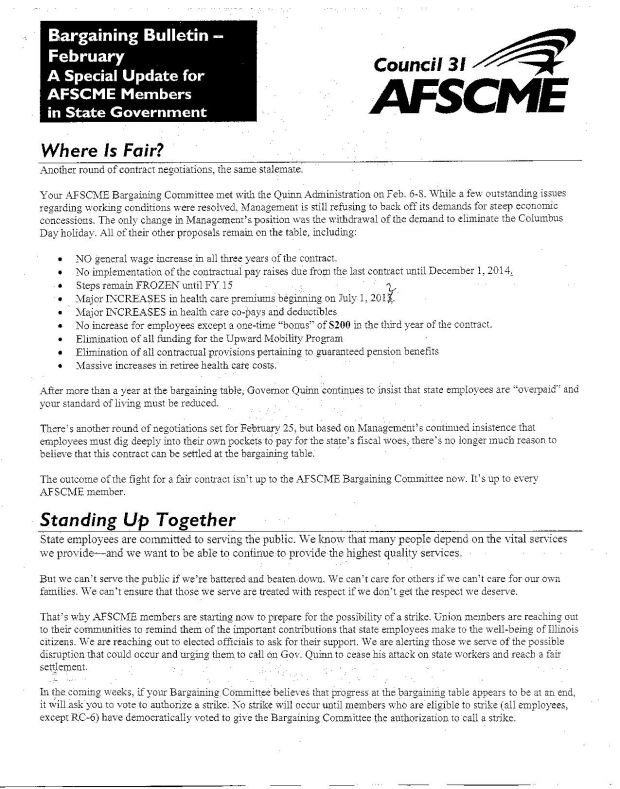
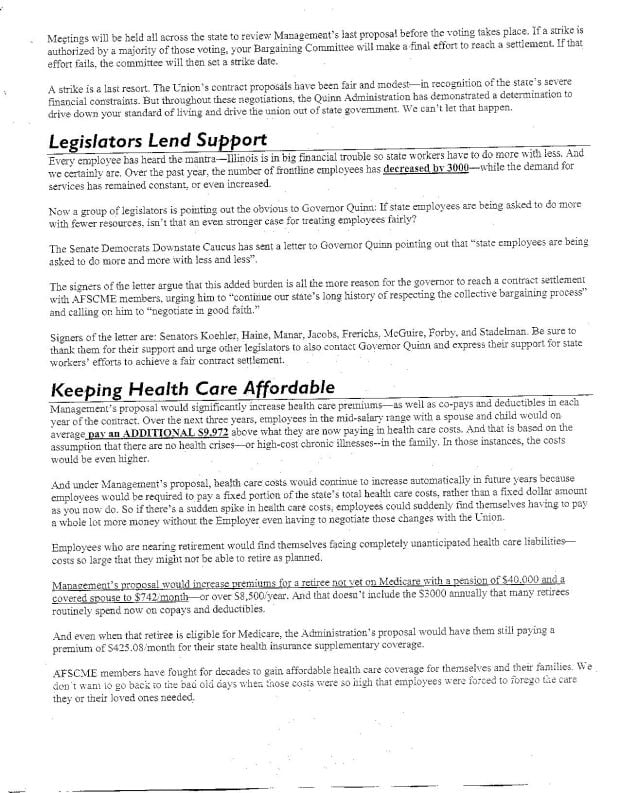
In a new memo obtained Tuesday by the Herald & Review’s Springfield Bureau, the American Federation of State, County and Municipal Employees union said an ongoing impasse in its talks with the Quinn administration has workers preparing for the possibility of a strike.
“(B)ased on management’s continued insistence that employees must dig deeply into their own pockets to pay for the state’s fiscal woes, there’s no longer much reason to believe that this contract can be settled at the bargaining table,” the memo notes.
“In the coming weeks, if your bargaining committee believes that progress at the bargaining table appears to be at an end, it will ask you to vote to authorize a strike,” the two-page memo adds. […]
In the new memo, AFSCME said the administration continues to demand no wage hikes in all three years of the proposed contract and major increases in health care premiums for current workers and thousands of state retirees.
The union, which represents about 40,000 state workers, has agreed to take no raises in the first year of the contract.
* And here’s the memo. Click the pics for larger images…