* I didn’t realize bar volleyball was such a thing in Lake County…
The Lake County Health Department is warning residents of several COVID-19 cases linked to adult volleyball leagues that competed in Gages Lake this month.
According to health officials, at least 14 people, who played or watched volleyball at Jesse Oaks Food and Drink in Gages Lake in September, tested positive for COVID-19.
“Of these cases, multiple people reported that they also played volleyball at other bar/restaurant locations, which could contribute to further spread of the virus,” Lake County officials said.
“We are currently working diligently to speak with infected individuals and notify close contacts who have been identified,” said Dr. Sana Ahmed, medical epidemiologist at the Lake County Health Department. “However, nearly 200 volleyball players and spectators may have been exposed. This could potentially be a large outbreak, and we need the public’s help to contain the spread of this virus.”
Health officials are asking that anyone who played volleyball at Jesse Oaks this month, or visited and did not wear a mask, to quarantine at home for 14 days from their last visit.
[Larry Mackey, director of environmental health at the county health department] said there is “some disagreement” as to whether the games taking place at Jesse Oaks were in violation of state guidelines, but the health department believes they were league games and therefore prohibited.
However, he said, no enforcement action are being taken against the establishment.
“They voluntarily agreed to stop the games for 14 days and we’re working with them to meet the guidelines,” Mackey added.
Governor Pritzker and the Illinois Department of Public Health (IDPH) are announcing COVID-19 resurgence mitigations will be implemented in Region 1, the northwestern most counties in Illinois, beginning Saturday, October 3, 2020. The region is seeing a 7-day rolling average test positivity rate of 8% or above for three consecutive days, which exceeds the threshold set for establishing mitigation measures in the region under the state’s Restore Illinois Resurgence Plan. This announcement follows last week’s warnings to local leaders that additional mitigation measures would be implemented if the region continued to see an increase in cases. Region 1 includes Boone, Carroll, DeKalb, Jo Daviess, Lee, Ogle, Stephenson, Whiteside and Winnebago counties.
“The concerning uptick in Region 1’s positivity – jumping more than two percentage points in two weeks even as the majority of Illinois continues to see downward trends – demands increased efforts to stop the spread in our northwestern counties,” said Governor JB Pritzker. “As other regions have demonstrated, stricter mitigations will lead to safer communities when people mask up, keep their distance, wash their hands and respect public health. It is my hope that the residents of Region 1 can turn this situation around quickly, and Dr. Ezike and I continue to coordinate with local officials to make that happen.”
“COVID-19 spread can increase very quickly, as we’ve seen in some regions in the state, now including Region 1,” said IDPH Director Dr. Ngozi Ezike. “As the pandemic continues, so must our fight against it: Please, don’t hold or attend large events or mass gatherings, wear your face covering, and keep six feet of distance between you and others.”
In the past week, Region 1 also had an early indication of increasing hospital admissions for COVID-like-illness. Although this increase has not yet reached the threshold level, it indicates more severe illness is increasing and IDPH will continue to monitor the region’s hospital capacity.
Mitigation measures taking effect October 3, 2020 in Region 1 include the following:
Bars
• No indoor service
• All outside bar service closes at 11:00 p.m.
• All bar patrons should be seated at tables outside
• No ordering, seating, or congregating at bar (bar stools should be removed)
• Tables should be 6 feet apart
• No standing or congregating indoors or outdoors while waiting for a table or exiting
• No dancing or standing indoors
• Reservations required for each party
• No seating of multiple parties at one table
Restaurants
• No indoor dining or bar service
• All outdoor dining closes at 11:00 p.m.
• Outside dining tables should be 6 feet apart
• No standing or congregating indoors or outdoors while waiting for a table or exiting
• Reservations required for each party
• No seating of multiple parties at one table
Meetings, Social Events, Gatherings
• Limit to lesser of 25 guests or 25 percent of overall room capacity
• No party buses
• Gaming and Casinos close at 11:00 p.m., are limited to 25 percent capacity, and follow mitigations for bars and restaurants, if applicable
These mitigations do not currently apply to schools.
IDPH will track the positivity rate in Region 1 to determine if mitigations can be relaxed, if additional mitigations are required, or if current mitigations should remain in place. If the positivity rate averages less than or equal to 6.5% for three consecutive days, then Regions 1 will return to Phase 4 mitigations under the Restore Illinois Plan. If the positivity rate averages between 6.5% and 8%, the new mitigations will remain in place and unchanged. If the positivity rate averages greater than or equal to 8% after 14 days, more stringent mitigations can be applied to further reduce spread of the virus.
Region 4, the Metro East, remains under additional mitigation measures as well. Although the 7-day rolling average test positivity rate is less than 8%, it remains above 6.5% and has increased in recent days.
IDPH continues to monitor each region in the state for several key indicators to identify early, but significant increases of COVID-19 transmission in Illinois, potentially signifying resurgence. Indictors include an increase in the region’s positivity rate with a simultaneous increase in either hospital admissions for COVID-like-illness or a decrease in hospital capacity, or three consecutive days of greater than or equal to 8% test positivity rate (7-day rolling average). These indicators can be used to determine whether additional community mitigation interventions are needed for a region to prevent the further spread of COVID-19.
A full list of mitigation measures pertaining to some businesses and industries may be found on the Illinois Department of Commerce and Economic Opportunity (DCEO) website at www.dceocovid19resources.com/restore-illinois.
Texas-based energy company Vistra plans to accelerate its transition to clean power generation sources and advance efforts to significantly reduce its carbon footprint. The company launched Vistra Zero, a portfolio of zero-carbon power generation facilities, which includes seven new developments — some solar, solar + storage and standalone energy storage — in its primary market of ERCOT that total nearly 1,000 MW.
In addition, Vistra established further long-term emissions reduction targets, released its first climate report and announced its intention to retire all of its generation subsidiaries’ coal plants in Illinois and Ohio. […]
Vistra also announced its next phase of coal plant closures in Illinois and Ohio. The company expects to retire seven Luminant power plants, of which the company owns a combined capacity of more than 6,800 MW, between 2022 and 2027.
Since the company’s leadership change in 2016, Vistra and its subsidiaries have closed or announced the closure of 19 coal plants totaling more than 16,000 MW across Texas, Pennsylvania, Ohio, Illinois and Massachusetts. In total, Vistra and its subsidiaries have now retired or announced the retirement of more than 19,000 MW at 23 coal and natural gas plants since 2010.
Vistra said it will retire the Baldwin and Joppa plants in southern Illinois no later than 2025, “or sooner should economic or other conditions dictate.” The Kincaid and Newton plants southeast of Springfield will close no later than 2027, again with the same caveat.
The four plants together employ about 400. […]
Under the plan, which requires action in Springfield, Vistra would convert its coal-plant sites into utility-scale solar facilities accompanied by powerful batteries that could store some of the energy when it’s not needed.
Vistra already has announced the planned closure of the Edwards plant near Peoria, which will occur by the end of 2022.
That’ll leave three Illinois coal plants owned by NRG.
* Sierra Club…
Texas based Vistra Energy announced plans today to accelerate its transition to clean energy generation by retiring all the coal plants owned by its subsidiaries in Illinois and Ohio. In a move intended to reduce the utility’s outsized climate impact, the announcement targets more than 6,211 megawatts (MW) of coal based electricity generation at six coal plants, which is equivalent to a year’s worth of carbon emissions from 10,380,659 passenger vehicles. These announced retirements mark 166,395 MW of coal capacity retired with 176,617 MW remaining in the United States.
“Vistra is the largest emitter of climate-warming carbon pollution in the US electric sector, and today they made one of the largest coal retirement announcements in US history, sending a clear signal that the transition from coal to clean energy is accelerating nationwide. Vistra’s plan to stop burning coal altogether in Illinois and Ohio is a testament to a decade of tireless work by advocates fighting for the significant public health and climate benefits that come from moving away from coal to clean energy,” said Mary Anne Hitt, National Director of Campaigns at the Sierra Club. “Supporting a fair and robust economic and community transition is a critical next step for Illinois and Ohio as lawmakers in both states are in dialogue about the future of state energy policy.”
Vistra’s announcement comes amid record low coal use in the US, as clean energy now routinely outperforms coal plants. Vistra announced plans for new solar and storage developments, primarily in Texas, prompting advocates in Illinois and Ohio to redouble calls for state level energy transition planning and policy. Vistra made no changes to its Texas coal fleet, which includes the Martin Lake coal plant; the nation’s largest source of sulfur dioxide pollution and mercury pollution. Martin Lake is the source of ongoing violations of local pollution standards.
“It’s urgent that Illinois plan now to assist the workers and communities that will be affected by these closures, ensure that Vistra cleans up these sites, and that we build clean, renewable energy infrastructure to replace these dirty sources of power,” said Jack Darin, Director of the Illinois Chapter of the Sierra Club. “The Clean Energy Jobs Act (CEJA) is a plan for a just transition for these communities that creates jobs where they are needed most, while holding big polluters accountable for the messes they leave behind. We call on the Illinois state legislature to pass the CEJA this year, to respond to these closures proactively, and ensure a brighter future for our most impacted communities.”
In Illinois, the new retirements include the Baldwin and Joppa Power Plants by the end of 2025, and Kincaid and Newton Power Plants by 2027. The Edwards coal fired power plant near Peoria is already slated to retire by the end of 2022. In Ohio, Miami Fort Power Plant, in North Bend, and Zimmer Power Plant in Moscow, are planned to retire by 2027. The utility added that all these retirements may be sooner than the announced dates should economic or other conditions dictate.
* Illinois Clean Jobs Coalition…
Vistra’s announcement to close five coal plants around Illinois is an urgent call for Gov. Pritzker and the General Assembly to take action to help workers who face lay-offs and local plant communities that will lose significant tax revenue. This announcement leaves out that Vistra’s own proposal is little more than a corporate bailout for cutting and running that does nothing for communities like Waukegan who have a heavily polluting plant in their backyard.
In contrast, the Clean Energy Jobs Act will provide real help to these communities throughout the state by accelerating renewable energy, providing property tax replacement, securing worker benefits and training, and delivering resilient, economic futures. The Illinois Clean Jobs Coalition is ready to get to work to pass CEJA this year.”
…Adding… Congressman Rodney Davis…
“I’m deeply disappointed in Vistra’s plan to retire their Kincaid plant, which employs 115 of our friends and neighbors. The Kincaid plant has created good-paying union jobs and reliable, baseload power for households and manufacturers in Illinois and states in the Mid-Atlantic region for decades. Because the plant is a significant employer and generator of local tax revenue in Christian County, our hometowns, schools, and other public bodies will be negatively affected by this closure. Our Congressional office stands ready to support the workers and communities impacted.
“I have always been an advocate for an all-of-the-above energy portfolio, but I am becoming increasingly concerned about the planned nuclear, coal, and gas plant closures across Illinois in the coming years. Our state cannot continue to be a leading net electricity exporter if this trend continues. Additional plant closures will put thousands of good-paying union jobs and reliable, affordable power at risk. I’m committed to making sure American energy policy supports a diverse, reliable, and affordable array of baseload energy sources. American families need certainty that when they flip a switch, they will have access to low-cost, reliable electricity. We can’t let America’s energy future look like California brownouts and blackouts, but the Green New Deal and other far-fetched, left-wing environmental proposals are moving us closer to that sad reality.”
…Adding… Nikki Budzinski, executive director of Climate Jobs Illinois…
As Springfield debates new energy legislation, the final bill must include meaningful policies that support the workers, families and communities affected by Illinois’ transition to clean energy. That means providing workers lost wages and benefits, meaningful job support and apprenticeship opportunities, and replacing the lost tax base in these communities. Climate Jobs Illinois will be an advocate for these issues to ensure workers are not left behind in the state’s move to a clean energy future.
“This contagion, this enemy of the virus, is only going to be conquered if we all stick together,” said Cardinal Cupich.
He does not agree with pastors of some Illinois churches who say they’re opening for regular services against the governor’s stay-at-home order, claiming a constitutional right.
“People do have freedom of religion, the right to worship and so on. And yet, it’s not an absolute right if the public good, and public health, is jeopardized as a result,” Cardinal Cupich said.
The cardinal admits the pandemic is creating a financial challenge for the church, but he notes many people who’ve lost their jobs are in the same situation.
Springfield’s Catholic Bishop is arguing against government-imposed shutdowns, saying the extraordinary measures to mitigate COVID-19 should be avoided in the future. […]
“Yes we should do the ordinary things for protecting life, but we don’t have to do the extraordinary things that are being mandated,” [Bishop Thomas John Paprocki] said. “What we did in the last six months was really extraordinary, in shutting everything down, putting people out of work, telling them to stay home, don’t go to school, don’t go to church.”
He equated the extraordinary steps Pritzker took earlier this year that closed businesses, schools and churches to taking everyone off the road to save from vehicular deaths. […]
“No governor can say, ‘I’m suspending that right until this virus goes away,’ so I think there are real concerns here, avoiding any hyperbole or anything like that, of criticism,” Paprocki said. “But I think there’s some real legal and constitutional concerns of what Gov. Pritzker is doing.”
OK, but I think every court outside Clay County has sided with the governor, so the judicial branch so far has not shared those concerns.
* Jordan Abudayyeh…
The Governor believes it is his duty, as the leader of this state, to protect the health and safety of all Illinoisans. In the early days of the coronavirus pandemic, experts warned that lack of action to stop the spread of this virus could result in tens of thousands of Illinoisans losing their lives. As a reminder to those who still question the public health experts, we have lost more than 8,600 Illinoisans to this virus and every person who lives in this state has a moral obligation to follow the public health guidance to lower the risk of spreading this deadly virus to others around them. We must work together, listen to the experts, and continue following the health guidelines as we learn more about this virus. The Governor is proud that Illinoisans have overwhelmingly done their part to follow necessary guidance to reduce the spread of this virus and save as many lives as possible.
The Illinois Department of Public Health dismissed the suggestion by officials in St. Clair County, who say the downward trend in COVID-19 cases warrants an exemption from the stricter safety mitigation placed on Region 4.
On Monday, St. Clair County Chairman Mark Kern said the county should stand alone given its improving COVID-19 positivity rate and case numbers. He expressed hope that IDPH would consider excluding the county from metro-east restrictions.
On Tuesday, IDHP dismissed a St. Clair County exemption as a possibility.
“This appears to be a rumor and is not being considered,” IDPH Public Information Officer Melaney Arnold said in an email.
We saw this sort of thing earlier in the pandemic. If people thought the regional maps were unfair, they insisted that counties should be stand-alone. And when the counties refused to budge, they insisted that towns be given the right to decide. And when that didn’t work, they said individuals should just do what they wanted.
St. Clair County didn’t complain a bit when the map was drawn. They may have thought that they’d be hit the hardest, but it turns out it’s most of the other counties that are holding the region back with high average positivity rates…
Bond 10.1
Clinton 12.7
Madison 7.4
Monroe 8.4
Randolph 2.1
St. Clair 6.3
Washington 11.5
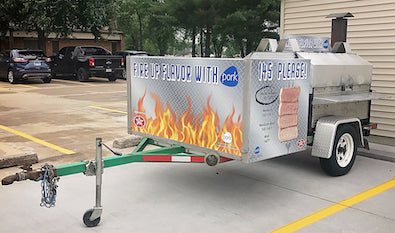
An agricultural trade association for pig farmers is reporting the theft of a large grill embedded into a trailer.
A Facebook post from the Illinois Pork Producers Associated (IPPA) said their grill was stolen from their office at 6411 S. Sixth Street Road in Springfield. IPPA said it was last seen Friday, and the trailer was covered in two black, custom fitting tarps that hide the graphics.
* The pilfered grill…
* The Question: What would you do with a sweet but “hot” grill like that?
The Illinois Department of Public Health (IDPH) today reported 1,362 new confirmed cases of coronavirus disease (COVID-19) in Illinois, including 23 additional confirmed deaths.
• Bond County: 1 male 70s
• Clark County: 1 female 90s
• Clinton County: 1 male 80s
• Cook County: 1 female 30s, 1 female 80s, 1 male 80s, 1 female 90s
• DuPage County: 1 female 90s
• Jasper County: 1 male 70s
• Madison County: 4 females 90s
• Marion County: 1 male 80s
• Moultrie County: 1 male 70s
• Peoria County: 1 female 80s
• Rock Island County: 1 female 70s
• Whiteside County; 1 male 70s
• Will County: 1 male 100+
• Williamson County: 1 female 70s, 1 female 80s
• Winnebago County: 2 males 70s
Currently, IDPH is reporting a total of 291,001 cases, including 8,637 deaths, in 102 counties in Illinois. The age of cases ranges from younger than one to older than 100 years. The preliminary seven-day statewide positivity for cases as a percent of total test from September 22 – September 28 is 3.6%. Within the past 24 hours, laboratories have reported 45,624 specimens for a total of 5,566,276. As of last night, 1,535 people in Illinois were reported to be in the hospital with COVID-19. Of those, 363 patients were in the ICU and 151 patients with COVID-19 were on ventilators.
Following guidance from the Centers for Disease Control and Prevention, IDPH is now reporting separately both confirmed and probable cases and deaths on its website. Reporting probable cases will help show the potential burden of COVID-19 illness and efficacy of population-based non-pharmaceutical interventions. IDPH will update these data once a week.
*All data are provisional and will change. In order to rapidly report COVID-19 information to the public, data are being reported in real-time. Information is constantly being entered into an electronic system and the number of cases and deaths can change as additional information is gathered. For health questions about COVID-19, call the hotline at 1-800-889-3931 or email dph.sick@illinois.gov.
A legislative panel investigating House Speaker Michael Madigan reconvenes Tuesday on the same day a former top Commonwealth Edison official is expected to plead guilty to federal charges tied to the utility’s bribery-stained lobbying efforts targeting the speaker.
The House committee probing potential misconduct by Madigan could hear Tuesday from a top Exelon official and former federal prosecutor who was hired to repair the utility’s damaged reputation following its July acknowledgment of a 9-year illegal effort to woo Madigan.
But perhaps the bigger headline could emerge at a noon hearing at the Dirksen Federal Building, where Fidel Marquez, ComEd’s former in-house lobbyist, is expected to enter a plea to a charge that he engaged in a conspiracy to commit bribery to help the utility advance its Springfield wishlist.
“We’ll be watching the Marquez court appearance closely to see if there is any additional information that comes out of that,” said State Rep. Tom Demmer, R-Dixon, who serves as the top Republican on the bipartisan committee investigating Madigan.
The former, highly-compensated lobbyist, just accused early this month, is expected to plead guilty to arranging jobs and other perks for Madigan’s political allies in exchange for favorable action in Springfield. “for the purpose of influencing and rewarding Public Official A in connection with his official duties as Speaker of the Illinois House of Representatives.”
The feds accuse Marquez of working “to obtain jobs, contracts, and monetary payments associated with those jobs and contracts from ComEd and its affiliates, even in instances where such associates performed little or no work that they were purportedly hired to perform for ComEd.”
Rep. Emanuel Chris Welch, its chairman, confirmed Monday that David Glockner, ComEd’s executive vice president for compliance and audit, will testify before the committee Tuesday. Glockner will be accompanied by Reid Schar, the company’s defense attorney in federal court.
The committee had also invited several key players in the scandal to testify — including Madigan, his political ally Mike McClain, and former ComEd execs Marquez, John Hooker and Anne Pramaggiore. All have declined to participate except for ComEd, according to Rep. Tom Demmer, the Republican spokesperson on the committee. […]
Finally, Demmer said the committee is likely to discuss last week’s letter from Madigan, in which the speaker said he would not be appearing before the committee while insisting, “I have done nothing wrong.”
Though Madigan wrote that, “I cannot provide information I do not have, and I cannot answer questions about issues of which I have no knowledge or conversations to which I was not a party,” Demmer said members of the committee might still have a few questions for the speaker.
Democrats and Republicans have sparred over what the committee can and can’t ask under guidelines laid down by U.S. Attorney John Lausch.
The U.S. attorney’s office would object, for example, to lawmakers asking witnesses about grand jury proceedings or their conversations with federal authorities, among other subjects. The office also would object if the committee offered immunity in exchange for testimony or documents.
But the letter, sent as a follow-up to a discussion held at the lawmakers’ request, leaves room for the committee to ask about facts laid out in the deferred prosecution agreement.
Lausch clarified in a second letter to Welch and the committee’s top Republican, Rep. Tom Demmer of Dixon, that he doesn’t object to the committee asking witnesses about “nonpublic” information as long as it doesn’t fall into one of the categories he previously deemed off-limits.
Republicans in the Illinois House Special Investigating Committee looking into Speaker Michael Madigan’s involvement in a nearly decade-long patronage scheme may seek to issue subpoenas. […]
Demmer also expects there may be a motion Tuesday to subpoena not just Madigan and others, but also documents related to the case.
“We know the nature of the investigation means that you don’t just talk to people who are eager to talk to you but you talk to folks who may not be so eager to talk to you in order to get a full picture of the situation,” Demmer said. “The question of a subpoena is one that I think we’ll have to deal with as a committee and decide which witnesses we want to issue subpoenas to and for what documents we might want to issue subpoenas.”
Such a motion could fail if it’s split along party lines in the six-member bipartisan committee. Demmer wouldn’t predict that’ll happen.
Mike Lawrence, a press secretary for former Republican Gov. Jim Edgar, said he has “no confidence that legislators can investigate legislators.”
“It is not reasonable to expect lawmakers to be nonpartisan, independent investigators, prosecutors and ultimately judges in this atmosphere — particularly during an election cycle,” said Lawrence, a former Sun-Times Springfield Bureau chief. “Democrats and Republicans on the committee have been unable to agree on the process — let alone determine whether the accusations are valid and, if so, justify his removal.” […]
Republicans are eager to make sure any heat Madigan felt over the summer doesn’t cool down before fall election.
“It’s the biggest issue the Republicans have got going,” [John Jackson, a visiting professor at the Paul Simon Public Policy Institute at Southern Illinois University-Carbondale] said. “They’ve had some difficulty mounting competitive campaigns and particularly funding competitive campaigns for the legislature, and this is their one best single thing they will be using throughout the state.”
JUST IN: Feds say they intend to ask for probation for ex-ComEd VP Fidel Marquez if he cooperates fully — a huge break given the length of the scheme and that ComEd allegedly reaped tens of millions of dollars in illegal benefits.
High school students and parents in Crystal Lake are rallying in a push to resume in-person learning.
Students and event organizers rallied Tuesday night in front of Prairie Ridge High School. Organizers intended for the event to be a place for people to come together to get students back in school.
However, at one point, people began to cheer for the Confederate flag. Some of them held signs supporting President Donald Trump and Vice President Mike Pence. Some wore Make America Great Again hats. According to organizers, they did not intend for the event to be political.
“The main focus today is getting the kids back in school and putting the kids in the best position they can be in,” Steve Smith, co-organizer of the rally, said. “As parents, we don’t want this to be political and maybe we should make that a little more clear.”
The Trump and MAGA stuff is beside the point. The Confederate flag, however, is inherently racist. Full stop.
Unfortunately, at protests in some places such as Prairie Ridge High School in Crystal Lake, the majority of participating parents were maskless.
The CDC Wednesday released new indicators for decision making for schools to reopen. At the top of the list is the correct and consistent usage of masks.
When you show up in a pandemic to make a protest that children can safely return to school and you fail to follow even the most basic social distancing guidelines, you tend to lose some credibility.
And this also isn’t the first time a Confederate flag has been an issue at the school. Click here for that one.
A mother charged in the fatal stabbing of her 5-year-old daughter was denied bond Monday.
Simone Austin, 27, is charged with with first-degree murder in the death of Serenity Arrington. […]
Police also said they are familiar with the home.
“There were prior calls to the address. We just don’t know at this time why what happened today. But there were multiple calls,” said Chicago Police Officer Jose Jara.
DCFS confirmed to WGN they have had prior contact with the family, but did not give specific dates.
Meanwhile, reporters were told Monday afternoon that 500 DCFS frontline workers – caseworkers and investigators – have been hired in the last year and half since the governor’s announcement. But that number is offset somewhat by retirements.
The Illinois Department of Children and Family Services has reached a “crisis point” at some of its offices in terms of staffing shortages partially related to COVID-19 concerns, the union representing DCFS workers said in an email to its membership.
The email, sent last week from the American Federation of State, County and Municipal Employees Council 31, addressed concerns regarding caseloads in understaffed offices throughout the state.
AFSCME, which represents Illinois’ DCFS employees, warned DCFS workers that the department had 500 vacant positions and plans to reassign employees to assist with remote investigations in understaffed areas. […]
By the end of August, DCFS had 2,726 of its 3,056 budgeted positions filled, department spokesman Bill McCaffrey said. By the department’s count, that’s 330 vacant positions, or a little more than 10%, about the start of September. That includes all staff, not only case investigators.
Good morning – I’m reaching out to connect you with a source who can talk about why sportsbooks are creating more-accurate political predictions than some of the country’s leading polls.
David Strauss, lead oddsmaker at sportsbook MyBookie, can discuss why political polls are oftentimes wrong, and why sportsbooks have done a better job at getting it right. For example, 2016 polls suggested Clinton would win, while gambling lines were more indicative of the actual outcome.
* Politicians and pundits always reference polls when the results are in their favor but are quick to point out their inaccuracies when they are not. Strauss can discuss why sportsbooks are different, including:
* People are willing to lie on a poll but are unlikely to gamble their hard-earned money on something they don’t believe in
* Sportsbooks/oddsmakers also have money to lose if the political odds are set inaccurately
* Why sportsbooks are seeing a Trump win in the 2020 election, and how that differs from current polls
For more of an in-depth chat on this topic, let me know what time you’re able to connect with David Strauss this week for a phone interview.
Thanks,
Natasha
Um, there’s a reason casinos are so opulent: Gamblers do not generally make rational decisions, even when they’re only betting a few bucks. Add our insane national politics into the equation and you’ve got a real problem on your hands.
…Adding… From a good buddy…
(A)s someone who’s made decent money wagering on elections I’ve always found the prediction markets to be trailing indicators. Also, it’s much easier to make money on the political markets by monetizing the yo-yo than betting on the outcome, I’ve been frustrated by how stable this race has become, it’s interfering with my monetization.
The general idea is to take advantage of the mopes.
* So, in an unfortunate moment of uncoolness which I now regret, I sent this reply…
Seriously, y’all need to watch this video and take me off your list
After a member of Governor JB Pritzker’s staff tested positive for COVID-19, the governor and all other close contacts will self-isolate for a 14-day period, pursuant to state and federal public health guidelines.
The staff member was tested on Wednesday during weekly testing for the governor’s office and was negative. After experiencing symptoms, the staff member was tested again Monday and confirmed as positive. The staffer attended events with the governor on Wednesday in Chicago, Thursday in Marion and Sunday in Marseilles. Both the governor and the staffer were wearing masks during the entirety of their interactions.
The staffer has been interviewed and a contact tracing effort is underway to ensure all close contacts are notified. Event organizers at each impacted event have also been contacted and made aware of the staff member’s positive results as well as appropriate next steps.
In accordance with state and federal guidelines, the governor and all close contacts will self-isolate for 14 days. In addition, all staff who currently report to the office are being tested and must test negative before reporting back to the office. Yesterday, all samples that were ran to test for COVID-19 came back negative.
Staff members reporting to the office have followed all public health safety protocols including weekly testing, daily temperature checks, wearing face coverings, social distancing and strict hygiene procedures. The office undergoes a weekly deep cleaning and an additional deep cleaning was conducted Monday night.
The governor will continue to hold regular COVID-19 press briefings which are live-streamed at illinois.gov/LiveVideo as well as on Facebook and Twitter.
In an effort to promote diverse businesses, Illinois three years ago passed a law that required companies receiving state tax breaks to report how much work they did with minority- and women-owned vendors.
But since the law went into effect, 119 companies that had more than $150 million shaved from their tax bills have not submitted any such reports, a Better Government Association examination has found. And of the 61 firms that did file the required reports, nearly three-quarters reported none of the data the law was intended to gather.
The problems with the state’s largest job incentive program are in large part due to the administrations of both Illinois Gov. J.B. Pritzker, a Democrat, and his Republican predecessor, Bruce Rauner, failing to enforce the law, according to the sponsors of the legislation.
Both administrations allowed the tax breaks to continue even after companies failed to submit the forms. For those firms that did submit reports, the administrations interpreted the law to mean the companies only had to file paperwork with the state even if the forms were mostly blank of critical information.
The resulting lack of any significant data intended to detail how much major multinational companies seeking taxpayer help are spending on minority- and women-owned vendors has angered both legislative sponsors. Following BGA inquiries, they said they will call for tougher actions by the Illinois Department of Commerce and Economic Opportunity, the state agency that oversees the program.
“We’re asking the enforcement body, which is the Department of Commerce, to tell these companies, ‘If you’re filing these reports, you should be filing them with data,’” said state Rep. Will Davis, a Democrat from suburban Homewood and co-sponsor of the changes to the state’s Economic Development for a Growing Economy, or EDGE, jobs program. “That’s the expectation.”
Illinois Sen. Cristina Castro, a Democrat from Elgin who sponsored the Senate version of the bill, said the language in the law is clear, and she is disappointed it has been interpreted so favorably to companies seeking taxpayer assistance.
“We’re giving you state tax dollars. Where are you trying to expand the diversity when it comes to minority-owned spending?” asked Castro. “It’s terrible.”
The law states companies “shall … submit to DCEO an annual report containing the information” on “actual spending for female-owned, minority-owned, veteran-owned, and small business enterprises.”
Lauren Huffman, a spokeswoman for DCEO, said the agency has interpreted the law to exclude, or grandfather, any company that received tax breaks prior to the passage of the 2017 measure. She said the law also doesn’t mandate companies collect minority data they don’t already collect.
“We will continue to work with EDGE companies to expand compliance with the 2017 law,” Huffman said in an emailed statement, “and look forward to working with the General Assembly to determine where changes could be made to the current statute and to enhance diversity reporting by Illinois companies and their contractors.”
A spokesman for Pritzker declined to answer questions about the state’s failure to collect the data, offering only a statement about how the governor is “deeply committed” to diversity in state contracts.
If he’s that “deeply committed” he’ll force a change. Pronto. I am fed-up to my eyeballs with this bureaucratic nonsense. If the law needs fixing, fix the law. Until then, take the most aggressive enforcement route possible and stop making excuses.
The American Hotel & Lodging Association (AHLA) released a new survey last week that underscores the devastating results for the hotel industry. Seventy-four percent (74%) of hotels would be forced to lay off additional employees and two-thirds of hotels (67%) would not make it another six months if Congress fails to pass another COVID stimulus bill. As a follow up, below is a breakdown of this impact by state. […]
Here is a quote from Chip Rogers, president and CEO of the American Hotel & Lodging Association:
“It’s time for Congress to put politics aside and prioritize American workers in the hardest-hit industries. Hotels are cornerstones of the communities they serve, building strong local economies and supporting millions of jobs. Thousands of hotels across America are in jeopardy of closing forever, and that will have a ripple effect throughout our communities for years to come. It is imperative that Congress act now before leaving town, or thousands of small businesses and the jobs associated with them will be lost. The American people cannot wait for relief. Congress needs to act now.”
According to the AHLA, Illinois has lost 22,621 hotel and lodging jobs as of September, out of 59,372. That’s 38 percent, in case you’re doing the math.
The AHLA also projects a loss of 41,560 Illinois jobs without a new stimulus bill. They’re also projecting the closure of 1,020 hotels (out of 1,522) and the loss of 131,665 hotel-related jobs (out of 292,588).
*** UPDATE *** From UNITEHERE…
Rich-
Hope you are well and hanging in there. I read the AHLA entry on the blog and wanted to make sure you had our union’s perspective. Namely, the “relief” the AHLA is seeking from Congress would largely benefit wealthy, sophisticated real estate investors and do little, if anything, about brining hotel jobs back or the corresponding tax revenue for state and local governments. Please see attached letter our President sent up to the Hill on Monday. Links to news coverage on this below. To state the obvious, getting the virus under control and the traveling public comfortable flying and booking hotel rooms again is the key, not bailing out risky mortgage bets made by investors who know (or should have known) what they were doing. Thanks
House Democrats started off the 2020 cycle looking to protect roughly four dozen vulnerable members, including 30 whose districts voted for President Donald Trump four years ago.
Now as they enter the final month, Democrats are scaling back defensive spending and funneling their remaining millions to knock out vulnerable Republicans and expand their 34-seat majority, according to a POLITICO review of recent advertising data. […]
In a sign of their growing optimism, Democrats canceled millions of October TV reservations for lawmakers like Reps. Jared Golden in Maine or Matt Cartwright of Pennsylvania — in two districts that Trump had won by about 10 points in 2016. And party officials also nixed ad time in a pair of purple Michigan districts belonging to freshman Reps. Haley Stevens and Elissa Slotkin, which Trump also won in the last presidential election.
Now Democrats are pouring that cash into capturing red seats — in Michigan, Colorado, Montana and Alaska — that the party hadn’t been eyeing until late in the election cycle as Trump sagged in the polls and GOP campaigns entered crisis mode. […]
“It’s a combination of a lot of things,” DCCC Chair Cheri Bustos (D-Ill.) said in a brief interview, stressing that party officials began early with recruitment and on-the-ground staff in battleground districts. “We’re raising money like it’s falling from the sky.”
Here’s to the doers, the ones who feed the world and make America work, even in tough times.
I’m Cheri Bustos and I’m doing everything I can to get us moving again. Better trade deals, so our farmers sell American products. New infrastructure projects. and demanding they use products made in America, not China.
I’m Cheri Bustos,and I approve this message because we’re doers here and it’s time to get to work.
The northwest region of Illinois could be two days away from triggering increased mitigations from the state to slow the spread of COVID-19.
The Illinois Department of Public Health on Monday announced the rate of positive test results had reached 8 percent in Region 1, which extends from DeKalb and Boone counties west to the Iowa border, on Sept. 25, the most recent day those statistics are recorded. A region that has three consecutive days of positivity rates above 8 percent is subject to increased mitigations that include limited capacity indoors and restrictions for restaurants and bars.
Region 4 in the Metro East area already has increased restrictions. Its daily test positivity rate increased for the first time in 10 days, to 7.1 percent. A region must have a positivity rate below 6.5 percent for a 14-day period to have increased restrictions lifted. The IDPH placed additional restrictions on bars, restaurants and social gatherings in Region 4 on Aug. 18.
Region 7, which includes Kankakee and Will counties, got out from under increased restrictions 10 days ago.
Health Department Administrator Sandra Martell said Winnebago County on Monday had reached a 9% rolling seven-day positivity rate on COVID-19 tests. An additional 225 cases were confirmed since Friday, bringing the county total to 5,935 cases. […]
Case investigations and contact tracing suggest there have been no large events at which the disease has been spread. Family gatherings and out-of-town sporting events appear to be the biggest culprits for spreading the disease, Martell said.
The Illinois Department of Public Health also began reporting daily county testing data but with a three-day lag. For Friday, DeKalb County had a daily positivity rate of 3.6% with a rolling seven-day positivity average of 6.9%. The county’s daily rate had been 9.2% on Wednesday and seven-day rate had peaked at 7.5% on Sept. 21.
In all, there have been 1,651 cases and 38 deaths, with the most recent death reported Sept. 18 in an infant younger than 1 year old.
* According to IDPH, Boone County’s seven-day rolling positivity rate is 10.7 percent, Carroll County’s is 3.8 percent, DeKalb’s is 6.9, Jo Daviess’ is 9.1, Lee’s is 9.9, Ogle’s is 6.9, Stephenson’s is 5.2, Whiteside’s is 6.4 and Winnebago’s is 8.7.