Question of the day
Friday, Oct 30, 2020 - Posted by Rich Miller
* Your closing argument for/against your favorite/most hated state/local candidate or ballot issue?
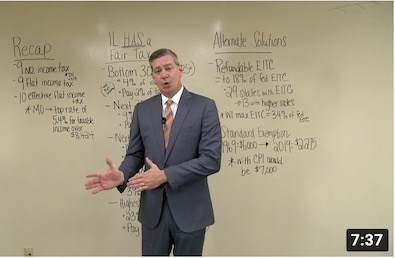
…Adding… As an example, Illinois Chamber CEO Todd Maisch says Illinois already has a fair income tax…
32 Comments  
|
|
Comments Off
|
* WBEZ…
The boys and girls high school basketball seasons are on in Illinois, opening the door for other high contact sports to play this year — as well as potential lawsuits. […]
“IHSA may have their views of it, but school districts know what the rules are,” Pritzker said. “It’s unfortunate, but [school districts] would probably be taking on legal liability if they went ahead and moved beyond what the state had set as the mitigation standard.”
* Nexstar…
[IHSA Executive Director Craig Anderson] was asked about the risk of lawsuits the IHSA might potentially face.
“You know at some point, I think over the next month or whatever time frame we’ll figure out if this is a legal issue for us as an association or if it is for our schools and then we’ll have to pivot as we’ve been pivoting a number of times throughout this school year.”
It’s probably more about the schools. But we’ll see.
* Joliet Herald-News…
“The problem you are going to have is, even if you have parents sign waivers, if a kid gets [COVID-19] and then goes out and gives it to someone else, you have a potential of a lawsuit against the school district,” [Attorney Terry Ekl] said. “The basis of the lawsuit is they ignored the Illinois Department of Public Health and went ahead and allowed these kids to play.” […]
“There’s a proof issue involved here, but that doesn’t mean the school district is not going to get sued and have to engage in costly defensive litigation,” Ekl said. “Sometimes the cost of litigation exceeds the cost proven to be a damage. You win the case, and you still have to pay the cost of defense, which could be tens of thousands of dollars.” […]
“[Insurance carriers] may very well say to the school district, ‘If the department of public health is saying they are recommending you should not play basketball, and you go ahead and do it, we would negate your insurance coverage,’” Ekl said. “‘We’re telling you right now you should not engage in athletic activities that are in conflict with the Illinois Department of Public Health.’”
Ekl said a group of parents approached him last month about suing the IHSA. He said he researched the matter and ended up turning down the case, which was dismissed by a DuPage County judge Oct. 1.
* Les Winkeler at the Southern Illinoisan…
I covered the courthouse beat in a previous life. The lawsuit will read something like this, “Good ol’ Hometown High fielded a basketball team in the midst of a pandemic, disregarding state medical guidelines. As a result of this negligence, athletes suffered illness, resulting in death.”
And, given the strong, consistent pronouncements of state officials, that’s a difficult argument to refute.
What’s more, the Illinois State Board of Education also Tweeted that due to liability issues schools, should think carefully before plunging ahead with the basketball season.
In terms of standing up for student-athletes, I suppose you could interpret the IHSA’s actions that way. Given the fact that athletes could possibly be exposed to infected individuals by competing with students outside their circle, the organization’s response seems less heroic.
…Adding… I meant to post this and somehow forgot. Sorry…
Chicago Public Schools will likely not play basketball this winter. The CPS sent a memo to schools on Thursday announcing that girls and boys high school and elementary school basketball is postponed until further notice and possibly moved to the spring or summer of 2021.
“While the Illinois High School Association has not removed high school basketball from its winter sports calendar, [Gov. J.B. Pritzker] and [the Illinois Department of Public Health] have determined that basketball presents a greater risk of COVID-19 transmission and is not safe to play this winter,” the email from CPS said.
61 Comments
|
* Press release…
Governor Pritzker and the Illinois Department of Public Health (IDPH) are announcing COVID-19 resurgence mitigations will be implemented in Region 6—East-Central Illinois—beginning at 12:01 a.m. on Monday, November 2, 2020. The region has seen a 7-day rolling average test positivity rate of 8 percent or above for three consecutive days, which exceeds the thresholds set for establishing mitigation measures under the state’s Restore Illinois Resurgence Plan. Region 6 includes Iroquois, Ford, Dewitt, Piatt, Champaign, Vermillion, Macon, Moultrie, Douglas, Edgar, Shelby, Coles, Cumberland, Clark, Fayette, Effingham, Jasper, Crawford, Clay, Richland, and Lawrence counties.
The administration continues to provide relief for small businesses impacted by the ongoing pandemic, distributing more than $32 million in emergency grants and assistance to Region 6 alone. Moving forward, businesses in Region 6, as well as other regions currently under additional mitigations, will receive priority consideration for the current round of the historic Business Interruption Grants (BIG) program. To date, through BIG, more than $42 million has been directed to regions currently under mitigations or where mitigations will soon take effect. These programs are guided by an equity framework and seek to address the hardest hit communities with emergency relief dollars.
“As of this morning, Region 6 has now sustained an average positivity rate of 8 percent or higher for three days, today hitting 8.6 percent – meaning that, starting Monday, they will join the majority of the state in operating under resurgence mitigations,” said Governor JB Pritzker. “With community transmission rates on the rise all around our state, it’s more important than ever to take caution, mask up, avoid gatherings and ensure your family gets through this as safe as can be. Let’s remember that the quickest way we get kids back into schools and businesses open and workers employed is to bring down infections, positivity rates, and hospitalizations in our communities – and that means mask up, wash up, back up, and sleeve up to get your flu shot.”
“We are on the precipice of the entire state entering into mitigation,” said IDPH Director Dr. Ngozi Ezike. “These last few regions have seen rapid increases in test positivity, one right after another, because of increasing disease spread throughout our communities. We need all people to adhere to both the community mitigation measures and well as personal and family measures so we can swiftly turn our entire state around.”
Mitigation measures taking effect November 2 in Region 6 include:
Bars
No indoor service
All outside bar service closes at 11:00 p.m.
All bar patrons should be seated at tables outside
No ordering, seating, or congregating at bar (bar stools should be removed)
Tables should be 6 feet apart
No standing or congregating indoors or outdoors while waiting for a table or exiting
No dancing or standing indoors
Reservations required for each party
No seating of multiple parties at one table
Restaurants
No indoor dining or bar service
All outdoor dining closes at 11:00 p.m.
Outside dining tables should be 6 feet apart
No standing or congregating indoors or outdoors while waiting for a table or exiting
Reservations required for each party
No seating of multiple parties at one table
Meetings, Social Events, Gatherings
Limit to lesser of 25 guests or 25 percent of overall room capacity
No party buses
Gaming and Casinos close at 11:00 p.m., are limited to 25 percent capacity, and follow mitigations for bars and restaurants, if applicable
These mitigations do not apply to schools or polling places.
From the onset of the pandemic, support for small businesses has been one of the central features of the Pritzker administration’s COVID-19 response. Since March, the administration has launched a menu of small business and community relief programs – with over $500 million in grants and programs launched by the Illinois Department for Economic Opportunity (DCEO), including emergency hospitality grants, a downstate small business stabilization program, Fast Track Capital, and more. For more information on programs available for businesses and communities, please visit DCEO’s website.
DCEO is also actively processing reimbursements for local governments impacted by COVID-19 via the state’s Local CURES program. Thus far, nearly $5 million has been awarded to governments in Region 6 to help cover the costs of the emergency response, with eligible costs including PPE and other public health expenses. All eligible governments in Region 6 can submit their certification to the department and begin submitting reimbursement requests. For more information on programs available for businesses and communities, please visit DCEO’s website.
Region 6 is currently seeing an 8.6% positivity rate, an increase from 5.2% in mid-September, a summer peak of 6.2% over Labor Day weekend, and a low of 1.1% in late-June. While nearly every region is seeing sustained increases in both positivity and hospitalization rates, today the COVID-related hospital admissions in Region 6 have tripled since mid-September now averaging 18 admissions per day.
In the coming days, IDPH will continue to track the positivity rate in Region 6 to determine if mitigations can be relaxed, if additional mitigations are required, or if current mitigations should remain in place. If the positivity rate averages less than or equal to 6.5% for three consecutive days, then the regions will return to Phase 4 mitigations under the Restore Illinois Plan. If the positivity rate averages between 6.5% and 8%, the new mitigations will remain in place and unchanged. If the positivity rate averages greater than or equal to 8% after 14 days, more stringent mitigations may be applied to further reduce spread of the virus.
Every region is being closely monitored since as of today, including Region 6, a total of ten of the state’s 11 regions have triggered one of the state’s failsafe state-action metric. Regions 3, 4, 5, 7, 8, and 9 will all operate under Tier 1 mitigation measures by the end of this weekend, given that these regions continue to report a 7-day rolling positivity rate above 8%. Regions 10 and 11 are now operating under Tier 1 mitigations after triggering additional mitigations based on sustained increases in both positivity and hospitalization rates. Region 1 is currently operating under Tier 2 mitigation measures after continuing to see a rise in positivity even under the Tier 1 mitigation framework, with the highest rolling positivity average in the state.
As part of the administration’s robust response to the pandemic, the state continues to strengthen its nation-leading testing operation. Today, Illinois reported a record high of 95,111 tests in a single day. The administration is building upon this groundbreaking progress, given that testing remains a critical step to reduce further spread of the virus. For a more targeted approach, the state provides mobile testing allowing testing to be directed toward communities most impacted by COVID-19. In Region 6, mobile testing has been deployed in Richland County today, in Effingham on Sunday, and in Macon at the Decatur Civic Center from today through Sunday. Next week, Region 6 will have a testing site from November 2 through November 8 at the Danville Area Community College. To find the nearest testing center, please visit DPH.Illinois.Gov/Testing.
IDPH will continue to work closely with local health departments in Region 6 to provide education to the public and offer information to businesses and organizations on keeping residents safe. The significance of face coverings, social distancing, and hand washing have been consistently emphasized by the administration throughout the pandemic.
A full list of mitigation measures pertaining to some businesses and industries may be found
*** UPDATE *** The entire state will likely be in mitigation in a few days…
6 Comments
|
* WCIA…
Lab tests from wells near Nicor Gas’ oldest underground natural gas storage facility detected alarming levels of benzene, a chemical known to cause cancer.
In a violation notice issued in December 2019, the Illinois Environmental Protection Agency alleged the state’s largest natural gas company broke the law and threatened the quality of groundwater when it dumped the carcinogenic wastewater into the soil.
Federal safety standards set the limit of benzene at five parts per billion. According to lab tests obtained in a Target 3 investigation, the benzene found in eight Nicor Gas wells exceeded federal safety standards for three consecutive months. One test conducted in February of 2019 detected 26,000 parts of benzene per billion, an astounding 5,200 times higher than legally allowed.
In an emailed statement, the company said it discovered benzene during regular monthly testing and reported it immediately the state’s environmental regulators.
“Nicor Gas and the IEPA have been unable to identify the source of the benzene,” spokeswoman Jennifer Golz wrote on Wednesday. “Benzene is not a chemical that we use in our processes.”
According to the Centers for Disease Control and Prevention, benzene “is a natural part of crude oil, gasoline,” and is a widely produced industrial chemical often associated with underground storage sites.
Gas companies like Nicor, a subsidiary of Southern Company Gas, routinely pipe fracked gas in from out of state before storing it deep underground in naturally occurring aquifers. Industry experts say the chemical liquids used in hydraulic fracturing are often kept secret as proprietary information, but several health studies and news reports have documented widespread use of benzene in fracking fluids
Go read the whole thing. Crazy.
*** UPDATE *** Nicor…
Hello Rich,
I saw your mention of the WCIA article about Nicor Gas, and I wanted to let you and your readers know that this downstate television station did not attempt to factcheck its reporting, nor has made the factual corrections Nicor Gas has requested. Therefore, I am reaching out to you directly to ensure you know that all Nicor Gas storage facilities are safe and in compliance with local, state and federal environmental standards and guidelines.
WCIA is presenting factually inaccurate information about the operation of our storage facilities in a misleading and irresponsible manner that alarms those in our state who rely on Nicor Gas to keep their families safe, homes warm and businesses running.
There are several inaccuracies in the WCIA report including assertions that Nicor Gas “dumped” contaminated water without regard. All produced water was discharged legally in seepage fields permitted by the Illinois Environmental Protection Agency for more than 20 years. The presence of benzene was not identified in any of the company’s routine monitoring and analytical tests until 2018. Nicor Gas was first to detect the benzene, and we immediately reported this to the IEPA and implemented proactive corrective actions to stop benzene discharge, including disposal of the produced water in appropriate and permitted disposal facilities.
It’s important to note, as we have also shared with WCIA, that benzene is not used by Nicor or in natural gas operations. Its presence is not an effect of our work or processes.
The source of the benzene is still unknown. However, as soon as it was identified, Nicor Gas immediately shut in the extraction well where benzene was detected despite the challenges it would present to operations and distributing natural gas to our customers during the winter heating season. These events were happening during the same time as last year’s Polar Vortex. Without the added capacity of our underground storage, more than 700,000 customers would have been without heat during the dangerously cold temperatures.
If you’d like to learn more about how our storage ensures we are able to safely and reliability meet the energy needs of Illinoisans, I encourage you to visit https://www.nicorgas.com/storage.
Thank you for your time and consideration to help set the record straight.
Jennifer
Jennifer Golz
Manager, PR & Media Relations
Corporate Communications
14 Comments
|
* Finke…
Rep. Mike Murphy, R-Springfield, a former restaurant owner, said during a briefing with state health officials Thursday that lawmakers were told private gatherings and universities pose a bigger transmission problem than bars and restaurants. He, too, wants to see the data Pritzker is using to determine the mitigations.
Pritzker has said that information will be made available early next week. He said it’s taken time to compile records from nearly 100 separate local health agencies.
Murphy said if “it proved to be that restaurants and bars were the reason why we cannot control the spread of this, yes I would (support the mitigations). But I haven’t seen that proved, and I’m not sure they have it.”
“There has been no data that says there has been an outbreak linked to bars and restaurants,” Bourne added.
* I told subscribers about this earlier today, but it’s important enough that I think we should go over it here now. This IDPH data is for Region 3 (which includes Springfield) through a couple weeks ago. Expect an update very soon…
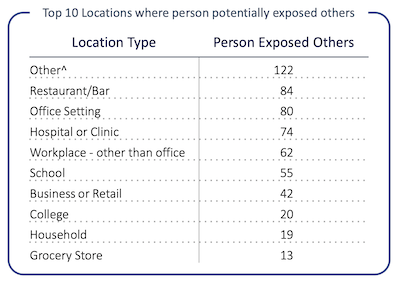
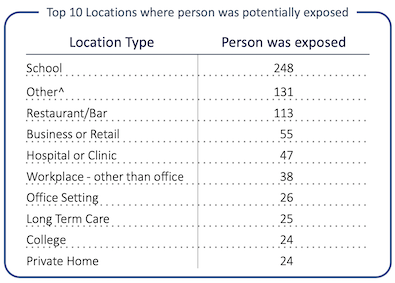
“Other”…
‘Other’ means locations not selected from the 37 standard locations available to the contact tracing workers. These locations include vacation, frat house, library, fire department and a variety of other venues and may include non- responses.
As you may recall, Rep. Tim Butler, who was also at yesterday’s HGOP press conference, said he had no idea how he caught the COVID. He’s therefore an “other.”
* Dr. Ezike yesterday…
There’s exposure data, and then there’s outbreak data. Those are two different pieces of data that are collected.
As the governor explained, the outbreak data will be where all of these individuals in the same space and time were diagnosed as cases and they’re connected to one another clearly. There’s a connection like ‘I was with you. And I developed symptoms, we were in this space,’ and these people were all connected. So that could be at a fraternity party, that could be at a wedding. Those were clearly identified outbreaks.
Most people who end up contracting the infection don’t know exactly who they got it from. They don’t say, ‘Oh, I was with so and so who was positive, that’s where I got it’. If they don’t have any idea of who they got it from, then that’s when you go into the contact tracing, in terms of identifying places that they were in the time that you would have contracted the virus.
And so from that data that you collect from all these people who were just like, ‘Well, I was here, I was there,’ it is consistent that where those people recollect that they were in the time, were bars and restaurants. Obviously, if people were in school, they will say school people who were at work will say work.
So, we already told you we’re not the ones who are going to be closing school, we’re not going to tell people not to go to work. We have to operate in the place that we can operate. And there you have, sitting there, bars and restaurants coming up time after time in the exposure sites that people were before they contracted the virus.
…Adding… IDPH Region 3…
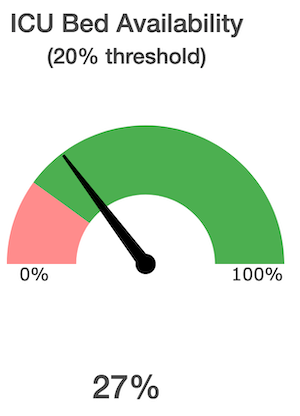
And from Sangamon County…
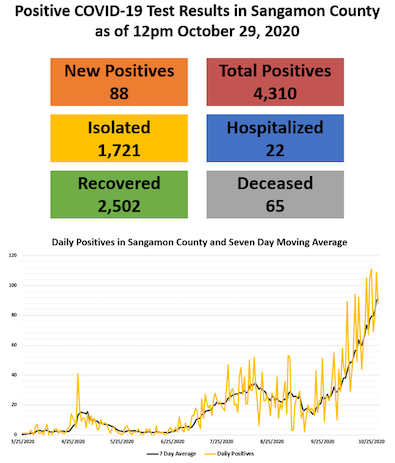
But, yeah. Go hang out in a crowded indoor tavern.
60 Comments
|
* Tribune…
Thirty-seven restaurants and bars in McHenry County filed suit Thursday against Gov. J.B. Pritzker and health officials, trying to prevent enforcement of an order to shut down indoor service, which is meant to prevent the spread of the coronavirus.
A hearing was set in the matter for Friday, one day before the shutdown was scheduled to take place in Lake and McHenry counties. A similar order has been imposed in Cook, DuPage, Kane, Kankakee and Will counties, and other parts of Illinois. […]
He based the legal challenge in part on the state law that gives the governor power to issue executive orders in an emergency, as Pritzker first did in March, but limits that power to 30 days. Some courts previously have upheld the governor’s power to issue consecutive orders to extend that time period indefinitely, but a downstate judge ruled this summer that the governor may not do so, a case that the state is also appealing.
* Pioneer Press…
Five Park Ridge restaurant owners filed a lawsuit this week against Gov. J.B. Pritzker, objecting to the governor’s latest order shutting down indoor dining at bars and restaurants.
The lawsuit, filed in Cook County Circuit Court late Wednesday, claims Pritzker lacks the authority to issue the executive order because the emergency powers he used to issue it expired in April.
Just a ridiculous assertion.
*** UPDATE 1 *** Sam Toia of the Illinois Restaurant Association announced today that his group will develop a standard amicus brief so that it can weigh in on lawsuits as they are filed.
*** UPDATE 2 *** Welp…
A McHenry County judge denied a temporary restraining order Friday filed by 37 local bars and restaurants can remain open despite the governor’s mitigation rules that take effect Saturday.
Attorneys met Friday morning at the McHenry County courthouse in Woodstock, where they argued primarily about Illinois Gov. JB Pritzker’s powers or lackthereof to enforce consecutive 30-day executive orders.
McHenry County Judge Thomas Meyer said that he ruled that way because he felt that the new mitigation orders were based on new facts and were not simply an extension of Pritzker’s original executive order.
*** UPDATE 3 *** The attorney general’s office tells me that judges in DuPage and Cook counties today also denied TRO motions filed by restaurant plaintiffs.
36 Comments
|
|
 Support CapitolFax.com
Visit our advertisers...
  ...............
 ...............
 ...............
 ...............
 ...............
 ...............


|
   
|
Hosted by MCS |
SUBSCRIBE to Capitol Fax |
Advertise Here |
Mobile Version |
Contact Rich Miller
|




