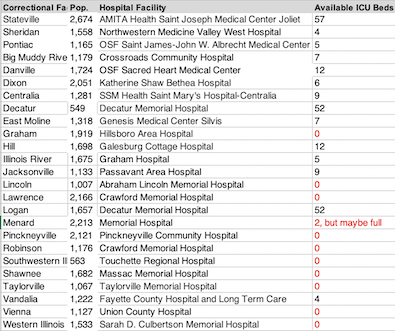
* These numbers come from two graphics on display at the governor’s press conference…
* ICU beds: 1,525 in use and another 1,053 are still available. Of those 1,525 ICU beds in use, 889 are occupied by COVID-19 patients.
* Ventilators: 785 in use and another 1,675 are still available.
Of those 785 ventilators in use, 589 are being used by COVID-19 patients.
* On to extending the stay at home order…
With each step, we have been forced to take by this pandemic has made things more challenging for our residents. The cascading consequences of these steps weigh on me, every minute of every day.
But as I’ve said since the beginning. My priority through each and every one of these decisions has been, and continues to be saving as many people’s lives as possible.
That’s the one goal that I will put above all others, every time, most critically I have let the science guide our decisions. I’ve relied upon the top medical experts scientists, public health researchers epidemiologists mathematicians and modelers from the greatest institutions in the world, like the University of Illinois Northwestern University, University of Chicago, SIU, and others whose guidance on infection rates and potential mortalities and protective measures is frankly second to none.
It is based upon that advice that tomorrow I will be signing an executive order to extend Illinois disaster proclamation our stay at home order and our suspension of on site learning at schools, through the end of the month of April.
If we can end these orders earlier, I’ll be the first one to tell you when we can start to make strides toward normalcy again. But that time is not today.
* Bed and ventilator availability…
As of March 30th, our preliminary reports from hospitals statewide show just 41% of our adult ICU beds are empty staffed and ready for immediate patient use - a two percentage point decrease from the moment in time numbers that I ran you through last week. And 68% of our ventilators are available statewide - a 4% point drop in a week.
That doesn’t mean that every hospital has that availability, but collectively, that’s what we have across the state. […]
From all the modeling that we’ve seen our greatest risk of hitting capacity isn’t right now, but weeks from now. The virus is spreading, it is growing. So are its risks. We must not let up now.
Again, pardon the typos.
* On the pressure to regionalize the response in order to concentrate efforts where the cases are now…
I’ll remind everyone that these interventions don’t work if they’re piecemeal across the state. It was only a few weeks back when we had just a handful of cases, all in one county. That’s up to 5994 across 54 counties. And we know that there are even more people out there who have contracted COVID 19 and already recovered without realizing it, or recovered at home and never qualified for a test. That’s true in all 50 states. And that’s the price that we will continue to pay for the lack of early robust national testing. So we have to stick to the knowledge that we have no community is immune.
* Prisons…
Fortunately DOC is at its smallest population since 1995, and it currently has 36,944 individuals. That’s 1069 fewer prisoners than on February 1 of this year.
* After detailing his actions to date, Pritzker had a warning for hospitals…
I want to say to the local hospitals that are near the prison facilities, we will do all that we can to ensure that any patients receive the best care that we can provide. And we will work with local departments of public health to get you all the equipment and support that we can.
But hospitals that refuse to take on residents of the Department of Corrections will be called out by name, and those that refuse to operate in accordance to their oath can and will be compelled to do so by law.
We are asking everyone during this extraordinarily difficult time to do their part to keep residents, all residents of Illinois safe.
* He also had a message for prison reformers…
We inherited a prison system that has suffered from overcrowding after decades of tough on crime policies, focusing on punishment, without attention to rehabilitation. Democrats and Republicans agree on this and have worked together over the last number of years to make real changes. And while we have prioritized support services for the men and women in our care. We’re still operating in facilities that were not built to support these kinds of efforts.
When we get through this immediate crisis, we all need to have a real conversation about criminal justice reform and the status and conditions of our state prisons. But I’ll be frank with you. We still don’t know exactly when this immediate crisis will pass. And I know this continues to be an extraordinarily difficult time for families across our state, especially for our workers. I have directed my governor’s office staff and agency directors to do everything and anything in our power to help our residents who are hurting.
* He then reached out to students…
Lastly, I want to talk about what this extension means for our students. Well, first and foremost, I want to recognize the creativity of our Illinois State Board of Education and the superintendence in the school districts all across our state for their remarkably able and agile efforts that they’ve demonstrated providing learning opportunities, meals connection and stability throughout this crisis.
Under this extended order schools will transition from Act of God days to remote learning days. All of these days count toward the school year, and absolutely no days need to be made up. […]
Students are going through a situation over which they have no control. Our first response must be empathy.
I want to end with a message for our students who I know, never envisioned a pandemic derailing their spring semester. Believe me as a parent of two teenagers, you’re not the only one.
I won’t try and tell you the texting and calling each other is the same as hanging out in the hallways, or in the lunchroom. And I won’t try and tell you that zoom prom is the same as a real problem. I won’t try and tell you not to be sad about the last goals and plans that you may have had for March and April. It’s okay to be sad. And if you do feel sad or frustrated or angry. Whatever you feel, please let yourself feel that way. Don’t beat yourself up over being human.
And if you’re experiencing overwhelming anxiety or you have a friend who is. And you need someone to talk to. There are resources available to you by phone and online […]
But I also want to say something else. Once you’re ready, take a look around. Take in the incredibly unique moment that you’re living in. Yes it’s scary. And it’s uncertain, and it’s difficult. But if you’re looking for a lesson in the fundamental goodness of people and of your community, it’s right there in front of you. Take a look at the districts across the state that have taken it upon themselves to support our health care workers like Tinley Park High School’s science department, delivering goggles to advocate Health’s Christ Medical Center, or Decatur public schools donating over 200 iPads to promote contactless communication at area hospitals. Maybe those are your teachers and administrators or maybe your school is one of the many that have made donations, even if it’s not, I bet people in your school are finding a way to help be one of those people
* Mayor Lori Lightfoot…
As we just heard from the governor, this virus is lethal and growing. That is why I fully support the governor’s bold and necessary extension of the stay at home order. And this may not be what residents want, but it is what we need. And the city of Chicago stands ready to continue to partner with the state in any way possible as we navigate the challenges that lie ahead.
Just as we heard, to pretend this crisis and is anything less than dangerous, that would not only be irresponsible, but it would be deadly.
* IDPH Director Dr. Ngozi Ezike…
As you know, those who are moderately ill may need medical care. And although those individuals may not require an ICU bed, they may not require intubation and a ventilator. They will still need doctors and nurses and the medical professionals who tend to them, will still need the personal protective equipment to care for those who are moderately ill. We want to make sure that we have enough resources for those who are the sickest. In order to reduce the overall number of people who are exposed and infected with COVID 19.
We see that there’s some hospitals that are reaching capacity of the number of ICU and ventilators, and we want to make sure that everyone who needs an ICU bed everyone who needs a ventilator will get the care they need. And that’s why it’s so important that we flatten the curve. The concern is that our medical resources will be stretched to their limits. And so that’s why staying at home will help us have the healthcare capacity we need. […]
Early data does show that the vast majority of people we think up to 80% will not need any severe critical care.
* Recovered data…
IDPH recently sent a survey to COVID 19 cases and asked about their recovery. It was sent to people who tested positive for at least seven days after their positive test results. Of those that responded, 48% indicated that they had recovered. And as we get more responses we hope to show you that with more time, even more have fully recovered.
* Stay home…
The CDC just recently put out new guidance in the last 24 hours, saying that we should be concerned about people transmitting the virus, even 24, or 48 hours before symptoms [are evident].
So that’s even further evidence that we need to stay home. You can’t eyeball someone and think, you know, if they’re sick or not. Let’s continue to do what we’ve been telling ourselves to do, washing our hands, staying home, covering our cough cleaning frequently touch surfaces. Let’s do it all for ourselves, for our family, and for our community.
* Tim Drea, Illinois AFL-CIO President…
While social distancing is critical, these frontline workers are in desperate need of PPE and access to testing immediately. We joined with Governor Pritzker, Senator Durbin, Senator Duckworth and the Illinois congressional delegation to urge the president to utilize the defense production act to mobilize all of industry to produce the safety items workers desperately need to protect themselves and their families. We further call upon OSHA to issue an emergency temporary standard to protect all workers at potential risk of occupational exposure to infectious diseases, including COVID 19.
On behalf of the nearly 1 million workers of organized labor throughout Illinois. The Illinois AFL CIO will continue to advocate for the health and safety of each and every worker currently engaged in the fight to defeat this virus. All of us depend on all of us depend on them staying healthy and safe, to keep up the fight.
* On to questions for the governor. Why not just say schools will be closed to the end of the year so they can prepare?…
Because we don’t know that this need for a stay at home order will go beyond May 1. And that’s why we haven’t extended the order beyond that. I mean we’re trying to follow the best science. You heard the CDC and the President of the United States suggesting that April 30th was the extension date that they put forward, that, you know, we had been thinking that if we needed to extend and it was looking like we would that we would go to the end of April and so that’s the date we chose.
* Another reporter followed up with when the stay at home order will end…
First of all, we have to see the peak her. We haven’t seen the peak and there’s no perfect model that you can look at. Whether it’s the University of Washington model or for any other, and we’ve got great institutions here in Illinois that have done a lot of modeling, based upon the science and the medical doctors and their estimations. But the truth is that we don’t know when we’re going to peak, we don’t know when we’re going to come off that peak. And so I think we’re looking everybody’s taking their best educated, look at what date seems appropriate and this is the best educated, you know date that they’ve come up with between the experts and those of us who know something about how to manage city and state matters.
* The Illinois Nurses Association says there is a critical shortage of disposable thermometer probes, so they are being told to save them so they can be sanitized with bleach and heat and reused. Have we heard about this, if there is a shortage and what should health care workers do?…
Director Ezike: This pandemic is global and so supplies are scarce throughout the country. If people have items that have that can be reused with certain sanitation mechanisms, we have some guidance that we’ve given for certain equipment on our website in terms of, you know, PPE. And there also are definitely instructions for medical equipment so those should be followed things should be and disinfected with approved approved products, and we definitely want to be able to stretch out our supplies. But we also know that everybody is working hard to obtain additional supplies so that we can have what we need to do the best job we can for all the people that were taken care of, because of course we support our nurses completely.
* Governor, groups have called on you to overturn the ban on rent control is this something that you have the power to do and if not, what is the state doing to aid residents who have lost jobs and will have difficulty paying rent next month and what advice do you have for people in those situations?…
There’s currently in state law a moratorium on rent control so that’s not something that under an executive order that I can overturn. However, as many of you know, we’ve issued Executive orders to ban evictions across the state, to make sure that people are not having their utilities turned off so we have a moratorium on shut offs of any utility that you may be utilizing, and we’ve provided other supports for, you know, for working families and really everybody across the state, to make sure that they’re taken care of and, you know, we’re. We obviously I said yesterday, something very important for people to recognize which is your healthcare workers who are coming home, and anybody who’s experiencing a landlord who’s hassling them about the fact that they may be exposed because their health care worker and interfering with their right to rent in a building needs to come forward because we will go after those landlords,
* Are you considering designating specific nursing homes my understanding is that other states like Massachusetts, Connecticut and others are doing this and then Illinois nursing homes are concerned about mixing COVID residents with non COVID residents…
So the challenge, just to be clear about that is that often there are nursing home residents who can’t be moved, and indeed the best advice by doctors has been, don’t move patients, if you can quarantine them in place. And so we’re trying hard within the nursing homes that exist today to have covered patients in one area of a nursing home many times their wings floors and so on in a nursing home, and we’re trying to separate the, those who are kovat positive those who may have been exposed to somebody with COVID 19, and those who don’t have it. And we’re frankly, those are the divisions that we’re trying to keep around the state and everywhere we can.
* Will you move to expand mail-in ballots or make that the norm for future elections?…
Well I’ve been an advocate for mail-in ballots for a long time. But I do think that we’re going to have to look at it for the general election.
The idea that we may have to move to a significant amount or maybe all mail-in ballots, or at least giving people the opportunity to do that. And so we’re going to look at that, but that is something that the legislature needs to do. And so, you know, we have to find a way to get the legislature together. That’s going to be a decision that gets made by the legislators, along with our public health professionals to determine how you get 177, General Assembly members in the, you know, similar area and vote on things, let alone, you know how they’ll manage through committees.
* Grocery store workers and delivery services you deemed essential have gone on strike. Amazon fired one worker who organized a strike. Do you support their movement and is it appropriate to strike during a pandemic?…
Well I’ve been a lifelong supporter of labor unions. I believe it’s a fundamental right to collectively bargain.
My view is that we are in a very difficult moment there’s no doubt about it. And the conditions you know you heard Mr. Drea talk about the conditions that people are working under and you know making sure that there are standards that are set in these very unusual times. Look, I support workers, and I also have talked to many many businesses, they want to work this out. The workers, the unions and the businesses are talking. And I certainly have tried to wherever I could to create a bridge for them. So I hope and believe that these things will get worked out.
* With a tenfold increase in unemployment claims, does Illinois have enough unemployment savings to pay out all of the applicants. As of 1/20/20, the state has 1.4 billion in unemployment funds…
The answer is no, but fortunately the federal government in the latest stimulus package provided a significant amount of funding for unemployment. We are also allowed in a state to, you know, dip below the reserves that exist. If we need to borrow from the federal government but the federal government has done a great job of providing funding, I believe we’re going to need more, I mean I think I said this at a press conference with Senator Durbin was here.
We’re going to have to see another relief package because not only is there an unemployment problem, which, you know, hopefully it will be only four months or so long but there’s also a challenge to all of our city budgets and state budgets and it goes beyond what was provided in the federal stimulus that was passed just recently
* Do you support the idea of temporary licenses for nursing students to get more help and hospitals? Ohio just approved a similar plan to get thousands of students into hospital…
Yes indeed, we’ve been spending quite a lot of time I’ve got a terrific legal team working together with our IDFPR professionals to look at giving temporary licenses to people who are mostly trained, who are nearly graduated. We have nursing students who are a month away or two months away from graduation, they’re capable of being healthcare professionals, even now we need them in the healthcare field. Same thing with medical students and others.
-30-