|
Chicago property taxes set to rise
Tuesday, Jun 13, 2017 - Posted by Rich Miller * Greg Hinz…
The average city increase will be about $360. * ILGOP…
…Adding… As a commenter notes, Gov. Rauner signed the bill that allowed Chicago to raise these taxes. Click here. * Chris Kaergard…
Yes, you could.
|


|
*** UPDATED x1 - He didn’t totally dodge *** Once again, Chris Kennedy dodges a marijuana question
Tuesday, Jun 13, 2017 - Posted by Rich Miller *** UPDATE *** I just totally unloaded on the person who sent me the original video because I specifically asked if there was anything else about the topic on the clip and was told in no uncertain terms that what I had been given was all that Kennedy said. Turns out, that wasn’t the case. Here’s the end of Kennedy’s answer… * Transcript…
So, he’s getting closer to actually coming right out and saying he’s OK with legalization, but he’s not quite there yet. More importantly, my apologies to the Kennedy campaign. * Tracker footage from last night’s Democratic Women of Kendall County event… * Transcript…
Lots of words. And, may I ask, who are these people who say we should abandon the hard work of balancing a budget and “pay for everything by legalizing marijuana”? It’s a red herring. * Related…
|
|
*** LIVE COVERAGE *** State worker pay appellate argument
Tuesday, Jun 13, 2017 - Posted by Rich Miller * Brian Mackey is in Mt. Vernon today to watch the appellate hearing on the lower court’s ruling to pay state employees without an appropriation. Background on the case is here. Justices Richard P. Goldenhersh, Melissa A. Chapman, and Judy Cates are hearing the oral arguments. Deputy Solicitor General Brett Legner is arguing for the attorney general, who wants the payments stopped. On the other side of the case are Steve Yokich for AFSCME and Kenton Skarin for the Rauner administration… …Adding… Brian is also covering another lawsuit over the comptroller’s office. So, we’ll leave this on.
|
|
*** UPDATED x1 *** Apparently, I have to say this again: Stop it, governor
Tuesday, Jun 13, 2017 - Posted by Rich Miller * Let’s revisit my newspaper column…
* OK, now let’s take a look at these three issues one at a time. First, here’s the Chicago Tribune editorial board on the education funding reform bill that has passed both chambers…
Not exactly the neutral third-party validation I was hoping for last week, but it’ll do for now. * OK, on to the 911 emergency call center legislation. Here’s Rep. Chad Hays’ (R-Catlin) take…
And if it’s a “bailout,” it’s a self-imposed one because the Chicago City Council has to approve that new fee before it can be implemented. * And here’s the Sun-Times editorial board on the Thompson Center sale…
As I’ve also argued, this had nothing to do with a “bailout” and everything to do about control. * Back to my newspaper column…
If the governor was accurately describing the above legislation as “Chicago bailouts,” I’d let it go. But he’s obviously not, so somebody needs to point out that he’s using politically expedient dog whistle language. And, please, don’t tell me this isn’t racially and geographically divisive rhetoric. I grew up in a rural Downstate area. I also covered Pate Philip’s tenure for many years. This ain’t rocket science. It’s old style politics at its worst and was used to fire up the rubes since long before I was born. * And it’s not new to Rauner, either. From a column I wrote almost exactly one year ago today…
* From Ameya Pawar’s appearance on Rick Pearson’s “Sunday Spin” show…
What a lame push-back. Look, Rauner has accomplished some things on criminal justice reform (including signing the bail reform bill last week) that no racist would ever do. He’s for automatic voter registration, for crying out loud. I think that Rauner is simply a very accomplished political opportunist who claims he’s for “the people” while employing all sorts of tactics to win the media cycle, including tactics used by racists and those who would divide this state for their own personal political gains. But it does need to stop. No political gain justifies this crud. *** UPDATE *** Pawar is now coming right out and saying it…
|
|
*** UPDATED x1 - Berrios responds *** Kennedy says Cook property tax system “a de facto violation of the Civil Rights Act”
Tuesday, Jun 13, 2017 - Posted by Rich Miller * Kass…
* But Greg Hinz also makes a good point…
Here’s that map. Dark red means the properties were overvalued by at least 10 percent, light red is overvalued by less than 10 percent… 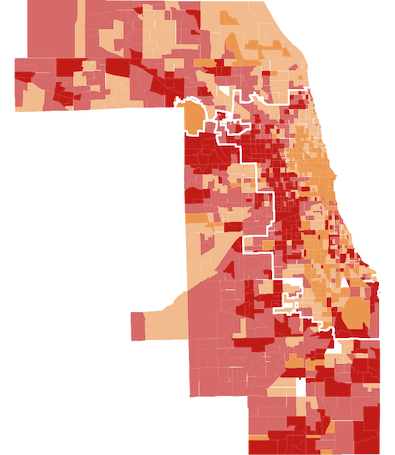 The full Kennedy interview is here. That’s quite a play-in Kass has. *** UPDATE *** From Assessor Joe Berrios…
* And check this out… 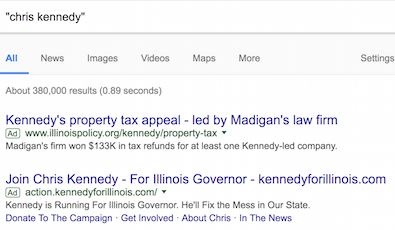 Setting aside the fact that the “institute” claims to be non-partisan, Kennedy needs a better online ad strategy than this. * And while we’re on the subject, Jacobin Magazine has a long, left-perspective oppo dump on the candidate. Click here. * Related…
|
|
*** UPDATED x2 *** Rauner’s worst headline ever
Tuesday, Jun 13, 2017 - Posted by Rich Miller * This says so much about what we’ve been through the past 2+ years…
* From the story…
Except the governor has said he could support that $215 million in exchange for pension reforms. * Tribune…
*** UPDATE 1 *** Pritzker campaign…
*** UPDATE 2 *** Biss campaign…
|
|
*** UPDATED x1 - Huge pass-through to House Republicans *** Rauner contributes $1.5 million to the ILGOP
Tuesday, Jun 13, 2017 - Posted by Rich Miller [Bumped up to Tuesday for visibility.] * The A-1 is here. The governor’s contribution history to the party is here. The state party can now afford to design lots more infographics, etc. …Adding… These folks are some of the best trolls around…
*** UPDATE *** ”Member management” ahead of the massive June legislative battles…
For the newbies, HRO = House Republican Organization.
|
| « NEWER POSTS | PREVIOUS POSTS » |