“Over the last few years, my office has become accustomed to facing a barrage of challenges to newly-enacted state statutes and executive orders. The Protect Illinois Communities Act is an important tool in our fight to protect Illinois residents from gun violence, and as with past matters, we recognize that the act’s constitutionality will ultimately be decided by a higher court. We are reviewing the circuit court’s decision and continue to review the 5th District’s decision. We will seek the Illinois Supreme Court’s review of challenges to the Protect Illinois Communities Act, and we will ask the court for an expedited schedule.”
* From End Citizens United…
Hi Rich,
Hope you’re doing well. Reaching out from End Citizens United. Saw your coverage of the letter we sent to Rep. Mary Miller calling on her to donate the money she received from George Santos. Wanted to flag for you that it appears Rep. Miller showed no sign of disbursing her Santos money in the most recent FEC filings she submitted this week.
All the best,
Arik Wolk
* Press release…
The Justice Department announced today that the village of Hinsdale, Illinois, has agreed to pay $800,000 to settle a lawsuit alleging that the village violated the Fair Housing Act when it refused to allow the operation of a sober living home for persons in recovery from drug and alcohol addiction in a residential neighborhood.
The settlement, which still must be approved by the U.S. District Court for the Northern District of Illinois, resolves a lawsuit that the Department filed in November 2020. This settlement also resolves a related suit brought by the sober living home’s owner and operator, Trinity Sober Living LLC.
“Individuals with disabilities – including those recovering from drug and alcohol addiction – should not be excluded from living in residential neighborhoods,” said John R. Lausch Jr., United States Attorney for the Northern District of Illinois. “Such discrimination by local governments is forbidden under the Fair Housing Act.”
“Local governments do not have the right to use zoning laws and restrictions as a vehicle to discriminate against people with disabilities,” said Assistant Attorney General Kristen Clarke of the Justice Department’s Civil Rights Division. “The Department of Justice is committed to vigorous enforcement of federal law to ensure that individuals in recovery have access to the housing and support they need to maintain their sobriety and lead productive lives.”
The Department’s lawsuit alleged that the village of Hinsdale violated the Fair Housing Act after it denied a reasonable accommodation request by Trinity Sober Living LLC to operate a sober living home with ten residents and a house manager in a residential neighborhood. The complaint alleged that, one day after Trinity requested an accommodation, the village sued Trinity in state court for violations of the zoning code, including that the home was a “commercial use” and would have more than three unrelated adults.
Under the settlement, the village will amend its zoning ordinance to comply with federal anti-discrimination laws, including permitting homes for persons with disabilities in residential districts, with the same size limitations applied to families of similar size, and implementing a reasonable accommodation policy. The village will also pay $790,000 in monetary damages to Trinity as well as a civil penalty of $10,000 to the United States. The village also agreed to take a number of other actions to guard against housing discrimination, including training village officials and employees about their obligations under federal law, designating a fair housing compliance officer and reporting periodically to the Justice Department.
Neighbors of the city’s new abortion clinic at 611 Auburn St. have filed a lawsuit in Winnebago County Court claiming the clinic is improperly zoned and that the clinic’s operation is negatively impacting the neighborhood. […]
The suit says the Rockford Zoning Board of Appeals “abdicated their solemn duty to enforce the City of Rockford Zoning Ordinance” by allowing a medical clinic to operate as a home business and allowing the clinic’s operator to live elsewhere.
The lawsuit also claims that the controversial nature of the business has caused disruption to the neighborhood, attracting protesters, traffic and noise.
• Opening schools well into the evening, weekend and holidays to provide academic support, recreational activities and community-based services
• Creating paid High School Work Study programs in place of non-essential electives to build the competence, confidence and life skills
• Expanding the Alternative Schools network and opening Adult High Schools to reclaim the thousands of students who left during the pandemic.
• Empowering and trusting local communities through elected Local School Councils and redirecting funds there instead of the Central Administration
• Systematically identifying at-risk students and providing early intervention and support
• Expanding quality school options by converting failing or under-enrolled schools into magnet schools or other models directed by the local community
* Update on recent story…
Christian Mitchell, Illinois deputy governor, has been named the next vice president for civic engagement. In his new role, Mitchell will work to foster deep partnerships across the University and South Side communities. https://t.co/sDSXSIuWAE
* WCCU | Police recruits now required to take wrongful conviction course: Schlosser added the course in 2016 to the roster of available trainings for new police recruits in the Champaign facility. This year, the Illinois Law Enforcement Training and Standards Board embraced the concept and made the course mandatory as part of the training for all news police recruits in the state.
* WBEZ | A Woodlawn migrant shelter sparks anger — and reflection — among Black and Latino residents: Asylum seekers are expected to move into the temporary Wadsworth shelter on 64th and University Thursday. And it’s turned into a heated conversation about resources, city transparency and Black-Latino relations in Chicago. Woodlawn resident Benji Hart said the shelter controversy shows how anti-Black and anti-immigrant racism reinforce one another.
* WICA | IL DCFS offering college scholarships to current, former youth: A minimum of 53 academic scholarships will be awarded to current and former youth in care for the upcoming school year. Scholarship recipients will receive up to five consecutive years of tuition and academic fee waivers to use at participating Illinois state community colleges and public universities, a monthly grant of $1,506 and a medical card.
* WTTW | Englewood Rail Yard Expansion Back on Track With Ald. Taylor’s Support: A 15-year effort by the Norfolk Southern Railway to double the size of its storage yard in Englewood finally got the green light from the Chicago City Council on Wednesday, after Ald. Jeanette Taylor (20th Ward) dropped her opposition to a measure long sought by the railroad.
* Center Square | As rural areas lose population, some suggest ways to attract residents: Winchester said small communities in a region should come together and coordinate economic and community development plans to attract and retain residents to their region. The survey showed the top three reasons respondents would move to a rural area are to take advantage of a slower pace of life, to live closer to relatives and to find a less congested place to live.
* Tribune | Tom Girardi, disgraced former lawyer, indicted on fraud charges in Chicago: The charges are the latest legal blow to a once-powerful player who rubbed elbows with politicians and celebrities. As one of the nation’s most prominent plaintiff’s attorneys, Girardi was known for high-profile litigation such as the case that led to a $333 million settlement portrayed in the movie “Erin Brockovich.”
* Tribune | 50th Ward race: Offensive tweets, including about Israel, threaten challenger’s efforts: Mueze Bawany, 35, who’s backed by the Chicago Teachers Union and the local chapter for the Democratic Socialists of America in his bid to upset three-term incumbent Ald. Debra Silverstein in the 50th Ward, made the statements on Twitter three years ago on an account he subsequently deleted. The Tribune received copies of the deleted tweets and Bawany confirmed he wrote them.
* AP | Average long-term mortgage rate falls a fourth straight week: Mortgage buyer Freddie Mac reported Thursday that the average on the benchmark 30-year rate fell to 6.09% from 6.13% last week. That’s the lowest level since September. The average rate a year ago was 3.55%.
* Chalkbeat | How to grade schools post-pandemic? States must decide: This debate — in essence, whether to ease up on academic expectations or double down — is flaring up across the country as school accountability systems creak back to life after a pandemic pause. Mandated by federal and state laws, the systems set goals for schools, rate their performance, and direct support to schools identified as struggling. But the pandemic has complicated every step of that process.
* Fortune | Once the ‘intellectual blood banks’ of the rich and powerful, can speechwriters be replaced with ChatGPT?: Speechwriter or not: Any good communicator understands that good writing demands good thinking. And everything that’s worth reading has evolved from an unformed interstellar cloud that was in the writer’s mind into something else altogether. I’ve sat down to write a poem and written an essay. I’ve sat down to articulate one opinion and wound up expressing its opposite. “I don’t know what I think until I write it down,” Joan Didion said. Many other writers have expressed a similar sentiment.
* FiveThirtEight | How Our 2022 Midterm Forecasts Performed: While some polling firms badly missed the mark, in the aggregate the polls had one of their most accurate cycles in recent history. As a result, FiveThirtyEight’s forecasts had a pretty good year, too. Media proclamations of a “red wave” occurred largely despite polls that showed a close race for the U.S. Senate and a close generic congressional ballot. It was the pundits who made the red wave narrative, not the data.
* Block Club | New York City Gets Its Own — Tinier — Version Of The Bean: A bite-sized version of The Bean was unveiled this week under a corner of Jenga Tower, 56 Leonard St., in New York’s Tribeca neighborhood. It was four years in the making. The baby Bean was also created by artist Anish Kapoor, the same sculpture artist behind Chicago’s Cloud Gate, which is more commonly known as the Bean. Kapoor has also snagged an apartment in Jenga Tower, according to Curbed.
* Tribune | Why can’t the Chicago Sky attract — and then keep — top talent?: Candace Parker, Courtney Vandersloot and Azurá Stevens have all now chosen to take their talents elsewhere. Parker will be joining the defending champions Las Vegas Aces. Vandersloot hasn’t announced her new team, but did say her goodbye and thank you to the Sky and their fans in an Instagram post. Stevens, who saw her minutes decline in favor of Emma Meesseman, is reportedly signing with the Los Angeles Sparks. And Allie Quigley, a hometown basketball legend, has decided to take the year off from basketball entirely.
* Daily Herald | Introducing a new and improved way to engage with our content: As our new commenting tool rolls out, you can expect more lively, yet civil discussions and better ways to interact with fellow commenters. You will have the ability to upload content, like, reply, follow or share right in the comments.
* SJ-R | ‘View comments’ button removed from online articles: While we continue to believe in the importance of comments, we had to make the hard choice to move away from the space due to changes in staffing and the time investment necessary to bring you a safe, moderated and productive discussion space. We’re not willing to risk discussions veering off track or people being verbally attacked. With this change, we’ll continue to focus on exclusive, local reporting and finding new and exciting ways to tell your stories.
* Bloomberg | The Race to Waterproof Your Outdoor Gear — Without Toxic Chemicals: But really: How much of the volume of corporate communication is a sincere attempt to communicate strategies, build culture and create a human connection between an organization’s leaders and its stakeholders? And how much of it is just filling the vacuum with corporate noise, in what Maggioncalda describes as, “a friendly, upbeat, authoritative tone with mixed cadence?” I’ve wondered that for a long time. And it looks like we’re all about to find out.
* Sun-Times | After 30 years, ‘Groundhog Day’ holds up, and you can say that again: Yet of all the painful, unimaginable, horrific experiences Phil endures time and again in Harold Ramis’ classic “Groundhog Day,” was there anything more brutal than having to drink a sweet vermouth on the rocks with a twist, over and over and over?
* Fox Sports | Iowa sniffs out Illinois student prank ahead of Saturday’s game: The Illinois student spirit group “Orange Krush” had its order for 200 tickets to the men’s basketball game at Carver-Hawkeye Arena on Saturday canceled Wednesday after Iowa discovered the person who made the purchase falsely claimed the tickets were for a Boys and Girls Club in Champaign.
Announcer: It’s happening across the country. Republicans pushing to ban all abortions. Here in Chicago, we have to protect our rights. But Paul Vallas won’t. Because Vallas is a Republican.
Vallas: I’m more of a Republican than a Democrat. Fundamentally, I oppose abortion.
Announcer: Chicago deserves someone they can count on. Chuy Garcia will keep fighting to expand access to reproductive health care because women’s rights should be protected, not taken away. We can trust Chuy Garcia to protect our rights.
In 2020, local governments across the United States collected just under $9 billion in fines and fees. Local governments in three states—New York ($1.4 billion), California ($1.26 billion), and Texas ($1.17 billion)—collected well over a third of the $9 billion in fines and fees in 2020.
Local governments in New York, California, Texas, Illinois, Florida, Georgia, Ohio, New Jersey, Washington, and Pennsylvania collected the most fines and fees in 2020. In all, 20 states saw their local governments bring in more than $100 million in fines and fees in 2020.
On a per capita basis, local governments in New York, Illinois, Texas, and Georgia collected more than $35 per resident in fines and fees in 2020. In contrast, local governments in New Hampshire, Connecticut, Maine, Nebraska, and Kentucky collected less than $3 in fines and fees revenue per resident in 2020. […]
At least 482 local governments derived 10% or more of their general revenue from fines and fees in 2017.
Illinois ranked second at $50 per capita. Locals imposed $641.6 million in fines and fees overall.
Sangamon County derived 15.8 percent of its revenue from fines and and forfeits in 2020, according to the study. That’s $14 million, or $70 per capita. Menard County was the worst offender, at 30 percent of revenues and $422 per capita.
Ten Illinois counties received at least ten percent of their revenue from fines and fees in 2020: Ogle, Mercer, Ford, Fulton, DeWitt, Menard, Sangamon, Cumberland, Richland and Massac.
Grundy was one of 15 counties which received at least 5 percent of revenues from that source ($1.9 million at $37 per capita).
* And a ton of suburban and exurban towns also received at least 5 percent of their revenues from fines and fees…
Develop standardized tools to determine the ability to pay and scale fines accordingly
Determination of a defendant’s ability to pay fines should not be left solely to the subjective assessment of an individual judge. This can result in wildly different outcomes for otherwise comparable defendants. Establishing standard practices would ensure that individuals are treated equally under the law. Scaling fines according to an individual’s ability to pay would also reduce the administrative costs associated with pursuing uncollectable debts.
Affidavits, bench cards, or ability-to-pay calculators may be used to standardize ability-to-pay determinations. Income-based fines, or day fines, could also be used to scale penalties according to an individual’s financial status. There is room for experimentation among the states in this area. Still, state law should clarify the factors that are considered when determining an individual’s ability to pay. Defendants should be made aware of these factors and what documentation they will be expected to provide.
Provide alternatives to monetary sanctions
Indigent defendants should be able to receive alternatives to monetary sanctions. Community service is one possible alternative to fines but it may prove overly burdensome for some. For example, community service may conflict with work schedules or family obligations. Such conflicts should be avoided, as maintaining employment and social ties are critical to reducing the risk of recidivism. Courts should be able to consider a range of alternatives, including waivers, job training, and drug or mental health treatment. Incarceration should never be considered an alternative to monetary sanctions, and fees should never be charged for alternatives to monetary sanctions.
Discuss.
…Adding… From comments…
As soon as the secret was out that duplicating state laws as local ordinances was something that could be done by municipalities to increase the percentage of fines they would keep from writing tickets, all bets were off with this.
Almost nobody looks at their ticket to see if it was written under a state law violation, or an identical local ordinance violation. More people should though. An example would be a ticket for not wearing a seat belt. When that state law is duplicated into a local ordinance, the tickets written locally are then written under the ordinance instead of the state law. That allows the locality to keep almost all of the fines, instead of those fines being paid to the state.
I don’t see that mentioned anywhere in the analysis.
The incentive to generate revenue through fines would go away quickly if that revenue from writing tickets was being primarily being generated for the state instead of the locality.
But I won’t be holding my breath any municipality will willingly change this practice, without legislation forcing them to.
Following an Illinois appellate court’s decision that a one-year limitations period applies to certain sections of the [Illinois Biometric Information Privacy Act] while a five-year period applies to other sections, the sole issue on appeal for the Supreme Court is to identify the proper statute of limitations for claims under the BIPA. […]
This case originated in March 2019, when plaintiffs Jerome Tims and Isaac Watson filed a class action lawsuit against their employer, logistics company Black Horse Carriers, Inc. Plaintiffs alleged that the company unlawfully collected, possessed, and disclosed their fingerprints in violation of BIPA when the employees clocked in and out of work using a finger scanning timeclock. The company moved to dismiss the plaintiffs’ claims as untimely, arguing that, because the BIPA does not contain its own statute of limitations, the court should apply the one-year limitations period for privacy actions set forth in § 5/13-201. The plaintiffs countered that the five-year “catch-all” limitations period contained in § 5/13-205 was more appropriate for actions under the BIPA.
In a somewhat unique ruling on interlocutory appeal, the Illinois First District Appellate Court effectively “split the baby” by holding that both the one-year and five-year limitations periods applied to different sections of the Act. Specifically, the Appellate Court reasoned that the one-year period from § 201 applies to BIPA Sections 15(c) and 15(d) because these sections involve “publication” of biometric data, which is a term explicitly used in § 201. Conversely, since the Appellate Court found that Sections 15(a), (b), and (e) of the BIPA do not involve publication of an individual’s biometric data, it applied the five-year limitations period from § 205 to these sections. The defendant subsequently appealed this decision to the Illinois Supreme Court. […]
Given the flood of BIPA class action lawsuits filed against Illinois businesses after the Illinois Supreme Court’s decision in Rosenbach v. Six Flags Ent. Corp., 129 N.E.3d 1197 (Ill. 2019), employers should pay special attention to the decision in Tims. The Illinois Supreme Court Justices did not suggest that they would rule in a certain way during oral arguments, but one takeaway was evident: the Supreme Court may not uphold the Appellate Court’s decision in its entirety. Nevertheless, while a decision in Black Horse’s favor would not fully curtail this recent wave of BIPA filings, it would certainly help limit the number of plaintiffs eligible to sue under the BIPA, as well as the potential amount of damages owed to these plaintiffs. [Emphasis added]
(W)e find that, because the Act does not have its own limitations period; because the subsections are causes of action “not otherwise provided for”; and because we must ensure certainty, predictability, and uniformity as to when the limitations period expires in each subsection, the Act is subject to the default five-year limitations period found in section 13-205 of the Code. […]
In light of the extensive consideration the General Assembly gave to the fears of and risks to the public surrounding the disclosure of highly sensitive biometric information, it would thwart legislative intent to (1) shorten the amount of time an aggrieved party would have to seek redress for a private entity’s noncompliance with the Act and (2) shorten the amount of time a private entity would be held liable for noncompliance with the Act. […]
(T)he full ramifications of the harms associated with biometric technology is unknown, and absent the Act’s protections, it is unclear when or if an individual would discover evidence of the disclosure of his or her biometrics in violation of the Act. Moreover, a shorter limitations period would prejudice those whom the Act is intended to protect. Therefore, we find that a longer limitations period would comport with the public welfare and safety aims of the General Assembly by allowing an aggrieved party sufficient time to discover the violation and take action.
For the aforementioned reasons, we find that the five-year limitations period contained in section 13-205 of the Code controls claims under the Act. Therefore, we affirm in part and reverse in part the judgment of the appellate court and remand the cause to the circuit court for further proceedings.
…Adding… ATRA…
The American Tort Reform Association (ATRA) is disappointed in today’s decision out of the Illinois Supreme Court to expand the statute of limitations to five years for Biometric Information Privacy Act (BIPA) claims, reversing an intermediate appellate court that put a one-year limit on claims.
This decision will have far-reaching consequences for businesses in Illinois and across the country, and will only exacerbate Cook County’s status as a “Judicial Hellhole®.”
“This decision is a setback for any businesses that operate in Illinois,” ATRA President Tiger Joyce said. “Expanding the statute of limitations for BIPA claims will only encourage more lawsuits and create an environment of legal uncertainty for businesses which will be exposed to an undue risk of litigation for an extended period of time.”
Trial lawyers have cashed in on the existing ambiguity in BIPA by targeting businesses that use this technology. They’ll often find a business that didn’t follow a small, technical portion of the law, then use that as a basis for a class action lawsuit, even though their clients didn’t suffer any harm or injury.
The large monetary penalties associated with BIPA have led to a surge in lawsuit filings under BIPA in recent years, and the expansion of the statute of limitations will only add fuel to the fire.
The climate for lawsuit abuse in Illinois is already bad, as demonstrated by the $228 million verdict delivered in the first-ever BIPA case that went to trial last year. The case was originally filed in Cook County and ended with a federal jury delivering the massive verdict, even though the plaintiffs didn’t claim any actual injury.
“The decision by the Illinois Supreme Court to expand the statute of limitations for BIPA claims will only increase the number of frivolous lawsuits and make it even harder for businesses to defend themselves,” Joyce said. “It’s time for the state to rein in these excessive penalties and put a stop to the endless cycle of lawsuit abuse that is driving up costs for consumers and businesses alike.”
In the recent annual report from the American Tort Reform Foundation, Cook County, Illinois was named the fifth-worst “Judicial Hellhole®” in the nation. The report cites the prevalence of no-injury lawsuits filed under BIPA.
Every morning before sending her two kids off to second and third grade, Sadiya Zackria checks the school’s breakfast and lunch menu to see whether she’ll have to send along a brown bag. […]
According to the Halal Food Standards Alliance of America, zabiha refers to meat that comes from an animal that was hand-slaughtered instead of machine-cut in a way that aims to ensure the animal does not suffer and is treated humanely. Also, the Muslim individual who cuts the meat must recite tasmiya, or the name of God, when doing so. Halal is an Arabic word that means “permissible” and refers to foods and other things that are allowed in Islam. […]
But a new Illinois bill, slated to be voted on in the spring legislative session, would be a game changer for students and parents, and any individual who requires food from a state-operated facility, said Maaria Mozaffar, director of advocacy and policy at the Illinois Muslim Civic Coalition.
If passed, the Faith By Plate Act would ensure that any state-owned or state-operated facilities such as hospitals, schools and prisons that provide food services or cafeteria services also offer zabiha-halal and kosher food options upon request when provided with notice. […]
The bill was co-sponsored by State Rep. Janet Yang Rohr, who said that a piece of legislation that was passed last year — the plant-based lunch bill that will go into effect in August — gave them a few pointers.
* Brenden Moore picked out a baker’s dozen of new bills to glance at. Here are some…
* Senate Bill 43, introduced by state Sen. Sara Feigenholtz, D-Chicago, would remove the 2024 sunset date on the state law permitting bars and restaurants to sell to-go cocktails. Lawmakers approved the measure on a temporary basis in 2020 as a means of helping the state’s hospitality industry survive the COVID-19 pandemic. The law, initially in effect for one year, was extended for another three years in 2021. […]
* Senate Bill 95, introduced by state Sen. Laura Murphy, D-Park Ridge, would prohibit a legislator from engaging in paid lobbying of a municipality, county, township or the executive branch of state government.
* Senate Bill 100, introduced by state Sen. Laura Fine, D-Evanston, states that starting in 2025, a retail establishment may not use a disposable food service container that is composed of polystyrene foam. […]
* House Bill 1110, introduced by state Rep. Kam Buckner, D-Chicago, would give people the option to carry a digital driver’s license. A person would not be issued a citation for driving without a physical driver’s license if they present a digitized driver’s license. Secretary of State Alexi Giannoulias has also expressed support for the concept.
* The time may have finally come for another bill on that list: HB1113…
Amends the Illinois Vehicle Code. Provides that, beginning with the next registration year after the effective date, the Secretary of State shall issue one registration plate (instead of 2) for newly registered motor vehicles and the registration plate shall be attached to the rear (instead of front and rear) of the motor vehicle.
Secretary of State Jesse always resisted efforts to make this change. The Tollway has also expressed concern because of their plate reading technology, but Florida has rear-only plates and they have a large toll system.
The Illinois Freedom Caucus today is issuing the following statement on the adoption (largely along partisan lines) of the new House Rules that will determine how the Illinois House of Representatives will be governed in the 103rd General Assembly.
“Illinois Freedom Caucus member Adam Niemerg negotiated some rule changes to no longer allow votes to be cast via Zoom. Committees will be able to operate via Zoom if technology allows, but floor votes will have to be made in person, which is something the Freedom Caucus has been pushing for a long time.
Niemerg also negotiated the end of the consent calendar that allowed large number of bills to be voted on with one roll call. Consent Calendar bills often included ceremonial legislation such as measures to change the name of roads to honor members of the community, but the list also included substantive legislation. Substantive bills deserve individual roll calls so that members are completely aware of the full implication of their votes, and thanks to Freedom Caucus member Adam Niemerg we secured an important victory for the people of Illinois.
But unfortunately, the House rules as a whole give the majority party total control of the process. There is nothing in the rules to drop major pieces of legislation at the last minute without giving individual members adequate time to review what is in the legislation being considered. The new rules also give the House leadership and Committee chairs total power over what bills are voted on in House Committees. The rules essentially are the same rules that former disgraced House Speaker Michael Madigan used to exercise complete control of the process. While there are elements in the rules we can support, given the lack of transparency and lack of accountability built into these rules, we voted against them. The people we represent have a right to have their voice and their concerns heard. Under these rules, their voice is being silenced.”
* Here’s some of what Rep. Niemerg said during debate yesterday…
A lot of this is just going back to business as usual. I mean, there were 19 of you who stood against Mike Madigan and called for change. I expect 19 of you to vote ‘No’ on this because this goes back to the same Madigan-era politics. Our bills will be stuck in Rules, the’ll never see the light of day. We’re going to be passing bills again at 2, 3, 4, 5 in the morning. You’re going to move to motion for the previous question when a bill comes over from the Senate and it’s dropping 11:55, kill off debate from our side of the aisle, deprive so many thousands of folks in the state of Illinois of their right to have us represent them. So honestly, I don’t believe that you tell me that you believe in government transparency. I just don’t believe it. And to the bill, folks, we call for change in this legislature all so often. We call for bipartisanship, right? And Representative, Leader Keicher and Leader Davidsmeyer and I, we proposed an idea for rules. We propose changes. But we look at the rules now, folks are still going to be asleep, sound asleep at their homes are going to have the radical bills they’re going to be pushed through the important bills. are going to be pushed through. They’re not going to know anything about it and it’s business as usual. So if we want change, I think the 19 folks over there who wanted change and wanted Mike Madigan gone, vote ‘No.’ Thank you.
* Rep. Bob Morgan (D-Deerfield) rose later in response. Excerpt…
I also want to thank members of both sides of the aisle that made comments that I think reflect good ideas and ways in which we can always make this chamber operate better. I think a number of colleagues on the other side of the aisle appropriately referenced, the proof is in the pudding. It’s about how committee chairs and how Speaker and how the Rules Committee and how we treat each other and how we demand greater respect from one another. So, I think the implementation of these rules are just as important as the the plain language of the rules. Specifically I want to point out now as we are in the endemic times, endemic. COVID-19 is leaving us and we’re returning to normal. It’s important that this chamber also returns to normal. So I think it’s very important that we go back to in-person voting. I think we all know the the unintended consequences of having remote voting, so I strongly support that.
And lastly, to those who want to reference the 19: As a member of the 19, I would encourage everyone to know that we’ve never been shy about speaking up when we feel strongly about an issue. We haven’t in the past, we will not in the future. So anybody who wants to invoke the 19, I would encourage you to keep our names out of your mouth. Because when we have something to say you’re going to know about it. I urge a ‘Yes’ vote.
The sweet smell of green chile roasting on an open flame permeates New Mexico every fall, wafting from roadside stands and grocery store parking lots and inducing mouth-watering visions of culinary wonders.
Now one state lawmaker says it’s time for everyone to wake up and smell the chile.
Senator Bill Soules’ visit with fifth grade students in his southern district sparked a conversation about the savory hot peppers and the potential for New Mexico to become the first state in the nation to proudly have an official state aroma, a proposal now being considered by lawmakers.
“It’s very unique to our state,” the Las Cruces Democrat said of roasting chile. “I have tried to think of any other state that has a smell or aroma that is that distinctive statewide, and I can’t think of any.”
For New Mexico, chile is more than a key ingredient for every meal. It’s life. It’s at the center of the official state question – “red or green?” – and is one of the state’s official vegetables.
I hesitate to do this, but…
* The Question: Your Illinois nomination(s) for official state aroma? Make sure to explain yourself. Also, keep it clean, people. Thanks.
…Adding… A buddy ran a version of this question through ChatGPT twice today…
Suggest an official state smell for the state of Illinois and write 25 words defending the choice
“The official state smell of Illinois should be corn. Corn is an integral part of Illinois’ history and economy, as it is one of the largest producers of corn in the United States. It represents the state’s commitment to agriculture and its important role in feeding the nation. The sweet, distinct smell of corn symbolizes the abundance and prosperity of Illinois.”
Suggest an official odor for the state of Illinois and defend the choice in 25 words
“The official odor of Illinois should be the scent of blooming lilacs. Lilacs symbolize the arrival of spring and bring feelings of renewal and rejuvenation to the residents of Illinois. Their sweet fragrance represents the state’s natural beauty and the hope that comes with each new season. The scent of blooming lilacs is a reminder of the state’s rich history and enduring spirit.”
* Cor Strategies | 2022 IL General Election Final Analysis: The Illinois Republicans’ failure in 2022 wasn’t due to just one factor. A monumental failure like this is rarely caused by just one thing, especially since our party has been failing in Illinois for well over a decade.
* Donald DeWitte | Legislators should ask why so many sheriffs refuse to enforce assault weapons law: Law enforcement officers have felt the brunt of these new extreme laws. Whether they are seeing a diminishment in their ability to do their jobs effectively and safely when approaching and apprehending suspected criminals, or knowing the Democrat majority in Springfield sees nothing wrong with providing an avenue for anonymous complaints and civil suits against them — as in the SAFE-T Act, which provides for both — law enforcement personnel recognize they are presumed by a growing number of majority party lawmakers as the bad guys.
* Tribune | State Farm, Wells Fargo plan to lay off hundreds in Illinois: Insurance giant State Farm, which is headquartered in Bloomington, told the Illinois Department of Commerce and Economic Opportunity it would eliminate 451 positions at the end of March. Wells Fargo reported the layoff of 140 workers in Springfield.
* Center Square | Illinois House passes rules removing pandemic-era remote voting: Removed from the House rules are the pandemic-era provisions that allowed for remote voting. State Rep. Robyn Gabel, D-Evanston, explained some other changes. “It updates the COVID decorum rules, it renames the rule to replace COVID with the more generic term pestilence or public danger,” Gabel said.
* Pantagraph | 13 bills Illinois lawmakers have introduced in 2023: So far, 1,646 House bills have been introduced while 280 Senate bills have been put forward. The number is inflated as hundreds of them contain no substance. Known as “shell bills,” these are used as “gut and replace” vehicles at the end of the legislative session for larger items like the budget. It’s a trick for legislators to get around constitutional requirements for bills, such as they be read three separate days in each legislative chamber.
* Tribune | First cannabis store with a bar and a bakery under the same roof opens in Illinois: The majority owner is Charles Mayfield, who is interim chief operating officer for Chicago Public Schools, while Chicago 47th Ward Ald. Ameya Pawar and others are minority owners. They formed a partnership with West Town Bakery to include a cafe and an event space that can be rented out for birthday parties or other occasions.
* Illinois Newsroom | A new Champaign clinic will focus on equity in abortion care: [Dr. Keith Reisinger-Kindle, the founder of Equity Clinic] said the Champaign Clinic will offer financial and travel assistance to some patients and will be open on weekends to allow for more flexible scheduling. Reisinger-Kindle said the clinic is committed to addressing disparities in reproductive healthcare.
* Vox | Insulin is way too expensive. California has a solution: Make its own.: Their premise: Take away the private market’s profit motive and maybe states can deliver affordable insulin as a wholly public enterprise, run by civil workers, that does not need to make money. Because these states buy a lot of drugs too, through their Medicaid programs and the health plans for government workers, they would also reap the rewards if those drugs are cheaper.
* Crain’s | Mike Quigley denied a spot on House Intel—and he’s not happy about it: U.S. Rep. Mike Quigley of Chicago began getting texts from his U.S. House colleagues on Wednesday saying, “Sorry.” He was briefly mystified before he realized that they had seen a news release from House Democratic leader Hakeem Jeffries of New York about final committee assignments. Quigley had lost his seat on the House Permanent Select Committee on Intelligence, where he has served for eight years.
* WSJ | Dangerous Fungi Are Spreading Across U.S. as Temperatures Rise: Dangerous fungal infections are on the rise, and a growing body of research suggests warmer temperatures might be a culprit. The human body’s average temperature of 98.6 degrees Fahrenheit has long been too hot for most fungi to thrive, infectious-disease specialists say. But as temperatures have risen globally, some fungi might be adapting to endure more heat stress, including conditions within the human body, research suggests.
* The Wrap | Marjorie Taylor Greene Dragged for Saying Grade School Got $5 Billion to Teach Critical Race Theory: This time, during a congressional hearing, she claimed that an Illinois elementary school (which she, of course, didn’t name or offer anymore identifying characteristics for) was awarded $5.1 billion to teach critical race theory, which she called “a racist curriculum used to teach children that somehow their white skin aren’t equal to Black skin.” (It’s actually the study of how the social conceptions of race are shaped by media, politics and preexisting laws.)
* WMBD | FACT CHECK: Did one Illinois school really get $5 billion for CRT?: It is true that Illinois received over $5 billion in education funding during the second round of COVID-19 relief funding in 2021. This was part of the American Rescue Plan Elementary and Secondary School Relief program (ARP ESSER) which distributed over $81 billion to all 50 states. It is not true that all of this funding went to a single elementary school. The money was split between 851 school districts in Illinois.
* Today at 10 the Illinois Manufacturers’ Association will launch their “Makers Madness” contest, a bracket-style tournament in which the public will decide which product earns the 2023 title of The Coolest Thing Made in Illinois. What’s your favorite product made in the Land of Lincoln?…
* From an attorney pal: “There’s this little thing called legislative privilege. DeVore would know that if he was a half decent lawyer”…
So today on behalf of our clients, we are sending subpoenas to each of these sponsors of the gun bill. We want to see all text messages, e-mails and documents all of these sponsors have in regard to the bill. Let’s see what they were talking about. pic.twitter.com/ixFpxxWzRa
Except in cases of treason, felony or breach of peace, a member shall be privileged from arrest going to, during, and returning from sessions of the General Assembly. A member shall not be held to answer before any other tribunal for any speech or debate, written or oral, in either house. These immunities shall apply to committee and legislative commission proceedings.
Members of my administration have been in contact with the College Board today to discuss the final curriculum for the AP African American History course. Although we were pleased to see many important core ideas remain in place, there are still significant issues with the way the College Board has chosen to present this curriculum. Refusing to name the components of Black history that Governor DeSantis is most afraid of like intersectionality, feminism and queer Black life, but still including them in the curriculum can be viewed as a weak attempt to please extremists. I’ve asked the College Board to provide more information on the process behind amending this curriculum and will continue to work with them to understand these changes because it is important to me that all students feel represented in the history they learn. I look forward to Illinois educators taking on this task because I know our state is one that is inclusive and welcoming for all.
After heavy criticism from Gov. Ron DeSantis, the College Board released on Wednesday an official curriculum for its new Advanced Placement course in African American Studies — stripped of much of the subject matter that had angered the governor and other conservatives.
The College Board purged the names of many Black writers and scholars associated with critical race theory, the queer experience and Black feminism. It ushered out some politically fraught topics, like Black Lives Matter, from the formal curriculum.
And it added something new: “Black conservatism” is now offered as an idea for a research project.
* While we wait, the College Board has pushed back hard on the NYT story, which has caused quite a bit of stir online…
Today’s New York Times piece about the official AP African American Studies framework is a gross misrepresentation of the content of the course and the process by which it was developed.
The Times reporting is rife with inaccuracies. Despite their claim that Black feminism is “purged” from the course, the facts are that the course framework explicitly includes this material as required content. That section, Black Women and Movements, can be seen below: […]
Note especially the last required topic: Black lesbians’ special role in developing alternatives to mainstream feminism are cited explicitly, including the Combahee River Collective.
The Times reports that gay experience is not in the course, but deliberately ignores that several explicit references to gay Black Americans were included. In addition to the previous material about the role of Black lesbians, a section was also included in the Civil Rights Movement portion calling out Bayard Rustin and Pauli Murray by name and noting their contributions as required content. […]
The Times argues the revisions were made in response to Florida, despite the fact that the College Board has time-stamped records of revisions from December 22, 2022. The article simply ignored that the core revisions were substantially complete – including the removal of all secondary sources – by December 22, weeks before Florida’s objections were shared.
The fact of the matter is that this landmark course has been shaped over years by the most eminent scholars in the field, not political influence.
Dr. Robert Patterson, Professor of African American Studies at Georgetown University and co-chair of the committee of professors and teachers who developed this course, gives the facts of the revision process as follows: “The development of the AP African American Studies course has been an on-going, iterative process that calls upon the expertise of teachers, professors, and experts who understand the key concepts, themes, and methodologies of African American Studies, and this refining process, which is a part of all AP courses, has operated independently from political pressure.”
Dr. Kerry Haynie, Dean of the Social Sciences and Professor, Department of Political Science and Department of African & African American Studies at Duke University, and member of the development committee, put today’s Times story in stark relief: “It’s wildly misleading, at best. We reject any claim that our work either indoctrinates students or, on the other hand, has bowed to political pressure.”
While the leaked and much discussed pilot framework experimented in the assignment of secondary or derivative sources – a privilege of a pilot phase – the fact is that no AP courses, not one, not ever, has required a list of secondary sources in their frameworks. Specific theories in secondary sources, no matter how brilliant, are not part of required AP topics. The Times ignores this fact, and their reckless mischaracterization of our processes and motives is deeply damaging to the promise of this course and the millions of lives it could enlighten and enrich.
The Times reporting is an outlier to otherwise accurate reporting about the framework. But most importantly, we encourage everyone to read the framework. Before criticizing this remarkable work of scholarship, we ask that you immerse yourselves in the facts of what’s there and why.
The AP Program is focused on our long-established processes for creating compelling, meaningful college-level coursework, and in creating an historic course in African American Studies that will make generations of students better informed than they are today. [Emphasis added.]
* Isabel posted this Capitol News Illinois story yesterday, but let’s circle back…
Pritzker and Comptroller Susana Mendoza have frequently pointed out that recent budgets have not been balanced by the $8.1 billion in direct federal COVID-19 stimulus funds sent to Illinois through the American Rescue Plan Act. But the comptroller noted in a recent interview with Capitol News Illinois that the economic effects of broader federal stimulus – such as added unemployment benefits and direct checks to Illinoisans – have been a main driver of state revenue growth nationwide.
“The stimulus that went directly into people’s homes was significant in terms of its help, not just in Illinois, but across the country,” Mendoza said. “These numbers could be replicated in any other state, where instead of collapsing the economies, those states saw that their residents who received this direct stimulus did not save it in most instances, but they actually spent it in the marketplace.”
Low unemployment rates continue to boost revenue performance, she said.
Startup electric truck manufacturer Rivian said Wednesday it is laying off 6% of its workforce, including a small number of nonmanufacturing employees at its downstate Normal assembly plant.
California-based Rivian has about 7,000 employees at its assembly plant and 14,000 across the company, meaning about 840 total positions are being eliminated. The company did not disclose the number of employees being laid off at the plant, but the restructuring “doesn’t impact manufacturing jobs in Normal,” Rivian CEO and founder R.J. Scaringe said in an email to employees.
Bryce Hill is the Director of Fiscal and Economic Research with the Illinois Policy Institute. Bryce graduated from Capital University in 2017 with a bachelor’s degree in Economics and Political Science.
Prior to joining the Institute, Bryce was an economic research assistant at The Buckeye Institute in Columbus, Ohio.
A recent statewide poll in Michigan found that 58% of voters support the state’s right-to-work law, though unions are lobbying for its repeal, hoping to be successful now that Democrats control the state House.
A study by the Mackinac Center for Public Policy, a think tank based in Midland, Mich., states “right-to-work laws have shown themselves to be useful economic development tools. Research by academics and other scholars generally show positive economic gains from adoption of right-to-work laws.”
Not mentioned is that the poll was taken by a Republican PR firm and was commissioned by the Mackinac Center for Public Policy, another Illinois Policy Institute clone.
From another poll taken in December for Progress Michigan by liberal pollster PPP…
I am going to list possible priorities the Michigan legislature could tackle in 2023 and ask if you strongly support, somewhat support, somewhat oppose, or strongly oppose the legislature taking action on these issues. … Here’s the next issue: repealing Michigan’s right to work laws:
Strongly support 30%
Somewhat support 12%
Somewhat oppose 8%
Strongly oppose 18%
Not sure 31%
* Meanwhile, WGN amplifies a police “shortage” in this piece, but couldn’t non-officers handle this paperwork?…
A growing shortage of Chicago Police officers is impacting how the department staffs a key office that helps track people convicted of certain crimes. […]
WGN Investigates found people waiting in line for hours, simply to comply with a state law that requires arsonists and those convicted of sex and gun crimes to check-in and register with police. There is no other registration unit in the city.
Also…
Stop saying CPD has "staffing" problems when you mean "priority," "efficiency," or "management"
[Note: I might update this chart since the Fall 2022 FBI report is likely out, but it is not misleadingly out-of-date. As of January 3, 2023, CPD has 434 officers per 100k residents] pic.twitter.com/ZYVZUIeirS
And from the Chicago Alliance Against Sexual Exploitation…
From our perspective at CAASE, the sex offender registry system is a drain on law enforcement resources and promotes a lot of myths about sexual violence. As lawyers for victims of sexual harm seeking justice in the criminal legal system, we’ve seen officers having to spend more time on updating registrations for people with past convictions and are compliant or trying to be compliant (as seen in WBEZ and WGN stories), than meeting with victims in real time asking for their help.
The registry system also does not prevent violence from occurring. Most often, people are harmed by people they already know who are not on the registry. This is often a family member, friend or acquaintance, not a stranger they discovered from the registry (survivors know the perpetrator in 85% of sexual assault cases). And, the person who harms them very likely will never be on the registry, given that less than 3% of sexual assault incidents lead to a conviction and likely registration. It’s an uncomfortable truth, as so many things are about the reality of sexual assault and our justice system, versus how people assume it happens from what they see on police TV shows, etc. People may *feel* safer that a registry exists, but research and evidence demonstrates that the registry system doesn’t actually prevent violence or keep people safe.
We would much rather direct these finite resources to supporting survivors in real time asking for help from law enforcement, and to proven prevention strategies like quality health, sex and consent education. We also have to confront the discrimination and oppression that make people disproportionately vulnerable to experiencing harm like sexism, racism, misogyny, poverty, homophobia and transphobia, among others.
We also want to create opportunities for people who have caused harm to successfully re-integrate into their communities, improve their lives, and meet their basic needs. There’s a maze of laws and requirements for people with past convictions to follow that make re-entering their communities extremely difficult, as the 2017 task force report found too. Also, lowering the housing restrictions (from 500 ft to 250 ft) will help address the housing crisis created by the sex offender registry in Chicago and elsewhere among people with sex offenses who have homes but legally cannot live in them when they exit prison.
* Freshman state Representative protests in Chicago…
Following a deadly raid by Israel in the occupied West Bank last week, dozens of protesters gathered in downtown Chicago on Sunday demanding an end to U.S. support for the country and calling for Palestinian independence.
Demonstrators gathered at the intersection of Ida B. Wells Drive and Michigan Avenue, waving Palestinian flags and chanting “Free free Palestine” and “long live Palestine.” The Chicago Coalition for Justice in Palestine, which organized the protest, called the Israeli raid “a massacre.” […]
State Rep. Abdelnasser Rashid, who joined the rally, said the latest Israeli raids represent “a continuation of what the occupation represents, which is violence against the Palestinian people.”
Rashid urged the crowd to continue to contact elected representatives to enact change in the region.
“I can tell you this, you will have a receptive audience among many of them, maybe not among all but among many,” Rashid said. “It’s on us to take that opportunity to let them know the truth because the truth is on our side. Our struggle is a just struggle.”
Chicago’s mayoral hopefuls exchanged personal attacks during a contentious candidate forum Tuesday evening that was repeatedly interrupted by loud protesters.
A group of demonstrators chanted against Cook County Commissioner Brandon Johnson, who joked during the live broadcast that he must be doing something right if he isn’t mayor yet but already drawing protests. Mayor Lori Lightfoot, meanwhile, stood up for Johnson, saying he “has a right to talk without interruption.”
Nobody seems to know what the hecklers were angry about, but here is a clip…
These opportunities range from generating higher returns by better managing the assets the city owns, to using the city’s buying power to drive lower costs – and then marketing these advantages to businesses and other governments. That means getting serious about selling our world-class water, exploring expanding our public workers health care plan to neighboring municipalities, and additional creative approaches other states and cities have adopted.
Why did she rush this, it’s confounding. Unless there’s some deadline—the agreement just renews year to year now—why engage this issue now? Even if it’s a good deal, how is “I signed an agreement with one of the names on your monthly bills!” A headline you want https://t.co/5lf3q2GVTX
Yesterday, the CTA L lines ran: 62% Blue 77% Brown 96% Green 98% Orange 79% Pink 75% Purple 78% Red 57% Yellow … of scheduled trains. Riders deserve more accurate schedules.
The Illinois Department of Transportation announced today that a series of improvement projects along Interstate 57 made possible by Gov. JB Pritzker’s historic Rebuild Illinois capital program have been completed, with another anticipated to wrap up later this year. The four projects, which involve repairing two bridges and resurfacing nearly 20 miles of interstate highway from Chicago through the south suburbs, represent a total investment of $82.1 million for the region. […]
Projects include:
• I-57 from Steger Road, in University Park, to West County Line Road, in Peotone
The $42.2 million project patched and resurfaced the 13-mile stretch of I-57, including the ramps, rest areas and weigh stations. New ADA-compliant sidewalk ramps were constructed at the rest areas and the weigh-in-motion (WIM) scale and Bluetooth sensors were upgraded. The project started in spring 2022 and was completed in December.
• I-57 bridge over Interstate 80, in Country Club Hills
The $5.2 million project repaired the bridge deck and structural steel and installed a new bridge deck overlay and approaches. The project started in spring 2022 and was completed in December, with landscaping to be finished this spring.
• I-57 bridge over the Canadian National Railroad, in Matteson and Richton Park
The $2.1 million project installed a new bridge deck overlay, replaced joints and repaired structural steel. The project started in spring 2022 and was completed in November.
• I-57 from Interstate 294, in Posen, to Halsted Street (Illinois 1), in Chicago
The $32.6 million project consists of patching and resurfacing the 7.6-mile stretch of I-57, along with replacing large overhead expressway signs. The project started in spring 2022 and is anticipated to be completed this fall.
* Press release…
After nearly three years of reduced operating hours due to the COVID-19 pandemic, the Illinois State Museum (ISM) is announcing that, effective today, its flagship facility in Springfield and its Dickson Mounds Museum in Lewistown will return to pre-pandemic operating hours.
Additionally, the Illinois State Museum flagship facility in Springfield and all its affiliated locations will continue to offer free admission.
“We are thrilled to announce this expansion of hours and continued free admission at the Illinois State Museum and Dickson Mounds,” said Natalie Phelps Finnie, director of the Illinois Department of Natural Resources, which oversees ISM operations. “These attractions are special places with a long history of delivering exciting, educational and affordable experiences for all visitors.”
The Museum’s downtown Springfield facility will now be open to visitors seven days a week from 9:30 a.m. to 4:30 p.m. Monday through Saturday and from noon to 4:30 p.m. on Sunday.
Dickson Mounds Museum in Lewistown will open seven days a week from 9:30 a.m. to 4:30 p.m., Monday through Sunday. ISM’s Lockport Gallery in Lockport will continue to operate five days a week. The location’s hours are 9 a.m. to 4:30 p.m. Tuesday through Saturday.
For more information on the Illinois State Museum’s location and hours, visitors can learn more at www.illinoisstatemuseum.org.
If you are Rep. Kelly Cassidy, Playbook would like to know what you look for in a good central committee member. Email skapos@politico.com.
From my favorite group chat, here’s another ChatGPT request…
Please write a funny email in the form of an epic poem from Rep. Kelly Cassidy to Politico Playbook about what she looks for in a good central committee member.
Dear Politico Playbook, I write to you
With tales of what I look for in a crew
Of central committee members, brave and true
Their duties, many, their challenges few.
I search for ones with wit and tonque sharp
Who can recite the rules with nary a harp
And make decisions that won’t bring us harm
And put our party’s values at the forefront, arm in arm.
Ilook for ones who know how to communicate
And work well with others, it’s simply first-rate
For in a team, we rise and conquer all
With a united front. we’ll never fall.
But most of all, I seek a member bold
With a heart of gold and a story untold
Someone who laughs at life’s little quirks
And never fails to put forth their best in their work.
So if you know of someone who fits the bill
Send them my way, I promise I will
Welcome them to our central committee band
Where together, we’ll make our party stand!
Yours truly,
Rep. Kelly Cassidy
* Isabel’s roundup…
* Crain’s | Lightfoot looks for new city leaders after Ken Griffin exit: The Democratic mayor, seeking reelection this month, is urging executives who have “profited mightily” to tell their success stories, she said in an interview at Bloomberg’s office in Chicago. While New York has renowned business giants such as JPMorgan Chase & Co.’s Jamie Dimon, Lightfoot said her city has an opportunity for its leaders to promote its economic competitiveness and bolster its reputation.
* Center Square | Illinois school superintendents describe staffing situation as ‘crisis’: The Illinois Association of Regional Superintendents of Schools is describing what he says is a teacher shortage around the state as a crisis. The group conducted its sixth statewide survey of school superintendents on the staffing situation, and found that 79% of the 690 respondents said they have a teacher shortage problem.
* Chicago Reader | Brandon Johnson supports safe consumption sites: “Yes, I do support safe consumption sites in Chicago, and I also want to make sure that there’s some real equity with these sites. I know I’ve mentioned this before, but my eldest brother died from untreated trauma, addicted and unhoused. I have another brother who is also struggling with addiction.”
* WBEZ | Paul Vallas will keep campaign contribution from former CPS board member: Vallas said he would keep the total of $7,500 he received from Quazzo in the past couple weeks. The move marked an about-face from the candidate’s position four years ago, when he returned a $500 contribution from Quazzo during his losing run for mayor.
* Windy City Times | Lamont Robinson talks political switch, guns, LGBTQ+ issues:“ I have been humbled by the work I have been doing in the Illinois General Assembly—saving Mercy Hospital, securing funding for an LGBTQ center on the South Side and funding for a senior center, passing legislation to help replace lead pipes across the state and making sure [people] get PrEP. As a state rep, I can appropriate monies, make and amend laws—but as it relates to the ills (crime, economic parity) that affect our city, particularly in the 4th Ward, my reach is short. And I see a void, with Ald. [Sophia] King running for mayor, in the community that I run my [insurance] business in.”
* Crain’s | Meet Lori Lightfoot’s top donor: Laura Ricketts: But Lightfoot’s largest individual personal donor may come as a bit of a surprise. It’s Laura Ricketts, who like Lightfoot is one of the leaders of the LGBTQ community nationally but also happens to be a co-owner of the Chicago Cubs, a business that depends on City Hall’s largesse.
* Beacon-News | Former Aurora police chief offers thoughts in wake of fatal beating of Tyre Nichols in Memphis:Early in his long law enforcement career that included the title of Aurora’s first Black police chief, a suspect spit into his face during an arrest. Which did not sit well with this young officer, whose father taught him as a child that if anyone ever spits at you and “you don’t turn around and go back, then I will do something to you.”
* Press release | Illinois State Museum returning to pre-pandemic hours: After nearly three years of reduced operating hours due to the COVID-19 pandemic, the Illinois State Museum (ISM) is announcing that, effective today, its flagship facility in Springfield and its Dickson Mounds Museum in Lewistown will return to pre-pandemic operating hours.
State Rep. Debbie Meyers-Martin, D-Matteson, said the bill, introduced last month, would give county homeowners who are behind on property taxes and at risk of losing their homes a chance to keep their properties.
Her legislation, House Bill 1238, and corresponding legislation in the Senate introduced by Sen. Robert Peters, D-Chicago, would allow taxpayers the opportunity to catch up on delinquent tax bills, which Meyers-Martin said has been a big obstacle for homeowners in the south and southwest suburbs.
Under the current system, homeowners who want to avoid having their home sold for back taxes have to pay the full amount of taxes owed, plus interest and penalties, which can be a daunting challenge, Meyers-Martin said. […]
Her bill was introduced Jan. 18 in the House, and the Senate bill was introduced Jan. 20. For now, both bills are being evaluated in committee.
* Hmm…
New Illinois Senate bill! @senvillivalam has introduced SB0166 - a bill to ban the sale of alcohol at self-checkout stands. Not that I don't love my time at @jewelosco or @MarianosMarket but do I really want to spend more time checking out to buy 6 pack?https://t.co/IcxsdArlsu
A bill to make sure that patients know about changes to their medical records has been introduced in the Illinois state capitol.
Representative Dan Caulkins, the bill’s sponsor, said that some healthcare provider systems are filtering out information on changes to medical records. He said that the bill is also meant to make sure that patients have the most accurate version of their medical history.
“What we what we hope to accomplish here is to give the patients an opportunity, or the comfort of knowing that what they’re seeing in their medical record is the most current and up to date version,” Caulkins said.
The bill also makes sure that patients know if their records have been altered and why, including after their date of care.
???? Status Change ???? ????Bill: Illinois HB1562 ????Title: INTERSCHOLASTIC SPORTS-GENDER ????️Bill Type: Trans Sports Ban ????Erin Reed's State Risk: Safest ????Status: Referred to Rules Committee ????Bill Text:https://t.co/dEge5dLOQG
In light of a rising number of mass shootings the country has seen in recent weeks, U.S. Rep. Diana DeGette, a Denver Democrat, and two Democratic colleagues put forward another push to ban the sale of high-capacity gun magazines nationwide.
The Keep Americans Safe Act would prohibit the sale of high-capacity magazines capable of holding more than 15 rounds to anyone other than law enforcement, according to a news release from DeGette’s office. Co-sponsored by Reps. Dina Titus of Nevada and Brad Schneider of Illinois, the bill comes after occurrence of more than 40 mass shootings in January, the most the country has ever seen in the first month of the year, according to DeGette.
(a) On any session day through January 11, 2023, the House may adopt a motion to allow members to remotely participate and vote in session on any matter before the House that day, provided that at all times a quorum of members is physically present at the location of session.
Some limited remote committee participation will be allowed for members. Those who testify in committees will be allowed to do so if the technology is available. But no more remote floor voting. The Senate has kept its options open.
* The Question: Are you in favor of eliminating remote floor voting or should it have been kept? Take the poll and then explain your answer in comments, please.
The Illinois Freedom Caucus today is announcing the addition of their newest member, State Representative Jed Davis (R-Newark) who was elected to the Statehouse in the 2022 election.
Representative Davis is a 5th generation resident of Kendall County. He married his high school sweetheart, Melissa, and together they have four children with one being adopted from foster care. Jed is a firm believer in local government and the freedom of local boards to direct the institutions they represent without overreach from state agencies or officials.
“Jed ran for State Representative because he is concerned about the direction of our state and because he wants to ensure his kids and grandchildren are not saddled with out-of-control debt and are not forced to comply with over-the-top government mandates,” said Illinois Freedom Caucus Chairman Chris Miller. “He is a man of integrity and someone who will fight for lower taxes, limited government, and stand up to the corruption that has become so pervasive in Illinois government. We are pleased to welcome Jed to the Freedom Caucus to help us stand up for Illinois families.
Davis said joining the Illinois Freedom Caucus was an easy decision.
“I ran on a platform of family, finances and freedom,” Davis said. “These are the values of the Illinois Freedom Caucus. We are fighting every day to improve the lives of Illinois families, to get our state finances in order, to lower the tax burden and preserve our Constitutional rights and freedoms. I did not get elected to get a title. I ran and won my elections to fight for the rights of families and to stand against government overreach. That is what being an Illinois Freedom Caucus member is all about.”
The Illinois Freedom Caucus is comprised of State Representatives Adam Niemerg (R-Dieterich); Chris Miller (R-Oakland); Brad Halbrook (R-Shelbyville); Blaine Wilhour (R-Beecher City); Dan Caulkins (R-Decatur); and State Representative Jed Davis (R-Newark). The members of the Illinois Freedom Caucus are members of the Illinois General Assembly who are advocating for limited government, lower taxes and accountability and integrity in government.
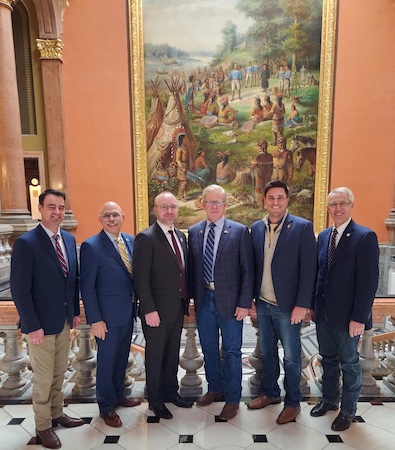
This depiction of George Rogers Clark negotiating with Native Americans at Fort Kaskaskia in 1778 is the largest painting in the Capitol and is best viewed from the third floor. It was done by Gustav A. Fuchs, a German immigrant from Chicago, and completed in 1886. The painting measures 40 x 20 feet and has been criticized because the Indian culture portrayed was never found in Illinois.
Illinois Fraternal Order of Police (FOP) State Lodge President Chris Southwood issued the following statement regarding the police beating death of Tyre Nichols in Memphis.
Tyre Nichols died at the hands of bad police officers. All good law enforcement officers are outraged and sickened by his brutal and senseless slaughter. But there are some politicians in Illinois who are using Nichols’ horrific death as another opportunity to bash all police officers, painting the thousands of good cops with the same brush as the five Memphis officers who murdered him. Would those same politicians sit by silently if they were accused of being felons simply because several of their fellow office-holders have been sent to prison?”
Those politicians need to realize that the so-called police reform laws they passed in Illinois have driven many good potential and serving officers away from the law enforcement profession. Many departments in this state have had to lower their hiring standards since those laws were passed just to get enough officers on the street. No one wants to be a cop in a state that treats police like villains, and lower standards in one of the nation’s most stressful occupations is a certain recipe for disaster.
Good cops hate bad cops. Don’t lump the good in with the bad. And don’t think that bad laws will produce good results.
I also received that statement from the group’s spokesperson.
Since the statement refers to the “so-called police reform laws they passed,” I figured the claim that the same politicians who were using the death to “bash all police officers” were state legislators. So, I reached out to the FOP and asked what specific politicians had made such statement.
No response.
So, I tried again.
No response.
* We already talked about the Illinois Legislative Black Caucus’ statement…
“The release of police body camera footage makes clear what we already knew: the murder of 29-year-old Tyre Nichols was brutal and unjustified. Our deepest condolences are with his family and all those who knew and loved him. The police officers who beat this young man to death have no place in law enforcement, and were rightly dismissed. Still, this is not enough. These officers callously and viciously killed another human being, and Mr. Nichols’ family deserves justice. We know very clearly this is about more than a few bad apples.
“For the people who are angry, for the people who are sick of living in fear, we will always stand with you in the fight for justice. We are proud of the steps we have taken in Illinois, including restrictions on dangerous policing methods and closing prosecution loopholes in officer-involved killings, but we know there is still much more work to do.”
I guess maybe speaking to angry people and those living in fear could be twisted somehow into what the FOP was saying, but that seems like a real stretch.
* The Illinois House Progressive Caucus released a statement today…
The Illinois House Progressive Caucus today released the following statement on the death of Tyre Nichols in Memphis, TN:
“As we begin Black History Month and Tyre Nichols is laid to rest today, the Illinois House Progressive Caucus today stands with the Illinois Legislative Black Caucus in response to his senseless death at the hands of police officers in Memphis, TN.
We strongly condemn the outrageous actions of these now-former officers and call for accountability and justice for Mr. Nichols and his family. We have taken important steps in Illinois to ensure the law is enforced equally and fairly. But this case is clear evidence our work is only beginning.
We share these powerful words from the Illinois Legislative Black Caucus as we seek healing, accountability, and a recognition that we all are human beings who deserve much better.
‘The release of police body camera footage makes clear what we already knew: the murder of 29-year-old Tyre Nichols was brutal and unjustified. Our deepest condolences are with his family and all those who knew and loved him. The police officers who beat this young man to death have no place in law enforcement, and were rightly dismissed. Still, this is not enough. These officers callously and viciously killed another human being, and Mr. Nichols’ family deserves justice. We know very clearly this is about more than a few bad apples.
‘For the people who are angry, for the people who are sick of living in fear, we will always stand with you in the fight for justice. We are proud of the steps we have taken in Illinois, including restrictions on dangerous policing methods and closing prosecution loopholes in officer-involved killings, but we know there is still much more work to do.’”
So, I’m still waiting. Have any of y’all seen anything?
“What you can’t do is use campaign money for your own personal legal fees… if you’re gonna spend money on legal fees it has to be associated with your political activities, and this lawsuit that was filed by Mr. Caulkins, in his individual capacity, he can’t use campaign funds and you certainly can’t use that money to pay for some association that doesn’t exist,” said DeVore. “You can give it to Gun Saves Lives and National Rifle Associations because those are non-profit organizations.”
The Illinois Supreme Court recently weighed in on this topic…
The Supreme Court affirmed the Illinois State Board of Elections decision that found Solis’ use of campaign funds to pay legal fees was a proper expenditure “incurred to defray the customary and reasonable expenses of an officeholder in connection with the performance of governmental and public service functions” in accordance with state law.
Rep. Caulkins could probably claim that his lawsuit has a “public service” function. But…
Caulkins filed the lawsuit in his personal capacity outside of his official position and is the lead plaintiff.
Tom DeVore said six individuals felt misled by Dan and reached out to him and expressed that they were upset that they have been added to an association,Law-Abiding Gun Owners of Macon County,” that they have never heard of. So now, DeVore filed a request in that case for the judge to issue an order saying, ‘We are not members of this association and we are not plaintiffs in this case.’ […]
Caulkins also said his attorney has talked with Tom DeVore and Caulkins offered to pay Tom $5,000 for using his lawsuit arguments in his own lawsuit. Tom said he refused the money.
“He thinks he is smarter than anyone else,” said Caulkins. “We will see him in court.”‘
* The Illinois Freedom Caucus, of which Caulkins is a member, released this statement the other day, which not so subtly sides with Caulkins…
The Illinois Freedom Caucus today is issuing the following statement on the various lawsuits being filed to challenge the weapons ban legislation recently signed into law.
“Illinois, like the federal government, is comprised of three co-equal branches. The Legislative and Executive branch have the ability to enact legislation into law, but it is the job of the courts to be a check on the other two branches and to ensure the laws we have on the books are Constitutional.
To that end, the Illinois Freedom Caucus supports ALL legal challenges to this unconstitutional legislation. We are in unprecedented territory and now is the time to be united. We support and welcome all legal actions that could result in restoring our 2nd Amendment rights and putting our out of control government in check.
We support these lawsuits because upholding our Constitution is paramount. The idea that honest citizens must register their firearms with the state as a condition to exercising their 2nd Amendment rights is unconstitutional on its face. It is imperative for honest citizens to take a stand against this extreme law and that is what exactly what Illinois Freedom Caucus members are doing.”
The Illinois Freedom Caucus is comprised of State Representatives Adam Niemerg (R-Dieterich); Chris Miller (R-Oakland); Brad Halbrook (R-Shelbyville); Blaine Wilhour (R-Beecher City) and Dan Caulkins (R-Decatur). The members of the Illinois Freedom Caucus are members of the Illinois General Assembly who are advocating for limited government, lower taxes and accountability and integrity in government.
I’ve tried to stay above board, take the high road. Tom just seems to keep wanting to pound away and pound away. I don’t know whether he misses the spotlight of running for Attorney General. I don’t know what’s wrong. […]
Now, this is a big money-making deal for Tom. He’s made almost $500,000 in the last month or so with these two lawsuits, and soon to be three lawsuits. And I don’t you know, I don’t understand, you know, why he thinks he needs to get involved in mine. […]
I’ve talked to him and I’ve corresponded with him. He is on a rampage. I don’t know why he won’t listen. He talked to our attorney yesterday, called the Attorney General’s Office, he’s making a mess of this. […]
He’s gotten on my Facebook page, and put up things that I think are probably derogatory. Well, they are derogatory. And defamatory? I don’t know, but I’m not interested in that. And I can’t talk to Tom. He has already made it perfectly clear that he’s on his own trail.
Mike Cabonargi, the longtime Chicago Democratic insider and former Cook County Board of Review commissioner, is exiting the Democratic State Central Committee because he’s taking a job in the Biden administration. […]
Cabonargi, once an aide to Sen. Dick Durbin, stepped down from the state Democratic Party committee Sunday. Democrats have until Feb. 28 to replace him in a process that’s similar to how state representatives are chosen. Elected Democrats from the area represented by Congresswoman Jan Schakowsky’s 9th Congressional District will name Cabonargi’s successor.
Angling for the seat: Leo Smith, director of policy at Chicago CRED (Creating Real Economic Destiny) and husband of former state Sen Heather Steans, is a name that’s popped up.
And the Asian American Caucus is pushing for an Asian American to get the appointment. “Asian Americans are the fastest growing demographic in Illinois,” the group wrote in a letter to fellow Dems who will vote on Cabonargi’s replacement. Here’s the letter.
Population power: The caucus notes that the 9th District contains the largest Asian-American population of any congressional district in Illinois and that it helped flip three Illinois General Assembly seats from R to D in the past two cycles. “We deserve a seat at the table,” the group wrote.
Cabonargi won reelection to the state central committee, but lost his Board of Review seat (and his paying job) last year to fellow Democrat Samantha Steele.
* Not mentioned in the above story, for whatever reason, is that the Asian American Caucus is backing freshman state Rep. Kevin Olickal (D-Skokie) for the appointment…
We support State Representative Kevin Olickal to be the first Asian American / Indian American State Central Committeeperson in Illinois.
● Kevin is a sitting State Representative in the 16th District. He represents a diverse district that is city and suburban, just like the 9th District.
● Kevin is a proven campaigner. He ran successful target races for the Illinois House Democrats. And he just won a very competitive primary.
● Kevin will represent the suburbs in a majority suburban district. He will help cover the district by balancing the 9th CD’s State Central Committee with the sitting city Committeewoman.
● Kevin can represent, recruit, and fundraise from a community that needs to be engaged more in the Democratic Party of Illinois.
Olickal defeated Rep. Denyse Wang Stoneback in the 2022 primary.
* Rep. Theresa Mah (D-Chicago) is one of the signatories. This is what she told me…
People are going to question Kevin’s qualifications because he’s a new state Rep, but if years in office is the criteria our entire community is at a structural disadvantage. There aren’t going to be many electeds to choose from. But as a collective, we bring a lot, and the job for Kevin is to represent all of us on that body. He is connected to Ram and Raja and all the fundraising potential in the South Asian community, me and the Chinese community, Sharon and the Korean community, Hoan and the Vietnamese community, Nabeela and the Muslim community, etc. Leo Smith is not in office and yes he (or Heather) has money but is it new money for the party? Is it a whole new population of voters? My hope is the committeepeople will vote for what’s good for the party and not the same old cronyism because that will be the party’s downfall.
* Tribune | Illinois COVID-19 disaster declaration to end: These disaster declarations have allowed those states – including Republican-run Texas – to continue benefiting from COVID-era bumps in federal reimbursements for programs like Medicaid, additional benefits for those on food stamps and the ability to quickly deploy emergency workers to respond to areas in need, like hospitals with severely short staffing.
* WCIA | Illinois House Republicans discuss reforms to budget-making process: “Illinois House Republicans are here to govern,” House Minority Leader Tony McCombie (R-Savanna), said. “We are here to give solutions. We want to help and are willing to share our ideas that address the budget shortcomings and provide tax reform policies that Illinois taxpayers and job creators need to stay in Illinois and need to grow in Illinois.”
* Bloomberg Law | Illinois Paid Leave Brings a Twist to Expanding Sick Time Laws: “The mandatory paid time off laws are an interesting twist,” she said, noting measures like the Illinois legislation raise employer concerns about possible abuses. “The time can be used for any reasons, but that time appears to still have job protections attached to it that a paid sick time law would have.”
* Chicago Mag | The Computer That Will Change Everything: Eight years in the making, Aurora, a powerful new machine at Argonne National Laboratory, could help solve some of the most pressing questions of our time. Welcome to the new era of supercomputing.
* Tribune | Protesters disrupt Chicago mayoral forum as candidates exchange personal attacks: A group of demonstrators chanted against Cook County Commissioner Brandon Johnson, who joked during the live broadcast that he must be doing something right if he isn’t mayor yet but already drawing protests. Mayor Lori Lightfoot, meanwhile, stood up for Johnson, saying he “has a right to talk without interruption.”
* AP | Republicans set to oust Rep. Omar from Foreign Affairs panel: House Speaker Kevin McCarthy has been eager to flex Republican power to remove the Minnesota Democrat after he blocked two other Democrats, Rep. Adam Schiff and Rep. Eric Swalwell, from rejoining the House Intelligence Committee once the GOP took control of the chamber in the new Congress.
* Tribune | Lake County vigil raises awareness about human trafficking: Lake County State’s Attorney Eric Rinehart and Pat Davenport of Mundelein, chief executive officer of A Safe Place, opened the program. “We need all hands on deck,” Rinehart said. “We’re not only talking about sex offenses or sex trafficking, but also labor trafficking; and we know that labor trafficking is also very hidden in a lot of our underserved communities.
* Center Square | Invest in Kids program slated to end in 2023: Illinois’ only scholarship-based school choice program is in peril unless lawmakers take action. The Invest in Kids program, which is funded by charitable donations, will expire at the end of the year unless it is extended by lawmakers.
* WILL | What effect is Illinois’ rising minimum wage actually having?: To discuss these questions and more, The 21st was joined by the CEOs of the Illinois Retail Merchants Association and the Shriver Center on Poverty Law, as well as a worker who has been part of the Fight for 15 movement.
* Capitol News Illinois | Gun lawsuit restraining order remains in place: In a 2-1 ruling, the justices said plaintiffs in the case made a plausible argument that the law violates their rights to equal protection under the law. Under the law, some categories of people – active and retired law enforcement officers, correctional officers and military personnel on active duty, for example – may purchase and possess those weapons. Other groups, such as retired military personnel or those who are not on active duty, are barred from obtaining assault-style weapons after Jan. 1, 2024.
* Eliot Clay | Clean, affordable, reliable energy is best for state’s future: Investing in new and more reliable transmission infrastructure will generate jobs, which means more economic growth for communities. The proof is in the numbers — nearly 120,000 people work in Illinois’ clean power industry. Besides that, manufacturers support clean energy technology and build much of that technology in the state. Illinois needs to add renewables to the energy sector since American manufacturers consume one-third of all U.S. energy. The industry created new technologies that make energy more affordable and reliable.
* Axios | New AI tool instantly analyzes police bodycam footage: A small but growing number of police departments are using a new AI system that analyzes officers’ bodycam footage and flags problematic encounters — as well as commendable ones. Police departments may be more likely to seek out such tools after five Memphis Police Department officers were charged with second-degree murder and other crimes in the death of Tyre Nichols.
* NYT | Vaccine Makers Kept $1.4 Billion in Prepayments for Canceled Covid Shots for the World’s Poor: Gavi, the international immunization organization that bought the shots on behalf of the global Covid vaccination program, Covax, has said little publicly about the costs of canceling the orders. But Gavi financial documents show the organization has been trying to stanch the financial damage. If it cannot strike a more favorable agreement with another company, Johnson & Johnson, it could have to pay still more.
* Tribune | For the first time, jazz musician Roscoe Mitchell takes center stage as a painter : Mitchell, 82, is among the most influential living musicians in the free-jazz firmament, famed for his work with the Association for the Advancement of Creative Musicians and the Art Ensemble of Chicago, an AACM outgrowth he cofounded. Mitchell’s first forays into painting coincided with his first footholds in Chicago’s creative music scene in the early 1960s. Those artistic practices might have continued in tandem, had Mitchell not walked away from painting in the 1970s to focus on music.
The losing candidate in the 2022 race for Will County clerk is asking a judge to order a new election in the case, citing mathematic formulas alleging the final count was fraudulent.
Republican Gretchen Fritz filed the lawsuit Dec. 28, claiming she believes “mistakes and fraud have been committed in the casting and counting of ballots” in the Will County clerk’s race because her opponent, Democratic Will County Clerk Lauren Staley Ferry, received more votes than Democratic Gov. J.B. Pritzker. […]
“It appeared quite unusual that a candidate for Will County Clerk, listed at least eight offices below the office with the most media coverage and largest political spending in the state, would receive more votes than the gubernatorial candidate of her party,” according to the lawsuit. […]
Fritz’s attorney, David Shestokas, said Tuesday the lawsuit highlights a “21st Century approach to manipulating the election process.”
Man, Will County really dodged a bullet. Imagine that person overseeing elections. Whew.
* Also, Fritz’s lawyer David Shestokas ran for attorney general last year as a Republican. He has repeatedly claimed that the 2020 presidential election was corrupted by fraud and even outright stolen…
After 5 weeks election work in #PA and now in #GA, I know the election was stolen. 10 people can actually do something about it. Here's the info to contact them. Over 130,000 people have, but we need millions more. @mtgreenee@LLinWood@realDonaldTrumphttps://t.co/2RiEUI8LuJ
…Adding… Per a tip in comments, this is from September of 2020, right as the second wave was gaining steam…
Several Will County Republican candidates in the Nov. 3 election say the Illinois Department of Public Health coronavirus data used to restrict Joliet area bars and restaurants from being open for indoor guests is flawed and it’s not accurate data. […]
Will County Board member Gretchen Fritz, District 5 Republican from Plainfield, said she does not believe Will County’s coronavirus data is accurate, either.
Fritz is running on the Nov. 3 ballot for Will County Recorder of Deeds. […]
Fritz contends the totals have been inflated because Pritzker wants to unfairly target the people in Will and Kankakee Counties. “We are never going to get an accurate positivity rate,” Fritz said.
Governor JB Pritzker announced the state’s public health emergency will end on May 11, 2023, aligning the state with the federal government’s decision to end the national public health emergency. Ensuring Illinois’ and the federal government’s health emergencies were linked brought in additional federal funding and expanded healthcare access for residents across the state.
“Since COVID-19 first emerged nearly three years ago, my administration has worked diligently alongside the federal government to battle this once-in-a-generation pandemic by following scientific and medical guidance to support frontline workers and save lives. Our state’s disaster proclamation and executive orders enabled us to use every resource at our disposal from building up testing capacity and expanding our healthcare workforce to supporting our vaccine rollout and mutual aid efforts,” said Governor JB Pritzker. “Let me be clear: COVID-19 has not disappeared. It is still a real and present danger to people with compromised immune systems—and I urge all Illinoisans to get vaccinated or get their booster shots if they have not done so already.”
After joining 12 other states and the Department of Health and Human Services in declaring a public health emergency at the outset of the COVID-19 pandemic on March 9, 2020, the state of Illinois has continued to remain aligned with the federal government to ensure every available resource was utilized in the state’s COVID-19 response. Illinois residents were able to collect additional SNAP benefits, more than 1.4 million children received Pandemic EBT (nutrition) support, and Medicaid expansion ensured access to telehealth options and the resources Illinoisans needed to stay healthy.
The proclamation formalized emergency procedures by activating the State Emergency Operations Center (SEOC), bringing together decision makers from every state agency and the state’s highly qualified mutual aid network to deploy resources as necessary during the public health threat.
Since March of 2020, state and local partners benefitted from a disaster proclamation in the following ways:
• Allowing federal reimbursement for state response costs.
• Allowing use of State Disaster Relief Fund, covering direct state costs and reimbursements to Illinois National Guard and mutual aid groups.
• Allowing use of the state’s mutual aid network, groups of public safety response professionals — including hundreds of health care providers and management professionals, law enforcement officers, fire fighters, emergency medical technicians and disaster response professionals — that are available to deploy to areas of shortage.
• Authorizing the Governor to activate Illinois National Guard reservists, some of whom were doctors and nurses and served on the front lines of the pandemic response.
• Allowing expedited procurement should it be necessary.
• Authorizing additional executive actions as needed to protect public health and safety.
The soon-to-be vacant position of Shelby County’s state’s attorney is set to be temporarily filled with the help of area state’s attorney’s offices.
The Shelby County Board voted during a special meeting Monday night to request that the resident circuit judge “take necessary action” to fill the position until a new state’s attorney can take this post full time. […]
In response to questions from fellow board members, [Shelby County Board Chair Robert Orman] said this action will involve having state’s attorney’s offices from other counties help fill the Shelby County position starting Wednesday. […]
The current Shelby County state’s attorney, Nichole Kroncke, will leave her office Tuesday, Jan. 31, to become a special prosecutor for the Illinois State’s Attorneys Appellate Prosecutor’s Office. Shelby County’s only assistant state’s attorney, Jay Scott, is also set to end his employment on that day.
A challenge to the Illinois assault weapons ban by McHenry County has been transferred up to federal court after a hearing Monday.
McHenry County State’s Attorney Patrick Kenneally filed the challenge to the Illinois assault weapons ban.
Monday morning, Illinois Attorney General Kwame Raoul made the request to remove the case from state court and send it to federal court.
* Press release…
Secretary of State Alexi Giannoulias announced that Illinois will receive $424,500 as part of the $45 million multi-state settlement with Nexo Capital, Inc.
Through its Illinois Securities Department, the Secretary of State’s office joined other state security administrators and the Securities and Exchange Commission (SEC) as part of the investigation and settlement of $45 million with Nexo Capital, Inc. (Nexo), which was offering and selling unregistered securities in digital asset investments. This is part of a $45 million settlement, $22.5 million which will be distributed to state securities regulators.
“Crypto assets are not exempt from state and federal regulations, and financial services involved with them must comply with those regulations to ensure consumers are protected,” Secretary Giannoulias said. “We will continue to investigate interest-bearing cryptocurrency accounts and take action against firms that offer them without complying with state law. However, this settlement demonstrates why Illinois investors must make sure that any financial advisor they use is properly registered with the state.”
Nexo’s Earn Interest Product (EIP) accounts allowed customers to deposit crypto assets with Nexo. In exchange, customers earned interest rates on their deposited crypto assets. The quoted rates were significantly higher than rates offered for short-term, investment grade, fixed-income securities, or bank savings accounts.
Illinois found that when Nexo offered its EIP, it failed to disclose material information about the investment and did not disclose all the risks associated with the digital assets.
In addition to the monetary settlement, Nexo agreed that it will stop offering its EIP unless properly registered. It also agreed to notify account holders on or before Feb.1, 2023, that investors should withdraw any assets from their accounts before April 1, 2023. The company also agreed to separate U.S. investor assets, recognize that U.S. investors hold legal title to those assets and not use those assets in risky speculative activities.
* Press release…
Mayoral candidate Paul Vallas outlined his Economic Development plan at a speech today at the City Club. Designed to rebuild disadvantaged communities within the city, Vallas’ plan consists of five major planks that collectively would lay the foundation for sustainability and growth.
Vallas’ full Economic Development plan can be found here: https://www.paulvallas2023.com/economic
“For far too long, too little of government has been devoted to holistic and inclusive community development that brings opportunity to the historically disadvantaged and neglected, and as Mayor I will change that course,” said Vallas. “Alongside our key goals of reducing crime and improving public schools, our economic development plan will deliver more opportunity to our city and our residents, helping move Chicago out of the current crisis created by failed leadership and into a brighter future. Our plan isn’t about the same old transactional redistribution of wealth, it is about reactivating the wealth within communities and putting it to work for all Chicagoans.”
Highlights of the Vallas Economic Development plan include:
• Creating an independent Community Development Authority (CDA) that will operate free from City Hall politics and aldermanic privilege.
• Establishing a Fair Share Investment Trust to hold and reinvest both public and private monies for second and third generation (re)investment.
• Implementing a strategy to reclaim and repurpose vacant & idle property across the city’s South and West Sides to support their development into locally owned performing assets like affordable housing.
• Recognizing that economic development must be supported by an ecosystem of wellness and framework of well-being, by ensuring that all new developments must include an agreement that takes into account cumulative environmental impact and commits funds to social service infrastructure.
• Elevating and empowering citizens returning from incarceration into full and productive economic and community participation and standing through a blend of alternative educational, workforce development, and prioritization of community development project contractors and vendors who employ returning citizens.
An “independent” development authority and a trust fund. What could possibly go wrong?
* Lightfoot press release excerpt…
As Vallas prepares to rebrand INVEST South/West and sell it as his own, we put together a run down of his less-than-impressive record of financial mismanagement to add some context to his sub-par dupe:
- As CEO of Chicago Public Schools from 1995 to 2001, Vallas oversaw financial manipulations that stripped Chicago teachers’ pensions of consistent funding.
- Vallas can’t even lead a fiscally responsible campaign—at the end of his failed 2019 Chicago mayoral bid, Vallas’s campaign reported over a half million dollars in unpaid debt.
The flawed email campaign to recruit student volunteers to Mayor Lori Lightfoot’s reelection campaign is now the subject of a negative ad by an independent political action committee.
Cue haunting music: “Politicians have no right to enlist public school students as campaign pawns,” the ad says, referring to emails sent by Lightfoot’s campaign to teachers to rally student volunteers. Lightfoot says the emails were a mistake, and the Chicago Board of Ethics is looking into whether they violated the city’s ethics rules.
Behind the attack: A group called Americans for a Safer and Better Tomorrow PAC is running the digital ad on Facebook and YouTube. It also plans to send texts to likely Chicago Public School parents based on cell numbers on voting records, according to a person familiar with the PAC’s efforts. (Is that different from sending emails to teachers? We’ll defer to the ethics board.)
Connecting the dots: The PAC is the same group behind a poll by M3 pollster in December showing Lightfoot trailing Jesus “Chuy” Garcia and Paul Vallas in the mayor’s race.
* Capitol News Illinois | Amid ‘unprecedented’ prolonged revenue boom, Illinois finds budget breathing room: The governor attributed the strong revenue performance at least partially to conservative initial budgeting estimates, changes to corporate tax exemptions and collection of online sales tax. Others have cited such factors as inflation and wage growth, as well as changes in consumer spending amid the COVID-19 pandemic.
* Fox 2 Now | ‘St. Louis’ Bears? Illinois rep. wonders amid stadium talks: Todd Maisch, president of the Illinois Chamber of Commerce, tells the Chicago Sun Times, “I think it needs to happen by the end of this session. If not, you’re going to start to have other states make their cases on why the Chicago Bears should be the St. Louis Bears.”
* Crain’s | How Willie Wilson built the fortune that fuels his populist giveaways: His disclosure valued Omar at between $25 million and $50 million. He also reported assets, including his Hazel Crest home (he rents his Wacker Drive penthouse), stock options and bank accounts valued between $2.4 million and $5 million. … While Wilson says his company does not have any contracts with the city, it was listed as a minority participant, splitting a 30% stake in an up to $30 million contract from the city’s sister agency, Chicago Public Schools, awarded to Office Depot.
* Streets Blog Chicago | Mayoral candidates weigh in on transportation at Safe Streets for All forum: The coalition’s platform calls for investments in pedestrian and biking infrastructure and improvements to CTA service and safety. All candidates except Mayor Lori Lightfoot attended. The event was moderated by Urban Gateways CEO and Elevated Chicago co-chair Leslé Honoré, who posed a set of questions to each mayoral hopeful, curated from queries submitted by pre-registered attendees. Or rather, posed them to candidates who kept their responses concise enough to get through more than one or two.
* Center Square | Illinois cannabis sales remain strong in 2022: About 113 dispensaries now operate across the state, leading to booming adult use cannabis sales in Illinois. In 2022, legal cannabis sales totaled $1.5 billion, the Illinois Department of Financial and Professional Regulation said.
* Chalkbeat | Tony Sanders named next Illinois State Superintendent of Education: “Dr. Sanders’ breadth of experience as superintendent of School District U-46 and his entire background have prepared him to take on this role,” Gov. J.B. Pritzker said in a statement. “His focus on innovation, social emotional development, and academic excellence make him an extraordinary pick. I can think of no better person to lead the Illinois State Board of Education as we continue to invest in, support, and elevate our students and educators.”
* AP | Adult Happy Meals and the McRib feed McDonald’s sales in the fourth quarter: Global same-store sales — or sales at stores open at least a year — rose 12.6% in the October-December period, the Chicago company said Tuesday. That beat Wall Street expectations for an 8.8% increase, according to analysts polled by FactSet.
* Marketplace Tech | Rural communities are slow to adopt EVs — but a national charging network depends on them: The federal government aims to change that as part of the Joe Biden administration’s larger plan to decarbonize the transportation sector by 2050. It wants to increase the number of public charging stations for electric cars tenfold by the end of this decade. Rural areas play an important role in the broader electrification plan. In the 2021 infrastructure bill, there’s $7.5 billion dedicated to building out EV chargers nationwide, with a special emphasis on rural America.
* NPR Illinois | Dirksen Driver’s Services facility to close for lengthy period: A temporary facility at 1650 Wabash Ave., which is comparable in size to the Dirksen Pkwy. facility, will be open Mondays through Fridays, from 8 a.m. to 5 p.m. It will provide the same services to the public including: the issuance of driver’s licenses, ID cards and instruction permits; license plate sticker renewals; and title and registration services.
* AP | 2 monkeys taken from Dallas Zoo in latest suspicious event: Two monkeys were taken from the Dallas Zoo on Monday, police said, the latest in a string of odd incidents at the attraction being investigated — including fences being cut and the suspicious death of an endangered vulture in the past few weeks.
* WILL | Hip hop’s history in Illinois and America: Hip hop as a genre is only 50 years old, and its cultural impact in Illinois and America at large is unquestionable. According to Nielsen, hip hop and R&B are the most popular genres in the United States, and it’s the subject of a new documentary. Fight the Power: How Hip Hop Changed the World premieres tonight on your local PBS station. It features interviews from some of the most prominent Hip Hop acts of all time, including Run DMC, will.i.am and Chicago’s Lupe Fiasco.
* NBC Chicago | Country Music Star Maren Morris to Headline 2023 Illinois State Fair: “To kick it all off with Maren Morris who brings hit after hit to our Illinois Lottery Grandstand Stage is a dream come true,” Clark continues. “Whether you are a fan of her hit collaboration “The Middle” with Zedd or her hit country singles such as ‘My Church,’ ‘80’s Mercedes’ or ‘The Bones,’ it is sure to be a concert you are not going to want to miss.”
* Sun-Times | Sean O’Shea, a South Side native who worked at the White House under Clinton, dies at 46: “I am not exaggerating, the guy walked in our office and I think within the first day we were like ‘Who the —k is this kid?’ He was amazing,” said Kris Balderston, who was Mr. O’Shea’s boss while he worked for a semester as a White House intern in the Office of Cabinet Affairs under former President Bill Clinton.
*** UPDATE *** Annie Thompson from the attorney general’s office…
The Protect Illinois Communities Act is an important tool in what must be a comprehensive approach to addressing gun violence throughout Illinois, and we remain committed to defending the statute’s constitutionality. We are reviewing the 5th District’s decision, and we will seek its review by the Illinois Supreme Court, and we will ask the court for an expedited schedule.
The narrow issue before us in this case is whether the circuit court of Effingham County properly granted a temporary restraining order (TRO) in favor of plaintiffs under Illinois law. In counts I, II, and III of plaintiffs’ verified complaint, plaintiffs alleged that the procedure by which Public Act 102-1116 (eff. Jan. 10, 2023) (Act or Protect Illinois Communities Act) became law violated the Illinois Constitution and therefore denied them due process of law. In count IV, plaintiffs alleged that the exemptions provided for in the Act violate the equal protection clause of the Illinois Constitution based on their right to keep and bear arms. […]
In order to obtain a TRO, plaintiffs are required to demonstrate the following elements: “(1) a clearly ascertained right in need of protection, (2) irreparable injury in the absence of an injunction, (3) no adequate remedy at law, and (4) a likelihood of success on the merits of the case.” … Once the plaintiff establishes a fair question that his or her rights were violated, the plaintiff has also established a fair question that he or she would likely prevail on his claim. […]
With regard to count I, plaintiffs alleged that the Act violated the “single subject rule” and therefore should be declared unconstitutional. … The Illinois Supreme Court enunciated a two-tier test to determine whether an act runs afoul of the single subject rule. … The court determines first whether the act involves a legitimate single subject and then whether the various provisions within an act all relate to the proper subject at issue. … Thus, in light of the test before the court, and the liberal construction afforded to the single subject rule (Cutinello, 161 Ill. 2d at 423), we cannot conclude that inclusion of these clarifications offends the subject matter so much as to violate the single subject rule. […]
We turn now to count II of the complaint, which alleged the Act violated the three-readings rule found in article IV, section 8 of the Illinois Constitution. … Plaintiffs acknowledged the enrolled-bill doctrine before the circuit court, and that the legislation at issue was certified pursuant to the doctrine. However, plaintiffs asserted the enrolled- bill doctrine should be abandoned and/or abrogated. The circuit court agreed, specifically stating that “the time to revisit this practice is now.” … We cannot agree. … Accordingly, in this case, the circuit court did not have the authority to decide if or when the Illinois Supreme Court should revisit the issue raised by the plaintiffs in count II, and this court does not have that authority either. […]
With regard to count III, plaintiffs alleged that the manner in which the Act was passed violated due process as required by article I, section 2 of the Illinois Constitution, and that accordingly the Act should be declared unconstitutional. Specifically, plaintiffs alleged they “were denied any meaningful opportunity to participate in the passage of [the Act] which attempts to materially impair their fundamental rights to bear arms.” As further explanation, plaintiffs alleged that the “due process violation being complained of herein is the complete and total failure of the [d]efendants to comply with express constitutional procedural guarantees afforded the [p]laintiffs under Ill. Const. 1970, art. IV, § 8(d).” In the response filed with this court, plaintiffs stated that the crux of count III is that plaintiffs “demand the legislative process comply with the procedural requirements of the Illinois Constitution, particularly the single subject rule and the three-readings rule.” However, because we have found there is no likelihood of success on the merits with regard to counts I and II, we must likewise conclude there is no likelihood of success on the merits of count III, because by its plain language it is contingent upon the existence of potentially meritorious claims on counts I and II. As such, we find the trial court erred in granting a TRO on this basis.
With regard to count IV, plaintiffs present an equal protection claim, based not upon the process by which the Act was passed, but upon the groups created by the enumerated exemptions found in the Act. … Defendants claim there is no fundamental right at issue here and so the level of scrutiny is rational basis. This standard requires the court to determine whether the statute bears a rational relationship to a legitimate government purpose. […]
[In Guns Save Life, Inc. v. Ali, the Illinois Supreme Court stated] “We agree that the ordinances impose a burden on the exercise of a fundamental right protected by the second amendment. At its core, the second amendment protects the right of law-abiding citizens to keep and bear arms for self-defense in the home.” […]
While there is no dispute that the Illinois Supreme Court did not find the right to bear arms under the Illinois Constitution was a fundamental right in 1984 when deciding Kalodimos, it is equally undisputable that the Illinois Supreme Court now accepts the second amendment as a “fundamental right” guaranteed by the United States Constitution and the fourteenth amendment. […]
Under the strict scrutiny analysis, legislation that significantly interferes with the exercise of a fundamental right will be upheld only if it is “necessary to serve a compelling state interest” and is “narrowly tailored” to effectuate that purpose. … Defendants have argued that plaintiffs have no right in need of protection and are unlikely to succeed on the merits; however, defendants’ arguments were based on an erroneous perception that plaintiffs’ right to keep and bear arms was not a fundamental right. As such, we find that plaintiffs’ allegation that the Act infringes on their rights as Illinois citizens to keep and bear arms is a sufficiently alleged right in need of protection. Here, plaintiffs’ complaint alleged that the legislation’s exemption of seven categories of persons from the now prohibited purchase and/or possession of assault weapons, assault weapons attachments, .50-caliber rifles, and .50-caliber cartridges had no basis and therefore violated equal protection guarantees.
In response, defendants claimed the purpose of the Act was to reduce firearm deaths and mass shooting casualties and the exempted categories were based on employment and/or training. We note, however, that no such purpose or basis for the exempted categories is found in the record. The closest this record comes is the naming of the Act as the Protect Illinois Communities Act. While intent of legislation can be found by reviewing the legislative history, based on the legislative procedures utilized for this Act, there is no legislative history. We only have post- enactment statements. Comments issued after legislation is passed is “subsequent legislative history,” not “legislative history,” and is entitled to little, if any, weight. … Accordingly, we find that plaintiffs alleged sufficient facts for a TRO to issue on count IV. […]
We hold no crystal ball allowing us to determine the likelihood of potential harm if the TRO is granted, but we temper our lack of prescience with recognition that both interests—whether through the regulation of firearms or through the fundamental right to keep and bear arms—are based on the increased desire to protect and defend loved ones in light of these horrifying and devastating shootings.
Here, we find it extremely relevant that no opportunity for discourse was provided to the citizens of this state that would allow for recognition of the competing interests in accomplishing what we believe is likely a common goal. Nor does it appear that the legislative process allowed for even a moment of debate between the lawmakers to ensure that the enactment of this law was “narrowly tailored” to effectuate the Act’s purpose in any manner that would allow a larger exempted group to retain their fundamental rights. For these reasons, we find that balancing the equities favors the issuance of a TRO for count IV, and therefore, we affirm the trial court’s order granting the TRO for count IV.
I begin by stressing that in my view, this appeal does not allow us to address whether Public Act 102-1116 (eff. Jan. 10, 2023) (Act) infringes upon any rights granted by the United States Constitution, specifically the second amendment. This significant point was expressly stated to the circuit court by counsel for the plaintiffs during the hearing on the emergency motion for a temporary restraining order (TRO) when he stated, “We are not making second amendment constitutional arguments here because those are for a different day and a different court ***.” Because no issues related to the second amendment of the United States Constitution are before us, as they were not pleaded and were notably disclaimed by counsel for the plaintiffs, I believe our ruling on the grant of the TRO should in no way be interpreted as instruction or guidance as to any issues that may in the future be raised under the second amendment of the United States Constitution. […]
Turning to count IV, as noted by the majority, in this count the plaintiffs present an equal protection claim, based not upon the process by which the Act was passed, but upon the group created by the enumerated exemptions found in the Act. However, I believe the majority has failed to adequately address a crucial threshold matter relating to count IV. As the Illinois Supreme Court has stated, “it is axiomatic that an equal protection claim requires a showing that the individual raising it is similarly situated to the comparison group.” People v. Masterson, 2011 IL 110072, ¶ 25. If a party fails to show that he is similarly situated to the comparison group, his equal protection challenge fails. Id. The plaintiffs’ complaint failed to allege how each, or even any, of the plaintiffs are similarly situated to the exempted group set forth in the Act. The plaintiffs’ complaint and arguments point to a hypothetical Navy SEAL, but failed to allege this scenario was applicable to the plaintiffs. As set forth above, “to be considered ‘well-pleaded,’ a party’s factual allegations must be supported by allegations of specific facts.” Allegations that are “cursory,” or “inexplicably lacking in specifics,” are not sufficient to support the granting of a TRO. This is true because “the standard for injunctive relief is far too high for a court to rely solely on the moving party’s innuendo.” … Therefore, because the plaintiffs have failed to allege facts demonstrating that they are similarly situated to the exempt group complained of, their equal protection challenge fails, and the circuit court’s granting of the TRO must be reversed in its entirety.
I also cannot agree with the majority that if we were to further analyze count IV, strict scrutiny would apply. … As a factual matter, Ali involved a claim under, inter alia, both the second amendment to the United States Constitution and the Illinois constitutional provisions regarding the right to bear arms. Accordingly, it is not surprising that the court would mention “a fundamental right protected by the second amendment.” At no point did the court state that Kalodimos was no longer good law, or in any other way imply that the right to bear arms is now a fundamental right under the Illinois Constitution. Thus, I cannot attribute to Ali the significance the plaintiffs desire.
Accordingly, in light of the only extant precedent on this question, the only way this court could find that a fair question existed that the plaintiffs had a likelihood of success on the merits of this claim under a strict scrutiny equal protection analysis would be to find that Kalodimos has been overruled by a case or cases other than Ali. There is no evidence to support such a conclusion, and as explained above with regard to the other counts before us in this appeal, the circuit and appellate courts of the State of Illinois are required to apply binding precedent from the Illinois Supreme Court to the facts of the cases before the circuit and appellate courts. […]
Put another way, only the Illinois Supreme Court could rule that in a case such as this one—where the plaintiffs pointedly do not invoke the protections of the second amendment to the United States Constitution, and in fact pointedly disclaimed, in the circuit court, “making second amendment constitutional arguments [in this case]”—the development of federal precedent related to the second amendment to the United States Constitution nevertheless has rendered untenable the Illinois Supreme Court’s previous holding that the right to bear arms under our state constitution is not a fundamental right. […]
(I)n this case the plaintiffs have stated emphatically that they are not proceeding under the United States Constitution, and thus have clearly and unequivocally chosen not to avail themselves of the level of protection offered by the second amendment. That leaves only the protection offered by the Illinois Constitution, which pursuant to Kalodimos does not afford to the plaintiffs a fundamental right and does not entitle them to strict scrutiny analysis of their count IV equal protection claim.
*** UPDATE *** It appears the sheriff broke an agreement. From DuPage County Board Chair Deb Conroy…
I’ll just stick by our statement yesterday. We had a productive conversation, and the sheriff assured me he would uphold all state and local laws. During our meeting, we agreed to release a joint statement and say nothing further.
So, as far as I’m concerned, there’s nothing more to say. We move forward, focusing on keeping our residents and community safe.
Do not listen to the media. I was not threatened to be censured or anything else during this meeting.
Um, the public threats of censure clearly came well before the meeting. Sheriff Mendrick knew what he’d gotten himself into and what consequences he faced. As far as I can tell, no media outlet reported that any such threats were made during the meeting. Maybe he just saw something on Facebook.
The meeting that I had with States Attorney Bob Berlin and County Board Chair Debra Conroy yesterday was the first day three tiers of government came together in discussion on this topic.
We ALL agreed that our police should not be going to the homes of our law. abiding residents to harass them over gun registration. They get the issues. We will not be sending deputies out proactively to take your lawfully owned guns. Please remove that stressor from your lives.
Sheriff, it was you and others like you who freaked people out by claiming that law enforcement would be going door to door.
What we will be doing is enhancing penalties for those that use guns illegally in the commission of crimes. Those that commit gun crimes in DuPage will find out how seriously we take gun offenses. If you are not using a gun to conduct criminality, you have nothing to fear from us. If your use of a gun is to harm someone within DuPage County, we are united to make sure you endure every possible penalty that we can bestow upon you for your crimes.
We have reached a time where we must protect our citizens from illegal gun use and at the same time allow law-abiding citizens the ability to defend themselves. The media will make up their own version of this interaction to create conflict, but the truth is that we all agree on the difference between lawful citizens and criminals.
So, if a Naperville police officer arrests a gun store owner for selling banned assault weapons, the sheriff will now allow that person to be incarcerated in his county jail?
We asked about a State Journal Register story that says there are nearly 1,700 bills being introduced from both chambers that apply to income tax credits for eligible taxpayers, state agencies and departments.
As of Friday, there were 1,690 bills introduced from both chambers - 156 in the state Senate and 1,534 in the House. A common thread in the bills was income tax credits applying to a wide spectrum of eligible taxpayers, state agencies. and departments.
The SJ-R story looked at only a sampling of all the bills. Of those 1,690 bills, Speaker Welch has introduced 940 shells. Deputy Majority Leader Mary Flowers introduced another 76 bills, as did Rep. La Shawn Ford.
* Campaign press release, but it ain’t a bad idea…
Kam Buckner filed legislation to ensure that the head of CPS is a Superintendent and not a CEO, ensuring that schools prioritize students, are not run like businesses, and that there are strict education, certification, and work experience requirements for this role.
CPS had a superintendent until 1995 when the legislature changed Illinois’ law and appointed Paul Vallas to run Chicago’s school district. The change has allowed people like Paul Vallas to ignore the needs of children, their families, and communities and instead make decisions driven by financial outcomes and self interest.
“Our school district has been traumatized by school closures and poor decision making,” Buckner said. “By having a CEO lead our schools we have allowed people without the proper job qualifications to run our district as a business and see our children as data points and not the future of our great City. Legislation I have proposed will change that by reinstating the Superintendent role in CPS and eliminating the title of CEO.”
There have been ten CEOs of Chicago’s public schools since Paul Vallas first took office in 1995.
“As CEO Paul Vallas was driven to create a balanced budget for CPS and it resulted in neighborhood school closures for our children,” said Buckner. “He didn’t put our kids first then and he certainly won’t as Mayor of Chicago.”
Paul Vallas has been an opportunist collecting titles instead of prioritizing Chicago’s youth and education. Chicago State University’s board of Trustees created a job specifically for Vallas to help them turn things around but Vallas was terminated by the Trustees after they realized they had been a pawn in his attempt to advance his bonafides among black voters during his first Mayoral run.
“I sat on the board of Trustees that fired Vallas,” Buckner said. “It was clear then and it’s even clearer now that he puts himself first and it is that same self interested attitude that is allowing him to accept donations from people who used our schools to increase their personal profits. We simply cannot have people like this running our schools or our City.”
Paul Vallas has accepted campaign contributions from Deborah Quazzo, a former CPS employee who violated ethical school standards by pitching her businesses to school principals in an effort to secure CPS contracts and she benefitted from a kickback scheme under CEO Barbara Byrd-Bennett.
As state Representative, Kam Buckner has sponsored 100s of bills to help improve public safety, education, housing, and transportation in Chicago including legislation on needs based school funding, which set a minimum teacher salary and an elected Chicago school board.
A proposed amendment to the Sports Wagering Act in Illinois filed by Rep. Robert Rita would introduce exchange trade wagering.
House Bill 1405 seeks to extend the current sports betting regulations in the Prairie State to include betting exchanges, defined in the bill as “the buying and selling of betting contracts at any time prior to the conclusion of an event based on a describable zero to 100 scale of probability”.
Under the bill’s terms, two betting exchange licenses would be up for grabs if it were to pass, with licensees liable to a $500,000 licensing fee.
Any licensee would be allowed to offer betting exchange services for a period of four years initially and may renew for a $100,000 fee as long as the operator remains compliant with regulations.
Illinois lawmakers on Monday introduced workers compensation bills that would affect compensability on cumulative trauma and work travel.
H.B. 1543 would determine that an injury arose out of and in the course of employment only if the accident “significantly caused or contributed to both the resulting condition and disability.”
The bill doesn’t define “significantly caused,” so it’s not clear how that would compare to other causation standards such as major contributing cause, proximate cause and predominant cause.
Case law says only that workers must prove by a preponderance of the evidence that the work incident or duties were a causative factor in an injury. That bill would limit coverage for cumulative trauma, prohibiting coverage for “ordinary, gradual deterioration or progressive degeneration of the body caused by aging or normal activities of living.”
The Illinois Workers’ Compensation Commission would be required to establish a new medical fee schedule and implement a closed drug formulary, under legislation introduced Monday.
H.B. 1548 would render all current medical fee schedules inoperative after Aug. 31, 2024, and establish new reimbursement rates based on Medicare percentages. The bill would also require annual updates to the fee schedule starting Sept. 1, 2025, that would be equal to exactly half the increase in the Consumer Price Index.
H.B. 1546 would require the commission to adopt an evidence-based drug formulary by Sept. 1. The bill does not direct the commission toward any current formulary.
* Stand Up America…
State Legislatures are Back. Here’s How They Can Protect and Strengthen Democracy.
State legislatures are back and beginning to set priorities for the 2023 session. As lawmakers gather it’s critical that they prioritize protecting and strengthening democracy – especially with a divided Congress in Washington.
Legislators and voters in New York and Michigan are coming off of big wins in 2022 – having passed sweeping democracy legislation and ballot initiatives – that will now need to be implemented. Meanwhile, the Illinois and New Mexico legislatures will take up fights that fell short last year like voting rights restoration and a democracy package to create a permanent absentee voter list, restore voting rights, implement automatic voter registration, and more.
Here are a few ways states are prioritizing protecting democracy in 2023:
• Minnesota: Minnesota lawmakers recently introduced a comprehensive pro-democracy package – the “Democracy for The People Act” – that includes automatic voter registration, restoring the right to vote for Minnesotans on probation or parole, and modernizing the state’s campaign finance system. Legislators also launched a democracy caucus in the Minnesota state house. Recently, lawmakers and voting rights advocates from We Choose Us MN held a press conference to announce a legislative agenda to make the North Star State a national leader in democracy.
• New Mexico: Last session, New Mexico voting rights advocates nearly passed a sweeping legislative package to strengthen democracy and secure citizens’ access to the ballot. Last week, legislators introduced a revamped version in the statehouse. The bill includes a permanent absentee voter list, rights restoration for people on parole/probation, automatic voter registration, an Election Day holiday, and more. New Mexico lawmakers and advocates hosted a press conference on their plans for the session.
• Oregon: For the past few years, Oregon advocates have worked diligently to pass legislation to allow currently incarcerated citizens in the state the opportunity to vote to support their communities and families. Last year, the legislation was held up in the Joint Committee on Ways & Means, but with Sen. Elizabeth Steiner and Rep. Tawna Sanchez at the helm of the committee this year, hopes of passage are much greater. A coalition, led by formerly incarcerated individuals, continues to fight to pass the legislation, SB 579, this session.
• Illinois: Illinois voting rights advocates have been working to pass voting rights restoration for people with felony convictions for years. Last year, SB 828, legislation to restore voting rights for currently incarcerated Illinoisans, came just a few votes shy of passing the House on the final day of session. This session, advocates are bringing back the bill, HB 989, and making sure it is prioritized by lawmakers.
Stand Up America’s members are not new to fighting for legislation to shore up democracy at the state level. In fact, last year, Stand Up America’s members drove more than 1,800 calls and 15,000 emails to legislators and sent over 650,000 texts in support of state-level measures that would strengthen democracy in Arizona, Michigan, New Mexico, Illinois, Oregon, New York, and beyond. This year, they will again work in their state houses to pass legislation to state level protections for their democracy.
* And…
My tweets about newly introduced Illinois bills usually don't get much play on here but I'll bet a pound of catnip this one does…
Rep Barbara Hernandez has introduced HB1533 which would ban the declawing of cats in Illinois. ????????⬛????????https://t.co/zxn1LWoifb
I wonder if the upholstered furniture lobby has a position on that one. /s
…Adding… Press release…
Today, U.S. Congressman Sean Casten (IL-06) introduced a package of legislation to increase the size of the House and Senate, as well as restore the Supreme Court’s jurisdiction to better align with Article III of the US Constitution.
The package, named “A Common Sense Vision for American Democracy” would:
Establish 12 at-large senators to be elected through a nationwide system of ranked choice voting
Add approximately 138 additional Members of the House (if it had been implemented after the 2020 census)
Change the jurisdiction of the Supreme Court and create a 13-judge multi-circuit panel to hear cases where the United States or a federal agency is a party
This is the first attempt by a sitting Member of Congress to enact this type of reform. There have been no attempts in Congress to expand the Senate or reinstate the original jurisdiction of the Supreme Court. The last time the House was expanded was in 1911. After an inability to settle disputes over reapportionment after the 1920 Census, the size of the House was arbitrarily locked in place at 435 in 1929.
An overview of A Common Sense Vision for American Democracy can found below, including bill text and section-by-sections of the legislation.
“The fundamental promise of our democracy is to fulfill the will of the people,” said Rep. Sean Casten. “In recent years, we have failed to meet that promise. There is a growing list of issues – from climate action to gun control to healthcare to voting rights – where the federal government has consistently ignored the priorities of the majority of Americans. This failure not only breeds cynicism but ultimately risks the very survival of our government. We must act against the counter-majoritarian institutions of our political system and seek to reestablish the government as a stalwart for the people.
“The Equal Voices Act will increase the size of the House to be in line with the growing population of the United States. Not only will this bill create smaller districts to allow Members to be more responsive to the needs of their constituents, it will also rebalance inflated representation between districts, and allow for greater diversity that is more representative of our great nation. On top of that, it will grow and equalize the Electoral College, better aligning outcomes with the national popular vote.
“The Senate was purposefully constructed to not reflect the will of the majority. However, a government that doesn’t represent the people cannot sustain the support of the people. This amendment establishes 12 at-large senators to be elected through a nationwide system of ranked choice voting. By creating this bloc of senators, comprising roughly 10% of the body, who are directly responsible to public will, the Senate will be forced to move their agenda towards the will of the majority.
“There are currently incentives to control the composition of the Supreme Court to affect the resolution of disputes in a way that furthers specific policy objectives and politics. These incentives have distorted the actual and perceived fairness and independence of the Court, and this must be remedied. The Constitution gives Congress the power to address the structural concerns of the Supreme Court, and we must do so. It’s time for Congress to restore the Court’s jurisdiction to align with Article III of the Constitution and eliminate the current elements that allow the Court to be gamed for political advantages”
* I’ve been following this person for a while on Twitter, etc. and he seems to be pretty darned good at what he does. Press release…
The Illinois State Board of Education (ISBE) today named School District U-46 Superintendent Dr. Tony Sanders the new state superintendent of education after a nationwide search. He will assume his duties in late February. ISBE Deputy Education Officer Krish Mohip will serve as interim state superintendent of education during the transition. Dr. Carmen I. Ayala’s term as state superintendent of education concludes Jan. 31. She announced her retirement after 40 years of service and leadership in Illinois public schools.
“Dr. Tony Sanders is an extraordinary choice for State Superintendent of Education,” said Governor JB Pritzker. “Dr. Sanders’ breadth of experience as superintendent of School District U-46 and his entire background have prepared him to take on this role. His focus on innovation, social emotional development, and academic excellence make him an extraordinary pick. I can think of no better person to lead the Illinois State Board of Education as we continue to invest in, support, and elevate our students and educators.”
“Dr. Tony Sanders has distinguished himself as a visionary leader and passionate advocate for students and educators,” said ISBE Board Chair Dr. Steven Isoye. “As the superintendent of one of Illinois’ largest school districts, he intimately understands the strengths, the policy history, and the challenges of our public schools. At U-46, he has championed equity, expanded opportunities for students, and brought innovative new programs to the district. The Board looks forward to his leadership; we are confident he will build on our record-high graduation rates and college and career readiness to continue leading Illinois’ schools in a positive direction.
“We are also very grateful to have Krish Mohip serve as interim state superintendent. Krish has a wealth of education leadership experience and will provide important guidance and oversight for the agency during this transition.”
Dr. Sanders expanded the district’s offerings during his tenure in U-46, which is headquartered in Elgin and is the second-largest school district in Illinois. He added full-day kindergarten for all students and implemented a developmentally appropriate play-based instructional program. Dr. Sanders grew the district’s dual language program and created a new alternative high school, the DREAM Academy, to reduce expulsions and better serve students in need of trauma-informed care. He also invested in a grow-your-own educator initiative to provide educational support professionals the ability to return to school to earn their teaching credentials. The initiative has supported more than 60 U-46 employees in receiving full tuition reimbursement as they work toward their teacher licensure. Dr. Sanders improved the district’s financial standing, while overseeing a $660 million operating budget.
Dr. Sanders also has advocated at the state and federal levels as a member and past chair of the Large Countywide and Suburban District Consortium. He supported the effort to reform Illinois’ school funding formula and enact Evidence-Based Funding and to pass the Every Student Succeeds Act.
Prior to becoming the U-46 superintendent in 2014, Dr. Sanders served as the district’s chief of communications and accountability and then chief of staff. He also previously served as the chief communications officer for St. Louis Public Schools and in communications and governmental relations roles within Illinois government, including at ISBE. Dr. Sanders received his bachelor’s degree from the University of Illinois Springfield, his Master of Business Administration from New York Institute of Technology, his Chief School Business Official Endorsement from Northern Illinois University, an Honorary Doctor of Laws from Judson University, and his Doctor of Education from Aurora University.
…Adding… IFT…
The Illinois Federation of Teachers (IFT) President Dan Montgomery issued the following statement on the appointment of Dr. Anthony “Tony” Sanders as the 31st State Superintendent of Education for the Illinois State Board of Education (ISBE).
“We congratulate Dr. Tony Sanders on his appointment as State Superintendent of Education and are thrilled to partner with him to achieve policies that center and engage our students and teachers, especially our Black and Brown students who are still recovering from the pandemic. As an Illinois superintendent with a strong education background, Dr. Sanders thoroughly understands the challenges facing our students, teachers, and staff. His steady leadership during the pandemic ensured that Elgin students and school staff were safe and healthy.
“During Dr. Sanders’ tenure leading Elgin District U-46, he was a strong advocate for equitable policies for Black and Brown students. His visionary leadership helped improve district assessment data collection to better the student and teacher experience. We support furthering that effort at the state level and call on him to convene assessment experts, including practitioners, to develop an assessment theory of action.
“We appreciate Dr. Sanders past advocacy for the Evidence Based Funding Formula and hope in his new role, he helps to move our state closer to achieving equitable funding and eliminating disparities in districts statewide.
“We thank Dr. Carmen Ayala for her service and strong leadership during the pandemic, and we are eager to work with Dr. Sanders to continue the equity work that Dr. Ayala started on behalf of our students and teachers.”
* Illinois Chamber President Todd Maisch in Crain’s…
The Illinois Chamber of Commerce believes that business and labor can work together. Here are three areas where they can in Illinois. […]
Business and labor both like to build productive assets for our economy. Unfortunately, the state of Illinois has a history of waiting until the last minute to decide what our critical infrastructure needs are and how to pay for them.
The harsh reality is that our typical answer—an increase in the gas tax—will not meet our future needs. Increasing fuel efficiency and a move to electric vehicles will leave our roads, bridges and transit to the ravages of perpetual underfunding. Illinois leads the nation in the vitality of our transportation system. We must have a better way.
Tolling our interstates, allowing public private options and deciding how we fund our waterways and airports are absolute musts. They may not be instantly popular, but we cannot wait for these complicated issues to be addressed years from now. These issues must be addressed now.
Just for a little context, Illinois raised the Motor Fuel Tax by 19 cents per gallon in 2019 and pegged it to inflation. The most recent MFT increase before that was in 1990 - 29 years earlier.
* The Question: Should Illinois convert its interstate highway system to a tolled system? Take the poll and then explain your answer in comments, please.
Illinois State Police say they took enforcement action against a business for openly advertising the sale of newly banned weapons, but no additional information was provided.
In a YouTube video Friday, gun-rights advocate Todd Vandermyde revealed he’d been told that the state is taking actions to enforce the state’s ban on certain semiautomatic guns and magazines.
“It appears that there was a gun shop that was selling stuff, post the enactment,” Vandermyde said after sharing an anonymous tip that state police confiscated weapons from an individual.
Monday, a spokesperson for Illinois State Police confirmed in a statement to The Center Square that ISP took enforcement action earlier this month against a business for “openly advertising the sale of banned weapons.” The statement said the investigation is ongoing and additional information wasn’t immediately available.
The Uihlein Foundation gave the Illinois Policy Institute another $1.5 million in 2021, bringing Uihlein's total support of IPI to more than $19 million since 2010 –> https://t.co/9noaLuIrrVhttps://t.co/fuqDhEpVWF
* Sun-Times | Son of former state Rep. Eddie Acevedo found guilty on tax charges: Prosecutors alleged during his trial that Alex Acevedo failed to report about $49,000 for 2016 and $16,000 for 2018. They said he thought he could get away with it because the money came from Michael Acevedo’s lobbying business, Apex Strategy LLC.
* Sun-Times | Springfield man who waved Trump flag on U.S. Senate floor on Jan. 6 found guilty of federal charges: An FBI special agent explained in a court affidavit that authorities first noticed Adams because of an interview he gave to the publication Insider following the riot. The article said Adams trampled over police barricades, made his way into the Capitol and eventually reached the Senate chamber after lawmakers had been evacuated, according to the affidavit.
* Todd Maisch | Illinois needs both business and labor, so they must cooperate:Tolling our interstates, allowing public private options and deciding how we fund our waterways and airports are absolute musts. They may not be instantly popular, but we cannot wait for these complicated issues to be addressed years from now. These issues must be addressed now.
* AP | President Biden to end COVID-19 emergencies on May 11: It comes as lawmakers have already ended elements of the emergencies that kept millions of Americans insured during the pandemic. Combined with the drawdown of most federal COVID-19 relief money, it would also shift the development of vaccines and treatments away from the direct management of the federal government.
* Tribune | Legal experts fear Chicago’s slow police reforms could lead to a Tyre Nichols incident here 8 years after Laquan McDonald firestorm: A common thread between both Nichols’ and McDonald’s cases was perception of a cover-up by police to protect their own. In the McDonald case, a spokesman for the Fraternal Order of Police Lodge 7 initially provided a statement that described the teen as the aggressor despite police dashcam video evidence that later showed the knife-wielding African American teen backing away as he was shot 16 times by Van Dyke, who is white.
* Vandalia Radio | Rep Wilhour talks about his new district, passage of the gun ban: A major topic of discussion throughout the state right now is the gun ban passed earlier this month that is facing a number of court cases at this time. One major issue to many is the passage of the bill during the final moments of the past General Assembly. Wilhour says that was not surprising.
* SJ-R | Income tax credits abound in early bills introduced to Illinois General Assembly: More attention has turned, however, to talk of a new graduated tax proposal. A group of Republican Senators dismissed the possibility on Wednesday. The ballot measure originally failed in the 2020 General Election. The minority party filed a resolution calling for no legislative effort to follow.
* WGN | Officer Exodus, 1,000+ Chicago cops left the job last year: Delayed response is just one impact of an exodus of Chicago police officers. Last August, the number of sworn officers plunged to 11,611, its lowest level in years. The department was down 1,742 officers from its peak four years earlier.
* Greg Hinz | Tax breaks aren’t always bad policy. But sometimes, they really, really are: The top example is the ongoing campaign by Gov. J.B. Pritzker to bulk up the state’s nascent electric vehicle manufacturing business, and particularly to convince Stellantis to convert its Belvidere plant to EV production rather than shipping out the work to Michigan. Pritzker is going to have to put real money on the table because other competing states are. The type of property tax breaks the Bears want might be helpful, too, though not for the Bears. I wish him luck because the loss (or gain) of thousands of well-paying factory jobs that can support a middle-class family is really at stake in this one.
* WBBM | Survey suggests Illinois teacher shortage as bad as ever: The Illinois Association of Regional Superintendents of Schools’ sixth annual survey paints a picture of a crisis among the 690 districts that responded (80 percent of the state). The group’s president, Dr. Mark Klaisner told reporters on a Zoom call about a colleague who recently told him a middle school in rural central Illinois did not have a single teacher with the proper qualifications to teach their subject.
* The Center Square | Illinois Association of Chiefs of Police weighs in on Memphis police video: “Their [the officers] actions will be judged by a jury and rightfully so,” Winslow said. “I’m sure that they will spend a little time in prison if I was a guessing man, but it is one of those things where we don’t have all the facts, but I do not need all the facts to know that use of force is not what those in professional law enforcement use.”
* Chicago Reader | ‘She was somebody to us’: In 2022, six people I know from Lower Wacker and the Loop died. The first passed the day after Valentine’s Day, the last on December 2, when I was midway through my first draft of this story and had to adjust my word count to fit in a sixth death when I thought I was mourning five.
* Fox | Illinois school district worker accused of taking $1.5 million in chicken wings: An official at a Chicago, Illinois-area school district was arrested for stealing $1.5 million worth of food – mainly chicken wings – from the district during the COVID-19 pandemic, according to reports. The Associated Press reported that Vera Liddell, 66, was held in the Cook County Jail on $150,000 bond, according to WGN-TV out of Chicago.
* STLPR | Illinois task force to study warehouse safety after Edwardsville tornado: “The fact that we had such a tragic result makes me wonder if we don’t need to look at those building codes and see that maybe Illinois needs to go above and beyond what’s already expected,” said state Rep. Katie Stuart, D-Edwardsville, who will serve on the 16-member Warehouse Safety Standards Task Force.
* Stateline | ‘Ghost Buses’ Haunt Transit Agencies and Frustrate Riders: The ghost bus phenomenon stems largely from two problems: a bus driver shortage that agencies have been grappling with since the COVID-19 pandemic and technology that doesn’t give riders accurate, up-to-date information. Transit agencies that have ghost bus problems say they’re aware of riders’ frustrations and are trying to address them, by updating their tracking systems and by hiring more drivers.
* Fast Company | Here’s what Frank Lloyd Wright’s unbuilt designs would look like today: Over the past four years, however, one Spanish architect has been painstakingly reimagining some of Wright’s unbuilt buildings (and some demolished ones) into elaborate 3D renderings. Together with the Frank Lloyd Wright Foundation, David Romero has created over a dozen virtual models of Wright’s buildings, many of which are known to Wright’s most reverent fans only.