* From the Illinois Supreme Court on the DeVore school mask case…
IT IS ORDERED: Emergency motion by Petitioners for expedited consideration of Petition for Leave to Appeal and any subsequent proceedings on appeal. Allowed. The petition for leave to appeal is denied. In the exercise of this Court’s supervisory authority, the February 4, 2022, temporary restraining order is vacated. (See, e.g., Felzak v. Hruby, 226 Ill.2d 382, 394 (2007) (when an appeal is rendered moot through happenstance, the judgments of the courts below are vacated). The matter is remanded to the Circuit Court of Sangamon County.
Michael J. Burke, J., joined by Overstreet, J., dissenting. Written dissent to follow.
No TRO means it’s now as if Judge Grischow’s ruling never happened. Poof, it’s gone. And since there’s no IDPH emergency rule in place, thanks to JCAR, the whole thing will likely have to start all over if IDPH files a new emergency rule. DeVore can try to litigate it again, but the Supreme Court has vacated a TRO already, so he might want to think again.
* Here’s some background from the state’s appeal…
Accordingly, there is reason to believe that IDPH would issue that rule again if the TRO were vacated […]
Although State defendants hope that additional surges will not materialize, they must have appropriate guidance on these important questions should the need arise to reissue similar emergency rules.
*** UPDATE *** Gov. Pritzker…
Gov. Pritzker’s Statement on the Illinois Supreme Court’s Decision
I’m gratified that the Supreme Court vacated the lower court’s restraining order, meaning that if a school mask mandate needs to go into effect in the future, we continue to have that authority.
I’m also extremely pleased to say that because the CDC has recommended that masks are needed only in areas of high transmission, the State of Illinois will move forward to remove our school mask mandate, effective Monday. We will recommend that all school districts follow CDC guidance and will update our existing guidance in the coming days.
…Adding… There are at least 15 counties in the state (most of them small) with high transmission levels, according to the CDC. Click here and scroll down to the map.
…Adding… From the attorney general’s office…
We are pleased the court acted quickly to vacate the TRO, as the state requested. However, as the case is returned to the circuit court, we will continue to defend the governor’s executive orders to protect all Illinois residents and mitigate the spread of COVID-19.
…Adding… Grasping at straws…
Friday evening’s Supreme Court order canceled the Sangamon County Circuit Court’s restraining order against the governor’s mandates, but the attorney that brought the case on behalf of parents and school staff said the lower court’s underlying premise is still law.
“Even though the temporary restraining order is not in effect, [Sangamon County Circuit Court Judge Raylene Grischow’s] legal analysis is still the law of the state because neither the appellate court or the supreme court overruled her legal analysis,” attorney Thomas DeVore told The Center Square Friday evening.
The legal analysis was all about backing up her TRO, which is now vacated. But you know what’s are gonna you know what.
Comments Off  
|
Question of the day
Friday, Feb 25, 2022 - Posted by Rich Miller
* A couple of tweets…
* The Question: How do you think things have gone in Illinois government and politics since Michael J. Madigan stepped down as House Speaker and state party chair?
17 Comments
|
It’s just a bill
Friday, Feb 25, 2022 - Posted by Rich Miller
* Press release…
Widows of Chicago firefighters and police are one step closer to receiving additional support after a measure advanced by State Senator Robert Martwick (D-Chicago) passed the Senate Thursday.
“Despite the false narrative of an overgenerous pension system, widows of Chicago first responders have been living with great financial hardship for decades,” Martwick said. “This adjustment is essential if we are going to support the widows of our Chicago firefighters and police officers who put themselves in the line of duty to keep all of us safe. This is a small step that we can take to support the families who sacrifice so much for all of us.”
Senate Bill 4053 would change the Chicago police and Chicago firefighter articles of the Illinois Pension Code to increase the minimum annuity for widows to no less than 150% of the Federal Poverty Level. It is currently set at 125%. In 2022, the Federal Poverty line is set at a mere $13,590 for a single person. This measure would ensure that if a Chicago firefighter or police officer dies in the line of duty, the widow’s annuity could not fall below 150% of the Federal Poverty Level for that family.
Earlier this month, seven Chicago firefighters were injured in a house fire in the Roseland neighborhood caused by a “flashover” when crews were battling the flames. Incidents like these underscore the dangers that first responders encounter on the job and the concern that their loved ones have when they leave the house every day to go to work.
“The loss of a loved one who sacrificed so much to serve their community is unimaginable and their family shouldn’t have to struggle financially as a result,” Martwick said. “This measure aims to tackle the disparity that comes with this tragedy and provide basic dignity to the families who have lost a loved one.”
Senate Bill 4053 passed the Senate on Thursday.
* Media advisory…
2022 LGBTQ Legislative Agenda Press Conference
LGBTQ Illinoisans share issues and legislative initiatives at upcoming press conference
WHAT: At a time when anti-equality governors and legislators in states like Texas and Florida are pursuing harmful and discriminatory initiatives that target their LGBTQ constituents, LGBTQ Illinoisans will roll out their 2022 legislative agenda to raise awareness about critical priorities and initiatives for the LGBTQ community and the diverse communities to which they belong. The Illinois LGBTQ 2022 Legislative Agenda Press Conference will be held virtually on Monday, February 28 at 9:30am.
LGBTQ community organizations hosting the event include: Equality Illinois, Rainbow Café LGBTQ Center (Carbondale), Peoria Proud, Prairie Pride Coalition (Bloomington/Normal), AIDS Foundation Chicago, Taskforce Prevention & Community Services, and Pride Action Tank.
State Legislator will be announced soon.
For more information, please visit Equality Illinois 2022 Legislative Agenda and AIDS Foundation Chicago 2022 Legislative Agenda.
* This is the committee that the House Republican Leader has refused to appoint members to…
In a Thursday press conference, state Rep. Carol Ammons, D-Urbana, touted the accomplishments of the House Small Business, Tech Innovation and Entrepreneurship committee. Several major policy initiatives have passed the committee, all focused on providing relief to small businesses impacted by the COVID-19 pandemic and removing barriers to entry for professionals in underserved communities.
“I am proud of the work my committee has done to help Illinois’ small businesses,” Ammons said. “The legislation we passed was the result of listening to hours of testimony from expert stakeholders and holding vigorous debate in committee. Small businesses are the foundation of Illinois’ economy, and they deserve our attention and assistance. I look forward to continuing to lend a hand to hard-working Illinois families who have been hit hard by the impacts of the COVID-19 pandemic.”
Ammons passed House Bill 4993 out of committee, legislation which creates a fund to distribute money to chambers of commerce which have financially suffered during the pandemic. The funding will only go to chambers with less than 1,500 members. Ammons crafted this legislation with the help of the Small Business Advisory Council.
House Bill 5575, another Ammons bill, also passed. It creates the Comprehensive Licensing Information to Minimize Barriers (CLIMB) task force to address major barriers underserved communities are facing, specifically unfair and outdated business licensing requirements. High costs of licensure disproportionately affect low-income entrepreneurs and business owners without extra capital to spend. The task force will study solutions on how to remove similar barriers.
“It is disappointing that none of my Republican colleagues were interested in joining us to do this work, despite numerous invitations,” Ammons said. “Regardless, I feel confident that we are providing Illinois’ small businesses with much-needed assistance, and we will continue to do so as long as necessary.”
* Press release…
In an effort to remove a barrier to full inclusion for immigrant communities in Illinois, State Senator Mike Simmons (D-Chicago) is leading a measure that removes the use of “alien” in any Illinois statute when referring to people who have mixed statuses and referring to commerce outside of Illinois and the country.
“As the son of an Ethiopian immigrant and asylum seeker, I am beyond proud to support this measure by assisting in removing barriers for communities to access much needed resources,” Simmons said. “I want Illinois to send a clear message that we welcome immigrants and that we are working to eliminate the historic barriers that many of these communities have endured.”
Senate Bill 3865 would remove the use of “alien” in any Illinois statute when referring to people who have mixed statuses and referring to commerce outside of Illinois and the country. Eliminating references to “alien” in Illinois law would remove a regressive and outdated legal term and symbolize the full inclusion of immigrant communities in Illinois. Similar legislation has recently passed in California and Colorado.
Continued use of the term “alien” as a legal term sends a negative message that recent immigrants, including many who have begun the naturalization process, are not welcome and not valued as full members of their communities.
“I believe that these efforts will facilitate a pathway to build trust and understanding between the government and immigrant communities,” Simmons said. “We all succeed when we welcome our new neighbors and make them feel a part of the family.”
Senate Bill 3865 passed the Senate and moves to the House for further consideration.
* Press release…
To encourage employers to hire people in recovery for mental health or substance abuse disorders, State Senator Laura Fine (D-Glenview) introduced a bill offering eligible employers tax credits for hiring and retaining employees with these conditions.
“Far too often, hard-working, experienced employees are turned away because of a mental health or substance use disorder,” Senator Fine said. “This bill will incentivize employers to give qualified candidates in a state of recovery and wellness an opportunity to succeed.”
Stigma around mental health and substance use disorders can be a deterrent for employers to hire candidates who disclose their mental health conditions. This disproportionately impacts people of color and women who suffer mental health disorders. This may prevent people with mental health conditions from holding secure employment, impacting their financial stability and their ability to receive necessary treatment.
This legislation would incentivize employers to hire and retain employees with mental health disorders by providing tax credits of up to $2,000 for each employee hired and retained per year. Senator Fine is hopeful that this initiative will lead to more people in recovery the ability to find stable employment and be able to disclose their disorders to their superiors without judgment.
“People with mental health conditions can lead successful lives,” Senator Fine said. “This bill will ensure that people with substance use or mental health disorders are not excluded from job opportunities because of their health conditions, and are instead supported by their colleagues in the workplace.”
SB 3882 passed the Senate on Thursday. It now goes to the House for further consideration.
* Press release…
Educators throughout the state spend their own money for classroom supplies and materials with no expectation of repayment, but that will change if State Senator Linda Holmes’ (D-Aurora) Senate Bill 1143 becomes law. The measure passed the full Senate Thursday.
“Our school funding falls short of what materials students need in the classroom, and I’m pleased we can offer support in the gap between what district funding affords and how much educators are voluntarily spending out of their own pockets for these items,” Holmes said.
Senate Bill 1143 amends the Illinois Income Tax Act to allow a tax credit in the amount paid by the educator or other school staff for classroom-based instructional materials to an amount equal
to the expenses, but not to exceed $300, beginning in taxable year 2023. In current law, the maximum credit allowed is $250.
“Educators need our support for the extra efforts they make at their own expense,” Holmes said. “Many children would go without necessary supplies they don’t have, but they cannot get the full benefit of education without all the needed tools. It’s time we pay them back.”
At the highest reported amount in record, teachers spent an average of $750 on school supplies out of pocket during the 2020-2021 school year. Thirty percent of teachers spent $1,000 or more on school supplies (Source: AdoptAClassroom.org’s 2021 Teacher Spending Survey). Purchases often include professional development books, office supplies, tissues, art supplies, snacks for students who don’t have food at home, and clothing.
SB 1143 was approved by the Senate Thursday and will now head to the House of Representatives for their consideration.
* I initially hoped to use this last bill in a post of its own, but the facts got in the way. Here’s the synopsis for Rep. Eva Dina Delgado’s HB4434…
Amends the Illinois Vehicle Code. Provides that the Secretary of State, in issuing professional sports teams license plates, shall include the option to display the logo of the Chicago Sky or the Chicago Red Stars.
Awesome idea.
But Amendment 1, which passed out of committee on a unanimous vote this week, deletes the St. Louis Rams from the list of eligible teams in existing statute. That makes sense because the team no longer exists in St. Louis. The Rams split for Los Angeles at the end of the 2015 season. The team won the Super Bowl this year. I know Metro East folks who refused to root for their old team, and I know some who were joyful at the win.
But, it turns out, the secretary of state never produced the plates to begin with. And that’s why it’s at the tail end of this Friday afternoon post.
* Related…
* Elgin signs $84,000-a-year deal with lobbyist in effort to secure state, federal funds
7 Comments
|
It’s just a (crime) bill
Friday, Feb 25, 2022 - Posted by Rich Miller
* PJStar…
Mental-health experts could be deployed alongside Peoria police officers as soon as late this year as part of a pilot program proposed by state Rep. Jehan Gordon-Booth.
The Peoria Democrat’s House Bill 5319 would designate Peoria as the pilot city for a possible statewide program involving calls where behavioral health specialists are deemed more effective at handling a situation than patrol officers.
“We know that we have over 600 calls for service that are categorized as mental health calls but we have officers that are responding to that who are on patrol,” Police Chief Eric Echevarria said. “What we want to see is we want to be able to take those of their plate because we want our officer to be proactively working to make Peoria safer.”
* WCIA…
Remote video conferencing, a popular habit formed during the pandemic, could offer courts a safer path to help victims of sexual assault and domestic violence pursue justice against their abusers under a new plan approved by the Illinois Senate.
“For sexual assault survivors, a number of people were in situations where they didn’t feel safe, where they didn’t have as much access to resources as they had prior to the pandemic,” Carrie Ward with the Illinois Coalition Against Sexual Assault said after a press conference at the Illinois Capitol on Tuesday morning.
During the early days of the pandemic, reports of domestic violence dropped off as many people were less likely to come into contact with mandated reporters like teachers, caregivers, or other co-workers who might have offered to help someone go through with filing for an order of protection.
“We don’t believe that this last two years has resulted in less violence,” Ward said. “We believe that it has resulted in less violence that has been reported to law enforcement or even to social service agencies.”
* WBEZ follow-up on a topic we covered this week…
After authorities in a Chicago suburb held a teenager for two days and wrongly charged him in a shooting, the county’s top prosecutor says police officers misled the boy during his interrogation and that a detective assigned to be his advocate helped extract his confession, which turned out to be false.
Authorities released Martell Williams, 15, and dropped aggravated battery charges last week after his family provided evidence he was playing in a high school basketball game the evening of Feb. 4, when a clerk at a dollar store in Waukegan — a city 18 miles away — was shot in the face.
“One of the concerns we have after watching the [interrogation] video is that there is an attempt to reduce the consequences for Martell … and make him feel like everything is going to be OK if he simply accepts the wrong information that the detective is giving him,” Lake County State’s Attorney Eric Rinehart said of the Waukegan cops who questioned the boy. “It was, like, ‘We’ve driven kids home before who have been accused of shooting if they just tell the truth.’ ”
In July, Illinois Gov. JB Pritzker signed the nation’s first state law forbidding police from lying to minors during interrogations. The measure, which took effect Jan. 1, renders evidence from those interrogations inadmissible at trial but does not hold officers liable for the lying. […]
Rinehart said his office will also help write state legislation banning police personnel from serving as “advocates” for children under interrogation by the same department.
…Adding… ABC 7…
The Jelani Day Bill has officially passed the Illinois State Senate.
The bill would require a coroner or medical examiner to notify the FBI when human remains are not identified within 72 hours of discovery.
Day was a graduate student at ISU in Bloomington when he disappeared at the end of August. His body was identified weeks after he was reported missing, having been pulled from the Illinois River near Peru.
The FBI is still investigating his death, and is hoping to get more information from Day’s close contacts to better understand the circumstances surrounding his death. The agency is engaging in a coordinated, nationwide, multi-platform social media campaign to identify new leads, including offering a $10,000 reward.
4 Comments
|
Campaign notebook
Friday, Feb 25, 2022 - Posted by Rich Miller
* Rodney Davis campaign…
The Federal Election Commission (FEC) is dinging Mary Miller’s campaign for artificially inflating her already-dismal Q4 2021 fundraising numbers by double-counting campaign contributions and taking prohibited contributions in excess of federal campaign contribution limits.
“This isn’t just shoddy record-keeping. Mary Miller is attempting to hide her dismal fundraising numbers because she’s a carpetbagger who is running for Congress in a district she doesn’t live in. Miller has to fabricate fundraising numbers to give the illusion of support. What else is Mary Miller lying about?” - Aaron DeGroot, Davis campaign spokesperson
Mary Miller reported a dismal $165,000 in campaign contributions and $177,000 in expenditures for Q4 2021, but that doesn’t tell the whole story.
It appears that Miller is double-counting around $30,000 in contributions that she received in Q3 2021 for Q4 2021 as well. She reported roughly $15,000 in contributions from the Freshmen Agriculture Republican Members (FARM) Trust on 9/30/2021 in her Q3 2021 report, but then reported those contributions again three days later on 10/2/2021 in her Q4 2021 report, totaling over $30,000. Some of the FARM Trust contributions are even dated as being received in June 2021, which is in Q2 2021. […]
Additionally, the FEC cited Miller as taking unlawful contributions above contribution limits, totaling $14,000 […]
That would mean that Miller has less than $400,000 cash-on-hand, as of the end of Q4 2021.
This is not the first time the FEC has dinged Miller. She most recently had to file an amendment to her Q3 2021 fundraising report after reporting unlawful campaign contributions in that quarter as well.
What else is Mary Miller lying about?
* Fran Spielman…
Gov. J.B. Pritzker is the “favorite” to win a second term but it won’t be a “walk in the park” —no matter how deep his billionaire pockets.
Mayor Lori Lightfoot is in so much political trouble she may want to consider not even trying to get reelected. […]
“Given the nature of the year and the resources that are massed against him and some of the scars of having to lead a state through the pandemic, he has to be seriously focused. …This is not gonna be a walk in the park for him,” [David Axelrod] said of Pritzker. […]
Polls done for other politicians have recently shown Lightfoot’s approval rate in the 30% range, roughly 10 percentage points lower than Rahm Emanuel’s ratings were when he abandoned plans to seek a third term. […]
“The first question she’s gonna have to ask herself is, does she want the job for another four years. She doesn’t always seem terribly joyful in her work,” Axelrod said.
The 30 percent range? Whew.
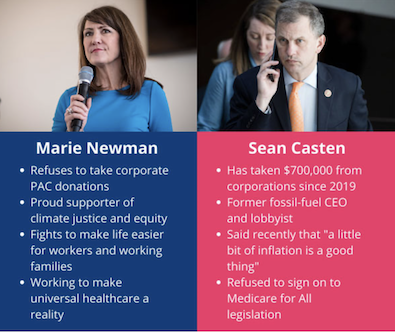
* From a Marie Newman fundraising email…
* Sen. Darren Bailey this morning during his daily live Facebook broadcast…
With the recent advent of the Irvin campaign, they are touting many legislators and many people supporting them. Yesterday, we discovered three people on their list, a state senator and a few others, who weren’t supposed to be on that list. Never gave them any permission. These lies and deception have got to stop, but it only stops when you get involved, when you truly find out what’s going on and you confront these people and tell them to knock it off.
I’ve asked for the list. I’ll let you know if I get it.
* Also from Sen. Bailey earlier this week on Facebook…
If you think Governor Pritzker’s actions, have been despicable over the last three years, which they have, friends, I’m going to contend that they are wholly nothing in comparison to what Democrat Richard Irvin, the candidate for governor on the Republican Party, is doing with the barrage of emails and text messages that I know you’re getting.
A complete twisting of truth. All out lies. I can’t even fathom someone like this in leadership.
You know, it’s interesting. Just look up the city of Aurora and compare it with other cities. You’re going to see the highest debt, you’re going to see the highest the pensions are funded at the one of the lowest levels. It’s ridiculous. You’re going to see a sanctuary city. You’re going to see a … mayor who actually embraced the sanctuary city when Governor Rauner brought this stuff in 2017, 2018. You’re going to see a may who’s embraced and literally held up everything that Mayor Lightfoot has done that JB Pritzker has done.
Friends, here’s the deal. This campaign has hijacked the Republican Party. Yesterday on GOP Database, that is something that we have access to in government to go back and look up voters, constituents to see, you know, where they stand at. Richard Irvin was switched yesterday morning to a hard Republican. Typically a hard Republican or a hard Democrat means that you voted straight through in the last four primaries. That’s what it is supposed to mean. But unfortunately, the Illinois Republican Party has allowed this. And you know, I don’t know if they did this, or there are several employees from the Illinois Republican Party and the Illinois Republican groups that have went to work with his campaign because they’re sitting on $20 million. People love to follow and fall for the money. But it is that mindset and principle that is destroying our society and destroying our state.
So I just simply asked you to educate yourself find the truth. I want to make sure that you understand something. These attacks that are being leveled against me, this is nothing new. I dealt with this when I primaried tax hiker in my district in 2017 and 2018, I dealt with it. It was the exact same group that was working with Governor Rauner. It’s the exact same group using the exact same methods. […]
So I just ask you to do your homework, look up the true facts of the city of Aurora. And look at the fact that Clay County and our school districts are the third lowest taxed in the state. And Governor, and Mayor Irvin’s city and county is the third highest taxed in the state and kind of put that correlation together and figure that out. […]
Money in and of itself is not a bad thing. Money is obviously needed to get the message out. But when you totally distort and try to change who you are, and then you totally, you can’t run on your own merits, but you run on tearing the other person down. Well, that’s a problem because then when you get in power, you destroy a state. We’ve seen it before, friends, and we’re not going to witness it again.
* Gary Rabine’s running mate Aaron Del Mar was in Normal this week…
Del Mar said crime rates in Chicago and throughout Illinois are concerning.
His plan for education involves improving school resources throughout the state.
“We want to give everyone an even playing field. That means all-day kindergarten, affordable day care for mothers who want to work and giving access to the best techniques and practices available,” Del Mar said. “Education should be accessible to everyone in Illinois, regardless of background.”
Del Mar noted how in his children’s school district in Palatine, students have access to Chromebooks, a resource that is not available throughout the state.
He said increasing educational access would include making those same improved resources available everywhere.
He sure doesn’t sound like Rabine.
* Politico…
Gilbert Villegas has picked up endorsements from Amalgamated Transit Union Local 241 and City Council colleague Sue Sadlowski Garza in his bid for the newly drawn 3rd Congressional District. Sadlowski Garza, the alderman who chairs the council’s Workforce and Development Committee and a former Chicago Teachers Union area VP, said Villegas “has integrity, is committed to getting the job done right, and is tenacious.” […]
Joliet firefighter seeks state Senate seat: Eric Mattson Mattson, who also is president of the union that represents Joliet firefighter supervisors, is a Democrat circulating petitions in 43rd District, reports Shaw Local’s Bob Okon.
Michael Rabbitt, Democratic candidate for state representative of the 15th House district has been endorsed by the 40th Ward Dems and Committeeperson Maggie O’Keefe, The People’s Lobby, Northside Democracy for America, and 39th Ward Neighbors United.
The story doesn’t elaborate because there’s zero interest in the beat over there, but this Mattson announcement sets up what could be an interesting primary…
Joliet Fire Department Capt. Eric Mattson is running for the state senate seat in the 43rd District.
Mattson, who also is president of the union that represents Joliet firefighter supervisors, is circulating petitions for the Democratic primary to be held June 28.
“I can make a difference,” Mattson said Wednesday of his candidacy for the seat now held by state Sen. John Connor, D-Lockport. Connor is not seeking reelection and plans to run for a vacant judicial seat in the Will County Circuit Court.
Also seeking the Democratic nomination for the 43rd District state senate seat is Will County Board Member Rachel Ventura, who announced her candidacy in June.
Also, Michael Rabbitt tried and failed to be appointed to the 15th District House seat when Rep. John D’Amico (D-Chicago) resigned last year. The district’s committeepersons replaced D’Amico with Michael Kelly, a Chicago firefighter. Rabbitt, who announced for the seat last fall against D’Amico, is also was backed by SEIU Healthcare during the appointment process, but the union hasn’t taken an official stand in the primary as of yet. More here.
19 Comments
|
*** UPDATED x2 *** COVID-19 roundup
Friday, Feb 25, 2022 - Posted by Rich Miller
* Hospitalizations are down 28 percent from last week’s report and are at their lowest number since August 3rd of last year. The case positivity rate is down 25 percent, to less than 2 percent. Deaths are down 14.9 percent. IDPH…
The Illinois Department of Public Health (IDPH) today reported 13,028 new confirmed and probable cases of coronavirus disease (COVID-19) in Illinois, including an increase of 355 deaths since February 18, 2022.
Currently, IDPH is reporting a total of 3,026,737 cases, including 32,654 deaths, in 102 counties in Illinois. The age of cases ranges from younger than one to older than 100 years. Since February 18, 2022, laboratories have reported 716,997 specimens for a total of 54,338,979. As of last night, 1,143 individuals in Illinois were reported to be in the hospital with COVID-19. Of those, 211 patients were in the ICU and 103 patients with COVID-19 were on ventilators.
The preliminary seven-day statewide positivity for cases as a percent of total test from February 18-24, 2022 is 1.8%. The preliminary seven-day statewide test positivity from February 18- 24, 2022 is 2.4%.
A total of 21,070,546 vaccines have been administered in Illinois as of last midnight. The seven-day rolling average of vaccines administered daily is 16,309 doses. Since February 18, 2022, 114,160 doses were reported administered in Illinois. Of Illinois’ total population, 76% has received at least one COVID-19 vaccine dose, more than 67% of Illinois’ total population is fully vaccinated, and almost 49% boosted according to data from the Centers for Disease Control and Prevention (CDC).
All data are provisional and will change. Additional information and COVID-19 data can be found at https://dph.illinois.gov/covid19.html.
Vaccination is the key to ending this pandemic. To find a COVID-19 vaccination location near you, go to www.vaccines.gov.
* From the governor’s office…
Due to the continued decrease in COVID-19 cases and hospitalizations, and increase in available ICU beds, the Illinois indoor mask requirement will end Monday, February 28, 2022, at 12:01 a.m. Since the Governor announced his plan to lift the indoor mask requirement, the number of people in the hospital with COVID-19 has been cut in half and the number of ICU beds available increased by 24%. Illinois’ weekly COVID-19 case rate has also decreased by 70%,
More than 8 million people in Illinois are fully vaccinated with an average of approximately 16,000 COVID-19 vaccines administered each day, including more than 4,600 first doses daily.
“Throughout this pandemic, we’ve taken action to save lives and keep our economy open – and I’m proud that Illinoisans have done the hard work that has our made our state a leader in the Midwest,” said Governor JB Pritzker. “Today, our hospitals are much better positioned to handle emergencies and more than half of all eligible adults have been boosted; this is the progress we needed to make to remove our state indoor masking requirements. As individuals, I encourage everyone to make the best choices going forward to protect your health, along with that of your family and community – and most importantly to treat each other with kindness and compassion.”
“We are now entering the third year of the COVID-19 pandemic and while our focus continues to be on preventing severe illness and ensuring our health care systems aren’t overwhelmed, we are also looking forward to how we will coexist with COVID-19,” said Illinois Department of Public Health Director Dr. Ngozi Ezike. “We each have a role to play in staying healthy and we have many tools that can help protect us from severe illness due to COVID-19. Our tools include readily available safe and effective vaccines, monoclonal antibody and oral antiviral treatments, at-home testing, as well as the personal health actions people can take such as avoiding crowds, hand washing, and continued mask wearing as may be recommended.”
Masks will still be required where federally mandated (including on public transit), health care facilities, congregate settings, long term care facilities, and daycare settings. Additionally, private businesses and municipalities may choose to implement their own masking requirements. Schools are urged to continue following state and federal guidance to help keep students and staff safe in the classroom. The Governor will review the results of lifting the indoor mask mandate before making any announcement regarding the school mask mandate.
In the last four months of 2021 following the reinstatement of Illinois’ mask mandate on August 30, 2021, Illinois had fewer COVID-19 hospitalizations per capita and fewer COVID-19 deaths per capita than the entire Great Lakes region. In the same period, Illinois out-tested the entire Midwest on a per capita basis, providing residents with significantly better access to testing than any of its neighbors. Even with a much greater testing capacity, Illinois saw fewer reported COVID-19 cases per capita during this time than neighbors such as Iowa and Missouri.
Illinois remains a standout in the Midwest for its vaccination rates. Illinois is home to the highest percentage of residents who have received a COVID-19 vaccine as well as the highest percentage of vaccinated and fully vaccinated 5–17-year-olds.
Vaccines continue to be readily available at pharmacies across the state, many local health departments, doctor offices, federally qualified health centers, and other locations. To find a COVID-19 vaccination location near you, go to www.vaccines.gov.
* Sam Adler-Bell in New York Magazine…
The pandemic briefly widened our aperture for reckoning with the pain and vulnerability of others, many of whom were suffering long before COVID-19 struck. Epidemiologists, meanwhile, encouraged us to take some responsibility for protecting them. But this created a problem. Such thinking chafes with American moral common sense. To maintain sanity in a country as bafflingly unequal as ours, you must convince yourself that your own comfort is causally (and morally) unrelated to the suffering of less fortunate strangers. The alternative is an acknowledgment of our interdependence that is, frankly, incompatible with our social order. In this sense, people who continue to insist on safeguarding the medically vulnerable are irrational, beset by a kind of madness.
* Some info on the BA.2 subvariant…
It’s not really new.
Scientists learned soon after the Omicron variant was first detected in November that it came in three genetically distinct varieties. They focused on BA.1, because it was about 1,000 times as prevalent as BA.2 in the early going; the third subvariant was rarer still. It was BA.1 that first broke out and raced around the world, while BA.2 took longer to become significant, but both have been on scientists’ radar from the outset.
It seems to be easier to catch.
All kinds of Omicron are highly contagious, which is why Omicron swiftly crowded out earlier variants like Delta and caused an immense global surge. But preliminary studies suggest that BA.2 is even more transmissible than BA.1. It has already become the dominant form of Omicron in a few countries and is gaining ground in others. Its potentially greater transmissibility has raised some concerns that BA.2 could cause a fresh spike or could lengthen the current one, but the jury is still out on whether that is likely to happen.
* More from NPR…
BA.2 has now been found from coast to coast and accounts for an estimated 3.9% all new infections nationally, according to the federal Centers for Disease Control and Prevention. It appears to be doubling fast.
“If it doubles again to 8%, that means we’re into the exponential growth phase and we may be staring at another wave of COVID-19 coming in the U.S.,” says Samuel Scarpino, the manager director of pathogen surveillance at the Rockefeller Foundation.
“And that’s of course the one we’re really worried about. We’re all on the edge of our seats,” he says.
Some experts think it’s unlikely BA.2 will trigger a massive new surge because so many people have immunity from prior infections and vaccination at this point.
* Rep. Dan Caulkins (R-Decatur) was asked yesterday if his anti-mask protests on the House floor “takes away from doing the people’s business, that it’s a distraction and it doesn’t allow for real work to be done”…
Well, I don’t think it’s interfered, what we’ve done is interfered with the real work being done at all. We haven’t seen any bills called for Third Reading. We’re going through a whole list of bills today. Just checking off the box. There’s nothing being voted on today on the House floor. There wasn’t anything of substance that’s being proposed. You know, Illinois is going down the tubes. We’ve got people that are leaving, what 100-plus thousand people every year abandon this state. And you know, we’re not doing the work of the people so that that argument doesn’t hold anymore.
Without the distractions from anti-mask drama addicts like Rep. Caulkins, the House passed 19 bills yesterday and 14 the day before.
*** UPDATE 1 *** US Rep. Underwood…
Today, Rep. Lauren Underwood (IL-14) released the following statement:
“Today, upon returning from an official trip overseas, I tested positive for COVID-19. I was tested throughout my trip and tested negative. I will be following guidelines from the CDC and House Attending Physician to isolate and keep others safe.”
“Thankfully, my symptoms are mild so far and I am grateful to have the protection of a safe vaccine and booster. I encourage everyone who hasn’t yet to get a vaccine and booster shot to help protect yourself and others from severe illness.”
*** UPDATE 2 *** Dave Druker with the Secretary of State’s office just called to say that, as of Monday, the public will not be required to wear masks when entering the Statehouse. That will not apply to offices and spaces controlled by the General Assembly and executive officers. But, the area around the rail on the 3rd Floor, for example, will be mask optional. Organized large group gatherings, however, are still not allowed. The same rules will apply to the Stratton Building.
23 Comments
|
* BGA…
The blind trust set up to manage Gov. J.B. Pritzker’s vast wealth bought stock in one of the state’s biggest Medicaid contractors in 2020, the same year his administration made several decisions that benefited the company’s bottom line.
The purchase of stock in health insurance giant Centene Corp. was made on behalf of the billionaire governor by trustees at Northern Trust, appointed by Pritzker to independently manage his portfolio to separate those investment decisions from his role as the state’s most powerful elected official.
The investment in Centene — which collected more than $2.6 billion from state Medicaid contracts in the first half of 2021 alone — demonstrates the pitfalls of a blind-trust arrangement that still leaves the nation’s richest governor open to potential conflicts of interest.
The acquisition by Pritzker’s trust came despite his campaign pledge to purge his personal portfolio of companies holding state contracts. He also promised, as governor-elect, to make charitable contributions matching gains in his trust’s holdings from entities that hold state contracts.
The issue of stock purchases by elected officials is now being debated in Congress, which is considering an array of strengthened stock disclosure laws aimed at stopping lawmakers from profiting from their access to insider information. The stock holdings of judges and federal banking officials also have come under scrutiny.
Experts interviewed by the Better Government Association say the governor could have avoided the potential conflict by instructing his trust managers to refrain from investing in state contractors. Pritzker’s spokespeople declined to say whether he ever considered doing so.
“I don’t see why a trustee couldn’t operate within those bounds — especially given that he seems to have acknowledged the potential of a conflict with his pledge” to divest of companies that hold state contracts, said Eleanor Eagan of the Center for Economic and Policy Research, based in Washington, D.C. […]
Experts interviewed by the BGA said there is a conflict of interest if the state has contracts with a company in which the governor’s trust holds stock.
“Absolutely,” said Eagan. “I don’t really see how one can argue otherwise.” […]
A BGA review of public records shows the purchase of Centene stock could have been made any time between Jan. 1, 2020, and Dec. 31, 2020. While the blind trust is designed to guard Pritzker from knowing when the investment in Centene was made, actions taken by his administration nevertheless benefitted the big health care company.
Starting in 2019 and continuing into 2020, Centene faced antitrust concerns during its $17 billion acquisition of Medicaid insurer Wellcare. The Pritzker administration helped Centene overcome federal antitrust scrutiny by reassigning thousands of Centene patients into other plans.
The state of Illinois also oversaw Centene’s June 2020 acquisition of state Medicaid contractor NextLevelHealth Partners. The transfer gave Centene a toehold in the lucrative Cook County Medicaid market.
You’d think in a long piece about an alleged conflict of interest there’d be some sort of disclosure that Ken Griffin, who is funding one of Pritzker’s opponents, is a major BGA contributor and was the recent beneficiary of a kissy-face profile by the BGA’s own president.
* Full statement from Pritzker attorney Marc Elias to the BGA…
As the documents we’ve provided outline, Governor Pritzker did not personally make any investments, nor was he involved in any discussions at any time regarding any investments. His blind trust is just that: blind. He receives no information regarding potential investments and does not receive monthly or quarterly reporting that would outline what investments he has or their worth. The only information he receives is a ready-to-file Statement of Economic Interest which contains no values. He has no knowledge of the trust’s current assets. To suggest otherwise is not only inaccurate, but potentially libelous.
Oof.
* Full statement from the Pritzker campaign to the BGA…
This story completely mischaracterizes Governor Pritzker’s blind trust and his alleged role in any investment. As we have said numerous times and is made clear in the documents prepared by the attorneys, Governor Pritzker’s trust is blind. This means he is not a part of any decisions nor does he have any information regarding any investments. He receives no regular reporting on what the trustees and investment advisors decide to purchase and plays no role in any investment decisions. Period. Any reporting that would suggest otherwise ignores critical facts and would be grossly inaccurate.
* Anyway, the ILGOP seemed ready with some pointed questions for the governor…
Questions That Need Answering
· Why didn’t the Governor avoid this conflict of interest by simply telling his trust managers to refrain from investing in state contractors?
· When was the stock in Centene originally purchased and how much has Pritzker profited from the investment?
· Will the Governor release all correspondence and documents relating to Centene since he became governor?
* Response to the ILGOP at my request from Natalie Edelstein at the Pritzker campaign…
The Governor does not communicate with the trust managers and only receives his Statement of Economic Interest, which lists the assets, to sign annually in order to fulfill his obligation under Illinois law.
Emphasis in original.
I have asked both the Pritzker campaign and the governor’s office if Pritzker has followed through on his pledge to contribute matching amounts to charity whatever his trust gains from entities that hold state contracts. I’ll let you know if I hear back, but gains occur when stocks are sold, so I dunno if an answer is yet possible.
* Richard Irvin hasn’t yet put out a statement about an hour after the BGA unveiled its story (it was in my spam folder)…
It’s pretty clear the Governor’s blind trust can see perfectly well, and the people of Illinois deserve to know the extent of Pritzker’s personal financial benefit off one of the largest state contracts. This story continues to raise serious concerns not only of the governor’s judgment but also his continued enabling of the same kind of Madigan corruption that’s been plaguing this state for decades.
* Two others on the Griffin slate also put out a statement. AG candidate Steve Kim…
“Now we see why JB Pritzker and Kwame Raoul have kept up this needless crusade on masks in schools: to call attention away from Pritzker’s own potential conflict of interest,” Attorney General Candidate Steve Kim said in a statement. “I want to fight for Illinois and do everything that we can so that everyone in this state knows their leaders are working for them, not for themselves. As Attorney General, I will work to root out this Madigan-style corruption that has permeated this state for decades.”
That’s a stretch.
* Former US Attorney John Milhiser…
“These are the kinds of corrupt practices that have made Illinois families so distrustful of the current state of our government,” Secretary of State candidate John Milhiser said in response to this news. “We need to put leaders with a record of fighting corruption in state government so that we can root out practices like these and take action to end the exodus of people from our state who are disgusted with the way the career Pritzker-Madigan politicians do business.”
* Also from Natalie Edelstein at the Pritzker campaign…
Today’s story by the BGA ignores and misstates critical details and completely mischaracterizes Governor Pritzker’s blind trust. Despite multiple attempts at clarifying that the Governor has no role in any investment decisions and only receives the information required by Illinois law to file his Statement of Economic Interest—which the BGA’s own article acknowledges––the BGA nonetheless knowingly misrepresented the facts.
Governor Pritzker did divest his personal portfolio of companies holding state contracts and then removed himself from all investment decisions. To suggest he broke “his campaign pledge” is false. The trustees provide Governor Pritzker only with an annual report of his assets, which contains no values, in order to sign his Statement of Economic Interests pursuant to the Illinois Governmental Ethics Act. The BGA is suggesting that because the governor is following the law, he is doing something wrong. Most assuredly if the governor did not file a Statement of Economic Interests, the BGA would be writing about how he was violating the law.
The story also misleadingly attempts to connect the Governor to a current debate in Congress over barring federal elected officials from making stock purchases. What the story fails to note is that this effort is being undertaken because members of Congress are personally engaged in trading stock, which Governor Pritzker is not. Governor Pritzker does not personally make any investments, nor has he been involved in any discussions at any time regarding any investments since taking office.
While we are gratified that the BGA has admitted that Governor Pritzker has no involvement in investment decisions, it is unfortunate that despite several good faith discussions with the BGA, they pursued a story that is not based in fact, but rather speculation. We’ve come to accept this type of reporting as the norm from this outlet-–an organization that has accepted hundreds of thousands of dollars from Ken Griffin, most recently accepting $100,000 from him in their latest tax filing, and did not disclose this relationship when the organization’s President and CEO wrote a story revealing Mr. Griffin’s endorsement in the Republican primary for Governor.
* Jordan Abudayyeh sent along this email back and forth with a BGA reporter…
Q: After Gov. became aware in April 2021 that his trust owned Centene stock, did he take any steps to recuse himself from decisions and actions pertaining to Centene or to Medicaid?
A: Centene was initially chosen as a provider during the prior administration in 2018. Since then, any contract renewals have been handled exclusively at the agency level. The Governor is not involved in the contracting process relating to Centene or in any contract management. Since the Governor is not involved, there is nothing he would have to recuse himself from.
We are reporting that JB ran for office in 2018 by criticizing former Gov. Bruce Rauner for being slow to recoup millions of dollars in profits taken by Centene and other Illinois Medicaid contractors: “While costs skyrocket for his secret Medicaid overhaul, Bruce Rauner is negligent in recouping tens of millions of dollars in overpayments to insurers,” Pritzker said in a March 2018 press release. “Incredible sums of taxpayer dollars are falling through the cracks, and there’s no one in charge to stand up for hardworking Illinoisans.”
We have previously spoken with you for our article showing Gov. Pritzker in 2020 worked to quash a proposed bill by Democrat State Senator Dave Koehler that aimed to “claw back” COVID-era profits from Medicaid contractors including Centene.
Would you consider that a fair and accurate summary?
This summary is not accurate. Here is why:
• First, existing law provides the authority for the state to claw back excessive profits. Through HFS’ Medical Loss Ratio guarantee, MCOs are contractually prohibited from making excessive profits. Under the MLR, at least 85% of MCO funding is required to go back to medical expenses. Furthermore, the department increased that to 88% as a result of the pandemic to prevent the “windfalls” the legislation you reference was attempting to target. Anything over that is “clawed back.” The 12% “profit” also covers operational and administrative expenses so you’re looking at a theoretical 2-3% profit margin for MCOs on average.
o As a result of the Medical Loss Ratio, HFS is currently estimating the department will recoup approximately $220 million from the MCOs in 2020. This will take place after the 18-month bill cycle for 2020 concludes later this year.
o The Medical Loss Ratio guarantee existed during the Rauner administration as well, but they failed to exercise this authority – as documented by the Auditor General. To quote an article from the time, “In one finding, Healthcare and Family Services left $65 million on the table from 2013 to 2015 by not collecting so-called medical-loss ratio refunds, or money owed the state because the MCO didn’t meet the percentage of direct-care costs it promised.”
• The legislation you are referencing would have violated federal requirements and put tens of millions of dollars of federal funding at risk – raising costs for Illinois taxpayers. It would have failed to provide a true accounting of MCO profits, which are calculated based on a full claims process that takes place over an 18-month period. An interim snapshot provides an inaccurate picture.
• To further illustrate the degree to which this approach runs counter to responsible accounting, while most MCOs appeared to be profiting at higher rates in earlier phases of the pandemic, since that time those profits have significantly decreased
*** UPDATE *** A bit of tit for tat oppo, perhaps? WBEZ…
With Chicago-area homicides, carjackings and expressway shootings all up in 2021, billionaire investment tycoon Kenneth Griffin minced no words last fall when he singled out one man, Democratic Gov. JB Pritzker, for not confronting the crime scourge terrorizing the region.
But while Griffin was deriding Pritzker’s response as a “disgrace,” Griffin’s $46 billion hedge fund — Citadel — and its corporate cousin had investments and holdings in gun and ammunition manufacturing companies, federal securities records show.
In fact, Chicago police data analyzed by WBEZ show that nearly one out of every four guns recovered from city homicides in the past five years came off the assembly lines of companies in which Citadel held shares — weapons that have played a role in the same, worsening crime wave that Griffin blames on the governor.
Griffin’s activism and bank account are shaping the Illinois Republican Party in this year’s election cycle as the GOP looks for big gains in Springfield. Griffin and his favored gubernatorial candidate, Aurora Mayor Richard Irvin, are focusing on crime as a defining issue to deprive the Democratic governor of a second term. […]
“These investments make up less than .01% of our portfolio,” Citadel spokesperson Zia Ahmed said, calling any links between the companies’ positions and violent crime in Chicago “quite a stretch.”
2022 fall election preview: The Irvin campaign will slam Pritzker for things like a shaky claim of conflict of interest while the Pritzker people will try to claim on the slimmest of evidence that Irvin is bankrolled by a guy whose investments are flooding the streets with guns.
64 Comments
|
* Capitol News Illinois…
A House revenue committee on Thursday heard projections of an Illinois economy that is steadily moving back toward a level of pre-pandemic normalcy, which means revenue spikes realized due to temporary changes in consumer spending habits and federal stimulus packages are expected to subside. […]
Specifically, revenues for the fiscal year ending on June 30 are expected to be about $4.6 billion greater than were projected when the governor signed the budget into law last year, according to a presentation by the Commission on Government Forecasting and Accountability.
COGFA expects state coffers will have taken in $48.5 billion by the end of the fiscal year, up from a $44.4 billion projection in the budget that lawmakers approved in May. The base state revenue sources actually grew by $4.6 billion, however, because the governor’s office amended its planned use of federal funds to offset General Revenue Fund spending downward by $500 million due to the surplus.
The updated FY 22 estimates include a $1.6 billion increase in personal income tax from initial expected levels, a $1.2 billion increase in corporate income tax, and a $926 million increase in sales tax revenue.
*** UPDATE 1 *** Jordan Abudayyeh…
This adjustment reflects CoGFA’s updated revenue forecast, but it is ‘only’ $695M higher than what was in the GOMB’s revised revenue forecast at the beginning of February, so this shouldn’t be a surprise to anyone who reviewed the November 2021 Economic & Fiscal Policy report or the Fiscal Year 2023 Budget Book. This additional revenue is what the Governor is proposing be directed to paying off delayed bills accruing unnecessary interest costs, investing in pensions, building up the Budget Stabilization Fund and covering one-time tax relief.
[ *** End Of Update *** ]
* Mike Miletich…
House Majority Leader Greg Harris (D-Chicago) explained Thursday that appropriations committees are talking with each state agency to discuss requests in the budget. Both chambers are also closely watching sudden shifts in the state’s revenue projections, for the good and the bad.
Gov. JB Pritzker’s proposed tax relief plan included in the budget relief on the unprecedented revenue. However, Harris said members must be careful with using that money.
“We’re gonna still continue to look at the more conservative side of the numbers because we know that things can go south pretty fast if there’s another variant or something else comes up,” Harris said. “And we want to be sure we plan for those contingencies.” […]
Another area in the budget is funding for mental health services. Members of both parties have acknowledged the toll this pandemic has taken on mental health, from those living in isolation to children struggling to keep up in school. Harris noted that suicides are up 200% since the start of the pandemic and cases of people dying from overdose have gone up 33% during that same time. Although, the waitlist for mental health care continues to grow.
“There’s 4,000 vacant positions in community health centers and substance abuse treatment centers across the state,” Harris said. “One of the things people are really supportive of in the governor’s introduced budget is this new major investment of $130 million into the workforce and into mental health treatment and substance abuse treatment. It can eliminate the waitlist, fully staff community-based service agencies, and begin to provide rapid trauma-informed care to people when they are in crisis.”
* Majority Leader Harris was also asked about the huge deficit in the state’s unemployment insurance trust fund and what’s happening now…
There is a bipartisan, multi-industry working group that’s made up of Democrats and Republicans from both chambers, the governor’s office IDES, but also the representatives of business and labor who are meeting regularly, they have been for a couple of weeks. Looking at defining the scope of the problem, what are the available potential solutions and coming back with a recommendation. So they’re continuing to meet. And obviously, the potential use of ARPA, like many other states have done, is certainly on their plate.
* The Motor Fuel Tax break was also a topic yesterday…
One concern Kevin Artl with the American Council of Engineering Companies of Illinois raised deals with the governor’s proposed freeze of the annual gas tax increase set for July 1. Artl said that could lead to funding gaps of half a billion dollars over five years.
“Our first preference is to keep that in place and make sure that we can keep the commitment of Rebuild Illinois [the state’s multi-year infrastructure plan passed in 2019] on to repair and modernize infrastructure, but we’re also realists and willing to work with all parties to find something that could work,” Artl said.
One idea Artl said is to adjust the sales tax that’s on top of the gas tax to provide relief for taxpayers.
*** UPDATE 2 *** Uh-oh. Yvette Shields at the Bond Buyer…
The Illinois Sports Facilities Authority projects a nearly $30 million shortfall in hotel tax revenues needed to repay a state advance for debt service on Soldier Field bonds, and Chicago will have to cover the gap absent other mitigation actions.
The authority has grappled with shortfalls over the last two years as hotel taxes — the primary source of bond repayment — plummeted amid the COVID-19 pandemic.
Over the last two years, the authority dipped into its own reserves and pushed off debt service through a $19 million scoop-and-toss restructuring in order to spare Chicago from having to cover the gap.
The authority’s willingness and ability to do it again is in question. The use of reserves contributed to a downgrade and some board members last year worried about the added burden of restructuring, so it remains unclear whether ISFA will find a way to cover the latest gap that again spares the city.
* Related…
* New state legislative session will focus on budget, Peters and Hunter say
15 Comments
|
Open thread
Friday, Feb 25, 2022 - Posted by Rich Miller
* Every 2-4 months I wake up with an eye stye. Usually, I just power through it and don’t even mention my situation. But I woke up a few hours ago and decided this would not be one of those power-through days and treated it and went back to bed.
You’re gonna be on your own for probably a couple of more hours while I do what I generally do to make this thing go away enough so I can work at least half comfortably.
Keep the conversation Illinois-centric, please. No international stuff, no national stuff, not even indirectly. Also, keep it civil. If even the Illinois House could manage to do so this week, I have faith that y’all can as well.
Thanks.
58 Comments
|
|
 Support CapitolFax.com
Visit our advertisers...

 ...............
 ...............
 ...............


|
   
|
Hosted by MCS |
SUBSCRIBE to Capitol Fax |
Advertise Here |
Mobile Version |
Contact Rich Miller
|



