* Press release…
Illinois bars and restaurants will have more options and more time to utilize the state’s “cocktails-to-go” program under a new law sponsored by State Senator Sara Feigenholtz (D-Chicago).
“Many business owners in the hospitality industry were worried about recovering from COVID-19-related losses to their business,” Feigenholtz said. “We passed cocktails-to-go last year as a response to the pandemic, and it was a lifeline to restaurants. Expanding this further to give struggling bars and restaurants more options for cash management is crucial.”
Senate Bill 104 is an expansion of a similar measure Feigenholtz sponsored last May permitting bars and restaurants to include cocktails as part of their delivery services. The new law adds single servings of wine to the list of allowed deliveries, and permits the inclusion of products that were sealed by the manufacturer to be delivered as well. In addition, the law extends the sunset on cocktails-to-go until Jan. 3, 2024. It was originally scheduled to sunset this month.
“Restaurants are the cornerstones of our neighborhoods,” Feigenholtz said. “We should do all that we can to help them as we emerge from a global pandemic that put the economy into turmoil.”
The measure also includes provision allowing bars and restaurants to offer one free drink with proof of vaccination. This voluntary promotion is set to expire on July 11, 2021.
The General Assembly approved the measure with bipartisan support, and it was signed into law by Gov. JB Pritzker on Wednesday.
* From the House sponsor and originator of the “shot and a beer” idea…
7 Comments  
|
* Click here for lots more Chicago-only poll results…
* Methodology…
The WGN-TV/Emerson College Chicago poll was conducted May 31-June 1, 2021. The sample consisted of Chicago registered voters, n=1000, with a Credibility Interval (CI) similar to a poll’s margin of error (MOE) of +/- 3 percentage points. The data sets were weighted by gender, age, education, region, and race based on the voting-age population in Chicago (Census Reporter). It is important to remember that subsets based on gender, age, ethnicity, and region carry with them higher margins of error, as the sample size is reduced. Data was collected using an Interactive Voice Response (IVR) system of landlines, a cell phone sample of SMS-to-web and an online panel.
33 Comments
|
* Heidi Dalenberg, Director of the Institutional Reform Project, ACLU of Illinois…
“A cursory examination of the capacity of DCFS reveals that the agency does not have adequate resources to fulfill their core mission - assuring the safety and permanency for youth in their care. Consider the reality: DCFS does not have enough workers to investigate allegations of abuse and neglect, does not have enough caseworkers to help children return to their families or find a permanent home with other loving adults, does not have enough community-based services to help children with significant mental or behavioral health problems, and does not have enough doctors or enough residential facilities to safely care for those same youth.
None of these problems are addressed in the budget adopted for the new fiscal year. Instead, the budget appears to believe that DCFS is about to enjoy a series of miracles, starting with a reversal of the years-long trend of adding thousands more children to the total youth in DCFS care. We would love to live in the world where miracles are possible. The children in DCFS care live in the real world. Every day, DCFS underserves children to such a gross degree that its mistreatment exceeds the ‘offenses’ that DCFS labeled as abuse or neglect when taking the children from their families.
DCFS cannot fulfill its obligation to the children in its care with the budget it requested. We can only hope that if the miracles DCFS is counting on do not materialize, the Department comes to the Legislature for supplemental funding.”
* I asked for some specifics…
Trend of system growth:
According to DCFS’ prepared numbers, the system has been growing as follows, measured at the end of the FY:
FY 2018 closed with 17,463 youth in care
FY 2019 closed with 18,568
FY 2020 closed with 21,099
FY 2021 ESTIMATE is that we will be at 23,238
FY 2022 PROJECTION is 23,544 – essentially flat growth, with no significant change in DCFS practices in place.
Inadequate care of youth in DCFS custody – most extreme example is youth with significant mental / behavioral health needs who are not getting the treatment they need. We have approximately 10 youth per month, since the YouthCare MCO rollout, who have had what we consider “unaddressed” mental health crises. What that looks like is that a call is made for a provider to come out and do an emergency assessment of a youth whose behavior is out of control. The youth either needs stabilization services – and does not get them – or needs a psych hospitalization – and does not get it. The result is that the youth is taken to a hospital emergency room and may sit there for 2 days, 3 days, 5 days, or even longer. The youth eventually gets sent home from the emergency room without receiving appropriate treatment, and has been re-traumatized by this latest experience.
Inadequate placement capacity - Illinois has made little, if any, progress in building community-based supports for youth so that they can be “placed” in family settings rather than in residential facilities. But at the same time, the residential facilities are bleeding staff – they are unable to recruit and retain. By the end of the year we expect that more than 70 congregate care beds will have closed, in large part because providers cannot responsibly keep them open due to staff shortages. Two agencies are shutting down their foster care programs. Provider capacity for Intact family services is shrinking as well in some areas of the state. I believe ICOY has issued a statement about the newly passed budget that contains these figures and has more detail.
What does that look like for children? When a youth is entering care or disrupting from an existing placement, and has significant behavioral or mental health issues, Illinois has nowhere for the child to go. The Department is resorting to use of “unoccupied” bed space at residential facilities – where there is no program in place for the child, no education, no counseling, and no services during the child’s stay – and has one-on-one supervision of the child that is provided by the child’s caseworker. This can go on for weeks.
Inadequate staff of workers to investigate abuse and neglect allegations.
The most recent report we have received regarding the personnel available to conduct investigations shows that the Department is more than 100 workers short of its estimated headcount need. The pattern of vacancies is not consistent across the state – some areas are sufficiently staffed, but other offices are facing critical shortages that push the workers’ caseloads far above BH limits. The worst of the offices are understaffed by 40% or more. DCFS is putting in place emergency measures to support the hardest hit offices, but the shortage of workers continues to be a serious and dangerous problem.
*** UPDATE 1 *** Governor’s office…
Since taking office, Governor Pritzker has increased DCFS’ budget by $340 million. Most of the year over year budget increases funded increased staffing, caseload growth, rate adjustments and IT improvements for the agency’s case management system. DCFS is also making tremendous strides in hiring staff after prior administrations oversaw the hollowing out of the agency.
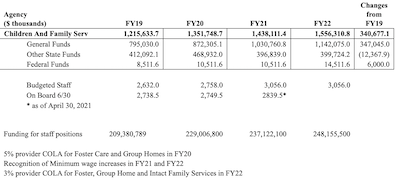
*** UPDATE 2 *** Andrea Durbin at the Illinois Collaboration on Youth…
Hi Rich,
Thanks for sharing the information from the ACLU. It is true that current staffing shortages within the child welfare system have created potentially dangerous conditions for the children and youth in the system. One aspect of the child welfare system that is frequently misunderstood is that it is not DCFS alone. Illinois has given full case management responsibility for approximately 85% of children in care to community-based organizations, as well as the case management responsibility for most of the families served through intact family services. While DCFS itself has been making strides in addressing the workforce challenges in the public sector, the workforce shortages plaguing community-based organizations have been persistent and dramatic, placing children at risk.
For example, providers are reporting foster care caseload ratios at 21 or 22:1, which is significantly higher than the 15:1 maximum imposed by the Federal consent decree in BH v Smith. These ratios persist even when supervisors and other eligible staff, including program leadership, are forced to carry direct service cases to ensure the safety of children in their care.
Residential treatment programs report staffing at between 63%-68% of capacity, resulting in program closures and long waiting lists at a time when children are living in hospital emergency rooms for days at a time and stuck in psychiatric hospitals for months beyond medical necessity due to a lack of adequate care options for them.
Over the past five years the number of children and families in care has steadily grown. At a time when we should be expanding capacity within the child welfare system, instead we are seeing system contraction. A recent survey of child welfare providers revealed that:
57% of respondents had voluntarily put their agencies on intake hold during the past 18 months
More than 70 congregate care beds have been closed or are closing by the end of this year, on top of the more than 500 beds that were closed during the past 5 years
At least two agencies are shutting down their foster care programs – one in the Chicago/Cook County region and another in six counties in Central Illinois. Some intact family services are also being closed in those same counties.
This workforce crisis is built into the contracts that community-based providers get from DCFS. For example, community-based contracts are structured around paying an intact family caseworker $32,000/year, or just slightly above the $15/hr minimum wage. That same position advertised on the state’s CMS website starts above $55,000/year. Providers are forced to offer wages comparable to fast food and retail jobs for positions that require bachelor’s degrees in human services and special trainings and certifications. In this tight labor market, it is no surprise that they struggle to recruit qualified staff for these essential jobs.
This is not a problem that has happened overnight and it is not going to be fixed overnight. We were heartened to see the letter from Acting Director Smith today assuring providers that there will be a 3% rate increase in FY22 to community-based contracts as well as the establishment of a rate methodology workgroup to address long-term sustainability of these essential services. We look forward to working in partnership with Acting Director Smith and the Governor’s office to address these urgent concerns. The children and youth in our care are counting on us.
Thanks,
Andi
A letter from Director Smith is here.
17 Comments
|
* The governor announced this week that the state is still on track to fully reopen on June 11. I think I will discontinue this daily posting on that date, while still keeping an eye on things, of course. Your thoughts?…
The Illinois Department of Public Health (IDPH) today reported 478 new confirmed and probable cases of coronavirus disease (COVID-19) in Illinois, including 9 additional deaths. In addition, more than 67% of Illinois adults have received at least one COVID-19 vaccine dose and nearly 51% of Illinois adults are fully vaccinated, according to data from the Centers for Disease Control and Prevention.
Cook County: 1 female 50s, 1 female 60s, 1 male 60s, 1 female 70s, 1 female 90s
Kane County: 1 male 80s
McLean County: 1 male 40s
Rock Island County: 1 female 70s
Will County: 1 female 80s
Currently, IDPH is reporting a total of 1,383,065 cases, including 22,842 deaths, in 102 counties in Illinois. The age of cases ranges from younger than one to older than 100 years. Within the past 24 hours, laboratories have reported 35,697 specimens for a total of 24,676,057. As of last night, 1,013 individuals in Illinois were reported to be in the hospital with COVID-19. Of those, 278 patients were in the ICU and 150 patients with COVID-19 were on ventilators.
The preliminary seven-day statewide positivity for cases as a percent of total test from May 26-June 1, 2021 is 1.5%. The preliminary seven-day statewide test positivity from May 26-June 1, 2021 is 1.8%.
A total of 11,338,305 vaccines have been administered in Illinois as of last midnight. The seven-day rolling average of vaccines administered daily is 41,234 doses. Yesterday, 29,322 doses were reported administered in Illinois.
*All data are provisional and will change. In order to rapidly report COVID-19 information to the public, data are being reported in-time. Information is constantly being entered into an electronic system and the number of cases and deaths can change as additional information is gathered. Information for previously reported deaths has changed, therefore, today’s numbers have been adjusted. For health questions about COVID-19, call the hotline at 1-800-889-3931 or email dph.sick@illinois.gov.
30 Comments
|
Vaccines, jobs and childcare
Wednesday, Jun 2, 2021 - Posted by Rich Miller
* Chief Economist at Grant Thornton and adviser to the Federal Reserve…
* Gov. Pritzker was asked today about the topic of getting people back to work…
I think there are a variety of things. Look, the pandemic is still with us. For those who’ve been vaccinated, the impact, the effect is much less than it was. For many people who have not been vaccinated yet, they need to get vaccinated, and we want to make sure that everybody gets back to work.
But it’s reasonable for people to feel somewhat concerned, as they have for the last 15 months, that getting back to work might be a difficult endeavor for them with the pandemic still upon us. We want people to get vaccinated so that they’ll get back to work. But I just want to point out, that’s one reason that people haven’t gotten back to work, still a concern, a fear, perhaps, that they might get COVID, or that others who enter a location might have COVID. So that’s one thing.
A second is that there are many, many women who, particularly women, who chose not to go back into the workforce yet, in fact, they stepped out of the workforce to take care of their children, or an elderly parent or someone else. And they’re still doing that. And it’s difficult for them, as childcare is still ramping back up, to find the childcare that they need, so that they can go out and get a job. So that’s another portion of people.
And then, I think that there may be people who are on unemployment right now, and who aren’t able to find a job that pays enough for them to pay their bills. Now, there’s, again, those three things are working together, perhaps, to keep some people from seeking out jobs.
But I would say that a lot of people are getting back to work a lot of people. And the fact that there’s so much sort of help wanted out there that help wanted signs are everywhere, is a great sign for the future of the economy of our state. And I’m looking forward, frankly, to people getting back to work as they have been over the number of months since January since people started getting vaccinated.
* Getting childcare ain’t easy for those same three reasons. Also, add in a demand shift…
A Bureau of Labor Statistics analysis shows that the child care workforce is down 15% from pre-pandemic to now, a significant challenge for the 16% of the overall workforce — or 26.8 million people — who depend on child care to work. Roughly 35% of child care workers were laid off in the early stages of the pandemic, says Rasheed Malik, senior policy analyst for Early Childhood Policy for the Center for American Progress (CAP), and only about half of those have returned in the last nine months.
There were hopes that more workers would come back as states prioritized child care workers for early vaccinations, but re-hiring has lagged. Malik believes that in an uncertain economy — with workers unsure they want to return to low-wage jobs and incentives offered in other industries — the staffing dilemma has become worse.
Part of the problem comes from a dramatic demand shift. Winnie, an online platform for finding child care, analyzed requests for care between February 2020 and 2021 among its network of 200,000 locations, and found a striking disparity between suburban and urban locations. Demand for open slots in child care centers had dropped in downtowns and big cities, meaning a big jump in available capacity, while many wealthy suburbs have seen demand for care skyrocket, shrinking capacity. Child care is a slow-moving, highly regulated industry — one can’t simply open up a new location overnight — so even small demand and population shifts disrupt a tenuous equilibrium.
“In suburban markets, families are searching, but new supply doesn’t exist, so it’s harder to get a spot,” says Sara Mauskopf, CEO of Winnie.
The shifts were consistent across the nation’s 10 largest metros; demand for care was down in urban centers and downtowns, and sharply up in more-distant suburban areas. (In the Bay Area, however, there was lower demand in urban and suburban locations across the board.) Take the Chicago metro area; in the city and Evanston, a neighboring suburb to the north with a large student population, the demand-to-supply ratio plunged 236% and 120%, respectively, while in areas further from the city, such as Naperville and Bolingbrook, it grew 57% and 52%.
* Related…
* Stimulus Checks Substantially Reduced Hardship, Study Shows: A new analysis of Census Bureau surveys argues that the two latest rounds of aid significantly improved Americans’ ability to buy food and pay household bills and reduced anxiety and depression, with the largest benefits going to the poorest households and those with children. The analysis offers the fullest look at hardship reduction under the stimulus aid.
* Despite vaccines, nursing homes struggle with outbreaks: COVID-19 vaccines have allowed nursing homes in the U.S. to make dramatic progress since the dark days of the pandemic, but senior care facilities are still experiencing scattered outbreaks that are largely blamed on unvaccinated staff members.
* As some mass COVID-19 vaccination sites close, next stage is doctor’s offices: New rules for storing Pfizer’s vaccine make that shift easier, Lake County’s public health chief explained.
* Illinois planning to offer a lottery for vaccinated residents
12 Comments
|
Man bites dog
Wednesday, Jun 2, 2021 - Posted by Rich Miller
* Center Square…
Democrats and Republicans have differing opinions on the $42 billion spending plan that was revealed just hours before passing.
Business groups had mixed reactions.
“REPUBLICANS MAD!” is a much-told story this session (like, multiple times a day), but Greg Bishop actually found a business group that didn’t completely dump all over the budget? What, pray tell, might that one be?
* Scroll to the end…
Illinois Chamber of Commerce President Todd Maisch also criticized the lack of money for the unemployment trust fund and decreased tax credits. But, on WMAY he did praise lawmakers’ decision to include paying down debt in the budget.
“And that is a good idea, we have to go ahead and reinforce that,” Maisch said. “Wherever you are on the political spectrum, paying down debt is a really important concept.”
Maisch also praised the hundreds of millions in federal funds outlined to support the state’s tourism and hospitality sector.
13 Comments
|
Reform groups slam ethics bill
Wednesday, Jun 2, 2021 - Posted by Rich Miller
* Let’s start with a proponent…
On May 31, the Senate and House approved a package of reforms that address some of Illinois’ most glaring ethical problems. State Senator John Curran (R-Downers Grove), a former Cook County Prosecutor, was the lead Senate Republican negotiator of the bill.
“With every new indictment or arrest of an elected official, the people of Illinois lose more faith in their government,” said Sen. Curran. “Through give-and-take bipartisan negotiations, today we took a large step forward in delivering real ethics reform. Through SB 539, we will hold elected officials to a higher ethical standard and we will empower our Legislative Inspector General (LIG) to independently investigate allegations of political corruption without first having to obtain permission to investigate from a panel of sitting lawmakers. This new level of autonomy is a crucial element of the reforms we passed today.”
SB 539 includes the following provisions:
· Allows the Legislative Inspector General to initiate a political corruption investigation without approval from the Legislative Ethics Commission;
· Reforms and strengthens the statement of economic interest disclosures by adding new disclosure requirements for legislators and their spouses, including disclosure of debts; and
· Prohibits legislators from leaving office and lobbying the General Assembly during the term they were sworn into for six months;
· Requires consultants to register and for lobbyists to disclose any contractual relationship with a consultant for the purpose of influencing the legislature;
· Prohibits fundraisers across Illinois on session days or the day before or after a session day;
“Through negotiations, Republican ideas were brought to the table, resulting in a more robust ethics package,” added Sen. Curran. “While there are still several components we would have liked to have seen in the final bill, the reforms we are sending to the Governor have teeth, and is a positive first step in restoring the public’s trust in state government.”
Sen. Curran said additional improvements in a future bill should include providing the LIG with subpoena powers, a provision that allows the Illinois Attorney General the ability to use a statewide grand jury to investigate, indict, and prosecute public corruption crimes, and an even stronger legislator-to-lobbyist revolving door.
“We must continue to build upon these bipartisan negotiations, in which we respected each other’s priorities, and continue to work to create a more ethical government that is free of corruption and which truly works for the people of Illinois,” Sen. Curran said. “While there is no denying there is a lot more we can do on ethics, I am pleased to know our spring session did not end without sending meaningful ethics reforms to the Governor.”
The two things I wanted most out of an ethics bill were the Monday fundraising ban and the consultant registration.
* On to the opposition. Reform for Illinois…
Yesterday, the General Assembly passed SB539, a long-awaited ethics omnibus bill. After endless scandals and indictments, we had hoped for comprehensive reform that would help restore Illinoisans’ confidence in their government. While SB539 takes some steps in the right direction, we are disappointed in the bill’s failure to make the hard choices necessary to uproot the culture of corruption that has harmed Illinoisans for years and earned our state government the lowest trust rating in the country.
Reform for Illinois has stood with its fellow good-government organizations—the Better Government Association, CHANGE Illinois, and Common Cause Illinois—and identified the ethics updates our state most sorely needs. The new bill makes some positive changes, including banning some legislator-lobbyists and requiring disclosure of lobbying consultants, which RFI proposed last year.
But SB539 falls short in key areas. For example, the bill:
—Bans former lawmakers from lobbying for just six months, a “bottom of the barrel” waiting period. A revolving door ban of just half a year will put Illinois behind 36 states that have a cooling-off period of at least one year, and well below the recommended prohibition of two years implemented in a dozen states. And there would be no waiting period at all for ex-legislators lobbying a new General Assembly–they could leave on the last day of session and be back on the first day of the next one to lobby their former colleagues.
—Fails to give the Legislative Inspector General’s office the tools it needs to exercise truly independent ethics oversight over lawmakers. SB539 takes a step in the right direction by enabling the Legislative Inspector General to launch investigations without the approval of the Legislative Ethics Commission.
But the Inspector General will still need to ask permission from the Commission–a body made up entirely of current and former legislators–to issue subpoenas or publish reports finding wrongdoing. This gives lawmakers ample opportunity to hamper or suppress investigations into their colleagues.
This bill will do nothing to solve the problem former Inspector General Julie Porter identified when she claimed legislators quashed her report finding “serious wrongdoing by a sitting legislator.”
SB539 also adds new and unnecessary limits on the Inspector General’s jurisdiction, and misses an opportunity to improve independence and transparency by requiring the appointment of members of the public to the Ethics Commission.
In short, we still don’t have truly independent oversight of the legislature–the fox is still guarding the henhouse.
—Aims to prohibit lobbying by elected officials but creates a loophole. As we learned from the Luis Arroyo case, sitting lawmakers shouldn’t be allowed to be lobbyists. Under the new law, members of the General Assembly will be prohibited from lobbying state or local governments, but only on behalf of entities registered to lobby the General Assembly. That opens the possibility that legislators may still be able to take some lobbying jobs that could conflict with their obligations to the public.
—Fails to provide essential information about legislators’ possible conflicts of interest. While the bill makes some improvements on the old economic disclosure forms (called “none sheets” for their lack of information), other states require lawmakers to disclose much more information about the value and sources of income that may cause conflicts with their legislative work. For example, an official who received a $100,000 consulting fee from ComEd could have a much more serious conflict than one who received $7,600, but their answers on the new forms would be the same. We can do better.
Lawmakers say this bill is just the beginning for ethics reform, and we hope to take them at their word. But how much longer will Illinoisans have to wait? After so many years of corruption and scandal, they deserve real change now.
* Change Illinois…
After years of ethical lapses resulting in lawmaker and political insider indictment-after-indictment, elected officials yet again fell short on delivering meaningful reforms to Illinoisans that would begin to restore their trust in government.
New House Speaker Chris Welch repeatedly promised a new day in Springfield and a meaningful ethics package and Gov. J.B. Pritzker also had called for reforms, but what was approved this session is a far cry from what’s needed and only serves to diminish voters’ hopes for stronger laws to guide officials’ actions.
After nearly two years of talk and work on ethics reforms, we’ve seen a do-nothing commission that did not even bother to publish a final report and an attempt to rush through ethics proposals in the middle of the night in a previous session. CHANGE Illinois, the Better Government Association, Common Cause Illinois and Reform Illinois have been unified in saying we need this serious package of reforms as a starting point:
Banning state lawmakers from lobbying local governments
Implementing a two-year revolving-door ban preventing former lawmakers from immediately lobbying colleagues
Strengthening the conflict of interest disclosure and recusal requirements
Fully empowering the Legislative Inspector General to operate independently
The ethics bill that will be sent to Pritzker falls short on all four issues. Only lawmakers lobbying local governments was addressed in a substantial way. Overall, this package is yet another example of the weak approaches we’ve seen in previous years that have done nothing to curb the continued cycle of corruption scandals that Illinois is infamous for across the nation. It reminds us of the campaign finance reform approved years ago after former Gov. Rod Blagojevich’s impeachment that was supposed to have been a “first step” toward more substantive improvements. Those subsequent steps never materialized and we cannot allow that to happen again with this effort.
The revolving-door ban on lawmakers becoming lobbyists included in the package falls severely short. The six-month ban is the lowest in the nation, putting Illinois at the bottom of the list.
The proposal does include needed improvements to annual financial disclosures officials must file. However, it lacks teeth without a recusal requirement. Any lawmaker still can have a conflict of interest and continue to vote in favor or against legislation that affects them personally without any repercussions.
The bare minimum also was done to give the Legislative Inspector General’s (LIG) office more independence to truly act as a watchdog. The proposal only allows for the LIG to start investigations without lawmaker approval for incidents that happened within the previous year. And it still requires the LIG to seek permission from the very elected officials it is supposed to investigate to collect necessary information for its probes. The LIG also still must seek lawmaker approval to publish reports when the office finds wrongdoing has occurred, yet another example of lawmakers trying to protect themselves.
Given the state we’re in, this is not nearly enough. This ethics bill must not be the last attempt to curb bad actors from further damaging the people’s trust in our government. As federal prosecutors continue to probe corruption in state government and new indictments come to light, Illinoisans must renew their call for stronger reforms. The people know we need stronger improvements that truly will signal lawmakers are serious about charting a new path forward, rather than relying on the same old playbook from the past that allows too many bad actors to tarnish the reputation of all of Illinois’ elected officeholders.
* BGA…
The Better Government Association stands with Reform for Illinois, Common Cause Illinois and CHANGE Illinois in voicing deep disappointment with the feeble ethics bill passed May 31 by the General Assembly.
The bill, which cleared both houses and soon will be on its way to Gov. J.B. Pritzker, contains some incremental improvements that are long overdue. But this legislation has been 18 months in the making. It’s fair to ask: Is that all?
The work of the Joint Commission on Ethics and Lobbying Reform highlighted many deficiencies in the state’s ethics laws. This legislation barely scratches the surface.
This follows an unfortunate historic pattern: Elected officials promised to clean up Illinois government in response to the licenses-for-bribes scandal that sent Gov. George Ryan to prison, and again after the impeachment and conviction of Gov. Rod Blagojevich. Many of the reforms that didn’t happen then didn’t happen this time, either.
This moment calls for much more than our lawmakers have delivered.
The BGA and its allies have advocated for a package of reforms that collectively would ensure that public officials act in the public interest and not their own. The bill approved by the General Assembly comes up short in every category.
Thoughts?
* Related…
* State’s new ethics rules under fire from unlikely source
20 Comments
|
* Tribune yesterday…
The Senate voted 42-17, and the House followed with a 79-36 vote, to approve a package of changes to a policing reform law set to begin in July. But reflecting tensions within the Democratic caucus, a parliamentary hold was placed on the bill, keeping it from being sent to the governor.
The new policing law was a major plank of the Illinois Legislative Black Caucus social justice platform. It included a ban on police chokeholds, a requirement that police wear body cameras by 2025 and expanded training on use of force and crisis intervention. It also allows for anonymous police misconduct complaints.
The proposed changes would allow an officer to view his own body camera video before writing a police report, require that a felony violation of body camera requirements be proven to be intentional and an attempt to obstruct justice, revise the definition of chokeholds and remove a ban on targeting someone’s back with a Taser. […]
But the changes caused some tension, particularly within the Black Caucus. State Rep. Curtis Tarver, D-Chicago, noted that law enforcement, which opposed much of the original law, didn’t oppose the new changes. “People don’t oppose things when we start clawing them back and watering them down,” said Tarver, who voted against the measure.
Rep. Sonya Harper filed a motion to reconsider the vote after the bill passed and withdrew it today.
6 Comments
|
ComEd case defendants argue for dismissal
Wednesday, Jun 2, 2021 - Posted by Rich Miller
* Sun-Times…
Members of former House Speaker Michael Madigan’s inner circle argued Tuesday that their indictment in the ComEd bribery scandal suffers from a series of “fatal” gaps — including the lack of a clear quid pro quo.
Lawyers for Madigan confidant Michael McClain, former ComEd CEO Anne Pramaggiore, onetime ComEd lobbyist John Hooker and ex-City Club President Jay Doherty made their argument in a lengthy court memo, hoping to convince U.S. District Judge Harry Leinenweber to toss certain counts in the indictment.
The four are accused of arranging for Madigan’s associates and allies to get jobs, contracts and money in order to influence him as lawmakers considered legislation that would affect ComEd. Their indictment in November prompted fiery statements from their defense attorneys, a sign that several legal challenges would be forthcoming.
Doherty filed a separate motion to dismiss last month.
* Tribune…
The filing argued that the U.S. attorney’s office has improperly used the federal bribery statute to criminalize recommendations forwarded by Madigan to ComEd officials — what the defense lawyers called a routine practice that falls well within the bounds of legal political horse-trading.
“The government does not allege any connection between the jobs and any actions by (Madigan),” the filing stated. “Adopting the government’s view would put huge numbers of American citizens at risk of prosecution for their ordinary participation in the political process.”
* CBS 2…
“The indictment loosely strings together an assortment of events over a ten-year period of time—largely hiring decisions made by ComEd made at the recommendation of Public Official A—and alleges that, because such recommendations were made in the same decade that legislation affecting ComEd was passed, a crime must have been committed. But the indictment fails to allege any connection between these hiring decisions and any agreement or understanding with Public Official A that he would take (or refrain from) any action on ComEd’s behalf in exchange for the things of value Defendants allegedly provided,” attorneys wrote.
Further, the defense team argued that accepting federal prosecutors’ stance that an explicit quid pro quo is not necessary to uphold the bribery charges “would put huge numbers of American citizens at risk of prosecution for their ordinary participation in the political process.”
“These gaps are fatal to the indictment because giving things of value to public officials can be perfectly legal. The Supreme Court has unanimously held that it is not a crime to give something to a public official ‘to build a reservoir of goodwill that might ultimately affect one or more of a multitude of unspecified acts, now and in the future,’” defense attorneys wrote.
The attorneys argued that allowing the bribery charges to stand without an explicit quid pro quo “would provide the government essentially unlimited discretion to prosecute anyone who has provided a benefit to a public official, and convict them on evidence that the public official took some official act that the defendant favored, without ever proving that the official’s actions were taken in exchange for the benefit provided, or even that the defendant understood or expected that the benefit would influence the official’s actions.”
“Such unfettered discretion is an open invitation for arbitrary and discriminatory enforcement. It surely cannot be the case that public officials commit a crime each time they make a job recommendation, nor can it be a crime each time a company accepts such a recommendation,” defense attorneys added.
Click here to read the memo supporting the motion to dismiss.
18 Comments
|
Chicago elected school board roundup
Wednesday, Jun 2, 2021 - Posted by Rich Miller
* WTTW…
The city of Chicago could begin holding elections for seats on the Board of Education as soon as 2024, with a fully elected school board in place by 2027, under legislation approved Tuesday evening by the Illinois Senate.
Chicago Public Schools is currently the lone district in Illinois with a school board appointed by the mayor. But under the new bill, the Chicago Board of Education would transition, first in 2024 to a hybrid board made of elected and appointed members, before fully transforming into an elected body by 2027.
The bill was approved by the state Senate with 36 yeas, 15 nays and two members abstaining. It will now go back to the Illinois House for another vote.
Under the legislation, Chicago would be divided into 10 separate electoral districts for the 2024 elections and into 20 districts for the 2026 elections. From January 2025 to January 2027, each district would be represented both by one elected member serving a four-year term and one appointed member serving a two-year term.
“A 20-member board ensures that every corner of the city has the ability to elect someone that they know, who has worked in their community, has been involved in (local school councils) and has been involved in PTAs and has been involved in community groups and neighborhood groups and their participation matters more than their money,” bill sponsor and state Sen. Rob Martwick, D-Chicago, said during a committee hearing Tuesday.
* Understatement from Fox 32…
In the latest sign that Lightfoot’s standing in the state capitol is unusually weak for a Chicago mayor, her objections did nothing to prevent the measure passing by a vote of 36 to 15, with two senators voting “present.”
* This was not a surprise. The Senate President said he was passing a bill this spring to provide for an elected school board and that’s what happened. Yes, some provisions were added late, but that’s normal. Chicago was warned not to try to stall an issue that has been percolating for years, but that’s just what they tried to do yesterday…
Within two hours of the compromise amendment being made public, some high-profile policymakers raised questions about the new language and called on lawmakers to pause before proceeding. Chicago’s deputy mayor of education, Sybil Madison, warned that provisions on who could run for the seats did not bar union leadership. Others asked about campaign-spending limits and why they didn’t appear in the measure.
However, the Senate executive committee passed the bill as amended with nine members in favor of the bill, five opposed, and two who voted present.
Tuesday brought the most heated public debate so far on the issue, as supporters and critics of the bill were suddenly put on notice to testify.
“I, too, have to scramble to be ready to participate this afternoon,” said Miguel del Valle, the current president of the Chicago Board of Education. He said he’d campaigned publicly for an elected school board for a decade but couldn’t support a 21-person body. “We can’t have a school board that is twice as large as the largest elected school board in the country. Down the road, I could see dysfunction, stalemates, all kinds of issues.”
Tuesday’s “overtime” brought a surprise ending to a lengthy spring session that was supposed to end at midnight Monday.
* WBEZ…
The bill passed by the senate would put a moratorium on school closings until 2025, which is a concession to proponents who are disappointed they will have to wait years for a fully elected board.
Also, it creates a mayoral-appointed advisory committee to represent the interests of undocumented residents, who currently can’t run for the board. Lightfoot said one reason she opposed the elected school board bill is that non-citizens can’t run.
The change from an appointed board to an elected school board in Chicago is huge. The closest the city has come to anything like an elected board is a community nomination process for board members that once existed.
* Sun-Times…
The mayor’s office was particularly interested in preventing Chicago Teachers Union leaders from running for school board seats.
The amendment as it stands already prevents any CPS employees from seeking a board seat. Most CTU officers are still employed by the district but are on leave for union work — making them ineligible for a seat under this proposal.
Sen. Michael Hastings, D-Tinley Park, the majority whip, called the mayor’s request “absurd” and “undemocratic.”
“Where else in the history of Illinois have we precluded someone from running for office outside of a felony?” he asked Madison. She said the mayor’s position is that a CTU leader, or anyone with an organization that has a contract with the district, would have a conflict of interest and couldn’t serve on the school board.
* The poison pill gambit didn’t work…
Some education activists who had pushed for a requirement that a certain percentage of the board include CPS parents walked away unhappy, as did members of the Latino Caucus who wanted noncitizens to have the ability to run for the board instead of the noncitizen advisory panel included in the bill. The provision was left out in an effort to secure votes from suburban and Downstate Democrats, sources familiar with the negotiations said.
60-30-1.
* More from the Tribune…
The legislation also does not address the fact that City Hall subsidizes CPS with payments of some $500 million per year, much of it going toward pensions.
“The city of Chicago, which has the worst rated credit of any major city in the country, and the Chicago Public Schools, which has one of the lowest credit ratings, they’re vulnerable to further financial downgrade,” said Laurence Msall, president of the Civic Federation, a government budget watchdog group. “If the goal here is to treat CPS and the city of Chicago like all other cities in the state of Illinois and all other school districts, you’ll have to find a way to make up that approximately half a billion dollars the city gives to the district.”
Or the city could just continue doing it. As Martwick noted, the money will come from the same place: Chicago taxpayers.
41 Comments
|
* Coming a little late to this story, but we were kinda busy around here…
Two uncounted ballots propelled a three-year-long recount that was finalized on Friday.
Macon County Circuit Court Associate Judge Anna Benjamin declared Jim Root the winner of the Macon County Sheriff’s race from 2018, a spot currently held by Sheriff Tony Brown.
So, why did the ruling take two and a half years? It was a number of factors, including the pandemic. Root’s lawyer said this type of election contest is just like any other lawsuit in Illinois, it’s a judicial process. Plus, manually counting ballots is time-consuming.
The initial count put Sheriff Brown in his current position by one vote. Now, the count shows Jim Root is the winner by 16 votes.
* There will be an appeal…
The 2018 race for Macon County sheriff isn’t over yet.
Tony Brown said Saturday that he plans to appeal the order from Champaign County Circuit Court Judge Anna M. Benjamin that found that Jim Root won the race by 16 votes. The final tally was 19,579 votes for Root to 19,563 votes for Brown.
“Obviously I am disappointed as far as the judge’s ruling,” Brown said. “We plan on appealing.”
Brown, who was sworn into office in 2018, said he also will be requesting that he be able to remain as sheriff pending the outcome of the appeal process.
6 Comments
|
About that “leaked” congressional map
Wednesday, Jun 2, 2021 - Posted by Rich Miller
* Senate President Don Harmon was asked about this tweet yesterday…
* Harmon…
I don’t know where those maps are coming from. I’ve gotten all sorts of panicked calls from people talking about some map or another. They’re not maps that we’ve produced.
42 Comments
|
Open thread
Wednesday, Jun 2, 2021 - Posted by Rich Miller
* Hopefully, some of us can finally catch our breath now. What are you thinking about today?
22 Comments
|
|
Comments Off
|
|
 Support CapitolFax.com
Visit our advertisers...

 ...............
 ...............
 ...............


|
   
|
Hosted by MCS |
SUBSCRIBE to Capitol Fax |
Advertise Here |
Mobile Version |
Contact Rich Miller
|



