Kirk takes a pass on Cleveland
Thursday, Apr 14, 2016 - Posted by Rich Miller
* Greg Hinz…
U.S. Sen. Mark Kirk, R-Ill., today announced that he just won’t be able to make the GOP National Convention in Cleveland this summer.
“Senator Kirk has his own re-election to win,” Campaign Manager Kevin Artl said in a candid statement. “So he will be working hard toward that goal, not going to the Republican convention in Ohio.”
Kirk is campaigning as a moderate. Hanging out with the likes of Donald Trump and Ted Cruz could only cause him problems back home, even if the GOP somehow is able to come up with another nominee.
Earlier, U.S. Rep. Peter Roskam, R-Wheaton, announced he’s taking a pass on the convention, and aides to U.S. Rep. Bob Dold, R-Kenilworth, indicated he almost certainly would make the same decision.
19 Comments  
|
New CUB Poll: 84% Oppose Exelon Nuclear Bailout
Thursday, Apr 14, 2016 - Posted by Advertising Department
[The following is a paid advertisement.]
Nearly 1,900 people responded to the recent Citizen’s Utility Board survey about Exelon’s push to bailout its nuclear plants. Here is how CUB put it:
“Exelon says keeping its nuclear plants open will fight climate change—and they need economic help. Opponents say Exelon just wants bigger profits.
Should Illinois give unprofitable nuclear plants more money if it helps fight climate change?
No: 1,583 (about 84 percent)
Yes: 298 (about 16 percent)”
—————————————————
Illinois still has no budget, the state’s finances and services are in shambles, the social safety net is being decimated but Exelon STILL wants the Legislature to pass a huge BAILOUT.
Just say no to the Exelon Bailout.
www.noexelonbailout.com
BEST Coalition is a 501C4 nonprofit group of dozens of business, consumer and government groups, as well as large and small businesses. Visit www.noexelonbailout.com.
Comments Off
|
[The following is a paid advertisement.]
Last week, a group of leading climate scientists and conservationists from Illinois and around the world, including Dr. James Hansen, Rachel Pritzker, and Michael Shellenberger, urged Illinois’ leaders in an open letter to save Illinois’ nuclear plants so they can provide clean energy for decades to come. They wrote:
Illinois generates more zero-emissions electricity than any other state. Most of it comes from the state’s six nuclear power plants, which produce about half of Illinois’ total generation and 90 percent of its low-carbon generation. These plants are in their prime and could stay in service many more years and even decades.
Unfortunately, Illinois is at risk of losing one or more of its nuclear plants and with them the progress the state has made in clean energy.
If Clinton and Quad Cities nuclear plants were replaced by natural gas, carbon emissions would immediately increase the equivalent of adding two million cars to the road. If they were replaced by coal, the carbon emissions would more than double.
… Illinois is at an urgent juncture. Failure to keep all of Illinois’ nuclear power plants running for the full lifetimes will result in more air pollution, and further cause Illinois to underperform on climate. Action now would establish all of you as leaders in safeguarding clean air today and the climate for future generations.
Read the full letter here.
Learn more about the importance of preserving Illinois’ nuclear energy plants at NuclearPowersIllinois.com
Comments Off
|
* Northwest Herald…
Gov. Bruce Rauner may have to turn Illinois around without the symbolic help of the McHenry County Board, which is settling a lawsuit prompted by its support of the governor’s agenda.
The County Board will vote next Tuesday to rescind its nonbinding 2015 resolution backing Rauner’s “Turnaround Agenda,” in exchange for the International Union of Operating Engineers Local 150 dropping its lawsuit alleging that board members who met with Rauner prior to the vote violated the Illinois Open Meetings Act. While the county admits no wrongdoing in the resolution, the settlement includes paying the union $25,000 to cover its legal fees.
The lawsuit seeks to get the vote rescinded and the resolution declared null and void, and alleges that it had its origins in an illegal meeting. Local 150 filed the lawsuit about a week after the County Board voted April 9 to approve a resolution backing Rauner’s agenda to reverse Illinois’ increasingly desperate economic fortunes, which among other things would significantly curtail union collective bargaining laws.
That whole local government maneuver by Team Rauner was silly and counter-productive from the get-go. And now it’s ending with a whimper.
31 Comments
|
* Press release…
The Illinois Department of Employment Security (IDES) announced today that Illinois’ unemployment rate in March rose 0.1 percentage points to 6.5 percent and nonfarm payrolls increased by +14,700 jobs, based on preliminary data released by the U.S. Bureau of Labor Statistics (BLS) and IDES. Illinois surpassed its January 2008 payroll peak by +16,500 jobs but remains -46,100 jobs short of its peak employment level reached in September 2000. Illinois continues to lag behind while the nation currently stands 3.9 percent above its prior peak employment level.
“While Illinois experienced job growth in March, the over-the-year growth rate still lags behind the rest of the nation,” said IDES Director Jeff Mays. “Monthly employment numbers are volatile but in order to see true and robust job growth, we need more effective policies in place to help Illinois recover its employment peak.”
“Unemployment in Illinois continues to rise as our state fails to keep pace with the rest of the country in job growth,” Department of Commerce and Economic Opportunity Director Sean McCarthy said. “Industries like manufacturing continue to struggle to regain jobs lost since 2008 - in March alone, 100 manufacturing jobs per day were lost; that’s 100 middle-class families every single day facing the financial stress, hardship and uncertainty of losing a well-paying job. We need to take action on structural reforms that will make Illinois as competitive as it should be to curb the loss of middle-class jobs.”
In March, the three industry sectors with the largest gains in employment were: Leisure and Hospitality (+6,300); Construction (+4,100) and Financial Activities (+3,200). The two industry sectors with the largest declines in employment were: Manufacturing (-3,100); and Professional and Business Services (-1,400).
Over the year, nonfarm payroll employment increased by +79,900 jobs with the largest gains in Leisure and Hospitality (+25,500); Educational and Health Services (+21,600); and Trade, Transportation and Utilities (+16,800). Industry sectors with over-the-year declines in March include: Manufacturing (-7,500) and Information (-1,900). The 1.3 percent over-the-year gain in Illinois is less than the 2.0 percent gain posted by the nation in March.
The state’s unemployment rate is higher than the national unemployment rate reported for March 2016, which inched up to 5.0 percent. The Illinois unemployment rate stood 0.6 percentage points above the unemployment rate a year ago when it was 5.9 percent. According to IDES analysts, the unemployment rate is increasing in Illinois because of lagging job growth and more workers entering the labor force who are not immediately able to find work.
The number of unemployed workers increased +2.3 percent from the prior month to 429,600 and was up +11.6 percent over the same month for the prior year. The labor force grew by +2.3 percent in March over the prior year. The unemployment rate identifies those individuals who are out of work and are seeking employment. An individual who exhausts or is ineligible for benefits is still reflected in the unemployment rate if they actively seek work.
…Adding… From walker in comments…
As soon as some sort of victory is declared on the TA, these same data will be portrayed as “Illinois Is Back!”
Yep.
30 Comments
|
Calm down, already
Thursday, Apr 14, 2016 - Posted by Rich Miller
* It’s only April 14th, for crying out loud…
Sheesh.
This is a Major League Baseball open thread.
41 Comments
|
Because… Madigan!
Thursday, Apr 14, 2016 - Posted by Rich Miller
* Speaker Madigan will appear at a fundraiser for Sangamon County Democrats on April 25. Bernie talked to Steve Brown and the county’s party chairman Doris Turner about the visit…
Brown said he didn’t want to single out any local races of interest to Madigan “because it might allow somebody to portray themselves as some kind of a victim. We don’t like to give them that advantage. There’s certainly a lot of competitive races around the state … especially given the fact that the governor seems to be pretty much of an anchor around the neck of most of the Republicans right now.”
Isn’t Madigan a similar anchor for Democrats?
“I’d say look at the results of the election and let us know how that worked out last election,” Brown said, apparently referring to races including [state Sen. Sam McCann’s] primary win [during which he was portrayed as “Madigan’s favorite senator] and the primary loss of state Rep. Ken Dunkin, D-Chicago, who sided with Rauner on some issues and criticized Madigan’s leadership.
I asked Turner if Madigan might hurt local candidates.
“I really don’t think so,” she said. “I think that in the current climate … his message is much more palatable to the average working people of the Democratic Party.”
* They gotta say what they gotta say, but the hard truth is that MJM is extremely unpopular in this state. Yes, some normally reform-minded liberal columnists have been praising him lately for standing up to Rauner, but out there in Voter Land, he ain’t exactly being hailed.
Along those lines…
* From the ILGOP…
Dear Friend,
Remember what Governor Rauner set out to do just over a year ago. Everywhere I go, people ask me to to tell the Governor not to back down, and believe me, he isn’t. Every day, he is fighting Mike Madigan and the politicians he controls to bring about much needed reform to a state government that is wildly out of balance.
Just yesterday, Governor Rauner met with Mike Madigan and leaders in the General Assembly to bring about a balanced budget, but Madigan said no to reform and yes to forcing a massive tax hike on working families here in Illinois.
Illinois’ debt grows every day, but Democrats in Springfield refuse to provide relief to Illinois taxpayers and refuse to live within their means.
Let Governor Rauner know, we believe as he does, that the path to saving our state starts with balancing our budget - not forcing a massive tax hike. The time is now to turnaround a state government that has been broken for decades.
But Governor Rauner can’t do it alone - your help is needed. Stand with him as he fights to end the status quo in Springfield. Can you give $25, $50, or $100 in the fight against Madigan and his Democrat allies?
Join the movement to bring back Illinois. Make sure the Governor knows that we don’t want him to back down. Your help is needed now. We don’t have much time before it’s too late.
For Illinois,
Tim Schneider
Chairman, Illinois Republican Party
They wouldn’t be using Madigan in a fundraising pitch if they thought it’d fail. Just sayin…
…Adding… Heh…
48 Comments
|
Shell Credit Union Supports Local School District
Thursday, Apr 14, 2016 - Posted by Advertising Department
[The following is a paid advertisement.]
Shell Community Federal Credit Union donated $5,000.00 to Roxana High School to aid in funding a new scoreboard for the baseball field. Representatives from Shell Credit Union participated in the dedication of the scoreboard last week.
“Roxana High School does a wonderful job in teaching/preparing our young people. The credit union membership, staff and Board of Directors are proud to be a part of making this new scoreboard a reality,” said Greg Lyons, President/CEO of Shell Credit Union.
Shell Community Federal Credit Union has been proudly serving metro east communities for over 80 years. To learn about the benefits of credit union membership, please visit www.ASmarterChoice.org.

Comments Off
|
* From March 7th…
Rauner said by refusing reforms and pushing for a tax hike, Madigan, the chair of the Illinois Democratic Party, is holding up money that could be used to fund universities and MAP grants.
“Madigan’s holding us hostage; he’s holding EIU hostage,” Rauner said. “The money is there for MAP grants, and the money is there to fund universities so there would have to be no layoffs. Madigan won’t allow it.”
Rauner said the state has $160 million “sitting there idle” and “gathering dust” in the form of special purpose funds that could be used to fund universities such as Eastern.
* So what’s going on with this “idle” money “gathering dust” in special funds that the governor talked about? From an SJ-R op-ed by an Eastern Illinois University associate professor of journalism…
FundEIU notes that money is in the Education Assistance Fund. Estimates are the fund has around $240 million stashed away at the moment.
* We talked about this fund before when a group of Senate Democrats proposed tapping it for $25 million to help Chicago State. From the Voices for Illinois Children explanation…
Budget Basics
The total state budget is comprised of over 700 funds from which appropriations are made. Each fund’s name corresponds with either the purpose of the appropriation or the major source of the fund’s receipts. Individual funds are grouped into larger fund categories, which include the General Funds, Highway Funds, Special State Funds, and Federal Trust Funds.
General Funds
The General Funds include the General Revenue Fund, the Common School Fund, and the Education Assistance Fund. The General Revenue Fund receives most of its revenue from income taxes, sales taxes, and various other state taxes and fees. The Common School Fund gets revenue from sales taxes, cigarette taxes, the state lottery, riverboat gambling, and bingo game receipts. These funds are used to support elementary and secondary education, including the State Board of Education and the Teachers’ Retirement System. The Education Assistance Fund, which is used for both elementary-secondary and higher education, receives a share of income tax revenue as well as proceeds from riverboat gambling.
Emphasis added.
* From FundEIU…
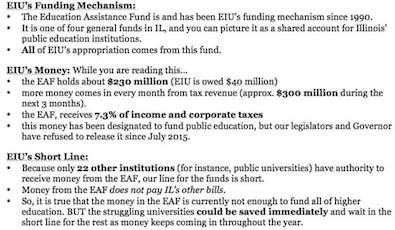
* The governor’s office, however, disagrees. The $160 million figure, they say, didn’t refer to any specific fund. Instead, Rauner was referencing $160 million in a bill sponsored by Reps. Ken Dunkin and Reggie Phillips that was part of the forgiveness of $454 million in previous interfund borrowing.
37 Comments
|
It’s just a bill…
Thursday, Apr 14, 2016 - Posted by Rich Miller
* I’m still not convinced that the Senate will even take this up, but you can’t succeed if you don’t try…
Four Illinois lieutenant governors quit the job mid-term. But six went on to become governor.
The debate over whether the state should continue to elect lieutenant governors bolstered some support on Wednesday, when Rep. David McSweeney, R-Barrington Hills, resurrected his attempt to abolish the position via a constitutional amendment. […]
In 2013, McSweeney sponsored the same constitutional amendment. Back then it passed the House with 83 votes, but stumbled in the Senate.
This time, he says, it stands a better chance. McSweeney says he was told by a Gov. Bruce Rauner liaison that the governor would support it. And there’s an identical measure in the Senate.
* In other news…
State Senator Andy Manar’s (D-Bunker Hill) plan to update the state’s education funding formula passed through the Senate Executive committee on April 13.
Senate Bill 231 would provide state funding for education based on student need while ensuring that no district would receive less state money than it did in the 2015 – 16 school year. Senator Manar says Wednesday’s vote is a great step forward in changing “the least equitable system of funding education in the nation.”
* ABC 7…
There’s a new push to tax you based on the number of miles you drive.
Gas tax revenue has fallen in Illinois, so this would be a way to make money off everyone, including hybrid and electric car drivers. But some critics worry about how the government will monitor the miles you drive. […]
Here’s how the plan would work. Drivers could have a mileage monitoring device put in their cars or if they have privacy concerns, they can choose to pay a 1.5 cent-per-mile tax on a base of 30,000 miles traveled per year. That comes out to $450. Drivers would get a refund for the taxes paid at the pump.
* Fox Springfield…
Illinois would be the first state in the country to crack down on predatory lenders if the new bill eventually becomes law.
The bill would require the lenders to take into account the borrower’s ability to repay before approving the loan and would limit late fees and repayment fees.
A representative of one of the loan companies that is targeted says this bill could encourage more lawsuits and hinder job creation.
But supporters say questionable loans and unclear terms from misleading and dishonest loan companies are crippling small business owners, who need to borrow capital in order to grow.
* Press release…
State Rep. Jack D. Franks, D-Marengo, passed legislation out of the House on Wednesday, with strong bipartisan support, requiring local governments to fully disclose taxpayer funded incentives in their budgets to increase transparency of the fiscal practices of local units of government.
“Too often, local governments do not count the incentives they have awarded as an actual cost, which does a disservice to taxpayers,” Franks said. “By requiring units of government to disclose theses incentives in their budgets, it will offer the public a greater understanding of the fiscal practices of their local elected officials.”
House Bill 3760 requires local governments to report the value of any tax incentive they have given as “community investment” on its annual financial reports. The bill also requires the Department of Commerce and Economic Opportunity to report the total value of tax credits it has awarded in a given year to the Governor and the General Assembly by August 1st.
* Journal-Topics…
Two Maine Township trustees were among 200 elected officials in Springfield last week challenging efforts aimed at consolidating or eliminating township government. […]
Calling township consolidation and elimination efforts by state officials “powerful bullying,” Maine Township Trustee Walter Kazmierczak said, “Townships are low hanging fruit. They (state legislators and Gov. Bruce Rauner) can’t get their own house in order to even pass a budget and they want to point fingers at us.”
* And one more for now…
The Illinois House of Representatives unanimously passed a bill April 12 prohibiting the secretary of state from charging fees to vehicle owners who renew their vehicle registration late due to the secretary of state’s suspension of mailed renewal notices. House Bill 4334 further provides that a vehicle owner who receives a ticket for expired license plates within one month of the plates’ expiration does not have to pay the fine if the plates expired during the period in which the secretary of state had suspended mailing vehicle-registration-reminder notices.
47 Comments
|
Lawsuit filed over state health insurance
Thursday, Apr 14, 2016 - Posted by Rich Miller
* Sun-Times…
A state employee filed a class-action lawsuit against Gov. Bruce Rauner and several other high-ranking state officials Wednesday, alleging the state’s budget impasse has effectively left some state employees without health insurance.
The lawsuit was filed in Cook County Circuit Court by Carrie Weeks-Kinowski, a nonunion civil service employee at Northern Illinois University. Weeks-Kinowski alleges that in September 2015, the state stopped giving nonunion employees’ insurance withholdings to the insurance companies, which stopped covering medical expenses.
Despite not turning over the withholdings, the state continues to dock employees’ paychecks, the suit alleges. The failure to pay, which in turn has left nonunion state employees to cover all of their medical expenses, was brought on by the continuing lack of a state budget.
Weeks-Kinowski alleged Rauner “suspended claim payments to insurance companies for about 146,000 state workers, retirees, and their families receiving coverage through plans where state funds pay for health-care costs” in September 2015.
* Meanwhile, WBEZ has a really good story on the budget. Here’s just part of it…
Cynthia Williams started Austin People’s Action Center 35 years ago. It was just her, one room, in a church. By last June, she had 50 employees at three sites, implementing nutrition, social services and employment programs.
Now, she has laid off at least half the staff and closed two of the three sites.
But the expenses haven’t stopped.
“We still have those buildings,” she says. “We’ve got mortgages. We’ve got rent. We’ve got lights. We’ve got the water bill. That didn’t go anywhere.” Those services and others, including internet access and copy machines, are on long-term contracts. […]
Williams still has some private dollars for job-training, allowing her to serve eight students. On the day WBEZ visits, they work out math problems with pencil and paper.
And Austin People’s Action Center has not come roaring back. It can’t. With workers laid off, they lost touch with the clients.
No clients means no services, and no dollars. “We have to start from scratch,” Williams says.
Cynthia Williams spent 35 years building this agency up. It’s effectively been dismantled. And, it’s in debt: She borrowed money to maintain a state-funded program. That hasn’t come back at all.
“We’re now $97,000 in the hole,” she says. “Could somebody have come and told us, ‘Stop the program’?”
* Related…
* Senate approves bill for human services, higher-education spending
* Rauner to veto ‘phony’ appropriations bill
* Senate sends Rauner higher education funding bill he’s vowed to veto
30 Comments
|
* WBEZ…
With no state budget, a program that would bus Chicago kids to visit their incarcerated mothers stalled months ago. To Pearl Mullen, who’s taking care of her grandchildren while her daughter is in prison, it’s meant her grandkids haven’t seen their mother in four months. WBEZ’s Tony Arnold has been keeping in touch with Mullen over the last few months, and found out there’s a new bus program starting up.
The program was run by Lutheran Social Services of Illinois, which laid off 40 percent of its staff last year.
Go listen to the interview.
11 Comments
|
Thanks!
Thursday, Apr 14, 2016 - Posted by Rich Miller
* Thanks to everyone who showed up for my “celebrity bartending” gig at JP Kelly’s last night. The place was jammed with people, so I had to do some honest hard work for a change, but I did have fun.
I was pleasantly surprised when legendary commenter VanillaMan showed up. I met him almost a decade ago when he attended a speech I gave in Springfield. I hadn’t seen him since, but he hasn’t changed a bit. We had a great talk last night.
The spouse of our commenter “Honeybear” also attended the festivities and we had a very nice chat.
Oswego Willy couldn’t make it, but he “sent” someone in his stead.
All in all, the evening was a success. I’m not sure how much we raised, but it wasn’t trivial. Again, many thanks to everyone who turned out.
18 Comments
|
WIU president announces 110 layoffs
Thursday, Apr 14, 2016 - Posted by Rich Miller
* From Western Illinois University’s president…
Dear University Community,
Due to the budget impasse, which is now in its 10th month, it is with much regret that I announce additional layoffs of approximately 110 non-instructional staff at Western Illinois University. Individuals facing layoffs will be given the appropriate 30-day notice. Within the next week, those individuals who are impacted will receive a letter.
Other additional measures are also immediately necessary. As of this week, all appropriated budgets have been swept and funds from those accounts are being held at the vice presidential level. To further limit spending, all P-Card purchasing is suspended, unless authorized by the division’s respective vice president. We must conserve all cash resources.
Despite the ongoing furlough/voluntary pay reduction program and the drastic reductions to spending, these layoffs are necessary to protect the University’s cash resources. In spite of our best efforts to conserve financial resources, without an appropriation from our state government, the University will face even greater financial challenges. Should the impasse continue it would require that we make further spending and personnel decisions. We implore the leaders in Springfield to resolve this unprecedented budget crisis and recognize that our public universities are critical to the future of a stable and innovative Illinois. We need state funds to operate and to support the thousands of students we serve. The decisions we are being forced to make are incredibly difficult, and they are being made due to the lack of state support. We recognize that as the stewards of this University, our first responsibility is to take the necessary steps to ensure that we continue providing a great education to our students.
To date, for Fiscal Year 2016, the University has made appropriated budget reductions of over $6 million. More than 500 employees are participating in the mandatory furlough or pay reduction program, resulting in cost savings of over $1.5 million. However, we must continue to reduce our FY’16 expenses. We will fall short of our $4 million savings goal for Fiscal Year 2016, as we have been unable to achieve furlough agreements with all of our employees. Because there appears to be no end to this budget impasse in the immediate future, we must move forward with additional layoffs.
The Office of Human Resources will provide assistance to those employees who will be laid off. It is our hope that if, and when, a budget is passed for Fiscal Year 2016, we may be able to call back a select number of non-instructional employees. However, if the budget stalemate continues, additional layoffs and the extension of the furlough/pay reduction program will be necessary into Fiscal Year 2017. I am distressed that we have been placed in this position. I realize the effect this decision has not only on our University community, but also the local communities in which we reside.
While the end to the budget impasse is uncertain, what is certain is the future of Western Illinois University. Our doors will remain open, and we will continue to serve students and provide an affordable, accessible and quality education.
We need the legislators, government leaders, and the citizens of Illinois to realize the value of public higher education, particularly regional universities. Each person who has been touched by WIU has a story to tell. Those stories must be shared so that others realize the value we provide to this state and beyond. We educate, guide, and develop the future leaders of this state and this nation. Recently, the University was recognized by the U.S. Department of Education for outperforming its peer institutions in enrolling and graduating Pell Grant recipients. Western is giving Pell Grant qualified students the opportunity to graduate.
A degree from Western Illinois University has great value. Please write and call your legislator and the state’s governmental leaders to help them understand how important regional public universities are for this state. We will continue to work with legislative and state leaders to urge an end to this impasse and to pass a budget that adequately supports public higher education.
Again, I deeply regret that these layoffs must be implemented at our great institution. Thank you for your continued support, loyalty, and dedication.
Sincerely,
Jack Thomas
President
122 Comments
|
|
Comments Off
|
|
 Support CapitolFax.com
Visit our advertisers...
  ...............
 ...............
 ...............
 ...............
 ...............
 ...............


|
   
|
Hosted by MCS |
SUBSCRIBE to Capitol Fax |
Advertise Here |
Mobile Version |
Contact Rich Miller
|




