* Resigned state Rep. Keith Farnham’s replacement could be picked this weekend…
Elgin businessman Kevin Echevarria is among candidates interviewed by Democratic officials for the seat left vacant after Keith Farnham resigned March 19, Kane County Democratic Party Chairman Mark Guethle confirmed Friday.
Another candidate is Elgin Councilwoman Anna Moeller. Kane County Board member Cristina Castro said she also talked to Democratic officials about the vacant House seat.
Anna Moeller is rumored to be the frontrunner, but things can change and we’ll see soon enough.
* I’ve been sick since I woke up Wednesday morning. I caught a cold or something that just won’t quit. That’s the hazard of working in a place which draws people from all corners of the state, I suppose. I’ve mostly tried to power through, but the weather certainly hasn’t helped.
* US Sen. Dick Durbin said he called Sen. Mark Kirk after Kirk said he would preserve his relationship with Durbin by not campaigning for Republican Senate nominee Jim Oberweis…
“You know, a lot of people have an image of Washington as a place of two parties at war,” Durbin said. “Mark Kirk and I have really tried to find ways to work together. I think that’s good for the state. t’s really good for our country. We do have a friendship and a partnership doing a lot of things together. Oh, we’re gonna disagree on some votes, that’s for sure. But we really try to accentuate the positive. His statement this week was very nice. I called him and thanked him.”
Kirk’s office has since said he’ll be endorsing the entire Republican ticket, but no campaigning for Oberweis has been scheduled.
The state is fighting to take back $2 million in grant money it awarded a company that promised to install ultra-high speed Internet access throughout the South Side.
Gigabit Squared, a Cincinnati-based company that last May touted the high-speed project in nine South Side communities, “has lied repeatedly” about its intentions and may have spent only $250,000 of the grant money for legitimate purposes, said David Roeder, spokesman for the Illinois Department of Commerce and Economic Opportunity, which issued the grant.
* The company has been a bust everywhere, and maybe far worse…
Gigabit—a four-year-old, Cincinnatti-based startup that has announced plans to bring broadband to Topeka, KS, Chicago, Jackson, MS, and other cities—has not, to date, hooked up a single Internet connection anywhere
Two community groups say they will jump-start a delayed plan to roll out ultra-high-speed wireless Internet access to as many as 100,000 residents and 11,000 students on Chicago’s South Side.
Pierre A. Clark, a community activist who heads the Woodlawn Broadband Expansion Partnership and the Southside Broadband Expansion Collaborative, said Sunday that the two groups have developed an alternative plan to deploy the high-speed wireless network first in Woodlawn and ultimately to the South Side, aimed at a mid-spring launch.
(A) South Side neighborhood group determined to get ultra-high speed Web access in Woodlawn has started work on a demonstration project aimed at starting up in late April. […]
Two of the community group’s engineers with Key Link Technologies, a south suburban engineering design firm, have started testing the Cisco access points at the Blue 1647 innovation center at 1647 S. Blue Island Ave. in Pilsen. The team hopes to put the first access point and network operations center in a business incubator started by Sunshine Enterprises and slated to open this summer at 501 E. 61st St.
Other supporters of the project include Globetrotters Engineering Corp., headquartered in Chicago, which does network mapping, and the New America Foundation, whose open-source software is designed to enable community-based and locally governed technology solutions.
The ultimate goal is to showcase Woodlawn as the “proof of concept” community in expanding to a Wi-Fi and fiber-optic network covering nine communities — Douglas, Grand Boulevard, Greater Grand Crossing, Hyde Park, Kenwood, Oakland, South Shore, Washington Park and the rest of Woodlawn.
The project engineers hope to set up applications for telemedicine, online banking and financial literacy, and neighborhood safety and communications.
Hopefully, the state won’t step in and screw this one up as well.
* State Sen. Jim Oberweis asked the Federal Trade Commission to comment on his legislation to repeal the Sunday car sales ban. After a vote by the FTC, the Federal Trade Commission’s Office of Policy Planning, Bureau of Competition, and Bureau of Economics responded…
The existing Code provisions effectively ban the sale or long-term lease of both new and used automobiles (except private sales) on Sunday throughout Illinois. They therefore eliminate the possibility of competition among dealers to determine the hours of operation on Sunday that might be most responsive to consumer preferences and most beneficial to automobile dealers.
Further, because automobile dealers also provide repair services and sell replacement parts, the probable effects of mandatory Sunday closing laws extend beyond vehicle sales. The principal harms to competition from such laws likely include:
(1) increased consumer search costs that impede comparison shopping;
(2) a market that is unresponsive to consumer preferences for hours of operation; and
(3) diminished competition among dealers for both automobile sales and a range of related services.
Collectively, these effects may lead to higher prices and reduced output for sales of new and used automobiles and related automobile services than would otherwise be the case.
“Since 1983, car dealerships in Illinois have been forbidden to be open on Sundays under penalty of a $1500 fine,” Oberweis said. “A majority of states allow automobile sales on Sundays, and car dealers in Illinois should be free to choose whether they wish to be open or closed on Sundays without government interference.” […]
“This analysis and recommendations from the FTC bolster the argument for repealing this ban. Senate Bill 2629 should not be bottled up in committee. It should be sent to the Senate for full, public legislative debate,” Oberweis said. “We need to rethink the weak argument that car dealers should be closed Sundays to give their employees a day off and keep costs down. Plenty of other employers and stores set their hours – with full consideration of what their competition is doing – without input from the government.”
The case for Quinn’s vulnerability is simple: He’s the leader of a dysfunctional state government that sent his two predecessors to federal prison. He raised state income taxes after saying he wouldn’t, and the state’s finances are still a mess. And by signing a pension-reform deal, Quinn alienated the public-sector unions that make up the Democratic base.
Just repeating that can work, Kirk said, provided Rauner doesn’t alienate the moderate suburban Chicago voters key to statewide GOP victory.
Kirk defined the recipe for Republicans to win in Illinois: “Be pro-choice and be a social moderate and be right up front with that. Use the pro-choice words that come out of your mouth, which for a lot of Republicans is hard to do.” […]
“He is a Republican in a Democratic sphere,” Kirk said. “If he ties his shoes wrong, the Democrats can always get a significant number of commentators to be offended at how he has tied his shoes. There’s a whole offended industry that will be ginned up to speak heavily against him in the coming campaign.”
“There was a lot of feeling that with an African-American president, life on the south side of Chicago would be radically different,” Kirk said. “You hear that, immediately that it’s not different for me. What you’ll see is Rauner reaching into the African-American community pretty heavily.”
I, too, have heard several people on the South Side say this. But it’s one thing for them to say it, and it’s quite another for a white Republican to attack Obama directly.
* And speaking of which, Sneed had a story this week about black GOP ward committeemen who’ve never really done much of anything attacking black ministers for cozying up to Rauner…
Sneed is told that the skirmish for fiscal attention resulted in a summit being called at 6 p.m. Monday at 2800 W. Madison by at least a dozen South and West Side committeemen — some of whom claim neglect and little funding under the leadership of Cook County GOP Party Chairman Aaron Del Mar. Del Mar is up for re-election on April 16, and the group is scheduled to hear from his opponent, 43rd Ward Committeeman Chris Cleveland. […]
[Larry Nelson, 24th Ward GOP committeeman] also is angry that ministers get more attention than committeemen.
“Don’t go to the ministers!” he told Sneed. […]
So who has more control over voting in the South and West Side wards?
“The ministers,” [Cook County GOP Party Chairman Aaron Del Mar] said. “Committeemen have small constituencies in their wards; the ministers have flocks all over the place. Both sides have to be happy.
There’s more than enough money to make everybody happy, I’m sure.
Gov. Pat Quinn has spent about 10 percent of his time in Springfield during the past six months.
The Democrat governor found himself absent from the Illinois capitol on all but 19 days since August.
* But you have to read between the lines to get a real idea what the actual timeline is…
The vast majority of the governor’s time has been spent in the Windy City, where he logged 148 days between Aug. 1 and Feb. 7 […]
Of the 19 days the governor did spend in Springfield during that same time period… [Emphasis added.]
* The beginning of August through the first week of February? You mean the totally dead time?
C’mon.
* The General Assembly was in session three days between January 1st and February 7th. The GA was in six days between August 1st and the end of December.
So Quinn was actually in town more than twice as many days as most legislators?
The chief of state parks in Illinois must repay $7,200 of travel reimbursement he wasn’t entitled to after inquiries by The Associated Press, the latest in a series of missteps at the Department of Natural Resources since February.
Ronald House, the department’s director of the office of land management, was reimbursed nearly 80 times for commuting to or from work when state travel rules forbid such reimbursement, according to an AP review of state records.
It’s another blemish for Natural Resources officials, who initially defended the reimbursements as proper, after a series of recent public relations troubles: a deputy director who attended fishing tournaments while on sick leave and two mining regulators who accepted campaign contributions from a coal-mine operator.
Chris Young, spokesman for IDNR Director Mark Miller, initially said the director would not require House, who makes $75,000 annually, to repay the money because it was not his error. But Miller changed his mind this week and asked for reimbursement, ten days after the agency acknowledged the error.
“I thought it was a pretty good speech, and I give the guy credit for taking on the really hard issues that have to be dealt with,’ Topinka said.
She said she’d like to see the tax increase phased out more gradually rather than have a large part of it disappear at once, which could trigger budget problems.
* State Treasurer Dan Rutherford’s reaction…
“I appreciate the fact that Governor Quinn is putting several options on the table for solving the state’s fiscal crisis. This is an approach I have long supported. I don’t want the income tax hike to stay, but it needs to be part of the discussion and not the only solution.
“I think state leaders should look to further reduce spending as I have in the Illinois State Treasurer’s Office. Through the years, I have been able to find ways to cut 10 percent from my budget. I also believe we need to focus on making Illinois more business friendly. ”
By the way, this is slightly off topic but Rutherford spokesperson Catie Sheehan, a former Downstate TV reporter, is leaving the office for a big job with the Mac Strategies Group on April 1st. That firm has made some big “gets” lately, including former Emanuel campaign manager Tom Bowen and former IRMA honcho Dave Vite.
Cook County Assessor Joe Berrios said the defeat of his daughter, Rep. Maria “Toni” Berrios, to a self-styled reformer in the recent Democratic Statehouse primary isn’t a referendum on what critics call his old-school approach to politics.
“I don’t see it that way,” Berrios, the powerful chair of the county Democratic Party, told the Sun-Times on Thursday, when asked whether Toni Berrios’ landslide loss diminished his political power. […]
Ultimately, Joe Berrios said, Toni Berrios lost the election because of the changing racial makeup of the district — a demographic shift anchored around the hipster-centric neighborhood of Logan Square, which was once a Hispanic stronghold.
“The district completely changed. It went from 64 percent Hispanic down to about 52 percent Hispanic,” Berrios explained. “She worked hard. We did everything we could to win that election and it didn’t come out the way we wanted it to, but, you know, you move on.”
I don’t think Berrios is as “evil” as the Sun-Times and others constantly make him out to be. But there’s no getting around the fact that his family name has been poisoned.
Yes, Will Guzzardi walked precincts non-stop for almost three years. And, yes, the district did change. But smart politicos change with the times and with the districts.
I checked out the recent Democratic primary vote totals for unopposed candidates, like Joe Berrios, who were on the Chicago and Cook County ballots. Nobody had to vote for these candidates, so people were making conscious choices if they voted for some but not for others.
Joe Berrios only got 200,992 votes, far behind Jesse White’s 252,005, Lisa Madigan’s 240,674, and Dick Durbin’s 239,348. Even Mike Frerichs, a non-incumbent from Downstate, got 212,827 votes, almost 12,000 more than Berrios. That’s a lot of dedicated Democrats deciding to skip voting for Berrios. It doesn’t really have any immediate effect, as he still wins office for four more years. But it does show a fair amount of discontent.
* Gov. Pat Quinn is making the rounds of editorial boards. Here’s some of what he said to the Sun-Times…
He’d like to finance a new statewide construction program for roads, bridges and other infrastructure projects by closing corporate tax loopholes. He said he plans to present lawmakers with a list of tax laws for businesses “that I think are loopholes that don’t produce jobs for our state” in hopes of generating money for such projects.
“A lot of the corporations would much rather have us build infrastructure than anything else,” he added.
Quinn said House Speaker Michael Madigan’s proposal to impose a 3-percent surcharge on nearly 14,000 Illinoisans with annual incomes of $1 million or more to generate $1 billion for schools is “worth considering.”
But he stopped short of endorsing it, noting that if lawmakers approve the plan, it would bypass him and go before voters in the form of a constitutional amendment. “Anything like that, the voters have to make the final call,” he said.
Edgar wasn’t the only Republican whom Quinn called for advice about his budget plan. He said he also reached out to former GOP Gov. Jim Thompson.
“He said he would look at our ideas,” Quinn said. “The difference between me and him on this issue is Jim Thompson did things after the election, OK? ‘Ooop, ooop, we need money.’ OK? We’re doing this before the election.”
That’s very true. This may be the first time since the income tax was initialized under Gov. Richard Ogilvie that such a vote will be taken during the spring session. Ogilvie, by the way, ended up losing to Dan Walker.
In a bit of a surprise, Mr. Quinn launched a financial attack on Mr. Rauner’s proposal to immediately stop workers from accruing further pension benefits and switch them to a defined-contribution system like a 401(k).
Even if Mr. Rauner succeeded, Illinois would still owe tens of billions of dollars to retirees for past service that the state is paying in part with retirement contributions withheld every month from the paychecks of current workers. If that revenue stream were diverted from the pension plan to a 401(k) plan, “There’s a tremendous transition cost,” Mr. Quinn said. Just one of the state’s five pension funds, the Teachers Retirement System of Illinois, estimates it would need $32 billion.
“What are you going to do, borrow $32 billion?” Mr. Quinn asked.
Indeed, Mr. Rauner has not released a detailed pension or financial plan; aides say they do not know when one will be available. Instead, he generally has suggested that the pension-reform plan adopted last year by lawmakers was inadequate and has not said whether he would raise other taxes to make up for allowing income-tax rates to drop back.
But another crucial part of the Rauner plan that Quinn didn’t mention is that Rauner would freeze all pensions forever. No more annual increases, ever. It may be heartless, but it does save a ton of dough.
During our examination we noted that there were problems with the Modernization - Re-Engineering Project.
The project has been ongoing for five years, is only 20% complete, and over $2,000,000 has been expended by the State Retirement Systems collectively.
Due to staffing issues and the lack of a project management framework and the associated documentation, the project has not been fully implemented. In addition, formal documentation to provide detailed information on the current status and projected completion date is lacking.
And as we work together to forge a solution, let me be clear about what I won’t do.
I won’t institute any new, unfair taxes on everyday services that working people rely on. It hurts working families the most to tax basic services like going to the Laundromat…like taking your child to daycare…like visiting the barber shop…or taking your dog to the vet.
We should not create a new and unfair tax burden on everyday families and the small businesses that serve them.
Bruce Rauner has said he is open to such a tax, which is probably why the line was inserted into the speech.
* But Rauner’s campaign dug up a couple of articles from 2009 when Quinn backed just such a tax…
In 2009, Quinn Supported A Tax Hike Plan Passed By Senate Democrats That Would Have Applied The State Sales Tax To “Dozens Of Services.” “Democrats warned of severe cuts in education and health-care funding without a tax increase, but couldn’t muster the votes in the House for a two-year, 50 percent increase in the personal income tax. The House likewise balked at the prospect of considering a Senate-backed plan to raise the income tax 67 percent and apply the state sales tax to dozens of services. Republicans, the minority in both chambers, opposed all tax-increase plans and blamed Democrats for a new round of dysfunction made infamous during the tenure of ousted Gov. Rod Blagojevich. With lawmakers facing the need to revisit the budget talks in coming months, post-session voting requirements will give the GOP a seat at the bargaining table. Rookie Gov. Pat Quinn, who supported both failed tax plans, said he would call legislative leaders together Monday to work on putting together a better budget than one that is ‘hopelessly out of balance.’” (Rick Pearson and Ray Long, “Tax Hike Defeated; Budget Gap Remains,” Chicago Tribune, 6/1/09)
Quinn Testified In Favor Of The Senate Tax Hike Plan Before An Illinois House Committee. “The Senate Democrats’ 2009 income tax increase bill also included a provision extending the state’s sales tax to services, such as haircuts, that are not taxed now. Quinn testified for the bill before a House committee.” (Chris Wetterich, “Quinn, Brady Far Apart On Taxes,” The State Journal-Register, 10/3/10)
Former Governor Jim Edgar says spending cuts triggered by the scheduled reduction in the state income tax rate would make it even harder to catch up on unpaid back bills and fund education. So the Republican Edgar says Governor Pat Quinn’s budget proposal to make the state income tax hike permanent is a good idea. But Edgar says it would have been better if the income tax increase had been paired with cuts and controls on spending in the first place.
“You don’t raise revenue or come up with a consistent revenue source and not do the tax cutting or controls that you need to do. You ought to do them all at the same time. Think that was a mistake they made three years ago, whenever they passed this temporary tax. They didn’t really make any spending cuts or put any effective spending controls in. Would have been helpful,” says Edgar. […]
As for the $500 property tax credit that Governor Quinn is proposing, Edgar says it’s useful if it helps get Quinn’s income tax rate extension passed. But he says it’s NOT like his proposal to cut school property taxes through a so-called “education tax swap” back in the 1990s.
* From an Americans for Prosperity Illinois press release…
AFP-Illinois is launching a new ad aimed at educating the public about the perils of Speaker Madigan’s so-called “millionaire tax”.
“This politically-motivated proposal seeks to cynically win votes rather than craft a serious fiscal policy that will help the Illinois economy recover from years of woeful mismanagement and cronyism,” said AFP-Illinois State Director David From.
The ad campaign targets specific members of the General Assembly. It highlights Illinois’ continued economic crisis and high unemployment and encourages their constituents to contact them and express their opposition to the job-killing tax.
“It is no accident that the Speaker made this proposal in advance of the Governor Quinn saying he wants to make his record setting temporary tax increase on all Illinoisans permanent,” said From. “This is the classic bait-and-switch designed to distract voters from the fact that the biggest tax hike being pushed through is going to land squarely on the backs of working families.”
The advertisements are being run online and on cable television with an approximately $120,000 buy funded by AFP-Illinois donors within the state. The ads will run for approximately one week and are part of AFP-Illinois’ effort to educate voters about the highly politicized anti-growth agenda being pushing in the Spring legislative session.
As we’ve already discussed, the group is already running ads against the progressive tax.
* This is the ad targeting Democratic Rep. Jack Franks (D-Marengo). Rate it…
Timid creatures by nature, state legislators often have to be cajoled, begged and even outright threatened to cast tough votes.
It took the Illinois General Assembly years to finally vote in December for a politically dangerous pension reform bill. The “temporary” income tax hike passed in 2011 only because some lame-duck legislators who had lost their elections (after campaigning against a tax hike) decided to play ball, and coincidentally got sweet state jobs.
That vote, which raised the personal income tax rate to 5 percent from 3 percent, was safely held weeks after an election. The hike is scheduled to expire Jan. 1, with the tax rate falling to 3.75 percent. But now, House Speaker Michael Madigan says he’d like to pass a bill to make the tax hike permanent by the end of the spring session, about five months before the Nov. 4 general election.
Making the tax hike permanent is probably very unpopular. A February survey found that 60 percent of Illinois residents want the tax hike to expire, while a mere 26.5 percent favor keeping it, according to the Paul Simon Public Policy Institute at Southern Illinois University.
Not to mention that the person taking the lead on making the tax hike permanent is Gov. Pat Quinn, who barely won his 2010 election.
Mr. Quinn forcefully argued during his annual budget address March 26 that keeping the tax hike in place would preserve much-needed state programs like education funding and prevent “draconian” budget cuts.
His Republican opponent has been ripping him all week. Bruce Rauner says Mr. Quinn in 2010 promised to oppose any tax increase above one percentage point and then signed a hike double that amount. Now he wants to make it permanent.
Mr. Quinn’s popularity among legislators is almost nonexistent; his political future is in doubt. So why follow him off a political cliff?
* Partial results of two Anzalone-Liszt-Grove Research polls taken for state Rep. Christian Mitchell’s primary campaign show Mayor Rahm Emanuel apparently bouncing back in March from some big trouble last December with African-American Democratic voters…
Emanuel has a base of senior African American voters — those over the age of 65 — in this district poll; his standing did not change much in the past months with his favorables holding at 62 per cent.
This is just one House district on the South Side, so it would be better to see broader results. Still, the mayor’s movement is quite interesting.
The overall health ranking for Cook County, the state’s most populous, was 75 of the 102 Illinois counties.
Collar counties Kendall and DuPage ranked second and third, respectively, and Kane was ninth.
The study looks at factors such as high school graduation rates, access to health providers and healthy foods as well as rates of smoking, obesity and teen births. […]
Not surprisingly, the healthiest Illinois county, Woodford in Central Illinois, had some of the state’s best scores for individual health and social and economic factors. Its childhood poverty rate was 8 percent.
Alexander County in Illinois’ far southern tip was at the bottom. Forty-nine percent of children there were living in poverty and the unemployment rate was 11.4 percent.
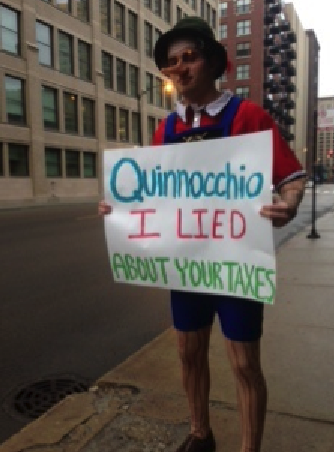
Pat Quinn’s alter-ego, Quinnocchio, is making his first appearance today alongside the governor at his noon campaign stop at Linné Elementary School to remind him of his broken promises.
Discuss.
…Adding… Here’s the governor’s press release for today’s school visit…
Governor Pat Quinn today visited Carl von Linné Elementary School in Chicago and discussed his fiscal year 2015 budget proposal and five-year blueprint to raise state investment in the classroom to its highest point in Illinois history. As a result of tackling the cost drivers behind the financial crisis he inherited, the Governor was able to present a budget that invests an additional $6 billion in education over the next five years.
“The future of Illinois’ economy depends on the quality of our education,” Governor Quinn said. “All students—no matter where they live—deserve to go to a first-rate school. That is why my budget proposal invests like never before in education and support for early childhood development.”
The Governor’s investment in education in the FY15 budget includes:
· Investing $100 million in Birth to Five in FY15, with a total five-year investment of $1.5 billion, a game-changing investment to expand access to prenatal care; early care and learning opportunities for every child; and strong parent support.
· Expanding dual enrollment and early college programs.
· Investing an additional $50 million in the Monetary Assistance Program (MAP) to expand opportunity for 21,000 students to attend college. The proposal calls for doubling MAP scholarships over the next five years.
· Modernizing classrooms across the state to ensure every student attends a first-rate school.
Since taking office, Governor Quinn has fought to preserve education from radical budget cuts, and built and repaired 978 schools. In his Fiscal Year 2015 Budget Address, Governor Quinn laid out an honest and responsible budget for the next fiscal year along with a five-year blueprint that will secure the state’s finances for the long-term, provide significant tax relief to homeowners and working families and invest like never before in education and early childhood.
For more than 100 years Carl von Linné School has been providing a world-class education to children in the Avondale neighborhood of Chicago. The mission of Carl Von Linné Elementary School is to prepare students for college and career by providing a rigorous research-based instructional program, aligned to the Common Core State Standards, with a focus on educating the “whole child.”
* The House Revenue Committee has voted down a proposed constitutional amendment for a graduated income tax while approving Speaker Madigan’s “millionaire’s tax” - a three percent surcharge on income over $1 million.
Today, by the way, was the “Fair Tax” Statehouse lobby day. The group has focused more of its progressive tax efforts on the Senate, but it got a taste of harsh reality in House Revenue today. A rally is scheduled for noon.
The state’s shuttered juvenile prison in Murphysboro could be reopened as a special adult prison for drunk driving offenders under Gov. Pat Quinn’s budget proposal.
The plan, which relies on the General Assembly making the 67 percent income tax increase permanent, could bring jobs to a Southern Illinois facility that Quinn closed less than two years ago.
According to the governor’s budget office, an estimated 2,500 inmates housed throughout the state’s sprawling prison system are serving time for multiple drunk driving offenses.
Moving some of them to the former minimum-security institution for juveniles could ease overcrowding in other facilities and provide them with specialized services designed to help them after release.
“Murphysboro could be re-purposed fairly easily,” said Abdon Pallasch, assistant director of the Governor’s Office of Management and Budget. “This center will help us reduce recidivism and save taxpayer money over time.”
Looks like decent policy to me.
Re-opening the facility also has a political benefit, however. State Rep. Mike Bost (R-Murphysboro) is running for Congress. The House Democrats pushed Bill Kilquist through the Democratic primary and have high hopes for his November chances. Creating a few jobs in an area that is so heavily dependent upon state employment probably won’t hurt at all.
* The Daily Herald writes about how the state’s ultra-exclusive golf country clubs are working the system for huge property tax breaks…
(I)f Medinah officials have their way, those schools and other local government entities will have to give back nearly $1 million to golf course operators, who say Medinah’s tax assessment was far too high for the past three years.
It would also shift that tax burden onto the private golf course’s mostly residential neighbors in the future.
In 2013, the country club’s property tax bill amounted to $391,554, according to assessment records from Bloomingdale Township. If the appeal is successful, the tax bill could shrink to $84,257, a 78.5 percent decrease. […]
Medinah officials are basing their appeal on the state’s disputed definition of “open space.” State law allows golf courses to be classified as open space for assessment purposes. Township assessors, county boards of review and the state’s Property Tax Appeal Board have always maintained that the open space designation only applies to golf course land that is either undeveloped or used for actual golfing.
Lawyers for the Onwentsia Golf Club in Lake Forest challenged that definition in 2006 and argued that land with buildings, parking lots and additional improvements helped conserve all the other open space and should be considered open space by proxy.
Legislation is now moving to address this. I doubt Medinah is gonna get its full break.
New regulations governing petcoke, as currently written, don’t appear to have the votes to get out of the Illinois House Environment Committee, according to vote counters on both sides of the issue.
Although Friday is the deadline for bills to get out of committee, in Springfield there are always ways to get around the rules. But there isn’t a way to get around a shortage of committee votes.
The legislation is being pushed by Illinois Attorney General Lisa Madigan and has 40 listed co-sponsors. It would require minimum setbacks for coal and petcoke facilities; set limits on dust; regulate storage, loading and unloading; require new permits; and require monitoring and testing. The bill is separate from the Illinois Environmental Protection Agency’s plan to draw up new rules on petcoke storage. The IEPA has been talking to members of the industry, both refiners and bulk operators, and to the environmental community. Environmentalists say new rules are needed, while industry calls the whole effort a solution in search of a problem.
Even if this bill as written doesn’t get out of committee, a bill with new language that resolves legislators’ concerns could be placed on a shell bill, circumventing the Friday deadline.
I spoke to a gathering of the Illinois Petroleum Council this week. They claim there has been just one reported problem with petcoke storage in Illinois. Whether that’s true or not, it’s a talking point that they’ve been relentlessly hammering home with legislators. One problem shouldn’t result in a major regulatory bill. Again, you may disagree with that, but it’s the argument they’re using and it appears to be successful so far.
A proposal that would allow truck stops to have twice as many video gaming machines as other establishments is moving through the Illinois Legislature.
A Senate committee on Tuesday approved the measure with a 9-2 vote. It would allow truck stops to have ten video gaming terminals. Currently, establishments with video gaming can operate five machines.
State Sen. Dave Syverson is sponsoring the proposal. He says it will create more revenue from truckers who are often from out of state. The Republican from Rockford says it wouldn’t affect other gaming businesses because truckers already don’t leave truck stops to gamble.
Before legalization and regulation, some truck stops had dozens of poker machines. They were like mini casinos.
A plan to let Rosemont and three other Illinois cities apply their local cigarette taxes to cigars and other forms of tobacco won initial approval in the state Senate Wednesday.
The legislation from state Sen. Dan Kotowski, a Park Ridge Democrat, would apply to Rosemont, Chicago, Evanston and Cicero, the four towns in Illinois that have local taxes.
The Rosemont tax, which is 5 cents per pack on top of state and federal cigarette taxes, will not be increased or decreased under Kotowski’s proposal. But it would be applied to other forms of tobacco based on weight.
Senate GOP Leader Christine Radogno asked before voting against it: “If it’s good for these four communities, wouldn’t it be good for the rest of the state?”
* Other stuff…
* Ride-sharing crackdown advances in House: Rep. Tom Morrison, R-Palatine, said those steps contained in Zalewski’s legislation limited new upstart competitors to the taxicab industry too severely. “I voted against this bill because it unfairly locks out competing companies and limits choices for consumers,” Morrison said. Candice Taylor, a Lyft representative who testified before the committee, said the bill’s “burdensome” requirements would mean “the end of companies like Lyft and Uber in Illinois.”
Quinn’s announcement Wednesday that he intends to push for a permanent extension of a temporary income tax he enacted in 2011 represents a huge political Achilles’ heel for him in his campaign against Republican Bruce Rauner.
But will it be fatal?
It’s too early to judge, though Dawn Clark Netsch’s 1994 campaign for governor largely was derailed by early summer that year because of her advocacy for an income-tax increase as part of a school-funding, tax-swap plan.
Quinn, by contrast, ran and narrowly won the Executive Mansion in 2010 when he embraced a 1-percentage point increase in what then was Illinois’ 3-percent individual income tax.
In his speech, Quinn said such a reduction in revenue would mean 13,000 teachers would be laid off, 30,000 fewer students receiving assistance for college expenses, 21,000 fewer seniors receiving home care services and 41,000 fewer children in child care.
By extending the tax, Quinn said “we can stabilize the budget for the long term in a way that provides targeted tax relief where it’s needed most, to homeowners and working families raising kids.”
Quinn offered property tax relief and an incremental doubling of the Earned Income Tax Credit as potential sweetener that might help the income tax proposal go down with voters. […]
Not surprisingly, a recent poll from the Paul Simon Public Policy Institute at Southern Illinois Carbondale found that 60 percent of voters oppose making the tax rates permanent. However, the majority of respondents liked major state services and were opposed to cutting them. Voters were also opposed to taxing retirement income or increasing sales taxes. The only new revenue source that more than half of those polled supported was expanding gambling. […]
Quinn’s proposal has the backing of the legislative leaders in his party. “I would commend the governor for his political courage and honesty,” House Speaker Michael Madigan told Illinois Public Television’s Jak Tichenor, host of Illinois Lawmakers. Madigan said that he “demanded” property tax relief be included in a proposal to make the tax rates permanent. “I plan to support the governor’s position on the extension of the income tax increase,” said Madigan. “If we wish to continue to provide the level of services which we’ve become accustomed to for education and other purposes, then the income tax increase should be extended.”
* Bruce Rauner…
“Pat Quinn first promised the working people of Illinois he wouldn’t raise taxes by 67%. He broke that promise, taking away nearly a week’s worth of pay for Illinois families. Then he promised his tax hike would be temporary. Today he broke that promise too and is doubling down on his failed policies. After five years of Pat Quinn’s failed leadership, we have record tax hikes, outrageously high unemployment, massive cuts in education, and there’s still a giant budget mess in Springfield. It’s now or never to save Illinois. We can balance the budget without more tax increases, if we create a growth economy, and restructure and reform our broken government. That’s what I’ll do as governor.”
In his speech, Quinn ruled out two other options that have been floated as ways for the state to collect more revenue. He said the state sales tax should not be extended to services.
“I won’t institute any new, unfair taxes on everyday services that working people rely on,” Quinn said. “It hurts working families the most to tax basic services like going to the Laundromat, like taking your child to day care, like visiting the barbershop, like taking your dog to the vet.”
Rauner has said he’s open to both the service and retirement income taxes.
* The Question: On balance, were the governor’s proposals yesterday a help or a hindrance to his reelection prospects? Take the poll and then explain your answer in comments, please.
Quinn sought to portray his fiscal blueprint as part of an effort to end a cycle of budget game-playing by his predecessors that left state finances in shambles. He said part of his strategy was the controversial pension overhaul law last year that he argued would dramatically cut retirement costs and let more tax revenue flow to schools, health care and other services.
Rauner contends that Quinn’s pension alterations are too timid and will save the state far less than the governor contends. That argument may have gotten a boost Wednesday when the state’s bipartisan fiscal forecasting agency revised downward by several billion dollars its long-term savings projection for the pension overhaul.
* That snippet may have been based on this Bruce Rauner campaign press release…
On the same day of Pat Quinn’s budget address in which he broke his promise to keep the 67% personal income tax temporary, the Commission on Government Forecasting and Accountability released an analysis of the so-called pension reform law that shows it will save $22.6 billion less than was promised when the legislation was passed.
* This isn’t much different than the same stupid canard I dealt with in the subscriber section back in January. Here’s what I wrote back then. Substitute $15 billion with $22.7 billion and adjust everything else and you’ll get the same sort of results…
ONE OF THE DUMBEST ARGUMENTS EVER There’s been much screaming and hollering about how new calculations show that the pension reform law is projected to save $15 billion less than originally advertised last fall when the bill passed.
The complaints are based mainly on a recent Chicago Tribune article entitled “Illinois pension law saves $15 billion less than first thought.” The ultra-conservative Illinois Policy Institute, Bruce Rauner and other pension bill opponents have used the story as ammunition to claim that the law is based on a tissue of lies.
But the premise of that article was completely off base because it looked at the wrong number. The only truly valuable number is what taxpayers will end up shoveling into the pension system. Like everything else, it’s all about the final bottom line.
OK, we’re gonna get into a little math here, but it’s really easy so stay with me a minute.
The basic thing to remember here is that calculations originally showed last fall that pension reforms meant taxpayers would owe the pension systems $220 billion over 30 years. A recalculation with updated numbers, however, showed the total taxpayer obligation is now at $205 billion. That’s really good news, but it’s being irresponsibly spun as bad news.
The original estimates were based on Fiscal Year 2012 data. Without the new pension law, the data showed that taxpayers were on the hook for $380 billion in pension payments over 30 years. The reform law reduced that obligation estimate to $220 billion, which was a 42.1 percent reduction in what the government would have to give the pension funds.
When the numbers were updated to include Fiscal Year 2013 data (which included some pretty high investment returns), the new research found that taxpayers were now on the hook for $350 billion over the next 30 years without the reforms. The reform law would result in a 41.4 percent reduction to just $205 billion.
So, what about that $15 billion difference touted by the opponents? Where does it come from?
It’s not that hard to figure out and here’s an easy little example if you’re still scratching your head.
Let’s say you’re looking for a new watch. You find one at Macy’s that’s originally priced at $109 and is on sale at 40 percent off. You’d save $43.60 for a final price of $65.40. That’s still more expensive than Rauner’s watch, but not a bad deal at all.
But then you go next door to Bergner’s and you see the exact same watch listed at $100 and it’s also on sale for 40 percent off. You’d save $40 with the 40 percent sale, but your final bottom line price would be $60, compared to $65.40 at Macy’s,
It doesn’t take Einstein to figure out the better bottom line deal here. Yeah, your 40 percent “savings” are higher with the more expensive Macy’s watch, but the bottom line price you pay is significantly lower at Bergner’s.
The Policy Institute and Rauner would have you believe that Bergner’s is somehow ripping you off because the sale’s 40 percent reduction amount is lower than Macy’s. But that’s just plainly ridiculous. Who thinks like that?
Illinois lawmakers have proposed a budget that tops $34 billion, but doesn’t rely on the 2011 tax money. If Quinn gets his wish and a permanent tax hike, state spending could increase to almost $36 billion for the next year.
That would mean Illinois is spending $12 billion a year more than in 2000.
Using a handy-dandy online inflation calculator from the US Bureau of Labor Statistics, $24 billion in 2000 equals $32.7 billion today. So, using the Watchdog’s budget numbers, the state is spending, in real dollars, just $1.3 billion more than it was back then, without half the tax hike revenue, or $3.3 billion with it. But the state is also making full pension payments these days. It was spending a whole lot less on pensions back in 2000.
The governor proposed the property tax refund Wednesday as the sweetener to help Illinoisans swallow his decision to make permanent the “temporary” income tax hike he signed into law in 2011.
If the Legislature goes along, Quinn plans to start sending out the $500 checks this summer so that voters might feel a little more kindly toward him when they step into the voting booth this November. […]
The average credit currently is $247, says the Quinn administration, which equates to a net gain to a taxpayer of $253 after trading off the credit for the refund. Your net gain will be more or less than that, depending on how much you pay in property taxes.
Quinn didn’t really make that clear, just as he failed to mention altogether that for anyone who currently pays more than $10,000 a year in property taxes, his plan will result in a net tax increase.
The governor’s office says that will effect fewer than 10 percent of Illinois homeowners, which sounds about right, but I’m pretty sure nearly all of them live in the high-tax Chicago metro area.
* The net effect of this is that the vast majority will get a small property tax break (which isn’t really a property tax break, it’s an income tax refund loosely based on property taxes), while the upper middle class and the wealthy will see a smaller break.
My own property taxes are above $10K in Springfield. The proposed plan means I’ll lose about $125. Mark Brown also admitted that the proposal would cost him a few dollars, but wrote that he doesn’t “begrudge the state the extra hundred bucks or so a year.”
By the way, Rauner paid about $2.6 million in state taxes for 2012, but he made $3.5 million in estimated payments, so he got a state tax refund check worth about $880,000.
* Also, Speaker Madigan claimed yesterday that the tax refund was his own idea…
Madigan said during a public television interview, adding, “My demand as part of this program is relief for homeowners on their real estate taxes.”
[Sen. Matt Murphy] said Quinn’s proposal to roughly double the current amount of overall property tax relief is equivalent to a $600 million “kickback” that would raise the overall amount of state relief for homeowners to more than $1.2 billion a year.
I think it’s actually $700 million in net new spending for a total of $1.3 billion, but whatever the case, it’s a lot of new money. More cuts in other areas will have to be made to pay for this, and that’s always one of the biggest problems with ideas like these.
Thursday, Mar 27, 2014 - Posted by Advertising Department
[The following is a paid advertisement.]
As not-for-profit financial cooperatives, credit unions exist to help people, not make a profit. With a goal to serve all members well - including those of modest means - every member counts. The movement’s “People Helping People” philosophy causes credit unions and their employees to volunteer in community charitable activities and worthwhile causes. Take for instance SIU Credit Union in Carbondale. They know all too well the damage natural disasters can cause, having seen the impact of tornadoes that have ravaged their nearby communities, including Harrisburg and Brookport. In the immediate wake of those storms, the credit union sent employees, already trained as members of a local Community Emergency Response Team, to assist in the emergency supply relief effort. In addition, the credit union donated numerous cases of water and hosted a pizza lunch for the community. It also utilized all of its branches as places where members could make monetary and other donations of needed items. Credit union members know their credit union will be there for them in bad times, as well as good. And they are fiercely loyal for this reason.