HIV Providers in Illinois have been feeling the drastic, statewide effects of the budget impasse for some time now.
• From July - December 2015, grantee HIV testing from the Quality of Life Fund decreased 62%, resulting in a 68% decrease in the number of positives found;
• Direct grant testing decreased 59%, with a 66% reduction in positives found;
• Regional Grant testing decreased 35% with a 70% reduction in positives found, all compared to the same period in 2014;
• In March 2016, the Families and Children’s AIDS Network stopped providing prevention services in Regions 2, 7, and 8;
• Central Illinois Friends of PWA stopped implementing Effective Behavioral HIV Prevention Interventions;
• Sisters and Brothers laid off both its Deputy Director and its Interventions Manager, impacting service delivery in several regions, and cut their Region 5 services to just one day per week;
• Fifth Street Renaissance in Springfield laid off four full-time and 3 part-time positions and reduced services;
• Jefferson County laid off two staff, reduced service hours, and have indicated they may need to close their HIV prevention program;
• Bethany Place’s (Belleville) Prevention Coordinator and entire prevention staff resigned due to non- payment;
• Macoupin County laid off their main prevention staff;
• Outreach and testing that is geared and targeted towards populations with the highest rate of new HIV infections have been significantly reduced, due largely to agencies not having the resources to conduct thoughtful, strategic targeting. As a result, suburban Cook County has seen a significant reduction in the amount of newly identified HIV-positive individuals;
Even with passage of the 2016 stopgap spending plan, which is detailed below, some HIV service providers will only receive 65% of their funding.
• HIV tests in suburban Cook County have fallen by 35% since the start of the budget impasse;
• The Jackson County Health Department has ceased providing HIV testing to recently released inmates in downstate Illinois;
• PrEP 4 Illinois, a program that was intended to cover costs of PrEP for those who required financial assistance, was appropriated $1 million in the FY 15 budget; however, that program was ultimately zeroed out by the incoming Rauner administration. Canceling the PrEP4Illinois program deprived Illinoisans of financial assistance to access this game-changing HIV prevention medication;
• The AIDS Drug Assistance Program (ADAP) has been forced to rely solely on federal funds to operate;
• In June 2016, Center on Halsted, Illinois’ largest provider of state-funded HIV testing, had received no state payment for HIV testing. The organization was uncertain if they would be able to continue to provide services without a budget in place […]
Here in Illinois, funding for the HIV Lump Sum, which includes the AIDS Drug Assistance Program (ADAP) and HIV prevention, treatment and education services, has been funded at roughly the same level since FY 2011, with the amount wavering between $25 and $29 million. Since Governor Rauner came into office, he has proposed merely $20 million for FY 16 and $18 million for FY 17. Every new HIV case prevented saves the state nearly $400,000 per person in lifetime medical costs , so this drastic cut to preventive and treatment services has the potential to make the situation worse.
We are at a unique time in the HIV epidemic following the advent of biomedical interventions like PrEP, which can prevent new infections. But effective means of HIV prevention requires a commitment from the state, and Illinois has not included funding for PrEP4Illinois program in proposed budgets since Governor Rauner used his executive authority to remove $1 million in PrEP assistance from the FY 15 budget.
*** UPDATE 1 *** From Catherine Kelly in the governor’s office…
“Fitch’s action further demonstrates the importance of reaching bipartisan agreement on a truly balanced budget and changes that will grow our economy and bring new jobs to our state.”
*** UPDATE 2 *** From John Patterson, spokesman for Illinois Senate President John Cullerton…
While unfortunate, this was expected.
The looming threat was among the many reasons why the Senate is working on a comprehensive budget and reform plan. The goal is to end the nearly two-year impasse and restore financial stability.
If there’s a silver lining, it would be that hopefully this adds to the growing urgency to pass the Senate’s plan and get a comprehensive budget for the state.
*** UPDATE 3 *** Treasurer Michael Frerichs…
“Our credit rating suffers because the leaders in the General Assembly and the Governor will not negotiate an honest budget,” Frerichs said. “This singular focus on non-budgetary items is silently ripping money out of the pockets of everyone who lives in this state.”
“Borrowing costs money. Borrowing without a budget costs even more money. We know a budget will bring down our borrowing costs and yet we still have a leadership team that chooses not to negotiate. We can do better.”
“Bruce Rauner’s failed governorship continues to hurt Illinois jobs and cost Illinois families,” said DGA Communications Director Jared Leopold. “Over and over again, Governor Rauner has sacrificed Illinois’s economy to protect his special interest friends. Today, Illinois families and business are paying
* And from Illinois Working Together Campaign Director Jake Lewis…
“To borrow a phrase from Fitch Ratings, Bruce Rauner has been an ‘unprecedented failure’ as the governor of Illinois. Today’s downgrade, the sixth under Gov. Rauner, is yet another indicator of the damage the governor has inflicted on Illinois and its people during his time in office. According to Fitch, the budget impasse has ‘fundamentally weakened’ the state. It will take years for Illinois to recover from Rauner.
“As residents and college students flee Illinois in record numbers, it is time for the governor to do something he has failed to do in his first two years in office: listen. The governor must drop his extreme political agenda for good and work to pass a responsible, fully-funded budget.”
Fitch Ratings has downgraded the following ratings of the state of Illinois:
–Issuer Default Rating (IDR) to ‘BBB’ from ‘BBB+;
–$25.9 billion in outstanding general obligation (GO) bonds to ‘BBB’ from ‘BBB+’;
–$431 million Illinois Sports Facilities Authority sports facilities bonds (state tax supported) to ‘BBB-’from ‘BBB’;
–$2.6 billion Metropolitan Pier and Exposition Authority McCormick Place expansion project bonds to ‘BBB-’ from ‘BBB’;
–$267.8 million city of Chicago motor fuel tax revenue bonds to ‘BBB-’ from ‘BBB’.
The Rating Watch Negative is maintained.
Fitch warned it would downgrade the ratings if the state didn’t have a budget by the end of January.
The downgrade of Illinois’s IDR and related ratings reflects the unprecedented failure of the state to enact a full budget for two consecutive years and the financial implications of spending far in excess of available revenues, which has resulted in increased accumulated liabilities and reduced financial flexibility. Even if the current attempts at a resolution to the extended impasse prove successful, Fitch believes that the failure to act to date has fundamentally weakened the state’s financial profile.
The Negative Watch reflects Fitch’s expectation that the state’s implementation of a solution, whether temporary or permanent, will be a challenge in the current political environment and that in the interim the state will continue to delay and defer payments in lieu of balancing the budget. While Fitch acknowledges that there is a plan being developed in the state Senate that contains elements that could ultimately resolve the impasse, its passage is uncertain and the timing of implementing solutions is unknown. Fitch expects to resolve the Rating Watch within the next six months based on an assessment of the state’s fiscal trajectory as it starts fiscal 2018. If the state continues on the current path, a further downgrade would be warranted.
Illinois has failed to capitalize on the economic growth of recent years to bolster its financial position. Rather, the decision to allow temporary tax increases to expire and the subsequent failure to develop a budget that aligns revenues with expenditures have resulted in a marked deterioration in the state’s finances during this time of recovery. Once again, the state has displayed an unwillingness to utilize its extensive control over revenues and spending to address numerous fiscal challenges.
* Fitch projects revenue performance will “continue to track slow economic growth,” and claims it is “unlikely that reductions in state spending alone would be sufficient to achieve budgetary balance given the magnitude of the current budget gap.”
Illinois’ operating performance, both during the great recession and in this subsequent period of economic growth, has been very weak. The failure to address a long-standing structural budget gap with permanent and comprehensive solutions, whether revenue or expenditure, has left the state with an gaping hole in its operating budget and increasing budgetary liabilities.
The state Senate has put forth a series of bills that have the potential to lead to a compromise that will resolve the impasse. The Senate bills include raising the state income tax and other revenue measures, debt issuance to reduce accumulated budgetary liabilities, pension reforms, aid to Chicago public schools, and non-budgetary reforms sought by the governor, including a freeze on property taxes, workers compensation reform, and some form of term limits. These proposals, if they proceed through the full legislature and are signed by the governor, have the potential to meet the requirements to stabilize the Illinois IDR and related ratings. However, their passage is uncertain as is the timing of the implementation of any solutions.
RATING SENSITIVITIES
BUDGET SOLUTIONS: Failure to enact a balanced budget for fiscal 2018 would result in a further downgrade. Successful implementation of measures to enact a structurally balanced budget and reduce accumulated budget liabilities would stabilize the credit.
LIQUIDITY: The rating is sensitive to a material reduction in the state’s ability to manage within available revenues through discretionary payment deferrals. Furthermore, failure of the state to make its statutorily required debt service transfers as scheduled, 12 months in advance on a rolling basis, would result in an immediate downgrade of the rating to below investment grade because it would suggest that the state’s liquidity pressures are presenting a risk to bondholder interests that has not been evidenced to date.
Governor Bruce Rauner’s Illinois School Funding Reform Commission today approved a framework that allows members of the General Assembly to create a new school funding formula.
“Illinois is another step closer to fixing our broken school funding system,” Governor Rauner said. “I applaud the Commission members for putting politics aside to advance a bipartisan framework that can serve as an immediate roadmap for legislation. The framework ensures all public school children in Illinois receive equitable funding, no matter where they live. We look forward to working with members of the General Assembly to quickly resolve the outstanding issues identified in the report with the hope of enacting a bipartisan school funding reform package as soon as possible.”
The 25 commission members, comprised of five members from each party in each chamber and five members appointed by the Governor, met for over 75 hours in the last six months to reform the school funding formula. The framework will better focus resources on the needs of the students and districts. Through this framework, new funding will first go to schools who are farthest away from their adequacy targets, serving the most vulnerable students. This measure will address inequity within districts, not just among districts, and also ensure all public school children, including those who attend charter schools, receive equitable treatment.
“This has been a robust, bipartisan and bicameral process,” said Illinois Secretary of Education Dr. Beth Purvis. “I am incredibly thankful that these really dedicated members of the General Assembly and the Governor’s appointees were able to come and have substantive conversations in which children were at the center of the decision-making.”
Three mechanisms have been discussed that could be used to increase funding to districts with high concentrations of poverty. First, elements could provide increased funding for low-income students and students living in concentrated poverty. Second, using enrollment instead of average daily attendance may increase funding to schools with large low-income student populations or populations of students in concentrated poverty. Third, the distribution formula could direct additional funds to districts based on poverty concentration. In addition, funding alone is unlikely to be sufficient to close the gap; new service delivery approaches will also be needed. ISBE is working to build a model in which the separate and cumulative effect of these factors can be assessed so as to best ensure that this point of consensus is reflected accurately in the data.
So, no consensus apparently on how to distribute funds, which was kind of the point.
Elements will be written into statute; however, it is important to the members of the Commission that there be flexibility in their implementation so that districts can implement strategies that will lead to the best academic and socio-emotional outcomes for their students. Within three years of the initial implementation, ISBE should suggest changes, if warranted.
At the time of writing this report, the amount of additional state money needed for all districts in Illinois to be at or above their adequacy target is estimated to be a minimum of $3.5 billion over the next decade. It should be noted that this figure makes several assumptions and will fluctuate over time as adequacy targets and local capacity change. In fact, for the state to take an increasingly larger share of responsibility for education funding (e.g., 51%), this figure is projected to rise by at least $2.5 billion. However, how the rate at which we achieve that goal has not been decided. Furthermore, this figure does not account for additional capital needs of the districts.
Commissioners agree that consolidation in certain areas of the state is important but that the solution to this problem should not be reached through funding formula reform.
There was also no consensus on mandate relief and private school tax credits.
* We talked briefly about this guy on Monday. Here’s WMAQ TV’s take…
As the Democratic field for the 2018 gubernatorial election continues to take shape, a little-known candidate from Chicago’s northern suburbs has already thrown his hat in the ring.
Alex Paterakis, a 29-year-old Skokie native, said he decided to run for governor in October as a response to the nation’s increasingly polarized political landscape.
“I was getting sick of how politics were being done, how things were being run, partisan politics being everyone against everyone else with no one actually listening to other people’s opinions,” Paterakis told Ward Room Tuesday.
The political newcomer is campaigning on a progressive platform that includes a minimum wage hike, marijuana legalization, and an agenda to oppose President Donald Trump. Paterakis, who owns a pair of small online retail businesses, hopes his campaign will appeal to middle class Illinoisans.
“I think people are really reflecting the message, which a lot of Democrats have forgotten, which is the middle class,” Paterakis said. “They lost the middle class to Donald Trump.”
PS: I have a ton of errands to run today, so I’m not sure when I’ll be back. It’ll likely be a very light early afternoon around here, so make the most of what you’ve got.
At a meeting Wednesday with members of the African American community, President Donald Trump again talked about Chicago violence saying if city officials don’t take steps,”we’re going to solve the problem for them.”
“Because we’re going to have to do something… What’s happening in Chicago should not be happening in this country,” Trump said.
Trump said violence in the city was ‘totally out of control.” […]
[Darrell Scott, an Ohio pastor who campaigned for Trump] said he was talking to members of “top gangs” in Chicago – he did not identify who – who wanted a “sit down” to discuss how to “get that body count down” in return for “social programs.”
“It’s a great idea,” Trump said about a possible meeting involving gang leaders and social programs.
* With all the talk of the Senate’s grand plan and the attorney general’s legal motion on employee pay, we may be forgetting that the governor’s budget address is just two weeks from today. So, this excerpt from a Tribune story today is worth posting…
In 2015, Rauner offered a budget that contained a $2.2 billion hole because of proposed pension savings that the governor eventually acknowledged might not pass constitutional muster. Last year, he offered lawmakers the choice of working with him to cut the budget or letting him do it himself. He did not spell out how he would close a hole of at least $3.5 billion.
* I, for one, believe that we should take the Illinois Policy Institute’s budget plan seriously. For too long, way too many Illinoisans have believed that the undefined “they” could simply cut governmental waste to balance the state’s budget. So, the “Institute,” in some ways, is doing us all a service by showing what will really happen if the budget is balanced without a tax hike, like tossing 600,000 people off Medicaid, or whacking university funding by a billion dollars and forcing school districts to pay a billion dollars a year in higher pension costs, etc.
A [property tax] freeze, coupled with stripping municipalities of the 9-cents per dollar they’ve received since Illinois first implemented an income tax, would further strip localities of another key funding source. The IPI says it’s taking away a “subsidy,” but head of the Illinois Municipal League Brad Cole says that’s a misnomer.
“For many small communities, it’s the only source of income they have, so it provides for the health, safety and welfare of their residents,” Cole said. “It’s not as simple as saying ‘let’s cut the LGDF (Local Government Distributive Fund).’ I mean, that would abandon the entire state, whether it’s Cairo or Chicago.”
Additionally, the IPI wants to make it harder for units of local government to look to raise taxes in the future, by requiring referenda pass with a two-thirds majority before any hikes. […]
That would be a “heavy burden” and is “overly restrictive,” Cole said.
“What if a water treatment facility doesn’t get expanded, then the community can’t grow, or keep up to date with EPA (Environmental Protection Agency) regulation,” he said, as a hypothetical.
Cole needs to up his game, but at least it’s a start. Local reporters ought to call their mayors, school board chairs and university/college presidents to hear what they have to say, as well. And, you know, maybe talk to some people who got into Medicaid because of Obamacare and who would be facing a life without affordable or any health insurance.
People have seen what the impasse has done. But they have to understand that solving this problem is no easy or painless matter.
research suggests that these cuts would also have a devastating effect on the state’s economy. Partly, that’s because they would directly lead to thousands of lost jobs, as schools and colleges laid off teachers, janitors, counselors, and other employees. (To get a sense of the magnitude, $200 million in cuts led to 1,400 layoffs in the Chicago Public Schools in 2015; Chicago State University laid off 300 employees to save $24 million in 2016. Scaled up to the full statewide cuts, that would total nearly 20,000 lost jobs as a direct results of cuts in the education sector alone).
But education, in particular, drives Illinois’ economy in ways beyond the people that schools directly employ. In fact, economists have estimated that for each dollar invested in an institute of higher education, $2.286 is generated in the state economy, as students, professors, and other employees patronize local businesses, support families, and contribute to a vital local economy. That means that IPI’s proposed $950 million cut to higher education could result in over $2.17 billion in losses to the state economy.
More broadly, CTBA’s recent report on higher education funding highlighted research showing that over the last generation, investing in residents’ educational attainment has been crucial to robust state economies.
Additionally, copious independent studies have found that the Medicaid expansion under Obamacare has been a net positive for state economies. A study in Kentucky found that Medicaid expansion in that state generated 40,000 jobs; another study found that Medicaid expansion created 31,000 jobs in Colorado. Blending these estimates and adjusting for Illinois’ population, that suggests that IPI’s proposal on Medicaid alone could eliminate more than 95,000 jobs.
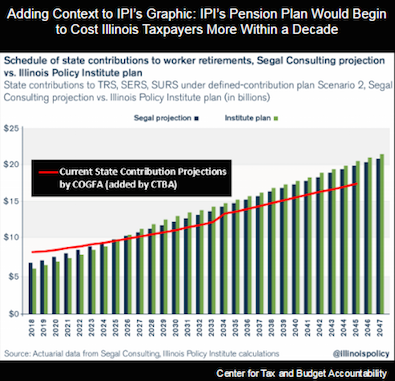
* The CTBA also looked at the “Institute’s” pension plan and discovered this…
While IPI’s plan costs less in the first few years — in part thanks to artificially lowered state payments from delaying the full implementation of changes to actuarial assumptions — within a decade or so, it actually becomes a net drag on the state budget, and continues to add billions of dollars in additional payments through the 2040s.
U.S. Senators Dick Durbin (D-IL) and Tammy Duckworth (D-IL) today urged Illinois Governor Bruce Rauner to stand on the side of Illinoisans and oppose repeal of our health care system. Repealing health care without a replacement would have immediate and harmful impacts on hardworking Illinois families – including those with employer based insurance – such as reducing insurance coverage, increasing out-of-pocket costs, reducing the quality of health care coverage, burdening providers, killing jobs and harming Illinois’ economy. They also called for his concrete recommendations on how to improve the health care system for Illinoisans state-wide.
“Independent analyses paint a very grim picture of the health care environment that Illinois would face if Republican ‘repeal without replace’ efforts are successful. For instance, the Illinois Health and Hospital Association (IHA) has expressed concerns that ‘people will not be able to get the care they need; local economies will suffer; and jobs will be lost.’ In our state alone, the IHA estimates that Congressional Republican plans to repeal the ACA without replacing it would result in ‘potential losses of $11.6 billion to $13.1 billion in annual economic activity, which translates to a potential job loss of 84,000 to 95,000 jobs,’” wrote the senators in a letter to Gov. Rauner. “We strongly urge you to reconsider your position towards these destructive Republican plans, and to stand firmly with Illinoisans against efforts to repeal the ACA without an adequate replacement plan in place to protect the coverage gains, affordability, benefits, and consumer protections that Illinoisans currently enjoy. Further, we would welcome your thoughts on how best to improve the ACA for Illinoisans state-wide.”
Durbin on Monday told the Sun-Times that governors across the country should be standing up against a repeal.
“Governors like [John] Kasich of Ohio are stepping up and saying eliminating Medicaid coverage is a disaster because that is compensation for providers that will go away. What we do know from the Illinois Hospital Association is that many downstate hospitals will be threatened if they lose this Medicaid infusion,” Durbin said. “We also know that when these hospitals in downstate communities start facing closure or they’re going to restrict construction and lay off people with the best paying jobs in town. So it is a devastating impact.”
In a statement regarding the senators’ letter, the Rauner administration on Tuesday noted Durbin was a lead proponent of Obamacare, which they said “resulted in skyrocketing health care costs on millions of Americans.”
“As Senators Durbin and Duckworth well know, our administration has urged Congress to take a thoughtful approach to any new health care changes,” spokeswoman Catherine Kelly said. “As always, the governor will continue to advocate for the best interests of the people of Illinois.”
The senators’ letter also criticized a Rauner administration response to House Republicans earlier this month, saying it failed to provide information about the potential fallout or benefit from appealing the act.
A political organization aligned with House GOP leaders unveiled a $1.3 million ad campaign on Tuesday that targets Democrats representing districts won by President Trump to urge support for repealing and replacing ObamaCare.
American Action Network’s campaign includes local ads in a total of 24 districts, as well as national TV ads on CNN and MSNBC. The ads focus on eight Democrats in Trump-country districts and 16 Republicans mostly representing swing seats.
The group’s advertising campaign in support of repealing the healthcare law will total $5.2 million for the month of January.
Yeah, it will most definitely mess with the governor’s messaging if it happens. How can Team Rauner say King Madigan is trying to shut down the government via his daughter’s legal motion in St. Clair County if the House puts this one on the big board?
Not to mention that the Illinois Policy Institute has already proposed doing the exact same thing.
On the other hand, how do lots of House members vote for this bill if it doesn’t include money for social service programs, higher education, etc.? And what does the Senate do? They’ve got their own proposal, after all.
So, possibly more positioning, but probably little actual progress - which is pretty much par for the course in the Illinois House.
Democratic members of House leadership received an email from Speaker Mike Madigan’s office Wednesday morning telling them to expect a bill that would appropriate funds for tens of thousands of employees. It could be voted on next week. […]
With such a bill, however, comes an interesting set of questions for lawmakers with various priorities, including those who would question paying state workers before paying social service providers or funding MAP grants for needy students. That likely means additional items are added to the bill. The proposed legislation would not negate the court battle, which could prove to take months, but would act as a stopgap, giving the Illinois Comptroller authority to pay certain bills on time.
*** UPDATE 2 *** The House Republicans are out with their own proposal…
- State Representative Avery Bourne (R-Raymond) filed House Bill 1787 today that would make state workers’ salary payments a continuing appropriation, guaranteeing payment during a budget impasse. This measure would keep workers paid and prevent a government shutdown.
This has become a particularly urgent issue due to Attorney General Lisa Madigan filing a motion in court to end payment to state employees beginning February 28th, 2017. In response, there has been talk of a similar bill that would provide for a short term appropriation for state worker salaries. However, a stop gap appropriation would be a temporary fix and would leave state worker pay vulnerable to future attacks. This proposal is a long-term solution to the problem of state worker pay being held hostage in a larger political fight.
“This legislation will prevent state worker pay from being used as a political pawn. Families across Illinois rely on the vital services provided by our state agencies. Before I arrived in the General Assembly, legislators chose to make their pay a continuing appropriation which guaranteed their pay with or without a budget. However, those legislators did not afford those protections to state employees. This legislation will keep state worker pay out of the political games that are too often played in Springfield.”
If enacted, this legislation would be effective immediately. Bourne previously co-sponsored similar legislation in the 99th General Assembly that was not allowed a committee hearing. Representative Bourne and her colleagues are calling on the House of Representatives to take up this issue as soon as they return to the Capitol next week.
* Greg Hinz on the Illinois Policy Institute’s budget proposal…
So, what’s in the institute’s secret sauce?
Just a few minor things: slashing the state’s Medicaid rolls by 600,000 people, allowing local governments to declare bankruptcy and impose rather than bargain pay and benefits, keeping $1.75 billion a year in revenue that the state now shares with municipalities for its own needs, and enacting workers’ compensation changes that Springfield Democrats have vigorously resisted.
Among other things.
Piece of cake, right?
Policy Institute chief John Tillman urged reporters not to be “cynical” about the plan, not at a time when the state is losing jobs and residents.
“Politicians have not earned the right to ask Illinoisans for more money,” Tillman said, accompanied by state Reps. Jeanne Ives, R-Wheaton, and Allen Skillicorn, R-Crystal Lake. “Our plan, unlike every other budget plan being discussed, ensures that taxpayers are respected and treated fairly rather than being treated like an ATM.”
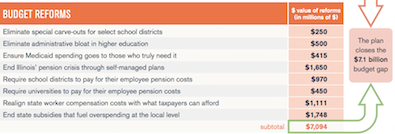
The other things include a half billion dollar cut to higher education, which is supposed to “eliminate administrative bloat,” but that could mean the General Assembly would have to take over their spending line by line to enforce something like that.
Higher ed would also be saddled with $450 million in additional pension costs and school districts would be whacked with almost a billion dollars in higher pension costs.
Next on the proposal is a revised state pension plan. The Illinois Policy Institute says the state could save $1.65 billion next year by offering some self-managed 401K accounts instead.
The plan would also streamline Medicaid spending and reform higher education.
Also, they have a big university right down the road from that station and yet they refer to a billion dollars in cuts and added costs a year as “reform.” Maybe check a dictionary.
“Raising taxes will not fix Illinois. We must reform the way Illinois does business,” Illinois Policy Institute CEO John Tillman said. “We must reform the way it actually spends the taxpayers’ money. We must slow the growth of spending to a rate below the growth in revenues. It is that simple. Spending must rise more slowly than revenues. That is the only solution.”
Agreed, but a lot of this plan isn’t about slowing state government growth, it’s about taking state money away from local governments, schools and universities and plowing it back into state coffers.
Meanwhile, the Illinois Policy Institute, a free-market think tank, released its own budget proposal on Tuesday — a plan that would impose no new taxes. It would alleviate the budget crisis by encouraging state workers to transition to cheaper pension plans; ease collective bargaining restrictions placed on local governments while reducing the revenue they get from the state; cut Medicaid rolls by limiting eligibility to only the most disadvantaged; and provide local property tax relief with a five-year freeze.
Some of the institute’s ideas have seen bipartisan support at the Capitol. But with a Republican governor and a Democrat-controlled legislature, policy differences create a frustrating divide between what is needed and what is doable.
The “Institute” couldn’t have written that editorial better themselves. The Trib makes a radical proposal look so… mild.
But, hey, look on the bright side. Two years in and they’re finally conceding that “doable” is a real life concept. Back in 2015, you may recall, the ivory tower sneered at folks like Jim Edgar who had the audacity to suggest that the governor ought to try cutting a doable deal. The Mother Ship also referred to those who wanted to work out a compromise as the “Surrender Illinois Caucus.”
* Anyway, it would be interesting to see this proposal put into bill form. Let’s hear from the mayors, the university presidents, the school superintendents and the nursing home residents who rely on Medicaid, among others. And then let’s hear the sponsors and proponents defend it during committee hearings and floor debate. That’s what democracy looks like, not a press conference with a couple of legislators and a snazzy packet.
Much of Caterpillar’s relocation rationale revolves around better international transportation options in Chicago. That’s a bit of a red herring. It can take as long to drive from, say, Naperville to O’Hare International Airport as it can to fly there from Peoria. And Caterpillar can and has use private aircraft to fly from Peoria to anywhere on earth.
Perhaps Caterpillar’s seventh floor is leaving Peoria for a more simple, personal reason, at least in part: [Cat CEO Jim Umpleby] and other executives want to live somewhere else.
Granted, we are speculating. But after talks with plenty of well-connected people the past few days, we believe this theory deserves at least some consideration.
Umpleby is a Caterpillar veteran, with more than 30 years of service. But it appears little of that time has been spent at a Peoria base.
The Chicago-area native worked for Caterpillar all over the country and world, including Malaysia, San Diego and Singapore. How you gonna keep them down on the farm after they’ve seen Kuala Lumpur?
Such personal-preference moves might not be unprecedented. In 2015, ConAgra Foods announced it was moving its world headquarters from Omaha, Neb., to Chicago. The new ConAgra CEO was residing in the Chicago suburbs.
Some commenters here made many of those same points yesterday.
Speaker Michael J. Madigan, D-Chicago, is directing the House Revenue committee to take up a Democratic Caucus proposal to reinstate a key tax credit for employers who create jobs in Illinois.
In a letter to state Rep. Michael Zalewski, chairman of the House Revenue and Finance Committee, Madigan requested the panel begin work to reinstate the Economic Development for a Growing Economy (EDGE) Tax Credit, a key component of the Democratic Caucus’ economic growth agenda.
“House Democrats know that Illinois must take serious steps to improve the business climate and create job opportunities, and we continue working on a reform agenda that promotes job growth without disadvantaging the people who work in those jobs every day,” Madigan said. “Businesses deserve the certainty of knowing that the state will stand with them as they work to create new jobs here in Illinois. By investing in businesses that invest in Illinois, the EDGE Tax Credit is essential to improving our business climate.”
The EDGE Tax Credit provides an incentive for employers who create a significant number of jobs in Illinois. The renewal of the tax credit was recently cited by the Illinois Chamber of Commerce as a key reform Illinois could undertake to help revitalize the economy.
“The House Democratic Caucus believes that it is possible to provide good jobs for working families while also passing policies that help businesses grow,” Madigan said. “These ideas are not mutually exclusive; in fact they’re both critical to the future of our state.”
The governor and the GA let the program expire at the end of last year and then reinstated it for a few months earlier this month. If this was the plan all along, they could’ve just made it permanent earlier.
Amends the State Designations Act. Repeals the following State designations: State bird; State insect; official language; State mineral; State tree and flower; State animal; State fish; State prairie grass; State vegetable; State fruit; State fossil; State artifact; State folk dance; State theatre; State soil; State snackfood; State amphibian; State reptile; State tartan; and State pie.
* The Question: Your thoughts on this proposed legislation?
As AFSCME leadership conducts its campaign for strike authorization, we will continue to provide accurate information and clarify any confusion that employees bring to our attention.
On that note, we learned yesterday of what appears to be a troublesome attempt to discourage voting by those who are inclined to vote against a strike. We learned that some union representatives were telling employees that not participating in the strike vote would be the equivalent of a “no” vote. However, a week ago AFSCME’s spokesperson said, “a vote of more than 50 percent of those voting would grant the bargaining committee the authorization to call a strike if necessary.”
Based on that statement, what the reps were saying yesterday is wrong. We hope the union confirms that by not voting, you have no say in the strike authorization decision.
The decision to vote is yours and yours alone, and we will respect your choice either way. Our obligation is to make sure you have accurate information. To that end, please continue to reach out with questions and concerns and refer to the Labor Relations link on team.illinois.gov.
Sincerely,
JT
John Terranova
Deputy Director
CMS Office of Labor Relations
Emphasis added because that’s a pretty serious allegation.
* From Anders Lindall at AFSCME Council 31…
The truth is plain and simple: We want every AFSCME member to vote, and they’re doing so by the thousands right now.
If the Rauner administration would seek compromise instead of spreading misinformation, we’d be at the bargaining table.
The government needs to move quickly, [Missouri Attorney General Josh Hawley] told a large gathering of wealthy conservative and libertarian donors gathered in California, to send power back to the states and deregulate the economy. The problem is how slowly Washington, D.C. moves, and how the administration is tied up in bureaucracy. But if states, which know which regulations affect them hardest, sue, that would give the feds the power to simply settle and withdraw the reg.
“If a state would bring a suit against a regulation, it gives the federal government the opportunity to withdraw that regulation.”
This, he told donors and reporters, “will give the government the ability to move quickly on deregulation.” […]
“I like President [George W.] Bush but… look, they screwed it up,” Rauner told attendees, echoing a common center-right gripe that Bush did not do enough to decentralize government. “Send power back to the states.”
OK, but what are you gonna do with that power, governor? I mean, dude, you can’t even pass a budget with your reforms.
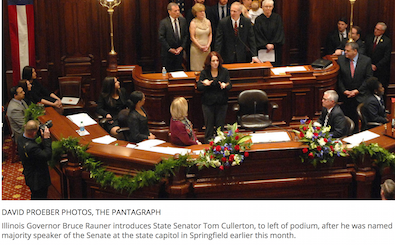
* As I told you yesterday, the Pantagraph’s parent company just shut down its Statehouse bureau. I’m assuming we’ll see lots more oopsies like these in the coming weeks and months, if they even bother covering the Statehouse at all.
Buried among the facts and figures in the Justice Department’s recent book-length report on the failings of the Chicago Police Department was a telling statistic: The rate of suicide among CPD officers is 60 percent higher than other departments across the U.S.
Among the ranks of the nearly 10,000 patrol officers of the CPD, an average of three officers will take their own lives each year, according to life insurance claims information from the Fraternal Order of Police Lodge 7, the union representing the bulk of the department’s sworn officers.
In the past decade, 13 officers have been killed in the line of duty. Nearly twice as many officers died by their own hand during the same span.
Ron Rufo was a peer support counselor for most of his 21 years as a patrolman in the 9th District, volunteering to talk to his fellow officers at any scene where an officer was killed or injured. Rufo, who retired a little more than a year ago, estimates the number of his former peers who kill themselves each year could be double the FOP figure.
“There is a problem, and nobody’s doing anything about it,” Rufo said. “Supervisors don’t talk about it. The rank-and-file don’t talk about it. And it’s like the administration does not want to admit it’s a problem.”
* From a Republican pal regarding the fight over Attorney General Lisa Madigan’s legal motion to stop paying employees without a formal appropriation…
I’m not sure I buy the theory that this is going to take away Rauner’s leverage… I think he’d rather not shut it down, but if it has to be done, he’ll let it happen and blame Speaker Madigan for it.
After House Democrats ignored the will of the people by electing Mike Madigan to a 17th term as Speaker, it’s clear the only way we will stop the Madigan Machine is by ousting the politicians that give Madigan his power.
This means taking the case directly to the voters.
That’s why today, the Illinois Republican Party is launching the first phase of its “Drop the Mike” campaign, highlighting how Madigan and his prospective Gubernatorial candidates are working for the Chicago machine and against the people.
» Revenue-sharing agreements that fuel excessive local spending, such as the Local Government Distributive Fund – for counties and cities with populations above 5,000 – and the Downstate Transit Fund. (Savings: $1.75 billion)
» State pension subsidies that allow districts and universities to dole out higher pay, end-of-career salary hikes and pensionable perks. Going forward, local school districts and universities should be responsible for paying the annual (normal) cost of pensions. (Savings: higher education: $450 million; K-12: $970 million)
» Special carve-outs in the state’s education funding formula that grant subsidies to a select few school districts affected by local property tax caps and special economic zones. (Savings: $250 million)
So, whack the LDF, transfer pension costs to schools and universities and cut Chicago’s school funding.
Reform costly state mandates imposed on local governments such as prevailing wage requirements and collective bargaining rules. Ease the process for government consolidation and other cost-saving measures. (Local government savings: $2 billion-$3 billion)
Right. Yeah.
* It also wants a 10 percent reduction in the number of state employees and implementation of Gov. Rauner’s contract terms, for a claimed savings of $500 million for each point.
The group wants to cut higher education spending by $500 million a year. It would cut Medicaid spending by $415 million.
» Phases in the costs of any pension funds’ actuarial changes over a five-year period. This will reduce the required $800 million increase in state contributions by nearly $650 million in 2018.
» Creates a new contribution schedule with a 2018 payment that is $1 billion less than baseline contributions. That will protect overburdened Illinoisans from
tax hikes and allow the state to prioritize funding for social services.
As her first act on the Senate Government Reform Committee, Senator Heather Steans (D-Chicago) introduced legislation to close the revolving door between state government employees, officials and lobbying firms.
“It is high time that we strengthen ethics laws in Illinois and tighten regulations on the revolving door,” Steans said. “The General Assembly last passed revolving door reforms nearly 10 years ago. While those acts were undoubtedly progress, elected officials and state employees should not be able to immediately translate relationships built on state time into lobbying connections upon leaving public service.”
Senate Bill 615 requires employees and officials to wait one year after leaving a position with the state before accepting a position or compensation for lobbying state government. The legislation also bans state employees and officials from negotiating employment terms or compensation from lobbying entities while employed or serving as an appointee of the state.
“SB 615 restricts legislators and state employees from lobbying for at least one year after their departure from state government, bringing Illinois in line with a majority of other states who restrict this kind of activity,” said Sarah Brune, executive director of Illinois Campaign for Political Reform. “This legislation is an important step in closing the revolving door of state government in Illinois and encouraging openness and transparency in the political process.”
(1) the Governor, Lieutenant Governor, Secretary of State, Attorney General, State Treasurer, and State Comptroller;
(2) Chiefs of Staff for officials described in item (1);
(3) Cabinet members of any elected constitutional officer, including Directors, Assistant Directors and Chief Legal Counsel or General Counsel;
(4) Members of the General Assembly; and
(5) Members of any board, commission, authority, or task force of the State authorized or created by State law or by executive order of the Governor.
Legislators in particular should not be allowed to negotiate employment terms with lobbying entities while in office. It defies common sense.
…Adding… It probably should be noted that the governor’s executive order from 2015 did some of this as well. But Rauner didn’t bar his people from working for lobbying entities for a year, like this proposal does. He just barred them from actively lobbying the governor’s part of the executive branch.
Caterpillar Inc. has scrapped plans to build a new office complex in Downtown Peoria and will move its global headquarters to the Chicago area by the end of the year.
The upper echelon of executives, including newly installed CEO Jim Umpleby, will begin relocating later this year, with up to 100 employees total moving by year’s end. About 300 employees will work in the new office at an as-yet undecided location once the transition is complete. […]
The [company’s restructuring] contributed to $2.3 billion in savings in 2016, but sales and revenue for last year still were more than 40 percent below peak levels of 2012. Umpleby said that decline is a fundamental reason the company’s Board of Directors opted to move global headquarters to an area where the global marketplace is in easier reach. […]
“I understand it is a big deal, and it is not a decision that we made lightly. As we step back and looked at what is most important, what’s most important for us is to get Caterpillar growing again and for us to make the company successful,” Umpleby said. “And I clearly recognize it will be disappointing, it will be tough. This is not easy. I clearly recognize that. But again I think it’s the right thing for Caterpillar to do in the long term.”
* The same thing happened with ADM not too long ago. Execs want to live in or next to a big city, with big city amenities and access to transportation hubs. From the Peoria paper’s interview with the CEO…
We have decided to locate a small, lean headquarters team, a team of senior executives, in the Chicago area to have better access to flights. About two-thirds of our business over the last five years has come from outside the United States. We see a lot of growth coming in the international markets, and we believe that speed and agility for our senior leadership team to be able to travel around the globe is very important. I do want to emphasize that the vast majority of our employees in Peoria will not be relocated. And again, both of these decisions, although they seem related, are independent decisions. They’re very much focused on allowing Caterpillar to grow and prosper again. […]
I suspect we’ll start with 100 employees, probably less by the end of the year. And when this new office is up and running, it will probably be around approximately 300 employees. One thing I want to make clear is we’re not moving the top 300 people to Chicago. That’s not happening. Many officers will continue to be in Peoria. We’re talking about the executive office, maybe a couple of the vice presidents. It will be a small group, and then, as with any lean headquarters, there will be support staff around, including a few key finance functions, human resources and members from the legal department. […]
There will be more vice presidents in the Peoria area than there will be in our new location. We have over 12,000 employees in the Peoria area, and we’ll still consider Peoria our hometown. This is where we grew up, this is where our employees are. We’ll be here a lot, so you’ll see us knocking around town. It won’t be a situation where we’re gone. We’re not looking for a building the size of AB (the current Downtown Peoria headquarters) to fill up. We’re not going to build a building. We’re going to lease space in an existing building.
Caterpillar already has a footprint in the Chicago area. There are operations in LaGrange, Joliet and Aurora, though the company is considering ending manufacturing in Aurora.
The company also houses its digital and analytics team in the Merchandise Mart. But the new headquarters will not be at any of those locations, and the employees at the Merchandise Mart will not be moved to the new headquarters, wherever it is situated.
Caterpillar has 12,000 employees in Peoria, Potts said, “and that’s not going to change.” The central Illinois city “is still our hometown.”
* When we think of local government consolidation, we often think of schools or townships. But Illinois also has 1,299 incorporated cities, towns and villages…
Former police chief Craig Kennedy said Monday he wasn’t surprised and has no hard feelings about being laid off by the village of Jerome.
As part of cost reductions necessitated by a budget shortfall, Village President Mike Lopez said the police chief was let go Friday. Kennedy was paid $55,000 per year.
“I attend 99 percent of the village board meetings and watched the downturn in sales tax revenue and figured I would be the first to go,” said Kennedy, 57, who spent the past 15 years with the Jerome Police Department, including three as chief. […]
Earlier this month, The State Journal-Register reported that police officers in nearby Leland Grove had been covering shifts in Jerome due to what village officials described as a temporary manpower shortage.
The 2015 Census estimate puts Jerome’s population at 1,651.
Lopez said that village coffers have been hurt by late payments from the state on monies owed. For example, the village in December received checks from the state to pay for officers who participated last spring in seatbelt emphasis patrols, he said. […]
Sales tax revenue in Jerome is also down, Lopez said. While the opening of Hy-Vee on MacArthur Boulevard might have been good news for the City of Springfield, it has reduced spending at Shop ’n Save, one of the largest businesses in the village. On the other hand, gambling revenue has soared to as much as $7,000 a month, he said, but that money will likely tail off due to the number of video gaming machines that have been installed throughout the area. […]
The village this month ceased paying a portion of health care premiums for dependents of village employees, which will save nearly $23,000, Lopez said, and Jerome residents can expect other cutbacks.
* Finke on AFSCME’s strike authorization vote, which began yesterday…
But as [AFSCME Council 31 spokesman Anders Lindall] said, only members who are eligible to strike are eligible to vote. AFSCME represents about 38,000 state workers in Illinois. Of those, roughly 30,000 can strike. The others work security jobs at the Department of Corrections and Department of Juvenile Justice and are forbidden from striking. […]
Actual voting will take place at 700 work sites around the state, Lindall said. The idea is to make it as easy as possible to vote for as many members as possible.
“We’re trying to give people multiple opportunities (to vote),” he said. “We are putting a tremendous effort into the access to vote and also for the integrity of the vote. We are following federal labor board processes for security votes similar to a union-authorization election.”
Although votes can be cast at hundreds of locations, they will be counted at a central location, Lindall said. None of the votes will be counted until after the election is concluded. Voting is scheduled through Feb. 19, although union officials have said it could be extended a bit if necessary to accommodate all voters.
Sen. Dick Durbin on Monday called Illinois Attorney General Lisa Madigan’s motion to halt state employee pay without a budget a “bold move” that will force Gov. Bruce Rauner’s hand.
Durbin — who last year opted not to run for governor — told the Sun-Times the budget impasse, which he said has shredded a safety net and cut off care for the most disadvantaged, hasn’t been enough to create a force for compromise.
“I think what she’s saying is ‘Let’s face the reality.’ The [Illinois] Constitution says you can’t appropriate it. You can’t spend it unless it’s appropriated. And if she tests that, and it comes through, it’s going to force the hand of the governor as to whether or not that the things he’s insisting on are so important that it would create an even worse situation in our state,” Durbin said. […]
“It’s no surprise that Dick Durbin is spinning like a career politician,” state Republican Party spokesman Steven Yaffe said in an email. “Durbin knows ridiculous political attacks by Mike Madigan and the money men who fund his machine don’t work, but exposing the failure of Madigan’s decades of rule in Springfield does. Dick Durbin is unwilling and afraid to stand up to Mike Madigan. It’s why Durbin chose not to run.”
The Diminutive Daughter of the Diminutive Don of Illinois politics shook things up big time last week when she inserted herself into the 19-month-old state budget battle between Republican Gov. Bruce Rauner and her father, Democratic House Speaker Michael Madigan.