The legislation would allow red light cameras near schools and parks to be used to ticket people who speed through those areas.
The Illinois House and Senate approved the measure last fall, but Quinn has yet to sign it, saying he is still studying the idea.
Emanuel says the study shows a new law could reduce fatal accidents.
“We have seen all the data that show when you put the cameras in – actually – traffic, people comply, and it’s the right thing to do,” Emanuel said. “I didn’t think it was going to be popular. The question is can I save lives.”
* The Expired Meter blog FOIA’d Quinn’s office on the public response to the bill, and it wasn’t even close to positive…
The Governor’s office released a report via a Freedom of Information request by The Expired Meter, that shows the Governor’s office has received a total of 224 phone calls, emails or letters from constituents regarding SB965, of which just 19 were in support of the bill. The other 205–over 91%–were opposed to the bill and urged the Governor to veto it.
In total the Governor’s office received 15 letters (11 opposed, 4 in support), 36 phone calls (35 opposed, 1 in support) and 173 email comments via the Governor’s website (159 opposed, 14 in support).
[Kim Clarke Maisch, Illinois director for the National Federation of Independent Business] said the governor should start considering how Illinois can compete against neighboring states that have enacted or are considering right-to-work legislation. The Indiana House recently approved a proposal banning contracts between companies and labor unions that require employees to pay union dues. The Indiana Senate will consider the measure this week and is expected to approve it. Gov. Mitch Daniels has said he will sign it.
Supporters say right-to-work laws make a state more attractive to businesses, but opponents say such laws are an attack on labor unions and will drive down workers’ salaries.
“Indiana is a game-changer,” said Maisch. “Most of the economic growth over the past 20 years has occurred in the right-to-work states in the South and West. But it’s coming to the Midwest now, not just in Indiana but Michigan is looking at it too, and that is going to give businesses here a very convenient alternative to Illinois.”
She warned that Illinois has to keep up with its neighboring states or its business climate will get worse.
If you compare Mark Kirk’s 2010 Downstate vote totals to Bill Brady’s, you’ll see that Kirk does slightly better. Some say the reason for that is Brady’s support of so-called right to work legislation. Also, too, Cook County. This is just talk for the NFIB base, nothing more.
A new progressive Democratic leaning SuperPac–called CREDO–announced Monday that Tea Party Rep. Joe Walsh (R-Ill.) will be one of their first targets. Walsh, a freshman, is running in the Illinois north suburban 8th congressional district. Democrats Tammy Duckworth and Raja Krishnamoorthi are locked in a March primary battle.
Earlier, the Democratic House political shop said Walsh is also one of their prime targets.
A local pastor accepted a bribe from a Danville Correctional Center prisoner to take time off the man’s sentence, according to law enforcement officials.
The Rev. Floyd S. Crenshaw Sr., 51, of the 500 block of East Main Street, appeared Thursday afternoon in Vermilion County Circuit Court for a preliminary hearing on a felony charge of official misconduct. […]
Bank records indicated that Crenshaw received two payments from the prisoner’s wife. Kilduff said the first, which totaled $4,000, was made to a non-profit organization handled by Crenshaw. The second payment was $700 sent via PayPal to a website handled by Crenshaw.
A week after Sen. Mark Kirk suffered a stroke, doctors Monday said his condition has been upgraded to fair.
“Senator Kirk’s recovery is continuing,” said Northwestern Hospital’s Dr. Richard Fessler in a statement. “He is alert, talking and responding well to questions. He has been upgraded to fair condition and we are very pleased with his progress.”
* Related…
* ADDED: Kirk, Giffords’ stories intertwine again, after stroke
* Imagine, if you will, the horrific anguish that the parents of this 14 year-old boy (named “N.B.” in this story) are going through…
N.B. has been placed in a psychiatric hospital 14 times, where he stays an average of three weeks. N.B. is extremely aggressive, doesn’t talk and has been diagnosed with moderate to severe mental retardation, autism spectrum disorder, intermittent explosive disorder, mood disorder, disruptive behavior disorder and more, the lawsuit states. He also has “a history of maladaptive and self-injurious behaviors, including hitting himself in the head, scratching himself and biting his hand.”
The parents have filed a lawsuit against the state to force it to provide better home-care treatment programs. According to their lawyer, the system is downright unfair…
“Some parents are told they can’t get funding for their child’s treatment and they reach a point where they don’t pick the child up from the psychiatric hospital because they’re a danger to their other siblings,” Farley said. “Then DCFS gets called and they take custody. The parents get residential treatment (for the child), but they’ve given up custody, and that shouldn’t have to be.”
The class action lawsuit could affect more than 18,000 kids with severe problems in Illinois alone. So, as the talk turns to cutting Medicaid, keep this heartbreaking story in mind. As the headline says, the budget is about people.
An attorney for Gov. Pat Quinn faced blistering questioning by legislators Friday on why the governor didn’t quickly fire the head of the state’s child-welfare agency last year after a report of fraudulent billing under his watch.
At a hearing in Chicago, Rep. Jack Franks called it “cowardice” on the part of Quinn’s office to ask for Erwin McEwen’s resignation from his post as chief of the Department of Children and Family Services rather than fire him. State inspectors had found that a friend of the former director collected millions of dollars for shoddy or non-existent work.
“I can’t believe the cowardice,” Franks exclaimed in reaction to Quinn’s general counsel, John Schomberg, who had said that accepting a resignation instead of firing an employee can avoid a lawsuit.
“Let him sue,” Franks said, his voice rising. “Who cares? Do what’s right.”
State ethics investigators say they may never know the full extent of an alleged contracting scheme that they say cost taxpayers at least $18 million and led to last year’s resignation of the head of the Illinois Department of Children and Family Services.
The comments came during a legislative hearing Friday examining a probe that found numerous violations by George E. Smith, who held various state contracts across a number of agencies, including DCFS.
The state executive inspector general’s office accused Smith of forging documents, presentingfalse information about grant funds for after-school services, submitting budgets that allowed him to conceal funds, and accepting payments he was not entitled to receive.
But Executive Inspector General Ricardo Meza said the wrongdoing may go further, as the state only investigated contracts Smith held dating back to 2008. Smith has been doing businesses with the state since 1986.
Sometimes, as in this case, the budget can be about the wrong people.
* And sometimes, a governor wants to do things that the state cannot afford…
Watch for Quinn propose a tax cut targeting families with children Wednesday at his State of the State address. “This tax cut will benefit almost 1.5 million families in Illinois, by putting more money in their pockets,” a top source said.
“We need to understand that by targeting tax relief for the people who need it the most, that’s a very important mission for us this year in Illinois. We have to help our veterans too. We have a veterans hiring tax credit that I’ll be speaking about Wednesday. We want to make sure our employers are hiring veterans because they have the discipline, the teamwork, the leadership and the skill to get a job done, “said Quinn.
TO: ALL USERS OF THE STRATTON TUNNEL
FROM: J. Richard Alsop, III, AIA
Architect of the Capitol
DATE: January 30, 2012
RE: Notice of Opening of Stratton Tunnel
Effective immediately, the Stratton tunnel to the Capitol is open to the public.
The weather is gonna be amazingly warm this week, but that blessing can’t last forever and the tunnel between the Stratton and the Statehouse is a must during winter.
Anyway, it’s not exactly the most important story in the world, but it is something that people like me need to know.
*** UPDATE *** Somewhat off-topic, but it wouldn’t qualify for its own post, so here’s the press release…
The Illinois House Republicans led by Leader Tom Cross (R- Oswego) are launching a new design of their website today at www.ilhousegop.org, which includes a platform driven by up to the minute House Republican news.
“Our caucus believes it is important to keep constituents informed and to keep the lines of communications open. We are making it a priority to provide constituents and the media with up-to-date information through the use of social media and websites. We are excited about this new format and hope you will visit our website often,” said Cross.
The new website is driven primarily by news releases, audio and video feeds. The House Republican Twitter and Facebook feeds are also present on the site. The website can be found at www.ilhousegop.org, the Twitter feed has the handle of @ilhousegop, and you can follow along on Facebook by hitting Like on the Illinois House Republicans page.
“Governor Thompson is a very intelligent person, quick learner, very flexible. Understood that he was involved in government, where everybody is entitled to their due and that you need to fashion compromise if you wish to move forward.”
___
Gov. Jim Edgar (1991-1999):
Edgar “was a little more strident than Governor Thompson. Jim Edgar was and is a student of government. Thompson had another career. He was a lawyer. He was a U.S. prosecutor in Chicago. Edgar was involved in government, I think, all his life, and he made himself a student of government. And so he’d be far more interested in heavy discussion about government policy, government operations. He’d be far more willing to engage in protracted negotiations in order to get what he wanted, especially on the budget, which is exactly what he did in 1991.”
___
Gov. George Ryan (1999-2003):
“Very flexible, very interested in just identifying problems and fashioning solutions. One of Governor Ryan’s favorite approaches … would be to convene leaders. He and I would be in the room with the other leaders and George would just say, `Well, look. We’ve got problem A. What do we have to do to solve this problem?’
“That’s what he was like. And of course in these situations, (leaders) might want to evade the question, they might have their strategic plan that they’re working on and they don’t want to answer today. And George would just pursue, persist: `I want an answer.’”
* The Question: Of the three governors Madigan mentioned above, who in your opinion was the best? Take the poll and then explain your answer in comments, please. Thanks.
* This story has not been getting the attention it deserves, mainly because the Civic Federation released its study late Sunday night…
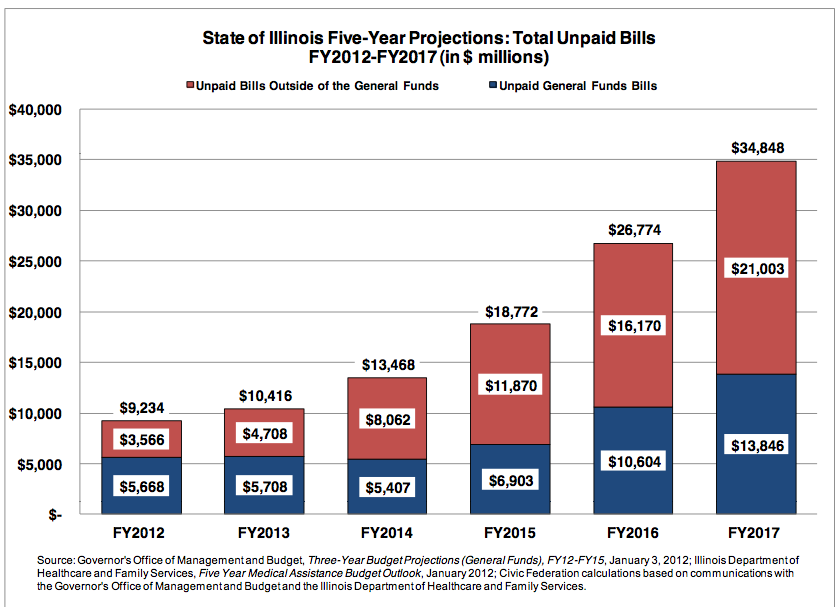
Illinois’ unpaid bills may more than triple to $34.8 billion by 2017 unless lawmakers and Democratic Governor Pat Quinn immediately bring Medicaid and pension spending under control, said a research group.
The “potentially paralyzing” backlog, projected to reach $9.2 billion when this fiscal year ends June 30, would be fueled by an “unsustainable” increase in Medicaid spending, according to the Civic Federation, which calls itself a nonpartisan government research organization.
“Failure to address unsustainable trends in the state’s pension and Medicaid systems will only result in financial disaster for the state of Illinois,” Laurence Msall, president of the Civic Federation in Chicago, said in a press release today.
The report points to rising pension costs and medical bills for the poor and uninsured as the primary culprits of increased state spending. Among the Civic Federation’s suggestions for reining in state finances are reducing automatic 3 percent increases built-in to retirement pay for government workers and increasing the cigarette tax.
“It’s a very frightening situation,” Msall said. “It’s one that calls for not half measures, not politically massaged answers. It calls for significant, drastic action by the state of Illinois.”
You’re darned right this is frightening. That report freaked me out when I read it last night. Right to the bone.
General Funds Medicaid costs are projected to increase by 41.7% from $8.6 billion in FY2012 to $12.1 billion in FY2017, according to a recent analysis by HFS.49 General Funds costs of the program are projected to increase 13.0% between FY2012 to FY2013 due to an anticipated decline in resources from Other State Funds. Between FY2014 and FY2017, program costs are expected to increase at an average annual rate of 5.8%. […]
Unpaid bills increase in FY2012 because the program is underfunded by approximately $1.5 billion. As a result, the backlog of unpaid Medicaid bills is expected to grow to roughly $1.8 billion by the end of FY2012 from approximately $300 million at the end of FY2011, meaning that it will take longer for healthcare providers to be paid. If the increase in Medicaid appropriations were limited to 2% a year going forward, unpaid Medicaid bills would grow to $21.0 billion by the end of FY2017. […]
Annual Medicaid costs can exceed appropriations because State law allows Medicaid expenses, unlike most other State expenses, to be paid from future years’ appropriations.52 This provision of Section 25 of the State Finance Act has repeatedly been used to budget an insufficient amount of Medicaid appropriations to cover costs for a given fiscal year, knowing that the bills will be paid from the next year’s appropriations.
There are no real solutions in this report, either. The Civic Federation wants aggressive cost controls, but they’ll have to be draconian to put this budget into balance.
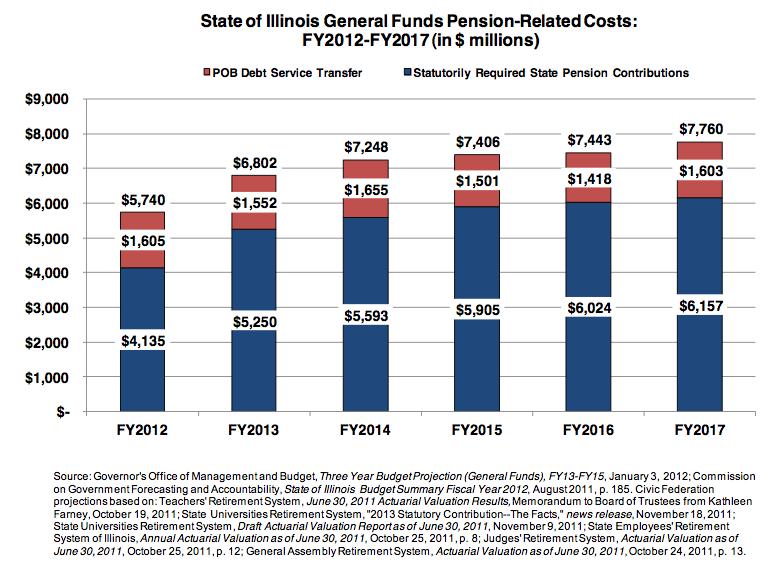
* Pension funding will cost the state a total of $9 billion from this year’s base in five years. The red is debt service costs on the chart…
That $9 billion isn’t chump change, of course, but it’s nothing compared to how much money will go into the base via Medicaid.
* One of the Civic Federation’s ideas is to tax retirement and Social Security income, as well as increase the cigarette tax by 98 cents a pack. This would put a dent into the stack of old bills, but not a big one. The Tribune, believe it or not, is not dismissing these two ideas out of hand…
All of us can debate these and other Civic Fed proposals. But we suspect many politicians would rather take an easy route this report doesn’t suggest: renewing the “temporary” income tax hikes for years beyond 2014.
Tell us, Governor, where you stand. Candor in these two speeches might restore some of the credibility lost when you (a) pledged during the 2010 campaign to veto any personal income tax increase above 1 percentage point and (b) after the election, signed your 2-percentage-point increase into law.
Tell every Illinoisan, Governor, that “temporary” does not mean “permanent.”
Um, even if the temporary tax is made permanent, that 2017 stack of unpaid bills will still be about $17 billion.
*** UPDATE *** AFSCME has issued a press release which it claims “debunks” the Civic Federation’s report. The union doesn’t challenge the Medicaid projections laid out above, however, and essentially focuses on a demand for a tax hike on the wealthy.
“Old timer, old timer, too late to die young now.”
I’m turning 50 soon, so I’ve been planning a big party in Chicago on March 31 to distract myself from my own mortality. As Todd Snider confides in his song Age Like Wine, “I thought that I’d be dead by now . . . but I’m not.”
The party will be a benefit for Lutheran Social Services of Illinois, one of this state’s most indispensable organizations. The featured presentation will be a roast of yours truly. Cash bar. The last thing I need is some of these roasters sucking down free drinks and then taking to the microphone to tell jokes about my many, many faults.
Carol Marin, this paper’s political columnist, has graciously agreed to roast me, as has the acerbically witty Roosevelt University Professor Paul Green. Politicians like Senate President John Cullerton (our event’s emcee) and Comptroller Judy Baar Topinka have agreed to join the fray. The rest of the list is pretty long, but no less distinguished.
Actually, the most difficult part of planning this event has been limiting the number of roasters. It isn’t every day that a media type gives those he or she covers carte blanche to say cruelly funny things about him in front of an audience. They’re coming out of the woodwork to be a part of this thing, and I guess I’m not surprised.
I’ve been pretty rough on them over the years, so they’re eager to exact some sweet revenge.
“Old timer, five and dimer, trying to find a way to age like wine somehow.”
Fifty used to be old. It used to be that when you reached 50 years of age, you were considered somehow wiser than others. Now, the baby boomers have decided to change all that and dub 50 “the new 30” and keep treating people like me as if we were kids.
But I clearly remember when my boomer friends turned 50. They were all horrified out of their minds. As they aged even further they’ve tried to pass off the milestone as no big deal, as if 50 isn’t even middle aged.
Let me tell you something, my friends, there’s no way on God’s Earth that I’ll live to be a hundred. Trust me on that. Middle-aged my eye.
“My new stuff is nothing like my old stuff was.”
U.S. Sen. Mark Kirk is 52, not much older than me. As I write this, Kirk is in a Northwestern University Hospital intensive care unit recovering from a major stroke. Most of the comments I’ve heard by his fellow politicians were about how young he is. People, he’s not young. Face facts here, man, bad things start happening to your body when you turn 50.
The night after we all learned about Kirk’s stroke, I found myself in a supermarket shopping for some sliced ham for my lunches. I remembered I was also running low on toothpaste, so I went to the “drug store” section, and before I realized what I was doing I’d filled my basket with vitamins for people over 50, various stop-smoking aids and Slim Fast. And then I returned to the grocery section and dumped the ham and picked up some turkey instead. It wasn’t until I got home that I realized what was going on. I’d been freaked out by Kirk’s stroke more than I cared to admit.
Get well soon, senator. And don’t let those graying boomers fool you.
You’re not nearly as young as you used to be. Neither of us are. Like it or not, we’re both getting old. Let’s try to make the best of it.
* The March 31st event will be held at Maggiano’s in Chicago. And I can’t wait until you see the menu. Mm-mm… good. This ain’t gonna be no rubber chicken political dinner, baby.
As of now, cocktails will start at 6:30. Invites will be mailed soon and tickets will also be available for purchase online here and at LSSI’s website. It’ll be high dollar, but it’s tax deductible. I’m mentioning it so early because I want people to save the date on their calendars. March 30th is the last day of session before spring break, so we needed to make sure folks didn’t zoom outta town before the party on the 31st. We tried to schedule it for the 23rd, but the date didn’t work for President Cullerton, and I specifically wanted him to emcee.
Our old friend Dave Kohn’s band Voodoo Pilot will be playing.
More details will be released soon, but there may be at least one big surprise that’ll be saved for the event itself. The idea is to raise lots of money for LSSI and throw the party of the year. Yes, it’s a tall order, but that’s one of the reasons I chose Lutheran Social Services of Illinois as the beneficiary - they have the experience, time and skill to put on a big to-do and I don’t.
Last week, powerful Illinois House Speaker Michael Madigan appeared to all but endorse an idea to force downstate and suburban school districts to pay a significant share of their state pension contributions.
Senate President John Cullerton (D-Chicago) floated the same proposal last year, and Gov. Pat Quinn added his support not long ago.
Needless to say, if all three Democratic leaders are talking about it, you can probably expect some action this year. However, there will be strong pushback from suburban and downstate legislators who undoubtedly will fear a voter backlash over potentially massive local property tax increases to pay for the idea.
Madigan (D-Chicago) spoke for well over an hour last week at an Elmhurst College event at the invitation of his old nemesis Lee Daniels, who served as speaker for two years after the 1994 Republican landslide. Madigan almost never talks for that long in public, so his speech was heavily covered by the media.
As is his custom, Madigan didn’t officially endorse the plan to ease the state’s ongoing budget strain by passing pension obligations down the governmental food chain to school districts and public colleges and universities, but he did indicate that he was strongly leaning in that direction.
The “normal arrangement,” for pensions, Madigan said, was that the employee and the employer both pay into the pension system. But school districts pay just 0.054 percent of payroll into the Teachers’ Retirement System, Madigan noted (and when he has it down to the decimal like that, you know he’s focused on the issue). He also said the universities pay “zero” toward employee pension costs.
“And let’s understand,” Madigan said about public school employees, “these are people who never got a payroll check from the state of Illinois.”
The speaker went on to note that the state paid $4 billion this year into its five pension funds, half of which went to the Teachers’ Retirement System (TRS).
“So over one half of our obligation to pensions, which is the subject of great public debate today, is for people (teachers) who never worked for the state of Illinois,” Madigan said.
Madigan also correctly pointed out that the Chicago Public Schools has its own pension fund and pays its employer share.
“You’re never going to read this in a newspaper article. … They’re never going to put a paragraph in there talking about that,” Madigan said, echoing others who’ve wondered for years why Chicago taxpayers fund the schools’ pension fund while they and the rest of Illinois taxpayers pick up the tab for suburban and downstate school districts.
“Even I don’t remember why that happened,” Madigan said jokingly. “I’ve never found anybody who can tell me why the state of Illinois stepped up one day and said, ‘OK, school districts, we’ll just pick up all your pension costs.’”
He also pointed out that school districts pay the employer share for pensions for support staff, such as janitors and cafeteria workers, but not for teachers.
This is truly an odd arrangement. All state taxpayers finance TRS, but the Chicago Public Schools receives just a relatively small amount of state cash for its pension fund. It doesn’t seem fair, but often life ain’t fair.
The teachers unions haven’t taken a position yet on this issue, probably knowing that freeing state money could mean more cash for education and that school districts couldn’t short the pension fund because state law forbids it.
The state is the only government entity in Illinois that can legally shortchange pension funds and has done so for years, which is what got us into this long-term pension crisis to begin with.
It’s doubtful that anything close to the state’s annual $2 billion contribution to TRS will be passed down to school districts right away, but property owners may be about to get hit with a bigger bill nonetheless. Get ready to pay. Again.
* Related…
* Speaker Madigan says it’s high time school districts pay for their own pensions
Anyone hoping that Mayor Rahm Emanuel would follow through on campaign promises of openness and transparency in Chicago government has to be disappointed in the ward remap fiasco that unfolded earlier this month. We certainly are.
The city’s ward map is legally mandated to be redrawn and rebalanced every 10 years, an event that is always a juicy opportunity for wheeling and dealing—the kind that usually takes place behind closed doors. Politicians know how to count, after all, and the maps they draw tend to be the kind that can best ensure each incumbent’s re-election. But even by Chicago’s considerable historic standards of backroom back-scratching, this latest effort is an embarrassment.
After a now-you-see-it, now-you-don’t public comment period that lasted just under two hours, the City Council, with the mayor’s acquiescence, rammed through new boundaries that ignore neighborhood history, sever residents’ and small-business owners’ long-standing relationships with City Hall representatives and effectively disenfranchise large swaths of voters by overweighting certain wards at the expense of others.
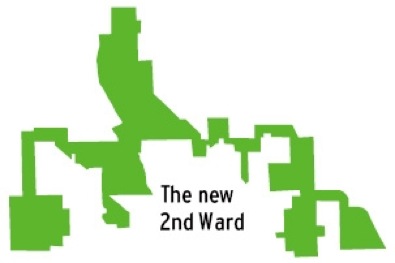
The result is a twisted mess. The 2nd Ward alone—as noted by Greg Hinz in a delightfully acerbic blog post—is a profile in absurdity, snaking as it does from the Gold Coast to the Clybourn Corridor, hopscotching over the Kennedy Expressway and curling around to encompass much of Ukrainian Village on the West Side.
State Sen. A.J. Wilhelmi has been tapped for a senior leadership post at the Illinois Hospital Association, the powerful lobbying organization that represents 200 hospitals, sources have told Crain’s.
Mr. Wilhelmi replaces Howard Peters, executive vice president of policy and advocacy, sources said.
An association spokesman declined to comment on Mr. Wilhelmi’s hiring but said Mr. Peters will be a senior adviser to the group.
* The Daily Herald just ran a statement from Sen. Mark Kirk’s neurosurgeon…
“Senator Kirk is doing quite well this morning. He is alert, responding more rapidly to questions and the swelling in his brain has stabilized. While he remains in serious but stable condition, we are pleased with his continued progress,” said Richard Fessler, MD, PhD, neurosurgeon at Northwestern Memorial Hospital and professor of neurological surgery at Northwestern University Feinberg School of Medicine.
Sen. Kirk knows we’re all hoping for the best. I’m told your well-wishes this week did him some good. Keep thinking positive thoughts.
Provides that if an Internet dating service does not conduct criminal background screenings on its members, the service shall disclose, clearly and conspicuously, to all Illinois members that the Internet dating service does not conduct criminal background screenings.
You may disagree with the bill, and the online dating industry most certainly does, but the proposed legislation wouldn’t mandate criminal background checks. It would just let consumers know that these online folks they’re chatting with haven’t been vetted beyond some questionnaire, if that.
* And keep in mind, this is only a bill. Just because a bill is introduced doesn’t mean it’s gonna pass…
Six years ago, a similar push to provide a modicum of regulation to online dating sites passed the Illinois House and then stalled.
Thousands of bills are introduced in the General Assembly, a tiny handful actually become the law of the land.
Nearly one in three Web users isn’t looking online for bargains or jobs.
Some 30% have romance in mind and are surfing the Internet for a boyfriend or girlfriend, according to a new poll.
* Meanwhile, what do you think would happen if a new product was released and we soon found out this horror?…
According to the World Health Organization, [using his product] before the age of 30 increases the risk of skin cancer by 70 percent. According to the American Academy of Pediatrics, the average age of most [product] customers is between 16 and 24.
If a new product caused a 70 percent cancer risk increase for those under 30, the uproar would be tremendous. And that age range on the product’s principle users would freak out moms everywhere.
But this isn’t a new product. The product in question is tanning booths. So, of course, a big deal is made about Big Brother because those alarming statistics caused some legislators to file a bill…
Banning tanning? Some Illinois law makers want to make tanning beds illegal for anyone under the age of 18.
It’s hard to worship the sun when you haven’t seen it in what seems like weeks.
So high school seniors Madison Meyer and Danielle Angevine are working on their tan the same way they have since age 14.
Again, this is just a bill. It ain’t a law. Not even close. Another bill like it was introduced last year. It went nowhere. No panic needed.
The number of people licensed to own guns in Illinois jumped by more than 78,500 last year, possibly fueled by a belief the state was poised to legalize the concealed carry of weapons.
According to figures provided by the Illinois State Police, nearly 1.4 million people had Firearm Owner Identification Cards as of Jan. 1, compared with just over 1.3 million the year before.
Todd Vandermyde, who lobbies in Illinois on behalf of the National Rifle Association, said along with the concealed carry issue, economic instability may be leading people to feel more exposed to violence.
“You can’t put it on any one issue,” Vandermyde said.
* I thought I read somewhere that the governors of New Jersey and Wisconsin were making huge strides toward improving their states’ business climates? And didn’t I also read somewhere that those two governors were courting Illinois companies by bad-mouthing this state’s business climate?
Yeah, I’m sure I saw something on those topics. I’m positive, in fact.
41. Iowa
42. Maryland 43. Wisconsin
44. North Carolina
45. Minnesota
46. Rhode Island
47. Vermont
48. California
49. New York 50. New Jersey
Well, slash my pension and call me Ty. I thought for sure that his holiness Chris Christie and his trusty sidekick Scott Walker would have done better than this. Guess I was wrong. Dangit. I just hate being wrong.
According to the new report, Illinois is in the middle of the pack, at 28th place. That’s down from 16th the previous year, but the tax hike is done so Illinois won’t plummet much more unless the Christie/Walker biumverate actually does something about their states’ absolutely horrible business tax climates. The Tax Foundation also noted this…
However, the [Illinois] legislature spent considerable time in 2011 dealing with the fallout from the increases, and the situation may change again before the automatic rate reductions take effect in four years.
* I’m really not being serious here. Govs. Christie and Walker both have their good sides, although Christie’s side is far bigger than Walker’s, but I digress. They’re both doing what they think is right, even if it grates on some of us that they appear to believe they have to tear down Illinois to make themselves look better.
And, really, are these reports worth anything? I mean, Iowa’s unemployment rate is just 5.7 percent, yet the state was just ranked 41st worst in the nation, mainly due to its 12 percent corporate income tax rate. Maybe taxes don’t mean as much as Christie and Walker keep saying, even though taxes do appear to have played at least some role in our state’s unemployment rate last year.
The bottom line is surveys like these don’t tell us a lot about what’s really going on with business development.
* If Gov. Pat Quinn sticks to his guns, this request won’t be fulfilled…
The Illinois State Board of Education is asking for $265 million more in state funding next year. The board approved its budget recommendation Thursday.
The $6.9 billion being sought for fiscal year 2013 is a 3.9 percent increase over the current budget.
Education officials stress that it’s still $426 million less than the funding received in 2009, the year with the highest level of school funding.
They say the increase is needed to cover costs associated with reform and growing numbers of low-income students.
A state panel is suggesting a $1 increase in Illinois license plate fees to encourage usage of electric cars.
The recommendation is included in a report forwarded to members of the Illinois General Assembly and Gov. Pat Quinn by the state’s Electric Vehicle Advisory Council.
The panel suggests the money raised be used to help pay for rebates and grants for alternative fuel vehicles.
The $1 increase would bring Illinois’ standard license plate renewal cost to $100 annually.
The Democratic majority already has enough problems with the income tax hike. I highly doubt they’ll up the plate fee again. Yes, it’s only a buck, but it’ll get a lot of press if it passes.
* Related…
* Report card changes don’t impress official - 205’s Joel Estes says school funding inequity more important: Some of the changes mandated by the new law include curriculum information — the availability of advanced placement classes, availability of foreign language classes, school personnel resources and dual credit enrollment — student outcomes, including percentage of students meeting and exceeding state standards; graduation rates and percentage of college-ready students, as well as numbers relating to student progress and school environment.
* Funding In IOUs: Throughout the 2009, 2010, and 2011 fiscal years, state payments to the universities were less than expected. The 2011 fiscal year, which started on June 30, 2010 and ended on July 1, 2011, was the worst for Illinois universities. That year, Eastern Illinois was appropriated $47.8 million. By June 30, 2011, the state still owed the university about $20 million. It would take until Dec. 6 for the state to pay out the full appropriation for the previous fiscal year.
* IHSA opposes bill on football practice waiver: The Illinois High School Association objects to proposed legislation that would give high school football players who have gone through military basic training waivers if they have not completed the minimum required 12 practices. The association, which governs high school athletics in Illinois, wants lawmakers to kill Senate Bill 2550, proposed by state Sen. Shane Cultra, R-Onarga. The association requires high school football players to go through 12 practices before participating in a game. Cultra’s bill would allow coaches to evaluate players and recommend to local school boards whether the requirement could be waived if the student had been serving in the military.
* State legislators seek more detail on JDC closure plan: However, panel co-chairman Sen. Jeff Schoenberg, D-Evanston, said he’s not sure the Commission on Government Forecasting and Accountability will hold more extensive hearings or again vote to recommend against closing JDC.
* Gov. Pat Quinn sent out a press release late yesterday to announce that he was heeding President Barack Obama’s call to raise the school drop-out age to 18…
Gov. Pat Quinn today announced his support for raising the minimum attendance age of students in Illinois schools to age 18.
As part of his ongoing commitment to reform education in Illinois, Quinn said he will propose legislation to the general assembly during the annual State of the State address next week to achieve this goal this year. By answering President Barack Obama’s State of the Union call for states to encourage students to complete their high school education by age 18, the governor said he is taking another step to improve education in Illinois.
“Every child in Illinois deserves a quality education that will serve them throughout their lives,” Quinn said. “The best way to ensure that our children have the chance to achieve and succeed is to make sure they stay in school long enough to earn their diploma.”
With a current minimum dropout age of 17, Illinois is one of 29 states that allow students to drop out of school before they turn 18. President Obama said in his address, when students are not allowed to walk away from school, they are more likely to walk across the stage to receive their high school degree. Research shows that increased educational achievement is not only positively linked to higher lifetime earning potential and stronger economies, but also to lower crime rates.
Quinn said under his proposal, Illinois will take another step toward the goal of increasing the state high school graduation rate. He said, as a result, more students will be better prepared for college or to join the workforce, which will help create jobs and strengthen Illinois’ economy for the future.
Quinn said Republicans need to put politics aside and work with the president.
“Some of the Republicans need to work with the president for the good of the national economy,” he said.
Quinn cited the payroll tax cut, which will expire in February. In December, some members of the GOP House revolted against a temporary extension of the tax cut, arguing that a full year deal should be negotiated before members left for the holiday.
The Democratic Governors Association is meeting in New York this week. Quinn is the group’s chief fundraiser.
* But all did not go smoothly for Quinn on the cable show…
[Quinn] he couldn’t steer clear of the narrative that he raised taxes on all Illinoisans, then let a few big companies off the hook when they threatened to leave.
That was essentially how host Joe Scarborough framed the issue, asking whether Quinn’s administration was going to bow to Republican pressure to scale back the 67-percent income tax hike the state imposed last year as it struggled with a crushing budget deficit.
“No, we’re not,” Quinn answered, then veered into what the state is doing to invest in new manufacturing jobs. Scarborough pressed back at the tax point—politely, but still—asking if it was fair to say that Quinn gave “big corporations sweetheart deals” in last month’s targeted tax rollback
“I don’t think it’s fair at all” to put it that way, Quinn answered.
The video isn’t online yet. I’ll try to update the post when the vid becomes available.
* Once again, let’s make sure to keep DC bumper-sticker slogans out of comments. There are plenty of websites where you can go all hyperpartisan in comments. This is not one of them. First and final warning.