* The Tribune editorial board had some news to report in an editorial demanding, again, that the video gaming law be repealed…
•When sponsors jammed this bill through the Legislature, many lawmakers didn’t realize that the state’s biggest city previously had outlawed video gambling. Chicago aldermen wise to the public’s antipathy toward video gambling haven’t been foolish enough to risk trying to overturn that ban.
•The 2009 law allowed communities to opt out of video gambling, further shrinking the portion of Illinois where this menace could thrive. Until recently, the Illinois Gaming Board’s unofficial list included about 80 opt-out communities. But we’ve just learned that a new state survey turned up nearly double that number: 151 municipalities — plus six counties (Cook, DuPage, Lake, McHenry, Mercer and Wayne) that have banned video gambling in all of their unincorporated areas.
•And on Tuesday we learned of what could be a third geographic exclusion to video gambling: Lawyers for gambling companies have told the Gaming Board that perhaps half of the communities in Illinois — and an unknown number of counties — have statutes that forbid all legalized gambling. Under the video gambling law, those communities, too, are ineligible for terminals, unless their city councils or county boards decide to reverse those anti-gambling statutes. Imagine the public uproar in many of those locales if officials now try to legalize gambling. (The state lottery law specifically forbade any impact on lottery sales in these no-gambling locales, but the video gambling act didn’t include a similar provision.)
Nobody yet knows how much of Illinois is off-limits to video gambling. But it’s a lot. We also learned Tuesday that the Gaming Board is investigating whether every community and county in Illinois has either an opt-out statute or an anti-gambling statute. The board will then build three lists: communities and counties where bans make gambling illegal, communities and counties that have opted out of video gambling since 2009, and the leftover communities and counties where terminals could be licensed. Much of that territory may be in less populated regions south of Interstate 80 — and arguably unlikely to produce big revenues for the state.
My own opinion, which I’ve expressed several times, is that legalizing video gambling takes money out of the pockets of mobsters, who control a big chunk of the video poker business here.
* The Question: Do you agree with the Tribune that the video gaming law ought to be scrapped? Explain, please. Thanks.
* OK, it’s been kind of a day. Prepping for my birthday party at Boone’s today (doors open at 5), lunch meeting with a very cool person and other stuff. My mind isn’t really working properly now, and I somehow forgot to post the ScribbleLive thingy. Thanks to Chris Wetterich for reminding me via Twitter. Oops.
* Anyway, BlackBerry users click here and everyone else can just hang back and watch all of today’s events unfold…
* I told subscribers about this earlier in the week…
Even if indicted state Rep. Derrick Smith is expelled from the Illinois House, nothing stops voters from putting the Chicago Democrat back in the Legislature in the November general election.
“There’s nothing in the election code prohibiting someone expelled from seeking re-election,” said Steve Sandvoss, general counsel for the Illinois State Board of Elections. […]
But the Illinois Constitution, which outlines how a legislator can be expelled, is silent on expulsion concerning re-election eligibility, said Kent Redfield, political science professor at the University of Illinois at Springfield.
“All the Legislature can do is affect his current status,” Redfield said.
However, Redfield noted that if Smith is expelled, but not convicted by the federal government on the bribery charge before the election, the House could vote to not seat Smith after a general election win. Like an expulsion, two-thirds of the House must vote to prevent Smith from being sworn into the General Assembly.
If Smith is found guilty of the felony in federal court, he is ineligible to serve in the Legislature until after completing his punishment.
* Meanwhile, the Legislative Research Unit has found three other cases of House members facing punishment by their own chamber…
- Rep. Frank Comerford, D-Chicago, wasn’t accused of corrupt activities. What got him in hot water was claiming that other lawmakers were corrupt.
After alleging “wholesale corruption” at the Statehouse in 1905, Comerford couldn’t back his claims and was expelled from the House because he “besmirched the good name and reputation of this General Assembly.” He was then elected to fill the vacancy created by his expulsion and returned to the House less than two months after leaving.
- In 1935, Republican Reps. Richard J. Lyons and Lottie Holman O’Neill, from Lake County and DuPage County, filed a resolution criticizing President Franklin Roosevelt and Gov. Henry Horner, both Democrats. The next day, a fellow legislator introduced a resolution saying Lyons and O’Neill were unworthy of membership in the House. Lyons publicly apologized, the critical resolution was erased from the records and no further action was taken on the resolution saying the two weren’t fit for the House.
- House Majority Leader Gerald Shea, a Cook County Democrat, was accused in 1976 of violating ethics laws by serving as an attorney for the Illinois State Medical Society and simultaneously introducing malpractice legislation that could affect the society. Shea was exonerated 153-7.
* That WSIL TV story I linked to earlier this morning was in error. The governor’s office did not apply for the “public” FEMA aid for the Harrisburg area because the damage clearly did not meet FEMA’s minimum requirements. The original story I linked to today has since disappeared from the station’s website.
I was in my car when the governor’s office called, so I just deleted the post and figured I’d do something after a meeting I’d already set up. That explains the delay in this explanation.
* I’ve mostly ignored the bizarre University of Illinois e-mail “scandal” because, well, I was once involved in university politics and I came to realize it was something to stay away from. I used to be student president at what was then known as Sangamon State University. During my one term, the university president was accused of sexually harrassing a student I’d helped elect to the Board of Regents. Things got mighty ugly after that, as you might imagine. The situation was used to avenge all sorts of festering grievances by faculty and staff.
By comparison, this e-mail thing at the U of I, which eventually led to the resignation of University of Illinois President Michael Hogan, seemed sorta tame and lame. But, whatever. I had too much stuff to cover to deal with that anyway.
* This, however, looks a lot more up my alley. We’ve got a real bare-knuckles, high-stakes fight happening in southern Illinois between a university president and a governor. SIU President Glenn Poshard has been catching grief from two SIU board members who are closely allied with Gov. Pat Quinn, so he fired back yesterday…
Poshard held a news conference Tuesday afternoon on the SIUC campus to respond to criticism by board members Don Lowery and Roger Herrin that his leadership is not effective and that he should step down as SIU President. Poshard says the intimidation goes beyond Lowery and Herrin and can be traced all the way to Governor Pat Quinn’s office. […]
Poshard says there is a sharp division within the board because of Lowery and Herrin’s tactics of bullying, circumventing the board as a whole, trying to influence hiring decisions, and meddling in last year’s faculty union negotiations.
* Poshard is no pushover. And last week he apparently engineered the ouster of Herrin as board chairman and replaced him with an ally, famed trial lawyer John Simmons. But a very intense, behind the scenes battle ensued when Gov. Pat Quinn’s people fought back…
According to Poshard, staff members for Quinn contacted board members and asked if they intended to vote for Roger Herrin for another term as chairman or to not show up if they did not support Herrin.
Poshard said he was also told that if Herrin was not given another term, the trustees and Poshard all could be replaced.
Trustee Marquita Wiley confirmed she received a call from a representative from Quinn’s office and was asked if she intended to support Herrin. After indicating she would support Simmons, Wiley said she was asked if she could refrain from attending.
Wiley said she told Quinn’s representative she would not be absent, as it is here duty as a trustee to attend each meeting.
Wiley said she was surprised and even asked if her resignation would be sought. The governor’s caller in turn asked her that if she was asked to resign, would she?
Lowery said Tuesday that SIU is no better off today than it was when the former congressman became president. “It’s time for change in the president’s office,” he said.
Glenn Poshard is southern Illinois to a whole lot of people. He’ll be fired at Quinn’s peril.
* Sen. Terry Link has an interesting little bill. State law currently allows churches and private schools which host election day polling places to ban all political signs from their properties. Here’s the summary…
Provides that nothing shall prohibit the placement of temporary signs within a private dwelling in a public or private building where a polling place is located. Provides that nothing shall prohibit the placement of temporary signs on the doors or windows of a private dwelling in a public or private building so long as that private dwelling is located on a different floor than the polling room or that private dwelling is located a distance of at least 100 horizontal feet from each entrance to the polling room if the private dwelling and polling room are located on the same floor. Denies home rule powers.
The bill passed the Senate Executive Committee 8-4 yesterday. From the SJ-R…
Sen. Terry Link, D-Vernon Hills, the chief sponsor of Senate Bill 3669, said he has received complaints about how private settings, like churches and private schools, that host polling places can ban signs on their property, but public schools and park districts can’t.
“I’m not saying that they have to have signs 365 days a year,” Link said. “I’m saying that one day, like every other polling place, allows them 100 feet away from the door.”
Sen. Dale Righter, R-Mattoon, took issue with Link’s plan.
“You’re comfortable with state government instructing a church that you’re going to allow political signs on your property?” Righter said.
Link’s response: “On that one day, they are renting to the state, county, federal, whoever, to operate as a polling place, so they are no longer a private entity. They are a subsidiary of the state where they are renting to us for that one particular day.”
A proposal to require all Illinois high school students to complete four years of math in order to graduate appears to be on hold for at least another year.
In action Tuesday, a Senate panel approved legislation to form a special task force to further study the four-year requirement, which was floated earlier this year in response to concerns raised by employers and college officials.
State Sen. Mike Frerichs, D-Gifford, said students are going to college unprepared for math classes and then entering the workforce without adequate math skills.
He had hoped to boost the state requirement for math from three years to four years, but a number of education groups and fellow lawmakers raised questions about how much it would cost, whether it would eliminate some class offerings in other subject areas for students and what types of subjects could be classified as math.
Illinois lawmakers might be ready to look the other way if an underage student takes a sip of alcohol as part of a cooking or food-service class — as long as he or she doesn’t swallow it.
The Senate Executive Committee Tuesday approved Senate Bill 758, dubbed the “sip and spit” bill at the Statehouse.
It would allow people between the ages of 18 and 21 to taste alcohol if they are part of a culinary arts, food service or food management program at an accredited institution. An instructor must be present, and the alcohol cannot be swallowed.
The bill was inspired by schools that teach culinary arts.
100 people surveyed, top 5 answers on the board: name an Illinois Republican who can get elected in a Democratic district.
Tom Swiss: X
Fred Crespo: X
Mitt Romney; X
Sorry ladies. Let’s see the answers: Jim Edgar, Jack Franks, Skip Saviano, Ronald Reagan and Abraham Lincoln.
However, I know who 47th Ward is, and I know he can afford to contribute to Lutheran Social Services Illinois, so he gets in free to my birthday party today (Boone’s, starts at five o’clock, goes to closing, $20, $5 for legislative staff and secretaries), but he has to make a $50 donation to LSSI.
* Second Place goes to the inimitable Wordslinger for this play on The Godfather, Part II…
JBT: “Buffers, yeah that’s right. The party had a lot of buffers.”
CR: “I don’t know nothing about that. I have my own caucus, Senator.”
If Wordslinger cannot attend, I will randomly choose a person today and grant that person free admission.
* Honorable mention goes to OneMan. I liked his comment the best, but he can’t make it to Springfield today…
Judy and Christine sit in stunned silence after Lisa Madigan and Mike Madigan do the exact same “Who’s on First” bit they had rehearsed.
* OK, on to today’s caption contest. Chicago Sun-Times columnist Carol Marin is one of the roasters at this Saturday night’s black tie optional charity event. Carol actually called my brother Doug yesterday for background info on me. Here’s a lesson for anyone planning a roast: Never, ever invite a reporter to be on the panel. She also has my father’s phone number and I am more than a little concerned about what else she may dig up.
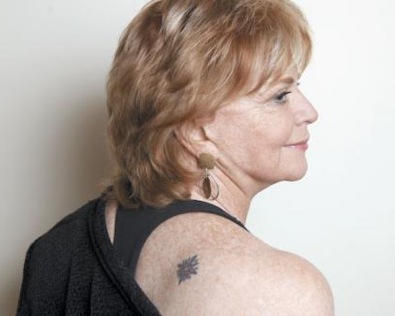
So, I’ve decided to comically retaliate in advance. Here’s Carol showing off her tattoo last year…
Carol Marin Chicago Sun-Times columnist, NBC 5 political editor, Chicago Tonight correspondent and…body inker? Yes, the 62-year-old, arguably Chicago’s most venerable journalist, has a tat—and she’s proud of it. Nine years ago, Marin’s son, then 16, approached her about wanting his own tattoo. “Joshua had been a great kid, so I said, ‘I’ll go with you, I’ll get one, too,’ ” she recalls. Joshua went with a sun; Mom chose a multicolored compass—both placed on their right shoulders. It’s a nod to her directional impairment. “Also,” she explains, “I went looking for a peace symbol but all had ghoulish faces and skulls in the background.” As the artist finished up her piece, Marin says, an 18-year-old girl with purple and yellow hair approached. “She looked up at me and said, ‘Does it hurt?’ I said, ‘A little bit.’ So she said, ‘Oh, I think I’ll just get my tongue pierced.’ I said, ‘Oh, honey, it’ll chip your teeth. Think about a tattoo.’ ”
Winner receives free entry to my birthday party at Boone’s, which starts today at 5 o’clock. All proceeds from the $20 entry fee ($5 for legislative staff and secretaries) benefit Lutheran Social Services of Illinois. [ADDING: I’ll post the winner’s name at the door today.]
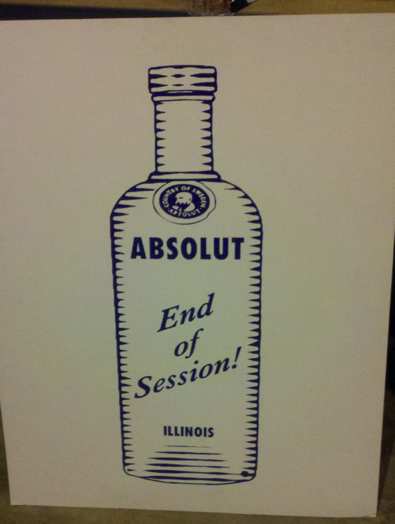
We will have a 50-50 raffle (the winner will be announced tomorrow on the blog), and we’ll have a couple things for sale and auction. For instance, this…
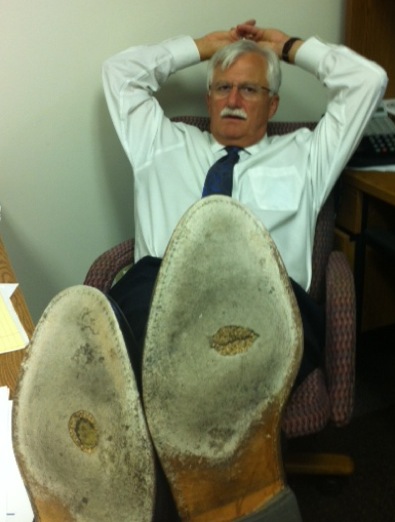
* David Vite of the Illinois Retail Merchants Association claims to have worn out his shoes walking precincts for Sen. Kirk Dillard, so we’ll auction them as well…
But we’re not gonna caption that ridiculous little post. I just thought you’d get a chuckle out of the site’s silly hostility.
* By the way, Jeff Trigg won yesterday’s caption contest and a free ticket to Wednesday’s benefit party for Lutheran Social Services of Illinois (5 o’clock at Boone’s) for this one…
Don’t worry, these drug dogs I brought with me aren’t actually searching anything.
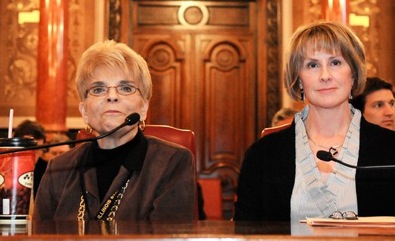
* Our first two roasters at the black tie optional charity roast for Lutheran Social Services of Illinois this Saturday night in Chicago are Senate Republican Leader Christine Radogno and Comptroller Judy Baar Topinka…
Leader Radogno has a funny, biting wit, but she doesn’t show it very often in public. I’ve been pushing her people to make sure she ups her game for Saturday night. Maybe this caption contest will prod them into retaliation.
Comptroller Topinka has a well-known reputation as a smart aleck, and she is that way in private, too. But she also has a sweet side that she doesn’t often show. Let’s hope JBT leaves her softer side at home. Saturday’s roast of yours truly is supposed to be funny, but it can’t really be funny if the roasters don’t go over the top.
* Anyway, commenters with the best two captions today will get a free ticket to tomorrow night’s big charity bash at Boone’s. The fundraiser starts at 5 o’clock. Admission is $20. Tom Irwin, Brooke Thomas and Mike Burnett will all be performing live and Mike Fountain is our DJ. I’ve heard a rumor that Luke Turasky might also be playing. I love Luke. He’s the best around, so I hope he makes it.
As I write this, a friend of mine is cooking a 28-pound roast for Italian beef. Another friend is making more Italian beef. Another friend is contributing some other foodstuffs. And last night, a blog fan gave me a case of barbeque sauce made in tornado-ravaged Harrisburg. I’m gonna sell those bottles for as much as we can get and give the money to the relief fund. It’s good stuff, by the way. I tried it this morning (I’m keeping that test bottle for myself, however).
Also, if anyone wants to bring food or stuff to sell or whatever, send me an e-mail or call me. I’ll say yes.
* Oh, there’s one other thing. Legislative staffers don’t make much money, so they get in Wednesday for $5. All the legislative staffers (including secretaries) have to do is show their state ID cards and they get the discount.
* As I mentioned earlier, the bipartisan House Investigating Committee meets at 11 this morning for the first time. The committee, chaired by Rep. Elaine Nekritz, will determine whether there is enough evidence against Rep. Derrick Smith to warrant referring the issue to a committee that will decide what the punishment should be. The full House will then have to vote on that punishment. Expulsion requires a two-thirds vote.
* Live video from the committee will be available here, but I’ll also embed the video feed in this post as soon as the hearing begins.
The leader of an Illinois House committee investigating alleged misconduct by a lawmaker wants to find out how much federal prosecutors can reveal about their bribery case against Rep. Derrick Smith. […]
A spokesman for Fitzgerald declined comment Monday on the proposal. Although she doesn’t anticipate the committee gathering much of its own evidence, Nekritz said the committee should try to collect information beyond the criminal complaint.
“We need to ask the question of the U.S. attorney what they’re willing to provide us because if we didn’t we would simply be acting on allegations of which no one has testified or proved,” Nekritz said Monday. […]
If the committee sends a letter to prosecutors, the committee would be inactive until it gets a response. If there’s no assistance the U.S. attorney can provide, “then it will be a fairly short proceeding,” Nekritz said.
“We will just have to engage in a discussion among the committee as to whether or not we think that the criminal complaint is sufficient to send it to the next level,” she said.
The House asked much the same thing of the US Attorney after Rod Blagojevich’s arrest.
With expulsion hearings set to begin Tuesday, state Rep. Derrick Smith should resign his House seat rather than holding onto it as his federal bribery case unfolds, Gov. Pat Quinn reiterated Monday.
“I really feel that Rep. Smith would do himself a favor by taking the advice of Secretary of State Jesse White and many, many others and resigning,” Quinn told reporters.
* But check out how the governor bobbed and weaved several times when reporters asked him about why he didn’t call for Smith’s resignation before the primary. It’s vintage Quinn and the reporters never do get a decent answer...
Illinoisans eagerly awaiting their state tax refunds could be in for a big letdown under a new law that went into effect earlier this year.
In its search for a quick infusion of cash, the city of Chicago and a handful of other local governments have struck an agreement allowing the state to withhold millions of dollars in tax refunds from people who owe the cities money.
Since going into effect, Illinois Comptroller Judy Baar Topinka’s office has notified 40,735 people that their tax refunds will be smaller or nonexistent because they owe money for old traffic tickets and unpaid water bills.
While the bulk of people affected by the Local Debt Recovery Program are from Chicago, it could affect residents throughout Illinois. Other governments participating in the program include Aurora, Joliet, Springfield, Collinsville and Lakeland Community College in Mattoon.
* The Question: Should all local governments be allowed to tap state income tax returns to recover money owed for unpaid traffic tickets and water bills? Take the poll and then explain your answer in comments, please. Thanks.
* On Sunday, the Chicago Tribune demanded that Senate President John Cullerton allow a floor vote on a bill to abolish the legislative scholarship program…
Yet the Illinois Senate probably won’t get around to voting on a bill to abolish this irredeemably corrupt program, even though the House voted Wednesday to do just that. What’s standing in the way? Senate President John Cullerton.
For years — years — the Chicago Democrat has refused to allow a vote on any of several measures that would kill the scholarships. He insists the program should be reformed rather than scrapped, though there’s been no meaningful effort to do so. Lately his excuse is that he wants to review all state university waivers instead of focusing only on those handed out by lawmakers, which is like saying there’s no point in wiping that big dirty handprint off the kitchen counter until you’ve searched every corner of the upstairs closets for dust bunnies.
Let’s not play games here. There are at least three bills to abolish those scholarships sitting in committee in the Senate. The version filed by Sen. Dan Kotowski, D-Park Ridge, is identical to the measure that just passed the House. It has 31 co-sponsors, more than enough votes to pass. That list includes the entire Republican caucus. But there are Democrats on the list, too, and they ought to be hammering Cullerton to stop blocking a vote.
Cullerton doesn’t want an up-or-down vote on the scholarships because he knows which way it will go. He’s not trying to fix things. He’s protecting the corrupt status quo. He’s running interference for the few lawmakers who don’t want to give up this lucrative political perk.
Gov. Pat Quinn ratcheted up the pressure on Senate President John Cullerton Monday in an attempt to end a decade’s old perk allowing state lawmakers to hand out university scholarships.
Talking with reporters, Quinn called the controversial tuition waiver program “political scholarships,” owing to the program’s reputation of abuse by some lawmakers. He urged Cullerton, D-Chicago, to call legislation abolishing the waivers for a vote.
“I really feel that its time for the Illinois Senate to step up and do what I’ve urged for two years in a row, that the whole political scholarship program be abolished, especially be in these times of austerity,” Quinn said.
Quinn’s call comes after the Illinois House last week voted 79-25 to end the program, which allows members of the House and Senate to dole out scholarships to students in their districts.
A spokeswoman for Cullerton said the measure, Senate Bill [2914], will go to the Senate Executive Committee, where it then will be assigned to the Subcommittee on Special Issues.
“If it passes the Executive Committee, there will be a floor vote,” said Cullerton’s press secretary, Rikeesha Phelon. “These bills will follow the normal legislative process. They will be heard in committee. Proponents and opponents will have the opportunity to testify, and there will be an opportunity to vote. If it passes, it moves on.”
Subcommittees typically have only three members, two of them Democrats. That means fewer Democrats are exposed to political blowback if they kill bills that might be popular with the public.
The SB2914’s sponsor, Sen. Dan Kotowski, D-Park Ridge, said he thinks his legislation will get fair treatment.
“It looks very possible to resolve this issue this session. … We’ve got to make sure the money goes toward helping students. I have every expectation this will get a fair hearing.”
* The bill is currently in the Executive Subcommittee on Education. Two of the subcommittee’s three members are co-sponsors. No hearing is scheduled yet, but the bill is likely to be sent to the full Executive Committee if the chairperson, Sen. Kimberly Lightford, allows a vote. Lightford has strongly supported the scholarship program in the past.
If it passes subcommittee, you can probably expect a big round of news stories about how the proposal “advanced.” But if it does move, it will only advance to the Executive Committee, where, as they say, it’s fate remains uncertain. The Democrats in charge of the committee are mostly opposed to abolishing the scholarship program.
In other words, only believe there’s progress if the bill actually gets out of Exec.
And then there’s the issue of whether the House will take up the Senate bill after passing its own House bill. But I’ll save that for another time.
Tuesday, Mar 27, 2012 - Posted by Advertising Department
[The following is a paid advertisement.]
As opponents of SB 678 and the Taylorville Energy Center unleash their latest onslaught on the truth, Ronald Reagan’s famous line seems particularly apt.
There they go again.
The only thing that’s happening faster than the Exelon/ComEd/STOP penchant for saying anything to defeat the bill regardless of accuracy is the rapid-fire closing of coal-fired plants. And their seemingly endless collection of false claims hasn’t gone unnoticed by objective observers.
“This episode was a lesson for us. It said ComEd would do anything necessary to protect its bottom line and keep competition away, no matter how much hyperbole and alarmism was necessary.”
- Springfield Journal-Register Editorial – September 13, 2011
As the Chicago Tribune recently reported, ComEd parent Exelon spent $40,000 on a lopsided report full of “sky-is-falling” claims. Not only did this Exelon-funded “study” grossly exaggerate the unfavorable effect of natural gas price changes, but it ignored big improvements such as falling interest rates and increasing coal plant retirements that more than offset lower natural gas prices.
Why is Exelon/ComEd/STOP engaged in such a massive misinformation campaign and unleashing thousands of robocalls throughout the state? Here’s why:
“If the plant is built, Exelon could lose more than $107 million each year in fees it receives from consumers as part of the auction-based system that reserves power in advance from generators to ensure lights stay on,’ according to Mark Pruitt, the immediate past director of the Illinois Power Agency.”
- Chicago Tribune, March 16, 2012
So next time Exelon/ComEd/STOP try to scare you about SB 678 and the Taylorville project, remember: there they go again.
Tuesday, Mar 27, 2012 - Posted by Advertising Department
[The following is a paid advertisement.]
ComEd is investing $2.6 billion over the next ten years to strengthen and digitize the electric grid. Our work – a direct result of the historic Energy Infrastructure Modernization Act passed last October – is already underway. In the past few months alone, ComEd has:
Replaced more than 22,000 feet of mainline cable. Replaced or injected more than 300,000 feet of underground residential distribution cable (URD). By replacing cable where necessary or injecting cable to fill in voids in insulation, ComEd will reduce the number of service interruptions.
Reinforced and replaced utility poles in over 200 locations: ComEd is inspecting, treating and, where necessary, replacing or reinforcing wood poles. Properly maintaining utility poles will help ComEd keep customers’ power on during severe weather.
Installed more than 110 distribution automation devices: These devices will automatically detect problems on the electrical grid and reroute power, making service more dependable.
These and other improvements made in recent months are just the beginning of ComEd’s commitment to delivering power you can depend on. We will continue to update you on our progress in the weeks and months ahead.
* The House’s Special Investigating Committee will meet today at 11 to begin proceedings against Rep. Derrick Smith (D-Chicago). We’ll have live video and a separate ScribbleLive Feed which will look a lot like this one.
Anyway, the House convenes at noon and the Senate is in at 4. BlackBerry users click here and everyone else can just hang back and watch all of today’s events unfold…
Sponsors of “Stand Your Ground” legislation in Iowa and Illinois said they still intend to push their respective self-defense gun bills even in light of the national debate spawned by the shooting death of 17-year-old Trayvon Martin in Florida.
Florida is among 21 states with “Stand Your Ground” laws that give people wide latitude to use deadly force rather than retreat during a fight, regardless of whether the action takes place in one’s home or on the street. Iowa and Illinois have “Castle laws,” in which the use of deadly force in self-defense is restricted to one’s home.
A Quad-City area lawmaker said he sponsored a “Stand Your Ground” bill in Springfield last month that languished. He intends to reintroduce it again.
“I support the lawfulness of using very strong force, if necessary deadly force, in self defense when you’re off your property,” Rep. Rich Morthland, a Republican from Cordova, said Friday. “I think it’s appropriate.”
Morthland said what happened in Florida is a tragedy and echoed President Barack Obama’s comments Friday morning that every aspect of the case needs to be investigated.
Provides that a person is immune from civil liability arising out of the use of force that is intended or likely to cause death or great bodily harm if (i) the person reasonably believed that the force was necessary to prevent imminent death or bodily harm to himself or herself or to another person and (ii) the person against whom the force was used either was in the process of unlawfully and forcibly entering, or was inside after unlawfully and forcibly entering, the dwelling, motor vehicle, or place of business of the person using the force.
In such a case, provides that the finder of fact may not consider whether the person using the force had an opportunity to flee or retreat before he or she used the force, and provides that, with exceptions, the person using the force is presumed to have reasonably believed that the force was necessary to prevent imminent death or bodily harm to himself or herself or to another person. Provides for an award of reasonable attorney’s fees, costs, compensation for loss of income, and other costs reasonably incurred to a person using such force. Provides that nothing in the Act limits any other available defense.
* The Question: Do you support Rep. Morthland’s bill? Take the poll and then explain your answer in comments, please.
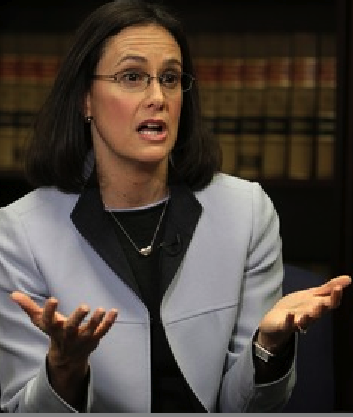
Ms. Madigan wanted to know who was emceeing my 50th birthday charity roast this coming Saturday in Chicago. I said it was Senate President John Cullerton. She thanked me and said she would call him.
“Wait a second!” I hollered before she could hang up. “Why are you calling Cullerton?”
The AG said she had decided she wanted to participate in the roast and needed to talk to Cullerton about it. I replied that we already had a program with a strict time limit and there just wasn’t room.
“I’m doing it,” she said.
Knowing there was nothing I could say, I surrendered and went back to work. But I decided to catch up with Cullerton that night to ask what the heck was going on. Yes, she had called, he said, “But I can’t tell you what she’s doing.”
Great.
* So, here’s a caption contest in honor of our persistent AG. Winner gets a free ticket to this Wednesday’s Springfield benefit at Boone’s. The event starts at 5 o’clock and all proceeds from the $20 admission fee will go to Lutheran Social Services of Illinois….
Legislation attempting to prevent cozy relationships between lawmakers and lobbyists was squashed Friday by an Illinois Senate panel.
The measures would have required officials to disclose family members who are lobbyists.
Legislators also would have been barred from becoming lobbyists for one year after their terms end and they wouldn’t have been able to negotiate for lobbying jobs while in public office.
Similar “revolving door” restrictions already apply for many federal offices and are common in other states.
The measures were buried Friday in a three-member subcommittee that is controlled by Senate Democrats. The Republican member made a motion to pass the bills. Neither Democrat would second the motion, so the legislation is stuck in the subcommittee.
In December, former state Rep. Kevin McCarthy, D-Orland Park, quit after 14 years in the House to become a lobbyist for ComEd. The move raised eyebrows because McCarthy had spent the prior two years serving as the main negotiator and sponsor of legislation that gave the utility giant the ability to raise rates on customers with less regulatory oversight.
State Sen. A.J. Wilhelmi, D-Joliet, left the Senate earlier this year to become the chief lobbyist for the Illinois Hospital Association.
The two are among an estimated 40 former lawmakers registered to lobby members of the General Assembly.
Illinois is among 15 states that have no revolving-door provisions for lawmakers. Most states have imposed cooling-off periods ranging from six months to two years.
* Chris Kaergard of the Peoria Journal Star, LaHood’s hometown paper, was outraged…
I also have to take issue with what Senate Democrats’ spokeswoman Rikeesha Phelon told The Associated Press about the bills. She claimed the bills weren’t “buried,” and in fact that everything was on the up-and-up.
“They received a fair public hearing,” she said. “I also wouldn’t consider the issue ‘buried’ because I believe that there are other senators that are continuing to work on similar issues this session.”
Forget delicacy or diplomacy. The ability to say that with a straight face is unbelieveable. It simply defies logic and flies in the face of common sense.
These are the bills currently on the table. They were ready. They were the ones set for a hearing — and instead were brought up in a farce of a hearing.
There is no excuse — none — for not allowing the bills a roll call vote. These bills are not inherently dangerous in the slightest. There is precisely zero reason that they cannot be allowed to the floor for an up-or-down vote. The failure to do so is an abomination, a perversion of democracy, and the more people who say so the better.
A different panel rejected a plan from state Sen. Dan Duffy, a Lake Barrington Republican, that would have required candidates for office in Illinois to show a birth certificate or other documents that proved they were a citizen.
Candidates need to be citizens to hold office in Illinois, and they have to sign papers when they make their campaigns official stating they are.
Duffy’s plan would have required proof, but the subcommittee voted against it by a 2-1 vote.
He said his proposal was unrelated to disproved rumors that President Barack Obama isn’t a citizen.
“I’m not a birther,” Duffy said. “I believe Barack Obama is a U.S. citizen.”
Frankly, it’s amazing they’re even doing subcommittee hearings since the committee passage deadline has long since past.
* Bills sponsored by Springfield legislators often go nowhere: Even though they are political opposites of the Democrats who control the General Assembly, neither Brauer nor McCann would complain about the treatment they receive from the majority party. Other Republicans in recent years, however, say Democrats have bottled their bills up in the House Rules Committee, never to be heard from in a committee or on the floor.
* Lawmakers eyeing outdated voter rolls: An effort is under way in the Statehouse to address problems with voting rolls in at least 16 Illinois counties. Under a proposal that could be debated in the Senate [this] week, the state Board of Elections would be required to conduct an audit to determine whether voter registration numbers are current and accurate.
* Could suburban ‘lame ducks’ play key role in reforms?: Among Tuesday’s fallen is Rep. Randy Ramey, a Carol Stream Republican who lost a bid for the Illinois Senate. He disputed the idea that lawmakers will change their minds just because they don’t face election. “I won’t flip-flop,” Ramey said. “You won’t see me voting for crazy things that I never would have voted for before.”
It’s difficult not to contemplate how Illinois Secretary of State Jesse White has screwed up lately on so many fronts.
White has managed to mostly avoid scandals throughout his political life, and as a result has become one of the most popular Democratic politicians of the past half century— one year winning all 102 Illinois counties and later taking about 70 percent of the vote in the national Republican landslide of 2010 (Democratic state Attorney General Lisa Madigan won with 65 percent, and Gov. Pat Quinn won with less than 47 percent that year).
But White’s engineering of state Rep. Derrick Smith’s appointment to his old House seat was no doubt the biggest mistake White has made in his decades-long political career.
As you know by now, Smith (D-Chicago) was arrested on a federal bribery charge last week. Smith is White’s guy. There is no plausible deniability for White. He hired Smith at the secretary of state’s office, even after the Chicago Sun-Times discovered that Smith was involved in shenanigans at his city job, from which he was fired. White then put Smith into the House seat, even though Smith was the sort of person who could barely speak in floor debates.
Smith was an embarrassment even before he was arrested. He was in over his head and obviously lacking in skills. He was White’s hack, and everybody knew it. But at least Smith looked like a clean embarrassment. Now, he’s a dangerous embarrassment facing a federal felony charge.
Before the last election, White had promised that this would be his final term. But he changed his mind last year and said he would run again in 2014. It’s possible that the Smith arrest could cause him to rethink those plans. The high-profile bust has most certainly put some blood in the political waters.
Whether White runs again or not, this is the first time he has ever displayed any sort of political vulnerability. There are now visible cracks in his bright, shining armor. The political superman looks more human.
He’s done something that he’s never done before — handed his potential opposition a beautiful gift. “He’s an honest, standup kind of a guy,” White said after he engineered Smith’s appointment to the House last year. That’ll look great in a TV commercial … for his opponent.
White also defied legislative protocol this year by going after state Sen. Annazette Collins (D-Chicago). Collins was backed to the hilt by Senate President John Cullerton as she fought what turned out to be a losing battle to Patricia Van Pelt-Watkins.
Cullerton dumped more than $167,000 into the primary, an almost unheard of amount for a Senate race. That sort of involvement is usually a big warning sign to other pols to stay the heck away. Legislative leaders don’t like it when fellow party members challenge their authority over their caucuses.
This isn’t the first time that White has meddled in that Senate district, though. He backed candidates against former Sen. Rickey Hendon more than once.
And even though White seemingly picked a blue-chip candidate to challenge Collins (unlike the Smith debacle), and even though Collins is an appointee who hasn’t made much impact in the Senate, the Senate Black Caucus was very aggressive in making sure that Cullerton expended serious resources to defend her. As a result, this particular challenge has seemed to generate harder feelings against White than his past efforts.
This was the first time that any Democratic Party leader has so directly and bluntly challenged Cullerton’s authority over his caucus. In this business, if somebody disrespects you, then they’d better be made to fear you or that disrespect could spread to others.
White is attempting to fight off a 9 percent budget cut for the secretary of state’s office proposed by Quinn (who, like everyone but White, backed Collins). White has offered to cut 2 percent instead. Good luck with that.
Since the election, top Democrats including the governor, Chicago mayor, and even Smith’s mentor and former boss, Secretary of State Jesse White, have called on Smith to resign.
But not Madigan, who says he hasn’t talked to Smith since his arrest earlier this month.
“No, I have not spoken with Derrick,” Madigan said.
“And I’m not going to offer any comments or opinion because I’m leading the investigation. I’m the one who created the committee, appointed the chair and so I don’t plan to offer any comment or opinion or direction.”
Madigan is talking about a special committee, formed at the request of House Republicans, that will meet Tuesday to look into the allegations.
Mayor Rahm Emanuel on Friday jumped on the bandwagon of Democratic politicians demanding the resignation of state Rep. Derrick Smith (D-Chicago) because of the federal bribery charges against Smith.
“I do not think — while Mr. Smith won the primary — that his name should be on the ballot in November,” Emanuel said.
“He’s already shown a violation of the code of conduct that comes with the honor of serving the public.”