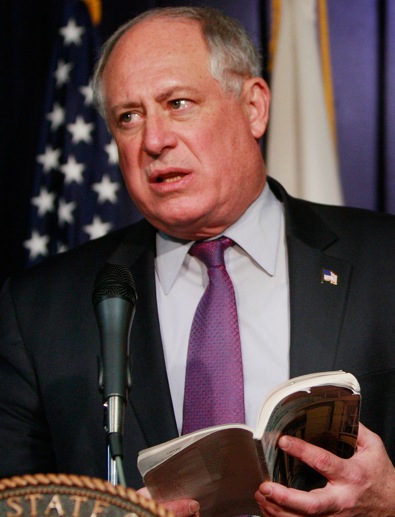
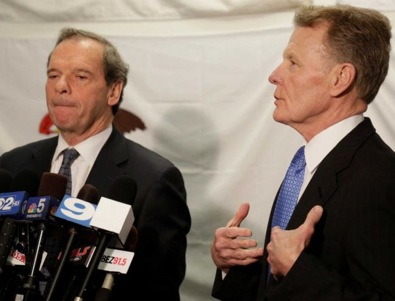
State Sen. Kirk Dillard (R-Hinsdale), who’s not officially in the race yet but will be this summer, says Rauner isn’t really a Republican.
“Bruce Rauner, while running in a Republican primary, has donated hundreds of thousands of dollars to (former Chicago) Mayor (Richard M.) Daley, Democrat members of Congress including Jan Schakowsky and Bill Foster, and hundreds of thousands of dollars to Democrat governors nationwide,” he said.
State Treasurer Dan Rutherford, also running for governor, criticized Rauner for making his campaign announcement via a video on his website, Rutherford making the point that he meets the public and the press face-to-face.
He added that criticism over campaign contributions to top Democrats must be viewed with a grain of salt. He gave money to four Democrats, two of whom are particularly notable.
“I’ve worked with Rahm Emanuel and Rich Daley because they control the public schools in Chicago and they are powerful allies who you need to work with if you hope to transform the schools,” Rauner said. “It’s the same technique the teachers’ union uses on both parties to block reform. I’m using it back on them.”
Numerous other contributions have been made in his household, but he claimed those come from his wife. He called her a staunch Democrat.
Saying Rauner is contributing to candidates when it’s actually his wife is gonna backfire badly if this keeps up. Just sayin’.
Rauner was criticized by fellow candidate Dan Rutherford as the state treasurer faced the media and citizens in a 13-city tour for his own announcement. Rauner decided to announce his campaign via video in order to reach more supporters.
“We’re trying to maximize my exposure as much as possible,” he said. “Launching a video that could be spread throughout the state digitally was hugely powerful. When we launched our two-minute video, we thought we would get 2-3,000 views that first day. We got 40,000.”
[Rauner] said the accusations by State Sen. Kirk Dillard (R-Hinsdale) over his connection to fraudster Stuart Levine is non-existent.
“He’s bringing up some guy named Levine who I’ve never had any interaction with and didn’t even know he was there,” Rauner said. “Somehow my old investment firm is involved in corruption and has something to do with him? It’s pure bologna.”
The connection is indirect: a company that was owned by Rauner’s firm once hired Levine as a consultant, so Rauner did not “employ” Levine.
* The anti-frackers are furious at Gov. Pat Quinn for signing the fracking regulatory and taxation bill yesterday. From a press release…
“It is obvious from his signing this bill that the Governor did not do his due diligence on this issue,” said Dr. Lora Chamberlain, spokesperson for the coalition, adding, “Any responsible person after looking at the evidence for serious harm caused by fracking across the nation would have wanted to investigate further to make sure that the regulations, written primarily by the industry, in SB1715, were sufficient to protect Illinois. But Gov. Quinn is acting like a desperate man and his actions will prove to be penny wise and dollar ridiculous. We will see how this plays out here in IL, but it is our prediction that the state will end up paying dearly to clean up the environmental mess from fracking and the resultant health problems. Polluting our precious fresh water permanently for oil will also turn out to be very unwise.”
OK, first of all the regulations were not “written primarily by the industry.” The negotiations were, in reality, based on the environmentalists’ legislative template. The fracking industry cooperated because Speaker Madigan threatened them with a moratorium.
Secondly, the Sierra Club, National Resources Defense Counsel and the Illinois Environmental Council all backed the bill. Those groups are made up of “responsible persons.”
* More..
With the signing of this bill the Shawnee National Forrest located south of Carbondale will be fracked and tourism in the area will be negatively impacted, many local business might be devastated. Penni Livingston of the Southern Illinoisans Against Fracturing Our Environment stated, “With a stroke of a pen, the Governor may have harmed irreparably the tourism industry in the Shawnee National Forest today.”
The Shawnee is located in parts of Pope, Jackson, Union, Hardin, Alexander, Saline, Gallatin, Johnson, and Massac counties. Current unemployment rate for each county…
Except for Jackson, which has SIU, and Massac, which has a casino, employment in that region ain’t exactly strong. They’re just not making it on tourism alone.
* More…
The coalition is asking the Governor to follow this dangerous technology very closely, and create the investigative task force that is included in SB1715 as soon as possible, so that they can start an independent examination of the many negative effects of fracking. The coalition is asking that the Governor include public hearings in this task force in order to provide a transparent avenue by which the citizens of the state can be heard. Dr. Lora Chamberlain said, “The last thing the Oil and Natural Gas companies want is public participation, but it is quite clear to this coalition that it is the public who is paying attention to the devastation from fracking around the country, and not our legislators or our Governor.”
The demand for public hearings isn’t unreasonable at all. But hearings shouldn’t be turned into circuses. This is serious business, not a way for people to creatively vent.
* Related…
* Fracking Standards Now Law In Illinois: The director of the Illinois Environmental Council, Jen Walling, says she wishes the state would ban the practice. But she says given that fracking’s already happening in Illinois, her group and other major environmental organizations agreed to the new law. Walling says it sets tough, comprehensive standards drillers must follow. “We don’t allow open pits storage of waste water afterward. This has been a huge problem in other states. Our law requires that all waste water be kept in closed loop tanks. That’s a really big deal.”
* Colleges plan training for gas drilling jobs: Both colleges plan to provide a safety program and other training needed by the industry. Southeastern Illinois College has submitted a custom training certificate program to the state for approval. Rend Lake College plans to establish an associate degree program in oil and natural gas.
* The Shale Boom Has Given America Tons Of Political Leverage In The Middle East: Many have been skeptical of the true extent of the shale revolution’s impact on the U.S. economy, beyond localized effects like lowering mid-continent crude prices and reducing costs for industrial petroleum product manufacturing. But in a new note, Standard and Poor RatingsDirect’s Peter Rigby says it’s actually given the U.S. a tremendous amount of political leverage.
* California Assembly Rejects Fracking Ban: The California assembly vote followed closely on the heels of a comprehensive federal study of water quality near more than 100 natural gas fracking sites in Arkansas. As Environment & Climate News recently reported, the U.S. Geological Survey study found the extensive fracking in Arkansas has not compromised water quality near any of the fracking sites. Lisa Jackson, who led the U.S. Environmental Protection Agency during the first four years of the Obama administration, has repeatedly testified to Congress that EPA has never found a single instance of fracking polluting groundwater.
* 10:15 am - The US Supreme Court has granted Attorney General Lisa Madigan’s motion for a second extension to file a writ of certiorari on the concealed carry case. The Court extended the deadline until July 22nd, according to the attorney general’s office.
This means that AG Madigan won’t have to decide whether to appeal until after the appellate court’s July 9th deadline for enacting a public carry law. That deadline was also extended at AG Madigan’s request.
* Subscribers were told much more about this earlier today, but here’s a quick e-mail from Rep. Elaine Nekritz’s spokesperson…
I’m told the House committee this afternoon will not be acting on the new version of SB 2404 this afternoon. Testimony will be presented on the bill in a subject matter hearing.
Also, I’m told the plan for tomorrow is for the Senate to non-concur on the House-approved amendment to Senate Bill 1 that make up the House pension plan. The House would then refuse to recede, sending the issue to a conference committee.
The “new version of SB 2404″ is Speaker Madigan’s amendment which guts Senate President Cullerton’s union-negotiated bill. No vote means MJM has backed off a bit. A good sign.
And Madigan opposed formation of a conference committee last week. That position has changed. Again, subscribers know more.
*** UPDATE *** Subscribers were told about this as well…
Quinn's office: Gov, Madigan, Cullerton have agreed to set up a pension conference cmte Wednesday, then gov calls back lawmakers in July.
* The Senate Executive Committee meets at 3 o’clock this afternoon. The House Personnel and Pensions Committee meets at 4:30. Blackberry users click here…
* Do you ever get the feeling that the Chicago Tribune editorial board has been taken over by drama queens? Check out today’s editorial on pension reform, which includes a shout-out to their new bestest buddy, Democratic gubernatorial candidate Bill Daley…
Former White House chief of staff Bill Daley, who’s exploring a run for governor, took a stab at Illinois’ pension stalemate Monday. He had some good ideas for how Gov. Pat Quinn could force the issue — starting with a promise to veto any faux pension reform that doesn’t get the job done. […]
Daley endorsed Michael Madigan’s pension bill, which this page also strongly supports. We wish only that Daley had taken advantage of his news conference to do a dramatic reading of the names of the dozens of members of the House and Senate who have obstructed the Madigan bill. It’s a long list, we know. We wish Daley had read it twice, with feeling.
Oh, yeah, that would’ve made for great TV. A “dramatic reading” of a long list of names. Also, kicking off your campaign by making enemies with a hostile name-check would serve no useful purpose, especially since the pension issue is still evolving (subscribe for more info).
Daley had some pointed advice for another potential Democratic rival for governor, Attorney General Lisa Madigan. Daley said Madigan should weigh in with a legal opinion on the constitutionality of the rival pension bills, including the bill sponsored by her father, House Speaker Michael Madigan. Enough with standing on the sidelines while the state implodes.
* I asked for a response yesterday from the attorney general’s office to Daley’s demand that she issue a formal opinion on the constitutional prospects of the various pension proposals. Here’s what I got…
The Attorney General is already aggressively defending the state in multiple cases that will significantly impact what the legislature can do to solve this crisis, and for over a year, she has been providing the legislature with legal advice and analysis on the constitutional issues.
As everyone is aware, the constitutional questions involved will ultimately be resolved by a court opinion, not the Attorney General’s opinion. As a result, the Attorney General is doing her job to keep the state’s legal options open while building the strongest legal arguments to ensure that the legislature’s final plan survives an inevitable court challenge.
I asked for clarification in a follow-up call. The AG has apparently been helping legislative legal staff to formulate constitutional justifications for their respective bills. Does that mean she believes that the bills are constitutional? They wouldn’t say.
[AG Madigan spokesperson Natalie Bauer] noted that under a policy in place for more than 50 years, “the office doesn’t issue opinions on matters that will end up in court.”
I don’t think issuing a legal opinion would be all that difficult. And since she’s been helping to construct justifications for the plans, it might not take all that long, either.
* But there is a new game in town. I gave this development short shrift on the blog yesterday, but that was a mistake.
Senate President John Cullerton now supports a pension reform idea that isn’t solely based on his demand that pension system members be given a choice before their benefits can be cut. The proposal, which is backed by the state’s university presidents, only currently applies to SURS, but it looks like a model for the other systems…
The plan would reduce the unfunded liability in the State Universities Retirement System by 28 percent, from $20.2 billion, and could be a model for a comprehensive solution. It would mean a paid-up SURS system by 2044 and, during that time, reduce state contributions by 47 percent, from $76 billion to $40 billion.
Although Cullerton supports the idea, Phelon said it’s uncertain whether he’ll sponsor the legislation. A version was introduced May 31 by Democratic Sen. Michael Hastings of Orland Hills.
• Change the annual Cost Of Living Adjustment (COLA) for future retirees from a guaranteed compounded rate of 3 percent annually to a yield that is linked to the actual inflation rate – which would deliver higher yields in periods of high inflation, lower yields in periods of low inflation. “The COLA is the biggest driving force in the state’s inability to solve the pension problem,” Poshard said.
• Shift the state’s 11 percent share of SURS pension contribution to the state’s public universities and colleges over 12 years. If used as a model for all the state’s public pension plans, the cost shift to local governments would be softened by guarantees of stable funding that would minimize or eliminate property tax hikes. “If you guarantee them at least level funding, not cutting their funding every year, why do you need a property tax increase?” Poshard said.
• Require employees to contribute an additional .05 percent towards pension cost each year over four years, increasing the annual contribution from 8 percent to 10 percent.
• Obligate the state by written contract to make full pension contributions annually or the pension system of any of its members would be able to take legal action to compel the state to make the specified payment.
• Allow new employees to participate in a hybrid pension plan comprising a defined benefit and an individual defined contribution portion that resembles the 401 (k) plans common to the private sector. Poshard said employees would be able to decide if they wanted to take on greater risk for the potential of greater reward.
I’m just not sure that trumpeting his stewardship of a “too big to fail” bank is gonna do him all that much good in a Democratic primary. Maybe I’m wrong. Feel free to correct me in comments.
*** UPDATE *** Oops. I meant to post this story as well. Sun-Times…
Bill Daley, who launched his race for Illinois governor last week, donated $100,000 to his warchest, while tapping long-time friends here, New York and Florida to help bankroll his Democratic primary bid, according to a report filed on Monday.
Daley contributed the $100,000 to his “William M. Daley Exploratory Committee” on June 11; a big enough sum to show that Daley is just not marking time waiting to see if Attorney General Lisa Madigan jumps in the contest.
* So, more than 30,000 votes in 2010 for Pat Quinn were fraudulent? That’s what Roger Keats says and Bill Brady appears to agree…
State Senator Bill Brady won the 2010 gubernatorial election, former State Senator Roger Keats emphatically alleged last week during a Chicago book tour, and Pat Quinn is governor today only because election fraud in Chicago and Illinois is prevalent and widespread.
“Bill Brady won the election. Even the media realized what had happened, but said nothing,” Keats said. “Brady knew it was hopeless to try to overturn the election, as those entities involved with deciding close elections were composed of majority Democratic members.”
State Senator Bill Brady (R-Bloomington), who is expected to declare soon another try at the governor’s seat in 2014, confirmed that Keats’ allegations aren'’t as far-fetched as they might sound.
“After a very close election in November 2010, there was a suspicion that voter fraud had taken place, but how would we prove the presence of fraud?” Brady said. […]
“Only 30,000 votes separated me from Pat Quinn. Lawyers were consulted, they advised me that it would cost millions of dollars to prove that fraud had occurred to result in my defeat,” he said.
OK, wait a minute here. This is just goofy on its face.
Republican Mark Kirk defeated Alexi Giannoulias by 59,220 votes in 2010. Those must’ve been some seriously sophisticated fraudsters if they were splitting their tickets like that.
Not to mention that Republican Dan Rutherford defeated Robin Kelly by over 161,000 votes.
Oh, and Republican Judy Baar Topinka won her race by 429,876 votes that same year.
“The funny thing is the vote fraud that saved Quinn was, I believe, really to protect Joe Berrios in his race against Forrest Claypoole [for Cook County assessor]. Quinn just benefitted from straight Democrat ballots,” Keats wrote in follow-up correspondence.
* Madison County’s state’s attorney was the first this month to say he wouldn’t prosecute anyone arrested for concealed carry, as long as they followed some rules. Several others have followed, including these…
Tazewell County State’s Attorney Stewart Umholtz issued a formal statement stating such about noon Friday, saying that a recent federal appellate court ruling declared the state’s blanket ban on concealed carry unconstitutional.
“A citizen who wishes to exercise their Second Amendment right to carry a firearm outside of the home for self-defense should not be placed in the situation where they fear prosecution if they exercise a constitutional right,” the prosecutor said in a news release.
By 3 p.m., Peoria County State’s Attorney Jerry Brady said he agreed with much of what his colleague across the river said.
“Since the court’s ruling, Peoria County has been following the court’s opinion and not charging persons with valid FOID cards entitled to possess a firearm,” he said. “Our office seeks to follow the court’s opinion and honor a person’s constitutional rights outlined by the recent decision.”
Woodford County State’s Attorney Gregory Minger said he fully supported the Second Amendment and Umholtz’s stance as it related to concealed carry. He qualified his statement by saying he needed to talk to law enforcement in his county to see how such a change would manifest itself.
Macon County officials are crafting regulations to allow concealed carry in the county, State’s Attorney Jay Scott said.
Scott said he and Sheriff Tom Schneider plan to meet later this week to discuss some of the “sensible rules and regulations” which will dictate how and when residents will be able to carry firearms in public. […]
Scott said he will follow the ruling already sent down from the courts and craft their own regulations since no law has taken effect.
“Prosecutors and law enforcement across the board have to come up with some sort of policy to let the people know what’s going on,” Scott said. “Without a concealed-carry law and with the current law (banning concealed carry) being ruled unconstitutional, there’s just a lot of issue to sort through.”
White County State’s Attorney Denton Aud says since a federal court ruled Illinois’ concealed carry ban is unconstitutional he should not prosecute those cases.
“It would be in direct conflict with my oath of office so I would be betraying the trust of those individuals that put me in office by prosecuting anyone for that,” said Aud.
Randolph County State’s Attorney Jeremy Walker told KFVS-TV that residents can carry concealed guns in public.
“Responsible, law-abiding citizens will finally be able to exercise their constitutional right to carry concealed weapons in Randolph County,” a statement from his office reads, according to the station
But in Rock Island County - this states attorney says he will be following the law - until the law changes.
“We are not legislators. That’s for them to write the laws. We enforce the laws that are written.”
The Illinois State Police, Illinois Association of Chiefs of Police, and the Illinois Sheriff’s Association issued a public safety advisory in response to numerous inquiries from citizens to the Illinois State Police Firearm Services Bureau empasizing that it will continue to enforce Illinois’ current unlawful use of a weapon statute in all jurisdictions.
Current Illinois law prohibits the carrying of an immediately accessible or loaded firearm on your person or in your vehicle regardless of whether it is concealed. Persons in violation are subject to arrest until the law changes.
A move by several municipal governments to consider banning assault weapons has come to Lake County, and gun owners are preparing for a struggle.
The first arena will be village board and City Council chambers across the region, as firearms owners plan to speak publicly in opposition of local bans. If that doesn’t work, the next venue likely will be the courtroom, according to Mike Weisman, second vice president for the Illinois State Rifle Association.
“There is litigation around the country on ordinances like this, and I wouldn’t be surprised to see more,” Weisman said.
A state law allowing gun owners to carry their handguns awaits Gov. Quinn’s signature, but it also starts the clock ticking for home-rule municipalities with regard to larger firearms, commonly referred to as “assault weapons.”
* With Illinois’ new law requiring gubernatorial candidates to choose their running mates before they file their official candidacy forms, there’s been a lot of debate about what the candidates should do.
My pal Tom Bowen wrote this about the topic and I decided it was definitely worth posting here for your perusal…
There are time honored rules to picking a running mate that have been practiced at the presidential level for a generation. Illinois gubernatorial candidates would be wise to follow these rules while modifying them to fit this situation.
The first and most important thing to realize is that unlike the presidential process, Illinois gubernatorial candidates will now be picking running mates before any votes are cast. In the presidential process, the vice president is chosen after the Parties choose their nominees. That means there will be a limited field of candidates who will be a good fit to be a running mate, so you must start this process early and you must run background checks on your choices. If you don’t vet them, you run the risk of the media doing it for you.
On to the rules.
Rule #1: Do no harm.
The risk of choosing an aspiring, up and coming, or even experienced politician to join your team is that they will want to be the focus. Sarah Palin is a perfect example of what kind of harm a reckless running mate can do to your team.
Rule #2: If you weren’t running, who would you want to be your Governor?
This is a much more important rule at the presidential level due to the danger of the job, but if you were not governor, who would you want to have the job? Who shares your values or your philosophy on how government should be run? The job is to fill in for you if you cannot or will not continue, so choose someone you think would be a good governor.
Rule #3: Balance is overrated.
This rule compliments Rule #2, but it should be kept in mind that voters do not vote for the bottom of the ticket, they vote for the top. Brining key regional or political support to a ticket is a minimal asset at the end of the day. Do not be afraid to choose a running mate from a similar background or skill set and do not overemphasize “balance.” Fitting square pegs into round holes doesn’t work.
Rule #4: Raising money is a very, very important job.
If a running mate is not going to do call time, show up at fundraisers, or can bring a base of donors to your team, they are lacking a key asset. Money is necessary to be successful in politics, and every running mate has to pitch in.
Rule #5: Pick somebody who is willing to draw a sharp contrast.
The best running mates are the ones who are not afraid to level an attack at your opponents. The press has to cover what they say and it can force opponents to answer the points your campaign wants them to make. If a running mate is timid, tainted, or flat out unwilling to get down in the mud for your benefit, take a pass on them.
There are many more considerations that go into this process, but these five rules are above and beyond the most important to pay attention to. Since candidates will be choosing their running mates so early in this process, it gives voters a window into how they make decisions. Let’s see who chooses wisely.
* At one time, the Senate’s union-negotiated pension reform bill had 23 House co-sponsors. Three have dropped off since House Speaker Michael Madigan attached a hostile amendment which would strip the bill and replace it with Madigan’s pension reform bill.
The We Are One Illinois coalition has been circulating a letter demanding that Madigan call the Cullerton pension bill without an amendment. The co-signers…
llinois Comptroller Judy Baar Topinka (R)
Senator Melinda Bush (D-31)
Senator Jaqueline Collins (D-16)
Senator Bill Cunningham (D-18)
Senator Michael Frerichs (D-52)
Senator David Koehler (D-46)
Senator Toi Hutchinson (D-40)
Senator Mike Jacobs (D-36)
Senator Andy Manar (D-48)
Senator Sam McCann (R-50)
Senator Julie Morrison (D-29)
Senator Michael Noland (D-22)
Senator Steve Stadelman (D-34)
Senator Donne Trotter (D-17)
Rep. Kelly Cassidy (D-14)
Rep. Jack Franks (D-63)
Rep. Robyn Gabel (D-18)
Rep. Jay Hoffman (D-113)
Rep. Robert Martwick (D-19)
Rep. Rita Mayfield (D-60)
Rep. Elgie Sims (D-34)
Rep. Mike Smiddy (D-71)
Rep. Michael Tryon (R-66)
Rep. Larry Walsh (D-86)
Rep. Chris Welch (D-7)
Rep. Ann Williams (D-11)
Rep. Sam Yingling (D-62)
Interesting that JBT heads the list. Big get for the unions.
But just 13 House members? Really? That’s just over half the original co-sponsor numbers. What the heck?
* There is one interesting angle here. Of those 13 House members, three (Franks, Gabel and Yingling) voted for Madigan’s bill. And since Madigan’s bill received just 62 votes, it might not have passed without them. Maybe they should’ve told their Speaker “No” the first time around.
Then again, Madigan would’ve probably just pulled a few more folks out of his back pocket to pass the thing.
…Adding… Rep. Raymond Poe (R-Springfield) just asked to be added to the list.
Illinois Gov. Pat Quinn signed legislation giving the state the nation’s strictest regulations for high-volume oil and gas drilling.
In a news release, Quinn’s office says the governor signed the bill Monday. Quinn says the law will “unlock the potential” for thousands of jobs in southern Illinois while protecting the environment.
Governor Pat Quinn today, avoiding the public spotlight, signed a new hydraulic fracturing bill into law.
Rather than hold a traditional bill signing ceremony and press conference to trumpet one his “top priorities”, Quinn signed the new bill in private and later issued a press release.
Sheesh. He could’ve traveled to southern Illinois and finally received decent media coverage.
* From the press release…
Under the new law, Illinois will become the first state in the nation in which hydraulic fracturing operators will be required to submit pre- and post-fracturing chemical disclosures to the state. Additionally, Illinois will become the only state in the nation to require pre- and post-fracturing water testing. Operators will be required to provide a baseline water test prior to the act of hydraulic fracturing and then tests six months, 18 months and 30 months after operations have concluded. Illinois will also require the storage of fluid in above-ground closed tanks, rather than traditional pits.
The law includes a mandatory 30-day public comment period, a public hearing opportunity and a 15-day follow-up public comment period on new permit applications. The state will consider all submitted written comments and testimony from public hearings when making its decision to approve or deny the application.
“This is a monumental achievement for economic development and jobs in Illinois,” said Mark Denzler, vice president and chief operating officer of the Illinois Manufacturers’ Association. “Hydraulic fracturing will create good-paying jobs and reduce our reliance on foreign source of oil.”
The legislation was supported by numerous environmental advocacy groups, including the Sierra Club Illinois, Environmental Law and Policy Center, Natural Resources Defense Council and Illinois Environmental Council.
The IMA kept the talks on an even keel and the environmental groups were real heroes here. They insisted on a tough law and fought off their left flanks as the more radical local startup groups screamed bloody murder. Good for them. Good for all of us. Let’s get some jobs.
Will County Executive Larry Walsh is hosting his first fundraiser for Gov. Pat Quinn at the IBEW union hall on Monday. But the event doesn’t mean Walsh is endorsing his fellow Democrat’s re-election before all gubernatorial candidates are announced, including potential candidate Bill Daley.
“It means that I feel that Pat Quinn’s administration has been very, very supportive of what is going on here in Will County,” Walsh said. “I’m hosting a fundraiser to say thank you to the governor.”
Madigan wants “a second and final thirty-day extension” to file a possible appeal of the appellate court’s ruling that Illinois’ total ban on public carrying of loaded firearms is unconstitutional. Currently, Madigan has until June 24th to file her writ of certiorari.
The motion follows the recent granting by the appellate court of AG Madigan’s request that its June 9th deadline be extended for 30 days. So, Madigan wants the extension with the US Supremes until after the appellate clock stops ticking. It also keeps her out of the debate, of course.
Good cause exists for this application. The undersigned counsel, who has principal responsibility for the certiorari petition in this case, serves as the Solicitor General in the Office of the Illinois Attorney General. Counsel filed the opening brief on June 3, 2013 as counsel of record for Illinois Attorney General Lisa Madigan and other petitioners in Madigan v. Levin (U.S. 12-872). In addition, counsel’s supervisory responsibilities over the Civil and Criminal Appeals Divisions of the Attorney General’s Office-including editing and revising briefs and preparing attorneys for oral argument-have occupied a substantial amount of time in May and the first two weeks of June, 2013.
Wherefore petitioners respectfully request that an order be entered extending the time to file a certiorari petition to and including July 24, 2013.
* There’s lots more to the pension reform impasse than what the AP is telling you, but this’ll do for starters…
Cullerton is known for trying to work collaboratively with interest groups and fellow senators, both Democrat and Republican. Madigan is known for his strategic control of House matters through his years of experience and formidable fundraising powers. Currently, he controls more than $2 million he can distribute, while Cullerton oversees funds with about $100,000 in them.
Cullerton “likes to bring parties to an agreement,” said Sen. Don Harmon, an Oak Park Democrat. His pension proposal “is the first and only time (state) workers impacted have agreed to meaningful pension reform. … He attempts to simultaneously do what’s in the best interest of the state and what the caucus would like to do.”
Rep. Lou Lang, a Skokie Democrat and assistant majority leader under Madigan, argued that part of the problem is senators under Cullerton who bristle over the speaker’s influence. Cullerton has to deal with members that “go overboard not doing things the speaker’s way,” Lang said. “The senate wants to have its own identity.”
But Kent Redfield, a former House staffer who teaches political science at the University of Illinois Springfield, believes Cullerton has more to gain from taking a tough stand at an opportune moment. He says Cullerton realizes his pension proposal likely has the most support in the legislature, and that’s why he’s still pushing it regardless of how he and Madigan have worked together in the past.
“Part of it is redefining those roles … Cullerton does not want to be in a position of weakness,” Redfield said. “He’s got an agreement with the unions that puts him in a pretty strong position.”
Madigan has indicated he doesn’t believe the Senate plan saves enough money and that approving it will result in the state having to address pension reform again.
“What’s been frustrating is (determining) what is the dollar amount they think needs to be saved,” [Sen. John Sullivan] said of the House. “What is the money (Madigan) wants to get to? Once we have that number, let’s see … what we can negotiate.”
Earlier this week, Quinn proposed a compromise that would combine Madigan and Cullerton’s plans: Madigan’s legislation would be “Plan A” and Cullerton’s plan - with more cost savings worked in - would be the backup if the courts threw out the other.
Madigan quickly showed his disapproval, filing an amendment on Cullerton’s bill that would essentially gut it and replace it with his own measure. Asked Friday whether his digging in could be perceived standing in the way of compromise, Madigan said he believes he’s doing what voters want him to do.
“I don’t think you send people to the Legislature to be weak,” he said. “I think you send them down there to be strong, to understand the issues, work on bills, advocate for positions and advance those positions through the Legislature. That’s what you want.”
* That’s probably why there’s no comment from Madigan’s office on this…
Legislation resolving the state’s public university and community college pension debt could to be used as a model for reforming all state public employee pension plans and eliminating a nearly $100 billion debt over 30 years, SIU President Glenn Poshard said Saturday.
Poshard said Senate President John Cullerton would present a plan from the state’s public university presidents, created by the Institute for Government & Public Affairs at the University of Illinois, to the Senate executive committee Tuesday. It would then be heard by the full Senate in Wednesday’s General Assembly special session and, if passed, move to the House.
Poshard was optimistic about the potential of the plan passing the House and being signed by Gov. Pat Quinn. It grew out of an early meeting with Quinn, has the support of Cullerton and addresses key pension reform objectives of House Speaker Mike Madigan, Poshard said.
* And once again, you should really take some time today and listen carefully to Madigan’s and Cullerton’s comments during Friday’s pension reform press conference. You’ll learn a whole lot more than you would by just reading the news stories…
* Universities offer partial Illinois pension fix: Although Cullerton supports the idea, Phelon said it’s uncertain whether he’ll sponsor the legislation. A version was introduced May 31 by Democratic Sen. Michael Hastings of Orland Hills.
* Rival pension plans likely to bog down special session: Republicans voting “no” on the Madigan plan, also known as Senate Bill 1, include state Sens. Jason Barickman of Bloomington, Tim Bivins of Dixon, Dave Luechtefeld of Okawville, Dale Righter of Mattoon and Chapin Rose of Mahomet.
* Editorial: Sen. McCarter, Sen. McCann, why are you crushing Illinois?
Democratic gubernatorial candidate Bill Daley took Governor Pat Quinn to task for failed leadership, offering a three-point plan to break the impasse on pension reform.
“Governor Quinn has failed to lead, maintaining over and over again that it’s the legislature’s job to pass the bill, and his job to merely sign it. That’s not leadership, that’s a cop out,” said Daley, who added “his failure to get a legal opinion from the Attorney General Madigan has made the impasse even worse.”
Daley noted that Quinn’s vacillations have exacerbated the differences between the Senate and House. “Quinn was for his own plan, but never made the case for it. Squeezy the python never squeezed anyone. He was for the Cullerton plan, then he was for the Madigan plan. Then last Monday, almost comically, he said he wanted to pass both plans at the same time. Friday he asked for a conference committee, which is nothing more than passing the buck. No wonder the legislature is conflicted,” said Daley.
Daley maintains that the plan backed by House Speaker Mike Madigan, now known as Senate Bill 1, is the only solution that truly addresses the pension shortfall. Senate Bill 1 is projected to trim $21 billion off the nearly $100 billion unfunded pension liability the state now faces and reduce overall state payments to the pension systems by $187 billion over the next 30 years — about three times the savings of Senate Bill 2404, the plan backed by Senate President John Cullerton and a coalition of labor unions.
Daley said if he were governor right now, he would have driven three important principles to shape the debate and forge a consensus around Senate Bill 1:
Step One - Make a Clear Case That Senate Bill 1 is Constitutional
Daley observed that one of the biggest issues separating the House and Senate is the dispute over the constitutionality of both bills. Senate President John Cullerton’s staff has argued that only Senate Bill 2404 is constitutional. Daley says other lawyers differ, including the law firm of Sidley Austin, in a detailed opinion prepared for the Civic Committee of the Commercial Club.
The opinion explains that if the State has the right to lay off workers or cut salaries in times of budget crisis, then it also has the right to take the much less drastic step of reducing pension benefits earned in the future.
“Senate Bill 2404 was written with good intentions, but it is simply another band-aid that will not solve the problem. There is a solid legal case that it is no more constitutional than Senate Bill 1. The only real difference is that Senate Bill 1 goes three times farther toward solving the problem,” said Daley.
Daley criticized both Governor Quinn and Attorney General Lisa Madigan for failing to make the legal argument that Senate Bill 1 is every bit as constitutional as Senate Bill 2404.
“Governor Quinn failed to make the case that Senate Bill 1 is constitutional. Attorney General Madigan, who has publicly opined on other constitutional issues she may later defend, has refused to say anything other than she would support doing something. That’s not leadership,” said Daley.
“If Attorney General Madigan can’t provide a full legal opinion without a formal request from the Governor or the legislature, they should make that request right away,” added Daley.
Step Two – Veto any pension plan except Senate Bill 1
Daley said the Governor should long ago have made it clear that he would veto any pension plan that did not achieve the same amount of savings as Senate Bill 1. “If the Governor had said from the beginning that Senate Bill 2404 was dead on arrival and actually stuck by his words for a change, Senate Bill 1 would have gotten a lot more than 16 votes,” said Daley.
Were he the governor, Daley would have made the veto threat early and often. “I saw first hand how Presidents Clinton and Obama used the veto threat to move Congress toward the right action. That’s what I would have done here,” said Daley, referring to his service as Secretary of Commerce under President Clinton and Chief Staff to President Obama.
Step Three – Give Senators something to vote FOR.
According to the Civic Federation’s February 25, 2013 budget report, pension contributions could decline by $2.5 billion in FY2018 if the state enacted comprehensive pension reform similar to Senate Bill 1.
Daley suggested that a portion of the $2.5 billion in reduced pension contributions – perhaps as much as 51% — could be earmarked for public education as a related piece of legislation connected to the passage of Senate Bill 1.
“The most important job the state does is finance the education of our children. It is the key to economic growth and it is key to making sure every child has a shot at a brighter future,” said Daley, who added, “Senate Bill 1 is a very tough vote. To me, you have to give these senators something to be for, and dedicating over $1 billion in freed revenue to educate our kids is something both Democrats and Republicans can get behind.”
I boldened the Lisa Madigan stuff. The rest is in the original.
* Equality Illinois PAC’s account balance at the end of March was just $17K. So, they have a very long way to go before they can bank this kind of dough. But there is big money out there, as the spring session demonstrated.
From a press release…
Equality Illinois, the state’s oldest and largest LGBT advocacy organization, today announced a half-million dollar FIGHT BACK FOR MARRIAGE campaign leading to the 2014 election.
Equality Illinois (EQIL) has pledged to use half of the fund toward an educational campaign focusing on the collar counties, Downstate areas and Chicago neighborhoods where there is a need to strengthen the advocacy for and defense of the freedom to marry.
The organization’s political action arm, Equality Illinois Political Action Committee (EQIL PAC), has pledged the other $250,000 in order to match marriage opponents dollar-for-dollar on the political battlefield. […]
The $250,000 political action piece of the Fight Back for Marriage plan, though formidable, is a target set to directly confront an opponent of LGBT equality, the so-called National Organization for Marriage, which threatened to spend $250,000 to oppose particularly Republican legislators who supported the freedom to marry.
“We will defend those candidates who demonstrate a dedication to the freedom to marry through their votes and campaign commitments,” said Jeremy Gottschalk, chair of Equality Illinois PAC board of directors. “And we will ensure that those who stand in the way of marriage equality are held accountable to the voters. No opponents of marriage equality can be sure that their re-election campaigns will be easy next year.”
EQIL PAC has a strong history of success at the ballot box and expects to be even more successful in 2014 in helping our allies and confronting our opponents. In last November’s election, 69 of Equality Illinois PAC’s 82 endorsed candidates were elected (including 26 of the 39 EQIL PAC-endorsed candidates involved in competitive races), for a success rate of 84%.
Equality Illinois’ reinvigorated educational and advocacy campaign for the marriage bill, funded by the other $250,000 of the Fight Back for Marriage campaign, is already underway after the Illinois House of Representatives failed in its responsibility to vote and pass the Religious Freedom and Marriage Fairness Act by May 31.
Once the law passes, as we are confident it will, we must educate public officials and the public how the law works and defend it against expected attacks. There are likely to be attempts to weaken it or challenge it in the courts. Already, there is legislation introduced for a state constitutional amendment seeking to define marriage only as between a man and a woman.
Also, the educational arm will inform voters about the incumbents and their challengers. “We will be aggressive in both arms of the Fight Back for Marriage campaign,” Cherkasov said. “We have to let the voters know which lawmakers support the right of all couples to marry and raise families under the recognition and protection of marriage and which senators and representatives stand on the wrong side of history.”
Nervous House members will probably be grateful for this PAC if, indeed, the group can raise the money.
However, taking credit for all those wins just isn’t credible. The PAC spent just $53K in the last quarter of 2012 and only $1,200 in the quarter before that.
* Meanwhile, if you’re gonna protest the Speaker, maybe you should get yourself better organized…
About 18 people attended the rainy mid-day protest, held outside of Madigan’s district office in Chicago’s West Lawn neighborhood. The demonstration intended put heat on Madigan after the Illinois House adjourned without voting on a bill that would legalize same-sex marriage May 31. LGBTs have partially blamed Madigan, stating that the speaker did not use his power to influence support within the Democratic Caucus.
“The notion that state reps. vote their conscience is as ludicrous as saying most Chicago aldermen vote their conscience,” said Gay Liberation Network co-founder Andy Thayer. “Mike Madigan put his finger to the wind and decided that the anti-gay bigots are more mobilized.”
That’s truly pathetic.
*** UPDATE *** From Mitch Locin at Equality Illinois…
Hi Rich,
Thank you for the coverage of our release in your blog this morning. I wanted to add two things for your consideration:
1. Juxtaposing our news item with the one on the protest in front of the office of Speaker Madigan may have left an impression that Equality Illinois was connected to that protest. The protest was not Equality Illinois’ event.
2. Just to put the $250,000 PAC goal in some greater perspective, Equality Illinois PAC directly contributed $127,000 during the 2012 election cycle in addition to other expenditures, which was an increase of over 100% from the previous cycle. Our goal, therefore, is to double our capacity yet again in the 2014 cycle and have an even greater impact.
In a sign that some truly awful publicity for her father may be hurting her possible gubernatorial bid, Attorney General Lisa Madigan’s poll numbers have plunged in the past several months. And Bill Daley has considerably improved his standing since he announced his candidacy.
Back in January, a We Ask America poll had Ms. Madigan leading Gov. Pat Quinn in a Democratic primary by 25 points, 51 percent to 26 percent. A Public Policy Polling survey taken last November had Madigan stomping Quinn by a whopping 44 points, 64-20.
But the newest Capitol Fax/We Ask America poll, taken June 13th, had Madigan’s lead over Quinn at 11 points, 44-33. That’s still a big lead, but not nearly the cremation many were expecting.
The poll of 1,322 likely Democratic primary voters had a margin of error of +/- 2.8 percent. About 22 percent were cell phone users.
It’s possible that House Speaker Michael Madigan may be at least somewhat responsible for his daughter’s slide. He’s clearly wearing the jacket for the General Assembly’s failure to pass pension reform because he’s refusing to compromise with Gov. Quinn and Senate President John Cullerton. That stalemate has resulted in some spectacularly bad publicity for the elder Madigan.
“It’s easy to look at these results and assume the governor could easily lose in a primary,” said pollster Gregg Durham last week. “But Mr. Quinn would be a more formidable opponent than these numbers indicate. He’s not only had a history of coming back from atrocious poll numbers, you and I know that any challenger in a gubernatorial campaign is going to face an extra level of scrutiny that won’t be easy to overcome. You never know what that white-hot spotlight will show. Quinn can’t legitimately be viewed as ‘The Walking Dead.’ He’s more a ‘Person of Interest.’”
Madigan’s lead among Democratic women has dropped considerably since January’s We Ask America poll was taken. Back then, she was ahead of Quinn 53-22. This time around, she’s ahead 47-29. And Quinn has overtaken Madigan among men. Madigan led with men 46-30 in January, but now Quinn is ahead 41-38.
Her lead over Quinn in Chicago has also dropped. January’s lead was 46-30, but now it’s 39-35. She has also lost major ground in suburban Cook County and Quinn has overtaken her in the collar counties. But Downstate is still a huge problem for Quinn, where he trails 56-22, about the same as January’s poll.
Bill Daley announced his candidacy last week, and his poll numbers have improved, at least in the We Ask America poll. In January, Daley trailed Gov. Quinn in a one-on-one matchup by five points, 38-33. But now he leads Quinn 38-37. However, Public Policy Polling had Daley leading Quinn 37-34 last November.
In January, the polling showed Daley trailing the governor by a couple of points among women. He now leads by about 2 points. Daley, the son of a former Chicago mayor and brother of another, was losing among men by eight points back in January, but is now tied.
As expected, Quinn is leading Daley among likely black voters 42-34 and 40-23 among Latinos. Daley does lead Quinn 41-35 among whites, however.
Daley trails Quinn in Downstate counties 38-33, and in Chicago 39-37. But he leads the governor in suburban Cook 46-36 and in the collars 39-37.
Daley has also improved his numbers in a three-way contest against Madigan and Quinn, while Madigan has lost some ground.
Back in January, We Ask America had Madigan at 37 percent to Quinn’s 20 percent and Daley’s 15 percent. The newest poll, however, has Madigan at 32 percent to 21 for Quinn and 22 for Daley.
Daley and Quinn have both upped their numbers among Democratic men. Back in January, it was 34 for Madigan, 24 for Quinn and 18 for Daley. Now it’s 28-27-24, respectively. Daley has also improved among Democratic women. In January, Madigan led Quinn and Daley 38-17-13, now it’s 35-18-20.
Madigan leads Quinn and Daley in Chicago 30-25-18, which is below her 35-18-18 advantage in January. Madigan actually trails Daley by a point in suburban Cook and in the collars, but leads big Downstate.
Attorney General Madigan is still the favorite, but this may not be a coronation if she decides to run.