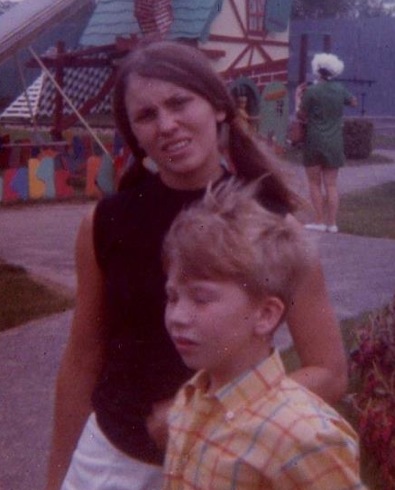
* My mom and me at the Wisconsin Dells. I think I was eight…
Mom has never liked her picture taken, but her expression probably indicated her exhaustion from the trip. My parents had four sons by then and one or two foster children. Another son would be born two years later.
* The Question: What was going through our minds at the time?
* Mary Mitchell writes about a recent teleconference Sandi Jackson had with her supporters, who were gathered at her former ward office. She believes that Mayor Emanuel will choose her anointed successor, Jackson chief of staff Keiana Barrett, even though Barrett doesn’t live in the ward. And what if the mayor chooses someone else? Well…
Jackson also noted that all of the furnishings for her ward office at 71st and Exchange were bought with campaign dollars.
“That means the city does not own any of the furniture that you are currently sitting on, any of the furniture that is in the campaign office, any of the furniture that is in the aldermanic office. I bought every item personally, and if the mayor upholds my wishes, everything in that office will stay the same. Keiana will inherit everything,” Jackson said.
* Dawn Clark Netsch on her thoughts when she was diagnosed with ALS, also known as Lou Gehrig’s Disease…
“And my first reaction was I’m not even a Yankees fan. I’m a White Sox fan,” she said.
She’s one tough woman.
* I have to admit having a bad taste in my mouth for Ms. Netsch for many a year, culminating with her opposition to a state constitutional convention. But then I saw her at the Carlos Hernandez Gomez funeral, sitting alone in a pew. She didn’t work the crowd, or look around to see who was looking at her. Just respectful, dignified silence for our mutual friend. The years of animosity immediately melted away, at least for me. On my way out of the church I leaned down and gave her a hug.
Dawn Clark Netsch has had an enormous impact on Illinois, from her participation in the drafting of our Constitution, to her insistence that the courts badly misinterpreted the Constitution’s “preponderance” of education funding language, to her many years of conscientious legislative and statewide service, to her 1994 education funding plan that was eventually adopted by her opponent Jim Edgar.
She is a founding mother of the modern state. And we all owe her a debt of gratitude.
ALS robs a person of some of life’s most basic functions and normally can be deadly in three to five years. ALS weakens the nerves and makes it difficult to walk, swallow and speak.
“It’s a tough one,” she said sitting in the kitchen of the near north side home she shared with her late husband, famed architect Walter Netsch.
Asked why it was important to speak of her disease, Netsch did not hesitate.
“Might get more people thinking about what is ALS,’ she said, noting, “I’m going to be straight about this also.”
Let’s all hope for the best.
And it should go without saying that disrespectful comments will be deleted. I don’t care what your politics are, you can be a human being.
* Ralph Martire of the pro-union Center for Tax and Budget Accountability has correctly identified the pension funding problem…
The vast majority of the unfunded liability is made up of the third contributing factor: debt. Indeed, for more than 40 years. the state used the pension systems like a credit card, borrowing against what it owed them to cover the cost of providing current services, which effectively allowed constituents to consume public services without having to pay the full cost thereof in taxes.
This irresponsible fiscal practice became such a crutch that it was codified into law in 1994 (P.A. 88-0593). That act implemented such aggressive borrowing against pension contributions to fund services that it grew the unfunded liability by more than 350 percent from 1995 to 2010 — by design. Worse, the repayment schedule it created was so back-loaded that it resembles a ski slope, with payments jumping at annual rates no fiscal system could accommodate. Want proof? This year the total pension payment under the ramp is $5.1 billion — more than $3.5 billion of which is debt service. By 2045, that annual payment is scheduled to exceed $17 billion, with all growth being debt service.
* To solve the problem, Martire wants to reamortize that debt. Basically, it’s a refinancing plan…
Simply re-amortizing $85 billion of the unfunded liability into flat, annual debt payments of around $6.9 billion each through 2057 does the trick. After inflation, this new, flat, annual payment structure creates a financial obligation for the state that decreases in real terms over time, in place of the dramatically increasing structure under current law. Moreover, because some principal would be front- rather than back-loaded, this re-amortization would cost taxpayers $35 billion less than current law.
This makes a lot of sense on numerous levels. It’s like refinancing a mortgage that had been stupidly rigged with expensive balloon payments.
* However, Wall Street will hate it. Why? Because as soon as you move back the payoff date, the total unfunded liability will skyrocket. And Wall St. is concentrating almost solely right now on that unfunded liability number. If Illinois does this, a big credit rating cut will likely happen.
The Tribune and some big business groups will also hate it. Why? Because it causes no real pain for public employees and retirees. And that’s really what they want.
And others who depend on the state budget will probably hate it, at least in the short term. Why? Because the Martire plan requires a big increase in current pension spending, from $5.1 billion to $6.9 billion. And, remember, the income tax hike is scheduled to sunset two years from now.
* On the other hand, if policy makers could incorporate Martire’s refinancing idea with some other cost-cutting and revenue (requiring higher employee contributions, cost shift, etc.) moves, it might just work.
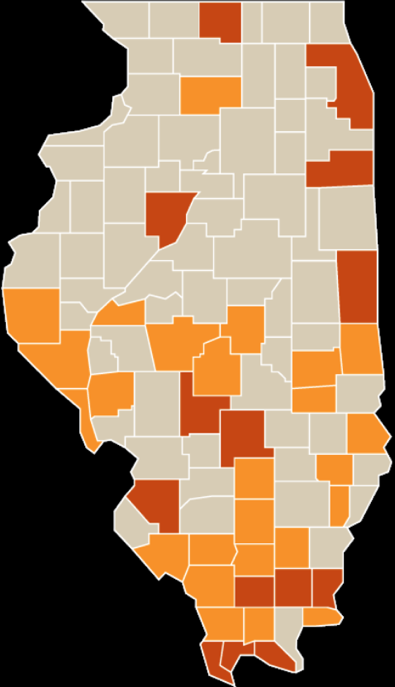
The County Well-Being Index highlights counties that are experiencing particularly negative conditions and trends on four key indicators: poverty, unemployment, teen births, and high school graduation.
Counties in Illinois are evaluated using a point system, with a higher number of points indicating a worse score. A county receives a point if its rate is worse than the state average and/or if it has worsened since the previous year.
Light orange counties are on the Poverty Watch List. Dark Orange are on the Poverty Warning List…
* Other stats from the report…
Nearly half of all private sector employees in Illinois don’t have access to paid sick leave, which poses particular challenges for women with caregiving responsibilities.
Since the recession began, the number of homeless students enrolled in Illinois public schools has increased 48%.
Over half of all private sector workers in Illinois lack access to an employment-based retirement plan, and lower-wage workers are the least likely to have access.
* Coverage…
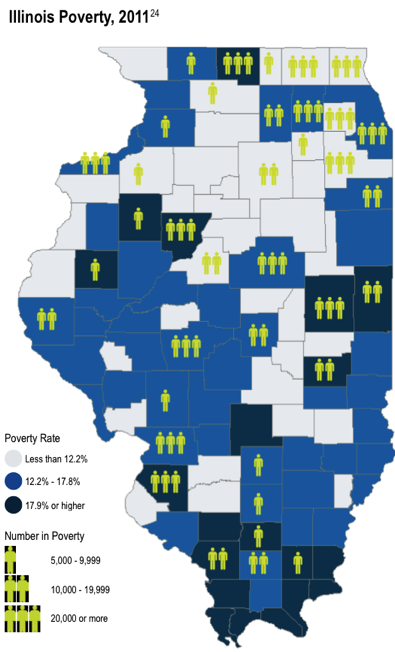
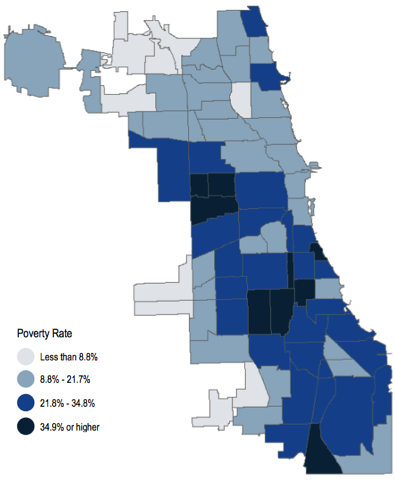
* One in three Illinois residents in or near poverty, according to Heartland Alliance report
[Gov. Pat Quinn’s] governing style is often puzzling: He declares deadlines for lawmakers to act, setting himself up for failure when the date comes and goes and nothing happens. He publicly switches positions multiple times on major issues, leaving his allies wondering if they can trust him. And he seems to lack the political skills of past Illinois governors who were able to get stakeholders in a room, find common ground and seal the deal.
“He’s not constitutionally cut out, I don’t think, to be a manager,” said Charles N. Wheeler III, who teaches how to cover state government at the University of Illinois at Springfield. “He is more a rabble-rouser, a populist, a bomb thrower out there stirring the pot. But when it comes to actually figuring out how to get things done, that is not his strong suit.”
* Meanwhile, Montreal Alouettes play-by-play radio announcer Charles-Andre Marchand talked to the Sun-Times about new Bears head coach Marc Trestman…
“He’s a guy who is a leader. He’s charismatic. The players really buy into his system. They really love it. Definitely for a quarterback, he’s a great mastermind. […]
“Every detail for him counts. He’s got a sense of detail that is really something. […]
“I’ve covered pro sports for 33 years. I’ve never seen practices so well organized, so drilled. Not a minute was wasted. I’ve seen practices in football, hockey and soccer, you name it. I’ve never seen that. It was like they were practicing their practices before we could see their practice. To the most extreme detail, he will be very thorough. […]
“He really figured out the subtleties of Canadian football, where you can have movement before the snap. As a play-by-play guy, he was really making my life miserable because one minute I look at S.J. Green on the right side, and whoops he was hooking to the left, while [Jamel] Richardson was doing the opposite. You know those guys in New York City, who play with the nuts and shells, where you try to figure out where is the nut under the shell. That was basically the offense that Trestman was putting on the field.”
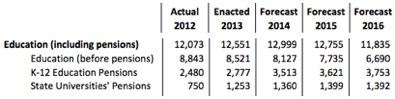
Gov. Pat Quinn’s administration is projecting a $400 million reduction in education spending in the next budget after the state failed to rein in government worker pension costs.
If that holds up, the governor would unveil a financial blueprint that would result in state education funding going down for the third consecutive year. The move also would be part of a broad-based, across-the-board slice made throughout most of state government. Among major exceptions would be health care spending for the poor, which is expected to rise after cuts last year, and public safety, an area projected to be mostly flat after the recent closure of two prisons, according to new preliminary figures.
“The explosive growth in the state pension payments means every other part of the budget has less money,” said Abdon Pallasch, Quinn’s budget spokesman. “The pain’s going to get worse and worse every year before we fix this pension problem.”
The money pressure is intensifying at a fast clip. The standard annual pension costs are expected to rise from about $5.2 billion this year to $6.2 billion in the new budget that begins July 1, but the overall cost is even higher. The total pension drain could hit almost $7.9 billion — about one-fourth of the state’s operating budget. The higher figure includes $1.66 billion in repayments of loans taken out to cover annual pension costs in previous years.
The General Assembly’s inability to overhaul the state’s pension mess has universities looking at a cut in state aid next year of about 4.6 percent.
That possible reduction, just the latest in a decade-long decline in state assistance for the state’s institutions of higher education, could again mean a new round of tuition hikes, hiring freezes or larger class sizes.
The number was included as part of a budget projection released by Gov. Pat Quinn, who says without action by the legislature, the state’s rising pension costs will mean less spending in other areas of government in the fiscal year beginning July 1.
* The new budget projection is here. By law, the Quinn administration is forced to make these budget projections based on current statutes. So, the projection includes no pension reform and the sunsetting of the tax hike.
With that in mind, here’s what education spending will look like…
But we can’t do the cost shift because that would raise local property taxes. Whatever. Property taxes are going up without the cost shift, campers. Bet on it.
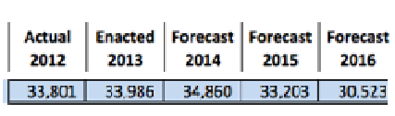
* Now, look what happens to total projected state Fiscal Year 2016 spending. FY 2016 will be the first full fiscal year without the income tax hike revenues, but with additional mandated spending of $2.2 billion on pensions and group health insurance…
Campaign finance reports filed with the state this week showed Quinn raised nearly $300,000 during the last three months of 2012, including $50,000 donations in December from the pipe trades and the Teamsters. He also got $25,000 contributions from the United Auto Workers and the plumbers.
He’ll obviously have to rely on private sector unions for his cash from here on out, unless he wins the primary and is up against a totally anti-union Republican. In that case, it’ll be the devil you know, etc.
Lisa Madigan has about $3.6 million in the bank. She raised $10K from the IEA, and some from other public worker unions. Bill Daley has not started raising money.
Among potential Republican candidates, state Treasurer Dan Rutherford reported $593,710 to start the year and has raised another $11,400 since Jan. 1, campaign reports show. Rutherford reported raising almost $218,000 in the final three months of the year.
State Sen. Bill Brady of Bloomington, the unsuccessful 2010 GOP nominee for governor who is considering another run, took in $52,948 over the quarter and had $77,140 to start the year.
State Sen. Kirk Dillard of Hinsdale, who narrowly lost to Brady in the 2010 primary, got $10,000 in seed money for his still-active gubernatorial campaign fund from horse racing impresario Richard Duchossois and his wife. But Dillard’s governor fund still shows debts of more than $360,000. Dillard’s state Senate campaign fund showed $12,569 available after raising $105,000 in the last quarter of the year. […]
U.S. Rep. Aaron Schock of Peoria, who also is mulling a Republican run for governor, did not file a state campaign report. But his last federal campaign report showed he had nearly $2.2 million in his congressional campaign fund through Nov. 26. Generally, federal campaign funds can be used for a state contest.
Bruce Rauner hasn’t opened a campaign account as of yet.
* Speaking of Schock and Rauner, the TV ad whacking Schock for his fiscal cliff deal vote is still resonating. Breitbart News…
Many conservative organizations sharply disagree with Schock’s and Shearer’s rationale for this and consider the deal a tax hike. Barney Keller, the spokesman for the Club for Growth–a powerful conservative group whose support or opposition is often the difference-maker in elections–told Breitbart News that Schock can’t spin his way out of this vote for the fiscal cliff deal.
“In 2012, the American people paid lower taxes, on income, on payroll, and on capital gains and dividends than in 2013,” Keller said. “He can spin it out however he wants, but he still voted for legislation that created higher taxes than last year. The evidence can be found right on the paychecks of his constituents.”
Heritage Action, another grassroots group with swagger in elections, considered the deal a tax increase too. “To be clear, this is a tax increase,” Heritage Action said when urging members of Congress to oppose the deal. “In 2013, the top marginal rate, death tax, and taxes on long-term capital gains and dividends will all be higher than in 2012. Comparing tax rates to hypothetical rates that have hardly any support is nothing more than misleading Washington spin.”
FreedomWorks opposed it as well. The group’s president Matt Kibbe signed a letter to its millions of nationwide members, asking them to push legislators to vote against the deal because the deal contained “tax hikes” and postponed the sequester.
Asked to respond to the conservative criticism of the deal from places like the Club for Growth, FreedomWorks, and Heritage Action, Shearer told Breitbart News, “no doubt you are aware that [the Club for Growth’s] former leader, Pat Toomey, now a U.S. Senator also voted for the same bill.”
* A recent study of 1,183 Americans looked at what happened to their viewpoints when they were exposed to rude online comments…
Participants were asked to read a blog post containing a balanced discussion of the risks and benefits of nanotechnology (which is already all around us and supports a $91 billion US industry). The text of the post was the same for all participants, but the tone of the comments varied. Sometimes, they were “civil”—e.g., no name calling or flaming. But sometimes they were more like this: “If you don’t see the benefits of using nanotechnology in these products, you’re an idiot.”
The researchers were trying to find out what effect exposure to such rudeness had on public perceptions of nanotech risks. They found that it wasn’t a good one. Rather, it polarized the audience: Those who already thought nanorisks were low tended to become more sure of themselves when exposed to name-calling, while those who thought nanorisks are high were more likely to move in their own favored direction. In other words, it appeared that pushing people’s emotional buttons, through derogatory comments, made them double down on their preexisting beliefs.
Based on pretty indisputable observations about how the brain works, the theory notes that people feel first, and think second. The emotions come faster than the “rational” thoughts—and also shape the retrieval of those thoughts from memory. Therefore, if reading insults activates one’s emotions, the “thinking” process may be more likely to be defensive in nature, and focused on preserving one’s identity and preexisting beliefs.
In the golden oldie days of media, newspaper articles were consumed in the context of…other newspaper articles. But now, adds Scheufele, it’s like “reading the news article in the middle of the town square, with people screaming in my ear what I should believe about it.”
And some newspaper owners wonder why they should spend the time to police their online comment sections. Sheesh.
By the way, I think the same sort of thing applies to cable TV screamers. But unlike random reader comments, the cable TV people do this in a calculated way to reinforce the mindsets of their targeted audiences by getting people to stop thinking. Cable TV “news” rots your brain. And so, apparently, do rude blog comments.
Shearer says he has “no regrets” about the Facebook post and isn’t backing off his implication at all.
Only, there’s no proof of that. And, in a somewhat cryptic email, the Chicago financier says he’s innocent.
“I didn’t do ad and never heard of group,” Mr. Rauner wrote. “(I’m) surprised he implied I did, but perhaps rogue staffer (?) . . . I like Aaron and have supported him in the past, even though (I) have disagreed with some of his tax votes.” Added Mr. Rauner, “Seems somebody wants us fighting now.”
Mr. Rauner didn’t respond to other questions, such as how many millions or tens of millions he’s going to drop into his own campaign, and how he would have voted on the tax-cliff matter. Nor is he saying who that “somebody” might be.
Aaron Schock voted for the debt ceiling increase the last time.
He also voted for the McConnell tax hike. Aaron Schock, all along, has been fine with raising taxes as long as he could look like he wasn’t.
A group in Illinois decided to call him out on it. What did Aaron Schock do? He ran to his lawyer crying and the lawyer wrote a letter to television stations demanding they pull the ad.
Well, we won’t pull the ad. The ad is accurate. Aarson Schock voted to raise the debt ceiling and he voted to raise taxes.
* Possible gubernatorial candidate Bill Daley spoke at yet another high-profile event yesterday and said pretty much exactly what he’s been saying for weeks…
Former White House Chief of Staff Bill Daley says he still hasn’t made up his mind about a potential run for the governor’s office.
“I’m no further than what I’ve said publicly,” he said Tuesday at the Misercordia Home breakfast.
“I’m doing a lot of things that go into making a decision,” said the son and brother of two former Chicago mayors. “I’m talking to a lot of friends and elected officials and people that involved in community activities and getting their sense of what they think is needed and whether or not, in the end, I think I can add something to the debate. As I’ve said repeatedly, Pat Quinn is a very decent and honest guy who came in at a time time but has been there for 12 years as the number one or number two elected official in the state and one has to look and say, ‘What’s happened in those 12 years?’”
Daley said he’s got a lot to consider before he makes a decision on the 2014 race but said he hasn’t traveled to other key cities in Illinois and hasn’t done any fundraising.
“I think there ought to be serious thought to basically a nonpartisan election,” Daley told reporters after he appeared on a panel at a fundraiser for the Catholic charitable organization Misericordia, which assists the developmentally disabled.
“The American people and the people in Illinois and Chicago, everyone is desirous of effectiveness and efficiency in government,” said Daley, who served as chief of staff to President Barack Obama and commerce secretary for President Bill Clinton. “If it takes basic changes, whether it’s term limits or others to kind of shake this system up, we’ve got to do that because I think most people would say, ‘Right now, it may not be working anymore.’”
Daley said he still is pondering a challenge to Quinn. His only criticism Tuesday was to say the incumbent has been either governor or lieutenant governor since 2002, “and one has to look and say, ‘What’s happened?’”
Quinn, speaking later Tuesday at a diversity event at the University of Chicago’s Gleacher Center, said he thought the California “top two” law was worth looking at, though he has favored an “open primary” system in which voters would not have to declare a political party to obtain a primary ballot.
“Some of our more political people have opposed that in both parties, and I think it’s time to maybe open up the door at least to (an) open primary,” Quinn said.
[Daley] said it’s easy to throw stones if you are on the outside. He talked about a lack of civility in politics.
“Our society has gotten much less civil,” he said. “What’s popular on TV? Reality TV shows, where people act like total fools.
“But maybe our politics, which should always be better, is becoming reflective of our society.
“Maybe we need to think about that first before we just blame politicians for acting kinda goofy at times.”
* Steinberg doesn’t think he’ll jump into the race…
But later, in discussing the multitude of woes facing the state beyond owing Misericordia, he added something perhaps telling.
“This is not an easy job,” Daley said, referring to politics. “Legislators, aldermen, the mayor. These people sacrifice beyond anything in the private sector. I’ve spent my life around politics. It’s a brutal job, a brutal existence.”
Telling, though I’m not sure what it tells. Does that mean he’ll skip the baby-bussing nightmare of campaigning, preferring the far more private, more lucrative corporate world where he excels? Or is Daley laying the groundwork for his selfless sacrifice of actually running? My guess? He won’t run.
* Quinn’s 2010 primary opponent Dan Hynes also weighed in…
“There’s certainly a referendum that can be had about whether we are better off than we were four years ago or three years ago,” said Dan Hinz, (D) 2010 candidate for governor.
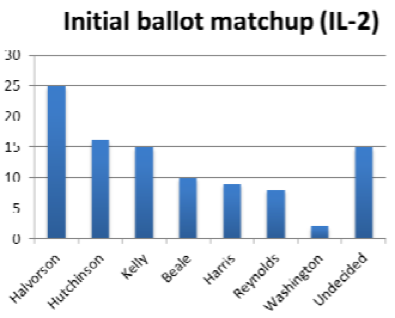
Unlike state Sen. Toi Hutchinson’s poll, Kelly’s pollster only asked about the top seven candidates. Actually, they asked about eight candidates, but then David Miller dropped out and they used voters’ “second choice” responses to reallocate his support elsewhere.
The poll of 500 likely voters was conducted by GBA Strategies January 3-7 with a margin of error of +/- 4.4 percent.
Hutchinson’s poll had Halvorson at 16, Hutchinson at 12 and Kelly at 8. Kelly’s poll has the race for second place much closer. Hutchinson’s attempts to push Kelly out or dismiss her to contributors and influencers as an also-ran probably aren’t gonna work, at least for now.
• Halvorson begins in the lead, but the race is wide open. Congresswoman Halvorson begins the campaign with 25 percent of the electorate in her corner, but her lead is soft. Senator Hutchinson (16 percent) and Kelly (15 percent) follow, with no other candidate getting more than 10 percent. Fifteen percent are purely undecided, but a full 65 percent of voters are either undecided or only softly supporting a candidate.
• Hutchinson and Halvorson share the same base. Both Debbie Halvorson and Toi Hutchinson start with their base of support coming from the same demographic and regional base, especially white voters and voters in the southern portion of the district.
• Kelly starts with a base of support in the suburbs. Robin Kelly currently leads all other candidates among several key groups, including African American women, African Americans in the suburbs and African Americans with a college degree. And Kelly’s support from these pivotal blocs grows during the survey.
• The NRA is extremely unpopular with this electorate. Just 17 percent of likely voters have a favorable impression of the NRA, with 63 percent saying they feel unfavorably towards the pro-gun organization. Kelly’s record of standing up to the NRA and her pledge to reduce gun violence resonates as one of the most powerful reasons to support her.
• Kelly has significant room to grow. Despite having lower name ID than Halvorson or Hutchinson, Kelly starts the race off statistically tied in second place. Once voters—especially voters in the city—hear more about Kelly and the leading candidates’ positions on preventing gun violence, the vote moves dramatically in her favor, pulling her ahead of both Halvorson and Hutchinson.
• Hutchinson/Halvorson’s growth limited by NRA ties. Both other leading candidates find their growth opportunities severely limited by their proud associations with the NRA and the ISRA. Nearly 7-in-10 voters (69 percent) oppose allowing concealed carry in this race. Voters have very serious concerns about Hutchinson’s and Halvorson’s positions on this critical issue.
There’s no doubt that Kelly believes the gun issue is her best path to victory here. She’s also raised more money than any other candidate so far (although not a huge amount more than Hutchinson is claiming).
Discuss.
*** UPDATE *** Speaking of guns…
Kelly Supports Obama Gun Control Initiatives, Calls Out Opponents
Only major candidate with a record of standing up to the NRA
RICHTON PARK, IL— Today, Robin Kelly, Democratic candidate for the Second Congressional District of Illinois, announced her support for the gun violence prevention proposals that President Obama and Vice-President Joe Biden announced this morning.
“I stand with President Obama’s plan to get the dangerous weapons that are killing our neighbors off of the streets,” Robin Kelly said. “The NRA has engaged in desperate smear campaign to stop him, including attacking President Obama’s daughters. We need more voices in Washington willing to stand up to NRA, instead of taking support from them.
“Unlike my opponents Debbie Halvorson and Toi Hutchinson, who both received support from the NRA, I got an F rating and frankly, I could not be more proud. I have the record and resolve to stand with President Obama, Mayor Emanuel, and Cook County Board President Toni Preckwinkle to get dangerous weapons out of our neighborhoods.”
Robin Kelly is the only candidate to have issued a five-point pledge to get assault weapons and high capacity magazines off the streets of Chicago and the Southland, as well as making sure that Illinois’ conceal and carry ban stays in effect. You can read her full pledge at RobinKellyPledge.com.
Robin Kelly is a former state representative, Chief of Staff to the Illinois State Treasurer and Chief Administrative Officer for Cook County under Toni Preckwinkle. But, most importantly, she’s a mother and a community activist who has dedicated her career to fighting for economic opportunity, domestic violence prevention and reasonable common sense gun control laws.
* Notice the absence of any Illinois Democrats on this list. From The Hill…
Promising to “stay on offense” in 2014, National Republican Congressional Committee Executive Director Liesl Hickey is out with a memo arguing it’s in a strong position heading into this election cycle, and outlining seven early targets for the committee.
The targets all hail from GOP-leaning districts that the GOP has carried in the past three presidential elections: Reps. Ron Barber (D-Ariz.), John Barrow (D-Ga.), Ann Kirkpatrick (D-Ariz.), Jim Matheson (D-Utah), Mike McIntyre (D-N.C.), Collin Peterson (D-Minn.) and Nick Rahall (D-W.Va.).
The memo points out that Mitt Romney carried 227 districts while President Obama won 208, a statistic that illustrates how difficult it will be for Democrats to capture enough House seats to retake control of the upper chamber. Much of that advantage came from successful Republican redistricting efforts after the 2010 election.
“As a result of redistricting, which favored Republicans, and this well-executed [offensive] strategy — the House is well-aligned and firmly in GOP control,” Hickey writes. “The national map of competitive House races looks very different headed into 2014. Namely, it’s smaller and Republicans have the upper-hand.”
Democratic congressional candidates won about a million more votes than Republicans, but still lost the House. Redistricting went the other way for the GOP here in Illinois, however, and that early list is a sign that the national GOP accepts the reality.
* This is not to say that there won’t be any targeted races here. I assume that the Republicans will be going after Brad Schneider in the 10th CD, who beat freshman Republican Bob Dold by just a handful of votes. Congressman Bobby Schilling may run again after losing to Cheri Bustos by six and a half points. And Bill Enyart obviously needs to watch his voting record because his district is so conservative.
“I like guns and I didn’t take any special interest money and it’s a good way to raise money and show my support for the Second Amendment,” explained Harms. “(Candidates) usually don’t do raffles because it’s a lot easier to get a thousand bucks out of a lobbyist than it is to sell a $5 raffle ticket.” […]
Raffles by political candidates in Illinois are legal, said Rupert Borgsmiller, executive director of the State Board of Elections, as long as candidates get an application in advance and file a report after the raffle.
And Harms, who had a similar raffle last year, has done both, Borgsmiller said. […]
Harms’ last raffle yielded $983. He sold $2,865 of tickets minus $1,881 spent to purchase the guns, according to his raffle report.
This time, Harms’ father, Jeff Harms, purchased the guns and two gift certificates to a Big R store and donated them to his son’s campaign fund.
Ruger Mini-14 stainless steel with a synthetic stockas GRAND PRIZE
JOSH HARMS
ILLINOIS STATE REPRESENTATIVE
DRAWING TO BE HELD ON MARCH 2, 2013
MUST BE 21 YEARS OF AGE • MUST BE ELIGIBLE TO OWN A GUN
First Prize – Ruger LCR hammerless 357mag revolver
Second Prize - Mossberg 535 pump 3 1/2 inch combo 28” & 24” barrels
Third prize - $100.00 Big R gift certificate Fourth Prize - $50.00 Big R gift certificate
WINNERS WILL BE CALLED AND YOU NEED NOT BE PRESENT TO WIN.
To obtain tickets send payment to:
Josh Harms for Illinois, 555 South Fifth St., Watseka IL 60970
For more in formation call: 815-432-3121
$5.00 PER TICKET OR $20.00 FOR 5 TICKETS
A copy of our report filed with the State Board of Elections is (or will be) available on the Board’s official website (http:// www.elections.il.gov) or for purchase from the State Board of Elections, Springfield, Illinois. Paid for by Josh Harms for Illinois.