Rep. Jack Franks, a Marengo Democrat, wants to take the chances for state pensions away from all future lawmakers.
Franks has filed legislation that would keep all members of the Illinois General Assembly taking office in 2013 and after out of the state pension system in an effort to save money.
But what about Franks’ own legislative pension?…
He said Tuesday that the law doesn’t allow the state to take away benefits that any state employees, including lawmakers, have already earned.
True, but he could vow to return the cash, minus what he’s already put into the system. Actually, he could just simply cash out rather than accept pension payments.
State Sen. Ron Sandack, R-Downers Grove, has added his name to a list of legislators who will not be offering any legislative scholarships this year because the state’s broke. […]
State Rep. Jim Durkin, R-Western Springs, who eliminated the scholarships from his district last year, said attempts have been made in the past to eliminate the program but were always shot down in the Senate. […]
Sen. Kirk W. Dillard, R-Westmont, said he has supported bills to eliminate the scholarships for the past two years as well and will not be awarding in the future.
* 12:30 pm - An appellate court has struck down the state’s capital construction program and all of its funding sources, claiming the legislation violated the constitution’s “Single Subject Rule.” Read the opinion by clicking here. A lawyer friend summarizes…
The unanimous court held that Public Act 96-34 (Video Poker, Capital Spending Accountability Law, Capital Projects Fund, taxes on beverages, candy, grooming and hygiene products, privatizing the Lottery, U of I study on effects of study of Lottery on families, increase in truck fees, and liquor tax increase) violated the single subject rule of the Illinois Constitution.
Public Acts 96-35 (clarifying changes to Public Act 96-34 and changes to River Edge Redevelopment Zone Act, Vehicle Code rental car provisions, an urban weatherization program, Gaming Board peace officers provisions, and CDB provisions), Public Act 96-36 (trailer bill amending Public Act 96-34), and Public Act 96-37 (appropriations for Capitol Projects) all fall since they by their terms were contingent on Public Act 96-34.
Public Act 96-38 was also nullified. That was the tax hike on candy and some trailer language on the video poker bill.
* This has to be, without a doubt, the biggest appellate court ruling on Illinois policy in decades. Everything, and I mean everything has to be redone if the capital projects are to be saved.
Oy.
* 12:42 pm - So much for that new $5 billion capital construction bond the state is about to sell. There’s no longer a funding source and the program itself is now declared unconstitutional. The Lottery privatization deal was just finalized, but that’s now out the window as well, pending appeal.
A state appeals court Wednesday struck down Illinois’ $31 billion capital construction program, asserting that the legislation that authorized it was unconstitutional. The ruling invalidates the revenue streams for the borrowing that has funded the construction program, meaning that video poker, privatization of the lottery and higher liquor taxes are now on hold. The case was brought by W. Rockwell Wirtz, owner of the Chicago Blackhawks, and his liquor distributorship, Wirtz Beverage Illinois. The court found that the legislation that was the basis for the construction program violated the state Constitution’s single-subject requirement.
A spokesman for Illinois House Speaker Michael Madigan estimated that the ruling eliminated at least 40 percent of the funding sources devoted to the state’s giant capital construction program.
*** 2:22 pm *** From Gov. Pat Quinn’s office …
The administration intends to appeal the appellate court’s decision and to seek an immediate stay from the Illinois Supreme Court.
The Illinois Jobs Now! capital program is an important part of Governor Quinn’s plan to put Illinois back to work. Capital bill projects are putting thousands of people to work in every corner of the state, while supporting local businesses, improving our infrastructure and increasing energy efficiency.
While the administration’s request for a stay is pending with the Illinois Supreme Court, capital projects already in progress will continue as scheduled. We would expect the Supreme Court to rule on the request for a stay in the very near future.
* 12:57 pm - I meant to tell you about this earlier and forgot. Amanda Vinicky of Illinois Public Radio has the scoop…
Despite claims their nominations had expired, dozens of the Governor’s appointments to state agencies and commissions still stand.
Attorney General Lisa Madigan has sided with Governor Pat Quinn in a dispute between the administration and the Senate President’s office … a dispute that had temporarily put in limbo whether a major state agency, the State Police, still had a director.
In the ruling … Madigan says a governor’s nominations DO carry over into the next legislative session.
The Senate President had claimed 38 pending nominations … including that of the State Police Director Jonathon Monken … expired earlier this month because Senators hadn’t acted on them before adjourning. The President’s office claimed there wasn’t even the legal authority to keeping paying what it referred to as “former” nominees.
But Madigan’s opinion says the constitution is clear. And she backs it up with statements by the constitution’s authors. She says the Senate has 60 legislative days to act on nominees, and that clock carries over between Senates. After 60 days, an appointment’s automatic.
Which means the Senate’s time to act on Monken is just about up. He’s a controversial pick to head state troopers as he has no police background.
* 1:01 pm - Cullerton response…
Based on our concern that key state personnel would be making decisions and being paid with no legal authority, we alerted the Comptroller on the matter.
Our opinion was based on 40 years of precedent followed by the attorney general’s office, six prior governors, and 21 prior General Assemblies regarding executive appointments. We are assessing how this impacts the legislative process, but we will comply with the opinion.
We intend to schedule executive appointment committee hearings for each of the nominees in question when the Senate reconvenes next week.
* Justice Burke had some sharp words for those who say she should recuse herself from the Rahm Emanuel residency case because her powerful husband is backing Gery Chico…
Illinois Supreme Court Justice Anne Burke today rejected the notion that she should recuse herself from deciding on the residency case involving mayoral candidate Rahm Emanuel.
“Aren’t we beyond that? Women have minds of their own. We have spouses in every kind of business. Are we returning to the days of Myra Bradwell?” she said, referring to the Illinois suffragette who was initially denied the right to practice law because she was a woman. She went on to become the state’s first female lawyer. […]
As for Mr. Burke, she notes that she also worked for former Gov. Jim Edgar — a Republican stalwart. Her Democrat husband “didn’t like that much either,” she said.
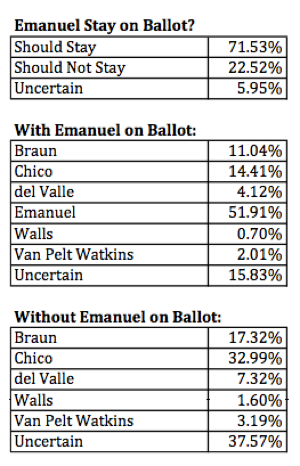
* Meanwhile, a new poll from We Ask America has Emanuel above 50 percent for the first time, and shows that over 70 percent want him to stay on the ballot…
* John Kass, however, thinks the only people who want Emanuel to win are our corporate overlords and does his best today to undermine whatever decision is made by the Illinois Supreme Court…
Rahm has all that big money behind him, that Chicago corporate and business muscle, and more money from the coasts. They want Rahm, and it seems as if they’ll kick the law right in the behind to make him mayor. […]
Now the Illinois Supreme Court has ordered Rahm back on the ballot, pending its ruling. Cudgeling the court to get the political result you want is supremely practical. But it does come with some cost.
It reinforces in the mind of the people that in Chicago, election laws apply only to those without clout. And when you hope to bend the law to suit your politics, even if the politics are the right politics, there’s another cost.
You’re not talking about the rule of law anymore. You’re talking about feudalism. And that’s what Chicago politics is about.
Whatever. If the Supremes side with Emanuel the score would be 4-1 to keep him on the ballot (hearing officer, board of elections, trial court judge and Supremes vs. a bitterly divided appellate panel).
To arrive at their ruling, those two judges — Thomas Hoffman and Shelvin Louise Marie Hall — advanced a groundbreaking residency standard far more restrictive than the one courts have applied for more than a century. That’s right, a new rule, starting with Rahm Emanuel.
In doing so they disregarded several appellate cases that support Emanuel’s position, including one case in which Hoffman concurred. They also ignored a guiding principle of elections law interpretation: It is supposed to be construed with an eye toward allowing ballot access, not limiting it.
Having just tossed the front-runner off the ballot in the biggest city election in decades, they then refused to certify the case as worthy of expedited Supreme Court review. Fortunately, the high court recognized the emergency. The appeal is now fast-tracked.
But now we’re to believe that because he rented out his Chicago home he forfeited his residency — a distinction by the way that is never spelled out in the appellate court’s opinion.
The justices say Emanuel was indeed a legal Chicago resident for voting purposes, but they say he did not “reside in” the city for purposes of being a candidate.
It doesn’t add up to me, and that’s why I’m glad the Illinois Supreme Court agreed Tuesday to hear Emanuel’s appeal and to leave him on the ballot until they make a ruling.
Emanuel’s eligibility to be on the ballot is a question of law to be decided by the courts, not something to be put to a popular vote. But the long history here is that the courts have liberally interpreted what it means to be a resident.
* In other news, Gery Chico has a new TV ad. Rate it…
Script…
Woman: “My son Anthony was riding his bike home…when somebody took his life. He was a wonderful boy.”
Chico: “If we don’t fight back for moms and dads of kids who have lost kids to gang violence, we’re not going to be a great city anymore.”
Woman: “We need to work together to stop this.”
Chico: “These murderers, these punks are stealing our children and they’re stealing our communities. We’re going to add thousands of police to the force, we’re going to rebuild community policing, we’re going to take our neighborhoods back and we’re going to be a city that protects its own.”
So far, that’s the most forceful ad by anyone this season and it stands in sharp contrast to Emanuel’s boring, predictable spots. Like Pat Quinn eventually did, Emanuel might want to take a look at his young, bright Internet video guy for a bit of inspiration. This piece was made by Chris Ramirez, who’s just 20 years old, but has a great eye…
Mayoral hopeful Gery Chico said Tuesday he’s open to abolishing the residency requirement for city employees, arguing that Chicago’s middle-class tax base can survive without it.
Chico dropped the political bombshell as he accepted the endorsement of a Chicago Firefighters Union Local 2 that has long advocated allowing firefighters and paramedics to live outside Chicago.
The Fraternal Order of Police, which has also chafed at the residency rule, has also endorsed Chico. Together, the two unions represent nearly 25,000 active members and retirees. […]
After the state state Senate voted earlier this year to lift the residency requirement for teachers in the Chicago Public Schools, Daley lambasted the idea as the beginning of the end for Chicago’s middle class.
“Mr. Chico’s support for lifting the city’s residency requirement poses a direct threat to our city’s middle class. Our neighborhoods are maintained through a strong and reliable tax-base and lifting the residency requirement endangers this important resource.
* The Question: Do you agree or disagree with ending Chicago’s (or any city’s) residency requirement for public employees? Explain.
The trip coincides with advertisements that [Christie’s] administration began running Tuesday in publications including the Chicago Tribune and the State Journal-Register in Springfield, encouraging businesses to relocate and invest in New Jersey, Christie said. […]
“If [Gov. Pat Quinn] wants to tank his economy, that’s just fine,” Christie, a 48-year-old Republican, said in an interview at Bloomberg News headquarters in New York on Tuesday. “I’ll go and try to collect as many businesses as I can, and every job that I create, that I take from Illinois, which comes to New Jersey, will be a net plus for us.” […]
Christie characterized Quinn’s move to raise taxes as a “typical bait and switch” after the Illinois governor campaigned saying “he might raise taxes about half as much as he wound up doing.”
Christie said Quinn did it because “he got in bed with the public-sector unions in order to win election by half a point.”
According to the Sun-Times, Christie’s ads were paid for by taxpayers. No word yet on the cost. Here’s the radio ad if you haven’t heard it…
The print ad is here. Christie’s taxpayer-funded photo is prominently displayed in the state’s newspaper ad, which would be illegal under Illinois law if Quinn tried to do the same thing…
Caption?
* When Gov. Christie arrives, reporters need to keep in mind that in spite of his rhetoric to the contrary, he’s reduced his budget deficit by just $200 million.
* Also, while we’re on the topic, a Wisconsin company just announced that it’s opening a new plant in Illinois…
American Aluminum Extrusions Co. intends to open a plant at the former Warner Electric site, creating 130 jobs by 2013.
Village President Dave Krienke believes the Beloit, Wis.-based aluminum manufacturer would initially create 60 jobs and could have its first line running by July 1.
“We have a great opportunity here — this is a company that’s going to be a leader in its field, and I see growth in its operations for many years to come,” Krienke said Tuesday. “You know we need jobs and we need people working … to spend their money in our community. This could create a great economic incentive for Roscoe.”.
Illinois taxpayers donated more than $1.3 million to 10 nonprofit causes last year, but many charities have yet to see the money.
The Crisis Nursery of Champaign County is still waiting to get its share of $44,771 donated to a statewide Crisis Nursery Fund on 2009 tax returns. It’s supposed to get more than $6,300, said Executive Director Stephanie Record.
And Feeding Illinois, which oversees the state’s eight food banks, has not received the $100,246 given by taxpayers for hunger relief.
“We were supposed to get it in July,” Record said. “Like everything with the state, it was held up a little bit. That’s frustrating.”
* Roundup…
* Illinois customers now have four choices for electricity - More alternative suppliers enter the market
* Waukegan weighs proposed foster home: A proposal to transfer ownership of a foreclosed property on South Park Avenue to a Chicago-based agency that provides housing for foster children is scheduled to go back before aldermen next week after running into opposition late last year.
* Rockford schools to face painful budget solutions
* I told you last week that Comptroller Judy Baar Topinka had boasted that she could easily find $1 billion in painless cuts to the state budget that nobody would miss. I asked for the list, and I received it late yesterday…
· FISCAL OFFICE CONSOLIDATION ($12 million in savings): Combining the offices of Treasurer and Comptroller will save an estimated $12 million annually – and while we’re at it, let’s look at the Lt. Gov’s office and all the other unnecessary layers of government that exist in Illinois.
· UNIVERSAL PRESCHOOL ($100 million in savings): If we roll back this Blagojevich giveaway and require financially-able families to pay for preschool, the state would save an estimated $100 million.
· SENIORS RIDE FREE ($40 million in savings): The bill to eliminate free rides for financially-able seniors is currently on Governor Quinn’s desk – I hope he signs and saves $40 million for the state.
· LATE PAYMENT PENALTIES ($60 million in savings): The recently passed tax hike budget plan allows for 2-percent in annual growth. If we eliminate that extra spending and instead use the dollars to pay down our bill backlog, we would save the $60 million spent annually on late payment penalties.
· MEDICAID ELIGIBILITY ($480 million in savings): By moving Medicaid to a managed care system and making slight adjustments to eligibility requirements, we would save $480 million annually.
· FEDERAL TAX COLLECTION COOPERATION ($30 million in savings): The state is considering a tax collection cooperation plan with the federal government where we withhold refunds until each other’s delinquent taxes are collected. Maryland conducted a similar pilot program and collected $22 million – we estimate Illinois would get at least $30 million.
· CAPITAL PROJECTS ($30 million in savings): The state plans to spend $65 million on capital projects this year – if we scale that back to $35 million we would save the other $30 million.
· SENIOR HOME HEALTHCARE ($120 million in savings): By improving access to home health care for seniors, we would save on nursing home costs. We project it would save $120 million annually, and that number will go up as the population ages.
· MERCHANT SALES TAX PAYMENTS ($60 million in savings): Illinois allows retail merchants to retain a portion of the sales tax they collect (1.75%) throughout the year. By cutting that in half, we would save $60 million annually.
· ELIMINATE AMTRAK SUBSIDY ($26 million in savings): Illinois cannot afford to continue its subsidy to Amtrak – if that is eliminated, the state will save $26 million annually.
· ELIMINATE CAPITAL LITIGATION TRUST FUND ($20 million in savings): The General Assembly has voted to repeal the death penalty. If Gov. Quinn signs the legislation, the state would realize savings in the Capital Litigation Trust Fund.
* OK, first of all, Republicans love to attach big numbers to Medicaid savings without really explaining what they are, and half of Topinka’s billion dollars is saved via Medicaid. I asked for a breakdown, but haven’t received it yet. Also, kicking people off the Medicaid rolls would not be “painless” for those folks. And a widely hailed bipartisan Medicaid reform bill signed into law yesterday would save between $624 million to $774 million over five years. It’s not clear at the moment if any of those Topinka reforms overlap.
* The Amtrak subsidy is a favorite target of Republicans without a train station in their districts. Bill Brady had a station in Bloomington, and he was and is very pro-train. But to put this into perspective, I checked a few sources online and found one which has the cost of milling and resurfacing a four-lane rural interstate highway at about $1.2 million a mile. So, if this estimate is about on-target for Illinois, getting rid of the Amtrak subsidy is equal to repaving less than 22 miles of Interstate 55.
The suggestion of abolishing the Capital Litigation Trust Fund to realize savings is one brought up by fiscal conservatives who were mostly agnostic on the death penalty. It’s an interesting argument, but notice there’s no declaration of where she stands on the abolition bill.
Also, good luck with that battle against the Illinois Retail Merchants Association on the sales tax collection fee. It’s been tried a dozen times at least and has always failed.
* Response from Gov. Pat Quinn’s budget office…
We appreciate Comptroller Topinka’s efforts to offer specific examples on how to further reduce state spending and we will take these suggestions into consideration. Governor Quinn has reduced appropriations by $3 billion since taking office and will continue to work with legislators to make further reductions to save taxpayers money. The Governor’s budget address will take place on February 16.
* Meanwhile, Kevin McDermott reports on new legislation introduced by the House Republicans…
Illinois House Republicans have already filed a bill to repeal the state’s new income tax hike, which was passed earlier this month in the final hours of the lame duck session of the last General Assembly.
The bill (HB175) doesn’t have the proverbial snowball’s chance in you-know-where of getting even a committee hearing, of course. Democrats still control the chamber and aren’t about to play games with the tax hike, which they barely squeezed into law in the first place.
Rolling back the tax hike isn’t ultimately the point of this bill. The point is so that co-sponsors like state Rep. Dwight Kay, R-Glen Carbon, can send press releases like the one we got this morning– “Kay Introduces Legislation to Repeal Tax Increase'’ –which doesn’t mention anywhere in it that he’s one of a couple dozen GOP co-sponsors of the thing. Which means there are likely a couple dozen press releases under those other lawmakers’ names, going out to their local papers, each one similarly claiming credit for spearheading this doomed expedition.
(In fairness to Kay and the Repubs, this is standard practice in Springfield, and no one’s better at it than Democratic House Speaker Michael Madigan.)
There is also not a single appropriations bill introduced by the Republicans to pay for this income tax hike rollback. Don’t expect one, either. Instead, expect lots of press release reprints like this one in the Carmi Times…
“…Sadly, the Chicago Democrats who passed the measure have no recognition or remorse for the severity of their actions on citizens struggling to make ends meet. Worse yet, it will not solve our long term structural deficit.”
* Nobody in Illinois really got to the bottom of what was going on with yesterday’s report about an SEC investigation of Illinois pension funds. This was typical…
Gov. Pat Quinn’s administration confirmed Tuesday that the federal Securities and Exchange Commission is conducting an inquiry into statements made by Illinois officials about prospective long-term savings from pension reforms passed last year.
Kelly Kraft, spokeswoman for Quinn’s budget office, said the SEC contacted the state in September regarding a “non-public inquiry” it was conducting regarding the financial effects of the reforms on the pension systems. The inquiry includes “communications relating to the potential savings or reduction in contributions by the state to the Illinois public pension systems,” Kraft said.
“We feel our disclosures are accurate and complete,” Kraft said. “In terms of what the SEC has told us, the non-public inquiry ‘should not be construed as an adverse reflection on any entity or individual involved, nor should it be interpreted as an indication by the Commission or its staff that any violations of the federal securities laws has occurred.’”
“They called, and I think nationwide they are probably looking at everything in light of what happened in New Jersey,” Quinn added. “So, you know, we want to make sure that we answer any and all questions. We’re totally confident that everything we do here is done in the right way and that’s the way it will always be.”
“We’ve never had a problem going into the market and getting plenty of bidders to lend money to Illinois, and I think that’ll be even more so in light of our most recent action,” Quinn said, referring to the income tax increase.
The S.E.C. contacted Illinois after an article appeared in The New York Times about an unusual actuarial technique the state had been using to save money by shrinking its annual pension contributions.
The method, enacted last year, is based on sharp cuts in benefits for state workers who have not yet been hired. Although the cuts will not produce an appreciable savings until far in the future, Illinois has begun funding its plans as if its current workers were already earning the smaller benefits of the future.
Earlier this year, Illinois said it had found a way to save billions of dollars. It would slash the pensions of workers it had not yet hired. The real-world savings would not materialize for decades, of course, but thanks to an actuarial trick, the state could start counting the savings this year and use it to help balance its budget.
Gov. Pat Quinn of Illinois approved a plan in April that seemed to help balance the budget, but it may imperil the pension fund.
Actuaries, including some who serve on the profession’s governing boards, got wind of what Illinois was doing and began to look more closely. Many thought Illinois was using an unorthodox maneuver to starve its pension fund of billions of dollars, while papering over a widening gap between what it owed and how much it had. Alarmed, they began looking for a way to discourage Illinois’s method before other states could adopt it.
They are too late. The maneuver, and techniques that have similar effects, are already in use in Rhode Island, Texas, Ohio, Arkansas and a number of other places, allowing those states to harvest savings today by imposing cuts on workers in the future.
More than 20 pages [in the current offering statement] are devoted to pension fund reporting in the $3.7 billion offering statement, more than double the section in past offering statements, including the one for the state’s $3.5 billion sale of GOs to fund its fiscal 2010 pension payments early last year.
The section underscores just how troubled the Illinois pension system remains. The unfunded liability rose to $75.7 billion in fiscal 2010 from $62.4 billion in fiscal 2009. That lowered the state pension system’s funded ratio to 45.4% from a 51% funded ratio that is among the worst in the nation.
Illinois shifted to a five-year smoothing model in fiscal 2009 that limits the impact of near-term investment losses and gains. The unfunded liability would stand at $85.6 [billion], for a funded ratio of just 38.3%, based on the fair market valuation that recognizes gains and losses annually.
The unfunded actuarially accrued liability “increased between fiscal 2009 and the end of fiscal 2010 primarily as a result of insufficient state contributions as compared to the actuarially required contribution,” or ARC, the state wrote in the offering statement. [Emphasis added]
* Gov. Pat Quinn was asked today to respond to New Jersey Gov. Chris Christie’s new advertising campaign in Illinois urging businesses to relocate to the Garden State.
“He was advertising before November 2nd for my opponent and nobody listened to him then and I don’t know why anybody would listen to him,” Quinn said, adding “This is a guy whose business climate is rated 48th in the nation.”
Quinn also said of Christie, “New Jersey’s way of balancing the budget is not to pay their pension payment, not to deliver on property tax relief that was promised, to fire teachers… I don’t need that kind of advice from that guy.”
Um, OK, what about that property tax relief, governor? Didn’t you promise that last year? Also, lots of Illinois teachers lost their jobs last year.
* State Treasurer Dan Rutherford showed his bipartisan chops during a CNBC interview earlier today. The hosts appeared to think the Republican would gush all over their budgetary hero Chris Christie (who has barely touched his deficit) and toe the DC party line on bankruptcy for the states. Rutherford, however, appeared to surprise them. He didn’t overtly praise Christie and he completely ruled out that silly bankruptcy proposal. He also refused to run down his own state, despite plenty of CNBC baiting. Must watch…
* Our last video is also a must-see. Tom Jaconetty talks to the Chicago Bar Association Election Law Committee about what ballot challenges are really all about. Jaconetty is working with Burt Odelson to kick Rahm Emanuel off the ballot. He’s brutally honest…
Sorry for the video quality on that one.
*** UPDATE *** The Illinois Policy Institute wants to repeal the income tax in its entirety…
* 1:21 pm - From a summation of the latest Supreme Court order that has just been filed on the Rahm Emanuel residency case…
The petition to leave for appeal is allowed. The Court will review it on an expedited basis. The court will be using the briefs filed by the parties in the appellate court. No additional briefs will be filed in the Supreme Court and there will be no oral argument.
Some folks are screaming that the state should put its newly adopted recall amendment to good use and recall Gov. Pat Quinn.
It underscores one of the concerns people have about recall, namely that it could be used to oust someone just because they made an unpopular decision. Trying to avoid that is one reason the recall process now part of the state constitution is as convoluted as it is.
If you don’t like the income tax hike or that Quinn acceded to a much higher one than he talked about during the election, fine. Politics involves disagreements. But Quinn knows the state is in severe financial difficulty and took the steps, however unpopular, he thought best to deal with it.
Recall was aimed at dealing with the Rod Blagojeviches of the state. Whatever else you think of Quinn, he isn’t another Blagojevich.
* The Question: Agree or disagree? And, as always, make sure to explain yourself.
* At least one of my readers was surprised this morning that Sheila Simon would speak out on this issue in public…
Lt. Gov. Sheila Simon has added her voice to the chorus of political leaders who are urging Gov. Pat Quinn to sign legislation ending the death penalty in Illinois.
In a letter she sent to Quinn on Monday, Simon points out that she spent four years as an assistant state’s attorney in southern Illinois’ Jackson County, and feels that she did a good job in that post. But she also says that our criminal justice system, even when operating at its best, is still imperfect.
My initial reaction was that this orchestrated at the very top levels. Turns out, I was correct…
In an interview Monday night, Simon said she shared her views recently with Quinn, and he asked her to put them in writing.
So, she writes the letter and then shares it with the media. It suggests that Quinn is leaning in favor of signing this bill and maybe wants to gin up at least the appearance of a groundswell of support.
* But the apparent careful stagecraft isn’t going down well in at least one of the trenches…
A DuPage County judge said it’s “grossly irresponsible” for Gov. Pat Quinn to remain silent on whether he’ll sign legislation that would abolish the state’s death penalty.
Circuit Judge John Kinsella made a plea from the bench Monday for Quinn to end the uncertainty over Illinois’ death penalty.
Advertisement
“He’s got to tell us if he’s going to sign the bill and make it law,” Kinsella said.
The judge’s remarks came as he scheduled a May trial for an Addison man accused of killing his mother and a prostitute five years ago. Gary Schuning, 28, may face the death penalty if he is convicted of the Feb. 26, 2006, double-stabbing.
I don’t blame Quinn for taking his time on this one, considering the seriousness of the issue, but I can empathize with Judge Kinsella. There are lots of people out there waiting on this very important decision. While the governor should take some time here, he can’t ignore the urgency of the matter.
…Adding… From Zorn in comments…
I’d just like to point out that John Kinsella was the lead prosecutor of Rolando Cruz in Cruz’s third trial for the murder of Jeanine Nicarico and was trying to put Cruz to death for that crime. Of course later it turns out that, d’oh!, Cruz was innocent. Brian Dugan and Brian Dugan alone killed that girl.
Good point.
* Meanwhile, the furor over the highly active lame duck session (which produced the death penalty abolition, the civil unions bill and the tax hike) will probably take years to subside…
In her first official act since her January appointment, state Rep. Pam Roth, R-Morris, introduced a bill Monday that would prohibit former lawmakers from taking a new state job for up to two years after they leave office, a bill aimed directly at her Democratic predecessor.
But Roth denied the bill was in direct response to former state Rep. Careen Gordon, who drew criticism for supporting a controversial tax increase and then being appointed to a state job by Gov. Pat Quinn just days later. Quinn appointed Gordon on Jan. 14 to the Illinois Prisoner Review Board, a job which comes with a 12 percent pay hike for Gordon, who was defeated by Sue Rezin in last November’s election.
The tremendous hurdles blocking major legislation means that this stuff mostly happens in clumps. It’s no coincidence that the GA has approved just one permanent income tax increase since the tax was first established under Gov. Ogilvie in 1969.
“It is ordered that the emergency motion by petitioner Rahm Emanuel for stay pending appeal is allowed in part.
“The appellate court decision is stayed. The Board of Elections is directed that if any ballots are printed while this Court is considering the case the ballots should include the name of petitioner Rahm Emanuel as a candidate for the mayor of City of Chicago.
“That part of the motion requesting expedited consideration of the petition for leave to appeal remains pending.”
I posted Emanuel’s petition for stay yesterday, but click here to read it if you missed it the first time around.
Rahm Emanuel is narcissistic and flippant, according to the lawyers opposing the former White House chief of staff’s request for injunctive relief from the city’s plan to print ballots without his name on it.
“The petitioner narcissistically asks this court to value his non fundamental right to be a candidate for mayor over the fundamental voting rights of potentially thousands of voters,” writes attorney Burton Odelson in a brief opposing Emanuel’s effort to have the ballot’s include his name regardless of the ultimate outcome regarding his eligibility to be a candidate. […]
But Odelson argues the actual effect could lead to disenfranchisement should Emanuel ultimately be deemed ineligible because many voters may not be aware of the court ruling and vote for the former Obama aide anyway.
“The petitioners flippant attitude to the disenfranchisement of potentially thousands of voters is disingenuous,” wrote Odelson.
The full Odelson response in all its glory is here.
House Majority Leader Eric Cantor said Monday that he opposes changing the law to allow fiscally pressed states to seek bankruptcy protection, an idea that has been raised by some conservatives.
Speaking to reporters, Cantor (R-Va.) also said state governments should not expect Washington to solve their fiscal problems. States have the ability to balance their books by cutting spending, raising taxes or renegotiating agreements with labor unions, he said.
While the feds should’ve given more money to states via the stimulus bill, they shouldn’t compound the problem now by allowing states to declare bankruptcy (if they even can, which is debatable).
The municipal bond market has been built on the notion that states have to pay off their bondholders. A bankruptcy option would mean the entire market would have to be rebuilt and restructured. Chaos would surely result. Imagine trying to sell a 20-year infrastructure bond when the buyers know the states could just declare bankruptcy at any moment and absolve themselves from the debt. Yes, there is that risk with corporate bonds, but the market was built with that in mind. Not so with munis.
* One reason this is being pushed is to allow states to break union contracts. But a state can pass a law to outlaw collective bargaining for public employees. It won’t kill off current union contracts, but it would preclude further contracts. That’s under discussion in Wisconsin right now.
* Another reason given is that states could perhaps get out of their pension obligations…
Kirk says the only legal options available now for states such as Illinois are default – which could be devastating – or a federal bailout.
“Between a bailout, which has no possibility of passing in the House, and a default, which means suddenly, the state treasury runs out of money to pay for anything, is there something that allows a state work out its debt situation?” Kirk said.
Bankruptcy would allow the state to restructure its pension system so that it may preserve benefits for existing employees.
Strangely enough, he said that after Illinois approved a tax hike. Apparently, he doesn’t see that as an option, nor does he see severe budget cutting as an option.
New Jersey, which didn’t really cut anything despite promises to the contrary, is planning to skip its pension payment for the second year in a row. Texas will skip most of its payment in the coming year. But federal bankruptcy judges could force draconian cuts or maybe even a tax hike. One never knows.
* And that’s really the heart of the matter here. Conservatives screamed bloody murder for decades about federal judicial takeovers of school districts. Now they want to hand over entire state budgets to unelected judges? Really?
There are those on the Left who believe that what’s really going on here is that the people behind this bankruptcy push want to save newly elected Republican governors from the political nightmare of having to make the hard choices on their promised cuts. That would be typical DC, and it would be just like DC to ignore decades of hard and fast positions in order to score a short-term political gain.
* Bob Dole once said this about Newt Gingrich…
“You hear Gingrich’s staff has these five file cabinets, four big ones and one little tiny one. Number one is `Newt’s Ideas.’ Number two, `Newt’s Ideas.’ Number three, number four–`Newt’s Ideas.’ The little one is `Newt’s Good Ideas.’”
Gingrich has been pushing this state bankruptcy idea for months. It certainly doesn’t belong in the little cabinet.
* The Tribune’s editorial blasting the appellate court ruling on Rahm Emanuel’s residency was full of a whole lotta bluster, but it did include one interesting factoid…
[Dissenting Appellate Justice Bertina E. Lampkin] accused the majority of ignoring case law that clearly supported Emanuel’s argument —including a significant case in which Hoffman prevailed.
The majority completely ignores Dillavou, a recent Fourth District case that addressed candidate residency, even though Walsh, on which Justice Hoffman previously concurred, favorably cited Dillavou and discussed it at length. […]
Of particular relevance to the case before this court, Dillavou quotes the language of Clark and Kreitz, which provides that, once established, a residence will not be lost by an individual’s absence from that residence unless the individual demonstrates such an intent.
Dillavou is a case from the 3rd District, so the 1st is not bound to abide by its reasoning. However, Walsh v. County Officers Electoral Board of Cook County is a 1st District case and, as Justice Lampkin notes, Justice Hoffman concurred in its result. Walsh involved Rep. David McAfee, who rented a little studio apartment in his post-remap district. He never moved his family to the apartment.
* Perhaps the most important aspect of Justice Hoffman’s opinion was whether the phrase “resided in” meant the same thing regarding voters and candidates. He ruled they did not. A voter would be given far more leeway, but a candidate must actually live in the municipality. Hoffman did admit yesterday, though, that Walsh assumed “implicitly that the terms were synonymous.” From Lampkin’s dissent…
In Walsh, [Justice Hoffman] agreed that physical presence and intent to remain at a place as a permanent home created a residence for purposes of candidacy. In Walsh, Justice Hoffman agreed that intent was a factual consideration and that Delk, which he now dismisses, supported his position.
The Supreme Court denied an appeal on the Walsh case, buttressing Justice Lampkin’s point.
And then there was this from the dissent…
Moreover. if the legislature had intended the phrase “has resided in” to mean “actually lived in” as the majority proposed, then the legislature surely would have chosen to use the more innocuous word live rather than the verb reside and the noun residence, which are charged with legal implications.”
* This is a pretty good summation of Justice Hoffman’s logical twists and turns…
They plowed through 193 years of history only to find their answer in the words of the last person to amend the law, State Sen. Dave Luechtefeld (R-Okawville).
Hoffman wrote that an amendment Luechtefeld sponsored in 2007, allowing those returning from military duty to run for local office, undercut Emanuel’s argument.
He wrote that a clause in the amendment refers to a person becoming again a resident of a municipality.
“If the military service person must ‘again’ become a resident of the municipality, then it logically follows that the person lost his or her resident status at some time prior thereto,” Hoffman wrote.
* And the majority also came to its conclusion by ignoring a state Supreme Court case that Lampkin believes is highly important, and to a layman’s eyes, looks quite relevant to today’s situation…
The majority is wrong when it contends the Smith decision was “based solely on the officeholder’s intent to return.” To the contrary, the court, in reaching its determination, considered “all of the circumstances in evidence,” and not solely the prosecution’s failure to establish that the appellant never intended to abandon his Illinois residence. Specifically, the court considered the appellant’s frequent declarations that his move to Tennessee was only an experiment and he would return to Illinois if he found that he could not remain with satisfaction among the Tennesseans. Further, the appellant refused his partner’s request to vote in Tennessee for a particular candidate, saying he did not want to lose his Illinois citizenship. The appellant also refused to sell his Illinois law books, saying that he would probably return to Illinois and would need them in his practice.
Moreover, the appellant only rented his residence when he left Illinois.
The two Appellate Court judges responsible for tossing Rahm Emanuel from the ballot in February’s mayoral race both won their jobs after being anointed by a Chicago political power broker who openly supports an Emanuel opponent. […]
Longtime Appellate Court Judges Thomas E. Hoffman and Shelvin Louise Marie Hall — who on Monday ruled that Emanuel’s stay in Washington precludes him from running for mayor this year — were both judicial candidates slated for election by the Cook County Democratic Party judicial slating committee chaired by Ald. Edward Burke, 14th.
Burke, one of Chicago’s most powerful politicians, holds huge sway in the election of judges at every level, including the Illinois Supreme Court, where his wife, Anne, sits as a justice and where the Emanuel ballot question is now headed for a final decision.
*** UPDATE - 10:36 am *** Teamsters Joint Council 25 just announced its endorsement and continued support of Emanuel.
*** UPDATE *** Another spot of slightly good news. Illinois is off S&P’s watch list…
Standard & Poor ’s Ratings Services on Tuesday removed Illinois from a watch list for a potential downgrade, citing the state’s action this month to raise taxes and cap spending.
“The CreditWatch removal reflects our view of the state’s recently enacted legislation that provides for structural budget solutions, which we believe will likely allow the state to begin to address its sizable accumulated budget deficit and could provide a foundation for structural budget balance in the future as well as improved liquidity,” said S&P credit analyst Robin Prunty in a statement.
S&P said Illinois is not out of the woods yet, however, as it affirmed an A-plus rating for the state’s general obligation bonds, while assigning a negative outlook to the rating
[ *** End Of Update *** ]
* Illinois continues to receive a “negative” outlook from Moody’s Investor Services, mainly because the state has not yet passed legislation to deal with its overdue debt…
The outlook for the State of Illinois is negative, primarily reflecting uncertainty surrounding plans to address the state’s large balance of accounts payable.
But it did offer some significant rays of sunshine…
Notwithstanding these sunset dates, the tax rate increases are an important first step in restoring fiscal stability, creating a window of several fiscal years in which the state can address structural challenges, such as rising pension expense. The next milestones will include the Governor’s budget proposal, expected February 16, and resolution of proposed measures to address an approximately $8 billion backlog of payables in coming months. […]
The [expenditure limitations] law, scheduled to remain in effect through fiscal 2015, therefore provides strong incentive for compliance. […]
In connection with fiscal legislation enacted in May 2010, the state has published its first multi-year financial plan, including revenues and expenditure projections through fiscal 2014. This represents implementation of a governance practice that, over time, may help produce strong operating results.
Statutory dedication of half a percentage point of the recent individual income tax increase [to pay of the bond for overdue bills] would mitigate impact on the state’s financial operations, however
* However, the Moody’s report also disclosed that the SEC is looking into how the state disclosed savings from last year’s pension system reforms…
The Securities and Exchange Commission in September began a non-public inquiry into the state’s disclosure of potential savings from these [pension system] reforms. The state is cooperating. The inquiry itself does not indicate that a violation of federal securities law has occurred, according to current state disclosure statements.
The state says the probe doesn’t indicate that laws were violated, but that’s pretty much ignored in the coverage…
The Securities and Exchange Commission has launched an inquiry into public statements by Illinois officials about the state’s underfunded pension fund, the state’s governor’s office confirmed Monday night.
The Illinois inquiry is focused on public statements concerning an overhaul measure passed in 2010 meant to help shore up the retirement system, said the governor’s spokeswoman, Kelly Kraft.
“We are fully cooperating” with the inquiry, said Ms. Kraft in an interview. “We feel our disclosure was always accurate and complete.” […]
An issue being examined is whether Illinois was taking future savings and treating them as current reductions in the cost of the pension fund, said Robert Kurtter, a managing director in the public finance division at Moody’s Investors Service, who said his firm spoke with Illinois officials about the inquiry. One of the measures that Illinois took to save costs was to raise the retirement age for newly hired Illinois workers. Mr. Kurtter mentioned the inquiry in a report released Monday evening.
Gov. Pat Quinn specifically said last year that the state would not draw down on the program’s long-term savings for immediate use. This is definitely an interesting turn of events.
* Meanwhile, the Teachers Retirement System has taken aim at Jonathon Rauh, an associate professor of finance at Northwestern University, who predicted with much fanfare that TRS would run out of money by 2018. From the pension system…
Rauh makes his predictions based on a set of facts of his choosing, and financial experts point out that he chooses a set of facts to ensure that he comes up with the conclusion he wants.
* For instance, he greatly underestimates the investment income pension systems will create in the future. He uses an unrealistic rate of return of about 2 percent on investments, which deliberately shorts all future income for TRS.
* The agency’s target rate of return is 8.5 percent. In the last year, the agency’s actual rate of return was 12.9 percent. Over the last 25 years it is 8.6 percent and over 28 years it is 9.4 percent. […]
Rauh’s prediction will only come true if TRS does not earn another dime in investment income or receive any state contribution over the next eight years. That scenario is not only unlikely, it is impossible. His prediction is wrong.
* New Jersey was investigated by the SEC last year for failing to properly disclose the true health of two pension systems. It settled the case without admitting wrongdoing. But this SEC probe of both states probably won’t be mentioned in the coverage of Gov. Chris Christie’s latest push…
The governor is launching an ad campaign encouraging businesses in Illinois to relocate to the Garden State. An official announcement from the Christie administration is planned for Tuesday, when ads will start appearing in newspapers and on radio stations in major Illinois cities like Chicago and Springfield.
Print and radio ads reiterate Christie’s commitment not to raise taxes. The ads follow substantial tax increases recently enacted in Illinois — and a promise from Christie earlier this month that he would reach out to Illinois businesses personally and invite them to relocate here. […]
[The tax hike] makes Illinois’ business tax rate higher than New Jersey’s 9 percent for businesses with incomes over $100,000. But its personal income tax rate remains lower: New Jersey’s rate is 6.37 percent for couples earning more than $150,000 a year and 8.7 percent for those earning more than $500,000 a year. […]
The ads follow a personal appeal from Lt. Gov. Kim Guadagno, who sent letters to 553 Illinois-based companies large and small that will be affected by the tax increases.