As written, SB 1 is a bailout for the decades of financial mismanagement at CPS. The bill directs millions of dollars to CPS and away from other deserving districts. Under SB 1, as compared to the Governor’s plan, the other 851 school districts in Illinois will receive less of the FY18 budget money while CPS receives credit for a $506 million historical pension payment. The CPS hold harmless includes both the $250 million block grant credit and $221 million for normal pension costs and retiree health care credit.
Part of that is misleading. For instance, in saying “will receive less,” Durkin implies some districts will get less aid than they get now, which is not true. One of the main points of the Democratic plan is a “hold harmless” for every district, spending truly new money on additional state aid without taking away any current money.
But Durkin is right about the $506 million—to a point.
Though Democrats in their comments have almost completely focused on the $221 million for CPS pensions, that only covers current, or “normal costs.” It doesn’t include another $506 million that city taxpayers are having to pony up this year to pay for old, unfunded, “legacy” pension costs. That’s money that doesn’t go to the classroom, and it reduces CPS’ available cash for classroom expenses.
Under the pending bill, as per Durkin’s note, some of that burden would begin to be shifted to the state. According to CPS, it would get up to $25 million or so in additional funds in fiscal 2018 because of that clause, a figure that chief bill sponsor Sen. Andy Manar, D-Bunker Hill, confirms.
Now, $25 million is real money. But it’s not the $506 million that by Durkin’s version CPS “would get credit for.”
That $25 million figure will rise with time. But CPS won’t get the full $506 million until and unless the new formula is fully funded statewide, something that would take $3.5 billion to $6 billion a year. That kind of money won’t be available in the strapped state budget for a decade, and possibly much longer.
Cook County Judge Daniel Kubasiak cleared the path Friday for Cook County’s penny-per-ounce soda tax to take effect.
Kubasiak initially sided with opponents of the tax because of hardships placed on consumers seeking refunds if the law was found to be unconstitutional. He granted a restraining order June 30 to prevent implementation of the tax.
He said Friday, however, that there’s nothing constitutionally that prevents implementation of the tax and the exercise of the county’s home rule powers. He said the tax “provides a person of ordinary intelligence a reasonable opportunity to understand what is required” and is “sufficiently detailed and specific to preclude arbitrary enforcement.” […]
County officials had projected the tax would raise about $200 million over the next 12 months, and expected $67.5 million in the remainder of the fiscal year to help cover costs. Cook County Board President Toni Preckwinkle ordered staff reductions and other budget cuts in the wake of the judge’s order, since the county was relying on revenue from the tax to cover those costs. The county laid off about 300 workers and the sheriff’s office laid off more than 110 recruits and trainees, according to officials.
Last week, county lawyers argued Illinois law permits differential taxation, which refers to the fact that the tax applies to some beverages and not others. The tax, they also argued, is needed to address concerns surrounding public health.
“Drinks that are widely available pose a greater risk to public health,” said county attorney Kent Ray. “We don’t believe there can be any rebuttal to the position that ready-made beverages and custom-made beverages are different from a public health perspective.”
Attorneys representing the merchants argued there was no substantial difference in how sweetened beverages are classified, making the tax unfairly vague for consumers and distributors.
“The [differences between the] sweetened beverages that are taxed and the sweetened beverages that are not taxed are not real substantial differences,” David Ruskin, an attorney for the retailers, said.
* From the the Illinois Public Health Institute and the Illinois Alliance to Prevent Obesity…
We are gratified that the judge rejected the unfounded arguments for a delay in implementing this optional tax that will benefit our county’s fiscal health and our communities’ physical well-being. The sooner people stop drinking sweetened beverages, the sooner we expect to see a decline in the chronic diseases caused by too much sugar.
…Adding… IRMA…
The Illinois Retail Merchants Association, on behalf of Cook County retailers, has issued the following statement regarding the Circuit Court of Cook County’s decision to grant the county’s motion to dismiss the retailers’ lawsuit against the sweetened beverage tax.
“We are disappointed with today’s ruling. We are exploring all legal options,” said Rob Karr, president and CEO of IRMA.
…Adding More… Preckwinkle…
Statement from Cook County Board President Toni Preckwinkle on Judge Kubasiak’s Ruling Dismissing the Sweetened Beverage Tax Lawsuit
We applaud today’s decision by Judge Kubasiak granting our motion to dismiss the plaintiff’s lawsuit challenging the sweetened beverage tax. We believed all along that our ordinance was carefully drafted and met pertinent constitutional tests. The delay in implementing the tax caused by the merchants’ lawsuit forced us to put into motion cost-saving measures to cope with this revenue loss, which currently is at least $17 million. Until we are able to fully implement and collect revenues from this tax, we will continue to review our financial position and make adjustments accordingly. The ordinance was approved last November and all retailers and distributors should have been prepared to collect the tax on July 1. The tax should be collected at the consumer level beginning on Aug 2. We are especially grateful to our legal team and the attorneys from the State’s Attorney’s office for the hard work that led to this decision.
Speaker Michael J. Madigan issued the following statement Friday:
“First and foremost, it is the sincere belief of House Democrats that Governor Rauner should sign the education funding reform bill currently on his desk. Should he continue to create chaos and attempt to pit one student against another by vetoing reform, we expect to move forward with an override.
“In the spirit of ongoing cooperation, Representatives Will Davis and Barbara Flynn Currie will continue to work with legislative Republicans, as they have been doing for some time now.
“At this juncture, doing what’s right and providing stability and certainty to all Illinois schools is more important than any arbitrary deadline put forward by a governor who continues seeking chaos over compromise. House Democrats are committed to passing school funding reform and we will continue working across the aisle to ensure our schools are able to open on time, despite the governor’s political games.”
…Adding… As several commenters have pointed out, SB 1 is most definitely not “currently on [Rauner’s] desk.” If it was on his desk, we wouldn’t be waiting around right now.
*** UPDATE 1 *** Still waiting on Cullerton…
A statement from Senate Republican Leader-Designee Bill Brady and House Republican Leader Jim Durkin.
“At the Governor’s request, we have asked Sens. Jason Barickman and Dan McConchie and Reps. Avery Bourne and Bob Pritchard to reach out to their Democrat colleagues on a school funding reform plan that treats all school districts in Illinois fairly and equitably.
Our schools cannot wait any longer, we must act now.”
*** UPDATE 2 *** Press release…
REPUBLICAN NEGOTIATORS PUSH FOR QUICK NEGOTIATIONS
Statement from Sen. Jason Barickman, Sen. Dan McConchie, Rep. Avery Bourne and Rep. Bob Pritchard.
“This afternoon, at the request of the Governor and our respective legislative leaders, we have reached out to convene a meeting with Rep. Barbra Flynn Currie, Rep. Will Davis, Sen. Kimberly Lightford and Sen. Andy Manar as soon as possible on school funding reform. We have cleared our calendars in order to facilitate these discussions today and over the weekend. We are hopeful our Democrat colleagues realize the urgency as well.
With sincere bipartisan discussions, a solution can be negotiated and presented for review before the scheduled transmittal to the Governor of Senate Bill 1 on Monday. Absent that, the Governor has made it clear he will use his Amendatory Veto authority.
We need to act quickly to ensure funding will be released in time for schoolhouse doors to open next month.”
*** UPDATE 3 *** Press release…
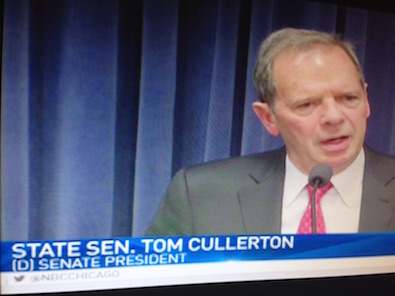
Illinois Senate President John J. Cullerton has asked Assistant Majority Leader Kimberly A. Lightford and State Senator Andy Manar, the sponsor of Senate Bill 1, to join renewed talks regarding school funding reform.
“This is the kind of meeting we’ve been trying to arrange for weeks. Hopefully we can now learn what the governor has in mind with his threatened veto and see if there is a path forward, together,” Cullerton said.
Lightford is a Maywood Democrat.
Manar is a Bunker Hill Democrat.
The Senate President has been trying to meet with the governor about his threatened veto prior to sending him a historic school funding overhaul on Monday, July 31. In addition to explaining the legislation, the Senate President wants to make sure the governor understands what his threatened veto would mean.
Rauner has said he would file an amendatory veto to rewrite Senate Bill 1.
An amendatory veto is a veto. It rejects the proposal but offers specific legislative changes that are supposed to be consistent with the initial theme and scope of the proposal. The constitution and court cases limit the governor’s ability to make changes.
Once that veto is filed with the Senate, the Senate has 15 calendar days to act or else the entire proposal is declared dead. The Senate’s options are to vote to accept the changes or try to override and enact the plan as originally written.
Overriding the governor’s veto requires support from 3/5ths of the members in each chamber. That’s 36 votes in the Senate and 71 votes in the House.
But so too does accepting any changes. That’s because those changes amount to new laws with immediate effective dates since it would be passed after May 31. The Illinois Constitution sets a May 31 deadline for action and anything after requires more votes to become law.
Again, if efforts to override the governor or accept his alternations fail, the entire school funding overhaul fails and lawmakers would need to start over with new legislation.
Day two of the Special Session in Springfield has Gov. Bruce Rauner Rauner meeting with his Republican caucus Thursday urging them to stick together in opposing the school funding bill.
Senate Bill One is not yet on Rauner’s desk, but, with schools opening in the next few weeks, many districts are anxiously awaiting the state’s financial aid.
So what happened at Thursday’s closed door caucus meeting?
Sources tell NBC 5 Rauner said a “revolution” is coming.
He also told Republicans SB1 is evil and a Chicago bailout.
I’ve talked with a half dozen or so Republicans I trust this morning who were at the meeting (none of whom are Rauner rah-rah types) and not one of them can remember hearing the word “evil.” One said he might have used it to describe what Madigan and Cullerton were doing by holding on to the bill, but he couldn’t be sure. That doesn’t mean the report is wrong, just that I can’t confirm it.
The governor regularly calls SB 1 a Chicago bailout, so that’s assured. And “revolution” is a term often used by Republican tea party types, so I can definitely believe he said it, particularly in relation to Speaker Madigan.
…Adding… From a Senate GOP source…
He said “evil” in describing them holding the bill and putting schools at risk of not opening, not the bill itself.
*** UPDATE *** Chris Kennedy…
The only revolution that needs to happen is for the people of Illinois to rise up in the next election and remove Bruce Rauner from office. His irresponsible, neglectful, self-serving leadership is holding back our state. That he would use children as political pawns and threaten not to open public schools in a few weeks is a new low in the history of Illinois. We need fundamental change to fix our public schools and provide all children with a quality education that prepares them for college, career and life. It is far past time that our state elects leaders in Springfield who will commit themselves to serving families throughout the state.
“Speaker Madigan and President Cullerton continue to delay putting the education funding legislation on my desk. Until then, I am unable to change the legislation so that it’s fair and equitable for all schoolchildren in Illinois and the taxpayers who foot the bill.
“Our schools cannot wait.
“If the Democrat majority won’t send me the bill, I’m hopeful they’re willing to negotiate with their colleagues to achieve the same result by July 31.
“I have asked key Republican lawmakers to reach out to their Democrat colleagues to negotiate in good faith so an alternative can be presented by July 31.
“If a reasonable compromise that is in the best interest of our children isn’t reached, I will move forward with my amendatory veto on Monday as planned.”
— IL Working Together (@IllinoisWorking) July 28, 2017
*** UPDATE *** Pritzker campaign…
Two days ago, Bruce Rauner was asked if he was willing to meet and negotiate Senate Bill 1, and his response was just as baffling as you’d expect: “Don’t you see how outrageous that is?” He then one upped that comment by telling Republican legislators yesterday that a “revolution” is coming.
However, the failed governor changed gears and today is suddenly calling on “key” legislators to negotiate the school funding bill for him. It appears that neither Rauner nor his new extremist staff will take part in those negotiations. All the while, schools across the state face the possibility of not opening this fall.
“While Bruce Rauner fantasizes about his ‘revolution,’ Illinois parents and children want to know that their schools will open in a few weeks,” said Pritzker campaign spokeswoman Jordan Abudayyeh. “Instead of signing SB 1, all we’re getting from Rauner is a staunch refusal to negotiate and a renewed promise to veto school funding. Don’t you see how outrageous that is?”
* Sen. Jason Barickman, the lead school funding reform negotiator for the Senate Republicans, told reporters this afternoon that he spoke to the governor about negotiating with the Democrats on SB 1…
I asked the governor, ‘When the bill is transmitted to you, will you hold the bill so that we can have a negotiation?’
He said, ‘Yes.’ He said ‘That’s a very reasonable thing to do. But I need the bill first.’ […]
I will tell you I am concerned that those negotiations will play out like prior ones, where the Democrats walked away from the table, introduced legislation that had no public scrutiny and advanced it through the legislative process that they control.
After a follow-up question, Barickman confirmed what he said. “There will first be negotiations, yes.” He also said there are no “hard lines in the sand.”
The best way to help schoolchildren is for Gov. Rauner to agree to sign a landmark overhaul of how Illinois funds public education, Illinois Senate President John Cullerton said Thursday.
Cullerton renewed his request for Rauner to indicate his support for Senate Bill 1 and cautioned him against using his veto powers to rewrite the plan, which would jeopardize its future. Cullerton noted that an amendatory veto does not automatically become law and instead sets up a showdown with lawmakers on an override vote.
Here is the full statement from Senate President John Cullerton:
“All the governor needs to do is tell us he will sign his name. The fastest way to help the children is to sign this historic education reform into law.
An unconstitutional amendatory veto threatens all the work that has gone into this reform proposal. I again urge the governor to show us any changes he wants and to sit down for rational discussions now.
We’ve done our homework. We passed an overhaul of the worst public school funding system in the nation. All the governor has to do is sign his name to get credit.”
*** UPDATE 2 *** Well that didn’t take long. And look how he’s blaming the coverage of his exact words…
Sen. Jason Barickman issued the following statement to clarify comments that were made at a press conference earlier this afternoon: pic.twitter.com/eEFDPH38Oo
PURVIS: In addition, the comptroller has not yet released the Q3 and Q4 what are called mandatory categorical payments. The schools are owed about $850 million from FY17. And so we also call on the comptroller to release at least those Q3 dollars so that schools have the cash on hand that they need to open their doors.
COCHRANE: Why did she not release that?
PURVIS: That is a question for the comptroller. We believe that, and I think there have been conversations with her from many people saying she can at least release those Q3 dollars. Again, Q3 and Q4 the districts across the state for their mandated categorical payments, which is serving students with disabilities, serving English language learners, transportation, transportation for special education students. So when you add what is now a 56 or 57-day delay [in sending SB 1 to the governor’s desk] and the fact that the comptroller will not release those Q3 and Q4 payments, it is creating a crisis in all 850, well, not all, in those districts that serve a high percentage of low income kids, including the Chicago Public Schools, and those districts, who, because of proration of General State Aid or the fact that the General Assembly did not fully fund the schools from 2009 to 2015, a lot of them have burned through their cash reserves, so this cash flow issue is a really big one.
COCHRANE: Nobody runs a business like this. How can you run, you know, politicians standing up and going ‘Oh, it’s the kids, it’s all about the kids.’ Kiss my butt. It’s all about the kids, you care about yourself. And let me tell you something, when it comes to the comptroller, gimme an e-mail address Andrea for the comptroller so that we can let every listener know that they should be e-mailing the comptroller today and demanding an answer for why those Q3-Q4 payments haven’t been released, and when will they be…
* From the comptroller’s office…
If creating havoc for the State of Illinois was a form of art, Governor Bruce Rauner would be Michelangelo. Just three weeks removed from a narrowly-avoided statewide financial meltdown, he’s back at work on his latest masterpiece, plunging the state into a school funding crisis, and blaming everyone but himself.
Governor Rauner more than tripled the state’s bill backlog from $5 billion to $15.4 billion since taking office. Despite Governor Rauner’s manufactured budget crisis, our office prioritized putting together $429 million last month to make a delayed categorical payment to schools around the state. As of today, the state’s checkbook balance is only $254 million. The Governor has not left enough money in the state’s accounts for another categorical payment to happen again soon. Falsely blaming our office for not making payments from a bank account he emptied is like a check-bouncer blaming the bank for bouncing his check.
Thanks to the General Assembly overriding his veto and passing a budget, our office has been able to use dedicated funds — funds that can’t be used for K-12 education — to provide much-needed relief to higher education and Medicaid. General State Aid (GSA) to K-12 schools cannot be paid through interfund borrowing or through the General Revenue Fund (GRF) without a school funding bill being passed to authorize those expenditures.
This misinformation campaign coordinated by the Rauner Administration is the height of hypocrisy. Unfortunately, we have seen this playbook before. The governor needs to stop the political spin, do his job, and stop holding schools hostage. School funding legislation must be sent to the governor and he needs to sign it so I have the legal authority to release critical funds for schools.
In other words, you can’t pay big bills with a nearly empty checking account.
In an interview with the Sun-Times on Monday, Education Secretary Beth Purvis noted vouchers were submitted to the comptroller’s office on time by the Illinois State Board of Education and implored Mendoza to “prioritize” the payment the same way she prioritized post-secondary education payments.
Purvis said that payment would alleviate some pressure — without a school funding bill in place. The governor and Democratic leaders continue to bicker about that measure, with Rauner vowing to issue an amendatory veto to take out Chicago pension costs.
The comptroller’s office released about $429 million for “categoricals” a month ago. But another quarterly payment is delayed because there’s no revenue in the books yet to pay for it.
Mendoza on Thursday pinned the blame for the delayed payment — and the budget impasse — squarely on Rauner’s back.
* I seriously doubt that this particular POTUS would’ve favored a state he lost by 17 points over a state he unexpectedly won and which helped make him President, but whatever…
Early this month, when they hit taxpayers with a 32 percent jump in the individual income tax rate, many legislators broke a promise they had made: No more tax hikes without major reforms to help Illinois’ moribund economy. Don’t worry, said Democrats who pushed the tax hike. We’ll get to those reforms soon enough.
But not soon enough, we now see, to keep electronics giant Foxconn from bypassing Illinois to make a jobs-rich investment in southeast Wisconsin. This is a huge win for Scott Walker, the Republican governor of Wisconsin whom Illinois Democrats loathe. Just as this is an embarrassment for Illinois House Speaker Michael Madigan and Senate President John Cullerton.
Once again, the people of Illinois see how Madigan and Cullerton, with their combined 86 years in Springfield, have left Illinois ill-prepared to compete for 21st-century jobs. Their agenda is about raising taxes, not about delivering those reforms. As we wrote a few days ago, every other state on Foxconn’s short list looked better than Illinois by the basic measures of financial stability and pro-growth economies. […]
But we do know this: Wisconsin boasts a freshly burnished global image. One of the planet’s largest tech firms, with a million workers worldwide, says its search led it to bet a fraction of its future on Wisconsin. Assuming that happens, expect robust economic growth from suppliers, subcontractors, construction companies and other businesses that will serve Foxconn and its workforce.
Illinois is a train wreck. The government is paralyzed with infighting and barely keeping its fiscal head above water, it can’t figure out how to fund its schools, the state has a lousy economic climate overall and is losing population. What’s not to love?
But it will still benefit from this because workers in the northern part of the state could find employment, and some or even many of those suppliers and contractors could wind up being from Illinois (unless they move operations north, of course).
* Not to mention that, at a time when the state is still struggling mightily to recover from the just-ended impasse and can’t even revive its most important corporate incentive (click here for that story), shelling out as much as $3 billion in subsidies probably would be frowned upon here…
Let’s take a look at those figures: Wisconsin is paying as much as $1 million per job, which will carry an average salary of $54,000. The state’s economic development corporation is selling the project to taxpayers with a claim that it will create 10,000 construction jobs for building the facility and another 6,000 indirect positions. It’s expecting $3.3 million of investment per employee from the Taiwanese company.
Politicians, lobbyists and Foxconn can make the figures work by being generous with the facts. For example, if every one of those jobs came to fruition, they can claim 29,000 positions for $3 billion, or $103,000 per job. But that’s not going to happen.
Foxconn has factories in China and another dozen countries globally, yet that stated $10 billion investment is more than the group’s publicly traded flagship — Hon Hai Precision Industry Co. — has devoted to capital expenditure over the past five years combined.
There is potential for the payroll to climb to 13,000 in the future — a figure crucial to Wisconsin justifying the expense — but I wouldn’t bet your 401(k) on it. That’s because if Gou really does dish out $10 billion on this facility, the only way to make it viable is by keeping staffing low and leaning on automation to boost productivity. This LCD factory will be either labor intensive or highly automated. It can’t be both.
The agreement represents an opportunity as well as a risk for Wisconsin — state lawmakers must now consider a subsidy package nearly 50 times bigger than the state’s previous record.
The factory project would involve a virtual village, with housing, stores and service businesses spread over at least 1,000 acres, according to interviews. That acreage, a 1.5 square-mile area the size of Shorewood, could be assembled from parcels that initially aren’t contiguous, the source said.
At 20 million square feet, the factory would be three times the size of the Pentagon, making it one of the largest manufacturing campuses in the nation. It would initially employ 3,000 workers making an average of $53,900 a year plus benefits and could eventually boast more than four times that.
Intersect Illinois already has been talking with county officials about how to plug local folks into Foxconn Technology Group’s talent search, and has had preliminary talks with the company that likely will be followed by a fuller discussion later this year, he said.
“We want to talk to them about what they need,” he says. “What can we do to customize (through worker training and other programs)?”
The state also may facilitate a connection between Foxconn and Northwestern University, Peterson said. Foxconn likes to work with academic institutions, and engineering-heavy NU “has a lot of things that could be beneficial.” […]
The potential is at least equally large for suppliers, Peterson said.
Though some will be located on a campus with Foxconn’s main factory—and still, a site hasn’t been chosen—”A lot of times, they want their suppliers close but not in their backyard. They don’t want to cannibalize their own workforce.”
Crisis Creatin’ Rauner released a new video today highlighting Bruce Rauner’s so-called “best team in America,” a group of radicals and amateurs, many of whom were hired directly from the Illinois Policy Institute.
After Rauner was asked about his controversial new hires by a Quad City TV station, Rauner said, “we’re building the best team in America.” So far that team has included a staffer fired on his first day for “racially-charged, homophobic and sexually explicit tweets,” and a still employed staffer who “compared abortion to Nazi eugenics.” In total, over 20 Rauner staffers have been fired or resigned in protest and have been replaced by people with little to no government experience and extremist views.
“The only thing Rauner’s new team is ‘best’ at is unleashing crisis on this state,” said Pritzker campaign spokeswoman Jordan Abudayyeh. ‘‘His new hires will only aid Rauner in furthering the damage he’s done to the state, and their radical views are deeply out of step with the people of Illinois. Surely, even Bruce Rauner and the Illinois GOP can do better than this.”
*** UPDATE *** That video reminded me of something that a buddy pointed out to me earlier this week and I forgot to post. This is from Gov. Rauner’s recent WSIL TV interview about the hiring and firing of his one-day body man, who, you’ll recall, tweeted out some pretty disgusting things…
REPORTER: But weren’t you involved in interviewing him?
* And if you click here and let the video run for a few seconds, you’ll see the governor appearing at an event with his body man on the day he was fired. Here’s a screen grab…
I suppose that traveling with the guy for a couple/three hours back and forth to an event in Mt. Zion could be characterized as meeting him “once.” Or maybe he was just hoping nobody would notice.
By itself, on a scale of 1-10 this might rise to a 1.3. Not a big deal at all (which is why this is an update and not its own post). But politicians who establish a pattern of telling little fibs to reporters can often find themselves in hot water down the line.
[ *** End Of Update *** ]
* And this is from the ILGOP…
It’s been over 57 days since Mike Madigan and his machine have taken school funding and the futures of Illinois children hostage for their $500 million Chicago bailout.
Today, the Illinois Republican Party has updated BossMadigan.com with a stopwatch to remind voters just how long the Madigan Machine has taken our children hostage.
On May 31st, SB1 passed the General Assembly. Per the Illinois Constitution, the bill is supposed to head to Governor Rauner’s desk.
But Mike Madigan and John Cullerton are intentionally holding the bill, perverting the legislative process.
It’s a blatant assault on our democracy in order to create pressure for their Chicago bailout.
* The governor was asked this question during a press conference yesterday…
Governor, the Senate President says he’s holding [SB 1] until Monday in the hopes that you’ll come around and agree to meet with him and to negotiate. Are you unwilling to have that meeting?
* The governor’s clearly angry response, after a long pause, is the headline to this post…
Now, the governor does go on to explain there is a constitutional process here. The legislature passed a bill in May, but haven’t sent it to him yet. The next step in the process is he takes action and then the General Assembly takes further action on his amendatory veto. He’s right about all of that.
But to claim that a meeting with a legislative leader is an “outrageous” demand is a bit much.
* Both chambers convene at noon. No committee hearings are currently scheduled. And since the Senate President said yesterday that he isn’t sending SB 1 to the governor’s desk until Monday, attendance may be even lighter today. Follow along with ScribbleLive…