* Oy…
Though its historic 2019 capital infrastructure plan was estimated to boost Illinois’ state transportation revenues by almost $2 billion dollars annually, state transportation and transit agency revenue generated $1 billion less than expected over the past year due to pandemic-related declines in fuel consumption, sales taxes, and transit ridership, according to a new study by the non-partisan Illinois Economic Policy Institute (ILEPI). […]
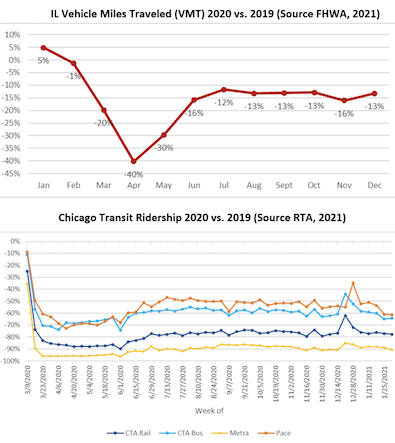
The state’s major transportation revenue streams—motor fuel taxes and transit system fees—saw their steepest declines in the two months immediately following the state’s March 21st stay-at-home order. During this period, statewide vehicle miles traveled (VMT) were as much as 40% less in 2020 compared to 2019. The state’s overall VMT finished the first year of the pandemic down 15% compared with pre-pandemic levels, and ridership for various Chicago area transit systems fell an average of between 50% and 90%. As of yet, neither has recovered back to pre-pandemic levels.
“Because the historic Rebuild Illinois plan doubled the motor fuel tax, the good news is that despite the drop in VMT, Illinois is still generating $800 million more in gas tax revenue than it was prior to the passage of the capital plan,” [ILEPI Transportation Analyst Mary Tyler] added. “The bad news is that because of the decrease in VMT, gas tax revenue still ended up being $308 million less than was projected pre-pandemic.” […]
“According to publicly available data, local sales taxes generated $96 million less for the RTA between March and November 2020 compared with the year prior,” Tyler added. “And combined farebox revenue from the CTA, Pace, and Metra generated $645 million less in 2020 compared to 2019.” […]
“According to the U.S. Census Bureau, 35% of Illinois workers who commuted prior to the pandemic are now working from home,” Tyler said.
The study is here.
* Graphs…
* Meanwhile, from WTTW…
According to BOMA, between 88% and 92% of workers who would normally be in their office are still not back. The rate of office subleases is at an all-time high. And the Chicago Tribune reports the overall Loop office building vacancy rate is 15% and could go higher. […]
“The experience of the office and your experience downtown is going to need to shift and change,” said Sheryle Shultze, who leads repositioning and landlord services for the design firm Gensler.
A survey the company published revealed that 70% of respondents plan to go back to the office, all or most of the week, while 30% said they wanted flexible work schedules.
* CBS 2…
a survey of chief executive officers from KPMG, which said last August, 69 percent said they would downsize their company’s physical space. When asked this spring, it was down to just 17 percent.
23 Comments  
|
* Veto message…
March 25, 2021
To the Honorable Members of The Illinois House of Representatives, 102nd General Assembly:
Today I veto House Bill 3360 from the 101st General Assembly, which provides for the recovery of prejudgment interest on all damages set forth in a judgment in any action brought to recover damages for personal injuries or wrongful death, whether by negligence, willful and wanton misconduct, intentional conduct, or strict liability of the other person or entity. HB 3360 would be effective immediately.
While I support joining the majority of states that allow prejudgment interest in personal injury cases in order to encourage their prompt resolution, the provisions of HB 3360 would be burdensome for hospitals and medical professionals beyond the national norm, potentially driving up healthcare costs for patients and deterring physicians from practicing in Illinois. The majority of Illinois hospitals are self-insured, and, as a result, would be required to pay the costs of this legislation directly, at a time when they can least afford this added expense.
HB 3360 imposes a rate of 9% per annum prejudgment interest, which would begin to accrue on the date the defendant has notice of the injury. Even states with prejudgment interest, such as Michigan or Wisconsin, provide a more reasonable rate structure by tying the interest rate to market conditions such as the federal prime rate, as opposed to a flat rate. The proposed 9% flat rate is higher than many of these market-based rates adopted by other states, even when accounting for additional percentages that many states add to the market- based rates as part of the calculation of prejudgment interest. Because many businesses have been severely and negatively affected by today’s economic climate, 9% interest is high and tying to market conditions would be less onerous. A 9% rate could similarly be damaging to entities like hospitals.
Further, HB 3360 would allow for prejudgment interest to be calculated on non-economic damages such as pain and suffering and loss of normal life. Again, when we compare this legislation to states that have prejudgment interest, many of them exclude non-economic damages from the calculation. For example, the prejudgment interest statutes in Massachusetts and Minnesota limit the application of prejudgment interest in personal injury cases to pecuniary damages. Minnesota law explicitly excludes future, punitive or noncompensatory damages.
While I appreciate the hard work of the House and Senate sponsors of the bill and their commitment to advocate for injured Illinoisans, HB 3360 simply didn’t receive sufficient input from some of the most impacted parties, including health care providers. At a time when the health care industry and the medical professionals who have dedicated their lives over the past year to combating a deadly virus are in need of support, I cannot in good conscience sign a bill that would place these individuals and entities in further financial distress.
I have urged the sponsors to return to negotiate a compromise that includes stronger protections for health care providers while encouraging the faster resolution of these cases that can leave families devastated for years. It is in the best interest of all Illinoisans for this issue to be fully negotiated with an opportunity to for input from all stakeholders, advocates, and other interested parties.
I understand that this compromise legislation is now advancing through the General Assembly with these suggested changes and additional feedback from stakeholders.
Therefore, pursuant to Section 9(b) of Article IV of the Illinois Constitution of 1970, I hereby return House Bill 3360, entitled “AN ACT concerning civil law,” with the foregoing objections, vetoed in its entirety.
The Senate approved the compromise bill which had already passed the House minutes after the veto was issued.
…Adding… Illinois State Medical Society President Robert W. Panton, MD…
The physicians of Illinois are deeply disappointed that, now, a second plaintiff lawyer-backed bill has cleared the Illinois General Assembly. When it became apparent that Governor Pritzker would veto a previously-passed prejudgment interest measure (HB 3360), the Illinois Trial Lawyers Association moved around a few words and numbers to come up with a slightly modified bill (SB 72) that delivers virtually the same harm as the initial legislation. ISMS vehemently opposes SB 72 and calls on Governor Pritzker to veto it.
If enacted, this new law would allow for imposition of six percent prejudgment interest annually in medical liability cases. This is a wholly new form of “punitive” damages not previously allowed in Illinois. Prejudgment interest will drive up the cost of medical liability insurance, force doctors away from our state and increase the cost of health care. Bottom line, patients will suffer.
ISMS advocates for policies that improve Illinois’ healthcare system and expand access to medical care for patients. SB 72 runs counter to both of these goals.
* IMA…
“We urge Gov. JB Pritzker to veto this legislation, which will dramatically increase litigation costs on manufacturers, hospitals, and doctors that have been on the front lines during the pandemic. Manufacturers across Illinois that have created life-saving vaccines, produced personal protective equipment for first responders and health care professionals and kept grocery stores stocked with safe and nutritious food will be hit with tens of millions of dollars in additional costs,” said Mark Denzler, president & CEO of the Illinois Manufacturers’ Association. “Illinois’ manufacturers need support from policy makers to create jobs and spur investment in communities around the state, not higher costs that will only stand in the way of our economic recovery.”
* Leader McConchie…
“During the global pandemic, Illinois health care workers answered the call to serve their country - and all of us - in a time of crisis,” said Illinois Senate Republican Leader Dan McConchie (R-Hawthorn Woods). “Right now, other states are working to protect businesses and health care workers from frivolous COVID-19 lawsuits. Here in Illinois, instead of thanking these life-saving heroes, we are instead exposing them to more liability.
“Today, the Illinois Senate Democrats voted to increase these liabilities and payouts for all personal injury lawsuits.
“Additionally, this legislation will increase costs for Illinois small business owners who are simply attempting to get people back to work in our communities. The cost increases caused by President Harmon’s bill will be passed along to consumers or force reductions in health care, retail products, services and, most importantly, Illinois jobs.
“People who are harmed by the negligence or wrongdoing of other parties deserve to be compensated, and they ought not be limited or obstructed in their search for justice. But SB 72, addresses these noble aims with punishments and regulations that will put small businesses and health care workers at risk, unfairly punish any party wishing to dispute claims against it, and drive up health care, product and insurance costs for almost everyone in Illinois.
“Our job as legislators is to come together to make Illinois a safer, fairer and more prosperous place to work and live. This legislation does none of the above. It just hurts the Illinoisans who need us the most right now.
“I strongly urge Gov. Pritzker to veto SB 72 so the legislature may bring the business, insurance and health care communities to the table to discuss a more reasonable strategy that will protect both jobs and justice in Illinois.”
8 Comments
|
* November 26…
Supporters of President Donald Trump sparred with counter-protesters during a downtown rally Thursday as they pushed the false claim that wide-scale fraud had swung the election for his Democratic rival, Joe Biden.
“Four more years!” a group of roughly 60 defiant Trump backers, mostly maskless, shouted as they congregated in Millennium Park after marching from Trump’s riverfront skyscraper. The crew included Edgar “Remy Del Toro” Gonzalez, president of the Chicago chapter of the far-right Proud Boys, as well as other marchers touting the pro-police “Back the Blue” movement.
* Today in the Sun-Times…
The former leader of the Chicago chapter of the Proud Boys says he plans to run for the Illinois Senate after being present for the violent riot at the U.S. Capitol that’s prompted federal criminal charges against roughly 20 other members of the far-right group.
Edgar “Remy Del Toro” Gonzalez told the Sun-Times that he’s collecting signatures to challenge state Sen. Antonio Munoz, D-Chicago, in next year’s election. Munoz’s 1st District covers portions of the city’s South and West sides.
“I will be the voice and the muscle for many in our state,” said Gonzalez, who plans to run as an independent, in a series of Twitter messages.
Though Gonzalez no longer serves as president of the Proud Boys’ Chicago faction, he is still a member of the all-male neo-fascist group’s overarching Northern Illinois chapter. In recent months, he has been photographed alongside some of the group’s most prominent leaders.
Kinda doubting that he’s circulating petitions this early, since I don’t even think he can legally do it yet. Also, he’s gonna need a ton of those signatures and he’ll be showing up at doors or at supermarkets looking like this…


Lovely.
*** UPDATE *** According to the Illinois State Board of Elections, independent candidates can’t start circulating petitions until March 29, 2022, more than a year from now.
46 Comments
|
* WaPo…
New jobless claims fell to the lowest levels of the pandemic era, federal data shows, with a better-than-expected 684,000 being filed last week.
Economists surveyed by Dow Jones had expected to see a number near 735,000 after filings spiked to 781,000 the week before. The latest tally is less than the pre-pandemic weekly high of 695,000, set in October 1982.
* CBS 2…
The Illinois Department of Employment Security (IDES) reported 15,595 new unemployment claims were filed during the week of March 15 in Illinois, a significant decrease from the previous week.
For comparison, during the same timeframe last year, 126,716 people filed claims in Illinois. That’s an 87.7% decrease. […]
There were 71,175 new unemployment claims filed in Illinois during the week of March 8.
That seems… very odd. But click here. According to the feds, we’re half the national total of reductions.
...Adding… Add in Ohio, and our two states account for more than the total national net reduction in new weekly claims.
*** UPDATE *** I asked for a response from IDES and here it is…
In the last two months, Illinois has added 44,300 jobs, and the last week of claims data is confirming that improved job market indicator. Additionally, continued claims for the last two weeks have fallen below the comparable weeks of the 2007 recession, which is further confirmation that the data is moving in the right direction.
* Also CBS 2…
“I’ve never applied for unemployment,” Nugent said.
So an email he received Tuesday morning was such a surprise. It claimed to be from IDES, directing him to a link to claim his $1,400 unemployment payment.
“I’ve got a pretty good spam filter, but somehow, this made it through,” Nugent said.
It was even from a dot-gov email account – but not one from Illinois. The dot-gov was Seattle.gov. […]
The City of Seattle said nearly two dozen of their employees fell for an email phishing scam Monday night and the city has now disabled those accounts.
* IDES…
The Illinois Department of Employment Security (IDES) announced today that the unemployment rate decreased -0.3 percentage point to 7.4 percent, while nonfarm payrolls were up +21,100 jobs in February, based on preliminary data provided by the U.S. Bureau of Labor Statistics (BLS) and released by IDES. The January monthly change in payrolls was revised from the preliminary report, rising from +9,700 to +23,200 jobs. The January unemployment rate was unchanged from the preliminary report, remaining at 7.7 percent.
The February payroll jobs estimate and unemployment rate reflects activity for the week including the 12th. The BLS has published FAQs for the February payroll jobs and the unemployment rate.
In February, the three industry sectors with the largest over-the-month gains in employment were: Leisure and Hospitality (+32,300), Trade, Transportation and Utilities (+2,400) and Information (+700). The industry sectors that reported the largest monthly payroll declines were: Construction (-5,600), Professional and Business Services (-4,500) and Government (-2,200).
“IDES and the Pritzker administration remain committed to supporting claimants and families with the services they need as the state moves toward a full reopening and the economy begins to recover from the COVID-19 pandemic,” said Deputy Governor Dan Hynes. “IDES continues to serve an unprecedented number of claimants while working on process improvements that make navigating unemployment and job-seeking services as easy as possible.”
“Under Governor Pritzker’s leadership, Illinois has prioritized a safe and measured reopening of our state – with data driven metrics updated on an ongoing basis to continue bringing people back into the workforce,” said Sylvia Garcia, Acting Director of the Department of Commerce and Economic Opportunity (DCEO). “The latest unemployment data demonstrates Illinois is poised to continue making progress in returning key industries, supporting workers, and restoring our economy.”
The state’s unemployment rate was +1.2 percentage points higher than the national unemployment rate reported for February, which was 6.2 percent, down -0.1 percentage point from the previous month. The Illinois unemployment rate was up +3.8 percentage points from a year ago when it was 3.6 percent.
Compared to a year ago, nonfarm payroll employment decreased by -461,200 jobs, with losses across all major industries. The industry groups with the largest jobs decreases were: Leisure and Hospitality (-185,700), Educational and Health Services (-62,900) and Government (-54,100). Illinois nonfarm payrolls were down -7.5 percent over-the-year as compared to the nation’s -6.2 percent over-the-year decline in February.
The number of unemployed workers fell from the prior month, a -4.0 percent decrease to 454,200, and was up +100.6 percent over the same month for the prior year. The labor force was down -0.1 percent over-the-month and down -3.4 percent over-the-year. The unemployment rate identifies those individuals who are out of work and seeking employment. An individual who exhausts or is ineligible for benefits is still reflected in the unemployment rate if they actively seek work.
5 Comments
|
The Illinois Department of Public Health (IDPH) today reported 2,190 new confirmed and probable cases of coronavirus disease (COVID-19) in Illinois, including 35 additional deaths.
- Cook County: 2 females 60s, 2 females 80s, 3 females 90s, 2 males 90s, 1 female 100+
- Douglas County: 1 male 80s
- DuPage County: 1 male 60s, 1 female 70s, 1 male 90s
- Henry County: 1 male 60s
- Kane County: 1 female 70s
- Knox County: 1 male 80s, 1 male 90s
- Lake County: 1 male 60s
- Macon County: 1 male 60s
- Madison County: 1 female 80s, 1 male 80s
- Marion County: 1 male 80s
- Massac County: 1 male 70s
- McHenry County: 1 female 60s
- Menard County: 1 female 70s
- Randolph County: 1 female 70s
- Saline County: 1 male 70s
- Sangamon County: 1 female 90s
- St. Clair County: 1 male 70s
- Tazewell County: 1 male 70s
- Whiteside County: 1 male 60s
- Will County: 1 male 80s
- Williamson County: 1 female 80s
- Winnebago County: 1 female 90s
Currently, IDPH is reporting a total of 1,229,898 cases, including 21,171 deaths, in 102 counties in Illinois. The age of cases ranges from younger than one to older than 100 years. Within the past 24 hours, laboratories have reported 90,101 specimens for a total of 19,895,617. As of last night, 1,251 individuals in Illinois were reported to be in the hospital with COVID-19. Of those, 267 patients were in the ICU and 119 patients with COVID-19 were on ventilators.
The preliminary seven-day statewide positivity for cases as a percent of total test from March 18-24, 2021 is 2.7%. The preliminary seven-day statewide test positivity from March 18-24, 2021 is 3.2%.
A total of doses of 6,091,965 vaccine have been delivered to providers in Illinois, including Chicago. In addition, approximately 414,900 doses total have been allocated to the federal government’s Pharmacy Partnership Program for long-term care facilities. This brings the total Illinois doses to 6,506,865. A total of 5,154,908 vaccines have been administered in Illinois as of last midnight, including 364,144 for long-term care facilities. The seven-day rolling average of vaccines administered daily is 101,175 doses. Yesterday, 118,544 doses were reported administered in Illinois.
*All data are provisional and will change. In order to rapidly report COVID-19 information to the public, data are being reported in real-time. Information is constantly being entered into an electronic system and the number of cases and deaths can change as additional information is gathered. For health questions about COVID-19, call the hotline at 1-800-889-3931 or email dph.sick@illinois.gov.
4 Comments
|
Unclear on the concept
Thursday, Mar 25, 2021 - Posted by Rich Miller
* Daily Herald editorial…
The Illinois Constitution allows the Democrat-controlled General Assembly to keep control only if it approves legislative maps by June 30. The job then goes to an eight-member bipartisan commission, but that commission has to get it done by Aug. 10. At that point, a ninth member’s name is pulled out of a hat, making him or her the tiebreaker and kingmaker.
That’s nuts. […]
Rather than spending time devising ways to keep control, Illinois Democrats should open up how remapping is handled. Naming a bipartisan commission to govern the process would tamp down the impact of the missed state deadlines through a good-faith effort to reach a consensus, no matter when the census numbers come in.
This might be unrealistically optimistic.
Yeah, I’m kinda thinking that ignoring the constitution with a “good faith” effort at an alternative bipartisan commission might just possibly be a wee bit on the unrealistically optimistic side.
11 Comments
|
* Comptroller Susana Mendoza was recently asked on Chicago Tonight about her brother, Chicago Police Det. Sgt. Joaquin Mendoza…
Back in November, I called him on his birthday to wish him a happy birthday and he had a cough. Two days later - he’s only 56 - he was at Northwestern Memorial Hospital fighting for his life for 41 days. And then about a month later - a month he spent in an inpatient rehab - he’s had tremendous complications. He’s suffered mini strokes in his brain while he was in the hospital. Total, complete kidney failure, so he’ll be on dialysis for the rest of his life.
And I share it because I think it’s important for people to know that when we hear about a 99% survival rate, you know, think about my brother’s situation. Sure he survived, and it’s a blessing for us, but it breaks my heart to see the complications for somebody who’s dedicated his life to public service and to protecting the public as he’s going through this. And it’s no joke. This is very real, and we’re thankful that he’s still with us, but many people are going through something similar. Many people have lost their loved ones. And I seriously, both as a sister and as a comptroller, you know, when we have to order things like body bags, it really hits close to home. And I just ask people, please get vaccinated the first chance you get. Please, do everything to protect yourself and protect your loved ones and let’s get through this together.
* Phil Ponce then mentioned that Mendoza’s brother has moved in with her…
I would just say it’s pretty devastating. And I’m so thankful that I can take care of my brother right now when he needs me. There’s so many families who probably feel completely overwhelmed. And I was one of them. I mean, honestly, I never thought I’d tell you that the easiest part of my life right now is managing billions in state debt, but it truly is. I feel so confident and sure of what I’m doing as the comptroller, but it’s certainly a lot heavier of a lift to try to keep my brother healthy. That’s where we’re at. Thank you for asking. I mean, it is something that I can relate to and I know that we’re not alone. Lots of families in Illinois and across the country are going through similar or even worse scenarios with having lost loved ones. But, it’s real and I just ask you to take care of yourselves, please.
18 Comments
|
[The following is a paid advertisement.]
Employers in Illinois provide prescription drug coverage for nearly 6.7 million Illinoisans. In order to help keep care more affordable, employers work with pharmacy benefit managers (PBMs), who deploy a variety of tools to reduce prescription drug costs and help improve health outcomes. In addition to helping employers, PBMs also work with the Illinois Medicaid program in the same way to help control costs. Over the last five years, PBMs have saved the state and taxpayers nearly $340 million.
Today, Illinois faces a multibillion budget shortfall as more Illinoisans are relying on Medicaid to help meet their health care coverage needs. As legislators work to address these challenges, one way to help ensure continued cost savings is by strengthening the PBM tools that the State and employers use, which are poised to save employers, consumers and the State $39 billion over the next 10 years. These are meaningful savings that will help continue to contain costs, ensure consumer access to medicines and drive savings in public health programs.
Amid a pandemic and economic challenges, now is the time to strengthen, not limit, the tools that employers, consumers and the State rely on to manage costs and ensure consumers can access the medicines they need.
Learn more
Comments Off
|
Lots of sizzle, very little actual meat
Thursday, Mar 25, 2021 - Posted by Rich Miller
* A Center Square headline appears ready-made for maximum social media exposure…
Pritzker in favor of passport to show COVID-19 vaccination status
* From the story…
As for a vaccination passport to prove a person has been inoculated against the coronavirus, Pritzker says a vaccination app would be useful, but should not be required to enter an event or facility.
“As long as it is your choice,” Pritzker said. “If people ask you to show that for a particular venue or private venue, they have the ability and right to do that. You don’t have to show that to them. You don’t have to be to go to that venue or be engaged in that activity.” […]
The U.S. is not distributing vaccination passports and there are concerns over falsified records and also potentially violating federal health care privacy laws.
U.S. Airlines and others in the travel industry are voicing support for vaccine passports to boost pandemic-depressed travel, and officials in Europe have been talking about the idea in time for the peak summer vacation season.
52 Comments
|
It’s just a bill
Thursday, Mar 25, 2021 - Posted by Rich Miller
* The House is sending a huge number of bills to the floor this spring and this is one of them…
A proposal that cleared a legislative committee in Springfield this week aims to fully legalize the delivery and possession of any amount of marijuana — a move that would also allow for the automatic expungement of more serious pot offenses and set free those who are currently incarcerated for those crimes.
State Rep. Mary Flowers, D-Chicago, said she introduced the bill to further address the toll of the drug war and its disproportionate impact on people of color.
Pot firms are currently cashing in on the newly legalized drug and selling millions of dollars in weed each month. But Flowers noted that some Illinoisans are still languishing in prison for cannabis-related crimes, while others are dogged by their past records.
That bill has no co-sponsors.
* Another one…
In addition to the state’s existing stamp, Illinois lawmakers are working on adding another fee for those who want permission to fish in the state’s rivers and various water holes that would go toward fighting off the spread of invasive Asian carp.
Lawmakers in the House Agriculture and Conservation Committee forwarded House Bill 2744 to the floor for consideration Monday after approving it along party lines. If enacted, it would implement the aquatic conservation stamp, a $5 stamp that fishermen must purchase before they’re able to legally fish in the state. It would be the same cost for in-state residents and those from elsewhere. It would become active in 2022.
Republicans in the committee rejected the plan because of the extra cost on fishermen.
“It is still a fee increase that everybody would pay,” said state Rep. Andrew Chesney, R-Freeport.
No co-sponsors on that one, either.
* Politico…
Former GOP Lt. Gov. Evelyn Sanguinetti testified in favor of a Democratic-backed bill Wednesday, and a fellow Republican blew up.
HB 2775 calls for the Illinois Human Services Department to step in and help landlords when tenants can’t pay their rent. Sponsoring Rep. La Shawn Ford, a Democrat, calls it “a human rights bill” that helps prevent homelessness among veterans, those with disabilities, families and seniors.
Sanguinetti supports the bill in her position as executive director of HOPE Fair Housing Center, prompting fireworks from fellow Republicans and signaling the challenge of who and what issues define the GOP right now.
During her testimony before the Housing Committee’s virtual hearing, she noted her GOP credentials more than once — she was Bruce Rauner’s No. 2 after all, a governor that engaged in a bruising fight with Illinois Democrats.
When she finished speaking, GOP Rep. Andrew Chesney erupted, saying it was “repulsive” that an avowed Republican would support such a progressive “anti-business” bill at a time the state is losing jobs and population.
He also criticized the bill, saying it would require all landlords to accept Section 8 housing vouchers mandating that private citizens or companies accept federal and state subsidies.
* Related…
* Juneteenth could be state holiday
* Bill would let more Illinois renters keep pets in their residence
48 Comments
|
* Kelly Bauer at Block Club Chicago…
One of Loretto Hospital’s top executives resigned Wednesday night after Block Club revealed people at three businesses he had close ties with were vaccinated early with doses from the West Side hospital.
Loretto Hospital’s Board of Trustees accepted the resignation of Chief Operating Officer Dr. Anosh Ahmed in a unanimous vote Wednesday, according to a news release. Ahmed’s resignation came just hours after Block Club reported ineligible people who work at a steakhouse frequented by Ahmed were vaccinated early.
The board thanked Ahmed for his work — but said it will “continue to investigate any and all deviations from the rules and regulations” for vaccinations. Ahmed was hired in 2018.
“If our review should uncover anything further that indicates our processes were compromised, there will be additional consequences imposed on those responsible for these actions,” board Chairman Edward Hogan said in a statement.
Thoughts?
*** UPDATE *** SEIU Healthcare Illinois President Greg Kelley…
“On behalf of our 190 members who work at Loretto Hospital, and of our wider membership of frontline healthcare workers across Chicago and across the state of Illinois, I want to express our appreciation for the Loretto board’s seeking and accepting the resignation of Dr. Anosh Ahmed.
“Our members at Loretto were daily witness to vaccination irregularities and were early voices in raising the alarm that vaccine doses were being improperly redirected away from the high-risk Austin community which has already experienced a disproportionate share of the suffering, illness, and loss inflicted by this pandemic.
“With this important step, the board is signaling their willingness to take the concerns of both workers and community members seriously. It is our fervent hope that the board will now take the additional steps needed to ensure that worker and community voices are heard both in redressing the impact of these misappropriated vaccine doses, and in addressing the longstanding issues of racial and income based disparities in healthcare access that have plagued the Austin neighborhood for decades.
“There is an immediate need at present to make sure that Austin residents are able to get timely access to vaccinations. And then, there is a need to address the larger, largely ignored scandal—the redirection, through legal and officially sanctioned means of funding and resources away from the health needs of communities like Austin and into the bank accounts and stock holdings of much larger, wealthier hospitals in the richest zip codes of the city.
“We urge the board to listen to and work with our members and Austin residents to address both the immediate need for vaccine access, and to move quickly to develop a program that ensures vaccinations are truly accessible for all Austin residents who seek them.
“Additionally, we take this opportunity to call for a renewed commitment by those involved in the daily running, resourcing and regulation of the city’s hospitals to accessible and affordable healthcare in all of Chicago’s high-risk and low-income communities, from Austin and Loretto to the South Shore communities recently threatened by the closure of Mercy Hospital and beyond.”
33 Comments
|
Open thread
Thursday, Mar 25, 2021 - Posted by Rich Miller
* Illinois-centric and polite, please. Thanks.
13 Comments
|
|
Comments Off
|
|
 Support CapitolFax.com
Visit our advertisers...

 ...............
 ...............
 ...............


|
   
|
Hosted by MCS |
SUBSCRIBE to Capitol Fax |
Advertise Here |
Mobile Version |
Contact Rich Miller
|



