“Pay Now Illinois” lawsuit dismissed
Thursday, Jul 20, 2017 - Posted by Rich Miller
* Press release…
The St. Clair County Circuit Court has dismissed the Pay Now Illinois coalition suit against Gov. Bruce Rauner and state agencies. Circuit Judge Robert P. LeChien cited the precedence established in the June 15 dismissal of a separate Pay Now Illinois suit by the Illinois Appellate Court. The St. Clair decision is attached.
A statement from Pay Now Illinois Chair Andrea Durbin…
“We obviously are disappointed by the decision in St. Clair County, and are considering our options. All along, we’ve sought to determine what legal options there are to enforce contracts under the law and to ensure that social and human service organizations get paid for the work they are doing on behalf of the people of Illinois. In our continuing efforts to ensure that everyone gets paid, we have requested an extension of the deadline to appeal the dismissal of our original suit to the Illinois Supreme Court.”
“As we look ahead, we are reviewing our next steps, including legislation, to make sure this doesn’t happen again – that anyone who enters into a contract has the right to get paid in a reasonable time period.”
The decision is here.
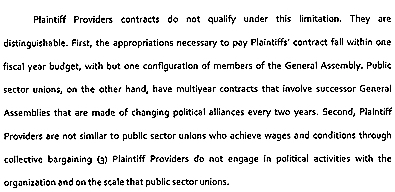
* Check out this kinda tortured logic from the judge on why this case differs from paying state workers without an appropriation…
18 Comments  
|
* Earlier today, the Rauner-funded Illinois Republican Party claimed that Speaker Madigan was holding the education funding reform bill hostage. This afternoon, Gov. Rauner pinned the hostage-holding tag on the Senate Democrats…
Today, Gov. Bruce Rauner again demanded that lawmakers put the children of Illinois first and send him Senate Bill 1, the education funding bill. Public schools in Illinois may not open in time for the new school year if Democrats in the Illinois Senate don’t send this bill to the governor’s desk. Democratic senators are using a procedural quirk to prevent this measure from reaching the governor’s desk, which puts every public school student in Illinois at risk.
“I’m determined to get our kids back to school on time. It’s my No. 1 priority,” Gov. Rauner said. “That’s why I again insist that lawmakers send me Senate Bill 1 so I can take immediate action. The bill is being held hostage by Democrats in the Senate. They’ve been holding this bill for six weeks now. It’s shameful. Stop putting politics and pensions before our kids. We don’t have any more time to waste. Send me SB 1 now.”
As written, the bill includes a bailout of Chicago’s broken teacher pension system. Gov. Rauner plans to issue an amendatory veto that will eliminate the Chicago Public Schools’ bailout and result in higher state funding for almost every school district in Illinois.
…Adding… The headline on that press release was a bit unfortunate…
Gov. Rauner: Put kids in front of politics, send me the education bill
Um, OK. Kids should probably never be put in front of Illinois politics.
27 Comments
|
* Tribune…
Weeks after former state Department of Children and Family Services Director George Sheldon resigned and took a job with a Florida nonprofit, new details are emerging about insider contract deals and allegations of Sheldon and his top aide’s mismanagement during his tenure at the scandal-tainted agency.
The state paid $262,000 to a longtime Sheldon confidant with whom Sheldon owns Florida property, after an initial $30,000 subcontract was extended two years, with Sheldon’s approval.
Sheldon’s top Cook County administrator resigned last month following a confidential state watchdog report that alleged she failed to account for thousands of dollars in holiday gift cards donated to teenage state wards.
And recent confidential state ethics reports allege breaches of procurement and hiring rules as Sheldon tapped a circle of Florida friends, former aides and lobbyists to help run the child welfare agency.
A series of confidential state watchdog findings were given to Gov. Bruce Rauner in the weeks before Sheldon resigned on June 15. While he admitted some lapses of judgment, Sheldon said the reports had no bearing on his decision to leave DCFS.
Go read the whole thing. Oof.
* Chris Kennedy responded this afternoon…
Governor Rauner’s leadership of DCFS is completely consistent with his Libertarian philosophy.
He does not believe that government should play a role in helping families. When he could not outsource government, when he could not eliminate it, he wounded it. He first wounded it by piling up unpaid bills then by putting in place incompetent staff whose floundering is destroying people’s confidence in government.
Rauner’s efforts to retain former agency director George Sheldon after state watchdogs showed he was either incompetent or corrupt is proof of his ongoing efforts to sabotage government.
32 Comments
|
* You’ll recall Moody’s put the state “under review” for a downgrade to junk status just prior to the final budget override votes. Press release…
Moody’s Investors Service has confirmed the State of Illinois’ general obligation bond rating at Baa3, following passage of budget legislation that alleviates immediate liquidity pressures, moves the state closer to fiscal balance and should keep pension and other fixed costs at manageable levels at least in the near term. The rating confirmation, which also applies to state debt linked to the GO (and listed at the end of this section) ends a review for possible downgrade that began July 5. Debt outstanding for all affected securities totals about $32 billion, though not all the non-GO issues have a Moody’s rating. The state’s outlook is negative.
The budget legislation includes income tax increases that the state expects will generate about $5 billion in fiscal 2018, which began July 1. Together with internal and external borrowing provisions in the legislation, the tax increases will help contain a backlog of unpaid bills that has been hovering above $14 billion in recent weeks. The legislation brought an end to a two-year period in which the state operated without a comprehensive budget, covering many of its expenses under court orders or consent decrees rather than standard appropriations. It highlighted two of Illinois’ intrinsic strengths: sovereign control over its taxing and spending policy and a diverse economy with the capacity to generate additional revenue.
While budget passage alleviates immediate threats to the state’s credit, long-term challenges remain. The outsized net pension burden (shown above as a share of revenue compared with state medians) will keep growing in coming years, despite certain reforms included in the budget legislation. Reducing and containing the backlog over the long term will likely depend on repeated operating surpluses, which the state has not produced in recent memory. […]
Factors that Could Lead to an Upgrade
Implementation of a realistic plan to provide long-term funding for pension obligations
Progress in reducing payment backlog and adoption of legal framework to prevent renewed build-up of unpaid bills
Enactment of recurring fiscal measures that support expectation of sustainable, structural balance
Factors that Could Lead to a Downgrade
Structural imbalance that leads to renewed build-up of unpaid bills following issuance of debt to pay down backlog
Efforts to obtain near-term fiscal relief by reducing pension contributions
Political paralysis that results in failure to provide for timely payment of subject-to-appropriation debt
Difficulty managing the impacts of an economic downturn, a reduction in federal Medicaid funding or other unexpected adverse event
Well, that’s a relief. But Illinois is going to be on the edge of junk status for a long time to come.
*** UPDATE *** Senate President John Cullerton’s spokesman John Patterson…
“It’s hard to disagree with many of the points Moody’s makes. Our balanced budget highlights our ability to self-govern and the strengths of Illinois’ diverse economy. What Moody’s seems to ask is: What took you so long? That’s a valid criticism. Looking forward, the Senate President knows more work is needed to continue to shore up our financial stability and keep Illinois moving in a positive direction.”
48 Comments
|
* Ahern…
Several sources tell NBC 5 that Gov. Bruce Rauner had planned to sign the new Automatic Voter Registration bill last week during the Rainbow PUSH Coalition Convention, but at the last minute the event was cancelled.
The bill allows voters to automatically be registered to vote through an electronic process when applying for a driver’s license or state ID, unless they opt out.
The governor signaled his intention to sign the bill, but he’s in the midst of overhauling his staff and there are now questions if his new team approves.
Last year Rauner vetoed similar legislation but changes were made and Senate Bill 1933 unanimously passed through the General Assembly. The governor has up to 60 days to sign or veto the legislation.
A bill that was rewritten to the governor’s specifications, then passed unanimously.
* From May 30th…
But a few changes were apparently enough to convince Rauner to sign on to automatic voter registration, which has already led to considerable gains in the number of registered voters in Oregon, the first state to implement it last year. Illinois would be the ninth state to adopt automatic voter registration, and advocates estimate it could add over 1 million voters to the state’s rolls.
“We must protect the sanctity of our election process, and we thank the bill sponsors and stakeholders who worked with us on this piece of legislation. The Governor will sign it,” Eleni Demertzis, a Rauner spokeswoman wrote in an email.
The Illinois Policy Institute’s legal arm, you’ll recall, filed a lawsuit last August in a failed attempt to strike down Illinois’ election-day voter registration law.
*** UPDATE *** I did a little calling around and the signing event was pushed back a couple of weeks ago, before the staff purge. There’s been no indication either way out of the governor’s new staff whether he still intends to honor his commitment and sign the bill. But that could be because Rauner now has an overwhelmed skeleton crew with little to no experience in government.
40 Comments
|
A quick look at campaign spending
Thursday, Jul 20, 2017 - Posted by Rich Miller
* From the Illinois Campaign for Political Reform, with my own bracketed comments…
J.B. Pritzker (D)
At $9.3 million in expenditures, J.B. Pritzker accounted for 67% of total 2nd quarter spending in the Illinois gubernatorial race. Advertising and media consulting represented a large portion of his committee’s expenditures. Pritzker utilized a Philadelphia media consulting group named Shorr, Johnson, Magnus, who has worked in the past with U.S. Senators Chuck Schumer and Al Franken. Pritzker paid the group $6,317,365 for media buys, consulting, and production. That amount itself is more than the combined total spending of all the other gubernatorial campaigns. In total, Pritzker spent an additional $928,160 on media buys from other sources, media and digital consulting, and media production. Pritzker also spent a significant amount of money building his campaign’s team. He spent $668,286 on payroll and associated fees for campaign staff - almost $500,000 more than any other candidate. [The dude has ramped up staff hiring faster and larger than anyone I think I’ve ever seen.]
Bruce Rauner (R)
Governor Rauner was the second highest spender in the second quarter, reporting nearly $3.4 million. The Rauner campaign enlisted Strategic Media Placement Inc, a major Republican media consulting company in Ohio, for $1,056,336 in media buys. The group has worked with a number of U.S. Senators, Governors, and the Trump campaign. In addition, the campaign spent $75,337 on mailings and postage to potential voters. The Governor also transferred $1.5 million to the Illinois Republican Party, which is reflected in his overall expenditure numbers. [The ubiquitous “duct tape” ads were paid for by a dark money group affiliated with the RGA and are therefore not included here.]
Chris Kennedy (D)
In the second quarter, the Kennedy campaign spent $652,524. A large portion of that, $178,726, went to payroll and associated fees. Kennedy also spent $23,806 on event costs, such as catering and venue reservations. Additionally, Kennedy spent $90,305 on digital consulting from Revolution Messaging, a Washington, D.C.-based progressive digital agency that previously worked with the Bernie Sanders presidential campaign, and $102,800 on polling and market research from two different firms. [Other consultants included Zlato Digital ($7,500), P2 Consulting ($52,550), Porter McNeil ($11,000), Tiffany Hightower ($12,500), Hart Research ($81,500), Grossman Heinz ($24,189), Adelstein & Associates ($19,817), 4C Partners ($9,000) and 3-Street, Inc. ($21,300)]
Daniel Biss (D)
Despite raising over $1 million, Daniel Biss’s campign spent frugally this quarter, only $265,710. A big focus of the Biss campaign this quarter was on digital advertising, as its largest single expenditure was $40,000 towards digital advertising from 270 Strategies, a Chicago consulting and outreach firm that previously worked with the United Way and U.S. Senator Corey Booker. The Biss campaign also spent $85,400 on consulting from a number of different local and national firms. This includes two expenditures worth $44,000 with LBH Chicago, a fundraising and public relations consulting firm that previously worked with Cook County State’s Attorney Kim Foxx and former Illinois Governor Pat Quinn. [LBH is run by Liz Houlihan]
Ameya Pawar (D)
Ameya Pawar’s campaign racked up $155,980 in second quarter spending. The Pawar campaign’s biggest expenditure was the $45,554 spent on staff salaries and associated fees. A significant amount of the campaign’s spending also went toward polling and research. The campaign spent $39,200 working with the Seattle-based research and marketing firm Strategies 360. Additionally, the Pawar campaign spent $15,383 on promotional merchandise. [Strategies 360 does not have an Illinois office and focuses mainly on the American West.]
Robert Daiber (D)
Robert Daiber had the second lowest expenditure total this quarter, with just $41,155. Over three-fourths of Daiber’s total spending went to consulting from individuals and small businesses, all located in Illinois. Daiber’s next largest expenditure was $5,110 for a fundraiser at Sunset Hills Country Club in Edwardsville, IL. [Barzin Emami is his top consultant. Enami ran the unsuccessful 2014 campaign to unseat Illinois Supreme Court Justice Lloyd Karmeier.]
Scott Drury (D)
Scott Drury, who has been in the race for about one month, was the lowest spender in the second quarter, only reporting $3,994. Of these expenditures, the largest amount went to processing donations to his campaign made through the Democratic fundraising platform ActBlue. [Drury was even outraised by the person who wants to run for his House seat.]
Click here if you want to take a deeper dive.
9 Comments
|
* From the ILGOP…
“Mike Madigan is trying to hold schoolchildren hostage to get a $500 million bailout for Chicago, just like he held the budget hostage for years to pass his 32% tax hike. It’s a desperate ploy to direct more taxpayer dollars to Chicago by using children as pawns. It’s sick, but that’s the Madigan way.” – Illinois Republican Party Spokesman Steven Yaffe
Democrats in the General Assembly are holding the future of Illinois schoolchildren hostage by “deliberately refusing” to send Governor Rauner any bill to fund education and ensure that schools open.
The News-Gazette editorial board blasted Madigan’s Democrats earlier this week, writing that, “They’ve been holding the school funding formula legislation in the Senate since May 31 — more than six weeks — deliberately refusing to send Senate Bill 1 for action to Gov. Rauner.”
“Democrats need to get the bill to Rauner’s desk as soon as possible.”
The Dispatch Argus editorial board highlighted how Madigan booby trapped his 32% tax hike budget in order to force a bailout.
“Among the devilish details in the 583-page Illinois budget we outlined Wednesday lurks a potentially dangerous phrase requiring school funding to be given out via an evidence-based system…. Senate Bill 1, which creates a needs-based funding method, was approved by the Illinois General Assembly in May. But it has never been sent to Gov. Bruce Rauner. Leaders reportedly are holding it while they seek ways to avoid a veto of the bill over what the GOP leader called a pension bailout for Chicago schools.”
“Critics believe Democratic leaders’ real motivation is to tar Gov. Rauner with slamming closed the schoolhouse doors.”
It’s time for Mike Madigan and his fellow politicians to stop holding children hostage and agree to bipartisan education funding that does not take money from students across the state to bailout Chicago.
As we’ve already discussed, that very same “devilish detail” was also inserted into a bill that Gov. Rauner himself supported. So, spare me.
* Even so, the editorial had a very reasoned conclusion…
Whatever you think of the final 2017 budget, a deal wouldn’t have happened if House Speaker Michael Madigan’s Democratic members had not demanded it. And it would not have survived an initial vote or gubernatorial veto if some Republican lawmakers had not defied the governor and voted for it. Just as in the successful 2015 stop-gap budget campaign waged by voters and their state lawmakers, our leaders were given an offer they could not refuse. And they didn’t.
So let’s make them listen again. Demand that your lawmakers tell their leaders — Gov. Rauner, Speaker Madigan and Senate President John Cullerton — to seek and find common ground between Senate Bill 1, which lawmakers approved, and the GOP bill Gov. Rauner favors. Somewhere in the middle is a deal that answers the needs of all of the state’s students — in Chicago and downstate.
Yep.
* And here’s the News-Gazette’s conclusion…
Given today’s data of July 19, Illinois is already on the brink of a problem, one that is wholly unnecessary.
There’s no reason Gov. Rauner and Democrats could not have worked out their differences, or still can’t, to reach a compromise.
Instead, Democrats seem intent on repeating their decisive win on the budget battle with one on the school funding formula. Rauner is equally intent on not letting that happen. K-12 kids represent the collateral damage if this battle-of-wills plays itself out to its ultimate conclusion.
35 Comments
|
Kennedy to announce “plan to address violence”
Thursday, Jul 20, 2017 - Posted by Rich Miller
* From the Kennedy campaign…
Chris will participate as the keynote speaker at the Solution to End Violence Forum this weekend, hosted by Pastor Anthony Williams, where he will announce his plan to address violence in communities. The forum is focused on discussing potential solutions to end the perpetual gun violence that plagues Illinois. Chris will share his personal and family-related experience with gun violence and engage with local residents who have been directly affected by Chicago violence.
* While we’re at it, let’s make a small dent in my in-box and do a little roundup. From the Pritzker campaign…
The day before JB is set to host a Women’s Rights & Resist Lunch at the Chicago Cultural Center, City Clerk Anna Valencia endorsed him for governor. Valencia has been a staunch advocate for women’s rights and economic opportunity during her tenure as Chicago City Clerk.
“I’m honored to receive the endorsement of Clerk Valencia,” said JB Pritzker. “Anna is a strong voice for women’s rights and economic opportunity here in Chicago and across the state. As governor, I will work with leaders like Anna to protect a woman’s right to choose, support women and minority-owned small businesses, and work to close the gender pay gap. We will also fight the hateful attacks we’re seeing from the Trump and Rauner administrations. Bruce Rauner promised Illinois women he would fight for them, but then he threatened to veto HB 40 and surrounded himself with a team of extremists. We have work to do to clean up Rauner’s mess and I look forward to standing with leaders like Anna to get our state back on track and ensure women always have a seat at the table.”
“Equal pay and investing in small businesses aren’t just economic issues, they are women’s issues,” said Anna Valencia. “Whether it is preparing our state’s workforce for the 21st century or making sure schools across our state have fair and equal funding, JB has what it takes to address these issues head on. I am proud to support JB for governor and to fight alongside him for the future of Illinois.”
* Biss campaign…
Governor Rauner has had a bad few weeks.
To distract from his unraveling governorship, Rauner is on a warpath. His target: SB1, the bipartisan education bill that would begin fixing Illinois’ deeply unfair system of school funding.
Illinois has the most unequal school funding system in the entire country, and our governor has the chance to do something about it. Instead, he’s threatening to do what he does best: nothing. Our kids are being deprived of the education they deserve, and it will be low-income students of color who are hurt the most.
School districts across the state don’t have the funding they need because of a set of out-of-date funding formulas combined with a dangerous reliance on property taxes. This system causes unfair balances in funding that punishes educators, families, and students whose schools, in some cases, may not be open next year. SB1 aims to help fix that — it funds each school district in Illinois based on need, and it would increase that funding over time.
Daniel has been fighting for education funding reform throughout his career. He supports SB1 because it’s the right thing to do to start fixing our broken system. But the work doesn’t end there.
That’s why, as governor, Daniel will work to end our reliance on a broken property tax system, so that we have the revenue to fully and equally fund education once and for all. He’s already made proposals to ensure that we have a fairer tax system and that the wealthy pay their fair share. These reforms will help properly fund our schools across the state.
Rauner will try to tell you that SB1 is a Chicago bail out, that it just siphons money into a broken system at the expense of other school districts. This couldn’t be further from the truth. This bill is about equity for all school districts. Rauner is holding our schools hostage in order to score political points. This is unacceptable.
We have a chance to change education in Illinois for the better, and give every student the chance to succeed. That’s something Daniel is committed to, and I hope you’ll join him in this fight.
* Back to the Pritzker campaign…
Another Bruce Rauner hire is the subject of controversy after the Chicago Sun-Times discovered an appalling blog post she wrote that “compared abortion to Nazi eugenics.” Responding to the reports, the Rauner administration said to quote the staffer’s past writing with “full context.”
In that spirit, here is her full article, brazenly titled An Inconvenient Analogy: Abortion, Eugenics, and Nazi Germany. In it, she explains, “Certainly nothing matches the atrocity of the Holocaust, but it’s undeniable that abortion is being used to rid the world of “disabled and other ‘unwanted’ persons”—a fact the Left and their pro-abortion allies don’t want discussed.”
Rauner filling his administration with radical social conservatives should come as no surprise. Rauner said he didn’t have a social agenda on the campaign trail, but he then abandoned Illinois women as governor, pledging to veto HB 40. This is a bill that ensures all Illinois women have access to reproductive healthcare.
The Rauner administration’s vague and distant response to their latest controversy begs the question: Will Bruce Rauner condemn his new staffer’s atrocious remarks?
“Rauner’s decision to stand by and say nothing when a member of his staff makes such an atrocious comparison tells Illinois women all they need to know about their failed governor,” said Pritzker campaign communications director Galia Slayen. “Comparing the right to choose to the Nazis is indefensible and has no place in the governor’s office. This is an administration being taken over by radical ideologues, intent on furthering the Trump agenda of bigotry and hatred.”
3 Comments
|
Griffin may run for SoS
Thursday, Jul 20, 2017 - Posted by Rich Miller
* Mark Maxwell at WCIA…
Sources close to the recruiting effort say Josh “J.C.” Griffin, a 5-year veteran of the U.S. Air Force, has impressed party leaders and is the leading contender to run for Secretary of State.
WCIA caught up with Griffin in Springfield and asked him about reports that he is working to build a statewide campaign.
“I think it’s premature to say whether or not I’m running for anything,” Griffin said. “But I think the organizations and the counties that I’ve been visiting over the past few months, we’ve had good conversations about what needs to happen and what needs to change.”
Griffin enlisted in the Air Force 2007 and fought in combat during the Iraq War. After leaving the military in 2012, he worked for Norfolk Southern Railway before taking a job in Governor Pat Quinn’s administration.
It’s still not totally clear whether Secretary White is running for reelection. I think he’ll do it, but he said a while back that he’d announce in a couple of weeks and then didn’t.
* From Griffin’s LinkedIn page, which is pretty devoid of specifics…
Professional expertise: Business Development and Training Management, Change Management and Legacy Affairs, Government & Legislative Relations and Organizational Leadership Management.
* Pic…
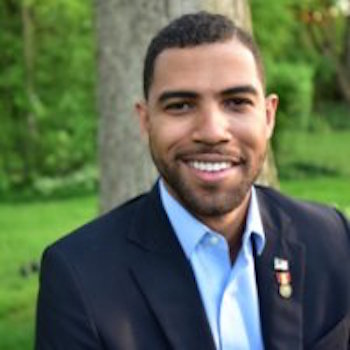
Anybody know much about him?
22 Comments
|
Unclear on the concept
Thursday, Jul 20, 2017 - Posted by Rich Miller
* Um…
Replacing her on the Arts Council wouldn’t free up that money for anything or anyone else. If Rep. Skillicorn wants to eliminate all state arts funding, well, that’s quite another thing and he should say so.
* On to the linked Adam Andrzejewsk story…
The Illinois Arts Council – led by the matriarch of the most powerful political family in Illinois – conferred grants without official meetings, ignored rampant conflicts of interest, and funneled millions of taxpayer dollars to asset-rich organizations – including media outlets – which don’t need public money.
Although Michael Madigan has served as the Illinois House Speaker for 34 years, interrupted for just two years in the 1990s, his wife, Shirley Madigan, has clinched a position on the Illinois Arts Council since 1976. She has served as the chair of the council since 1983.
Governor Bruce Rauner must move immediately to end Shirley Madigan’s tenure on the Illinois Arts Council. Rauner has an historic opportunity to appoint thirteen fresh faces and take a reform majority on this important council of twenty-one. Two weeks ago, Shirley Madigan’s latest term expired alongside twelve other board members.
Over the past three years, Shirley Madigan’s Arts Council rarely met. Instead of holding tri-annual board meetings – as they’ve pledged to do – the council never met during the entire fiscal year of 2016. Still, without the sunshine of a public meeting, the council paid-out grants, salaries, and operational expenses. Only later did the board ratify the payments.
23 Comments
|
Heckuva job, Raunie
Thursday, Jul 20, 2017 - Posted by Rich Miller
* WGN TV on Gov. Rauner’s latest Lake County visit to view the flooding…
[Rep. Sam Yingling] went on to say the governor’s response to flood was inadequate. Close to 7,000 structures were impacted by flood waters along the Des Plaines River. Hundreds more were impacted in McHenry County.
The governor and Representative Yingling appeared at a press conference Tuesday afternoon.
“We needed a state of emergency declared which came three days too late,” he said. […]
“I think it’s very important that we set aside political spin from serving Illinois. I was in contact with mayors in the area, they did not want me to personally to come during the time their first responders had to focus and get the job done,” the governor said.
At least one mayor said they never told the governor not to come. Another elected official said if you’re a leader you don’t have to ask.
Ouch.
* Tribune…
Yingling had said in interviews and his guest column that the declaration of a disaster area by the state was needed for low-interest Federal Emergency Management Agency loans.
Rauner’s director of the Illinois Emergency Management Agency, James Joseph, seemed to correct Yingling by saying that there are no “low-interest FEMA loans” at one point during the press conference, but mentioned the Small Business Administration loan program.
Afterward, Yingling said he was floored when he heard Joseph say that, because he had just come from a county meeting concerning exactly that issue. Accusing Joseph of doing some spinning of his own, Yingling said FEMA qualifies people for loans, but the SBA is the organization that actually makes the loan.
“He was splitting hairs,” Yingling said, adding that Rauner came because of his guest column. “He wouldn’t be here if it wasn’t for that. It was nice of him to take time out to come up here.”
From FEMA’s website…
Following a disaster declared by the president, FEMA partners with the U.S. Small Business Administration (SBA) to help disaster survivors. The SBA offers low-interest disaster loans to homeowners, renters and businesses of all sizes.
Rep. Yingling’s op-ed is here.
* The point is that the flooding began Wednesday and the governor waited until after 5 o’clock in the afternoon on Friday to finally activate the State Emergency Operations Center and issue a disaster proclamation that had been requested on Thursday. From that press release…
As reports indicate potential record flooding in the coming days, Governor Bruce Rauner today issued a state disaster proclamation for Lake, McHenry and Kane counties to ensure continued state support to communities as they recover from the recent heavy rains. [Emphasis added.]
Um, by Thursday, IEMA was already saying “Flooding of this magnitude has not been seen before.”
This isn’t about whether or not the governor should’ve visited sooner, although he wants to turn it into that “debate.” It’s about whether or not he did his job in a timely manner.
41 Comments
|
* Police abuse of asset forfeiture powers is widely known. Here’s just a little sample…
In 2016, Oklahoma police stopped a Christian band manager for a broken tail light and ended up seizing $53,000 in concert revenue and charity donations to an orphanage. The Washington Post reported a lengthy exposé on police taking hundreds of millions of dollars from motorists never charged with crimes. In Tenaha, Texas, authorities systematically confiscated motorists’ property and threatened them with criminal charges unless they signed waivers giving up their possessions (the department later used the money to buy, among other things, a popcorn machine).
* From the Illinois ACLU…
A strong reform bill passed in the legislature recently with overwhelming bipartisan majorities. It awaits the governor’s signature.
The reform legislation, a product of compromise between reform advocates and the law enforcement lobby, ensures that the burden of proving the property owner’s culpability in a forfeiture case rests squarely with the government and raises the standard of proof from probable cause to a preponderance of the evidence for the government to prevail at trial. The bill exempts small sums of cash from forfeiture and provides that possession of a miniscule amount of drugs alone shall not authorize forfeiture of personal property.
The reform legislation also eliminates the current requirement that property owners must pay 10 percent of the value of their property upfront in order to contest seizures, and it creates an expedited procedure will allow innocent owners to have their claims adjudicated more rapidly. These reforms will reduce the financial barriers and long delays that too often deter people from pursuing the return of their property.
Additionally, the legislation requires public reporting of seizure and forfeiture data, which will enable taxpayers and lawmakers to find out how much property is being seized by law enforcement agencies around the state, the types of property forfeited, the amount of forfeiture proceeds received by law enforcement agencies, and how they spend the money.
The bill unanimously passed the Senate on May 31st. Only one House member, Margo McDermed, voted against it when it passed that chamber on June 23rd. It has not yet been sent to the governor.
* And now this…
Attorney General Jeff Sessions signed an order on Wednesday reversing the Obama administration’s limits on civil asset forfeiture, a widely criticized practice in which law enforcement officers seize cash and property from citizens who have not been charged with crimes.
The policy change comes as a number of states — both red and blue — have clamped down on civil forfeiture abuses, and it will allow local police departments to circumvent state laws that restrict the practice. […]
Sessions’ order gives officers a way to bypass state restrictions.
It revives a program called Equitable Sharing or “adoptive forfeiture,” which allows local law enforcement to process forfeiture cases under federal statute and “share” the assets with federal authorities. In practice, the federal government sends up to 80 percent of the assets right back to local departments, effectively allowing them to get around stricter state laws, says Rulli. Eric Holder, Obama’s attorney general, eliminated adoptive forfeiture except in rare cases.
“Sessions is calling [adoptive forfeiture] a ‘partnership’ between the federal government and states,” says [Louis Rulli, a clinical law professor at the University of Pennsylvania and a leading forfeiture expert], “but in fact, it’s an attack on federalism and the ability of states to decide for themselves how they should handle this [issue].”
The order is here.
26 Comments
|
* A Bruce Rauner 2014 campaign promise…
But the problem isn’t limited to cronies leaving government and creating lobbying empires built on sweetheart deals – we also need to stop the practice of insider lobbyists putting their practices on hold and joining the administration, only to come back to their clients after helping them rig the system. The revolving door swings both ways.[…]
No senior executive official should have been a lobbyist in their preceding 12 months, nor should they be allowed to become a lobbyist 12 months after they leave. [Emphasis added.]
His recently hired chief of staff, Kristina Rasmussen, has been a registered Statehouse lobbyist since 2010.
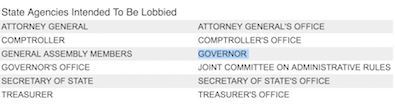
Notice that in Rasmussen’s former group’s latest filing, it declared its intent to lobby the governor’s office…
* Nice pickup by Doug Finke…
Gov. Bruce Rauner is apparently backing off of a campaign position from 2014 when he said senior administration officials should not be selected from among the ranks of lobbyists.
Rauner’s new chief of staff, Kristina Rasmussen, has been a registered lobbyist in the state since 2010, records show. Rasmussen, the former president of the Illinois Policy Institute, was registered first as a lobbyist for the IPI and later for Illinois Policy Action, an affiliated organization. […]
“Kristina has been fighting for a more prosperous and compassionate Illinois for many years, which aligns completely with the governor’s point of view,” [Rauner spokeswoman Laurel Patrick] said. “She’s thrilled to be part of the team.”
Patrick did not respond to additional questions.
* This other staff revelation, however, borders on being the liberal thought police…
A second newly-hired communications specialist, Meghan Keenan, deleted her Twitter account just after she was hired Monday as a $45,000-a-year communications specialist for Rauner’s office. But POLITICO has obtained screenshots of her tweets questioning climate change, calling for defunding the Affordable Care Act, and seeming to support the Religious Freedom Restoration Act, saying “religious objections can actually expand access to abortion, birth control, etc.”
Nothing about Nazis, no racist, homophobic or violence-approving tweets. Just a couple of policy issues where she may differ from the governor.
Meh.
This particular well may have run dry for now. We’ll see.
52 Comments
|
* Press release…
Americans for Prosperity-Illinois (AFP-IL) today announced the roll out of its accountability effort targeting 16 state representatives who voted to override Governor Rauner’s veto of SB9, House Speaker Michael Madigan’s proposal to permanently increase the state income tax by 32 percent. AFP-IL consistently advocated against increasing income taxes throughout the legislative session and has called for a long-term property tax freeze instead. The accountability campaign includes targeted digital ads, direct mail, and grassroots activities.
“We’re disappointed Springfield failed to provide taxpayers relief from their crippling property tax burden yet voted to demand they forfeit more money to the state by permanently increasing their income tax bill by 32%. A bipartisan majority of residents from all over the state supported a long-term property tax freeze, yet lawmakers overrode Gov. Rauner’s veto and passed the permanent income tax hike to help fuel an unbalanced budget,” said AFP-IL State Director Andrew Nelms. “This massive tax increase will cost a taxpayer with a net income of $50,000 a year more than $600 annually. Hardworking Illinoisans are already overtaxed and we want to make sure struggling families know which politicians failed to relieve their property tax burden and instead made living in the Land of Lincoln even more unaffordable.”
* I don’t have the full target list, but here’s one of the mailers…
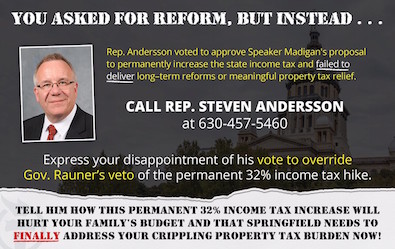

*** UPDATE 1 *** Here’s the target list…
Steven Andersson - 65th District
Daniel Beiser - 111th District
Deb Conroy - 46th District
Fred Crespo - 44th District
Mike Fortner - 49th District
Michael Halpin - 72nd District
David Harris - 53rd District
Stephanie Kifowit - 84th District
Natalie Manley - 98th District
Bill Mitchell - 101st District
Anna Moeller - 43rd District
Brandon Phelps - 118th District
Sue Scherer - 96th District
Carol Sente - 59th District
Michael Unes - 91st District
Kathleen Willis - 77th District
*** UPDATE 2 *** Pritzker campaign…
The Koch brothers launched new attacks on 16 state legislators who voted to override Bruce Rauner’s reckless budget veto. Americans for Prosperity-Illinois, the local dark money group funded by the Koch brothers, announced their new digital and direct mail campaign earlier today.
Two weeks ago to the day, Bruce Rauner suffered an embarrassing defeat after bipartisan members of the General Assembly successfully overrode his veto four times. In the weeks since, nearly two dozen members of Rauner’s staff were either fired or resigned in protest, as Rauner staffed up with new right-wing hires from the Koch network funded Illinois Policy Institute.
As Bruce Rauner prepares for an all-out war to force his special interest agenda on Illinois, it comes as no surprise that the Koch brothers would send in their attack dogs to do Rauner’s dirty work.
“Bruce Rauner and the Koch brothers are ready to punish anyone who isn’t fully committed to propping up their failing agenda,” said Pritzker campaign spokeswoman Jordan Abudayyeh. “After a mortifying public defeat, it’s clear that Rauner, his new team of radical right-wing staff, and the Koch network will continue working to create devastation across our state.”
89 Comments
|
|
 Support CapitolFax.com
Visit our advertisers...

 ...............
 ...............
 ...............
 ...............


|
   
|
Hosted by MCS |
SUBSCRIBE to Capitol Fax |
Advertise Here |
Mobile Version |
Contact Rich Miller
|