House Democrats explain their changing votes
Thursday, Jul 6, 2017 - Posted by Rich Miller
* Rep. Sue Scherer (D-Decatur) complained last month about the potential for a “huge tax hike” and said she couldn’t in good conscience vote for such an increase “on the backs of the hard-working families in my district.” Rep. Scherer voted against the tax hike on 3rd Reading. Her district just barely went Democratic at the top of the ticket last year and Gov. Rauner won it by about 6 points. She’s always voted like a target, until today, when she voted “Yes” on the override…
“When the budget package went to Governor Rauner’s desk, I sincerely hoped and believed that he would finally see the need to come back to the table, and negotiate an end to the crisis he created,” Scherer said in a statement. “I hoped he would see an opportunity to build off of the $3 billion in spending cuts we identified in our budget. But the governor’s total veto and his refusal to negotiate left me with an unfortunate choice: override his veto and support a deal I didn’t fully agree with, or follow the governor over a cliff, bringing millions of Illinois families down with us. … It became clear this week that the governor would not make the tough decisions needed to end his crisis, so I did.”
* Rauner won Rep. Mike Halpin’s (D-Rock Island) district by a hair three years ago. The freshman was one of a handful of House Democrats who initially voted for the tax hike bill on 3rd Reading the other day and then switched to “No” just before the roll call was closed. He switched to “Yes” today because four Republicans flipped. His explanation to a local paper…
After the vote, Halpin said he had heard from constituents since Sunday, including representatives from area universities, and decided that it was time to get a budget approved.
“I decided that having any budget, even if not perfect, was better than no budget at all,” Halpin said.
He added he was worried about rating agencies downgrading the state’s credit rating, as well as the effect of an extended impasse on schools and human service agencies.
Nothing yet from Rep. Natalie Manley (D-Joliet). Rauner barely won that district. Also nothing from Rep. Rita Mayfield (D-Waukegan), who represents a hugely Democratic district.
59 Comments  
|
House Republicans explain their changed votes
Thursday, Jul 6, 2017 - Posted by Rich Miller
* As we’ve already discussed, four House Republicans voted “Yes” on the tax hike bill and then voted “No” today on the override motion. Why did they do it? As I write this, three of the four have posted explanations on their campaign websites.
Rep. Charlie Meiercaught holy heck for it back home. So he switched to “No” on the override, even bringing up Speaker Madigan’s name in his press release to quiet the rebellion back home…
State Representative Charlie Meier (R-Highland) released the following statement after voting against Mike Madigan’s 32 percent permanent income tax hike:
“I listened to my constituents and voted against the permanent income tax hike. The people I spoke with want to see more reforms and cuts before any talk of increasing taxes. I voted against the tax hike since zero reforms came back from the Senate. I supported the Governor’s veto and the taxpayers’ wishes.”
* Rep. John Cavaletto (R-Salem)…
“My vote on Sunday for the proposal in front of us was based on the ‘junk bond’ rating threat to the State of Illinois and that huge negative impact on borrowing and the cost to Illinois taxpayers,” said Rep. Cavaletto. “But I found out this morning directly from Moody’s that this budget plan doesn’t seem to help and they are still considering a downgrade from Baa3 rating level because Illinois’ debt obligations does not have stable funding to meet our obligations, even with this tax increase,” Cavaletto continued.
“The more than one thousand calls, emails and Facebook messages I have received have been about 10 to 1 opposed to any more taxes. The message from my constituents has been loud and clear that they do not want a tax increase so I had to oppose this plan with a permanent tax increase,” Cavaletto said.
As part of this plan there is a 5% across the board cut of state agencies and a 10% cut in the funding to Illinois colleges and universities. But there are not enough reforms to change the way government spending is handled in Illinois.
“We’re pushing people out of this state with high taxes and property taxes and we need reforms and tax relief to keep people here and attract more with job growth,” Cavaletto concluded.
* Somebody threatened to hang Rep. CD Davidsmeyer (R-Jacksonville) from a tree and I heard he was really getting beat up back home even though his district contains a bunch of state facilities and state workers. Davidsmeier also switched…
“I voted for the budget packages earlier this week because I felt it was important to end the budget stalemate. Since that time, I have had many conversations with constituents and laid out the facts as well as the possible ramifications of not having a budget.
I have heard their voice and agree that there is a need for spending reform in order to truly fix the State of Illinois. They understand that there are no easy answers, but at the end of the day, a budget deal has to do something meaningful, not just keep doors open.
So today, I chose to do exactly what my constituents wanted me to do and voted ‘no’ on the motion to override.
I hope that my ‘no’ votes jump start discussions on how we can grow our economy and put people back to work.
For too long Illinois’ economy has lagged behind other Midwestern states. Citizens are leaving because there has been no action by the majority in the General Assembly to adjust their spending behavior.
Debt from unpaid bills, interest and pensions are crushing us. To those waiting on payments, I will continue to work to get real reform that doesn’t put us in this situation ever again.
We must do something that brings significant change to our state. We need regulatory relief, spending changes, and more opportunities for our people to thrive.
I want to thank the many constituents who took the time to contact me, discuss the facts, and get involved in this often difficult process.”
Nothing yet from Rep. David Reis (R-Ste. Marie). The fifth Republican, Rep. Bob Pritchard (R-Hinckley), was out of the country and didn’t vote today.
40 Comments
|
* Press release…
Governor Bruce Rauner today issued the following statement after the House of Representatives voted to override the Governor’s veto of Speaker Madigan’s 32 percent permanent income tax hike:
“Today was another step in Illinois’ never-ending tragic trail of tax hikes. Speaker Madigan’s 32 percent permanent income tax increase will force another tax hike in the near future. His tax-and-spend plan is not balanced, does not cut enough spending or pay down enough debt, and does not help grow jobs or restore confidence in government. It proves how desperately we need real property tax relief and term limits. Now more than ever, the people of Illinois must fight for change that will help us create a brighter future.”
*** UPDATE *** ILGOP…
Illinois Republican Party Chairman Tim Schneider released the following statement after the Illinois House of Representatives overrode Governor Rauner’s veto of Speaker Madigan’s permanent 32% tax hike:
“I am deeply disappointed in the Illinois General Assembly’s vote to override the Governor’s veto of Speaker Mike Madigan’s permanent 32% tax hike. Passing a 32% tax increase on the hard-working families of Illinois without any semblance of reform is absolute insanity. It hasn’t worked before, and it won’t work now.
“I am extremely troubled by the decision of 10 Republicans to again stand with Mike Madigan. Republicans in Illinois fought Madigan’s machine in 2014 to elect Gov. Rauner and won. In 2016 we beat Madigan again and made historic gains in the House and the Senate. After all we have accomplished together, it is astonishing that these legislators would now turn their backs on taxpayers across the state. I am confident voters will hold those politicians accountable for choosing Mike Madigan over the people of Illinois.”
138 Comments
|
* Press release…
Today, after 736 days, a bipartisan compromise budget passed into law. With the state on the cusp of junk status, Rauner continued to cling to his crisis with a desperate and reckless veto. But Republican and Democratic members of the General Assembly overrode the failed governor. Illinois now has a budget, but the damage is done and Bruce Rauner’s manufactured crisis will have long term ramifications for Illinois families.
In response to the override vote, JB Pritzker released the following statement:
“Bruce Rauner manufactured a 736-day crisis to force his special interest agenda on our state. Today, Democratic and Republican members of the state legislature came together to say enough is enough, but Bruce Rauner’s damage is already done,” said JB Pritzker. “Rauner led the state to $14.7 billion in unpaid bills, interest on state debt continues to skyrocket, and local governments across the state have been forced to raise taxes to compensate for a lack of state funds. Social services agencies closed, impacting countless families across Illinois, students fled to go to college in other states, and we lost opportunities for job creation. The suffering of Illinois families can’t just be erased. It will take years to clean up the mess of this failed governor’s creating and it’s clear that getting our state back on track can only happen with a new governor next November.”
Let’s take a look at Bruce Rauner’s damage to Illinois:
$14.7 billion dollars in unpaid bills piled up without a spending plan in place.
$2 billion dollars is owed to Medicaid doctors and hospitals.
130,000 students’ MAP grants were jeopardized.
37,508 residents fled the state amid historic fiscal uncertainly.
20,000 workers’ paychecks were put in limbo after IDOT halted road construction.
22 local health departments were forced to reduce services.
5 state universities were downgraded to junk bond status.
Countless social service agencies have drastically cut programs or closed altogether.
While passing a state budget marks an important first step in bringing our state back to fiscal sanity, Bruce Rauner’s damage is done. The wreckage from this over 700-day crisis will take years to address. This is what it looks like when a governor fails and it’s time Bruce Rauner was held accountable for the damage he’s inflicted on the people of Illinois.
* Sen. Daniel Biss…
“I’m glad that because rank and file legislators on both sides of the aisle followed their consciences instead of their leaders, we avoided the catastrophe of yet another year without a budget. Now it’s time to solve our long term problems. We need to build on this collaboration and come together to create real progress by making the rich pay their fair share to fund our schools, protect people’s health care, and get our economy moving.”
I’ll post other gubernatorial candidate reacts here. Otherwise, the rest will be found on our live coverage post.
…Adding… Ameya Pawar…
“Republicans and Democrats in both houses came together this week to pass a responsible budget that protects middle-class families and finally puts Illinois on a steady fiscal path. While Bruce Rauner’s reckless veto made clear he doesn’t care about the future of our state, today’s bi-partisan veto-override proves there are legislators still willing to put Illinois’ hard-working families over reckless partisan politics.”
“This episode is just another reminder that when we elect people like Bruce Rauner, who hate the institutions they seek to represent, they will try to destroy it once in office. That’s what Donald Trump is doing in Washington, D.C. and it’s what Bruce Rauner is doing in Springfield. We need to stop electing people who hate government more than they love their city, their state and their country.”
*** UPDATE *** Chris Kennedy kinda criticizes the tax hike…
“Illinois finally got the balanced budget it needed. Our state had little choice but to carry through with the budget agreement finalized today,” said Kennedy. “It came to us at the 11th hour after the Governor stood on the sidelines for years, shifting the goal post whenever we came close. Now we’ve raised taxes that impact the poor and middle-class without asking more of the wealthy. Rating agencies are still hesitant about our financial health, and our political leaders have done little to restore voters’ faith in our state government. Other states don’t need to threaten the future of their institutions in order to create a balanced budget. It doesn’t have to be this way. We can have a balanced budget. We can honor the contracts of our pensions and we can invest in our economy and see it grow. But, we need to give our state a budget and a government that’s free of corruption, that’s free of self-dealing, that’s free of self-interest. If we do that we can turn this state around,” added Kennedy.
48 Comments
|
* Roll call…
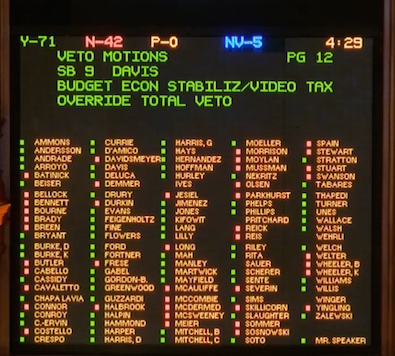
The House also just overrode the governor’s veto of the BIMP bill. And then they overrode the spending bill.
*** UPDATE 1 *** Republican Reps. Cavaletto, Davidsmeyer, Meier and Reis all switched from being “Yes” on 3rd Reading to being “No” on the override. So, they lost 5 Republicans (Rep. Pritchard was absent) and still approved the motion.
*** UPDATE 2 *** Democratic Reps. Halpin, Manley, Mayfield and Scherer switched from No to Yes. Scherer had said repeatedly that she was a “No” vote and is considered a target, so that one is really interesting.
*** UPDATE 3 *** Check out the big board games…
*** UPDATE 4 *** From Speaker Madigan’s remarks…
Today, Republicans and Democrats stood together to enact a bipartisan, balanced budget and end a destructive 736 day impasse.
Our budget agreement was made possible by legislators on both sides of the aisle who looked beyond partisan differences and put the best interests of our state and its residents first.
The people in this chamber did not do what was easy today, but we did what was right for the future of out state. There are a lot of things that will be said about this vote, but the most important thing I can point to is that Republican legislators and Democratic legislators got this done together.
*** UPDATE 5 *** Mayor Emanuel…
“I want to thank Senate President Cullerton and Speaker Madigan for their leadership, and I want to thank Democrats and Republicans in the Illinois House and Senate for coming together to put the people of Illinois before party politics. Like so many others across the state, I wish the governor had been willing to actually compromise at some point in this process because the only thing his my-way-or-the-highway approach has gotten Illinois is nearly three years of gridlock and $15 billion in unpaid bills. Thankfully, today’s bipartisan, balanced budget is the first step in bringing stability and certainty back to Illinois and putting our state back on track.”
162 Comments
|
* From the Illinois State Board of Elections…
Hon. Kris W. Kobach
Vice Chair
Presidential Advisory Commission on Election Integrity
Vice Chair Kobach:
On July 5, 2017, the Illinois Secretary of State received your letter dated June 28, 2017, wherein the Presidential Advisory Commission on Election Integrity (the “Commission”) requests information relating to elections in Illinois.
I am writing today in response to the request for the publicly available voter data roll for the State of Illinois. The Illinois Election Code, at 10 ILCS 5/1A-25, 4-8, 5-7 and 6-35, protects the confidentiality and privacy of voter registration data, limiting its release to registered political committees for political purposes and to governmental entities for governmental purposes, subject to the restriction that voter data not be released to the public. Your letter indicates that any information and voter registration data provided to the Commission will be made available to the public.
In short, the State of Illinois does not have a publicly available voter roll. Therefore, our agency does not have any material responsive to the Commission’s request.
We look forward to providing a supplemental response at a later date addressing the seven questions set forth in your letter.
If you have any questions or comments, please do not hesitate to contact me. Respectfully submitted,
Kenneth R. Menzel General Counsel,
State Board of Elections
16 Comments
|
Aetna threatens to leave, revenues down
Thursday, Jul 6, 2017 - Posted by Rich Miller
* Kristen Schorsch at Crain’s…
Aetna Better Health, which the state of Illinois owes at least $698 million, has had enough.
The subsidiary of the national insurance giant has given the state notice that it plans to terminate its Medicaid contracts, Aetna spokesman T.J. Crawford wrote today in an email.
“We have filed notices of intent to terminate our contracts but hope those terminations will ultimately be unnecessary upon resolution of the current Medicaid funding crisis,” Crawford wrote. “In other words, no final decision has been made.” […]
For Illinois Medicaid, the loss of a big insurer would mean a major shift. The roughly 235,000 low-income and disabled recipients Aetna covers would have to be moved to another health plan that might not have the same network of doctors and hospitals.
* Meanwhile, more bleak news from COGFA…
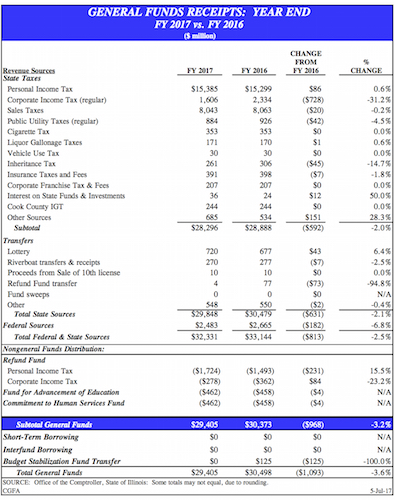
For the fiscal year, base general funds dropped $968 million or 3.2%. As discussed in earlier briefings, receipt weakness was widespread, and resulted in disappointing performances in key areas such as income and sales taxes as well as federal sources.
For the fiscal year, gross corporate income taxes were off $728 million, or $644 million net of refunds. Part of that decline was due to the IDoR now classifying pass-through withholding under the personal income tax designation rather than corporate. Because of this change, approximately $375 million gross, or $324 million net was moved from the corporate income tax line. Also significantly impacting corporate income taxes were the reconciliations made by IDoR’s during the move to their new accounting system. It is hoped that normalized receipt patterns will be reestablished as they caused significant difficulty in interpreting receipts in FY 2017. Inheritance tax, true to its volatile nature, declined $45 million. Public utility taxes were off of last year’s pace by $42 million while insurance taxes and fees dipped $7 million.
Other sources grew $151 million, in large part due to a one-time $84 million deposit of an SERS repayment. Despite being the benefactor of the previously mentioned pass through withholding designation change, gross personal income taxes returned only a gain of $86 million, but on a net basis actually fell $153 million. Public utility taxes declined $42 million for the fiscal year. Sales taxes dropped $20 million, although that total was largely the result of the IDoR diverting approximately $150 million from general funds to other local government funds that receive sales tax distributions. Insurance taxes eased $7 million in FY 2017.
Overall transfers ended down $39 million. Despite lottery transfers growing by $43 million, those gains were more than offset by a comparatively small Refund Fund transfer—down $73 million, a decline of $7 million from riverboat transfers, and a small dip of $2 million from all other miscellaneous transfers. Due to significant cash constraints throughout all of FY 2017, reimbursable spending was seriously hampered. As a result, federal sources fell $182 million for the fiscal year from the depressed level of FY 2016.
* Click on the chart for a larger view…
64 Comments
|
* One person has already been arrested…
Watch our live coverage post for instant updates.
*** UPDATE 1 *** Could be a bit…
*** UPDATE 2 *** The ventilation system has been turned back on at the Statehouse, so it may not be long before they get started again.
*** UPDATE 3 *** An “all clear” has been issued for the building…
58 Comments
|
* A statement by a group run by First Lady Diana Rauner urging a budget veto override didn’t get much media play in Illinois, but CNN picked it up…
The political situation in Illinois is so dysfunctional that even Republican Governor Bruce Rauner and his wife appear to be on different sides right now. […]
Diana Rauner did not sign the statement released by the Ounce of Prevention Fund. However, Megan Meyer, a spokeswoman for the Ounce of Prevention Fund, confirmed to CNNMoney that Rauner remains the president of the foundation, which describes itself as a “public-private partnership that prepares children for success in school and in life.”
Asked why Diana Rauner wants lawmakers to oppose her husband’s veto, Meyer explained that the Illinois budget impasse has put the state’s social services infrastructure “under tremendous pressure” and forced many organizations to close or reduce services. […]
Steve Brown, a spokesman for Democrat Speaker of the House Michael Madigan, said he wasn’t surprised by the support for the budget from Diana Rauner’s foundation.
“Social service agencies have been destroyed by the Rauner approach,” Brown said.
* Meanwhile…
Family Focus, a nonprofit early childhood education provider in the Chicago area, has gotten enough money from the state comptroller’s office to see it through August.
Before the holiday weekend, the agency had announced that on July 1 it would lay off 100 employees and effectively cease program operations. The state owes it $2.7 million for work accomplished. Not getting payments from the cash-strapped state had created a “severe cash-flow crisis,” meaning the organization’s endowment fund and line of credit had been exhausted. Emergency loans from board members and donors had helped cover the gap.
“The crisis is temporarily over,” says Merri Ex, CEO of Family Focus. She declined to reveal the exact amount of money the state released. […]
One of the founders of Family Focus more than 40 years ago, Irving Harris, also founded the Ounce of Prevention Fund, the national early childhood education nonprofit of which Illinois first lady Diana Rauner is now CEO. The two groups maintain close ties; Family Focus receives grants through Ounce of Prevention.
That’s good news.
13 Comments
|
* DGA…
Yesterday, Rauner staged a dramatic press conference called for lawmakers to sustain his veto. The Sun-Times Mark Brown described the scene:
“The governor could barely contain his phony outrage on the eve of an Illinois House effort to override his vetoes of a state budget that gifts him with both a functioning government and a re-election platform.”
In his most serious voice, Governor Rauner unequivocally said he was doing “everything possible” to prevent an override. NPR’s Brian Mackey continues:
“Here’s the thing: At least two Republicans who voted yes say neither the governor nor his office have been in touch.”
Oh.
Governor Rauner, as always, is putting on a show. He desperately needs the legislature to successfully override his veto, or else the state will be reduced to junk bond status, schools may not open in the fall, and universities may close. Even while Rauner recklessly calls for a veto, he does not offer up a viable alternative solution to prevent the fiscal collapse sustaining the veto would cause.
Rauner will play the role of tax crusader, but his own support for higher taxes was so real that traditional allies like the Illinois Policy Institute and the Wall Street Journal lashed out at him. Rauner’s own “Capitol Compromise” included higher taxes.
Finally, Bruce Rauner wants to make this deal about Democrats. The fact is this bill would never have passed if Republicans were not willing to break with Rauner and sign a deal before his demanded-reforms were addressed.
For three weeks, Rauner posted pictures of him sitting at his desk “waiting” for a budget deal. If he really wanted a different deal, maybe there should have been a picture of him calling someone.
“Bruce Rauner needs to explain to the people of Illinois why he was willing sacrifice their future and let the two-year budget impasse continue,” said DGA Illinois Communications Director Sam Salustro. “Lawmakers came together in a bipartisan fashion to end Rauner’s self-inflicted budget crisis and put their state back on track, but Rauner called for the impasse to continue. His veto without a follow-up plan was reckless and would only result in fiscal ruin for Illinois, and shows he is too busy setting up his reelection campaign than govern responsibly. Illinois can no longer afford failed leadership that puts politics ahead of people.”
* Pritzker campaign…
As Illinois hit day 735 without a budget, Bruce Rauner held a press conference expressing his “concern” for creating jobs in Illinois. But Rauner’s concern likely came as a surprise to the 20,000 Illinoisans he was responsible for laying off this week.
Just a few days before Rauner held his press conference, the Illinois Department of Transportation (IDOT) suspended all roadwork operations due to Rauner’s budget crisis. The IDOT laid off 20,000 people until a budget is passed into law and suspended 900 transportation projects totaling $3.3 billion. This could cause an estimated $35 million in lost economic activity in just the first week.
“Bruce Rauner held a press conference yesterday threatening to do ‘everything possible’ to prolong the suffering of Illinois families,” said Pritzker campaign communications director Galia Slayen. “Governor Junk expressed concern about creating jobs, but the only thing he has created is a crisis that has already done unfathomable damage to this state.”
* This, however, is a bit much, coming from the Rahminator…
Yeah. OK. Remember when he threatened to torch Rep. Greg Harris’ house? Dude, know thyself.
47 Comments
|
*** UPDATE *** From the Civic Federation…
Rich,
The Civic Federation supports the override of the Governor’s veto, because there is no other budget plan in place. Without a budget, downgrades are imminent. It remains to be seen how the ratings agencies will reaction even if we do pass a budget.
While the current plan is not a panacea, it is a building block to move the state forward.
See: our recent tweet.
Here’s another quote from a WSJ article this morning:
“It would be a great improvement to have any type of budget framework,” Mr. Msall said. “However that will not be the end of Illinois’ financial crisis.”
Please let me or Laurence know if you have any questions.
Katy
Katy Broom | Communications Director
The Civic Federation
[ *** End Of Update *** ]
* Reuters…
Moody’s Investors Service issued a warning on Wednesday that even if the House follows identical Senate action Monday and overrides Rauner’s vetoes, the nation’s fifth-largest state risks a credit rating downgrade to junk because of unaddressed fiscal woes.
Moody’s said the budget plan falls short of adequately addressing pensions and the backlog of unpaid bills. “It’s not clear to me that they won’t quickly find themselves with a comparable backlog and more long-term bonded debt,” said Moody’s analyst Ted Hampton.
Laurence Msall, president of the Civic Federation, a Chicago-based government finance watchdog, said the bill does not provide stability. “What rating agencies are pointing to, even with the tax increase if the General Assembly overrides the governor and with the spending plan as approved, the state still has severe financial challenges going forward,” he said. […]
The budget also purports to save $500 million from pension changes, although there were slim details on how those savings would be realized.
“The pension reform in (the legislation) doesn’t look like it’s really revolutionary or will move the needle in any big way,” Hampton said.
* From the BIMP analysis on pensions…
Requires contributions from the State Pensions Fund to SURS to be a portion of the certified contributions, rather than being in addition to the certified contribution.
Authorizes the GRF share of SERS contributions to be appropriated directly to SERS.
Provides 5 year actuarial assumption smoothing that affects GARS, JRS, SERS, SURS and TRS, identical to language from the House Republican plan and is similar to the Governor’s proposal from his FY 17 and FY 18 pension reform measures. Estimated reduction to the pension funds is $892.1 million.
Contains a limited cost shift for high salaried employees under SURS and TRS. Employers within TRS and SURS will contribute an amount for the normal cost portion of salary that exceeds the Governor’s salary and the state would continue to contribute on salaries below the Governor’s.
Requires a recertification of the state contribution to reflect the changes to GARS, JRS, SERS, SURS, TRS on November 1, 2017.
Contains changes to the Chicago Municipal and Laborers pension reform proposal. It is nearly identical to SB 14, which passed the House in April of 2017. The only change is a date that was moved 6 months from June 1, 2017 to July 15, 2017 to October 1, 2017 through November 15, 2017.
Provides language that is meant to clarify that all members of the Chicago Fireman’s Annuity and Benefit Fund born in or after 1955 through 1965 are entitled to a 3% simple COLA as required by statute.
Implements a Tier 3 defined benefit and defined contribution pension plan for current Tier 2 members (if they elect to participate) and future hires within SERS (only non-covered employees), SURS, and TRS. The normal cost of the benefits are shifted to the local school districts, community colleges and universities. The state will make a 2% contribution of Tier 3 payroll to the systems in FY 18, FY 19 and FY 20. This Tier 3 plan is very similar to the House Republicans and the Governor’s Tier 3 plan. HFA #1 allows the systems to establish by board resolution an implementation date for Tier 3. The Governor’s Office projects Tier 3 will save $500 million in FY 18.
48 Comments
|
Will enough members show up today?
Thursday, Jul 6, 2017 - Posted by Rich Miller
* The difference between the past few days and today is that House members were told that nothing would happen and they could go home if they wanted and await further news. Because of that advice, however, not enough showed up for a quorum and they couldn’t approve the Senate’s adjournment resolution, so they’re technically stuck in session looking like mopes…
Democratic House Speaker Michael Madigan has set this afternoon for a showdown vote with Republican Gov. Bruce Rauner over the tax hike and spending plan that could end a budget stalemate that’s lasted more than two years.
Even before the governor said he would work to prevent an override, a key question remains: Will enough lawmakers show up for the vote?
When Madigan’s House voted to approve the tax hike, 15 Republicans joined Democrats to help get the budget legislation just over the 71-vote threshold required to pass such legislation after May. That’s the same threshold needed to override a veto.
In recent days, though, low attendance at the statehouse has made it impossible for lawmakers to complete any business at all, much less a veto override. On Wednesday, just 59 of the chamber’s 118 lawmakers were on hand at the Capitol. That was up by five from Tuesday.
* SJ-R…
But the House, which had approved the fiscal blueprint Sunday night with veto-proof majorities, has failed to summon enough members the last two days to take action. Fewer than 60 of the House’s 118 members answered quorum calls on Tuesday or Wednesday.
Deputy Majority Leader Lou Lang, a Skokie Democrat, mentioned some members who were dealing with deaths of relatives or friends.
40 Comments
|
Lip service
Thursday, Jul 6, 2017 - Posted by Rich Miller
* Nice rhetoric…
Keep in mind as we move forward that Facebook allows users to automatically block profanity and specific words in comments.
* Earlier today, I posted this from the group’s Facebook page…
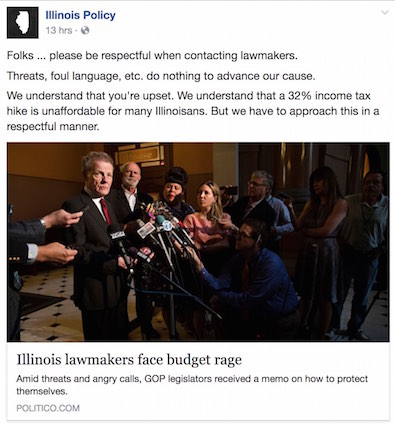
* A few examples from comments on that post, with expletives edited by me…
Jarrod Dowell: I think we’re beyond respect now. Look at the complete lack of respect these piece of sh*t scum bags have while claiming to “serve” the citizens. F*ck them! Maybe it’s time to water the tree of liberty.
Paul Sr Cappetta Eat sh*t Madigan!
Eric Quesada: I have a lot of respect for this page but I think it’s being on threats, these f*ckers are steeling tha people’s money, I think it’s time to go to war and get rid of them, just my opinion
Hallene Brooks: Respect is earned as it is given, these scumsucking Springfield parasites do not deserve one iota of respect, for what?? For spewing lies in order to get elected over & over again, to continue to blatantly extort the actual WORKING citizens of this sorry-*ss state?? Screw them & the golden taxpayer-funded horse they rode in on, they have no respect for their citizens, they get none, they’d prbly try to tax us for that too, thieving b*stards…..
Tim Mangia: Respect???
Since when has Madigan and his crones respected anybody but themselves!!! F*ck Madigan!!! He deserves to be b*tch slapped!!! This is exactly why our good Trump was elected! The hardworking middle class is sick and tired of getting spit on and kicked in the gut, (metaphorically speaking!), while the lower class gets more money every month and a sh*t ton of tax credits, and food stamps while driving around in cadillac escalades that have rims that cost more than my whole d*mn car!!! F*ck Madigan and any politician that votes to undo Rauner’s veto!!! It’s f*cking time the middle class gets what we have earned!!!
Reese Hartman: *sshats temp. Raised it before. What happened to all that money?? Madigan is a piece of sh*t that needs to go! GONE! f*cking clowns are completely ruining this state if they haven’t done so already
Carmine Coglianese: See thats the thing we don’t respect crooks and cronyism. A good old Lynch mob used to clear this sort of thing up QUICK! To H*LL with the Madigan’s, to h*ll with corruption, special interests and lobbyists. Here’s to term limits and running the scum out of office!
Teresa Hutchens Jimenez is a lying cow, Chad Hayes is a coward and Madigan is a money mongering *sshat. He has been the author of the downfall of a once great state. He is concerned with nothing but his lucrative pension while the taxpayers he is supposed to help and protect are dying without their medical care and starving. I squarely out the blame on those who re-elected the murderer.
Christopher O’Connor: so are pitch forks and torches respectful? I think it is about time for a lynch mob in springfield.
Tom Sye: Hey you f*cking lawmakers do you mother f*cking jobs you worthless pieces of sh*t. You all should be put to death for f*ck the Illinois citizens over! We citizens should be able to have you in a locked room with each of you *ssholes. That would be justice. You should pay back Illinois with those fat pensions you will be steeling from us.! You talk about respect you pr*cks you earn it oh boy you have not. So take this the wrong way when I tell you to go f*ck yourselves
Chuck Clifton: Why should we give a sh*t about them they don’t give a sh*t about us receiving threats well yeah I guess so me personally I hope he has a heart attack and dies
Paul Hart: You mean I shouldn’t say madigan go f*ck yourself. Is eat sh*t and die ok?
Dave Langenhorst: How about rope and tree for Madigan!!
And, remember, these were under a post supposedly designed to encourage civility.
87 Comments
|
* Gov. Bruce Rauner said this yesterday about the proposed tax hike…
“This is not just a slap in the face to Illinois taxpayers. This is a 2-by-4 smacked across the foreheads of the people of Illinois.”
* Chris Kennedy is understandably appalled at this sort of rhetoric by our state’s top elected official, or from anyone, for that matter. From his campaign…
“We have seen an increase in violent political rhetoric both in Washington and Illinois. That type of rhetoric has no place in the political discourse. We can disagree with one another on policy and politics without resorting to violence or political rhetoric that encourages violence. We should have vigorous debate, discussion and disagreements, but it should never veer towards violence ever.”
*** UPDATE *** The Pritzker campaign responds harshly and, unlike Kennedy, actually mentions the governor’s name…
The Trump administration has been marked by bald-faced lies, attacks on the press, inciting violence, and unrepentant hypocrisy. Bruce Rauner has not only failed to condemn this destruction of our norms and civility, he’s now adopted many of the same techniques as Donald Trump.
A particularly egregious example came in Rauner’s press conference yesterday. While Rauner used to campaign on the importance of the state having a good credit rating, now, as he finishes his push towards Illinois receiving junk status, he has completely changed his tune. Rauner’s attacks on members of his party for holding him accountable, and violent rhetoric, comparing the bipartisan budget he vetoed to a “two-by-four smacked across the forehead” are simply unacceptable. With Rauner on the precipice of watching his special interest agenda fall apart, the failed governor is getting desperate – Trump style.
“With no real accomplishments and a record of creating devastation, Bruce Rauner is desperately resorting to the Donald Trump playbook of preying on people’s fear and anger,” said Pritzker campaign spokeswoman Jordan Abudayyeh. “This is the lowest form of politics and entirely unbecoming of our state’s highest office. It is evidence of a governor who has failed on every level. Bruce Rauner can continue hiding behind Trumpist tactics of inciting violence and gas-lighting the public, but it won’t change the fact that he has unleashed long term damage on Illinois.”
38 Comments
|
* In a legally binding decision, the attorney general’s office ruled yesterday that the governor’s office has violated the Freedom of Information Act law by refusing to respond to a request for public documents. Attorney General Lisa Madigan then ordered the office to comply with the statute.
This past March, the Springfield Business Journal submitted a FOIA request to the governor’s office. It asked for all e-mails sent and received by former Comptroller Leslie Munger since being appointed deputy governor as well as her public schedule.
The publication never received a response, even after six separate e-mail requests, so they contacted the AG’s Public Access Bureau in May.
The Public Access Bureau attempted twice to get a response from the governor’s office to no avail.
So, yesterday Attorney General Madigan ruled that the governor’s office had violated the law and ordered it to comply. The governor either has to comply or take the matter to court.
Click here to read the order.
31 Comments
|
This is real and cannot be dismissed
Thursday, Jul 6, 2017 - Posted by Rich Miller
* On Facebook…
* On Twitter…
* It goes beyond “mean Facebook comments.” This memo was sent to House Republicans yesterday afternoon. There is a real and legitimate fear brewing…
Dear House Republican Members,
[The HGOP’s] Digital Media Manager, has prepared the information below to help guide members who experience abusive social media comments.
What to do if you receive threats on Facebook, Twitter or other social media accounts:
* If you feel the threat is imminent call 911
* Report threats of violence immediately to State Police at this phone number: 877-xxx-xxxx
* Then report to social media platform - here’s how
* Facebook:https://www.facebook.com/help/181495968648557?helpref=faq_content
* Twitter:https://support.twitter.com/articles/20169998#whatshouldido
* Or, ask your communications staffer for help
Others ways to manage posts or comments:
* Delete comments containing profanity, name calling, or libelous statements.
* Hiding a comment will leave it visible only to the person who posted it and their friends.
* Like or comment on positive comments - which will push them to the top of news feed. This is a very good strategy.
* Ban individuals who repeatedly post abusive comments especially if they are not constituents.
Call me if you have any questions or issues.
* We’ve already discussed much of the info in today’s Politico story…
One legislator was called a “f—-ing animal.” Another was told he’d be “hanging from a tree.”
“You are selling your soul to the devil,” said a message to GOP House floor Leader Steven Andersson, who reported receiving a steady flow of abusive text messages and calls — including a death threat. “I’m coming for you,” it said. Now the Illinois State Police are investigating. […]
Andersson said he didn’t believe any of the 15 GOP members were backing off their original votes.
Stoking the backlash are well-funded anti-tax groups such as the Illinois Policy Institute, whose staffing exceeds that of some legacy newspapers. That group had warned its subscribers that Andersson and another lawmaker might vote with Madigan. Andersson’s cell phone was somehow distributed as well as those of several other GOP members who voted for the tax hike, Andersson said. The Illinois Policy Institute said Wednesday it does not release or post lawmakers’ cell phone numbers.
74 Comments
|
|
Comments Off
|
|
 Support CapitolFax.com
Visit our advertisers...

 ...............
 ...............
 ...............


|
   
|
Hosted by MCS |
SUBSCRIBE to Capitol Fax |
Advertise Here |
Mobile Version |
Contact Rich Miller
|



