* Illinois State University is looking for a new president, and some are wondering if it’s a coincidence that Gov. Pat Quinn is now tinkering with ISU’s board of trustees…
Gov. Pat Quinn has taken steps to boot at least one Republican — and possibly a second — off the governing board at Illinois State University just weeks after triggering a political slugfest over Southern Illinois University trustees.
On Monday, the Democrat from Chicago nominated Barlett resident Bob Churney to replace Bloomington businessman Bob Dobski on the ISU board. The terms of Dobski and Joanne Maitland, the longest-serving trustee, officially ended in January.
Under a state law that took effect last year, their positions became vacant when Quinn took no action within 60 days of their term’s expiration. There was no indication Monday whether Maitland will be reappointed.
Joanne Maitland is former Sen. John Maitland’s wife. Not a good move by the governor. Quinn’s spokesman totally denies any ulterior motives, but…
State Sen. Bill Brady, R-Bloomington, called the situation unfortunate and disappointing.
“I’m appalled at the fact he would do this and I’m appalled at how he’s done this,” said Brady, Quinn’s opponent in the 2010 gubernatorial battle. “It’s disappointing. I couldn’t thank Bob Dobski and Joanne Maitland more for their service to their ISU board.”
If he used half the energy he’s expended on university boards and applied it to something positive at the Statehouse, the governor might actually be able to get something done in the General Assembly.
* Meanwhile, the plaintiffs and the state have both asked the Illinois Supreme Court to hear a direct appeal of a county judge’s ruling on the constitutionality of cutting government health insurance benefits…
Illinois officials have agreed to ask the state Supreme Court to directly hear the appeal of cases challenging the state’s authority to begin charging retirees premiums for their state-subsidized health insurance.
If the Supreme Court agrees, it will lead to a quicker resolution of whether the state can begin charging the premiums.
Last month, Sangamon County Judge Steven Nardulli ruled that state-subsidized health insurance for retirees is not a pension benefit protected by the state Constitution. He dismissed four lawsuits that were filed seeking to stop the state from imposing insurance premiums on retirees.
Springfield attorneys Don Craven and John Myers, who filed one of the lawsuits, appealed the decision to the 4th District Appellate Court. However, they also filed a request to the Supreme Court to hear the appeal directly, bypassing the appellate court. Craven said Monday the case was likely going to end up with the Supreme Court at some point anyway.
The FY 14 certified contribution appropriation for the five retirement systems is a combined $6.8 billion. This is an increase of $965 million, or 16.4% compared to the current fiscal year. Under current law, estimated payments in fiscal years
2015 and 2016 are $7.0 billion and $7.2 billion, respectively. The FY 15 estimated payment is an increase of $200 million, or 3% over FY 14. The increase in FY 16 is an additional $204.7 million (3%).
The future amounts aren’t as huge as they have been, but that’s still a lot of cash.
* Roundup…
* Cahokia looking at teacher, athletics cuts: A southwestern Illinois school district is blaming cuts in state funding for its tentative plan to eliminate dozens of teaching jobs and go next school year without an athletics director, coaches or extracurricular activities.
* New name emerges in Illinois Treasurer race: Carter describes himself as a “conservative media pundit and entrepreneur” who was raised in Chicago, went abroad and returned.
* Jackson Successor, Former Bear McMichael, Urlacher Brother On Ballot Today
The exact cost of HB 2762 is impossible to determine. Additional students means the cost of General State Aid will increase. However, the Illinois State Board of Education is unsure of the exact number of students who will be impacted by lowering the compulsory attendance age from 7 to 6, nor does the ISBE know which districts will see an increase in the number of students as a result of this legislation or if those children will be low-income students, which increases the cost of the poverty claim for the district.
* The Question: Should the compulsory school age be lowered from 7 to 6? Take the poll and then explain your answer in comments, please.
A memorial service for Dawn Clark Netsch, professor of law emerita, will be held at 2 p.m. Saturday, April 13 in Thorne Auditorium, Northwestern University School of Law, 375 E. Chicago Ave., in Chicago. The service is open to the public. A reception will be held in the Atrium immediately following the service.
Donation info is here. Northwestern has set up a “guest book” here.
Mayor Rahm Emanuel had some big shoes to fill when he took over for Mayor Richard M. Daley when he was inaugurated as mayor in May 2011. But according to a study released by the University of Illinois-Chicago, the City Council has been more compliant with Rahm in his first two years than they were with Richard J. Daley during his first two years in office and more than Richard M. Daley had in his final two years in office. Dick Simpson, a political science professor at UIC and a former alderman (44th ward, 1971-1979), headed the study which looked at “30 divided roll call votes since the current City Council began in May, 2011.” (Grain of salt #1: even just one alderman dissenting is enough to categorize a vote as a “divided roll call.”)
Per a press release on the study: “According to the study, 21 aldermen voted to support Mayor Emanuel’s position 100% of the time and 18 aldermen voted with him over 90% of the time. Only seven of the 30 issues drew six or more dissenting votes.” The study follows up that the issue with the most dissent was Mayor Emanuel’s proposal to put cameras in “Children Safety Zones” around schools. That vote had 33 vote in favor and 14 dissent (three voted absent).
The study continues: “The average level of support for Mayor Emanuel was 93% on all divided roll call votes, an increase from the overwhelming 88% Richard M. Daley enjoyed in his last term. It was also greater than the 83% achieved by Richard J. Daley in his first two years in office, 1955-56, or the 85% support the ‘Boss’ received in 1971-72. Emanuel even topped Mayor Edward J. Kelly’s 88% support earned in 1939-40.”
Aldermen claim that they voted more often with the mayor because Mayor Emanuel was more willing to compromise with them than Mayor Daley had been. When aldermen pushed back on cuts to staff and library service hours in the 2012 budget battles, the mayor agreed to reduce the cuts. Or when the rules for NATO Summit protests were too draconian and aldermen objected, the mayor made the rules less restrictive. So some aldermen argue that they vote with the mayor more often because they are able to work out compromises behind the scenes.
Yet, in two years since the mayor and the city council were sworn in, there have been only 30 divided roll call votes. The number remains at about the same level as under Mayor Daley at about two a month. Historically, the number of divided roll call votes has ranged between 50-100 a year and peaked at 387 divided votes during Mayor Eugene Sawyer’s two years in office during the chaos that which followed Council Wars from 1987 – 1989.
* My former intern Mike Murray is running for Schaumburg Township trustee. The Schaumburg Township Republican Organization sent out a mailer with Mike’s photo on a milk carton…
Well, yeah. He’s not a trustee, so of course he isn’t in the public records.
Kind of a lame attack if you ask me. I mean, sheesh, the local GOP should’ve just called me if they wanted some opposition research.
Just kidding.
Mostly.
Also, they have his name as Mike Murray and Mike Murphy. Proofread much?
* The comments on GOP state Rep. Ed Sullivan’s Facebook page have been overwhelmingly positive since he announced he was voting for the gay marriage bill. But, there’s always one goofball in the bunch…
Notice that Mr. Badenorst “liked” his own comment. I don’t get why people do that.
Hyperpartisans make me ill. The guy is with you. Get over yourself.
Also, keep in mind that the entire nation is being moved to support gay rights as more gay people have come out of the closet. So, that commenter’s “logic” (which some national Democratic pundit types have also been using) isn’t just an indictment of Republicans, it’s an indictment of the majority of Americans.
With the Illinois state Legislature set to return from recess, the National Organization for Marriage (NOM) today reiterated its pledge to spend $250,000 defeating Republican legislators who vote in support of same-sex ‘marriage’ in Illinois, just like NOM successfully did in New York.
“Any Republican in Illinois who betrays the cause of marriage will be casting a career-ending vote and will be held accountable to their constituents,” said Brian Brown, NOM’s president. “We will spend whatever it takes—hundreds of thousands of dollars if necessary—to remove them from office, just as we did three of the four turncoat Republican state Senators in New York who were responsible for gay ‘marriage’ passing there. We will not hesitate to support pro-family Democrats to replace them, as our record in New York proves.”
In New York, same-sex marriage narrowly passed the state senate after four Republicans and two Democrats changed their votes in response to promises of campaign cash from gay marriage activists. NOM targeted all seven for defeat, and was successful in removing five of them, replacing them in 2012 with pro-family Senators. As numerous media have reported, including the New York Times, three of the four Republicans were removed from office despite promises by Gov. Andrew M. Cuomo, Mayor Michael R. Bloomberg and gay-rights advocates to do everything in their power to protect them against political retribution. (”Costly Toll for Republicans Who Voted for Gay Marriage”).
In addition to supporting challengers to the four Republicans, NOM also supported pro-family Democrats, helping to re-elect Senator Ruben Diaz and electing a pro-marriage Democrat to unseat Senator Shirley Huntley in the Democratic primary. “Marriage is not a partisan issue,” Brown said. “We will stand with pro-family legislators regardless of party affiliation when they stand up for true marriage.”
I’ve asked NOM for a specific react to Rep. Sullivan’s announcement. Stay tuned.
* Coverage roundup…
* VIDEO: Illinois Republican lawmaker supports gay marriage
* National prognosticators are saying that Gov. Pat Quinn is favored to win reelection. From the New York Times’ FiveThirtyEight blog…
Although Mr. Quinn is the second most unpopular governor up for re-election in 2014, he is a Democrat in deep blue Illinois. If he runs, he is still considered a favorite to win re-election: the Cook Political Report, Sabato’s Crystal Ball and The Rothenberg Political Report rate the Illinois governor’s race, respectively, as leaning Democratic, likely Democratic and likely Democratic.
Despite Quinn’s terrible approval ratings, this is still a Democratic-leaning state. And 2014 doesn’t yet appear to be shaping up to be as horrible of a year for that party as 2010 was. So, those ratings are understandable.
Notice, however, that this is about a Democrat vs. a Republican. If Quinn is challenged in the primary, then all bets are off.
Tuesday, Apr 9, 2013 - Posted by Advertising Department
[The following is a paid advertisement.]
If passed, the Natural Gas Modernization, Public Safety and Jobs Bill (SB 1665/HB 2414) will:
• Provide Illinoisans with a more reliable, modern natural gas distribution system and reduce the adverse effects of pipe failures or gas leaks;
• Save customers money through new efficiencies in system operations and maintenance, including a reduction in repair costs and the need for repeat visits;
• Protect over 1,000 Illinois jobs;
• Boost our economy. Peoples Gas’ modernization program is expected to directly invest approximately $2.5 billion into the economy over ten years, which is anticipated to generate an additional $3.7 billion into the Illinois economy; and,
• Deliver environmental benefits to Illinois through a reduced release of greenhouse gas emissions. By upgrading and replacing around 1,000 miles of mains, Peoples Gas will reduce methane emissions by the equivalent of about 96,250 metric tons of CO2e, which is comparable to taking around 19,000 cars off the road, once the project is completed.
Illinois needs to invest in our natural gas infrastructure, but our state needs to enact a sound regulatory framework that gives utilities the certainty to invest.
CME Group Inc. paid its former CEO Craig Donohue $6.1 million last year, making him its highest-paid executive even though he held the post for only the first four months of 2012, according to a regulatory filing on Monday.
Donohue’s total compensation, including salary, bonus and stock and option awards, exceeded his previous year’s take of $6 million, the company’s 2013 proxy statement showed.
That was more than Phupinder Gill, who succeeded Donohue as CEO on May 1, 2012. Gill received total compensation of $3.3 million last year.
And it was more than Executive Chairman and President Terrence Duffy, whose total compensation was $4 million.
* Sen. Terry Link, speaking about trying to pass a gaming expansion bill and Gov. Pat Quinn’s demands…
“We have to figure out how (the bill) gets passed before we can do anything else,” Link said of accommodating Quinn’s demands. “At last count, I don’t remember him passing any legislation in his lifetime.”
“Any Republican in Illinois who betrays the cause of marriage will be casting a career-ending vote and will be held accountable to their constituents,” said Brian Brown, president of the National Organization for Marriage.
1. Eliminate the individual state income tax and the state corporate tax.
2. Give every parent in the state a school voucher to send their children to whatever school they want to send them to — public, private, religious, or home.
3. Place every government employee on a defined contribution, 401(k) style retirement plan.
4. Begin immediately tapping into our natural gas and oil reserves.
5. Eliminate township governments.
6. Give every law-abiding adult the right to carry a concealed weapon.
7. Have a federal prosecutor investigate how Michael Madigan and his legal clients have benefited financially at taxpayer expense from his role as Speaker.
8. Tell Judy Barr Topinka to retire.
An early reference to Chicago’s institutional dysfunction involves a double entendre. “Madigon” can double as a slur and a reference to an Illinois political power-family, the Madigans. Lisa Madigan, the Illinois attorney general known for her tough stance on gang violence, is the adopted daughter of another bigwig in state politics. Michael Madigan has been speaker of the Illinois House of Representatives for the better part of a quarter-century. The Audy Home, meanwhile, is an infamous under-18 prison in the Chicago area.
* Roundup…
* Southern Illinois counties seeing first of fracking rush: Hundreds of thousands of dollars in fees have flowed into county coffers from a stream of “land men,” often out-of-staters who converged in recent years to scour title records for prime parcels for exploration. County clerks funneled much of that windfall into digitizing bulky, age-yellowed record books that took a toll from all the frenzied searches.
* Debt piles up behind bars: An Illinois prisoner can accrue tens of thousands of dollars in child support debt while incarcerated because of Illinois child support laws.
* Logan Correctional Center: Prison inmates housed in gym: The Illinois Department of Corrections placed about 30 female prisoners into temporary dorm units at the Logan Correctional Center’s gymnasium on Wednesday, according to IDOC spokesperson Stacey Solano.
* Diplomat Killed on Afghan Mission She Coveted: “Only 25 years old, this brave young woman knew social justice was her calling, and selflessly lost her life while serving others in a war-torn country,” [Gov. Pat Quinn] said. “She was devoted to protecting America and improving the lives of others.”
* I went to see Dwight Yoakam last night. I’d heard earlier that a friend of mine had seen him walking with a cane near his hotel and wondered how the show would go. From my seat in the bleachers I could see Yoakam hobbling back stage. It looked like the poor guy could barely walk.
But then Yoakam hit that stage and played for over two hours, dancing away while belting out song after song, plus an encore.
Yoakam’s most recent album is last year’s “Three Pears.” The title of the album was inspired by a scene in a George Harrison documentary that showed John Lennon playing around with three pairs of glasses. Yoakam liked the contrast between the serious personae that Lennon had developed at that point in his life and the playfulness being depicted on screen.
Three pairs became “Three Pears,” which then became one of the most critically-acclaimed albums of 2012. Yoakam appeared on more critic’s year-end lists than any other country artist, including NPR’s “50 Favorite Albums” and Rolling Stone’s “50 Best Songs,” for the single “A Heart Like Mine.”
He emerged on the national scene in 1986 with the album, “Guitars, Cadillacs, Etc. Etc.” The title track hit No. 3 on the Billboard Hot Country chart, and then 26 years later inspired a local business owner to name his new bar Guitars-n-Cadillacs Saloon.
I heard he ended up at that bar last night, but I had to go home. Duty calls. I did wake up feeling kinda bad this morning, but that image of Yoakam struggling to walk and then toughing it out onstage got me out of bed. The man is a true professional and an inspiration. Above all else, though, he’s one heck of an artist.
* After going through the standard explanations of why state courts could use the Illinois Constitution’s strict language to strike down most of the pension reforms currently being debated, Laurie Reynolds, the Prentice H. Marshall Professor of Law at the University of Illinois talks about another possibility…
The other interpretive path is that no provision of any constitution is absolute, no matter how absolute its language. The U.S. Constitution, for example, has a “contracts clause” that explicitly states “No State shall make any law … impairing the obligation of contracts.” Just like the Illinois pension clause, that clause appears on its face to impose an absolute ban on any law that would impair contractual obligations.
If you were to read the U.S. Supreme Court’s case law interpreting that provision, however, you would find that the court has interpreted the clause to mean that, “No state shall make any law impairing the obligation of contracts … unless the impairment is reasonable and necessary to serve an important public purpose.”
If the Illinois Supreme Court takes this approach to the interpretation of the pension clause, then the constitutionality of any legislative action to solve the pension crisis is going to depend on how clear and convincing the evidence is that the state is in a disastrous fiscal crisis. If the state of Illinois can establish that there are no reasonable alternatives to reducing benefits that have accrued – and that, for instance, tax increases and spending decreases just can’t fill the hole – then I don’t think the Illinois Supreme Court is going to issue an opinion that would in essence push the state of Illinois into default. If, in contrast, a strong case can be made that the state can meet its unfunded pension obligations without running itself into the ground, then the court is more likely to invalidate the legislative cuts.
Q: Recently, an Arizona Superior Court overruled an attempt to lower cost-of-living-adjustments for existing employees. Arizona also has a constitutional impairment clause similar to the one in Illinois. What, if anything, can we conclude from this precedent?
Reynolds: Each state is the “master” of its own law. Illinois courts do not have to follow the decisions of courts in other states and the court decision in Arizona is technically irrelevant to Illinois. While courts of one state do occasionally cite decisions from another state, there are remarkably few cases in which one state court uses a different state’s court opinion as a persuasive precedent. On the other hand, state courts routinely parrot federal constitutional and statutory interpretation cases in developing their own jurisprudence, which is another reason why we would not be shocked to see Illinois following the U.S. Supreme Court’s line of analysis with regard to the contract impairment issue.
Discuss.
*** UPDATE *** From a subscriber…
There is, of course, the Illinois Supreme Court’s ruling from Jorgensen v. Blagojevich that draws what appears to be a pretty clear line in the sand.
* I’m told that state Sen. Michael Frerichs (D-Champaign) will report raising almost $200,000 in the first quarter, giving him more than $500,000 cash on hand. As you may already know, Sen. Frerichs is gearing up to run for state treasurer.
Here’s a little nugget to contemplate while discussing Frerichs’ chances: The last time a non-federal statewide Democratic candidate won both the primary and the general election was 1982, when southern Illinoisan Jim Donnewald won the treasurer’s race.
I’m sure there’s a real hunger out there for a statewide Democratic Downstater. But there are also some serious roadblocks, mainly caused by Cook County. They like their candidates liberal and local.
Discuss.
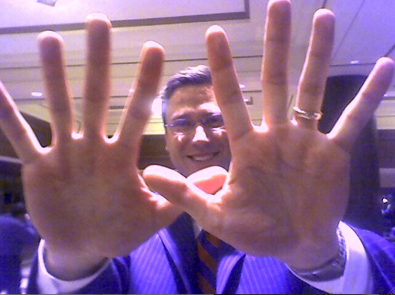
* Frerichs is a tall guy with huge hands. I took this photo of him several years ago…
Much of NOM’s money has been spent on consultants and pastors who oppose gay marriage. For instance…
The PAC’s public face, Bishop Larry Trotter, got $1,000 for “clergy consulting”. The PAC’s chairman, Lance Davis, got $1,000 for “clergy consulting.” The PAC’s treasurer, Marlo Kemp, got $2,100 for “administrative management.”
Public relations flack, Sean Howard, who has hovered under Trotter’s halo for years and who flits from office holder to officer holder, has pocketed $3,600 for “media” and “production.” Lobbyist Frank Bass got $3,600 for “consulting.” Attorney Anthony Bass pulled in $4,000 for “legal services.”
Convergent Consulting Group, whose Illinois corporate status was involuntarily dissolved in 2002, got $2,100 for a cheesy-looking Web site whose mission statement says nothing about opposing same sex marriage.
State Rep. Ed Sullivan Jr. of Mundelein said Sunday he will support a bill to allow gay marriage in Illinois, becoming the second House Republican to do so and first among leadership.
Sullivan, who is chairman of the House Republican campaign organization, said his decision to back same-sex marriage represented a personal and family evolution on the issue. Previously an opponent of civil unions, Sullivan told the Tribune that his mother-in-law, who lives in the southwest suburbs, has been in a same-sex relationship. […]
A state representative since 2003, Sullivan and state Rep. Ron Sandack of Downers Grove are the only House Republicans to publicly announce their backing of the same-sex marriage bill, which already passed the state Senate. With House lawmakers returning to Springfield on Monday after a two-week break, supporters of the measure have said they were within a dozen votes of the 60 needed to pass it.
Sullivan said he believes more Republicans among the 47 in the House will sign on. […]
“I try to err on the side of being a public servant and serving my district as opposed to potentially being a politician and just serving that subset (opposed based on religion) and those within my party who don’t necessarily want this to pass,” he said. “I look at this as a freedom, as a conservative view of treating people equally.”
You can always tell when somebody is losing an argument because they’re constantly backtracking and recalibrating. And it’s no different with gay marriage.
In January, for instance, newly elected state Sen. Jim Oberweis (R-Sugar Grove) freely admitted that gay marriage was at the heart of his desire to oust state Republican Chairman Pat Brady, who’d recently announced his support for a Senate bill to legalize same-sex marriage.
“I believe we have to have a meeting to ask Pat for an explanation, to modify his actions or get a new CEO,” Oberweis told the Kane County Chronicle then. “Our CEO has taken very open, public action contrary to the organization, and that’s unacceptable.”
Immediately, however, more moderate GOP leaders pushed back hard against Oberweis, saying that ousting the party’s chairman over gay marriage would send absolutely the wrong message to the voting public, which was coming around fast to supporting the issue.
Young people, in particular, count themselves as strong supporters of the concept, so staunchly advocating outdated policies would continue to stunt the party’s potential growth.
Oberweis didn’t give up his challenge to Brady. Far from it. Indeed, he apparently came within a weighted percentage point of the required 60 percent vote to oust Brady during a planned emergency state party meeting last month.
The meeting was canceled when some central committeemen decided to heed the commands of party leaders such as U.S. Sen. Mark Kirk and House Minority Leader Tom Cross (R-Oswego) and backed off.
But while Oberweis didn’t drop his attempt to force Brady out, he did change his tune on the reasons. A month after saying it was all about gay marriage, Oberweis told Chicago Public Radio “it has nothing to do with gay marriage.”
That even a guy like Oberweis felt the need to drastically retool his public message shows how far this issue has come — and how even some on the hard social Right now understand that they have to walk a whole lot more softly or risk a voter backlash.
Since then, Republican leaders who want Brady ousted have kept a lid on their conservative colleagues’ inflammatory rhetoric and tried to focus their ire on Brady’s performance during last year’s election campaign.
Those objections ring hollow, however, because none of the state central committeemen uttered so much as a peep about Brady’s tenure during a post-election state party meeting in December.
This putsch is all about gay marriage, but the coup plotters at least have the sense to try and couch their terms in a more acceptable manner, which means that even they know they’ve lost the public debate.
State Sen. Bill Brady (R-Bloomington), a conservative Catholic who has long opposed gay marriage, has not taken a public position on Brady’s tenure.
Sen. Kirk Dillard (R-Hinsdale), who has moved further to the right since losing the 2010 GOP gubernatorial nomination to Bill Brady, is, like his former opponent, staunchly opposed to gay marriage. But like Sen. Brady, Dillard has refused to take a position on Chairman Brady’s support for the issue, leaving it up to the state central committee to decide whether he should remain as chairman.
None of this is meant to suggest that state Sens. Oberweis, Brady and Dillard are about to switch sides and support gay marriage, as Kirk did recently.
But it does suggest that even these hardened conservatives understand that they’re on the wrong side of this issue and must tiptoe around it for fear of damaging their political party.
Two years ago, it would’ve been considered impossible that an Illinois Republican chairman would so publicly support gay marriage. That, in and of itself, shows how far and how quickly public sentiment on the issue has changed.
But Pat Brady has always been a part of the party’s more moderate wing. I think what’s more important here is how even some of the state’s top social conservatives are moderating their public messaging on same-sex marriage.
The battle for the potentially pivotal votes of African American legislators on a bill to legalize gay marriage in Illinois intensified Friday — as opponents and proponents alike pulled out the big guns.
Leading the opposition, Cardinal Francis George and a group of black ministers launched an aggressive campaign against same-sex marriage to be waged through radio commercials and telephone calls.
Weighing in on the other side, national civil rights leader Julian Bond sent a letter urging legislators to grant equal rights to “my gay and lesbian brothers and sisters.”
All politics is local and Julian Bond is not local. No contest on this one.
He approved a measure that allows the governor to deny collective bargaining rights for up to 3,580 managers and supervisors.
The traditionally pro-labor Quinn has supported the idea, sponsored by fellow Democrats, since it got House approval in 2011 — while at the same time excoriating his Wisconsin Republican counterpart for pushing through a law that rolled back union bargaining rights.
The law applies to “managerial or supervisory” positions under the governor and other statewide offices — such as the secretary of state and attorney general — that are not currently represented by a union or those who have gained representation since December 2008.
Supporters of the measure argue that state executives can’t effectively run the government with so few managers loyal only to them. They say that 97 percent of the state workforce now wears the union label.
* AFSCME Council 31 explained the bill to its members late last week via e-mail…
Allows the governor to designate up to 3,580 positions as exempt from coverage under the state collective bargaining law based on extremely broad criteria;
Provides that up to 1,900 of those can be positions that had previously met the criteria for coverage under the collective bargaining law and are currently represented by a labor union;
Provides that those designations must be made within one year of the effective date of the legislation;
Allows the governor’s designations to be challenged before the Illinois State Labor Relations Board, but provides that such designations “shall presume to have been properly made”—making it extremely difficult to prevail in such challenges.
* The union also updated members on negotiations to water down the bill’s impact…
AFSCME has been following up on the commitment made by its sponsor, Senator Don Harmon, to attempt to minimize the negative impact that the bill will have on union-represented employees. Sen. Harmon is facilitating negotiations between the union and CMS in which AFSCME is seeking to secure an agreement that:
1. the governor will not remove all 1900 positions that the law permits;
2. no employee removed from the bargaining unit will suffer a reduction in pay;
3. employees designated to be removed will be offered the option of taking another bargaining unit position.
AFSCME will not give up this fight. We’ll continue to represent to the fullest extent possible under the Personnel Rules members who are removed from the bargaining unit. And wherever the facts warrant, we’ll challenge removals at the Labor Board.
* In other news, AFSCME warned its members about possible upcoming pension votes…
The assault on retirement security for state employees is going into high gear in the House of Representatives. Just before legislators went home for their “spring break,” the House passed HB 1165, with strong bipartisan support. HB 1165 was considered a “test bill” to see if enough legislators would vote to cut the pension cost-of-living adjustment (COLA) for active and retired state employees.
The COLA plan they voted for is the same one that is included in HB 3411, the Nekritz/Cross bill. It would reduce the pension benefit of an average state employee by some $50,000 over the first ten years of retirement. HB 3411 would also raise the retirement age and increase employee contributions. It puts the whole burden of solving the pension crisis on the backs of public employees.
HB 3411 is now expected to be called for a vote when legislators return to Springfield [this] week. […]
We Are One Illinois has made clear that public employees recognize the severity of Illinois’ pension crisis and are prepared to do our part to help ensure the solvency of the state’s pension funds. The coalition stands ready to work collaboratively toward developing a fair and constitutional solution.
I haven’t been able to confirm whether the Nekritz bill will be called for a vote this week. Stay tuned.
* A good friend sent me an e-mail about Attorney General Lisa Madigan’s fundraising report for the first quarter. Yes, she did outdo Gov. Pat Quinn by quite a bit, but my friend reminded me “she’s playing a longer game now than just him.”
First, he pointed to Rod Blagojevich’s D2 for the first six months of 2005, the same period we’re in now ahead of the 2014 race. Blagojevich started the period with $10 million and raised $4.6 million. As my friend points out, that averages $2.3 million a quarter and $773K per month.
By contrast, Madigan had $3.6 million in the bank at the end of last year and has disclosed raising about $770K so far this year.
* He also pointed to Scott Kennedy’s quite comprehensive web page which totals campaign contributions by race for the past several years.
After transfers between funds are calculated, Quinn spent about $38 million on his 2010 primary and general elections combined. From my friend…
A governor’s race costs $30 million in this state, minimum.
So, her $4.3 million on hand is way, way behind. She’s going to need to blow open the caps or a superpac needs to do the dirty work for her.
Otherwise, her floor is 4 million dollars a quarter going forward.
In the wake of President Barack Obama apologizing to California Attorney General Kamala Harris for complimenting her on her good looks comes this blockbuster finding from a new study: when it comes to a female candidate, any media coverage about her appearance–even positive–hurts her with voters.
That’s a key conclusion of the poll for the Women’s Media Center and She Should Run, to be released Monday in Chicago at the Council on Foundations annual conference at the Hilton Chicago, 720 S. Michigan.
The survey’s release is timely because Obama’s remark about Harris is the latest in the long-running struggle of women seeking public office, not to have their looks influence how people assess their credibility. […]
The “Name It. Change It” survey, conducted by Celinda Lake of Lake Research and Robert Carpenter of Chesapeake Beach Consulting found that when any media coverage focuses on a female contender’s appearance–positive, negative, or neutral–”it made voters less likely to vote for her.”
* Lt. Governor Sheila Simon’s Firearms Working Group has released a “checklist” that it hopes the General Assembly will use when drafting a concealed carry bill. From a press release…
* Constitutionality: The concealed carry law must uphold the right to keep and bear arms, consistent with the U.S. Supreme Court’s interpretation of the Constitution.
* Basic Qualifications: Concealed carry permits should be issued only to adult residents of Illinois who hold valid Firearms Owner Identification Cards (FOID) and do not pose a danger to themselves or others.
* Funding: The concealed carry law should also create a fund made up of user fees in order to finance the concealed carry permit application and renewal process.
* Permitting Authority: The Illinois State Police (ISP) should be the permitting authority for concealed carry, and the ISP should maintain a database of permits issued.
* Local Input: County sheriffs and local law enforcement authorities should be allowed to provide the ISP with information about whether an applicant poses a safety risk if the applicant were allowed to carry a concealed firearm.
* Background Checks: Prior to issuing concealed carry permits, comprehensive criminal background checks should be conducted along with investigations into an applicant’s mental health history, record of substance abuse and history of domestic violence.
* Firearm Training: Concealed carry permit applicants should be required to complete firearm safety and live fire training prior to receiving and renewing permits.
* Permits: Lost, stolen or destroyed concealed carry permits should be reported to authorities in a timely manner.
* Sensitive Places: Concealed firearms should be prohibited in certain public places, such as schools, which is consistent with U.S. Supreme Court guidance. Private property owners should also be able to prohibit concealed weapons on that property.
* Violations: An applicant who violates the concealed carry law or makes material false statements on concealed carry permit applications should be subject to criminal penalties.
Sen. Melinda Bush (D-Grayslake), Sen. Tom Cullerton (D-Villa Park), Sen. Bill Cunningham (D-Chicago), Sen. Michael Hastings (D-Orland Hills), Sen. Andy Manar (D-Bunker Hill), Sen. Julie Morrison (D-Deerfield), Sen. Steve Stadelman (D-Rockford), Sen. Patricia Van Pelt (D-Chicago), Rep. Christian Mitchell (D-Chicago), Rep. Emanuel Chris Welch (D-Hillside), and Rep. Kathleen Willis (D-Addison).
A couple of Downstaters are on that list, including Andy Manar, who may have some statewide ambitions.
Another takeaway for me is that the announcement makes clear that quite a few liberal Democrats have come to the conclusion that a concealed carry bill has to pass. They’re not sticking their collective heads in the sand and hoping the issue goes away.
Cunningham moved to the Senate from the House and Manar was the Senate Democrats’ chief of staff before winning a Senate seat last year, but otherwise these are all freshmen. For the most part, they aren’t as beholden to the old ways of doing business in Springfield. It was an interesting move by Simon to persuade these freshmen to get on board.