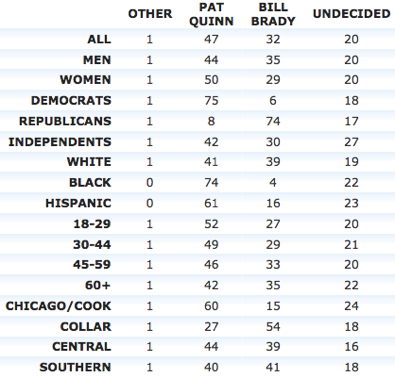
* A new statewide poll taken by Research 2000 for Daily Kos has Pat Quinn and Alexi Giannoulias with significant leads over their GOP opponents. Full results here.
First, a big advantage for Quinn vs. Brady…
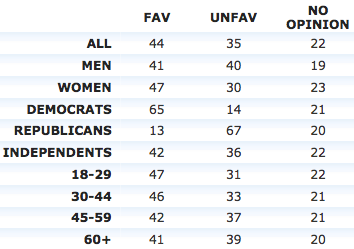
Pat Quinn’s favorables…
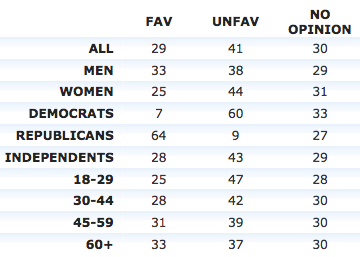
Bill Brady’s favorables…
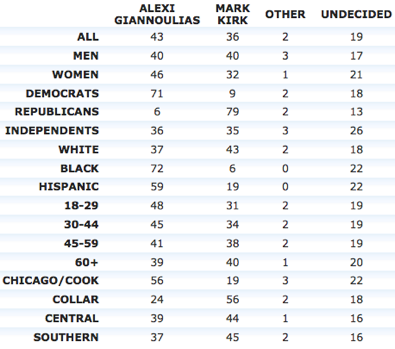
* Giannoulias vs. Kirk…
Giannoulias’ most recent poll had him ahead 49-45. Research 2K’s last poll in January had the race at 38-30.
The poll of 600 likely voters had a margin of error of +/- 4 percent. It was taken Feb. 22-24.
After a tougher primary race and whispers of a scandal surrounding a bank associated with Giannoulias’ family, Giannoulias is actually more popular than Kirk, according to the poll. Giannoulias is viewed favorably by 49% of respondents, while 34% view him unfavorably. Kirk’s fav/unfav rating stands at 42%/35%.
Despite a difficult climate for their party, Dems have been seeking to portray Kirk as the DC insider in the race. Among indies — those most likely to be disillusioned with DC — Giannoulias leads Kirk by the smallest of margins, 36-35%.
Kirk trounced challenger Patrick Hughes, who ran to his right, in the GOP primary. But his moderate creds, such as support for the Dem energy bill last spring, aren’t yet paying off in the general. He is capturing just 9% of the Dem vote in the poll, while Giannoulias holds 71% of Dems.
Meanwhile, IL’s most famous DC export, Pres. Obama, remains popular among the voters he once represented in the Senate. Fully 60% of ‘10 LVs view Obama favorably, while 36% have an unfavorable impression of him.
* I’m not the only one who can’t get a call-back from Forrest Claypool…
Cook County Commissioner Forrest Claypool, who’s retiring from that spot to go into private business, so far isn’t returning calls about a report in Capitol Fax that the White House wants him to replace Mr. Cohen on the November ticket.
Mr. Claypool has, frankly, seemed a bit burned out on public life lately, and winning in November is no sure thing. On the other hand, the commissioner is the best of buddies with presidential counselor David Axelrod, who can be mighty persuasive.
* Our afternoon video was taken by my intern Dan Weber. Rep. Elaine Nekritz (D-Northbrook) criticized the General Assembly this afternoon during a speech on the House floor for adjourning so early on yet another “go home” day. Nekritz said she thought that the GA was “fiddling while Rome burns.”
Don’t expect to see video poker any time soon in the city of Chicago.
That’s according to Mayor Richard Daley. The machines are banned in the city. The City Council would have to repeal that ban, but Daley says that’s not on the radar.
DALEY: So I don’t know how anybody can come out for it if we don’t allow video poker in Chicago. No, there’s no discussion. No one’s ever even brought it up.
The state of Illinois approved a measure legalizing video poker last year. That was designed to raise revenue to help the state deal with a massive budget debt. Daley has previously spoken out in favor of video poker.
If Chicago doesn’t approve video gaming, they’re gonna have to find another way to fund the capital bill.
Most likely, Daley wants to put off any decision until after next year’s election. It wouldn’t exactly be easy convincing aldermen to vote to legalize the machines with all the other grief they’re getting from constituents on parking, schools, mass transit, etc.
* Speaking of capital projects, an attempt to keep Illinois’ outsized share of federal transportation dollars jumped the tracks yesterday…
The $15-billion jobs bill the Senate passed Wednesday morning hit a roadblock in the House in the afternoon, partly because it steers a large amount of highway funding to Illinois.
Some House Democrats are balking at the Senate bill because four large states would get 58% of $932 million in highway construction money set aside for special projects. Illinois would get 16%, or about $151 million; California would get 30%, and 22 states would get none.
The controversy means Congress probably will have to pass yet another short-term renewal of federal highway programs for 30 days, instead of the one-year extension the Senate adopted, creating uncertainty and making it more difficult for bidding to proceed on major highway contracts this spring. The law authorizing federal highway expenditures otherwise expires Sunday.
The dispute harkens back to the 2005 surface transportation bill and the additional funding that Illinois and some other states received for special projects when former House Speaker Dennis Hastert, R-Plano, was in power. Illinois got the second-largest share of those earmarks, which were allocated separately from highway funding distributed by traditional formulas based on population and other factors.
Are U.S. Rep. Aaron Schock, and his chief of staff, Steven Shearer, trying to influence who gets on the Republican State Central Committee? And if so, why?
Those questions are being asked by some Republican county chairmen in central Illinois.
And some of them are asking another question as well: Is Schock preparing the way to run for the U.S. Senate against incumbent Democrat Dick Durbin, D-Ill., in 2014?
The Illinois House speaker, and leader of Democrats in the state, says only a handful of people have contacted him personally about becoming the party’s lieutenant governor candidate.
One of those is Raja Krishnamoorthi. He’s the former Peorian who narrowly lost the democratic primary for comptroller.
Less than a month after Krishnamoorthi narrowly lost his Democratic bid for comptroller, he has launched an entirely new political campaign. The Hoffman Estates resident said he has reached out to every committee member to stress what he could bring to that office: votes in the suburbs and downstate.
He also would continue themes cited in his February comptroller bid that he says would transition well to the lieutenant governor’s office: transparency, reform and accountability in government.
Response from members of the central committee has been positive, Krishnamoorthi said Wednesday while in Peoria, where he grew up.
Illinois House Speaker Michael Madigan’s plan to abolish the office of lieutenant governor in 2015 advanced Wednesday despite Republican concerns that too many proposed constitutional amendments might be vying for the November ballot. […]
In a letter to Democratic leaders, House Republican leader Tom Cross warned that a “judicious and prioritized approach” is needed to decide which amendments should go before the voters due to restrictions on the number that can appear on the ballot. Other amendments under consideration, for example, include redistricting reform and a progressive income tax.
Meanwhile, state Rep. Lou Lang’s proposal that would require candidates for governor and lieutenant governor to run as a team in the primary cleared a House committee Tuesday. Lang, a Skokie Democrat, said his proposal made more sense than completely abolishing the office because it “would solve the problem you’ve heard recently of candidates not being vetted by political parties.”
Illinois lawmakers are moving ahead with plans to push back the state’s early February primary to a later date.
A Senate committee and then the full Senate Wednesday voted without opposition for Senate Bill 355, which would move Illinois primaries to the third week of March. That’s when it was traditionally held before it was moved up to early February in 2007 to help then-presidential candidate Barack Obama.
The fact remains that the General Assembly’s powers-that-be could have [changed the primary date] last year and affected the election three weeks ago. Former IRC chairman Patrick Collins told me the 2009 non-decision was like “passing an incumbent’s protection act” in Illinois because the short campaign season favored those already in office and gave Cullerton and Madigan the best chance to sustain their democratic majorities in the Senate and House.
Collins’ prediction didn’t work out too well considering the lt. governor’s race.
With the murderer of Jeanine Nicarico now sitting on death row, DuPage County State’s Attorney Joe Birkett said it is getting time for him to find a new seat as well.
Birkett said during an informal press conference Wednesday that when his term is over in November 2012, he likely will not seek re-election.
The special prosecutor whose investigation led to criminal charges against seven DuPage County law officers for their handling of the Jeanine Nicarico murder case earlier had told prosecutors they had a “moral obligation” to try the case, DuPage County State’s Attorney Joe Birkett said Wednesday.
Birkett said William J. Kunkle, who in 1999 prosecuted the so-called DuPage 7 case, had five years earlier reviewed the case for then-State’s Attorney Jim Ryan. At that time, the Illinois Supreme Court had just overturned the second conviction of one of the Nicarico defendants, Rolando Cruz.
Kunkle told Ryan “not only is there sufficient evidence to go forward, you have a moral obligation to take the case to trial,” Birkett said.
In an extraordinary, two-hour interview with a handful of reporters and commentators — including some who have been highly critical of his office — Du Page County State’s Attorney Joe Birkett said Wednesday morning that, in his opinion, charges never should have been brought against the three initial suspects in the Jeanine Nicarico murder case.
Gov. Pat Quinn laid the groundwork Wednesday for another push at an income tax hike, previewing a grim spending plan that would severely cut money for education, social services and public safety yet still leave the state with a yawning budget gap. […]
Quinn unveiled the gloomy picture on a state Web site, budget.illinois.gov, asking citizens to e-mail any ideas that might help alleviate a budget shortfall he estimates at more than $11 billion.
And that’s after Quinn’s proposed $2 billion in cuts, including $922 million from elementary and high school spending, and about $400 million from public universities and colleges. Human services programs would take a $400 million hit and public safety would lose $69 million.
A spokeswoman for House Republican Leader Tom Cross terms the Guv’s plan “a set up” that seeks to force lawmakers into raising taxes by clobbering school spending.
Um, Tom? Dude, these proposed cuts are nothing considering the overall budget hole.
* Meanwhile, subscribers know the answer to this question…
House Speaker Michael Madigan, DChicago, would not say Wednesday if he advised Quinn to avoid calling for a tax hike now.
My own personal opinion is that Quinn should not ask for a tax hike and just run a very real, very stark budget without new revenues. The governor disagrees…
Quinn supported an income tax hike, and various tax hike proposals could raise $3 billion to $5 billion.
“I don’t think he’s wavered at all,” Vaught said of Quinn’s stance.
State Sen. Bill Brady, the Bloomington Republican running for governor, said a Quinn-backed tax increase would hurt the Illinois economy.
“The governor is out in left field here. I mean, he’s completely out of line. People are struggling in Illinois,” said Brady, who contended higher taxes would drive away more jobs and put more Illinois families at risk. “I’m hopeful that we’re able to persuade whoever we have to persuade that this is absolutely the wrong time to increase the tax rate.”
Brady has maintained he would address the budget woes largely by making across-the-board cuts in spending, rolling back taxes and fees, including the estate tax, and taking advantage of economic growth that would respond to a better business climate. Brady would not answer whether borrowing would be needed under his approach.
* And while the governor and the GA decide what to do, some local schools are hoping to try something new…
The Jamaica school district in southern Vermilion County could save as much as $100,000 a year by moving to a four-day school week, Superintendent Mark Janesky said Wednesday.
Janesky and state Rep. Bill Black, R-Danville, appeared before the House Education Committee to promote Black’s bill that would allow school districts to lengthen their school day while shortening their school week. The bill is being held in committee, Black said, while the State Board of Education reviews it.
I read somewhere that a Utah legislator has proposed balancing that state’s budget by eliminating 12th Grade.
* Budget plan threatens big cuts at schools, colleges
* New Budget Website May Prove To Be Too Much For Some Illinoisans
* State Senate restricts legislative scholarships: The measure would ban a legislator from giving a scholarship to someone whose family could be linked to a campaign contribution within the previous five years. In addition, family members of a scholarship recipient could not give a campaign contribution for five years to a lawmaker who distributed the award.
* Yesterday, I told you about how House Speaker Michael Madigan’s spokesman Steve Brown had written a letter flatly denying claims in Patrick Collins’ new book. Brown allegedly “essentially proposed that the [Illinois Reform Commission] cut a deal with the legislature,” according to Collins, who did not name Brown in the book. The allegations resulted from a meeting Brown had with reform commission member Brad McMillan.
Brown claims I intentionally distorted what happened at the meeting. He is wrong.
Within hours of the Brown meeting, McMillan contacted me and described the unusual session - the two had not previously met - in an e-mail being released today.
“Steve shared his thoughts that the panel had very little real-world political experience and ‘almost none of them had ever written a political campaign check.’ I told him that while the panel may not be the most experienced politically, it was a very diverse and talented group that was truly independent,” McMillan wrote.
Brown also told McMillan that Speaker Madigan wondered whether an agreement could be reached to “avoid a direct confrontation.”
“Steve also had done some research on my campaign for the Illinois Appellate Court (3rd District) and knew that I had taken out a personal loan that was paid back by the generosity of my supporters following my loss in the Republican primary. I think the point he was trying to make is don’t change the system because candidates will not be able to afford to run for political office if you limit contributions. In his opinion, the current rules are fine and it is just a few bad apples giving Illinois a bad reputation. I also think he was subtly trying to show that they were looking into the backgrounds of the commissioners,” McMillan continued.
I have never characterized the meeting as a shakedown. However, I do believe it was Springfield’s way of telling us prospects for success would be dim if our report veered from leadership’s script.
The meeting also troubled other commission members. Nonetheless, we chose to move forward and do our work over the next 100 days. We traveled Illinois, took testimony, drafted a comprehensive blueprint for reform and wrote legislation.
Brown and his boss did not like most of our proposed reforms. And so we lost. That’s the way it works.
By executive order, our commission expired last May. Since that time, a number of us have continued to promote reform as private citizens. That fact galls Brown, as he claims it is important to raise issues about my credibility now lest I further mislead the public.
Brown’s calculated personal attacks do not trouble me. What does trouble me as a citizen is the revelation that he disagrees with the premise of my book that there is a culture of corruption in Illinois that must be challenged. He believes that having 1,500 people - including several governors - convicted of corruption in 40 years is evidence of a 99.99 percent ethical government.
Many of us disagree. Beyond indictments, there are significant parts of government that are broken. Brown has been part of a team that has had power for over two decades to change Illinois, but they have chosen to steer their own course. They have to take their share of the responsibility for the plight we face, both on ethics and on Illinois’ monumental fiscal crisis.
I asked Brown today if he specifically passed along the information about how Speaker Madigan wanted to “avoid a direct confrontation.” Brown said he didn’t remember doing it and wouldn’t have anyway because Madigan wasn’t much interested in the reform commission at that point.
Brown also said he would respond in the comment section today.
*** UPDATE *** I have Collins’ book, and this is what he wrote…
Within days of the [Illinois Reform Commission’s] formation, we received a not-so-subtle message about the type of reception that awaited us in Springfield.
Unbeknownst to me, one of our commission members received an unexpected call from a top aide to Speaker Michael Madigan. He asked the member to meet for coffee to discuss “ideas on ethics reform,” and the member agreed to meet. However, instead of any discussion or exchange of substantive ideas on ethics reform, the aide essentially proposed that the IRC cut a deal with the legislature up front in order to avoid, as the aide put it, a direct “confrontation” with the legislative leadership.
When I received word of this visit, I passed on the information of the not-so-subtle message we were being sent to my fellow commissioners. Our decision: There would be no backroom deals; we would roll up our sleeves, get to work, and generate a thoughtful product for the public.
So, did Collins overstate the content of the meeting in order to gin up his fellow commissioners? Or was this a legit read of the meeting?
* After two years of negotiations, the Humane Society of Illinois succeeded in passing legislation to ban the use of gas chambers to kill several dogs and cats at once. From the June, 2009 press release…
The Humane Society of the United States, on behalf of its more than 448,000 supporters in Illinois, commends the state’s General Assembly for passing legislation at the close of the session banning the use of carbon monoxide gas chambers in shelters and animal control facilities. The new law also bans the use of carbon monoxide gas as a form of euthanasia statewide, so puppy mills will no longer be able to use makeshift gas chambers using engine exhaust.
“The Illinois legislature has spoken clearly that in those unfortunate situations where an animal must be euthanized, they deserve that it be done humanely,” said Jordan Matyas, Illinois state director for The HSUS. “The use of the gas chamber is less humane, more expensive, and more time consuming than the use of lethal injection.
The GOP’s likely nominee for governor, state Sen. Bill Brady, came under fire Wednesday from a leading animal-rights group for pushing legislation to allow the mass killing of stray shelter animals in gas chambers.
Brady (R-Bloomington) introduced the legislation sought by an animal-control facility in his district on Feb. 2, two days after the GOP gubernatorial primary that he now leads. […]
“I have no idea why Sen. Brady introduced a bill that would allow as many animals as you want to be put into a gas chamber and they’d be exposed to one another,” said Jordan Matyas, the Humane Society’s state director.
“Under his legislation, you could have 10 dogs in one box, gasping for air, at the same time fighting, at the same time fearing for their lives,” said Matyas, whose group has more than 400,000 members in Illinois. “Even if the animals are separated, you still have to run the gas chamber 20 to 40 minutes, which takes a lot more time than an injection.”
Brady said a veterinarian in his district asked that lawmakers consider making the change. But Wednesday, Brady moved to shelve the legislation.
Brady, the possible GOP candidate for governor, said he wanted to have a debate over how to tweak the plan but pointed criticisms from the Humane Society have killed that possibility.
“It’s not ready,” Brady said of the legislation. “And the political games were distracting from the discussion.”
Since my story appeared, Brady has filed an amendment to shell out the offending language and handed off sponsorship to Sen. John O. Jones.
According to the American Veterinary Medical Association, 54 percent of Illinois households own a pet. That works out to almost 2.5 million households. Average Illinois household size is 2.63, so that means about 6.5 million people have a family pet. That’s almost twice the number of people who voted in the 2006 gubernatorial general election (about 3.5 million).
* The House has overhwelmingly passed a bill to get rid of free rides for all seniors, regardless of income. 83 members voted “Yes.” If the bill becomes law (not guaranteed yet), seniors enrolled in the Circuit Breaker program would still be able to ride free.
* Also today, House Speaker Michael Madigan talked to reporters about his constitutional amendment, whether he advised the governor to introduce a budget without a tax hike, the Republican opposition, the people who’ve contacted him about the lt. governor opening and whether Rep. Art Turner has a better chance now that Duckworth has dropped out.
The Madigan availability continues. MJM talks about whether a Downstater would help the ticket, the budget and the Republicans, Bill Brady, whether a tax hike is more likely after the November election, his differences with Gov. Quinn over abolishing the lt. governor’s office, the weak support for the Senate’s tax plan in the House, how the state Democratic Central Committee will pick the Cohen replacement (one day for hearings and one day for votes).
* Southwest Side lawmaker to monitor Iraq elections : Rep. Susana Mendoza, 37, is part of a mission in conjunction with the National Foundation for Women Legislators and the U.S. Department of State to travel to Baghdad.
At noon today, Gov. Pat Quinn’s budget office will post information online about how much the state is receiving in tax dollars and where it’s being spent, and it will invite the public to recommend fixes to a deficit approaching $13 billion.
The Web site - www.budget.illinois.gov - will include a “suggest a solution” feature through which anyone can submit an idea. It will also be possible to add attachments to send to the governor’s budget staff.
Quinn teased the new Web site as part of “electronic democracy” during a Chicago news conference and said it’s his administration asking the public “What do you think?”
According to Quinn, information on the Web site will show tax revenues for the current budget year and how they’ve been spent so far. Also posted will be projected revenues for the next budget year, which begins July 1, and all the projected program costs, debt payments, pension liabilities and other spending pressures.
* The Question: Go to the new site when it launches at noon and rate it. Also, report back on any suggestions you sent or whatever else you did.
Mr. Daley told reporters in Washington, D.C., Tuesday afternoon that he’s not proposing to hand control of McCormick Place to a private operator under a long-term lease, as he has done with the Chicago Skyway and city parking meters in deals that reaped billions of dollars in upfront payments for the city.
Rather, he’s talking about short-term leases of individual convention halls within the complex to show operators—for the duration of a particular convention.
“You could lease it for seven days,” Mr. Daley told reporters in the nation’s capital, where the Supreme Court is hearing a case involving Chicago’s handgun law. “A lot of show places do that.”
Mr. Daley said show operators would be responsible for furnishing all services required for a convention, including labor, utilities and catering. They would have “full responsibility for all the payments inside their leased piece of property,” he said. “They’d pay for everything, not inside the building but inside the hall.”
The goal would be to cut expenses for exhibitors, many of whom have chafed at costs stemming from the in-house electrical service and from union work rules that prevent exhibitors from doing a lot of their own booth set-up. The city has lost two major shows that complained of high costs, and several more are on the fence.
If exhibitors can bypass the in-house electrical service and smash the choke-hold by the two contractors who control most of the price markups, then that would be worth looking into. The exhibitors would probably still use at least some of the union workers, particularly the Riggers and Decorators, because they know what they’re doing (lots of those union members are flown out to Vegas and Florida to handle shows there, which gives you an idea of their expertise). Work rules, however, would have to be loosened, especially for the electricians.
“Well, I think you’ve got to be careful here,” Quinn said Tuesday. “I think any of these privatization proposals need to be carefully analyzed to see whether or not they do indeed save money and if they do indeed improve service.”
The General Assembly is putting together a special joint committee to examine the situation…
On Wednesday, the House Executive Committee is expected to consider a proposal by House Speaker Michael Madigan to create a 16-member House-Senate committee to recommend ways to improve McPier’s “operational stability and profitability.”
“It’ll be a place to channel whatever legislative recommendations people have concerning that institution,” said Steve Brown, a spokesman for Madigan.
It’s absolutely essential to get at what’s really going wrong at McCormick Place. It’s a gigantic and irreplaceable economic engine for the state. The early ideas looked mainly to my eyes like they were designed to lower some costs for the contractors, so they could buttress their bottom lines in a down market. That’s not the way to go, however.
“Our priorities for the remainder of the fiscal year have to be debt repayment, general state aid to schools, expedited Medicaid payments and payrolls to keep government running,” said [Comptroller Dan Hynes] spokeswoman Carol Knowles. “We can’t afford to have our credit rating downgraded even further.”
The single biggest monthly commitment facing the state is repaying short-term loans obtained earlier in the year. Just over $500 million a month is needed through the end of the budget year June 30, except for April, when the repayment jumps to $750 million.
That money is needed just to repay short-term loans the state took out this year. Another $45 million is needed each month to repay pension bonds and $79 million to repay bonds issued for capital improvements.
The second largest monthly commitment is $450 million to make Medicaid payments to doctors, hospitals and nursing homes within 30 days. Making those payments quickly qualifies Illinois to get additional federal Medicaid reimbursements. […]
The state also is trying to keep up with general state aid payments to school districts. However, reimbursements for other school expenses, such as transportation and special education, are lagging. General state aid payments cost about $418 million a month.
Of course, that means that almost nobody else is getting paid. Some of that unpaid cash was also for schools, and the delay is causing big problems out there…
Maine Township High School District 207 in Park Ridge has approved the elimination of 75 teaching and 62 nonteaching jobs.
Plainfield Community Consolidated School District 202 has discussed cutting up to 160 full-time jobs next year and eliminating the fifth-grade band program. […]
Elgin-based School District U-46, the state’s second-largest district, has cut 348 jobs — mostly nonteaching — for the current school year. It also closed five swimming pools and canceled the athletic “B” teams. The district predicted a $15 million budget deficit next school year, on top of the $50 million deficit carried over from this year.
Naperville’s Indian Prairie School District 204 is considering up to $13 million in cuts, including a layoff of non-tenured teachers, increasing registration fees and delaying new textbook and technology purchases.
State Rep. Linda Chapa LaVia, D-Aurora, who heads a House education committee, said by the time lawmakers are done in May, schools could be looking at hundreds of dollars less per-student in state aid.
“The real price tag could be anywhere from $500 to $700 less,” said Chapa LaVia.
The Republicans say cutting school money is ridiculous…
“I think this is very cynical, and ridiculous to make a show like this. As if this is the only choice. This is the Democrats’ choice,” [GOP Rep. Chapin Rose] said.
Rep. Rose is staunchly against a tax hike and thinks cuts in Medicaid should be looked at first. What he surely understands is the state is facing a $13 billion or so deficit, and cuts to Medicaid alone won’t, um, cut it.
The federal government is sending a half-billion-dollars to Illinois schools. Illinois State Board of Education spokesman Matt Vanover calls the $555-million infusion a “relief.” He says the money will pay the general aid the state sends schools twice a month.
“We’re beyond a situation where we can do what I call ‘efficiency cuts,’ where we save money and eliminate waste,” he said. “We’re at the point now where cuts are very real. They involve a reduction of services and they involve pain in many communities.”
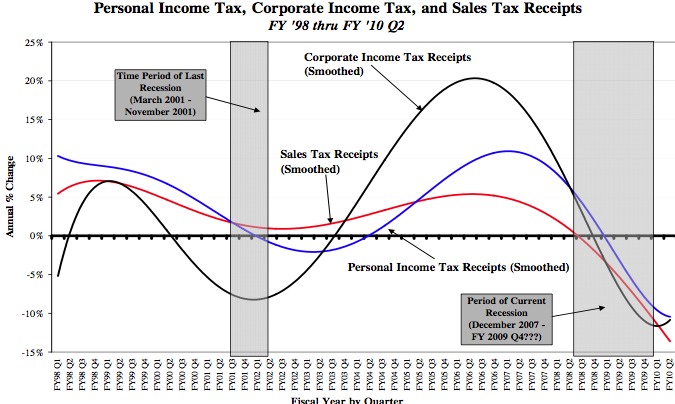
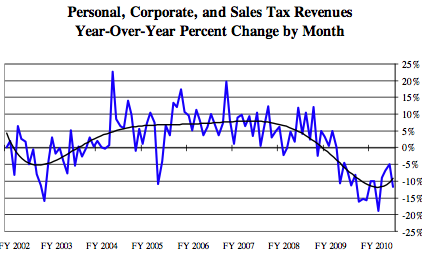
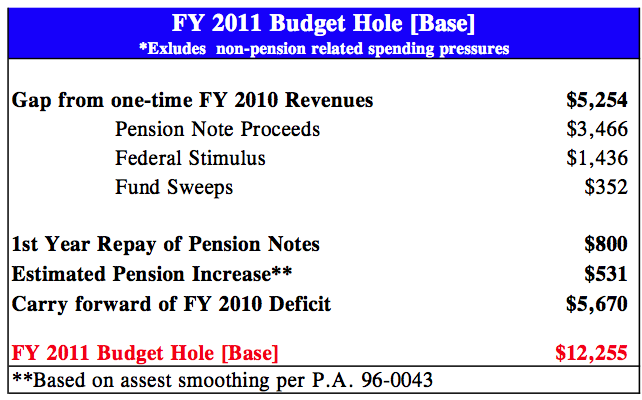
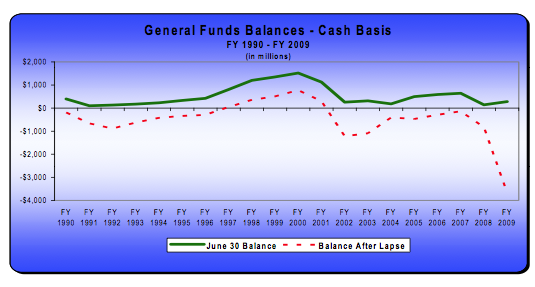
* CoGFA director Dan Long distributed an analysis at the same hearing last night which you can view by clicking here. Let’s look at a few of his charts. As always, click the pics for better views…
Personal Income Tax, Corporate Income Tax, and Sales Tax Receipts - FY ‘98 thru FY ‘10 Q2…
Personal, Corporate, and Sales Tax Revenues - Year-Over-Year Percent Change by Month…
FY 2011 Budget Hole [Base]…
Check out that dotted red line on this chart. It’s the General Funds balance after lapse spending. Oof…
Gov. Pat Quinn says he thinks it’s “necessary” the Illinois House consider a plan to raise the state income tax that passed the Illinois Senate last year.
* Legislative scholarship perk defended: The Illinois senator put in charge of overseeing efforts to reform controversial legislative scholarships defended those scholarships Tuesday, denying they are perks and saying they should remain in lawmakers’ control.
“One of our commission members received an unexpected call from a top aide to Speaker Michael Madigan” writes Collins. “The aide essentially proposed that the [Illinois Reform Commission] cut a deal with the legislature” to avoid meaningful reform.
Even though Collins ignored the alleged shakedown attempt, in the end - to use the terminology of infamous Chicago Alderman Paddy Bauler - Illinois “ain’t ready for reform.”
“With none of the major Democratic power brokers willing to champion our cause or seriously consider our proposed legislation” writes Collins, “the most significant proposals were rejected or simply ignored.”
Collins named neither the Madigan aide nor the commissioner. I determined Collins referred to a meeting I had with Brad McMillan on Jan. 26, 2009, at the One World Cafe in Peoria. This is a total distortion of our discussion. Furthermore, a distortion of this magnitude casts a troubling light on Collins’ credibility.
I had contacted Mr. McMillan because I wanted a better understanding of the institute he heads at Bradley University, to determine it if it could be a resource for the legislature and if I could be of service.
My other goal was to share my personal concern over many members of Collins’ commission and their general lack of campaign experience. Common sense suggests those who prepare rules for an activity have some experience. Aside from Mr. McMillan, who once ran for judge and served U.S. Rep. Ray LaHood, and Ms. Sheila Simon, few members of the commission had worked in a campaign or even made a donation to a political committee. It struck me that this was akin to asking novice Metra engineer to develop rules for Illinois’ high-speed rail line.
Mr. McMillan focused on reapportionment reform and further limiting legislative candidate’s ability to raise funds from outside their district. I mentioned the current Congressional remap plan was the product of an agreement between his former boss, former U.S. House Speaker Dennis Hastert and former U.S. Rep. William Lipinski. The outside donation issue was an outgrowth of efforts to support former state Rep. Rica Sloan from an expensive attack campaign.
At no point did I suggest a backroom deal or predict a confrontation. Mr. McMillan suggested I might want to testify at commission hearings. I find it unlikely that Mr. McMillan might believe any part of our conversation fits into Collins’ description. Since the commission had not begun its work, I think it actually strains credibility to even hint anyone was talking to anyone about deals.
I raise these issues because it seems Mr. Collins plans to continue to press for additional changes in state law concerning ethics and campaign law. I fear his distortion of my meeting with Mr. McMillan might become part of his characterizations and a tool to gain support. His conduct seems like an act that should disqualify him.
“Why should politicians in secret, and that’s key, behind closed doors, be allowed to choose their own voters? What’s democratic about that?” said Brad McMillan, a former member of the Illinois Reform Commission and now director of the Institute for Principled Leadership in Public Service at Bradley University. […]
“I would argue strongly that what we need in Illinois is a competitive two-party system in order to ensure accountability,” McMillan said. “The truth is it doesn’t matter if it’s Republicans or Democrats controlling the process, they draw safe districts. … They know they’re in safe seats and they don’t necessarily have to make the hard decisions to turn things around here.”
He said the gerrymandered districts in Illinois are partly responsible for a 98 percent re-election rate among incumbents. […]
McMillan said some districts aren’t always gerrymandered for political reasons. He said the 38th Senate District in the north was drawn to include the residence of the incumbent’s fiancee.
Again, many, if not most, of the current lopsided House and Senate districts will still be lopsided even if this amendment is approved. You’re not gonna get a Republican district on the South Side, and you’re not gonna draw a Democratic district in Bloomington.
What a change like this will do, however, is prevent districts from being drawn to benefit individual incumbents or candidates that the leaders want to run against the other party’s incumbents.
Also, it’s telling to note that McMillan knew about the situation in former Sen. Pat Welch’s district. The Senate Republicans are surely feeding the reformers all the dirt they can right now.
* Related…
* Congress not part of Fair Map Campaign: I apologize for misleading readers in previous columns, but I was under the impression that congressional districts would also be covered by the amendment.
* NBC5 broke the story yesterday afternoon that Tammy Duckworth doesn’t want to be Pat Quinn’s running mate. Here’s her statement…
“While I am honored my name has been mentioned for potential consideration by the Illinois Democratic Central Committee for the Lt. Governor candidate position, I have respectfully requested that my name be removed from consideration,” Duckworth said in a statement.
“I made a commitment to President Obama and our Nation’s Veterans to serve at the Department of Veterans’ Affairs and I want to fulfill my promise before returning home.
“Governor Quinn has my full support as he continues to fight hard on behalf of working families across the state.”
Quinn has been floating her name since soon after the primary, apparently without fully consulting her.
…ADDING… I’m now told that Quinn talked to Duckworth several times and that she expressed interest in the job.
Quinn said he met with Duckworth when he was in Washington last weekend for National Governors Association meetings and that she called him [yesterday] morning to say she was staying put.
“I think it was an agonizing decision for her,” Quinn said.
Some Quinn supporters say a female candidate would help his standing among women voters. A Downstater would help him win votes outside the Chicago area. Republican gubernatorial front-runner state Sen. Bill Brady and his running-mate Jason Plummer are both from Downstate.
The five candidates who lost the Democratic primary election to Cohen, led by State Rep. Art Turner, D-Chicago, are interested. Turner said on WVON Tuesday that he got votes Downstate, so he would be a good choice.
Quinn refused to say if he thought regional balance was important, saying only he is looking for “a person who shares my point of view, who believes in progressive, honest government. We have to use the power of government to help the people of Illinois. The economy is the No. 1 issue.”
He also wants someone committed to veterans’ well-being. Quinn spent his six years as lieutenant governor focusing on veterans — that’s how he met Duckworth. […]
Quinn did not say whether he’s hearing bloggers’ attempts to draft [Paul] Simon’s daughter Sheila, who Quinn named to his state ethics reform commission, as a nominee. Sheila Simon ran and lost for mayor of Carbondale. Another ethics panel member, Democratic U.S. Senate runner-up David Hoffman, has been mentioned as a possible running mate. Downstate Sen. John Sullivan has been touted by, among others, former state Senate President Emil Jones.
Being endorsed by Emil Jones is probably not the thing to highlight on the resume. Jones lost his state central committeeman slot to Jesse Jackson, Jr. this month, so Jones’ backing will work against him there. But Jones loaned a ton of money to Quinn’s campaign, and appears to have the governor’s ear on some matters.
A House committee approved one measure that would push the state’s primary election to mid-March instead of having it in February.
This year’s early election, which was the first in the nation, has been attributed by some lawmakers for low voter turnout.
“I think given the experience of the voters and candidates in the February election that it is a good idea to move it back,” said state Rep. Elaine Nekritz, D-Northbrook, the bill’s sponsor.
It was approved by a 9-0 vote and now moves to the House floor for a full debate.
The second plan lawmakers approved Tuesday also would shake up campaigns by requiring candidates for governor to pick a lieutenant governor running mate for the primary. Currently, governors and lieutenant governors are nominated separately in the primary, and they run together in the general election.
* House Speaker Michael Madigan is planning to testify this morning at 10:30 in the House Executive Committee (rm. 118) on behalf of his constitutional amendment to ban the office of the lt. governor. You can read HJRCA 50 by clicking here. You can also click here at 10:30 to see if they’re broadcasting the hearing live.
* Related…
* Illinois primary would return to March under House bill: Republican House leader Tom Cross of Oswego proposed legislation that would move the primary in presidential-election years to March and also shift the primary in nonpresidential years to June. Cross said he still doesn’t think March is late enough but felt the committee’s decision to advance Nekritz’s proposal was a step in the right direction.
* Primary election changes considered: “Who do you think Gov. Blagojevich would have picked? Harris?” asked Rep. Monique Davis, a Chicago Democrat, referring to the former governor’s chief of staff, John Harris, who pleaded guilty to wire fraud. “You’re saying that whoever the governor is would have the right to choose his or her successor.”
* Democrats dispute need for more campaign finance limits: Reform advocates testified in support of the legislation, calling it a necessary next step. Additionally, they said refusing to close the loophole would foster a dangerous dependence on legislative leaders and political party money in general elections. “That exception, I think, makes for not only an incomplete system of campaign finance but a system that discourages the support at the local level from the districts the legislators represent,” said Peter Bensinger, co-chair of CHANGE Illinois.
The Republicans are doing the very same thing as Democrats. We discovered 13 staffers taking a leaves of absence and being farmed out to do political work.
It’s not included in the Fox write-up, but if you watch the video you’ll see the chit-chat after the story included a charge from the House Democrats that 13 HGOP staffers taken off the payroll is way too low, along with a suggestion that the Republicans might have been using staff on state time for campaigns. The allegation wasn’t investigated further, however.
* House GOP Leader Tom Cross defended the practice of taking state staff off the payroll for campaigns…
“You get young kids that come to work for you that like politics and like policy and say I want to get involved in campaigns,” Cross said. “And that’s okay.”
As Cross explained, it’s only okay — and ethical — if there is a distinct line between state work done at taxpayer expense and political work done off the state payroll.
“We passed a law several years ago, an ethics bill, that made it very clear that you can’t do any political work while on state time,” he said. “Which would seem to be the obvious thing.”
Like the Democrats, we also found Republican staffers getting paychecks from campaigns while working fulltime for the state.
Leader Cross’s chief of staff Matthew O’Shea earned $140,000 in his state salary, but also collected $12,000 from the Republican party.
“He does political work, he likes it he want to do it,” Cross said of O’Shea’s two jobs. “It’s over and above his state work.”
* This is kinda interesting…
But there’s no explanation for another case uncovered by FOX Chicago Investigates. In July, 2008, house Republicans hired a pair of policy analysts to work for the state. After only two weeks on the job, they jumped off the state payroll to go work for the Republican party until after the November election.
So why put someone on the state payroll for two-weeks? Cross said he did not know the specifics of those two hirings.
* Patrick Collins kinda misses the point, at least when it comes to general elections…
“When [legislative leaders have] the ability to control the dollars as well as the people that’s really a one-two punch that can change the dynamic of a race,” he said.
Since everybody is doing this, it doesn’t really impact general elections. Primaries, however, are different stories…
When Democratic St. Rep. Dan Burke found himself in a tough race this year, Madigan told Burke to fire his campaign manager, and sent in state worker Tom Wogan to run Burke’s campaign.
Burke won.
Republicans also gave employees time off for the 2010 primary and paid them more than $50,000 dollars for campaign work.
Almost always, primary opponents who aren’t backed by the leaders are in a very disadvantageous position.
* Rich Means gets to the heart of the real problem here…
Election attorney Rich Means has battled state staffers on the campaign trail and says the ability to assign armies of state workers to political races gives legislative leaders a hammer.
“What it does is give all the power to the legislative leaders,” Means said. “It stifles political dissent within the political parties. It stifles independence in the legislature. It just closes the system down.”
* Picking on individual, rank-and-file staffers is way unfair. I don’t think Fox handled that aspect very well at all. In my mind, this issue is only tangentially about whether staff ought to be allowed to jump off state payrolls to work campaigns.
And completely separating politics from the Legislature is a goofy concept. Our democratic system is fundamentally based on campaigns - a basic fact that people like Collins don’t seem to understand. Still, there ought to be a limit.
What is important here is the power of the leaders. Without that staff, they can’t control their members nearly as well.
Here’s just one example: People who staff committees answer directly to the leaders, not the chairpersons and minority spokespersons. The leaders appoint the committee chairs. They appoint the committee members. It’s total, absolute control.
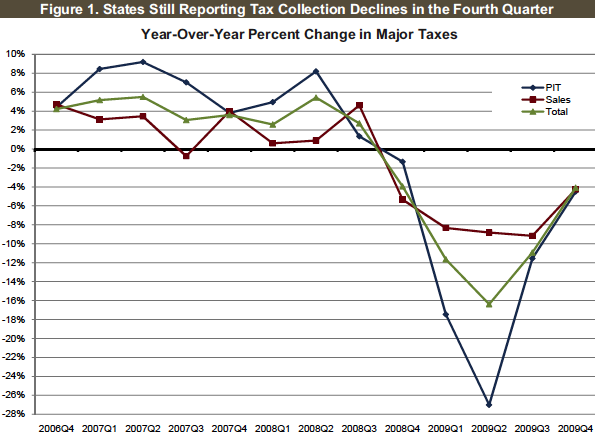
* Click the pic for a better look at this graph of year-over-year revenue receipts for major taxes. The blue line represents personal income taxes, the green line is total tax collection. This is for all states…
Yikes.
The graph is from the Nelson A. Rockefeller Institute of Government, which claims that Illinois’ tax receipts in the fourth quarter of last calendar year plunged 6.9 percent compared to the same quarter a year earlier.
From the dot points…
This is a record fifth consecutive quarter that total tax revenues and collections from two major sources — personal income tax and sales tax — declined on a year-over-year basis.
Oof.
* A map showing how individual states fared. Again, click the pic for a better look…
The gloomy national state budget outlook…
Despite indications that the national recession may be over, the revenue situation remained gloomy in most states in the fourth quarter of 2009. Many states have been reporting shortfalls in revenue compared to projections used for this year’s enacted budgets. While stock indices are well above their lows and some other indicators point to strengthening in the economy, overall conditions remain weak. Nonetheless, retail sales and consumption have stabilized and we expect more states to begin seeing year-over-year growth in some revenue sources over the next few months, particularly the sales tax.
However, even with growth, tax revenue is likely to remain below its prerecession peak for quite some time. State tax revenue will continue to be insufficient to support current spending commitments, and more spending cuts and tax increases are most likely on the way for many states — particularly those that did not take significant actions to balance revenues and expenditures in their FY 2010 budgets.
* The College Democrats at Northwestern University are bringing in Rod Blagojevich for a publicity stunt… er… um… speaking engagement…
As stated on the event’s Facebook page, a Northwestern faculty panel including law Professor Tonja Jacobi, Political Science Professor Donald Gordon and Medill Professor Donna Leff, will interview the former governor, and students will be allowed to ask questions afterward.
Why a group of Democrats thinks this is a good idea is simply beyond me, but whatever. Free country and all that.
Blagojevich (WCAS ’79) will have 15 minutes to plead his case before an NU faculty panel can begin asking questions, Rockoff said. The panel will include Law Professor Tonja Jacobi, Political Science Professor Donald Gordon and Medill Professor Donna Leff, the Communication senior said.
“The majority of the event will be an interplay between the faculty panel and the former governor,” he said.
After the faculty panel has finished, students will have the opportunity to ask questions, Rockoff said.
“Our belief is that students at Northwestern are interested in debating this issue,” he said. “They will be interested to see this kind of dialogue.”
* The Question: What questions would you ask RRB if you attended this function? Try to avoid snark, please.
* Everybody always wants to spend more money. That’s nothing new. They even want to spend more state tax money during the greatest fiscal crisis this state has ever had. Not surprising, considering the way people are.
The Southern Illinoisan today editorialized on behalf of a bill that would divert about $500,000 a year from the sales tax on wine to benefit the state’s fledgling wine-making industry. Normally, that might be a great idea, especially considering the much-needed tourism dollars the wine industry draws to southern Illinois.
And, frankly, $500,000 ain’t a whole lot of money, so I can see why Rep. Mike Bost (R-Murphysboro) could sponsor the proposal with a mostly clean conscience. Although his reaction to his bill’s defeat in the House Revenue Committee was more than a little over the top…
Bost was disappointed when his bill didn’t get out of committee Thursday, and accused state Democrats of wanting to control the state’s revenue stream.
“It’s an abuse of powers. It does not allow me to represent my district,” Bost said.
But perhaps there is some area for compromise, some tweaking of the legislation that would create the wine fund without shorting the general fund.
Yep. The answer is magic money! Unless they mean raising the sales tax, which they didn’t specify.
Money has to come from somewhere. Perhaps the Southern could offer to give up its state sales tax exemptions on newsprint, ink, equipment, etc. Until then, proposing a magic money solution is not a responsible alternative.
* Meanwhile, Mayor Daley talked to reporters yesterday about the state budget. Hizzoner made it clear that cuts must come before tax hikes…
“You just can’t increase taxes and say, ‘That’s the answer,’ ” Daley told reporters. “That’s not the total answer. If you think that is, you’re kidding yourself.” […]
“You have to streamline government,” said the mayor, who has cut some spending and raised taxes and fees to balance the city’s precarious budget in recent years. “You have to look at priorities and figure out if there’s waste, inefficiency and corruption, anything, because you have to look at that.”
” In the long run, you need a governor and a lt governor working together like that because there’s a responsibility when he or she is out of state, incapacitated. They can take over. It’s just like the presidency. I think they should run together.”
* Some more federal money? At least for a while, and for new recipients…
A White House compromise proposal on health care reform would boost funding for Illinois and other states facing newly eligible participants in their cash-strapped Medicaid programs. […]
Under the White House proposal, states would get 100% federal funding for any newly eligible Medicaid participants for four years, from 2014 to 2017, with 95% reimbursement in the following two years and 90% after that. Normally, the federal government reimburses half of Medicaid expenditures in Illinois, although that was boosted temporarily by last year’s stimulus program.
“It gives states plenty of time to adjust to these new responsibilities and gives them additional financing pretty much forever,” Nancy-Ann DeParle, director of the White House Office of Health Reform, said in a conference call for reporters.
However, the summary of the proposal didn’t address other details that concern some Illinois hospitals, such as the schedule for phasing out additional Medicaid payments they get for treating an above-average number of Medicaid patients.
* Chicago Tonight hosted a long discussion about the state budget last night. Have a look…
* Naperville considers joining push for statewide pensions: The state Constitution outlaws diminishing employee benefits, but [Assistant City Manager Dan] DiSanto said one option would be for the state to create a second tier of benefits for new hires.
* Tryon Legislation to Bring Transparency to State Budget
* Fox Chicago took a look at legislative staffers who also go off payroll to work on political campaigns. They focus solely on the House Democratic staff, whom they refer to as “Madigoons“…
“What they really are, are political workers with side jobs in the off season,” Means said. “They keep them employed so they’ll be around for the next political season. And that really does seem to me to be the tail wagging the dog.”
FOX Chicago News examined three years of legislative payroll records, and then compared them with political campaign expenditures. We found 34 Democratic House employees under the control of Speaker Madigan taking off from their jobs for weeks, sometimes months at a time.
From what I was told a couple of weeks ago by Fox, they could only find four or so House Republican staffers who dropped off state payroll. I thought that number seemed quite small, since they’re staffing most of the same campaigns as the Democrats. The HGOP number isn’t in the story, however. Maybe a follow-up is planned. I dunno.
…Adding… Dane Placko just called. He said they’re planning a story on the Republicans tonight. He eventually found a total of 13 HGOP staffers who also worked on campaigns. More than originally, but still not a lot by comparison. I’m looking forward to the piece.
But Decremer took off seven months in 2007, four months in 2008 and another four months in 2009. He has made more than $40,000 from political campaigns.
His specialty? Challenging the petitions of candidates Madigan wants off the ballot.
And with Illinois facing a $13 billion deficit, with all these people bouncing on and off the payroll, it begs the question–
“Is that a job we need in state government?”
Former Federal Prosecutor Patrick Collins chaired the Illinois Reform Commission, which lost its battle to curb the clout of the legislative leaders.
“Is that a job we need in state government? Because if it can go unfilled for four or five or six months at a crack, I can guarantee you there’s a cheaper way to provide that service to the people of the State of Illinois,” Collins said.
That’s certainly one way of looking at it, and I won’t dispute its validity. But when the GA isn’t in session, all of its staff just isn’t needed. Then again…
But that’s not what our investigation found. When the legislature was battling Gov. Rod Blagojevich over a budget stalemate in 2008, with plenty of work to do, nearly half of Madigan’s staff was off the state payroll doing political work.
Analysts, program specialists, legal assistants and even the house photographer bounced on and off the state payroll. His specialty is campaign mailings.
While on leave, those state workers collect paychecks from political campaigns. We counted a total of $728,000 in political pay the past three years.
“We’ve had so much in Illinois where politics drives our government. I think it would be a good time for government to essentially take the priority role,” said former prosecutor Collins.
Actually, nobody was doing much during that stalemate, but I see the point.
Bankruptcies in the region jumped more than 18 percent in 2009, despite federal changes that took effect in 2008 and made it harder to wipe out debt. More than 10,700 central Illinoisans filed for bankruptcy last year.
* CTA snow removal violates union deal, arbitrator says
The CTA continued to use its outside snow-removal contractor, Christy Webber & Co. Inc., to clear and salt station walkways and platforms, instead of calling on the CTA’s unionized janitors, during the snowfall that occurred Sunday and Monday.
* A year later, no answers in parking ticket probe
Chicago police say their investigation into the matter continues, but many questions remain in what ranks as one of What’s Your Problem’s most bizarre cases.
Attorneys for Calvin Boender have subpoenaed 10 aldermen for testimony about their knowledge of how Boender’s development, Galewood Yards, won approval from the city.
Huberman conceded that reforms he announced a few months ago didn’t go far enough and said he will hold public hearings to gather input on needed changes.
While we’re not willing to go so far as to support an Illinois bill that would let school districts ignore mandates that aren’t funded, we wholeheartedly agree that mandates need to be examined through a new lens - one that acknowledges the difficult economic situation our schools face.
The Oswego School Board voted 6 to 1 to approve a $5.5 million reduction plan that would include 80 employee reductions, furlough days and program cuts, the first phase of reductions to help balance a budget for the upcoming school year.
According to Assistant Superintendent for Business Dave Holm, the district estimates it will receive between $3.5 million and $4 million in federal funds that Springfield will use to make three general state aid payments to District 204. The state owes the district more than $7.8 million for the 2010 budget.
…
Bur earlier this month District 204 — like many others in the area — informed its residents that state funding for next year is, what Holm called, “the big unknown.”
His proposal to eliminate 56 teaching positions applies to non-classroom teachers, he said, such as reading coaches, post-secondary coaches and teacher leaders.
“Classroom teachers are OK,” Milton said.
Of the district’s 1,201 certified teachers, 427 work outside the classroom in various academic support roles, according to Alexander Ikejiaku, the district’s personnel director.
The city found out Monday that a $10 million line of credit with Associated Bank, which has been funding the Rockford Local Development Corp.’s purchase of the homes, has been extended for 60 days. City leaders also learned they may be able to further extend the line of credit with another bank after the city closes with Associated, said Ald. Carl Wasco, chairman of the Finance and Personnel Committee.
Also, according to a document from the Illinois Finance Authority, the project’s estimated cost is $90.2 million, down from the original $102 million.
City Manager Scott Moore said on Monday that city officials received a debt payment schedule on revisions to the project but are waiting for changes to the overall plans from developer Gary Matthews of East Peoria-based EM Properties.
* NIU’s proton-therapy cancer center back to square one
* 7:46 am - Rep. Art Turner is on WVON Radio right now talking about his campaign for lt. governor, race, the Democratic Party and Gov. Pat Quinn. Listen by clicking here. Help live-blog in comments if you can.
* 8:00 am - End. Since nobody apparently saw the link in time to comment, this is now an open thread on Rep. Turner’s argument in favor of his appointment to the ballot.
…Adding… I was working during the interview, but I did catch this quote by Rep. Turner about Sen. Rickey Hendon’s candidacy for lt. governor…
“Sen. Hendon was only in this race to stop me from winning.”