*** UPDATE 1 *** I asked the governor’s press office last night which police agency they’d like to see investigate the House vote on the ComEd/Ameren “trailer bill.” I was told I’d hear back. Hasn’t happened. But they did respond to Mary Ann Ahern, who Tweets…
Gov Quinn wants Inspector General to look into Com Ed Button gate
FYI, I asked this afternoon how many times Quinn has had the autopen sign legislation into law for him. I’ll let you know what they say.
* So, let’s see. He’s been fighting with Senate President Cullerton since Day One. He’s been arguing with Mayor Emanuel for months. And now he picks a fight with the biggest of the big dogs. Yep. This will end well. Sure worked for Rod.
*** UPDATE 2 *** Quinn was asked by a reporter today if he had asked the Speaker to investigate this week’s vote. “It doesn’t exactly work that way,” Quinn said, adding that the inspector general should investigate his allegation. “Any wrongdoing there, any monkey business” should be looked at. When asked if he had contacted the IG about this, Quinn said the IG, by law, was supposed to investigate anything he’s heard that could be a problem. Listen…
*** UPDATE 3 *** I asked Speaker Madigan’s spokesman for a response to the governor’s belief that Legislative Inspector General Tom Homer should look into this…
The General Assembly’s ethics watchdog agreed Friday to open an inquiry into allegations by Gov. Pat Quinn that several votes were improperly cast in the Illinois House when it passed part of a utility rate-hike package this week.
Thomas J. Homer, the state’s legislative inspector general, told the Chicago Sun-Times that he will look into the matter at Quinn’s request but stressed that any breaches of state ethics laws would have to involve legislative staffers or other lawmakers “maliciously” casting votes in an opposite manner than the way an absent legislator had intended.
Homer’s involvement comes after he was singled out Friday by Quinn and asked to undertake an investigation into the matter, which one top House Republican coined “Buttongate.”
[ *** End Of Updates *** ]
* I told subscribers yesterday about Democratic members being off the House floor for a budget briefing during the “Smart Grid trailer bill” vote this week. Gov. Pat Quinn got angry about the development and is now using it as an excuse to lay blame for one of his many defeats this week, even though the trailer bill passed with 91 votes, way more than was needed.
Seven or so members who were off the floor were voted as “Yes” during the roll call even though they were opposed to the bill. After they returned to the floor, they asked that their votes be recorded as “No,” but they did not publicly complain.
“Anybody watching this whole procedure where members may not have actually voted their own switch on such an important bill would say it’s rotten,” the governor told the Chicago Sun-Times.
“On a bill involving such high stakes and so much money, to have anyone other than the member casting a vote is a very serious matter that should be investigated immediately by the House,” said Quinn, who said such absentee voting “doesn’t work in the federal Congress” and is “breaking the law.”
“It’s a serious violation of ethical conduct,” he said.
* It’s not illegal for a House member to vote another member’s switch, no matter what the governor says. It is, however, a violation of House rules…
No member may vote on any question before the House unless on the floor before the vote is announced.
It is illegal for a staffer to vote a member’s switch if it’s done with “malicious intent”…
…no person other than a regularly qualified member of the House of Representatives shall at any time cause a vote to be recorded on such voting device whether by means of any voting switch or otherwise.
Whoever with malicious intent violates any provision of this Act shall be guilty of a Class B misdemeanor.
All complaints, complaining of the violation of terms of this Act must be filed in the circuit court of Sangamon County, Illinois, by the Speaker of the House of Representatives only after he has been authorized by a vote of 89 members of the House of Representatives.
In the 1980s, the controversy even surrounded paperclips.
The Senate used to have voting buttons that had a little wiggle room around them, enough so that a paper clip could be used to keep a button locked down on green or red while a lawmaker was away.
When some visitors from a Soviet bloc country showed up, they began to wonder about the marvels of democracy — particularly when a handful of lawmakers were in the Senate chamber but roll calls repeatedly registered nearly all 59 senators as “yes” votes.
Turned out many of the lawmakers had jammed paperclips into the voting switches next to their buttons and locked in “yes” votes for a series of non-controversial procedural motions.
There’s a new term being thrown around in Springfield: “buttongate”.
* It was wrong to do the trailer bill roll call with so many members off the floor at a budget briefing. But, make no mistake, this bill would’ve passed no matter what. The governor is likely attempting to justify a veto of the trailer bill. But if he does that, then all the reforms in that bill could die if the House decides not to override the veto.
Not to mention that he’s picking a fight he can only lose. Even if he manages to gin up a lot of press coverage and even if there is a vote and even if there is an investigation, payback will be absolutely brutal.
* Last night, somebody on my Twitter list retweeted a post by Occupy Chicago…
State police has brought canines to break up vigil. We are leaving Thompson Center and are on sidewalk
I went to the Occupy Chicago Twitter page and discovered that the occupiers were holding a candlelight vigil for Marine veteran Scott Olsen, who was allegedly shot in the head by an Oakland “police projectile.”
Also according to the page, the State Police asked the protesters to leave the Thompson Center plaza in 5 minutes or they’d be arrested. They claimed the cops had dogs.
The governor’s office said there were police dogs nearby as part of standard procedure. A different administration official said the coppers were advised not to provoke anybody and to keep things calm.
* So far, the only real violence involving the Occupy protesters here in America has happened when the police tried to break up a demonstration. Despite lots of fears, everything has been peaceful, as long as you don’t have to hear their loud drumming or their bullhorns. Let’s hope it stays that way.
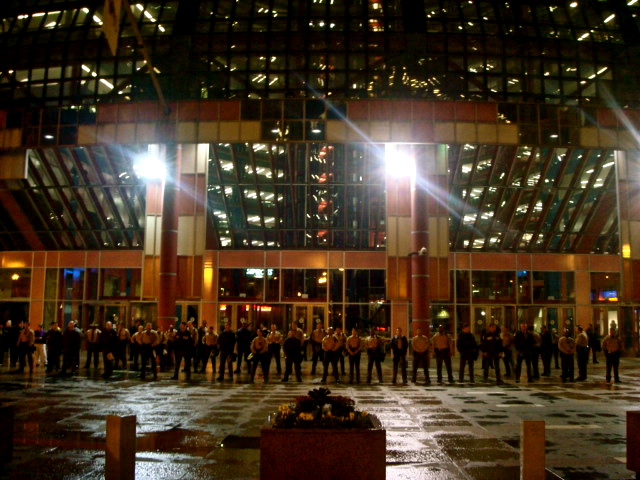
I do wonder though, why the state felt that so many police had to be deployed last night. Here’s a photo posted by the “occupiers.” Click it for a better look…
* I count 38 police officers in that photo. I was told there were no specific threats made in advance.
The Thompson Center plaza officially closes late at night, so technically the vigil was in violation of the law. They don’t want to give the occupiers the idea that they can camp out there permanently, so I get that they had to tell them to move along. But that’s a lot of cops for a peaceful crowd.
* My point here is that Gov. Pat Quinn needs to continue to make sure that everything stays calm. There’s no need to be provoking folks who are just expressing their 1st Amendment rights.
* By the way, I asked Quinn the other day what he thought of the occupy protesters. Here’s what he said…
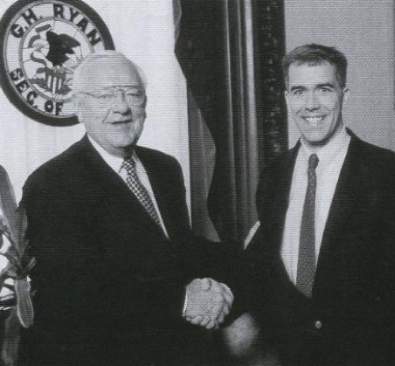
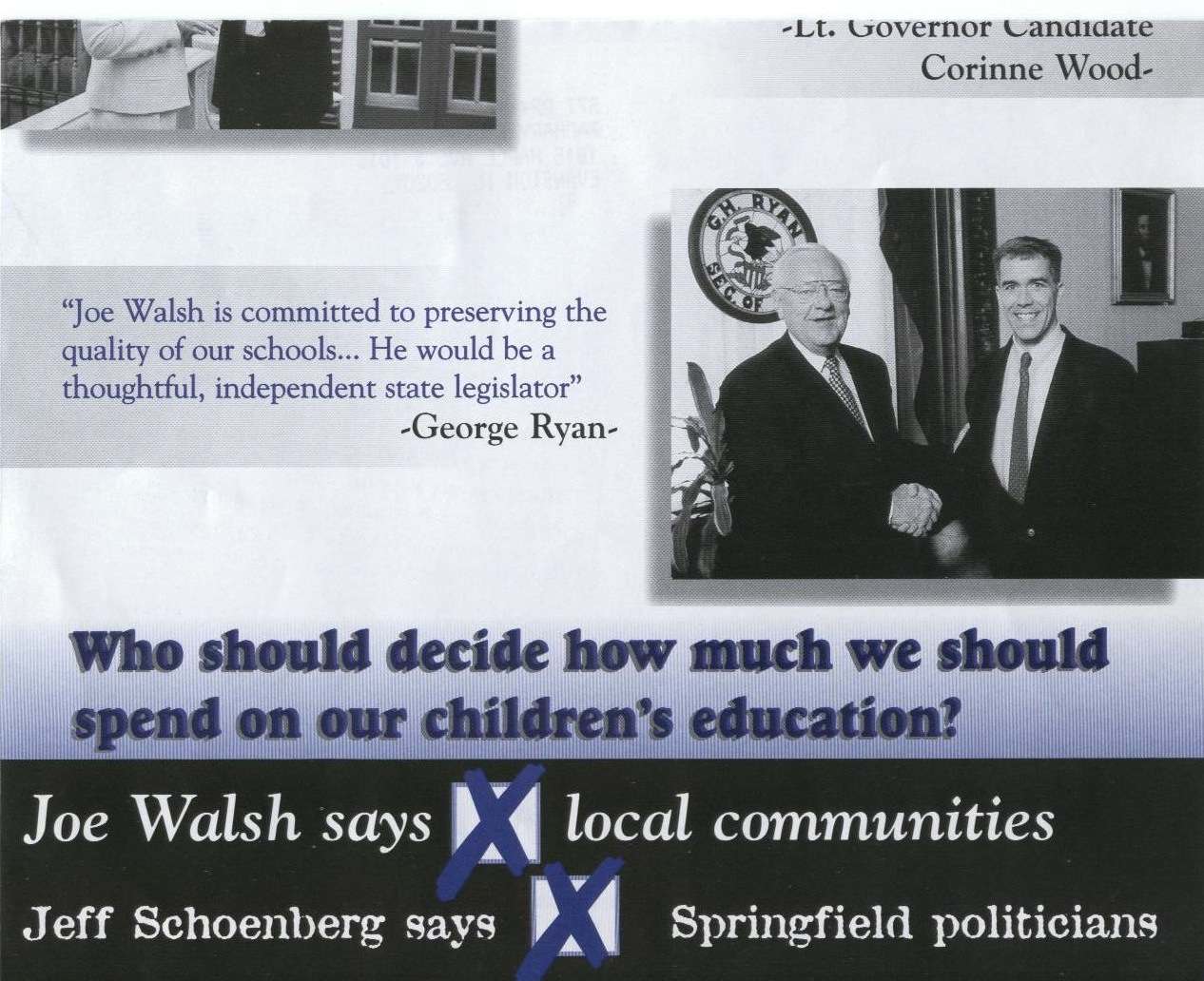
* Way back in 1998, Joe Walsh (the current congressman, not the rocker) ran against Rep. Jeff Schoenberg for the Illinois House. This is from one of Walsh’s campaign mailers…
See more of the mailer here.
* The Question: Caption?
The Illinois Supreme Court may have opened the door for Gov. Pat Quinn and state lawmakers to grab hundreds of millions of dollars for the next state budget.
In a 6-to-1 decision Thursday, the high court upheld a 2006 Sangamon County Circuit Court ruling that backed the governor and Legislature’s ability to take money from hundreds of special state funds, a practice commonly referred to as sweeping.
Motorcycle riders sued former Gov. Rod Blagojevich after he ordered that $296,000 be taken from the Cycle Riders Safety Training Fund, or CRSTF. A portion of the fee for an Illinois motorcycle license went into the CRSTF, which the motorcycle education and advocacy group A Brotherhood Aimed Towards Education, or ABATE, argued, was only to be spent on motorcycle safety education. The governor that year used the $296,000 to pay general state bills.
“Clearly, the fee charged by the state for motorcycle registration and licensing is state revenue, and therefore the portion of this state revenue which the General Assembly has allocated to the CRSTF is also public money,” wrote Justice Anne Burke in the majority opinion.
Burke rejected the ABATE lawyers’ argument that the special fund was tantamount to a special trust fund.
Quinn’s budget spokeswoman, Kelly Kraft, said there are no plans to sweep any special funds for the next state budget.
“Gov. Quinn worked to end the practice of fund sweeps, and sweeps are not a possibility for FY13,” said Kraft.
But the governor has come to rely on interfund borrowing. Quinn borrowed $500 million from special state funds in the current state spending plan. That money is supposed to be paid back at the end of the fiscal year.
* Considering the growing war between the governor and the General Assembly, I wouldn’t be too sure that Gov. Pat Quinn will necessarily follow precedent…
A legislative commission’s vote against closing four state facilities that treat people who are mentally and developmentally disabled isn’t enough to prevent Gov. Pat Quinn from shuttering the facilities.
The Commission on Government Forecasting and Accountability, or COGFA, voted to keep the following facilities open: Singer Mental Health Center in Rockford; Chester Mental Health Center in Chester; Mabley Developmental Center in Dixon; and Illinois Youth Center in Murphysboro.
Quinn announced he was targeting seven down-state facilities for closure, because the General Assembly’s $33.2 billion budget didn’t give him enough money to keep the doors open and their 1,938 employees working. Quinn introduced a proposed budget of about $36 billion.
“Their recommendation, unfortunately, doesn’t change the reality of the budget we’re tasked with managing,” Brooke Anderson, a spokeswoman for Quinn, said. […]
COGFA’s vote is only advisory, meaning that Quinn still can close the centers.
“However, no administration has ever moved contrary to how the commission has recommended,” state Sen. Jeffery Schoenberg, D-Evanston, and co-chairman of COGFA, said. “He could if he wanted to, but it would set a precedent.”
If the GA doesn’t find the money to keep those facilities open, then Quinn may have to follow through. So far, nobody has come up with alternatives. The only major legislative proposals we’ve seen from the Republicans (whose facilities were targeted) have been about cutting taxes by hundreds of millions of dollars, not finding ways to move money around or generate new revenue.
* And, finally, the Tribune editorial board really needs to get itself a clue…
No, Gov. Quinn, you may not borrow more money, no matter how often you call it “restructuring” or any other euphemism. Borrowing is borrowing. It’s a big reason why Illinois is drowning.
First, the state is not “drowning.” That’s just the Tribune’s hyperbolic goofiness showing through. Secondly, the state is already borrowing from struggling small businesses, not for profit social service providers, hospitals, doctors, pharmacists, road builders, etc. by not paying our bills on time. The state has mostly dealt with its structural debt through cuts and tax hikes. The problem is the old bills, which will take years to pay down, one way or the other.
Either Illinois sells bonds or it continues making late payments to its vendors for years and does major budget cuts along the way. Selling bonds is a lot less painful to all involved. In other words, the difference is we can shaft our own businesses and not for profits by borrowing from them, or sell bonds on the market. So, of course, Mother Tribune demands we continue shafting the little guys, whack the budget and slash pensions and healthcare.
* Most of my non-political Springfield friends are Cardinal fans. They’re pretty stoked after last night’s amazing finish. I don’t blame them. What a game.
So, for Keith, Ryan, Kenny, Kent and all the rest of my redbird buddies, have at it.
Former Gov. Rod Blagojevich’s brother has personally written to 10 members of Congress with an offer to testify before an ethics committee that last week re-launched its investigation of U.S. Rep. Jesse Jackson Jr. (D-Ill.).
Robert Blagojevich said Thursday that he sent letters to all the members of the U.S. House Committee on Ethics because: “I believe I have information I think will help them find the truth” on Jackson.
He offered his testimony or to be interviewed about Jackson’s effort to secure an appointment by then-Gov. Rod Blagojevich in late 2008 to fill the U.S. Senate seat left vacant with the election of President Barack Obama.
“Based on what I know, I believe Jesse Jackson Jr. has a lot of unanswered questions that he needs to answer,” Robert Blagojevich said. “There are a lot of unanswered questions he should be required to answer.”
* Robert Blagojevich took over fundraising duties for his brother’s campaign. That’s what got him into trouble and is also where he got involved with Congressman Jackson’s bid to be appointed to the US Senate…
As for his own role, Jackson under oath said: “No I did not” direct or order anyone to offer Rod Blagojevich fund-raising in exchange for appointing him senator.
“I never directed anyone to raise money for another politician in my life, other than myself, in 16 years,” Jackson testified.
Last week, the House committee on ethics announced it would restart its probe into Jackson
Rod Blagojevich was heard on tape calling U.S. Rep. Jesse Jackson Jr. “repugnant” and a “bad guy.”
However, on the way to his sentencing hearing, the former governor tried tapping Jackson’s father for a letter of endorsement.
In another twist to the ever-complicated relationship between the Blagojevich and Jackson families, Blagojevich asked the Rev. Jesse Jackson to write letter of support to the sentencing judge.
It was an offer Rev. Jesse Jackson refused, according to a lawyer for both the elder Jackson and his son, the congressman.
“Rev. Jackson will not write a letter on behalf of Gov. Blagojevich,” attorney Paul Langer told the Sun-Times Thursday.
Illinois lawmakers are dead set against Rod Blagojevich getting another dime from Illinois taxpayers.
On Wednesday, the General Assembly Retirement System, or GARS, Board moved to ensure that the former governor would not collect any of his $65,000-a-year state pension.
The board adopted a rule that will require it to meet and review any application from a person convicted of political corruption during his time working for the state.
A juror was removed Thursday morning from the trial of Springfield power broker William Cellini, forcing the panel to restart its discussions with a new member.
Jury deliberations in the extortion trial had begun Wednesday in the Dirksen U.S. Courthouse in Chicago.
U.S. District Court Judge James Zagel said a juror on Wednesday informed a court officer of a conflict of interest. Zagel declined to reveal the nature of the conflict, saying he was sealing the matter until after the verdict. He did not elaborate further.
Zagel instructed the jury in open court to begin deliberations from scratch.
Democrat Jay Hoffman has changed his mind about running for Congress and now plans to seek a seat in the Illinois House.
Democratic Party officials on Thursday endorsed Huffman’s run for the seat held until recently by Tom Holbrook. Holbrook announced plans to step down from the Illinois House after Gov. Pat Quinn picked him to head the Illinois Pollution Control Board.
A month ago, Hoffman had said he’d run for Congress in the newly drawn 13th District.
* It’s unclear who the Democrats will get behind in that 13th District now that Hoffman’s gone. It’s getting awful late in the petition process. Tim Johnson is surely smiling.
* And speaking of Congress, a bruising primary might be developing for Jerry Costello’s seat…
The St. Clair County Democratic Party is endorsing former county Regional Superintendent of Schools Brad Harriman to run for the seat held for 23 years by outgoing U.S. Rep. Jerry Costello, D-Belleville. […]
Harriman, 57, had resigned Sept. 30 after five years as the regional superintendent — the only elected office he has ever held. […]
Madison County Chief Circuit Judge Ann Callis, 47, is expected to announce her candidacy within the next week, Madison County Democratic Party Chairman Matt Melucci said again Thursday night following the St. Clair Democrats’ meeting.
“At this point, we are waiting for Judge Callis to announce,” Melucci said.
When asked whom the Madison County Democrats would endorse when they meet next Thursday and in light of St. Clair Democrats’ endorsement of Harriman, Melucci said: “Our committee actually votes, so I cannot say they will do this or that. There is no doubt in my mind they would be for the candidate from our county.”
The poll sponsored by the House Majority PAC found that only 42% of those surveyed in the north suburban 10th District want to re-elect Winnetka’s Robert Dold, and 50% want a change. Just 35% have a favorable opinion of Republicans in Congress.
The numbers are similar with U.S. Rep. Judy Biggert, R-Hinsdale: 52% want a new congressman. But the figures are south of there for Reps. Tim Johnson of Sidney, who gets a 33% re-elect, and Bobby Schilling of Moline, at 39%.
The survey of roughly 600 voters in each of the districts was conducted by Public Policy Polling. The firm generally works for Democrats and left-of-center groups. But it also has a reputation of calling it the way it sees it, for instance recently reporting that embattled Wisconsin Gov. Scott Walker, a Republican, has significantly boosted his odds of surviving any recall move.
An expensive bidding war is escalating at the Illinois Statehouse and it needs to be slowed down.
Gov. Pat Quinn met with the four legislative leaders Thursday morning. Much of the discussion centered around CME Group’s threat to leave Illinois unless it gets a tax break. CME owns the Chicago Mercantile Exchange and the Chicago Board of Trade, among other things.
CME says it pays six percent of all Illinois corporate income taxes, making it the state’s largest taxpayer. The company also claims that the recent income tax hike cost it an extra $50 million a year. Its executive chairman, Terry Duffy, has repeatedly warned that he’s furious about his company’s tax burden and is seriously contemplating a move to a more favorable location.
The problem is that Illinois bases corporate taxes on instate sales and CME records all of its transactions that way, even though lots of transactions are occurring in other states and other countries. When Caterpillar sells a bulldozer in Germany, Illinois doesn’t tax that income. But when a CME trade is executed in Japan, that income is taxed by Illinois.
Our corporate tax system was changed several years ago at the behest of companies like Caterpillar. As a result, Cat paid less and CME paid more.
If Illinois readjusted its tax code, Cat would scream bloody murder. Caterpillar was already involved in one scary blowup this year over the state’s business climate. Nobody wants to poke that giant again.
So, the options are adjusting CME’s taxes or letting it leave. The state budget would take a huge hit if CME left, so we’re back to a tax cut. The problem is, the legislation drafted by Senate President John Cullerton would reduce CME’s taxes by $75 million a year. That’s a 50 percent cut. The Senate Republicans say CME’s taxes would actually fall by $100 million a year.
To sweeten the pot and attract downstate, suburban and Republican votes, Cullerton offered to reinstate the corporate research and development tax credit, which will cost the state as much as $30 million a year.
However, the Republicans want more. House Republican Leader Tom Cross insisted Thursday that a $500 million tax cut package be considered as part of the deal. Cross also wants the R&D reinstatement, so the total amount of tax cuts on the table right now is somewhere around $600 million.
All of these tax cuts have legitimate arguments in their favor.
But big tax cuts are stupid at a time when Illinois can’t pay its own bills unless the tax reductions produce lots of new state revenue by providing strong economic stimulus, or prevent significant revenue losses by convincing companies to stay put. According to the comptroller’s office, the state owes roughly $6 billion in past due bills, including $600 million in unpaid corporate income tax refunds.
So, we’re gonna cut corporate taxes by $600 million when we can’t even afford to pay corporations $600 million in tax refunds?
One of the problems we’ve had in this state for the past 20 years is that expensive deals were cut by the leaders behind closed doors and then legislators rubber stamped the agreements. A careful, legitimate process is underway in the House Revenue Committee to look at reforming the entire corporate tax code. That ought to be given time to ripen before the state makes any big moves.
And Cullerton’s CME proposal is just way too rich. The company should get a significant break, but $75-100 million is too much to ask for a company with healthy pretax profits of around $2 billion a year.
* House Republican Leader Tom Cross’ tax cut plan is here.
“I get calls in my office, and I am not kidding, from small and medium sized businesses that say, ‘What about me? I’m struggling,’” Senator Christine Radogno, the Republican minority leader from Lemont, said during the committee hearing.
“I don’t want to perpetuate the perception of special treatment,” she said.
Speaking directly to CME’s Parisi, Radogno said, “If you guys leave because this doesn’t pass today, it does raise the question to the sincerity of whether or not you’re staying in the first instance.” […]
“We’re now looking at something growing like Topsy,” Representative Barbara Flynn-Currie, a Chicago Democrat, said in an interview. “The business community is telling us to spend less, get your fiscal house in order, and in the meantime their constituent elements are coming to Springfield with their hands out.”
James Parisi, chief financial officer of CME Group, said the company’s tax payment last year represented 6 percent of all state corporate income tax receipts. The company’s annual tab is about $150 million.
“This modernization of tax law would allow Illinois and Chicago to maintain leadership as a global financial services center,” Parisi told the Senate Executive Committee.
* This tax cut push is apparently an element of the company’s longterm strategy. From Morningstar…
We recently had an opportunity to attend CME’s analyst day, the company’s first such event since 2009. Among the subjects discussed at the gathering were the company’s targets for expense and revenue growth–two drivers we are particularly interested in. The company’s CFO set a long-term goal to grow revenue by at least 10% a year while keeping growth in operating expenses at no more than 5% per year on average. The expense target is in line with our views; the revenue goal, while certainly achievable, is a little more aggressive than our expectation for growth of around 8%
* Meanwhile, Reuters columnist David Clay Johnston reports that Navistar, Continental Tire, Motorola, Ford, Chrysler, Mitsubishi and other big Illinois companies are keeping the state taxes deducted from their workers’ paychecks. “If you’re already on the payroll, they get to get keep half of them,” Johnston says. “If you’re a new hire, they get to keep all of them.”
Because the companies don’t pay much state income tax the only way they can get any state tax help is by letting them “pocket their workers’ income tax.” Watch…
* Related…
* Illinois Senate Executive Committee advances tax break measure for Chicago’s financial exchanges - Measure, which still faces hurdles, could cut up to $110 million a year from state coffers
* House Republican Leader Tom Cross claimed today that Gov. Pat Quinn offered to support the CME Group tax cut proposal if the General Assembly agreed to borrow $4.5 billion over 7 years to pay off old bills. Cross said he didn’t favor the borrowing idea. Here’s part 1 of his press conference…
*** UPDATE 1 *** A spokesperson for Gov. Quinn denied that her boss specifically offered to straight up trade his support for the CME tax cut in exchange for a borrowing plan.
“Republicans made it very clear that they wouldn’t support the CME proposal as it is without a larger package of tax cuts,” the spokesperson said.
“In response to that, the governor is open to negotiating a larger package for jobs. There were a lot of things discussed in that context.”
The spokesperson said the governor is reviewing the CME proposal, which could cost upwards of $100 million.
“He’s looking at options to mitigate the loss in revenue, like closing corporate tax loopholes,” she said, saying the proposal would result in a “pretty hefty loss” for the state budget.
[ *** End Of Update *** ]
* Part 2 included more discussion about the CME bill. Cross claimed that the governor “wasn’t going to support CME” without borrowing, and said he mentioned some off-shore tax provisions as well. Cross also claimed that the governor “didn’t seem all that excited” about a pension reform bill Cross wants to bring to a vote in the second week of veto session, saying Quinn had some constitutional questions about the proposal.
Cross also said his “theory” is that the governor targeted Downstate facilities for closure had a lot to do with Quinn’s push for a borrowing plan for old bills. Watch…
* Senate President John Cullerton told reporters he’ll meet with Gov. Quinn next week to talk about gaming expansion. Cullerton said that means, as of now, the issue is on hold.
Cullerton also disagreed with characterizations made by Senate GOP Leader Christine Radogno and Leader Cross that Gov. Quinn signaled opposition to the CME Group tax cut bill. Cullerton claimed the governor said he’d look at the proposal. Watch…
*
* Cullerton’s Tenaska bill failed in the Senate today and was placed on Postponed Consideration. His closing remarks…
* Rep. La Shawn Ford asked for a moment of silence today for the Occupy Chicago protesters. Listen…
*** UPDATE 2 *** The governor’s plan to pay Regional Superintendent of Schools salaries out of the personal property replacement tax (which goes to local governments) fell way short today in the House. The bill received 59 votes. It needed 71 to pass. Here’s audio of the floor debate. Rep. Roger Eddy goes off on Quinn at about the 12-minute mark…
* More…
* Cross: Deal made for pension bill: Illinois House Minority Leader Tom Cross, R-Oswego, said he will be ready to call a bill to set up a three-tiered pension system for state workers during the second week of the legislature’s veto session, which starts Nov. 8… Cross said the Civic Committee of the Commercial Club of Chicago, a group of the city’s top CEOs, has brokered a deal in which House Republicans would provide 30 votes for the pension bill, Senate Bill 512, and House Democrats would provide another 30. Sixty votes are needed for legislation to pass the House… The bill would offer current teachers, university employees and state workers three pension options: Stay in the current system but pay significantly more, go into a second tier for workers hired after Jan. 1 that has reduced benefits or choose a 401(k)-style defined contribution plan.
*** UPDATE 3 *** IEA: Statehouse sources say today’s report that a deal’s been set to pass pension-cutting SB512 was erroneous. Still not enough votes.
* VIDEO: Treasurer Rutherford Opens Vault for Public Tours
Proposed tax breaks for Chicago’s financial exchanges, which could cut state tax revenue by about $70 million year or more, won endorsement from a key Illinois Senate committee Thursday morning.
But the measure continues to encounter resistance from Republicans, who are pushing for broader tax relief for business as part of any package.
And legislative leaders say Gov. Pat Quinn indicated in a meeting Thursday morning that he is not on board.
“I don’t want to be part of a perception that we are cherry-picking who we help,” said Senate Minority Leader Christine Radogno (R-Lemont) one of four members of the Senate Executive Committee to vote present. The vote was 10 yes, four present, to recommend Senate passage.
The bill, which would reportedly cut CME Group’s state income tax burden in half, is expected to come up for a vote in the second week of veto session. CME and CBOE have repeatedly threatened to pull up stakes and move out of Illinois if they didn’t get some relief. CME claims to be the largest single corporate taxpayer in Illinois, and claims that its annual income tax burden rose by $50 million after the tax was raised in January.
(T)he price tag has risen on the bill to help CME Group Inc. and CBOE Holdings Inc., hitting the $120-million-plus mark. […]
Mr. Cullerton’s office conceded that the cost of the CME-CBOE bill to the treasury has increased.
The latest estimate is that the bill would reduce state revenues $75 million a year from the CME, and $7 million from the CBOE, Mr. Cullerton’s spokesman said, with the city of Chicago losing $5 million a year. In addition, restoring the research and development credit would cost the state $25 million to $30 million a year.
Senate Republican place the cost somewhat higher: $100 million to the state each year just from the CME.
* The Question: Do you support this income tax relief package for CME Group and CBOE to keep them from leaving Illinois? Take the poll and then explain your answer in comments, please. Thanks.
Thursday, Oct 27, 2011 - Posted by Advertising Department
[The following is a paid advertisement.]
We know what ComEd and Ameren said about SB1652, but what did your constituents say on the issue?
On October 11th a statewide survey was conducted with 800 registered voters in Illinois on SB1652. Check out the results:
• 70% responded that their electric service was reliable.
• 69% responded that they would be against an annual increase in their electric bill to improve reliability and prevent power outages.
• 50% responded that they consider their electric bill too high.
• 47% responded that SB1652 should be “amended to protect consumers” AND, without being prompted, 26% said “don’t pass anything”.
• 52% responded that they would be “not likely at all” to vote for a candidate who allows electric utilities to raise rates annually – and 21% would be “somewhat less likely” to vote for a candidate who allows electric utilities to raise rates annually
• 10% responded “State Legislature” when asked, between the State Legislature and the ICC, which group best represents their interests in regulating electric utilities.
AARP will be informing our members of YOUR vote on the override of SB1652.
* After yesterday’s votes to override the governor’s veto of the “Smart Grid” bill and pass the companion legislation, AARP Illinois issued the angriest press release I’ve ever seen from that group…
“The General Assembly just sent a clear message to their constituents: Corporate interests and campaign cash trump the needs of Illinois consumers.
“Today, lawmakers voted to override the Governor’s veto of Senate Bill 1652 – guaranteeing higher electric rates for consumers and higher profits for ComEd and Ameren.
“At a time when consumers are struggling to make ends meet, with prices on the rise for everything from gas to groceries, taxes increasing, and home values declining, it is appalling that Illinois lawmakers would chose to further burden consumers with a law that amounts to nothing more than corporate greed.
“Under the guise of improved infrastructure, ComEd and Ameren successfully convinced the General Assembly to gut Illinois’ utility ratemaking process – a process that exists to balance the interests of consumers with that of the utility companies. This veto override has effectively silenced the voice of the consumer and tied the hands of the Illinois Commerce Commission – all while guaranteeing higher profits for two of the state’s largest monopolies.”
ComEd has said the bill will raise average household electric bills by about $3 per month to finance installation of “smart meters” throughout Northern Illinois and make $1.3 billion in improvements to traditional grid equipment.
But the bill’s actual cost to ratepayers may well be higher because the guaranteed return on equity ComEd will reap rises with Treasury bond yields, which currently are at historic lows.
State legislators essentially have boxed Quinn into a corner. After the governor vetoed the original smart grid bill, a so-called trailer bill was introduced this week that called for ComEd to make concessions. By passing that bill, legislators knew that if the governor vetoed it or signed it with suggested changes, the legislature could ignore his advice or nix the trailer bill altogether, leaving him again with the original bill, which is now veto-proof.
* The votes were close in the Senate, but the veto override and the trailer bill flew through the House…
The House voted 74-42 to override, with no debate.
Sen. Kyle McCarter, R-Lebanon, rejected the idea that this is a jobs bill. He said it adds a new burden in a state that already hits businesses with high taxes, fees and workers’ compensation costs. “One of the last good things we’ve got going in this state for businesses is affordable power,” he said.
Our communities, working through the Northwest Municipal Conference, have proposed legislative recommendations to address ComEd’s communication and transparency issues. These recommendations would help ComEd better partner with our communities during storm and non-storm related outages and must be adopted as a condition of any legislation to upgrade the electric grid.
Therefore, we as mayors have no option but to urge the members of the General Assembly to uphold the Governor’s veto of Senate Bill 1652 unless the bill is amended, via additional legislation, to directly address these shortfalls by including the language proposed by local governments. Until ComEd is held accountable for providing reliable power and effective communications on good days and bad, they don’t deserve the automatic rate increases and guaranteed profits in Senate Bill 1652. Unless this critical amendment is adopted, legislators should scrap Senate Bill 1652 and rewrite the bill so that smart grid technological advances don’t come at the expense of consumer safety and well-being.
Now, after a series of meetings, those suburbs say they’ve struck a deal with ComEd to develop enforceable protocols to address storm outages in the entire territory. The details will be filed with the Illinois Commerce Commission within 45 days if the smart grid legislation becomes law, according to ComEd.
The Tribune recently reported that while a law exists to reimburse consumers affected by extreme outages, the utility has never paid under the law.
Separately, ComEd previously announced that it has established a Storm Response Process Improvement Task Force to develop and implement improvements in its storm restoration process and reliability performance.
* And one legislator who voted against the utilities was upbeat…
And even critics, like Senator Dave Syverson, who voted against the bill twice, see a positive side to the upgrade.
“Its going to be a better system a more modern system to eliminate many of the outages and under the new system ComEd will know the power outages occur rather than someone having to call them and let them know electricity is out” says Syverson.
* Roundup…
* Legislators override Quinn’s veto on smart-grid bill
* Chuck Sweeny: Electric rates going up, thanks to Illinois Legislature
* Illinois Senate overrides Gov. Quinn’s veto of ComEd rate-hike bill
The state Senate has delayed action on a major gambling expansion, but behind-the-scenes efforts are under way.
Senate President John Cullerton’s office says he’ll be at a meeting with Gov. Pat Quinn this morning.
A Senate committee on Wednesday discussed a measure based on Quinn’s requirements for more gambling. He wants five new casinos in Illinois, including one in Chicago, but not slot machines at race tracks.
Sen. Matt Murphy, a Palatine Republican, questioned [Sen. Terry Link] at the earlier hearing, saying Quinn’s suggestions could kill the gambling expansion effort and leave the cash-strapped state without additional revenue more gambling can bring.
He called it a “failure of leadership.”
“That is going to sit right at the foot of the governor,” Murphy said.
The original plan was expected to generate $1.5 billion in upfront fees and another $1 billion annually.
Sen. Matt Murphy, R-Palatine, said he found it curious that “the governor who has lamented the lack of revenue would so flippantly turn his back on this revenue.”
The federal jury weighing the fate of Springfield power broker William Cellini was sent home early today so lawyers could try to resolve one of the first written questions submitted by the panel on its initial day of deliberations.
Jurors asked that they be given every slide shown during the 3 ½-week trial. The slides are demonstrative exhibits that had not been admitted into evidence, raising an issue for the lawyers to decide in consultation with U.S. District Judge James Zagel.
The judge asked lawyers to reconvene in his courtroom at 8:45 a.m. Thursday to decide what to do.
In their final push to take down a well-connected Illinois millionaire, prosecutors focused on one sound Tuesday - a laugh - as they tried to convince jurors he was in on a scheme to extort campaign cash from a Hollywood producer for then-Gov. Rod Blagojevich.
It was part of prosecutors’ closing argument against William Cellini, who denies that he tried to shakedown the Oscar-winning producer of “Million Dollar Baby” for $1.5 million in 2004. Cellini, whose influence among Illinois politicians once earned him the nickname The King of Clout, is the last to go on trial in the federal investigation of the ousted Democratic governor.
On secret FBI recordings that prosecutors played over courtroom speakers Tuesday, Cellini seems to chuckle as he talks on the phone about the extortion with another man accused in the alleged crime.
“And the defendant is laughing: That is what corruption sounds like,” government attorney Julie Porter told jurors, her voice rising.
* There was a lot of talk from Chicago Democrats in the Senate yesterday about how killing a properly negotiated state contracts was setting a very bad precedent…
An effort to overturn this year’s new health-insurance contracts for state employees and extend Health Alliance’s contract for two years failed Wednesday in the Illinois Senate.
On a 28-28 vote, the Senate failed to override Gov. Pat Quinn’s veto of a bill that would have extended for two years contracts that expired June 30. The measure also would have given a legislative panel explicit authority to throw out contracts awarded by state agencies. […]
But on Wednesday, 13 senators — almost all of them Democrats and most from the Chicago area — voted against the override after originally voting for the bill or not voting. One Democratic senator who previously voted “yes” didn’t vote Wednesday, and Senate President John Cullerton, D-Chicago, changed his previous “yes” vote to “present.”
They’re right that this is a very bad precedent. The separation of powers questions are a big problem with this idea. But what’s missing here is that Blue Cross won the bid to supply the coverage. Blue Cross employs a whole lot of people in Chicago. Ergo, hometown pressure. Don’t discount that.
* Gov. Pat Quinn’s office also worked this bill hard, which definitely helped kill the veto override. Unlike the “Smart Grid” bill and the gaming bill, the governor didn’t demagogue this issue. It worked. Perhaps a lesson could be learned?
State Sen. Shane Cultra, R-Onarga, said the failure of the override was an unwelcome surprise.
“It’s the old story that Chicago is dictating policy. This is a slap in the face to downstate,” said Cultra, who represents scores of Central Illinois constituents affected by the switch.
Opponents said the legislature should not intervene in an area that is the responsibility of the executive branch.
“Where does it stop?” said state Sen. Kwame Raoul, D-Chicago.
There’s fear by some Downstaters that if Health Alliance goes under because it lost its longtime contract, then Blue Cross might be able to raise its rates when the next contract negotiation comes along.
* Blackberry users click here. iPad and iPhone users remember to use two fingers when scrolling. The governor and the four legislative leaders are meeting this morning, and that could be the biggest highlight of the day…
* AFSCME Council 31 President Henry Bayer compares House Speaker Michael Madigan to Wisconsin’s Republican Governor Scott Walker…
* There was a pretty big union rally at the Statehouse yesterday. The IEA has a brief video…
* The Illinois College Republicans have a new video…
The Illinois College Republicans are launching a new grassroots initiative this week in response to OWS. The initiative is called “Liberate Main Street”. New CR state president Mick Paskiewicz told Illinois Review, “We’re kicking it off by releasing this video today, and from here we’re encouraging our chapters to host Liberate Main St. events on their campuses to recruit college students.”
Supporters of Joe Walsh’s campaign for the 14th District GOP primary have unleashed a brutal Facebook page that cuts at just about everything opponent (and current 14th District Congressman) Randy Hultgren stands for. […]
Writing as if it’s Hultgren himself who’s posting on the page, it mocks an “allegiance” to “GOP establishment masters” Peter Roskam and John Boehner, Hultgren’s recent hire of campaign “hit man” Joe Calomino, and his promise not to mudsling.
“Here’s screen shot number 14 of my personal attack (that I promised I wouldn’t do) of my opponent Joe Walsh on my Facebook page….that I recently deleted and some pesky Tea Partier took screen shots of. DING DANG IT!” is one recent post.