Dunn out at SIU
Friday, Jul 13, 2018 - Posted by Rich Miller
* Tribune…
Randy Dunn is out as president of Southern Illinois University, bookending a wild stretch of controversy and animosity at the two-campus system, the university announced late Friday.
Dunn has agreed to a voluntary separation with the university that will pay him a six-month severance of $215,000. Dunn was hired as SIU president in 2014. SIU’s board will meet on Monday in Edwardsville to finalize his departure, which is effective July 30.
Dunn will be on leave effective Tuesday, before his official termination on July 30. The separation agreement also agrees to hire Dunn as a visiting professor in Edwardsville at an $100,000 annual salary, starting January 1.
Dr. J. Kevin Dorsey, the former dean and provost of the SIU School of Medicine in Springfield, is poised to step in as acting president for a one-year term while the board launches a search for a new leader. Dorsey will receive a base salary of $430,000.
Comments Off  
|
* Press release…
Kwame Raoul, Democratic candidate for Attorney General, issued the following response to news of a federal indictment charging Russian officials for conspiring to interfere with the 2016 election in Illinois:
“With foreign adversaries interfering in Illinois elections, there must be full disclosure and consequences. I fought to get us out of Crosscheck to protect voter privacy. We can’t trust Trump and Rauner to safeguard our elections; as Attorney General, I will investigate any attempts to infiltrate our electoral systems or steal voter data. Our data must be secure, and we must be safe from attack.”
Earlier today, when asked by Crain’s Chicago Business about whether she would sue the Trump administration if elected Attorney General, Republican Erika Harold said she would not enter into lawsuits like those regarding family separation at the border, access to affordable healthcare, or a woman’s right to choose, dismissing efforts to protect our rights as “purely political.”
* From that Greg Hinz Crain’s piece…
Illinois Attorney General Lisa Madigan today took a step that has become almost routine in the past year and a half. She sued President Donald Trump’s administration, this time over its decision to withhold $6.5 million in law enforcement funds amid a dispute over how the state deals with illegal immigration.
The action was only the latest in a string of 28 lawsuits Madigan has filed over deportation of DACA recipients, provisions of Obamacare and a lot more. And with the Chicago Democrat retiring this fall after 16 years in office, the question of whether or not to continue such policies has become the sleeper issue in the contest to succeed her between the Democratic nominee, state Sen. Kwame Raoul, and the Republican candidate, attorney and Harvard Law School graduate Erika Harold.
The question shows signs of sparking a sharp debate between Raoul and Harold. […]
“I believe the attorney general’s office should not be using their scarce resources to enter into lawsuits for purely political purposes,” she said in a statement. “As attorney general, I would only sue the federal government if Illinois law has been implicated or the federal government has acted in violation of the Constitution.” she said, adding that she does happen to agree with Madigan on the $6.5 million. […]
Madigan, in her own statement, says she has no second thoughts. She says she’s “sued the federal government over executive orders, rule rollbacks and policy reversals because they pose a threat to our civil liberties, our environment and public safety efforts throughout Illinois.” And she’s also sued over new rules eliminating so-called “net neutrality” charges by telecom and internet providers.
5 Comments
|
Question of the day
Friday, Jul 13, 2018 - Posted by Rich Miller
* An old buddy of mine was in Speaker Michael Madigan’s Chicago office not long ago and snapped this photograph…
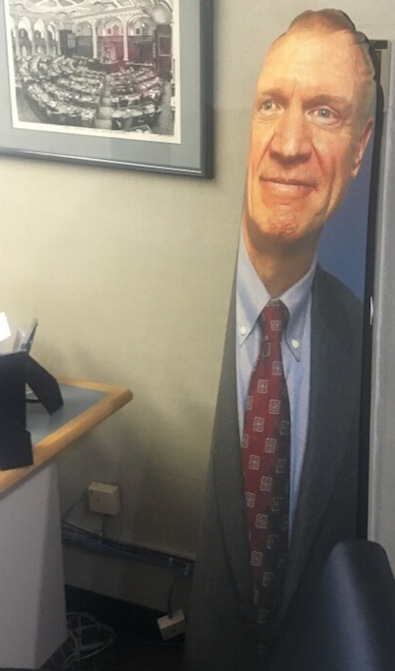
You may not be able to tell from the pic, but Gov. Rauner’s image is super-imposed on a “bop bag.” You’ve seen those. You punch them and they rock way back and then right themselves.
* The Question: Caption?
Please be careful not to get carried away with the violent imagery. This is supposed to be a fun little Friday thing. Keep it light and funny and harmless. I don’t want any visits from the state cops. Thanks.
46 Comments
|
Eight days of intense and comical weirdness
Friday, Jul 13, 2018 - Posted by Rich Miller
* I’ve been meaning to do this all week and kept forgetting. Thanks to Radical Candor IL for reminding me…
* Sherman, set the Wayback Machine to Monday, July 10, 2017…
* Illinois Policy Institute President picked as Rauner’s new chief of staff (updated x9)
* Rep. Steve Andersson ousted from House GOP Floor Leader slot
Andersson, of course, was one of the House Republicans who voted for the tax hike/budget bills and in favor of overriding the governor’s vetoes. He was also “whipping” HGOP votes in favor of both sets of roll calls.
* Tuesday, July 11, 2017…
* SUBSCRIBERS ONLY - Staff shakeup continues
* Michael Lucci, the Vice President of Policy for the Illinois Policy Institute, has been hired as Gov. Rauner’s new policy director, according to a staff e-mail sent today by Rauner’s new chief of staff Kristina Rasmussen. […]
Laurel Patrick is the governor’s new communications director. Patrick was Wisconsin Gov. Scott Walker’s spokesperson before eventually moving to the economic-right Franklin Center for Government and Public Integrity. Patrick replaces Brad Hahn, who was let go today. […]
* Rauner’s chief of staff told her new charges today that “mutual respect paired with radical candor will make this an even greater place to work.”
* Hahn out, more to come (updated: CK out)
Rauner spokesperson Catherine Kelly was just fired. What’s so unreal about this is that CK was a loyal Raunerite. She busted her tail for the governor. CK was expected to be leaving perhaps as early as next month anyway because her husband has a job in another state. But this action today was unexpected.
* Illinois Policy Institute’s Lucci, Scott Walker’s Patrick hired by Rauner
* I told subscribers about these developments earlier today. This evening, Mary Ann Ahern published the full memo sent out today by Gov. Rauner’s new chief of staff Kristina Rasmussen
* Wednesday, July 12, 2017…
* Democrats respond to Rauner’s new hires
* I cannot ever remember a time when this much focus has been placed on a governor’s staff changes. But it’s most certainly news and therefore political fodder.
* Clark out (update: Or not)
@MaryAnnAhernNBC
CORRECTION: “Jim Clarke has not, willnot and was never going to be fired.” From @GovRauner spksm [Clark was moved to IHDA the following month]
* “Outside the simulator”
WGN: There’s a sense among some Rauner loyalists that the governor, discouraged by defeat in the Illinois legislature, is now being influenced to go to the right rather than the middle. “It was one thing when nobody cared what they have to say it will be interesting to see how they perform outside the simulator,” an insider said.
* Tillman claims his group has “unblemished” record of “decency, civility, and candor”
* Click here for a reminder about their decency and civility.
* Thursday, July 13, 2017…
* More firing/hiring fallout for Rauner
* AP: Illinois Policy Institute CEO John Tillman said appointing former organization President Kristina Rasmussen his chief of staff is an “unmistakable signal” that Rauner intends to fulfill a promise to make Illinois “prosperous and free.”
* Sneed: “It’s been tough. The morale is bad. People are afraid. It has been a coup d’etat type of environment. The conservative Illinois Policy Institute has taken charge.”
* “The damage has been done. We can’t turn back the clock”
* Pritzker campaign: “As Rauner staffs up with a radical right-wing team determined to cause more devastation, our most vulnerable communities are still reeling from the damage of round one,”
* Leader Brady wants to use coming school funding crisis as “leverage” on “reforms”
* Rauner staff hirings prompt new “Trumpcare” questions
* Pritzker campaign mocks Rauner over new hires
* Video: “We need brilliant people who are doing it for the right reasons to drive a result.”
* Where’s Rauner during unprecedented Lake County flooding?
* You would think the governor’s new crack PR team would be all over this. As the old saying (from Gov. Rauner himself) goes: “Crisis creates opportunity.”
* Friday, July 14, 2017…
* Legislators want Rauner to declare emergency and call out National Guard
* @MaryAnnAhernNBC: As he picks new staff, not until NBC5 & @capitolfax started asking, now @GovRauner WILL tour flooding in Gurnee this am #ILGov18
* @MaryAnnAhernNBC: I’m not the only one who is noticing, @GovRauner wearing makeup on flood tour (filming ads too?) #ILGov18
* An “unblemished” record of “decency, civility, and candor”
* @illinoispolicy: .@capitolfax tell Steve Brown aka wordslinger that if he cared about the democratic process he’d get his boss to change his House rules
* Question of the day
* From a memo sent out Tuesday by Gov. Rauner’s new chief of staff: Please share with me your best ideas for transforming Illinois through better public policy and improved operations by Friday at 3:00 p.m.
* Rauner denies being distracted, says he’s “incredibly proud” of his staff
* From the governor’s media availability: “We are always trying to recruit and retain the best people in America to serve the people of Illinois. That’s all that matters.”
* The Rauner purge restarts
• Corrections and criminal justice adviser Jennifer Grady-Paswater;
• Jason Heffley, who handled environment and energy and helped cut the recent Exelon nuclear funding deal;
• Brian Oszakiewski who came from the staff of U.S. Rep. Dan Lipinski, D-Chicago, and who handled transportation;
• Daniel Suess, who made policy recs for smaller state agencies. […]
*** UPDATE 1 *** Rauner spokesperson Eleni Demertzis has just resigned. Unlike some of the others, Eleni walked out on her own terms.
*** UPDATE 2 *** Allie Bovis, who oversees agency communications and was the traveling press secretary today for the governor’s trip to Lake County, has submitted her resignation effective next Friday. She’s also leaving on her own terms.
*** UPDATE 3 *** Jared Dubnow, who is the governor’s Director of Operations, is reportedly leaving and will be going to DCEO. He made the trains run on time, but before that he was the governor’s top advance man and was Rauner’s “body man” during the campaign.
* Another one goes: Mike Z leaves Rauner campaign
* The governor recently asked him to stay on, so this is, by far, the biggest Rauner defection of the week. Boom
* Monday, July 17, 2017…
* The bane of their existence
* My weekly syndicated newspaper column: Rauner has always been a big fan of the Illinois Policy Institute’s way of thinking and ways of doing business. He insisted, for instance, that Rasmussen be included in some policy meetings. Rasmussen reportedly voiced support at those meetings for things like shutting down some state universities and prisons, regardless of the consequences, including the possibility of a prison escape during a hastily arranged facility shutdown. That’s just the sort of “bold” thinking that Rauner likes.
* Mahoney is latest top Rauner administration official to resign
* Mike Mahoney, the governor’s Deputy Chief of Staff for Policy and Legislative Affairs, resigned this morning.
*** UPDATE 1 *** Sources close to the governor’s office confirm that the governor’s Deputy Chief of Staff for Public Engagement Phil Rodriguez has also resigned. Rodriguez worked for Comptrollers Topinka and Munger and ran both of their campaigns. He’s moving over to the Tollway.
*** UPDATE 2 *** The govenor’s body man, Kyle Haevers, has been told his services were no longer needed and was asked to find an agency to move to. His replacement is Ben Tracy, who has already begun traveling with the governor. Kyle was a loyal Raunerite and has been part of Rauner World since 2014 and helped on the Rep. McAuliffe race last fall.
*** UPDATE 3 *** Digital Director Bridget Davidson and Deputy Press Secretary Olivia Munson also resigned today. Davidson came on board last October from a TV station in Milwaukee. I’m told that under Davidson’s direction “Facebook followers grew organically (no paid or sponsored posts) by 300 percent” in seven months.
*** UPDATE 4 *** Kathy Lydon, who runs the state’s Washington, DC office, has left. I’m told her deputy left as well. Lydon previously worked for Judy Biggert and goes all the way back to the Chuck Percy days.
*** UPDATE 5 *** Bob Stefanski, Director of House and Senate Operations, has departed. The House and Senate Republican leaders both wanted the governor to keep him around.
*** UPDATE 6 *** @IllinoisWorking: TWENTY ONE staffers have left or been fired from @GovRauner’s office since last week#ShakeUpSpringfield
*** UPDATE 7 *** Anyone paying half attention to the RadicalCandorIL Twitter account today could’ve guessed this was coming: @MaryAnnAhernNBC The new “body man” doesn’t last one day! @GovRauner fires him #chaos
*** UPDATE 8 *** Politico: Illinois GOP Gov. Bruce Rauner’s new “body man” — the government staffer who spends long days with governor — has a history of writing racially-charged, homophobic and sexually explicit tweets. “I’d f— her teeth straight,” said one. “To the Indian people in the library: SHUT THE F— UP!,” said another.
* More on the Mike Z resignation
* If you’re scratching your head wondering if you’ve ever seen anything like this past week in Illinois politics, stop. You haven’t.
*** LIVE COVERAGE *** “Radical Candor”
* It doesn’t take a genius to figure out what group of people are likely behind the new RadicalCandorIL Twitter account. I followed it closely all weekend and since the resignations are continuing, I thought you might want a ScribbleLive feed
* Rauner demands SB 1 be sent to him so he can AV it (updated x4)
* New Rauner comms staff officially announced
* Press release: Diana Rickert starts today as Deputy Chief of Staff of Communications. Many of you have worked with Diana during her six years at the Illinois Policy Institute
* Rauner to school superintendents: “Don’t give in to a tyrant”
* Besler hired as Rauner’s “chief strategic advisor”
* This is the new Mike Z…
14 Comments
|
* From the Betsy Dirksen Londrigan campaign…
Today, nonpartisan forecasters at Cook Political Report upgraded Betsy Dirksen Londrigan’s chances of winning in IL-13, shifting their rating of the race from Likely Republican to just Lean Republican. Cook Political Report’s Dave Wasserman specifically cited Londrigan’s strong candidacy and her focus on the issue of health care as reasons why the race is becoming more competitive.
“This confirms what we are already seeing on the ground here in central Illinois: Betsy is exciting voters and making this a race through her hard work and her focus on issues that matter to Illinois families every day, like protecting their access to affordable health care,” said Kate Martucci, Londrigan’s campaign manager.
Here’s what Dave Wasserman had to say about the IL-13 rating change:
In 2011, Illinois Democrats tried to draw the 13th to elect one of their own by connecting the disparate college towns of Champaign-Urbana, Bloomington-Normal and Edwardsville with union-heavy cities like Decatur and the state capital of Springfield. But since 2012, GOP Rep. Rodney Davis has defied that creative cartography, winning reelection by comfortable margins.
Davis has succeeded in part because he’s an affable, energetic member who eschews heated rhetoric, works diligently on the Agriculture Committee and chairs the moderate Republican Main Street Partnership. He’s also benefited from Downstate Illinois’s drift away from national Democrats: in 2008, the 13th CD gave Barak Obama 55 percent. In 2016, President Trump carried it by six points and Davis won it by 19.
But, this is the kind of seat that could be problematic for Republicans in a wave, and Democrats have a credible candidate in Springfield fundraising consultant Betsy Dirksen Londrigan. Londrigan can’t definitively trace her ancestry to late Illinois GOP Sen. Everett Dirksen, but in March she defeated four primary opponents with 46 percent of the vote and has raised over $1 million to date.
For a first-time candidate, Londrigan has spent an above-average amount of time around politics: she helped her husband ran (unsuccessfully) for state senate over a decade ago and she’s raised money professionally for Sen. Dick Durbin and the Lincoln Presidential Library Foundation. She’ll talk about her grandparents’ farm and opposition to tariffs to try to build appeal in the 13th CD’s soy-heavy rural counties.
It won’t be easy for Democrats to portray Davis as a Trump lackey; he rescinded his support of Trump in October 2016 after Access Hollywood. But Londrigan says Davis’s 2017 vote to repeal the ACA is what motivated her to run against the “Trump/Davis agenda.” She’ll use the personal story of her son’s life threatening tick bite in 2009 to illustrate her commitment to affordable health coverage.
To win, Democrats will need to convince voters that behind Davis’s likable demeanor lurks a voting record out of step with the district. And the more GOP Gov. Bruce Rauner looks doomed to defeat, the more plausible Londrigan’s path could become. Davis remains the favorite, but the race moves from Likely Republican to Lean Republican.
Londrigan’s campaign is gonna have to convince every possible African-American and college student to vote this November. And students, especially, don’t usually vote much during off-year cycles.
* In other Downstate congressional campaign news…
Vice President Mike Pence is scheduled to stop in O’Fallon next week for a fundraiser for U.S. Rep. Mike Bost.
The event is scheduled for 2:30 to 3:30 p.m. Thursday at the O’Fallon Regency Conference Center, said Dustin Rhodes, the campaign manager for Bost, a Murphysboro Republican. The event is closed to the press.
…Adding… Oops. I forgot about this. Bost got pwned…
* Related…
* Election 2018: Story-lines emerging: Now the second-most-expensive congressional race in the state outside of Chicago, the fight between U.S. Rep. RODNEY DAVIS, R-Taylorville, and Democratic challenger BETSY LONDRIGAN has ballooned into a $2.6 million affair. Londrigan has spent about $557,000 of the $779,000 she has raised; Davis has spent $886,571 of $1.8 million.
* Rodney Davis: Keep politics out of Supreme Court confirmation process
* Getting NGA to abandon St. Louis site would require a ‘game-changer,’ expert says
14 Comments
|
Did AFSCME gain members here after Janus?
Friday, Jul 13, 2018 - Posted by Rich Miller
* SJ-R…
Two weeks ago, the Rauner administration, in the wake of the U.S. Supreme Court decision in the Janus case, set up a web site to inform unionized workers about how much they are paying in union dues and how they could drop out of union representation.
To date, the administration has not said how many workers who previously were full union members have decided to opt out of union representation as a result of the Janus ruling.
At the same time, the union that represents the bulk of state employees said that “hundreds” of people have joined the union as dues-paying members since the Janus decision. It said only a “handful” have quit. The union said it could not provide specific numbers.
You’d think the Rauner administration would be crowing if lots of folks dumped the union. By the same token, if AFSCME did gain “hundreds” of members, you’d think they’d have some figures to share. Maybe nobody has the numbers collected just yet…
Since the site was set up, however, the state has not said how many full dues-paying members have opted to drop their union membership. Instead, CMS said, it has been busy ensuring that fair share fees are no longer withheld from worker paychecks.
* Meanwhile, the Catholic bishop of the Diocese of Springfield, Thomas John Paprocki, explains his support for the Janus decision, even though he has a lot of AFSCME members in his pews…
When the case reached the Supreme Court, the General Counsel for the United States Conference of Catholic Bishops (USCCB), Anthony Picarello, filed a “friend-of-the-court” brief, known by its name in Latin as an amicus curiae brief, in support of the union. When the case was decided against the union, Bishop Frank Dewane, chairman of the USCCB Committee on Domestic Justice and Human Development, expressed his disappointment with the Supreme Court’s decision, citing “the long-held view of so many bishops” in support of unions.
I respectfully disagree. Let me explain why.
The “long-held view of so many bishops” in support of unions is generally understood to go back to the time of Pope Leo XIII, who issued an encyclical letter in 1891 on the rights and duties of capital and labor, entitled Rerum novarum. While this encyclical voiced strong support for the rights of workers, particularly their right to form unions, this support was never unconditional. Rather, Pope Leo wrote (in paragraph 57) that unions “must pay special and chief attention to the duties of religion and morality, and that social betterment should have this chiefly in view; otherwise they would lose wholly their special character, and end by becoming little better than those societies which take no account whatever of religion. What advantage can it be to a working man to obtain by means of a society material well-being, if he endangers his soul for lack of spiritual food? ‘What doth it profit a man, if he gain the whole world and suffer the loss of his soul?’ (Matthew 16:26).”
In this regard, then, unions should not expect the unquestioning support of the church when their objectives are contrary “to the duties of religion and morality.” Today, a number of unions actively promote abortion rights. Three of the nation’s biggest unions — including AFSCME — contributed $435,000 to the nation’s largest abortion provider, Planned Parenthood, in 2014.
As a matter of policy, the delegates to the AFSCME International Convention, meeting in Chicago in 2014, complained that “health care laws have restricted the places where abortions can be performed” and voted to “oppose legislation that restricts a woman’s basic right to health care and reproductive rights,” by which they mean, of course, abortion. Forcing public employees to subsidize unions that promote such immoral policies and activities is just not right.
* Related…
* “Fraud”: Anti-worker Illinois Policy Institute caught again using phony photo
* Board to state: Figure out how to pay step increases
52 Comments
|
* You may have already heard about today’s federal indictments, but there’s at least one and maybe more Illinois angle, including the Russian hacking of the State Board of Elections. From Deputy Attorney General Rod J. Rosenstein’s statement today…
Today, a federal grand jury in the District of Columbia returned an indictment presented by the Special Counsel’s Office. The indictment charges twelve Russian military officers for conspiring to interfere with the 2016 presidential election.
Eleven of the defendants are charged with conspiring to hack into computers, steal documents, and release documents in an effort to interfere with the election.
One of those defendants, and a twelfth Russian officer, are charged with conspiring to infiltrate computers of organizations responsible for administering elections, including state boards of election, secretaries of state, and companies that supply software and other technology used to administer elections.
According to the allegations in the indictment, the defendants worked for two units of the Main Intelligence Directorate of the Russian General Staff, known as the GRU. The units engaged in active cyber operations to interfere in the 2016 presidential election. One GRU unit worked to steal information, while another unit worked to disseminate stolen information. […]
In a second, related conspiracy, Russian GRU officers hacked the website of a state election board and stole information about 500,000 voters. They also hacked into computers of a company that supplied software used to verify voter registration information; targeted state and local offices responsible for administering the elections; and sent spearphishing emails to people involved in administering elections, with malware attached.
* From the indictment…
The object of the conspiracy was to hack into protected computers of persons and entities charged with the administration of the 2016 U.S. elections in order to access those computers and steal voter data and other information stored on those computers. Manner and Means of the Conspiracy
In or around June 2016, KOVALEV and his co-conspirators researched domains used by US. state boards of elections, secretaries of state, and other election-related entities for website vulnerabilities. KOVALEV and his co-conspirators also searched for state political party email addresses, including filtered queries for email addresses listed on state Republican Party websites.
* And…
a. For example, on or about April 22, 2016, the Conspirators compressed gigabytes of data from DNC computers, including opposition research. The Conspirators later moved the compressed DNC data using X-Tunnel to a GRU-leased computer located in Illinois.
b. On or about April 28, 2016, the Conspirators connected to and tested the same computer located in Illinois. Later that day, the Conspirators used X-Tunnel to connect to that computer to steal additional documents from the network.
…Adding… From Matt Dietrich at the Illinois State Board of Elections…
I’m going through the indictment now. We have had no contact with the DOJ on this and did not know it was coming.
*** UPDATE 1 *** We’re about to find out if the ISBE knows any details…
*** UPDATE 2 *** “We think it’s very likely,” Matt Dietrich just told reporters, that the Illinois State Board of Election is the “SBOE 1″ described in the federal indictment. From the indictment…
In or around July 2016, KOVALEV and his co-conspirators hacked the website of a state board of elections and stole information related to approximately 500,000 voters, including names, addresses, partial social security numbers, dates of birth, and driver’s license numbers.
In or around August 2016, KOVALEV and his co-conspirators hacked into the computers of a U.S. vendor that supplied software used to verify voter registration information for the 2016 U.S. elections. KOVALEV and his co-conspirators used some of the same infrastructure to hack into Vendor 1 that they had used to hack into SBOE 1.
In or around August 2016, the Federal Bureau of Investigation issued an alert about the hacking of SBOE 1 and identified some of the infrastructure that was used to conduct the hacking. In response, KOVALEV deleted his search history. KOVALEV and his co-conspirators also deleted records from accounts used in their operations targeting state boards of elections and similar election-related entities.
*** UPDATE 3 *** The Board of Elections press release is here.
40 Comments
|
* Press release…
WASHINGTON—U.S. Senators Dick Durbin (D-IL) and Tammy Duckworth (D-IL), along with U.S. Representatives Robin Kelly (D-IL-02), Jan Schakowsky (D-IL-09), Bobby Rush (D-IL-01), Mike Quigley (D-IL-05), Cheri Bustos (D-IL-17), Danny Davis (D-IL-07), Brad Schneider (D-IL-10), and Bill Foster (D-IL-11) today pressed Governor Bruce Rauner on what steps his Administration is currently taking—or plans to take—to improve maternal and infant health outcomes in Illinois, as well as to reduce the stark racial disparities.
The United States is one of only 13 developed countries in the world where the rate of maternal mortality—the death of a woman related to pregnancy or childbirth either during pregnancy or up to a year after the end of the pregnancy—is worse today than it was 25 years ago. Each year, an estimated 700 to 900 women nationwide now die as a result of pregnancy or childbirth, with black women significantly more likely than white women to die from pregnancy related causes. In 2016, Illinois had more than 150,000 births, with 72 pregnancy-associated maternal deaths and 985 infant deaths. In Illinois, black women have 3.5 times higher mortality rates than white women and black infants have nearly 3 times higher mortality rates than white infants—far worse than the national average.
“The United States is one of the very few developed countries where deaths related to pregnancy or childbirth are increasing—and there is a greater racial gap in infant mortality rates today than there was during slavery in America. This is simultaneously unacceptable and heart-breaking,” the members wrote. “More must be done to help women and infants across Illinois—especially black mothers and babies—and we look forward to hearing what your Administration plans to do to assist in these efforts.”
Today’s letter, from members of the Illinois delegation, requests information regarding what steps the Rauner Administration is taking to improve maternal and infant health outcomes in Illinois and reduce the stark racial disparities. The letter asks for information regarding what services are currently, or should be, covered by Illinois’ Medicaid and private insurance plans with respect to maternity and newborn care, and seeks to get commitment from the Governor that, despite President Trump’s efforts to sabotage the Affordable Care Act’s important consumer protections, he will ensure that all health plans in Illinois are required to cover health care services vital to new families. Finally, the letter asks for more information on how Illinois is, or plans to, better tackle implicit bias in medical care for minority women and babies. [Emphasis added.]
Whoa.
The letter is here.
* WAND TV…
The governor’s office did not respond Thursday to a request for comment WAND-TV emailed to them early that afternoon.
I’ll follow up.
* Related…
* How Hospitals Are Failing Black Mothers - A ProPublica analysis shows that women who deliver at hospitals that disproportionately serve black mothers are at a higher risk of harm
25 Comments
|
A “revolving door of failure” at DCFS
Friday, Jul 13, 2018 - Posted by Rich Miller
* October of 2014…
Republican governor candidate Bruce Rauner today said he blames Democratic Gov. Pat Quinn for the deaths of child-abuse victims whose families previously had contact with the state’s child-welfare agency.
“Yes,” Rauner said when asked by reporters if the deaths of 95 children with past contact with the Department of Children and Family Services from 2011-2013 were attributable to Quinn.
“Pat Quinn is, in the end, responsible for the failings at the Department of Children and Family Services. If it was a one-year problem or a temporary problem you could say, ‘OK, maybe, there was, it’s not really his responsibility.’ But he’s been governor for six years. He’s had a revolving door of failure at Department of Children and Family Services for years and years,” Rauner said.
* Today…
A Cook County judge angrily scolded the state’s child welfare agency Thursday over the slow pace of its investigation into the fire death of a 3-year-old boy in foster care, losing his temper when officials refused to provide any details.
“You tell me how he died, OK?” Juvenile Court Judge Patrick Murphy said during an often combative hearing. “I failed a kid because I appointed you as a guardian.’’ […]
In another tense exchange, Murphy demanded to know why the agency hadn’t acted on an earlier complaint about inadequate supervision in the home. The complaint was made to DCFS earlier this year and investigators determined it was unfounded, but an agency attorney could not give any other details.
Man, what a mess.
And as far as Quinn’s “revolving door of failure” goes, let’s look at the history under Rauner. In January of 2015, Rauner appointed Cynthia Tate as interim DCFS director. A month later, he appointed George Sheldon. Director Sheldon abruptly resigned last year during an ethics probe, which turned up some not so savory stuff. After Sheldon resigned, Rauner appointed another interim director, Lisa Spacapan. A month later, he appointed Beverly Walker as acting director. A year into her tenure, Walker had still not been confirmed over concerns that she wasn’t moving fast enough to reform DCFS, so Rauner withdrew her nomination then nominated her again.
26 Comments
|
Live radio ain’t easy
Friday, Jul 13, 2018 - Posted by Rich Miller
* Sometimes, people screw up when they’re being interviewed live. I’ve done it. It’s not as easy as it looks. However, conflating the ongoing trade war with the NATO contribution disagreement is pretty odd…
Lt. Gov. Evelyn Sanguinetti was interviewed on Bloomington radio Thursday and was asked about fears of a growing agricultural trade war under tariffs imposed by President Donald Trump and counter-tariffs from other nations.
But her answer left some people scratching their heads.
“Well, yeah, yeah. I do believe that at the end of the day, if people are paying less to be part of an organized agreement between nations, they should pay their fair share,” Sanguinetti said on WJBC-AM 1230. […]
Sanguinetti’s response about paying a “fair share” and an “organized agreement between nations” echoes Trump’s recent appearance before NATO, the North Atlantic Treaty Organization, a military-based defense alliance with little to do with trade. […]
When asked if she was “OK” with the president’s trade policy, Sanguinetti said: “Well, I do believe that he needs to look out for us as far as trade is concerned and everybody paying their fair share.”
More coffee maybe?
21 Comments
|
* Greg Hinz…
Maybe there are some special reasons in this case. But for a guy who has kept his distance from Donald Trump, Gov. Bruce Rauner sure seems to be cozying up lately—at least a little bit—to a president the polls say isn’t very popular in Illinois.
* Daily Herald…
U.S. Rep. Peter Roskam is skipping Vice President Mike Pence’s appearance Friday in Rosemont — planning to be in Washington to take votes instead — but Gov. Bruce Rauner will be at the event to introduce Pence, officials confirmed Thursday.
Pence is expected to headline a fundraiser for Roskam and other Republicans in the area
Um. OK. Roskam isn’t showing for a fundraiser for… Roskam?
* Sun-Times…
Usually a Republican governor introducing a Republican Vice President wouldn’t be worthy of highlighting in the first paragraph. In this case it is, because Rauner has gone to some effort – until lately – to distance himself from President Donald Trump.
What’s changed? Rauner needs to repair relations with the Republican base in Illinois as he battles J.B. Pritzker, the Democratic nominee for governor.
But repairing relations with that base comes with consequences.
* DGA…
It’s only halfway through July, but for Governor Bruce Rauner, this summer has all been about President Donald Trump. The Chicago Sun-Times now reports that Rauner will introduce Vice President Mike Pence at a Chicago-area rally promoting Trump’s economic policies and performing “damage control” for the administration’s trade policy.
For Rauner, it’s just another day in his summer of Trump. Over the past few weeks, Rauner praised Trump’s Supreme Court nominee this week and flew to Washington for a “photo op” with Transportation Secretary Elaine Chao announcing an already-announced infrastructure grant. At the same time, a Super PAC affiliated with Trump’s Illinois backers began running ads propping up the vulnerable incumbent. And all the while, Rauner has kept on praising Trump’s handling of the economy.
“It’s the summer of Trump for Bruce Rauner,” said DGA Illinois Communications Director Sam Salustro. “All summer, Rauner has been moving from silently supporting Donald Trump’s agenda to outright embracing his administration. For Illinoisans concerned with how Trump’s policies are hurting their families, Rauner’s just finding a new way to fail them all over again.”
* Tribune…
The governor’s decision to introduce Pence in Rosemont drew criticism from Democratic challenger J.B. Pritzker, who previously has labeled the Republican governor a “silent partner” to Trump.
“Rauner has spent the last few months cozying up to Donald Trump, praising his policies, and getting support from his top Illinois fundraiser’s SuperPAC, but now he’s taking their partnership to the next level by campaigning with his VP,” the Pritzker campaign said in a statement. The campaign was referring to Pritzker attack ads being run by a PAC formerly headed by Ron Gidwitz, Trump’s Illinois campaign finance chair and now U.S. ambassador to Belgium.
“While Rauner ranges from Trump’s silent partner to his proud, vocal supporter, campaigning with Trump’s VP brings their alliance to new heights,” Pritzker spokesman Jason Rubin said.
* And here’s something brand new in the world of DPI: A protest led by its new interim executive director…
Today, Democratic Party of Illinois Executive Director Christian Mitchell will lead a protest against Mike Pence, Bruce Rauner, Peter Roskam, and their attacks on Illinois communities.
WHO: Democratic Party of Illinois Executive Director Christian Mitchell, Illinois Democratic Women, Citizen Action Illinois, Indivisible Chicago, Indivisible Illinois, Women’s March Illinois, Gather Activism, UFCW Local 881, ATU Local 308, Planned Parenthood Illinois Action, Personal PAC, and SEIU Healthcare.
*** UPDATE *** Sam McCann’s campaign was passing out this flier at the protest today…

22 Comments
|
* Just as a refresher, here’s the transcript of JB Pritzker’s new TV ad…
Across the country, Democratic and Republican Governors spoke out against their state supporting Trump and keeping children away from their parents. Rauner wasn’t giving it a thought and now we learn why. Rauner has been profiting on Donald Trump’s policy. Rauner is the owner of this company which is paid millions to keep children from their parents. Bruce Rauner, that’s a disgrace.
The ad also quoted Rauner as saying that he hadn’t given any thought to the family separations.
* AP…
THE FACTS: There is no evidence that Rauner has made money off keeping immigrant children separated, and Rauner did speak out against the Trump policy. […]
Correct Care Solutions does not hold contracts with any facilities that house separated children, said Judy Lilley, a spokeswoman for Correct Care Solutions.
Um, yikes.
* Back to the AP…
The company treats adult detainees at some Immigration and Customs Enforcement detention centers and provides a physician for the Karnes County Residential Center in Texas, which houses immigrant families together. The company also provides health care to a correctional center in Milan, New Mexico, where AP reported that a 31-year-old father separated from his child was being housed. […]
As for the assertion that Rauner hadn’t given any thought to Trump’s family separations, the governor called the policy “bad,” ‘’wrong,” and “heartbreaking,” in an interview with the Chicago Tribune in June, just before the practice was abolished.
Rauner did say he had not given “any thought whatsoever” to rescinding his offer to send National Guard troops to the US-Mexico border, as some governors did after the family separation policy generated controversy. No Illinois National Guard troops have been deployed to assist at the border, Major Dutch Grove of the Guard told the AP.
And Politico has still not changed its “Illinois governor profits off ICE detention center contracts” headline.
* Meanwhile, Pritzker defended the ad yesterday…
Pritzker said the ad is factual.
“Taking so long to speak out about the National Guard and on other issues about Donald Trump,” Pritzker said. “This is a guy who is standing up for immoral policies, or at least not speaking out quickly enough against them.” […]
“The fact of the matter is that he is an investor, owns a piece of a company, that is profiting off of the separation of families,” Pritzker said. “That’s all true. So I don’t know why we’d need to pull it. It’s a factual ad.”
* And I got dragged into it…
(T)he Capitol Fax state politics blog referred to [the ad] as “brutally deceptive” and said hopefully “the Pritzker campaign doesn’t whine when they are lied about.”
“No,” said Pritzker of whether Capitol Fax’s description of the ad bothered him. “It’s a truthful ad. Bruce Rauner is a failed governor who’s unwilling to stand up to Donald Trump. … He’s standing up for immoral policies, or at least not speaking out quickly enough against them.” […]
“(Rauner) has not run a single positive ad. Not one. It’s not shocking because, what has he got to brag about? Three-and-a-half years in office and what has he got to brag about? Nothing,” said Pritzker. “We need real leadership in this state that believes in lifting up working families.”
* Related…
* True or not, expect more mudslinging in race for governor: For the Illinois governor’s race, Mooney said the two major party candidates have “more money than they know what to do with,” so expect to get berated with negative ads, no matter the cost.
21 Comments
|
|
Comments Off
|
|
 Support CapitolFax.com
Visit our advertisers...

 ...............
 ...............
 ...............


|
   
|
Hosted by MCS |
SUBSCRIBE to Capitol Fax |
Advertise Here |
Mobile Version |
Contact Rich Miller
|



