* From an e-mail sent by the Commission on Government Forecasting and Accountability to Rep. Dave McSweeney…
See attached requested update of FY’17/18 estimated deficits. As shown, the FY17 estimated deficit is approx. $6.249 billion. It includes updated spending figures published in the Gov’s FY’18 budget book. We then updated the resource section with CGFA’s last official forecast of March 2017.
Similarly, updated FY’18 spending under the “maintenance” scenario per the Budget Book was combined with CGFA’s revenue estimate to yield a FY’18 deficit of $7.651 billion. When that figure is added to the Comptroller’s reported likely $15-16 billion end of FY’17 owed bills projection—the total end of FY’18 unpaid bills would approach $23 billion.
* Back in 2016, GOMB’s forecast for the unpaid bill backlog by the end of Fiscal Year 2018 was $19.9 billion. It’s been a widely used number ever since then. But COGFA’s new projection is a $22.7 billion mountain of bill backlogs by June of 2018 - almost $3 billion higher.
To give you an illustration of how bad this is, if they don’t pass a real budget, then by the end of June, 2018 our unpaid bill backlog will equal 73 percent of state revenue collections.
*** UPDATE 1 *** Ugh…
cause there hasn't been enough bad news…Univ of Ill and Illinois State University Debt Ratings Lowered Following Downgrade to state.
Odds are greater than even that Illinois debt officially will be rated junk—and soon—if lawmakers do not resolve an impasse with Gov. Bruce Rauner and enact a new budget by the beginning of the state’s new fiscal year on July 1.
That was the word from S&P Global Ratings today as the New York financial firm turned up the pressure another notch in a political feud that shows no sign of breaking soon.
In a call with reporters, analysts at S&P, which on June 1 moved state debt to just one level above junk, said that without a budget, the state’s rating could drop more than one notch.
“We think (a further downgrade) is above one in two likelihood around the time” the fiscal year 2018 begins on July 1, said Gabriel Petek, a managing director and sector leader for the firm. “This situation definitely is moving quickly if they don’t have a budget.”
Passing a temporary stop-gap budget—something Rauner has vowed to veto without Democratic concessions—”would be helpful” if only because it would provide cash to some programs and units that now are totally without help. It also “might result in us having a less than one notch” downgrade. But without new revenue, too, “the fiscal situation could continue to erode,” he added.
*** UPDATE 2 *** Pritzker campaign…
“Bruce Rauner is stumbling from crisis to crisis as Illinois families pay the price for his failed leadership,” said JB Pritzker. “Rauner ran for office attacking the previous governor for downgrades and promising a turnaround. But all we’ve gotten under Rauner’s failed leadership is eight downgrades so far and ratings agencies essentially promising that there will be more. These agencies are confirming what so many Illinois families already know: Bruce Rauner’s manufactured budget crisis has wrecked our state’s economy. S&P, Moody’s, and Illinoisans across the state have had enough. We need a real leader in Springfield who can pass a budget and clean up Rauner’s fiscal mess.”
* Related…
* Press release: Social Workers Call For End To Stop-Gap Budgets
Wiretapped conversations between current gubernatorial candidate J.B. Pritzker and Rod Blagojevich have provided plenty of ammunition for the billionaire Democrat’s political rivals, but Blagojevich’s lawyers thought the former governor came off pretty well on tape.
In fact, they had wanted to play Pritzker and Blagojevich chatting about the various options for the then-governor to appoint to the U.S. Senate seat that came open in 2008, when Barack Obama left the post to take office as president, said Sheldon Sorosky, who was part of Blagojevich’s defense team for both the former governor’s trials. […]
“[The conversation] was absolutely legal,” Sorosky said this week while walking the hallways of the Cook County Criminal Courthouse. “That’s why we wanted to play them.
“An argument could have been made that, if Blagojevich was interested in money, and he was interested in someone taking the Senate seat, why not Pritzker? He’s a billionaire,” he said. “He had more money than anybody.”
U.S. District Judge James Zagel wouldn’t allow the tapes of the Pritzker-Blagojevich conversations into evidence, Sorosky recalls, ruling that they had nothing to do with the charges that Blagojevich was shopping the seat for his personal financial gain. […]
Sorosky said he’d forgotten about the conversations until they started making headlines last week.
“I did not give out [the tapes],” he said. “I don’t know if I still have them. I think we had to give them back to the government after the trial.”
I dunno. Blagojevich was clearly trying to pry something out of Pritzker on those tapes. The only reason the conversations were “absolutely legal” was because Pritzker kept deflecting the governor’s probes.
And yet, those same tapes, which are still under federal judicial seal and were not even allowed to be played at trial, somehow found their way to the state’s largest newspaper.
* Chris Kennedy was on WBEZ this morning. This exchange begins around the 20:25 mark…
WBEZ: Certainly our finances here in Illinois are a huge issue and there have been a lot of discussions about ways to bring in some more money. One of them is legalizing marijuana, to do what perhaps Colorado has been able to do. Where do you stand on legalizing pot?
KENNEDY: I wouldn’t legalize pot as simply a way to balance our budget. I mean, we’re not a failed state. Gov. Quinn, with a slightly higher income tax, was able to balance the budget, make payments that are currently due under the pension program and pay down outstanding payables. And if… Gov. Quinn could do that, Gov. Rauner ought to be able to do it as well. It’s not beyond our grasp to balance the budget on the economy that we have in our state, but Gov. Rauner’s got such a stranglehold by not allowing us to have a budget that he’s repelling the very economic development activities that should be naturally occurring in our state.
WBEZ: So if not using legalization of pot for those purposes, would you still be supportive of legalizing marijuana just in general?
KENNEDY: I’d say this: I’m a big believer in science and the medical profession. I would take my cues from them. I do think we should understand what the long-term outcomes are in places like Colorado before we embrace, say … embrace massive change like legalization of marijuana. But if the studies indicate that we have no worse outcome, then I would follow the science on that. But, you know, we haven’t figured out what to do with the massive opioid epidemic that’s hollowing out our communities, that’s destroying the lives of young people and for which we have no clear answer. There’s no protocol. Every town doesn’t handle this the same way. Every family doesn’t handle it the same way. We have very few beds in Illinois to deal with the opioid crisis or a methodology to put people on the path to recovery, and I think before we introduce yet another drug into the lives of our young people and, I guess the full population as well, we ought to understand what we’re getting ourselves into.
The Macon County State’s Attorney says he’s satisfied after a woman who plead guilty to stealing almost $70,000 from Whitmore and Oakley townships has now paid the money back.
Tricia Napier, 41, the former assessor for the two townships, appeared in Macon County Circuit Court Friday and was placed on probation for two years in addition to the restitution order. She was also ordered to submit her DNA for indexing to the State Police offenders’ database, and charged a $250 fee for that. […]
Scott said full restitution in this case was particularly important given the size of the sum involved and the relatively small size of the two townships. Sworn police affidavits said Napier, whose office was in Oreana, looted the money over 13 months and spent a lot of it on feeding her addiction to OxyContin. Napier, who earned $20,500 a year in the job, had told detectives from the Macon County Sheriff’s Office that street prices for the drug ranged from $50 a pill to as high as $6,000 for a bottle of pills.
Detectives said they had discovered the township accounts had been drained with 88 checks written with forged signatures that had started being cashed in January 2015. Napier had told the police who arrested her in February 2016 that she was in “detox” and had filed a lawsuit against a hospital in connection with a previous surgery that had caused her to become addicted to painkillers.
As this story shows, opioid addiction can happen to just about anyone. And it almost never ends well.
* Yesterday, Gov. Rauner was near the Indiana border talking about people and businesses fleeing for the Hoosier State. He made some good points…
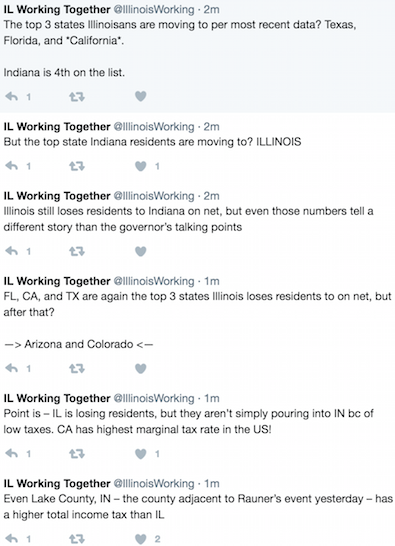
“We have the highest property taxes in America. We are literally two minutes from the Indiana border, and property taxes over in Indiana are between a half and a third on average of the property taxes for the same type of property here in the state of Illinois. That makes it unaffordable to compete here. That forces [businesses] to have higher prices to cover the high property taxes here. Customers can go across the border and have cheaper costs in large part because the property taxes are cheaper.”
* But the folks at Illinois Working Together took a look at some Census numbers (click here for the raw data) and tweeted out a storm…
* It’s dark and grainy and difficult to see, but a pal sent me this video of gubernatorial candidate Ameya Pawar “levitating” someone today, accompanied by saxophone music…
Facebook released on Wednesday a new set of tools to help facilitate civic engagement and discourse between voters and their representatives.
The new tools give both constituents and lawmakers more targeted means of interacting with another, and are a part of Facebook’s larger push to introduce civically focused features to the platform. […]
The “Constituent Badge,” feature will allow users to opt in to displaying a badge that they are a part of a lawmaker’s district, so that they lawmakers can know that they’re engaging with those they represent.
Along with the new badges, Facebook introduced “Constituent Insights,” a tab that allows lawmakers and their staff to see what topics and news stories their constituents are talking about. If there is a spike in discussions about something like crime, or the budget, representatives would be able to see this. A developer noted that trending news stories among constituents wouldn’t just be limited to news stories, so that they could get full insights on what their districts are discussing.
The “Districting Targeting,” feature allows lawmakers to make posts visible only to their district, with the idea of turning posts into a “mini community meeting.” The company also noted that in addition to posts targeted directly to districts, representatives would have the option of targeting live videos as well.
* As we’ve already discussed, Rep. Chad Hays (R-Catlin) led the mini revolt that passed a 911 emergency call center fee hike last month. He talked to Tom Kacich…
“I came to the conclusion that my constituents weren’t that concerned with the amount that the people of Chicago paid and if Chicago legislators were comfortable with that amount, fine,” Hays said. “But what I was not willing to do was go home and tell my own constituents that when you dial 911 and on the other end of the line it says that this has been disconnected and people ask, ‘Why did this happen?’ I was totally uncomfortable with saying that the mayor of Chicago and the governor are in a wrestling match over something peripheral to your 911 service.” […]
“I suspect that with this subject matter, if the governor chooses to veto the bill, he will be overridden,” Hays declared.
The problem comes if Rauner chooses to use his amendatory veto powers and then Speaker Madigan does his usual thing and rules it out of compliance with the Constitution and the bill dies from inaction.
* Hays also talked about if that template could be used to break the impasse…
“In the House, it’s very difficult to get anything passed that the speaker doesn’t at least allow for a vote. That’s the inherent problem with the rules of engagement in the House of Representatives, that the speaker of the House has the rules screwed down so tight that if he doesn’t want to run a bill, it doesn’t run,” Hays said. “So going over the head of the speaker in the House of Representatives and doing what you just darn well please whether he likes it or not is nearly impossible. […]
But Hays insisted that “there are budget talks going on as we speak behind the scenes” and “people talking to ascertain if there is a deal to be made.”
“If that is the case,” he added, “I think you’ll be seeing some more concrete proposals coming in the next couple of days.”
Hays said again he’s prepared to vote to raise taxes and cut spending as part of a budget deal.
If anybody can get this done from the ground up it’s gonna be people like Chad Hays. There aren’t many of them in the House, but you takes what you can gets.
*** UPDATE *** I just talked to Rep. Hays, who said that while people are holding discussions to see if there’s a pathway to ending this impasse, he didn’t mean to imply that something was imminent.
* Illinois owes billions to suburban non-profits, companies, government agencies: In the suburbs, that adds up to $2.2 billion owed to more than 5,100 health care providers, local government agencies, small businesses and other state vendors… The amount is roughly 15 percent of the $14.7 billion the state owes all vendors. Chicago-based vendors are owed close to $5.6 billion, according to the comptroller’s figures.
A federal judge says she’ll decide soon whether to order Illinois to pay health-care bills for low-income and other groups even as the state heads into another fiscal year without a budget.
Judge Joan Lefkow said during a Tuesday morning hearing in Chicago that she’d deliberate on the question of forcing Medicaid payments and post a ruling in the civil case later the same day. […]
But advocates for low-income families and others who rely on Medicaid say an order would help clarify that payments to health-care providers should be as high or a higher priority than other payments, including state salaries.
Two years after Lefkow’s ruling, a cash crunch in Illinois’ main checking account has caused the state to fall behind on a number of payments, including about $2 billion owed to Medicaid providers. Lawyers for Medicaid recipients argue that the doctors and hospitals who are owed the money are starting to cut off services to the poor people who need their care, putting the state in violation of federal consent decrees. […]
Yates argued Tuesday that the state is in violation of the 2015 order because it hasn’t kept current on the payments, instead sending dollars to pay other bills as required under state law. Yates argued that those payments are being made for “political reasons,” while the payments ordered by a federal court are being pushed to the back of the line.
More than two dozen health care providers and insurance companies have asked for a federal ruling.
“All we’re asking for today is that the consent decree takes precedent over pension obligations,” attorney Thomas Yates, executive director of the Legal Council for Health Justice said. […]
Lawyers representing the Illinois Attorney General’s office claim that the state is paying its bills, but “just not as prompt as the plaintiffs would like.”
During Tuesday’s hearing, Judge Lefkow said Illinois has “an insolvency situation,” comparing the state’s finances with bankruptcy – but she was reluctant to tell State Comptroller Susana Mendoza which bills to prioritize.
If, however, the Court grants the requested relief, Defendants request that the Court make the order effective July 1, 2017 (the beginning of the next fiscal year), for two reasons. First, as Defendants’ counsel advised the Court during the June 6, 2017 hearing, Moody’s Investor’s Service issued a statement on June 1, 2017, in which Moody’s stated that one of the factors that could lead to a downgrade of the rating on Illinois’ general obligation bonds is the entry of “[c]ourt rulings that increase the volume of payment obligations that are legally prioritized.” And, as Defendants’ counsel also advised during the June 6 hearing, a rating downgrade would have the immediate effect of triggering provisions in several credit swap agreements that could require an immediate payment of approximately $39 – 107 million and an increase in the interest rate the State pays under the swap agreements, which would further reduce the cash available to the State to pay its obligations.
If this Court enters an order granting Plaintiffs their requested relief, that order could lead to another downgrade. However, if the Court grants relief but the order is not effective until July 1, 2017, that likely will avoid an immediate downgrade and also would send a message to the Illinois General Assembly and Governor that they have until June 30 to resolve the State’s budget impasse and avoid the consequences of the Court’s order. If the budget impasse is not resolved by July 1, that fact alone likely will lead to a rating downgrade, regardless of the effective date of the Court’s order.
Second, making any order effective July 1 will give Defendants some additional time to determine how to comply with the Court’s order. Although Defendants do not know how the Court might word an order granting relief, Defendants anticipate that they will need some time to figure out how in practical terms to comply with any such order, given that, as has been described in earlier hearings, the State’s cash flow crisis leaves Defendants with no obvious way to satisfy Plaintiffs’ request for relief.
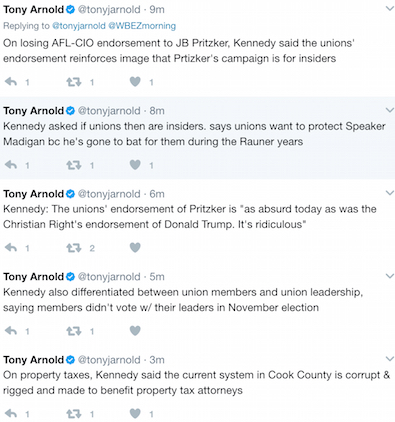
* Chris Kennedy was on WBEZ this morning. Tony Arnold gives us a rundown…
Except Kennedy himself made a play for that endorsement and tried to keep Pritzker from getting it.
* From the ILGOP…
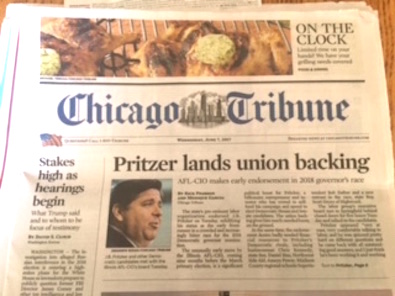
J.B. Pritzker was panned yesterday by Democrats and Republicans alike after receiving the Mike Madigan-backed AFL-CIO endorsement.
The endorsement comes hundreds of days before the primary, before any debates, and without a proper vetting process.
But Mike Madigan knows that J.B. Pritzker can be trusted to maintain the corrupt Chicago machine – Pritzker’s already been exposed on FBI tapes and media reports working the system to get state jobs and massive tax breaks.
Chris Kennedy, Ameya Pawar, and Daniel Biss blasted Pritzker and the insider process used to obtain the endorsement.
Pritzker appeared “very at ease, very comfortable talking to labor, and he was quizzed pretty hard on different question, and he came back with all outstanding good answers and I just think he’s been working it and working it hard,” Illinois AFL-CIO President Michael Carrigan said.
The decision to act so early was motivated by Republican Gov. Bruce Rauner’s efforts to weaken union rights, he added.
“There were a few who raised comments that this is the earliest we have ever done it, but we all agreed on one thing, that Gov. Rauner is not leading this state forward and he needed to go, and I think that propelled the early endorsement discussion for J.B.,” Carrigan said. […]
Carrigan dismissed suggestions that Madigan orchestrated the endorsement.
“I didn’t really hear that in the meeting today. I heard a lot of discussion focused on (Pritzker’s) questionnaire and how he answered and how he talked about helping other candidates,” Carrigan said. “The speaker is the chairman of the Democratic Party of Illinois, he has certainly been around a long time, but I didn’t not feel any, you know, hard force from him.”
* And the Pritzker campaign seems a bit unclear on the concept…
AFL-CIO is one of 16 Illinois unions that have now endorsed JB and are ready to bring Rauner’s war on the labor movement to a swift end. Throughout his time in office, Bruce Rauner has held this state hostage, in a reckless attempt to cripple unions and attack working families.
Oh, for crying out loud. The AFL-CIO is not a union. It’s the umbrella organization for most unions in Illinois. It’s a federation (that’s the “F”) and a congress (that’s the “C”).
Some of the top holders of Illinois debt aren’t bailing out, even as the state slides toward a junk bond rating. The reason? They say Illinois isn’t an economic basket case, just the victim of a political logjam that will one day be broken.
“Illinois’s problems are self-inflicted,” said Guy Davidson, director of municipal bonds at AllianceBernstein Holding LP, which owns about $550 million of the bonds. “They have the resources to pay their debt and we think they ultimately will.” […]
Like other money managers, [Peter Hayes, head of municipal bonds at BlackRock Inc.] sees Illinois as a state with a solid economy but serious political problems. “In that sense, it is very different from places like Detroit and Puerto Rico,” he said.
While Illinois has drawn comparisons to Puerto Rico, which collapsed into bankruptcy after the U.S. gave it legal power to escape from its debt, the differences are vast. Illinois’s bond debt is less than half the Caribbean island’s, even though the state’s population is more than three times as big.
Illinois’s $800 billion economy — more than 10 times the size of Puerto Rico’s — is growing, albeit slower than the rest of the nation. It has been adding jobs, sending its unemployment rate tumbling to 4.7 percent from more than 11 percent in the aftermath of the recession. State law requires the government to appropriate sufficient money to pay debt service and it can draw from all unrestricted funds to do so. Illinois has never defaulted.
* But the Illinois Policy Institute’s news service director sees it differently…
As in Puerto Rico, Illinois is in a fiscal death spiral because of decades of poor government.
“So, in the end, both chilly Illinois and tropical Puerto Rico have one really major thing in common — bad government,” the Investors Business Daily column concludes. “Both over-promised on welfare services, pensions and other government spending, then tried to raise taxes to pay for it. And both have been grossly mismanaged by people operating under the delusion that big government solves everything.”
Could bankruptcy be Illinois’ only hope? As in Puerto Rico, it would take an act of Congress for that to be an option. But, as far as the state has fallen, the remaining options for a fiscal recovery are limited.
From North Lawndale and Little Village to Calumet City and Melrose Park, residents in working-class neighborhoods were more likely to receive property tax bills that assumed their homes were worth more than their true market value, the Tribune found.
Meanwhile, many living in the county’s wealthier and mostly white communities — including Winnetka, Glencoe, Lakeview and the Gold Coast — caught a break because property taxes weren’t based on the full value of their homes.
As a result, people living in poorer areas tended to pay more in taxes as a percentage of their home’s value than residents in more affluent communities. Known as the effective tax rate, the percentage should be roughly the same for everyone living in a single taxing district.
But the Tribune’s analysis shows the rates became skewed in favor of wealthier residents.
“What the Chicago Tribune has revealed today is nothing less than an illicit enterprise that runs right through the Speaker’s office. The Chicago political machine has manufactured a property tax system designed to punish the poor and extort millions from taxpayers for their own benefit. Democratic candidates for Governor – J.B. Pritzker and Chris Kennedy – have profited from this corrupt system. They all have some explaining to do.” – Illinois Republican Party Spokesman Steven Yaffe
A bombshell three-part series released by the Chicago Tribune this morning documents how the Chicago political machine – Mike Madigan, Joe Berrios, and others involved in the property tax appeals business – have manufactured a property tax system that targets the poor and puts millions in their own pockets.
Some Key Highlights:
Cook County Assessor Joseph Berrios has “resisted reforms and ignored industry standards”, creating a “staggering pattern of inequality.”
Berrios, whose “strongest allies” include Mike Madigan and Ald. Edward Burke, has “raised more than $5 million since 2009, more than have of which came from property tax attorneys and businesses associated with them” in his capacity as chairman of the Cook County Democratic Party.
“Some of the state’s most influential political families have been tied to the office or the industry of tax attorneys that has grown up around it; Madigan, Burke, Hynes and Cullerton are among the most prominent.”
They have created “a property tax system that harmed the poor and helped the rich.”
The Assessor’s office “would not say” what methodology is used to determine valuation adjustments.
Property tax appeals lawyer’s fees – lawyers like Mike Madigan and those used by J.B. Pritzker to get massive breaks on his “uninhabitable” mansion – have soared to $35 million per year.
The wealthy are able to get huge tax breaks through the appeals process and loopholes like those that claim properties are not inhabitable.