Two cases of Legionnaires’ disease have been confirmed at the Illinois Veterans Home Wednesday morning.
David MacDonna, a Public Information Officer with the Illinois Department of Veterans Affairs says Legionella tests came back positive for two residents.
One of those residents is now deceased, however, the Illinois Veterans Home says the individual had a complex medical issue aside from Legionnaires’.
The second individual is being treated for the disease.
“We work continuously with the Adams County Health Department to identify any potential sources. We’ve done an extensive renovation, including a brand new water treatment plant to provide higher quality water,” said MacDonna.
Pritzker and Kennedy Continue to Dodge on Releasing Their Tax Returns
Tuesday’s forum highlighted growing pressure on Pritzker and Kennedy to honor their word, release tax returns
Tuesday’s Democrat gubernatorial forum at Aurora University raised questions for the two candidates who have yet to release their tax returns, J.B. Pritzker and Chris Kennedy, drawing criticism from fellow Democrats.
Both Pritzker and Kennedy pledged to release five-year’s worth of tax returns six months ago, though neither has followed through yet. Daniel Biss set up a counter on his campaign website to mark the days since the candidates made the pledge to release their tax returns, as well as lambasting them publicly for avoiding the subject.
The candidates provided no details on a timetable for releasing their taxes other than saying they will be released “soon,” the same answer each has been telling the media for months.
While the Democrats debate who comes from a wealthier family and dodge on releasing their tax returns, they continue to prove that the Democratic gubernatorial primary is a race to the bottom.
Speaking after the forum, Pritzker told the Sun-Times he plans to release his tax returns “soon.”
“We’re compiling them and we’re putting them together. We’ll make sure we get them out soon,” Pritzker said. Asked why they haven’t been released yet, Pritzker called the process “complex.”
Kennedy too said he’ll release his tax returns when he files his financial disclosure form: “That way everything is together in one place.” He said the state’s financial disclosure form is limited and it’s helpful for voters to see tax returns “to give a little fuller picture of what’s going on.”
Candidates are under no obligation to release their tax information, though it is customary. Forms help to discern potential conflicts of interest, fiscal management, as well as a candidate’s priorities through charitable giving.
Elected officials are obligated to file public economic interest statements, though watchdog groups have long criticized Illinois’ disclosure requirement and forms as weak and riddled with opportunities for loopholes.
It's always a privilege to encourage young women to run for office. Thanks @marieclaire for including my advice in your campaign guide pic.twitter.com/5VZSx8diOH
Sen. Dick Durbin, the number two Democrat in the Senate, said in a radio interview Sunday that his party could lose to President Donald Trump in 2020 if they “overdo it” and become too liberal.
The Illinois senator was asked on a local Chicago radio program about comments made by Democratic Rep. Cheri Bustos, which the host characterized as a warning to fellow Democrats that if the party becomes too liberal, they would give Trump another term.
“We need to be balanced,” Durbin said on “Connected to Chicago” on WLS-AM on Sunday. “She’s right about that. And as downstater like her, I understand she represents a challenging district. We don’t give up on our values, but we better be sensitive too that there are people with more moderate views, and people who may disagree with some parts of the Democratic platform as they as they are presented. We’ve got to be open to that possibility.”
“So you could lose it by being too liberal?” asked the host.
“You can,” Durbin said. “I think you can overdo it. We have to really appeal to that sensible center. It’s a thin stripe now. It used to be a lot wider stripe, but it’s an important and determining factor in most elections.”
Keep in mind before you answer that Illinois is not a bellwether state. President Trump lost Illinois by 17 points, 56-39. Durbin was talking nationally, we’re talking statewide here.
* The Question: Do you think the Democratic candidates for governor are moving too far to the left? Click here to take the poll and then explain your answer in comments, please.
State Representative Lindsay Parkhurst (R – Kankakee) and Kankakee County Board Chairman Andy Wheeler announced today Kankakee County submitted its Request for Proposal (RFP) to Amazon outside of the Illinois RFP package. Rep. Parkhurst commented:
“The Governor submitted a Chicago only proposal for the State’s RFP for Amazon HQ2. We respect the Governor’s decision, but are not letting this discourage us. The Kankakee County RFP is an inspired, inventive, imaginative, and innovative plan quite different from most submissions. Chairman Wheeler and Kankakee County presented a visionary, comprehensive, and conceptual plan for Amazon H2Q. Our RFP thinks outside the box.”
Somebody got out the thesaurus.
* From the Illinois Policy Institute’s news service…
Kankakee County Board Chairman Andy Wheeler sent their proposal Tuesday after hearing the news about Chicago’s submission. While he conceded that Chicago has the population, it isn’t necessarily known for being business friendly, which was among Amazon’s criteria.
“The amenities that Chicago offers are world class, but I wonder about the business environment,” Wheeler said. […]
Wheeler couldn’t give specifics of his county’s unique plan to persuade Amazon to overlook the lower population, but he said that the offer stood out by “allowing Amazon to create their own incentive package.”
For Amazon to select Kankakee County over huge cities such as Chicago, New York, Boston, Washington D.C./Baltimore, Atlanta, Denver, Austin (Texas) plus Ottawa and Toronto in Canada, would be considered a one-in-a-billion shot at best.
However, this county was ticketed as a long shot in 2001 when the Chicago Bears were looking for a new summer home for their annual training camp.
There were more than 20 other Illinois universities in the running at the time. Olivet Nazarene University in Bourbonnais, one of the smallest, put this county’s best foot forward when the Bears’ brass came to visit.
Kankakee County’s quest to get in on the new Amazon headquarters might have become greater as the Chicago region officially submitted its bid to land the company’s prized second headquarters.
Kankakee County’s hope is that if the Chicago region were to submit the winning bid, then, perhaps, some portion of the Amazon headquarters could spill here. If nothing else, county residents could gain access to those jobs.
Gov. Bruce Rauner’s administration borrowed $1.5 billion on the bond market Tuesday as part of a larger plan to whittle away at the state’s about $16 billion pile of unpaid bills and save money on interest costs.
The state received an overall interest rate of 3.5 percent on the bonds. That’s compared to as much as 12 percent per year in interest the state pays to contractors who have waited months to be compensated for their work because of Illinois’ cash crunch. The last time the state borrowed money, in November 2016, it received an interest rate of just less than 4.25 percent for $480 million in bonds.
* But…
note to the non-bond geek reporters out there….careful comparing ILL 3.5% cost of borrowing to last deal…..last deal went out 25 YEARS, this is a very very short deal, 1B paid off 2 years, $500M in 12. apples-oranges.
The loan carries an interest rate of 3.5 percent — remarkable given Illinois experts expected the state’s poor credit to drive interest as high as 6.5 percent. But, more importantly, it’s far lower than taxpayers have to fork over in late-payment fees.
Maybe don’t consult those “experts” any more if they’re so bad at predictions?
* Deets from the governor’s office…
· $500 million of general obligation bonds, series of November 2017A were awarded to Bank of America Merrill Lynch with a true interest cost of 1.67 percent for the one-year maturity.
· $500 million of general obligation bonds, series of November 2017B were awarded to J.P. Morgan Securities LLC with a true interest cost of 1.75 percent for the two-year maturity.
· $500 million of general obligation bonds, Series of November 2017C were awarded to Bank of America Merrill Lynch with a true interest cost of 3.95 percent for the 12-year maturity.
* For the bond geeks…
JPMorgan won two-year maturity with True interest cost of 1.746 %, about 75 over MMD, better than had been trading in recent days. So one and two year fared better, 12 year slightly over where had been trading.
* From the Illinois Policy Institute’s news service…
Illinois paid a penalty for its poor governing decisions when it made its first bond offering Tuesday to pay off part of its bill back-load.
The state will pay 3.5 percent on the $1.5 billion in debt that it issued Tuesday. The state will offer up more debt in the coming days, totaling $6 billion in bonds to pay down some high-interest bills accrued in the budget impasse. The state’s backlog of bills had ballooned to $16 billion.
While analysts said the rate was lower than they expected, a fiscally sound state would have paid a little more than two percent for a similar loan, according to Municipal Market Data. More bonds are expected to be sold next week.
* Comptroller Mendoza made a good point…
The 3.5 percent rate the state of Illinois received on its competitive bond offering Tuesday will serve state taxpayers much better than the interest rates of up to 12 percent the state pays on parts of its bill backlog now. Once the negotiated sale is complete, my office will leverage federal matching funds to get taxpayers a good return on their investment and we will move swiftly to pay down the highest-interest-accruing parts of the state’s debt.
The state’s nearly $16 billion backlog of bills is triple the amount when Rauner took office in January 2015. Though the state went two years without a budget amid fighting between the Republican governor and Democrats who control the legislature, government continued to spend money and rack up debt. A series of laws, one-time agreements and court orders meant money kept going out the door. And the Rauner administration continued to sign contracts, whether or not the money was there to pay for them.
Under state law, unpaid bills can accrue from 9 percent to 12 percent interest a year. The bipartisan Commission on Government Forecasting and Accountability has estimated that could cost the state as much as $2 million a day.
* And back to the governor’s office…
“The state received strong bids today for its bonds and is pleased with the market’s favorable reception of the sale,” said Scott Harry, director of the Governor’s Office of Management and Budget. “This bodes well for the state’s financing coming next week.”
Following the completion of next week’s $4.5 billion bonds to complete the backlog refinancing, the State will return to the capital markets later this year with a $750 million general obligation bond issue for 2018 capital projects, which will also be sold competitively.
Gov. Bruce Rauner’s administration has identified millions of dollars of cuts it will make to the new state budget, including to human services, agriculture programs and transportation.
Even then, the administration says the budget remains $1.5 billion out of balance, which will require further reductions. […]
Rep. Greg Harris, D-Chicago, the lead budget negotiator for House Democrats, said the cuts included $89 million to various human services programs, including autism services, after school programming and immigrant and refugee services.
“He has the authority, I understand that,” Harris said. “If you look at the human service programs, it is the same vulnerable seniors, people with disabilities and children that he has consistently targeted year after year despite the legislature continually trying to restore the funds. Those are his regular targets.” […]
In addition to the human services cuts, the administration outlined $85 million in cuts to the Illinois Department of Transportation, $41 million to the Department of Commerce and Economic Opportunity and $21 million to the Department of Agriculture.
* One of the problems is that the governor estimates the deficit to be $1.7 billion, while the GA claims the budget has a $356 million surplus…
GOMB estimates an original deficit of $1.7 billion and reduces it to $1.5 billion after initiating programmatic reductions totaling $156 million. There are four major factors driving the estimated budget deficit when compared to the General Assembly’s enacted budget which estimated a surplus of $350 million.
Those factors include:
1. A revenue estimate that is $511 million below the GA estimate
a. Personal income is $250 million less
b. Corporate income is $125 million less
c. Sales tax is $51 million less
d. Other sources total $62 million less
2. GOMB does not account for $500 million in savings associated with Tier III
a. The systems have publicly stated they did not anticipate they would have the new option in
place in order to achieve savings in FY18
3. Debt service costs associated with issuing $6 billion in bonds is estimated at $535 million in FY18
4. Due to the budget being enacted after the start of the fiscal year (enacted on July 6th) some automatic transfers out of GRF into special funds occurred on July 1, adding $234 million to FY18 statutory transfers out.
It’s worth noting that during all spring and summer budget negotiations the various working groups were using the same base revenue estimate. It was only after the FY18 budget was enacted that DOR readjusted their FY18 revenue estimate which lead to a drop in assumed revenues of over $500 million.
GOMB has implemented $156 million in GRF budget reductions. They chose to fully eliminated or reduce various grant programs to reach this savings level. For example, human services grant programs that the governor has repeatedly proposed to eliminate are either eliminated entirely or reduced by at least 5% from the FY17 enacted level. The FY17 enacted level already represented a 3% reduction from the FY15 base level. In some instances the reduction represents over a 66% reduction from the FY18 enacted funding level. There are at least five grant programs that GOMB has decided not to fund in FY18, despite an enacted appropriation for the program.
* Pritzker campaign…
Bruce Rauner is making another round of devastating cuts to crucial state spending on human services, agriculture, and transportation.
Rauner slashed funding for after school programming, autism services, business development and tourism grants, environmental programs, immigrant and refugee services, and para-transit. The latest round of cuts by this failed governor is all too familiar. In 2015, $26 million in funding for many of those same human services was eliminated in the aptly-named “Good Friday Massacre.”
“Bruce Rauner slashing vital programs that help Illinoisans build better lives comes as no surprise for this crisis creatin’ governor,” said Pritzker campaign spokeswoman Jordan Abudayyeh. “Bruce Rauner has no moral compass and he is hell-bent on repeating his same destructive mistakes with Illinois families paying the price.”
Illinois is out of the running for a prized 4,000-job assembly plant that Japanese auto makers Toyota and Mazda are planning to open in the United States.
The apparent reasons: lack of shovel-ready sites and the state’s failure to adopt a right-to-work law.
Mark Peterson, president and CEO of Intersect Illinois, the state’s privately run economic development corporation, said in an interview and email that while no formal announcement has been made, his sources tell him Illinois is not among the three or four finalists for the $1.3 billion facility.
“While we showed very well, particularly in the areas of workforce, and our proposal was very well received, in the end the site readiness of some other locations took us out of the consideration set going forward,” Peterson said. […]
“Recently, we have seen very public searches taking place for HQ and manufacturing facilities,” Peterson said. “The challenges with these is that although they are public in their media exposure, they are still very protected and confidential when communicating exactly what factors weigh in on final decisions. That said, many national site consultants charged with making recommendations for corporate relocations and expansions will not even consider a state that is not a right-to-work state. In this case, the three states I am told are still in the running are all right-to-work states.”
*** UPDATE 1 *** Greg Baise, president & CEO, IMA…
“When will Illinois lawmakers wake up and realize that their actions have real life consequences? For years, the IMA has pointed out that the state continues bleeding manufacturing jobs and losing opportunities for new plant expansions because of the high cost of doing business in Illinois while other states are gaining tens of thousands of jobs. The sad fact is that the General Assembly allowed the primary incentive program (EDGE) to expire during the time that the state’s bid was submitted. Illinois has many advantages including location, workforce, colleges and universities, infrastructure, and clean water but self-inflicted wounds are damaging our state’s economy.”
*** UPDATE 2 *** Illinois Working Together…
Today, Intersect Illinois announced that Illinois is no longer in the running for the Toyota/Mazda plant expected to generate as many as 4,000 jobs. Illinois lost out despite the Rauner Administration taking the lead in recruiting the companies and Gov. Bruce Rauner himself traveling to Asia last month to pitch top executives. Illinois has lost more than 12,000 manufacturing jobs since Gov. Rauner took office.
“Today’s announcement is yet another example of the economic damage Gov. Bruce Rauner has inflicted upon Illinois,” said Illinois Working Together Campaign Director Jake Lewis. “Gov. Rauner has created widespread economic uncertainty that has caused long-lasting damage to Illinois’ business climate. While Gov. Rauner trashes’ Illinois economy, job growth has sputtered and our bill backlog has soared.
“Instead of blaming workers for his failure to recruit new businesses to the state, Gov. Rauner should invest in Illinois communities and work collaboratively to find new ways to bring new jobs to Illinois.”
*** UPDATE 3 *** DGA…
Today, Crain’s Chicago reported that Illinois will not be a contender for a new Toyota factory and, rather than take any responsibility, Governor Bruce Rauner’s team quickly pivoted to bashing the state. While running for governor, Rauner touted himself as a natural salesman due to his business background. Instead, Rich Miller wrote, Illinois voters got “two and a half solid years of Rauner running down his own state.”
Rauner’s Asia trip was supposed to be the return of Rauner the Recruiter with a new Toyota factory as the crown jewel. But after failing to land the big fish, Rauner’s team quickly returned to their normal messaging, blaming Illinois. The CEO of Intersect Illinois blamed labor laws for Rauner’s failure and even claimed that Illinois was never going to get the plant anyway. He did not mention Rauner’s two-year budget impasse which drove up debt, devastated higher education, and slowed the state’s economy.
At least Intersect Illinois got a good meal out of it.
“Over and over again Illinois voters hear how Bruce Rauner’s failures are not his fault,” said DGA Illinois Communications Director Sam Salustro. “Governor Rauner just refuses to accept any responsibility. Now, his team is bashing the state for their own failure in recruiting companies, something Rauner promised voters he would succeed at. Rauner can’t blame away the fact that Illinois’ economy is lagging behind the state’s neighbors and the nation, and his failed leadership is at fault.”
*** UPDATE 4 *** Press release…
Senator Andy Manar (D-Bunker Hill) responded today to assertions that Illinois’ failure to adopt a right-to-work law factored into a manufacturer’s apparent decision not to site a factory here:
“When you have a governor who spends a significant portion of his time publicly bashing the state he is supposed to lead, it should come as no surprise that manufacturers would look elsewhere for a more stable home for their factories.
“Contrary to what Gov. Rauner and his administration would have people believe, labor unions are not to blame for all of Illinois’ problems. Two years of a devastating budget stalemate under the governor’s watch did nothing to improve the state’s economic outlook or its reputation in the corporate world.
“Turning Illinois into a right-to-work state and lowering wages for our workers does not mean the state suddenly would become an attractive location for manufacturers. Many more factors are considered when companies make these decisions.
“Illinois will become a more attractive site for companies when its state budget is in order; when it can show a record of investing in universities, colleges and public schools; and when its governor stops bad-mouthing the state and its people.”
Congressman Bobby Rush’s son and brother are working for Chris Kennedy’s gubernatorial campaign — their paydays coming just weeks after Rush endorsed the Democrat for governor.
Kennedy’s third quarter contribution report, filed on Monday, shows Jeffrey Rush — one of the congressman’s sons — has been paid $11,120.19 from the campaign with his first paycheck dated Aug. 16. His brother Marlon Rush’s first paycheck was on Aug. 4 for $3,000, with his pay now adding up to $11,354.31. […]
Kennedy on Tuesday night said he didn’t see a conflict of interest in having hired relatives of Rush after his endorsement.
“I’m from a large family. He’s from a large family. It never occurred to me,” Kennedy told the Sun-Times after a candidate forum at Aurora University. “Look at the dollars involved and the hours that they’re putting in. It’s fair compensation, and I don’t think there’s any extra going to any..I don’t see it as a conflict.”
Kennedy said the two are working on “everything from meeting planning to event organizing, political outreach, interface with different interfaith organizations.”
“Pretty much soup to nuts in the campaign,” Kennedy said. “And they’ve been very, very helpful and probably surprised by the amount of work they’re being asked to do.”
Um, they’re surprised at how much work they have to do?
An Illinois state senator says Facebook refused to take down a recent political ad despite his claims it contained false information.
“There was little if anything I could do about it,’ said Andy Manar, a Democrat from Bunker Hill.
Manar says the ad, from the Christian County Republican Party, ran for several weeks on Facebook stating Manar had voted for a bailout of nuclear power plants. Manar had voted on the bill, but voted no.
“We did get though to Facebook and I’m going to paraphrase their response,” he said. “It’s not their job to match votes of public officials up to news stories that are promoted on their platform.” […]
“What’s most alarming is there’s a financial incentive for Facebook to allow lies, blatant lies, about the record of public officials to be told because the more provocative the lie, the more money they make on advertising,” he said.
Manar ran into more problems when Facebook rejected his response ad because it had violated Facebook’s policy of using another ad’s content.
A Republican challenger for state Sen. Andy Manar’s seat said he took down a factually incorrect ad on Facebook, but it’s unclear whether the ad is still reaching local voters when they log on to the social media site.
“I think it was up there for a few days … when I found out that it was not accurate, I had it taken down,” said Seth McMillan, a Republican who announced he is running against Manar and chairman of the Christian County GOP. […]
Manar said he saw the ad still appearing on his personal Facebook account as recently as last week, after McMillan said the ad had been removed.
When McMillan explained the process of how his organization removed the ad, he described what Facebook calls a “boosted post.” This type of advertising allows the operator of a public page, like the Christian County Republicans, to pay Facebook to show the post on more people’s news feeds. […]
But McMillan said he was not sure if his organization also paid for another type of Facebook ad that’s meant to show up on the sides of the social media site, and if so, whether it had been deleted.
Fritz Kaegi has a mysterious problem: He’s running for Cook County assessor against a powerful politician, but someone has hijacked his online identity. […]
He’s just filed a legal action against GoDaddy, Facebook, Twitter, Crowdpac and others because someone created fake online web accounts in his name to raise campaign cash and connect with supporters. […]
The sham websites appeared shortly after Fritz announced he would challenge incumbent Assessor Joe Berrios, chairman of the Cook County Democratic Party.
A recent fake tweet mentions “orgies,” and a press release dated Aug. 29 says Kaegi was out talking about his campaign “with a deadly hurricane raging in Texas.”
“It’s creepy,” says Kaegi’s wife, Rebecca. “My children’s names and faces are on the fictional website.”
A state legislator who was groped by a male lobbyist weeks after she was sworn into office. A legislative staffer-turned-lobbyist who for years would only wear pantsuits in order to project a “business-only” air. A government affairs director who faced inappropriate advances from an associate in full view of male colleagues who seemed oblivious as it happened.
As Hollywood takes a hard look at itself in the wake of the spiraling Harvey Weinstein sexual misconduct scandal, the women of California politics are publicly declaring: Us too.
More than 140 women — including legislators, Capitol staff, political consultants and lobbyists — signed a letter calling out the “pervasive” culture of sexual harassment and mistreatment that plagues their industry.
The signatories include six of 26 women in the Legislature, two retired lawmakers, a Board of Equalization member and officials from the state Democratic and Republican parties.
“Each of us has endured, or witnessed or worked with women who have experienced some form of dehumanizing behavior by men with power in our workplaces. Men have groped and touched us without our consent, made inappropriate comments about our bodies and our abilities. Insults and sexual innuendo, frequently disguised as jokes, have undermined our professional positions and capabilities,” the women wrote. “Men have made promises, or threats, about our jobs in exchange for our compliance, or our silence. They have leveraged their power and positions to treat us however they would like.”
Lawmakers in other states have spoken out as well. In Rhode Island, for example, a handful of political leaders added their own messages, as reported in the Providence Journal. “I can say that as an elected official, as a state representative I have experienced this first-hand,” state Rep. Teresa Tanzi told the newspaper. “I have been told sexual favors would allow my bills to go further.”
Such descriptions could apply to many other statehouses as well. So far this year, sexual harassment scandals have roiled state capitols in Iowa, Nevada, Oklahoma and Tennessee. Those incidents resulted in secret settlements, a seven-figure jury award and the departure of at least four state lawmakers, on top of the personal consequences for the victims. […]
For years, researchers and advocates thought that simply increasing the number of women in politics would reduce the amount of harassment and violence they encountered. But that hasn’t turned out to be the case, even in places where the numbers of women in high government office have been on the rise, says Mona Lena Krook a Rutgers political science professor. “The resistance to women’s participation has just taken new forms,” she says. “There’s been a pushback against women’s inclusion.” […]
At least 37 of the country’s 99 state legislative chambers had a written policy on sexual harassment in 2016, according to the National Conference of State Legislatures. But those policies vary widely in their substance and effectiveness.
A new 60-second radio ad featuring a Chicagoan with a disability who is served by the DHS Home Services Program exposes the real-life consequences of Governor Bruce Rauner’s dangerous cuts to overtime care.
The new ad, which began airing Tuesday, October 17, features Jennifer Kostanski, who lost use of her limbs 14 years ago in a spinal injury suffered in a car accident.
The caregiver on whom Jennifer relies now faces suspension for working hours above the new overtime caps put in place by the Rauner administration; hours of care that Kostanski needs to live safely at home.
“I’m paralyzed from the chest down. I can’t imagine that I’d have any quality of life without my home care worker. I consider Melissa a godsend; she is my hands. I don’t see why Bruce Rauner is doing this,” Kostanski says in the ad. […]
Terri Harkin, a vice president with SEIU Healthcare Illinois, said:
“Jennifer’s story is a prime example of the dire consequences facing people with severe disabilities directly because of Governor Rauner’s strict overtime policy. The governor is threatening to take away trusted, dedicated caregivers from the people who need them most. We hope Gov. Rauner will hear Jennifer’s plea, change course and remove the threat of suspension to caregivers resulting from his illegally implemented policy.”
Jennifer: I was in a car accident… in a blink of an eye my whole life changed forever… I’m paralyzed from the chest down … I need 24 hour care for the most part
I can’t imagine that I’d have any quality of life without … my home care worker.. I consider Melissa a godsend… She basically is my hands.
VO: Governor Bruce Rauner is continuing his attack on people with severe disabilities and the caregivers they rely on. Rauner is threatening to suspend nearly one thousand home care workers and leave the people they care for with nowhere to turn to meet their most basic needs
Jennifer: I don’t see why Bruce Rauner is doing this…
VO: Rauner is taking away trusted, dedicated caregivers from the people who need them most.
VO: Call Rauner at eight five five nine nine nine zero two seven seven. Tell him to stop attacking Illinoisans with disabilities.
Jennifer: I rely on my home health care worker she’s my lifeline.
Gov. Bruce Rauner long has argued that one of the state’s best economic bets would be to somehow bridge the 140-mile gap that separates two of its strongest assets: the University of Illinois main campus in Urbana-Champaign and the city of Chicago. He thinks he’s got it figured out.
Joined by Mayor Rahm Emanuel and University of Illinois President Timothy Killeen, Rauner plans to announce tomorrow morning a project called the Discovery Partners Institute, which would be built on a 62-acre site along the Chicago River south of Roosevelt Road that is being developed by Related Midwest. Related calls the site “78″ in reference to hopes of becoming the city’s 78th neighborhood. The property also has been floated as a possible site for Amazon’s second headquarters, which the city and state jointly are pursuing. […]
The institute would be funded initially by as much as $200 million in private donors lined up by the governor, according to people who’ve heard the pitch. Exactly what programs will be represented is unclear, but it likely would involve both the university’s flagship campus and the University of Illinois at Chicago and both research and instruction activities. In broad strokes, the idea is to get academics and companies to collaborate on “pushing the art of the possible,” said one executive who was pitched on the idea by Rauner. It’s part of a broader innovation corridor envisioned by the governor that has multiple “nodes.”
With the clock running out on Rauner’s first term, the announcement would allow him to show some momentum on the economic-development front (along with hopes of landing Amazon and a Toyota-Mazda assembly plant, which the state also is pursuing). The question will be whether he can deliver.
Already, the proposed project has become the subject of political battles.
Rauner said project leaders have secured numerous commitments for private funding, though the governor would not identify those donors or reveal how much they planned to contribute. The governor also identified a source of public funding for the project that faces several hurdles: the sale of the James R. Thompson Center in the Loop.
Last week, Rauner said that he planned to use proceeds from the sale of the Thompson Center to help finance the institute. Rauner has said unloading the 1.2 million-square-foot building would fetch $300 million, though the state would have to pay around $60 million off the top to buy out the leases of the current tenants.
Rauner also said that though he was seeking some public funding for the initial stages of the work, over time he expected the institute to be primarily funded through private dollars.
Steve Brown, spokesman for House Speaker Michael Madigan, said Tuesday that legislative leaders were in talks about the institute but denied there had been any such accord, “in part because there was sort of a lack of detail about exactly how the state funds might be utilized.” Brown also said that the Thompson Center profits are incorporated into this year’s state budget, comprising a large chunk of new revenues.
When asked what income tax rate they would charge the top earners in the state, some offered approximate percentages, while others demurred and declined to state a rate.
Biss said he would look at Wisconsin or other neighboring states; he said top earners in Wisconsin, for example, pay 7.65 percent.
Kennedy said it’s “nearly impossible, with Gov. Rauner sitting as governor, to answer that question.” He said we don’t know if we’ll have a budget next year, or what the financial condition of the state will be. He accused Rauner of allowing the state to pile up its bills and its debt in order to “wound” state government.
Pritzker did not give a rate, but said creating jobs would “grow revenues in this state.”
Daiber said every person would pay $250 annually, with a one percent to six percent rate, with six percent for the highest income earners. Daiber said he based the six percent figure on neighboring states’ tax rates.
Hardiman said his rate would be one percent to 10 percent, with seven to 10 percent reserved for the highest income earners.
Whoever wins the primary, Rauner’s most crucial task next year is to make this race about two things: Speaker Madigan and higher taxes, as in he’s opposed, they’re in favor. That’s easier than explaining why they won’t be beholden to their party’s leader and what a graduated tax would mean for average citizens.
John Jackson, a professor at SIU’s Paul Simon Public Policy Institute, says the amount of money spent in Illinois governor’s race so far is unheard of.
“This is the earliest I’ve ever seen this much money being spent,” he said.
More than a year out from November 2018’s election, more than 100 million dollars has been raised in what is on pace to be the most expensive governor’s race in United State’s history.
Campaign Finance reports for period from July through September were due Monday, and show unprecedented levels of spending so early in the race from Republican Governor Bruce Rauner and Democratic candidate JB Pritzker.
“They’re both spending like the election is this November instead of next November,” Jackson said.
The debate exchange on the merits of Madigan came after the candidates clashed on the growing influence of money in politics, as billionaire Pritzker defended using his personal wealth to seek office while those with fewer resources bemoaned average citizens were being shut out.
Pritzker, who is self-funding his campaign, blamed Rauner for opening the floodgates by giving his campaign $50 million late last year, contending Democrats will need cash to build up infrastructure that could defeat the GOP.
Biss said Democrats should focus on building support using people, not money. “We’ve got to decide: Do we want to have an election or do we want to have an auction?” he said.
Kennedy joked that he “thought” he came from a wealthy family before seeing the amount of money that’s flowed in the race, which prompted Pritzker to shoot back, “You do.”
“Is this just a rich person’s game when we’re looking at this table? Is this just a rich man’s game of politics these days that regular people really can’t participate in?” [moderator Rick Pearson of the Tribune] asked the candidates.
“Unfortunately he set us on a course that I think is going to mean that we Democrats have got to build the infrastructure that we’ve lost. It’s important that we knock on doors, that we’re phone banking,” Pritzker said. “It also means that we Democrats have to join together to go beat Bruce Rauner. That is the campaign that I’m trying to put together. Not just here in the primary but also in the general election. For us to go out and beat Bruce Rauner and that’s why I’ve funded this campaign.”
Kennedy, heir of the famed political dynasty, too pinned the need to raise money on Rauner: “We need to respond to what they’ve done.”
But he noted his “outrage” at the amount of money in the race and the notion that you have to be wealthy to serve in politics.
“If that’s true, it’s the end of American democracy,” Kennedy said. Kennedy said people in the state must “rise up and make it clear that anybody can serve in office. You don’t need deep pockets.”
The Democratic candidates for governor sought to sell themselves to primary voters at a Tuesday night forum in Aurora, but much of the focus was on a guy who wasn’t on the stage: veteran Illinois House Speaker Michael Madigan, who also heads the Illinois Democratic Party.
State Sen. Daniel Biss and businessman Chris Kennedy ripped Madigan, saying he’s been in office too long and wields too much power. Meanwhile, entrepreneur and philanthropist J.B. Pritzker, who has received the backing of much of the Democratic establishment, declined to say whether it’s time for Madigan to go.
“He’s been around an awful long time,” said Pritzker, who suggested that putting in place term limits on legislative leaders is “an answer to that question.”
Pritzker said he and Madigan agree on some issues, but disagree on others, such as term limits and restrictions on the influence of politics when drawing legislative boundaries. […]
Biss contended Madigan’s grip has not only hurt Illinois but also prevented Democrats from pushing for progressive policies, saying it was “time for him to go.” Kennedy raised concerns about Madigan owning a property tax appeals law firm while also overseeing laws relating to property taxes, which are the primary source of education funding in Illinois.
Pritzker, who has had to fight off ties to Madigan, said there are issues he doesn’t agree with the speaker on. He said he favors independently drawn legislative maps and leadership term limits. He called himself an “independent progressive leader” and said that wouldn’t change should he win.
Pushed on whether the speaker has been around “too long,” Pritzker pointed to term limits as the answer to the question.
“There’s no chance I’m going to be working for the speaker,” Pritzker said.
“I don’t think that what Speaker Madigan is doing is illegal, I just think it should be,” Kennedy said. “He’s a state rep and he’s a property tax appeals lawyer. The problem with that is that it leads to us holding on to a system where we fund our schools through property taxes.”
Kennedy later added, “Mike Madigan makes money on a system that’s destroying our schools.”
Biss said Madigan has “been around too long” and is “too powerful.” He said he has supported term limits for legislative leaders, including proposing state constitutional amendments. However, Biss said Madigan is one person and is not the system.
“If we get too obsessed with just one person who has manipulated the system but did not create it, and then we don’t fix the system but just get rid of him, we’re going to be disappointed by how little changes,” Biss said.
*** UPDATE *** ILGOP…
Another day, another attempt from J.B. Pritzker to cover up his close ties to Speaker Mike Madigan.
Last night at an Aurora debate with the Democrat candidates for governor, the candidates were presented with a simple question: should Madigan stay in power. Even though Democrats Daniel Biss and Chris Kennedy have their own close ties to Madigan, they took the question as an opportunity to attack him, with both saying he’s been in office too long and wields too much power.
When it came time for Pritzker to answer the same question, he balked, refusing to say whether Speaker Madigan has been around too long or if it’s time for him to leave state government, surprising no one, as Pritzker is running for governor with Madigan’s blessing.
From the Chicago Tribune’s story, Dem gov. debate: Kennedy, Biss bash Madigan; Pritzker won’t say if it’s time for speaker to go:
The Democratic candidates for governor sought to sell themselves to primary voters at a Tuesday night forum in Aurora, but much of the focus was on a guy who wasn’t on the stage: veteran Illinois House Speaker Michael Madigan, who also heads the Illinois Democratic Party.
State Sen. Daniel Biss and businessman Chris Kennedy ripped Madigan, saying he’s been in office too long and wields too much power. Meanwhile, entrepreneur and philanthropist J.B. Pritzker, who has received the backing of much of the Democratic establishment, declined to say whether it’s time for Madigan to go.
Pritzker’s silent support of Madigan’s Speakership comes after he was asked about the same issue at a recent Chicago debate with the Democratic candidates for governor.
When asked about his relationship with Mike Madigan, Pritzker repeatedly dodged the question, fumbling over his inability to change the subject. His discomfort was so plain that after being challenged on the issue by moderator Mary Ann Ahern, Pritzker’s non-answers were met with laughter from the crowd of Democrat activists.
It’s clear - J.B. Pritzker is Mike Madigan’s candidate for governor and even other Democrats aren’t buying Pritzker’s spin.
Jesse Ruiz, a prominent attorney and community leader, announced Wednesday that he is running for Illinois Attorney General.
“I became an attorney so I could use the law to protect and defend others, and be able to step in when people need a champion,” Ruiz said in a video campaign announcement released Wednesday. “For too long, many of us have felt forgotten and let down by our government. As Attorney General, I will use all of the powers of the law as a shield – and if necessary, a sword – on behalf of everyone in Illinois.”
The son of Mexican immigrants, Ruiz has been a strong advocate for the rights of minorities throughout his legal career. He said that Donald Trump’s attacks on immigrant and minority rights motivated him to run for public office.
“Donald Trump launched his campaign by saying, ‘When Mexico sends its people, they’re not sending their best…. They’re bringing crime. They’re rapists,” Ruiz recalled. “When I heard those words, I got angry. He was talking about my parents, and about the millions of hard-working, tax-paying, law-abiding Mexican immigrants who came to this country to build new lives for themselves and their families. I feel that I would dishonor my parents if I failed to do everything I can to resist Trump and to put the law on the side of people who work hard and play by the rules.”
In his announcement video, Ruiz (52) talked about growing up in the working-class Roseland neighborhood on Chicago’s South Side. “I learned so much – like the value of hard work and determination, and that if you have enough to eat, you have enough to share.”
Ruiz attended Marist High School, on Chicago’s Southwest Side – a commute that required taking three different CTA buses. To pay his way through college, Ruiz worked a number of different jobs, including stints as a sales clerk, a machine operator, a meter reader, and a handyman. “As I was growing up, my parents made sure I knew the value of hard work and determination,” Ruiz said. “The Attorney General’s job is to be the champion of hard-working people, and I will make sure everyone’s rights are protected – in the workplace and in the marketplace.”
After graduating from the University of Illinois at Urbana-Champaign with a degree in economics, Ruiz spent four years working in the steel industry before entering law school at the University of Chicago.
While in law school, Ruiz took a seminar class on racism and law taught by then-faculty member Barack Obama. Ruiz became one of Obama’s earliest political supporters, knocking on doors with Obama and hosting one of his first fundraisers in his race for the Illinois State Senate. Years later, he worked as a volunteer on Obama’s presidential campaigns.
“As a teacher, Barack Obama always encouraged students to challenge everything, to stand up for what they believed in,” Ruiz remembers. “His example is even more important today, when so many of our nation’s fundamental principles are under attack.”
Ruiz is a partner at Drinker Biddle & Reath, a nationally renowned law firm, where he has worked for more than 20 years. He also serves as President of the Chicago Park District Board of Commissioners.
A tireless volunteer, Ruiz is best known as an advocate for public education. He served over four years as Vice President of the Chicago Board of Education and in 2015 stepped in to become Interim CEO of the Chicago Public Schools, the nation’s third-largest school district. In 2011, U.S. Secretary of Education Arne Duncan appointed Ruiz to serve on the U.S. Department of Education Equity and Excellence Commission, a post he held for two years. Previously, Ruiz served nearly seven years as Chairman of the Illinois State Board of Education (ISBE).
As the head of ISBE, Ruiz took prompt action when a school district refused to enroll an undocumented student, in violation of federal law. In an unprecedented action, Ruiz led ISBE to cut off the school district’s state funding. The very next day, school district backed down.
“I want to serve as the people’s lawyer,” Ruiz said. “As Attorney General, I will work to bring the power of government back to the people of Illinois. I will fight back whenever our government goes too far – whether that means standing up against Donald Trump’s assaults on our civil rights or speaking out against Bruce Rauner’s radical agenda here in Illinois. Every day, I will work to make Illinois a better, safer place – for all of us.”
Ruiz and his wife, Michele Ilene Ruiz, met when they were both law students at University of Chicago. Ms. Ruiz is now a partner at Sidley & Austin. The couple live on the south side of Chicago with their two young sons.
*** UPDATE *** Republican Attorneys General Association…
“This race is clearly going to be a sprint to the left and Jesse Ruiz will lead the pack. Former President Barack Obama was Ruiz’s law professor in the mid 1990s, so Ruiz learned from the best how to circumvent the rule of law and impose crippling regulations on our hardworking job creators. Illinois needs a fighter, outside the political class, who will defend the rule of law and fight public corruption.”
Campaigning against Obama in his home state? That’ll work.
* The Sierra Club’s gubernatorial candidates forum didn’t get a lot of media coverage, so here’s a press release from the group summing up the event…
Sierra Club held its first ever Illinois Gubernatorial Candidate Forum Saturday, October 14th at the University of Illinois at Chicago, and a crowd of over 500 witnessed a spirited exchange between candidates who are rivals for the Democratic nomination, but in broad agreement that Illinois should do much more to lead on the environment.
“It is crystal clear, given the rollbacks, the cuts, the denial of science, and attempts to divide our communities that are coming at all of us from the Trump administration, that Illinois must step up to lead,” said Sierra Club, Illinois Chapter Director Jack Darin. “Illinois must lead if we are to make progress against threats like climate change and toxins in our drinking water, and even to protect the tremendous progress we have made together as a society.”
Trump’s moves against climate action, and steps by Governor Rauner’s Illinois EPA to weaken clean air standards for coal plants drew strong rebukes and commitments to move Illinois in an entirely different direction.
Candidates Tio Hardiman, Chris Kennedy, J.B. Pritzker, and State Senator Daniel Biss made bold pledges for the future, including:
-Setting a goal of 100% clean renewable energy for Illinois, and joining the U.S. Climate Alliance of leading states,
-New investment to remove lead service lines and reduce nutrient pollution,
-Rebuilding the Illinois Department of Natural Resources after years of decline,
-Promoting environmental justice for communities of color and disadvantaged communities, including state help for a just transition to a clean energy economy.
Governor Rauner did not respond to an invitation to participate.
State Senator Daniel Biss said “I strongly support a firm commitment to move Illinois to 100% clean energy mix, and was the first candidate to do so.” Tio Hardiman agreed, saying “I plan to be a champion for renewable energy, and as a community organizer will build a movement for this goal.” Chris Kennedy pledged to begin with state properties, saying “we can make the State of Illinois commit to using 100% renewable energy for its buildings, and put the entire state on that same trajectory as well.” J.B. Pritzker said “we need to move this state to 100% renewables, and we must invest in clean energy and battery technology, as I have as an individual, in order to get to that goal,” before apologizing for leaving the event early to attend an event downstate, and introducing State Senator Heather Steans as his surrogate for the remainder of the forum.
The health of Illinois’ water supply was top of mind, with candidates sharing plans for protecting drinking water and Illinois’ rivers and lakes. Kennedy pledged to involve the public in the fight for clean water by informing residents about their water quality to inspire them to action.
Biss said that truly universal access to clean water would come at a cost, but that is clearly worth it to stop poisoning our children and put people to work on water projects in communities that need it most. Steans said Pritzker plans to replace 100% of lead service lines in Illinois, expand existing nutrient control programs, and develop a state water use plan to ensure sustainability of community supplies.
Biss and Kennedy each expressed opposition to the proposed Route 53 extension in Lake County. Kennedy also described the proposed Illiana expressway as “like one of those zombies in one of those movies – it’s time to put a stake in the heart of that thing and move on.” Biss said “investing in mass transit and sustainable transportation is an important part of acting on climate change and reducing carbon emissions. We have to have a holistic view of what transit means across the state – trains, buses, and access to economic opportunity.” Steans did not take a position on specific projects, but said that Pritzker would understand that we cannot look at road projects based on political considerations, but on technical merit. Hardiman also declined to take a position on specific projects, while noting his support for mass transit.
Each of the candidates lamented the long decline in staffing and budget at the Illinois Department of Natural Resources, and shared their personal connections to Illinois’ outdoors.
Gov. Bruce Rauner today released his 2016 federal and state 1040s, reflecting income and tax rates, while detailing the Rauner family’s charitable and community giving last year.
In 2016, the Rauners paid more than $22.9 million in federal and state taxes on federal taxable income of $73 million and state taxable income of $91 million. Their federal effective tax rate on income was 26.59 percent.
In addition, the Rauners and their family foundation made charitable contributions totaling more than $6.6 million.
Rauner 2016 Tax Summary:
Total Income on Federal Return: $90,707,917
Adjusted Gross Income on Federal Return: $90,441,458
Taxable Income on Federal Return: $73,347,568
Federal Income Taxes Paid: $19,504,022
Federal Effective Tax Rate on Taxable Income: 26.6 percent
Federal Effective Tax Rate on Adjusted Gross Income: 21.5 percent
Illinois Taxable Income on State Return: $91,354,858
Democratic candidates JB Pritzker and Chris Kennedy have not yet released their returns despite repeated calls by Sen. Daniel Biss that they do so.
* A bit more context…
Rauner's '16 state taxable income of $91 million is down from his '15, when he made $187.6 million. But up from '14 income of $58.5 million. https://t.co/9B9jUJHLkL
If @GovRauner makes as much this year as he did last year, the state income tax increase will cost him roughly an extra $1.3 million. https://t.co/R7TJoITlHs
* One of the most over-used dodges by House Democrats when asked where they stand on Speaker Madigan’s reelection is saying they want to first wait and see who the candidates are….
[Sen. Jason Barickman (R-Bloomington)] wished Rauner would have vetoed [HB40] because of the cost, and the Senator appeared to dodge the question of whether he will support Rauner for reelection or back a primary challenger.
“The reality is me – and any other Republican – are going to look at the field of prospective candidates for governor. We’re going to know what that field looks like here in just a few short weeks and I think we’re going to make our decisions based on [the candidates,]” he said.
As I noted in my newspaper column this week, these questions weren’t even being asked before the governor signed HB40. And now a bunch of Republicans are going to be put in an awkward situation, particularly if Rauner does get a primary opponent.
* Speaking of which, I can’t help but notice that Utica is about 80 miles and a world away from Rep. Jeanne Ives’ home town of Wheaton…
At the "Burgoo" Fesitval in Utica today with my fellow GOP Chairman Don Jensen and his awesome Republican team. I ran…
STATEMENT FROM MAYOR EMANUEL ON CHICAGO’S #1 RANK IN CONDE NAST TRAVELER’S READERS’ CHOICE AWARDS
“Conde Nast readers recognize what residents of Chicago have always known: the Second City is the best big city in the U.S. This title is a testament to the innovation found in our amazing architecture, the ingenuity captured at our award-winning restaurants and 67 breweries, and the congenial character of Chicagoans. While our 77 neighborhoods each have unique cultures and characteristics, we are one Chicago, and we are proud of this distinction.”
Chicago remains the rat capital of the United States of America — at least according to a pest control company that stands to profit from the effort to fight the disease-ridden vermin.
Based on the number of residential and commercial rodent treatments ordered in Chicago’s major metropolitan areas from September 2016 to September 2017, Orkin named Chicago the “rattiest” city in America for the third-straight year.
New York and Los Angeles round out the top three, with the City of Angels moving up one spot from last year, according to Orkin.
Mayor Rahm Emanuel Friday proposed spending an additional $1.5 million in 2018 to get rid of rats.
* The Question: What is your favorite thing about Chicago and what do you despise the most?
* It’s good to finally see a positive story about proactive governing coming out of the Rauner administration. Insurance Director Jennifer Hammer deserves much credit for this...
Even before President Donald Trump announced plans last week to nix Obamacare subsidies, the Illinois Department of Insurance raced over the summer to get insurers on board with a strategy to minimize the financial pain of such a move.
The action in essence allows Illinois—as well as more than two dozen other states adopting the maneuver—to sidestep Trump’s recent moves to undo major portions of his predecessor’s signature health insurance law.
Trump on Oct. 12 ordered the federal government to stop paying the cost-sharing subsidies provided to insurers to defray the cost of covering low-income people. But the Rauner administration has found a way to make the federal government pick up the tab anyway.
Consumers who qualify for cost-sharing subsidies under the Affordable Care Act are only allowed to use the aid to buy so-called silver plans—mid-level policies that cover certain basic services such as maternity care and emergency room services. Anticipating that Trump would eventually do away with the subsidies to insurers, Team Rauner directed carriers that aim to sell Obamacare insurance to Illinoisans in 2018 to attach a surcharge—on average, 15 percent—to silver-plan premiums.
That’s because as premiums rise, so do federal tax credits that reduce monthly premium costs for qualified consumers. Therefore, the federal government will absorb the cost of the increasingly expensive silver plans sold to subsidized buyers on the exchange, HealthCare.gov.
“Illinois deserves a great deal of credit to try to find a way to minimize the risk for both the consumers and their carriers,” said Sabrina Corlette, an Obamacare expert at the Center on Health Insurance Reforms at Georgetown University.
Democrats ridicule Trump for having no plan to replace the Affordable Care Act (also known as Obamacare) and criticize the president’s executive order ending $7 billion in federal payments to insurance companies. Those payments were created by a Barack Obama executive order because Congress would not approve them.
Supporters of Obamacare contend the federal payments are not an insurance industry bailout but part of a plan to keep insurance premiums for high-risk individuals affordable.
But I see those payments in another way. Instead of proposing true national health care with a dedicated funding stream – as provided by almost every other civilized country in the world – we have a system that fails to control medical or prescription drug costs while encouraging millions of people to sign up for private health insurance. It is in essence a system designed to provide the private insurance industry with millions of new customers while we (taxpayers) act as underwriters to minimize the industry’s risk.
That’s because when the Clinton administration proposed real national health care reform, the insurance industry launched a massive campaign in opposition. The industry told Americans they would no longer be able to select their own doctors and that death panels would decide who would get medical treatment.
Key senators reached a breakthrough deal Tuesday on resuming federal payments to health insurers that President Donald Trump has blocked. Insurers had warned that unless the money is quickly restored, premiums will go up. […]
Murray and Alexander began talks on extending the payments months ago, when Trump was frequently threatening to stop the subsidies. Both had said they were close to a deal, but GOP leaders shut the effort down in September when the Senate revisited the Republican drive to repeal Obama’s law. The repeal effort failed, as did an earlier GOP attempt to dismantle the law in July.
Trump’s halt of the payments and worries about its impact have galvanized lawmakers in both parties to take action to prevent it.
Longtime Speaker of the House Mike Madigan shocked the internet on Friday when it was revealed that Madigan has finally entered the 21st century with the creation of a new Facebook page and website, both ironically branded as “Madigan for Us,” in an attempt to put a positive spin on his tarnished image.
But Illinoisans are keenly aware of the real Mike Madigan and they know he’s bad news. Madigan has been described as “the constant in key decisions that created the mess.” Under Madigan’s watch, Illinois has seen massive tax hikes, out of control pension debt, and the worst-in-the-nation out-migration.
Unfortunately for Madigan, staged pictures of him sporting a smile won’t save him from his decades of destruction.
News outlets have been reporting on Madigan’s “nasty-to-nice makeover”:
Someone call the police about a missing person. Missing and replaced by a person of interest, actually. A man with a distinct resemblance to House Speaker Michael Madigan has been photographed reading books to children. He is smiling. And they are smiling. And he is wearing a plaid shirt. Where is the real Speaker Madigan and what has someone done with him?
The alleged explanation for the warm, welcoming Michael Madigan is that he’s launched a website, www.madiganforus.com, that attempts to soften his image as a cutthroat politician. He also has a Facebook page and an email address. This is big news. Until recently, Madigan famously didn’t use digital technology, email or social media.
…We wonder if, following the photo shoot with the kids, he handed them each a bill for $45,500. That’s how much accumulated state debt a 2016 Truth in Accounting study determined each Illinois taxpayer owes.
So there you go, kiddos. Scan the website. Enjoy the fairy tales.
There’s no doubt that the millions of dollars the GOP has spent savaging Madigan as a sociopathic politician who puts politics first and policy second has taken its toll on the Democratic Party and its legislative candidates. All of a sudden Democratic legislators are being asked by constituents exactly why Madigan commands so much clout.
Democratic legislators know they must pay fealty to Madigan in Springfield or pay an unacceptably high price for crossing the big man. But they also know that they’ve got to keep that reality to themselves when they’re back home or, alternatively and incredibly, tout their independence from Madigan when talking with gullible constituents.
…At least, that’s the cuddly face the long-serving Illinois House speaker is projecting on a new-look website. The rebranding exercise appears to be a response to several years of well-funded advertising by Republicans that paint Madigan as the dour, calculating root of all of the state’s problems (Gov. Bruce Rauner last week committed $4.45 million to the GOP’s “2018 Madigan Retirement Plan”).
* They missed one. From the Illinois Policy Institute’s news service…
Former Democratic Party press-secretary-turned public relations consultant David Ormsby said the point of an online presence for a politician is typically to get the candidate known in their district, but Madigan’s position of power in the state has done that for him.
“His own prominence has raised his profile over the course of decades,” he said. “He’s well known in his district.”
Madigan also quietly launched a Facebook page last month. Ormsby said social media pages like what Madigan launched are used as a cost-efficient way to reach voters via paid advertising that’s geographically and demographically directed. On the other hand, it also becomes a target of hostility for one of the least popular politicians in the state. On the page’s lone post, hundreds of Facebook users posted a variation of anti-Madigan statements.
“They see the comments that are left so they see the good, the bad and the ugly,” Ormsby said.
Most notably, Ormsby said the new online presence told him one thing about Madigan, who has led a legislative body for longer than anyone in modern American history: “He’s planning to stay for a while.”
Get news headlines sent daily to your inbox
Madigan, 75, has been an elected state representative since 1971. He has been House speaker for all but two years since 1983.
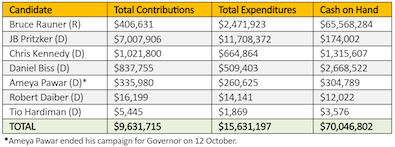
For all the talk about low dollar $ none of the cands really powering their campaigns that way. Pawar's ~13% was the high & he dropped out. pic.twitter.com/EVftqryBSp
Three months after the Illinois Legislature overrode Gov. Bruce Rauner’s vetoes to end a two-year budget stalemate, social service agencies held hostage during the impasse are still struggling to get back to normal.
Although funding is flowing again, many agencies are still owed substantial sums for past work performed for the state.
Then there is the more subtle damage: lost trust with program participants who couldn’t depend on the agency’s doors staying open, valued employees who quit to pursue careers with more reliable sources of income, remaining workers caught in the layoff-scarred mentality of waiting for the next shoe to drop.
“It is a challenge when programs are cut and you have to start and stop, start and stop,” said Mariana Osoria, a vice president with Family Focus, a social service provider that operates from seven locations in Chicago and the suburbs.
Family Focus specializes in early childhood development and related family support programs, including immigration services.
But in June as the state’s budget impasse surpassed the two-year mark with no end in sight, Family Focus found itself in the middle of the state political fight.
Owed $2.7 million by the state at that point for services already provided and having made some layoffs, agency officials essentially said they couldn’t take it any more.
Social service agencies are still reeling from the lack of steady state funds throughout Bruce Rauner’s 736-day budget crisis.
Even three months after the legislature overrode Rauner’s reckless veto, places like Family Focus are still owed large sums and are attempting to resume services to their pre-crisis capacity. Agencies must also rebuild trust in their communities after layoffs cut off services for those in need.
“Bruce Rauner leveraged the tools Illinoisans need to build better lives in order to advance his political agenda,” said Pritzker campaign spokeswoman Jordan Abudayyeh. “After mass layoffs decimated our social service agencies, it will take years to repair the damage done by Rauner’s manufactured budget crisis.”
It was another record year for the wealthiest people in America, as the price of admission to the country’s most exclusive club jumped nearly 18%. The minimum net worth to make The Forbes 400 list of richest Americans is now a record $2 billion, up from $1.7 billion a year ago. The group’s total net worth climbed to $2.7 trillion, up from $2.4 trillion, and the average net worth rose to $6.7 billion, up from $6 billion. […]
Every person in the top 10 got at least $1 billion richer in the past year. Number one for the 24th consecutive year is Bill Gates, who is now worth $89 billion, up $8 billion from a year ago. Amazon’s Jeff Bezos, whose fortune rose $14.5 billion in a year, retains the number two spot for the second consecutive year with a net worth of $81.5 billion, while Warren Buffett holds onto the number 3 spot. His net worth increased by $12.5 billion, despite giving away more than $3 billion of Berkshire-Hathaway stock in July. The biggest gainer (in dollar terms) is Facebook’s Mark Zuckerberg. His fortune jumped $15.5 billion, but in a crazy year like this one, it’s only good enough for him to hold onto his ranking as fourth richest.
That distinction belongs to Democrat J.B. Pritzker, whose wealth was pegged at $3.4 billion. Pritzker ranks 219th on the list of richest Americans. He’s one of four Pritzkers who appear on the list.
And Rauner? Didn’t make the list. The cutoff for Forbes’ list is about $2 billion, which is too rich even for the deep-pocketed Rauner.
Pritzker is not the richest person in Illinois, though. That distinction belongs to hedge fund manager Ken Griffin at $8.5 billion. Griffin has given millions to Rauner and the Republican Party, although it was reported that he also recently gave $1 million to the Obama Foundation.
Illinois residents are among the least likely in Midwestern states to have discretionary income, according to a business survey.
Across the country, Illinois is 30th for discretionary income but 12th among the 12 Midwestern states as defined by the study done by the storage firm Trove Technologies.
Trove used data from the Bureau of Labor Statistics, The Tax Foundation and The Council For Community and Economic Research for its analysis. Discretionary income is the money left after paying food, shelter, clothing and taxes; for this survey Trove assumed “a single person sharing a two-bedroom apartment with a roommate … a Single Filer with no dependents” for state and federal taxes. […]
Carbondale residents have $879 in annual discretionary income, according to the study, with an average salary of $37,308, taxes estimated at $8,234, and basic expenses costing $28,194.
That’s a pretty narrow assumption. But it is what it is. And if you’re in the bottom 20 percent of Carbondale occupations, your discretionary income is pegged at -$8,778 for the year.
* Other areas, with bottom 20 percent in parentheses…
Illinois: $5,811 (-$10,902)
Bloomington: $5,976 (-$8,893)
Carbondale: $879 (-$8,778)
Champaign-Urbana: $5,312 (-$7,911)
Chicago: $3,402 (-$13,579)
Chicago Metro: $5,002 (-$11,979)
Danville: $2,806 (-$6,564)
Decatur: $2,646 (-$8,631)
Kankakee: $4,719 (-$7,626)
Peoria: $6,386 (-$7,938)
Rockford: $5,810 (-$7,643)
Springfield: $5,395 (-$8,310)
See the numbers for yourself and plug in your own variables by clicking here. Just remember that the assumptions are very narrow.
“I had a stroke last Thursday,” she said, but didn’t get confirmation from doctors until Sunday.
“It was a teeny, tiny one, where the tumor was,” Lewis said of the stroke.
“What happens is, anytime you have a surgery and radiation, the blood vessels around there become friable. (The stroke) was so tiny they couldn’t find it the first time they examined me.” […]
“It’s going to be a lot of work, it’s going to be a lot of physical therapy, that’s what it’s gonna be,” Lewis said.
Speaking from the hospital, Lewis, who in recent years had a tumor removed from her brain, said she suffered a stroke Thursday.
“I woke up, couldn’t move my left leg, my left hand,” she told NBC 5.
Lewis said she had no speech issues following the stroke and plans to use physical therapy to regain movement on her left side.
She remained in the hospital Tuesday but said she expects to be in rehab “very soon.”
* Mayor Emanuel…
“I reached out to Karen this morning to wish her a speedy recovery and, as anyone who knows Karen would assume, she was in a good humor. Karen Lewis has always been a strong voice for Chicago’s children and Chicago’s teachers, and the strength of her voice is only matched by the strength of her will. A stroke can’t keep Karen Lewis down.”
That’s the amount of money raised over the past year by the three richest candidates vying to be governor of Illinois.
The lion’s share of that – 69 percent – was raised by Republican Gov. Bruce Rauner, with $50 million of the $70.9 million he raised coming from his own pockets.
Democrat J.B. Pritzker raised $28.2 million, every penny from his own personal fortune.
And businessman Chris Kennedy raised $3.4 million, bringing the combined contributions the three candidates raised over the last 12 months — from themselves and others — to a whopping $102,605,158.39
Biss has so far raised $120,700 from his immediate family, including $30K from his mother this past quarter. Amazingly enough, that’s more family money that Chris Kennedy has raised. Never would’ve guessed that.
* ICPR notes that third quarter spending topped $15 million…
Ad buys remained the single largest expenditure area for the field of gubernatorial candidates, although total spending in the area declined since last quarter. The majority of JB Pritzker’s expenditures, $5.9 million, went to producing and airing ads across Illinois. Bruce Rauner and Daniel Biss also spent approximately $229,000 and $69,000 on ads, respectively. Rauner also spent $164,000 on mailers. All told, $6.2 million was spent in advertising in the third quarter, a 17% decrease from the $7.5 million reportedly spent on ads last quarter.
Research and consulting services represented the next largest spending areas for the candidates at $2.94 million. Pritzker and Rauner devoted the most resources to various media and political consulting firms, with Kennedy and Biss trailing significantly. Pritzker spent $1.66 million on consulting, Rauner spent $1.61 million, and Kennedy and Biss spent around $87,000 each.
While Pritzker and Rauner, the two self-funders with deep pockets, focused their spending on expensive areas like ads and consulting, Biss and Kennedy mainly used the funds they raised on hiring staff. Kennedy spent over half of his total expenditures on salaries, and related expenses like payroll taxes and health insurance, dishing out $395,300 for his staffers.
Biss only spent $205,200 on paying staff, while Governor Rauner, with a communications staff in his office and no primary opponent, spent the least, only devoting $162,600 to payroll and related expenses. Pritzker outspent Rauner, Biss, and Kennedy combined, paying $1.58 million on personnel for his campaign. All told, payroll costs totaled $2.35 million, more than doubling since last quarter.
So, Pritzker spent several hundred thousand dollars more on payroll during the quarter than any of his Democratic rivals raised.
Kennedy did not report any expenditures to his fundraising consultant. I don’t know whether this is related or not, but the campaign told the Tribune earlier this month that he would end the quarter with $1.2 million and wound up reporting $1.3 million cash on hand. The campaign also didn’t report any expenditures to Revolution Messaging, a firm that previously worked with the Bernie Sanders presidential campaign and which received $90,305 from Kennedy in the seond quarter.
Erika Harold isn’t running against Lisa Madigan anymore, but she still has the state attorney general’s family in her sights.
“One Madigan down means one more Madigan to go,” she said of Lisa and her father, House Speaker Mike Madigan, D-Chicago. “People said, if you run against the Madigans, be prepared. Take your car in to make sure your brakes are checked. That was advice I really got. … That’s not a great commentary on our political system.”
Harold mostly avoided partisan issues, but she said she opposes local sanctuary city designations — Chicago has named itself one, setting up a protracted battle with President Donald Trump’s administration on immigration policy — and dislikes how Lisa Madigan has opposed Trump, including suing on the Deferred Action for Childhood Arrivals (DACA) program.
*** UPDATE *** From the Harold campaign…
Just to clarify, Erika was asked if she supported sanctuary cities and she said she believed it was a federal issue.
The reporter also wrote that Erika dislikes how AG Madigan opposed Trump on DACA. The simple fact is DACA was never mentioned at the event yesterday - a fact the reporter acknowledges. We have yet to receive an answer as to why he included that in the story.
* The governor was on CNBC yesterday to talk about the state’s bid for Amazon’s HQ2. He was his usual self. Click here to watch. I don’t know why he couldn’t answer the “cloud” question. Chicago has one of the best Internet hubs in the world.
Anyway, one of the things the governor talked a lot about was higher education. The DGA pounced…
[Yesterday] morning, Governor Bruce Rauner appeared on CNBC’s Squawk Box to talk about the state’s Amazon HQ2 bid and touted the state’s university system he called “second to none.” Left unsaid is that without Bruce Rauner, the university system would have been even stronger. Due to Rauner’s manufactured budget crisis, the state’s university system saw:
Enrollment drop by 70,000 students with some schools seeing drops of over 10% in enrollment;
Tuition and fees rise 6.7% system wide at a time when the state was not paying MAP grants;
A loss of 7,500 jobs;
And bond downgrades for many universities and colleges, leaving five with “junk” bond status including Governors State and Northeastern Illinois.
On CNBC, Rauner spent time profiling the strengths of Chicago and East-Central schools in particular, but those were some of the hardest hit. Illinois Economic Policy Institute found 78% of job losses occurred in the Chicago and East-Central Illinois, and nearly 60% of the enrollment drop came in the Chicagoland area. Chicago schools like Northeastern and Governors State saw tuition rise over 10%.
When Republican Representative Terri Bryant of Southern Illinois voted for the budget deal, she said “I hope you will help me bring my university back.” Bruce Rauner vetoed the budget and called for legislators to uphold his veto. Now, he wants to brag about the state’s schools.
“Governor Rauner is without shame,” said DGA Illinois Communications Director Sam Salustro. “Rauner touts Illinois’ education system to out-of-state businesses while cutting resources at home. He locked the state in a two-year budget impasse that devastated Illinois’ colleges and universities, cut jobs, and increased debt. Rauner’s failed leadership threatens the state’s economic future by leaving the state’s schools worse than he found them.”
* As did the Pritzker campaign…
Yesterday, Bruce Rauner praised our state universities as “second to none” in a CNBC interview, but throughout his term, Rauner has driven those same public colleges and universities into the ground.
Rauner’s budget crisis caused “significant damage” and forced “some of the deepest cuts to higher education in the nation” on Illinois schools according to a new report by The Atlantic. Here’s the real Rauner record:
* Bond downgrades: Seven state universities saw their credit downgraded, five to junk status.
* Enrollment drop: 72,000 fewer students enrolled in Illinois public colleges and universities.
* Funding cuts: Higher education would see a 20 percent cut in Rauner’s proposed budget.
* Lasting damage: Public universities leaders say, “it will take years to neutralize the harm” to their schools after Rauner’s budget crisis.
* Local economies hurt: $1 billion in economic activity disappeared each year.
* Mass layoffs: 7,500 jobs were lost in higher education.
* Rankings plunge: U of I, ISU, SIU dropped in the latest U.S. News & World Report Rankings.
* Tuition hikes: 7 percent tuition and fee increases were passed on to students.
“Bruce Rauner decimated the same public colleges and universities he is now calling ‘second to none,’” said Pritzker campaign spokeswoman Jordan Abudayyeh. “Bond downgrades, enrollment and rankings drops, mass layoffs, and tuition hikes are the damage done by this failed governor to our state’s most valuable institutions.”
The state’s budget crisis has subsided for now, but its impact on faculty recruitment remains a key issue at the University of Illinois.
Campus officials are still massaging the numbers, but outside recruiting of the UI’s top professors was up 50 percent in each of the past two years over previous years, according to interim Provost John Wilkin.
“It was a challenging couple of years,” Wilkin said at Monday afternoon’s annual meeting of the faculty, where the issue generated some discussion. […]
In 2015-16, a total of 124 faculty members were recruited by other schools, up from 84 the previous year; at least 50 opted to stay for the following year, many with the help of retention packages. And the number of new faculty hired dropped by half.
* Related…
* Chicago officially struts its stuff for Amazon: Though the statement refers only to “the Chicago area,” in fact the state and the city submitted one joint bid and it includes sites outside the metropolitan area, a source familiar with the matter tells me.
On Tuesday, the Biss campaign published a counter clock marking time passed since JB Pritzker and Chris Kennedy agreed to follow Daniel’s example and release their tax returns. Six months after the pledge, and a day after the extended deadline to file taxes on Monday, Biss for Illinois Campaign Manager Abby Witt released the following statement:
“This election offers Democratic voters a choice about who they trust to fight for them: wealthy businessmen or a middle-class grassroots organizer with a record of progressive accomplishments. If we can’t trust JB Pritzker and Chris Kennedy to keep their word on something as simple and customary as releasing their tax returns, why should we trust their other campaign promises?”
Background:
It’s been 6 months since JB Pritzker and Chris Kennedy pledged to release their tax returns. To date, neither has.
Biss releases 5 years of full returns. Daniel Biss, author of a bill in the Illinois legislature requiring Presidential candidates to release tax returns in order to appear on the state ballot, released five years of federal and state tax returns with schedules, and pledged to release his 2017 returns before the 2018 primary. [4/13/17].
All Democratic candidates for Illinois governor pledge to follow Biss, release 5 years of full returns. “Pritzker, Kennedy and Pawar all say they will release their tax returns. Gov. Rauner has released his returns every year. Rauner’s last return, for 2015, showed he had tripled his annual income.” [Capitol Fax, 4/14/17]
Rauner’s office announced last week that it has hired Statehouse veteran PATTY SCHUH as deputy chief of staff for communications. She begins the job Monday.
By title, Schuh replaces DIANA RICKERT, one of the communications staffers ousted shortly after the operation issued a statement that Rauner could not comment on whether a cartoon was racist because he is a white male.
Hiring Schuh is a departure for the administration. She’s been with the Senate Republicans since 1985 and has been the top communications person since 1995. In other words, unlike some other folks Rauner has brought on board, Schuh has dealt with state government and specifically, the legislature, for a long time. That sort of experience can’t hurt this administration.
Schuh, 58, has worked for GOP Senate leaders for two decades, stretching back to the days when James “Pate” Philip ruled. She stayed on through a succession of leaders that ranged from moderates like Christine Radogno to conservatives like Philip and Bill Brady. In the process, she earned a reputation as someone who knows her stuff and certainly can stand her ground, but can work with anybody.
In other words, she’s exactly the person needed for a troubled governor who can’t seem to settle on a consistent, believable message.
In fact, he almost certainly needs her more than she needs the job, so for the sake of a two-party system, let’s hope this match-up works.
If this was a TV or radio ad, Manar would likely be able to get it taken down. Facebook has been another story. The ad has been running for weeks. Manar even tried running an ad to counter the false GOP ad, but that ad was taken down.
* Here’s how Manar described the process to me today…
Our paid ad referencing the fake Christian County Republican ad was approved by Facebook. We simply posted a screenshot of the rollcall of the bill where there is an “N” by my name and a screenshot of the Christian County Republican paid ad. Then about one day into the schedule for our paid ad, Facebook sent us a message saying that our ad violated their policy of paid advertising referencing another paid ad. And then took the step of suspending our ad while the Christian County Republican ad continued.
That’s insane.
* Manar sent a blast e-mail about the ad early this morning…
As a father, my children know the rule: If you make a mistake, you own up to it. Don’t lie about it. My kids know that, if they lie (especially if they design a lie purposefully) they have no choice but to admit it and apologize.
It’s hard to say, “I’m sorry. I lied.” But truth is nearly always inescapable.
For weeks now, central Illinois Facebook users have been peppered with ads lying about my position on a multi-billion-dollar bailout for the energy corporation Exelon. Paid for by the Christian County Republican Party, the ad accuses me of voting to give Exelon the okay to impose the largest energy rate increase in U.S. history. That increase comes both at the expense of rate-payers and coal-fired plants and the workforce that relies on good jobs.
Here’s the problem, I didn’t vote for the bailout. I voted AGAINST it. The truth is, the Christian County GOP propaganda team is lying.
With more than a year before the 2018 election, Christian County GOP bosses are clearly willing to engage in fake news, false facts and flat-out lies. Blatantly lying about my record should offend everyone – Democrats, Independents and Republicans alike.
Politics is always riddled with embellishments. But the families and citizens of central Illinois are decent, honest, hardworking people. They have every right to be offended and turned-off when they’re lied to. Many of them are.
Make no mistake, millions of dollars are geared up to defeat me in the next election. Big-money opponents don’t like our ability to bring average, hard-working people together - Democrats and Republicans alike. There’s a desperation to use anything to break down the bipartisan approach we’ve found successful. For whatever reason, our success at compromise to make central Illinois better, is a threat worth lying about.
So, unfortunately, we can expect more lies and far more personal attacks.
That’s why your active support is so critically important. When my team sees lies, I need your help to respond to them. When we’re attacked without merit, your willingness to help set the record straight is critical.
If you’re interested in helping us, I encourage you to follow our campaign’s Facebook page so you can help call out fake news and phony claims.
I’m not expecting the Christian County GOP leaders to say to the citizens of central Illinois, “I’m sorry. I lied to you.” As a father, however, I’ll forever expect my children to reject the impulse to lie.
Campaign manager Abby Witt released the following statement in response to JB Pritzker’s decision to leave the Illinois Sierra Club’s gubernatorial forum after opening remarks in order to board a private jet to a downstate event.
“Only an out of touch billionaire would travel by private jet to talk himself up as a strong environmental steward.”
I asked the Sierra Club for a response, but haven’t heard back.
Two things. First, the link provided by the Biss campaign shows Pritzker actually took a twin-engine turboprop, not a jet, which would’ve caused more environmental damage. So… since he didn’t take a jet, does that make him an in-touch billionaire? /s
“While JB regretted having to leave the Sierra Club forum before it was completed, he was happy he got to both meet with an important group of environmental leaders in Chicago and also be part of the NAACP state convention in Mount Vernon,” said Pritzker spokeswoman Galia Slayen.
Biss’ campaign sent the state senator’s running mate, Litesa Wallace, to the NAACP event, saying there was no way he could make it there. The offensive by Biss could be a sign that with Ameya Pawar out of the race, Biss is emboldened to compete as the “regular guy” — who can also raise money.
It isn’t uncommon for candidates to use private jets or planes to campaign, though typically due to resources, they don’t come into play until just before Election Day. Pritzker’s deep pockets, however, means he can travel the state more easily than his opponents even six months before the primary. Campaign reports from the second quarter shows the Pritzker campaign paid more than $115,000 to Wheels Up Partners. Pritzker is financing his own campaign.
Meanwhile, the Democratic field for governor is down one candidate as of last week, but the remaining contenders will meet at two forums within 12 hours.
On Tuesday evening, much of the field will be at Aurora University for a forum moderated by Chicago Tribune political reporter Rick Pearson. The next morning, the candidates will be in Mount Prospect for a breakfast forum hosted by the Daily Herald and ABC 7.
A political activism group for moms based in Chicago’s northern suburbs received a small donation from J.B. Pritzker three days before their founder blasted Pritzker’s primary rival Chris Kennedy in a press release as “disheveled” and “disrespectful to women.”
The Pritzker campaign could not say with certainty if his recent gift of $128.50 was the only time he’s given money to the group, but the paper trail revealing the donation could serve to confirm suspicions from progressives who remain skeptical of Pritzker’s attempt to co-opt grassroots groups. […]
“Mom + Baby and 11 other organizations focused on women and family issues came together to put out a “No Salary History” Bill postcard campaign,” said Galia Slayen, a spokeswoman for the Pritzker campaign. “JB personally contributed $128.50 to help cover a portion of the postcard campaign cost.”
$128.50 is now the baseline amount for co-opting the left?
* A bill was signed into law this year which would create a Community Care Program Services Task Force to look for ways to reduce costs for programs for seniors “without diminishing the level of care.” The law requires that the task force contain “one individual from a statewide organization that advocates for seniors” and “one individual from an organization that represents caregivers” in the community care program.
Nobody from AARP or SEIU Healthcare were appointed even though the law seemed basically designed to put both groups on it. SEIU has been battling with the Rauner administration for years over this program and it was furious…
Gov. Bruce Rauner’s scheme to cut 36,000 Illinois seniors from the vastly successful Community Care Program (CRP) by forcing them into an untested and unproven initiative, the so-called Community Reinvestment Program, was met with intense public outcry from day one. SEIU Healthcare Illinois and numerous aging advocates were outspoken against the Governor’s plan and it appears are now being PURPOSELY left out of the Community Care Program Services Task Force, mandated to look into ways to improve services for seniors.
* So, at its first meeting, the appointed members took a vote and added both AARP Illinois and SEIU Healthcare to the task force. But the Illinois Department on Aging’s general counsel Rhonda Armstead then rescinded the move…
As the Ethics Officer and General Counsel for the Department on Aging, it is my responsibility to advise you and the other members of the Task Force that this action exceeds the prescribed scope of authority for the Task Force and is therefore void ab initio. In more practical terms, the action has no legal effect to change the membership composition of the Task Force.
* From Ryan Gruenenfelder, Director of Advocacy and Outreach, AARP Illinois…
AARP is a statewide independent advocate for the health and well-being of Illinois most vulnerable seniors; we represent 1.7 million individuals over the age of 50 in Illinois, and we are highly disappointed that our voice and the solutions we have to offer will not be included in the Task Force.
As a compromise on the decision not to fund IDOA’s proposed Community Reinvestment Program, a Task Force was created by legislators in July – which was supposed to be a good faith effort of those involved to work collaboratively to improve quality and efficiency in the CCP and ensure that CCP continues to serve Illinois’ vulnerable seniors at home for as long as possible, prevent unnecessary nursing home institutionalization, and save Illinois hundreds of millions of dollars annually. When the task force language was written, our understanding was AARP would be appointed as required by point 7 where it is clearly states that one of the members of the Task Force would be an statewide organization that advocates for seniors.
* Rep. Robyn Gabel sits on the task force…
AARP is the largest organization representing seniors. SEIU represents the vast majority of home health workers. I find it difficult and unproductive to have a conversation about the CCP without the two largest representatives of seniors and home health workers in the room.
* And so does Sen. Heather Steans…
I think that is very shortsighted. The task force language cleary includes an organization the advocates on behalf of seniors and an organization that represents home Health care workers. These groups are knowledgeable stakeholders that have significant insights to share about how we can improve the program and make it more efficient. The general assembly will want their input on any changes recommended as well.
* SEIU Healthcare
“As the union that represents the 28,000 caregivers who care for seniors every day as part of the Community Care Program, it is unfathomable that we would be deliberately excluded from any conversation about the future of the program. It is equally unfathomable that AARP would also be excluded. This follows a pattern wherein the Rauner Administration is deliberately excluding stakeholders from important debates that directly affect seniors, children, and people with disabilities. This task force appears to be rigged to arrive at the preordained conclusion. Rauner wants to attack seniors with a $120 million cut to a vastly successful program.”
* From Mike Deering at the Department on Aging…
Rich, have you looked at the list? Legally compliant, highly qualified, national authorities on the subject. The job is to serve the aging, not the advocacy groups. So what’s the problem?
He did not respond to follow-up questions. If you click here for the task force member list, it seems unclear to me which “statewide organization” advocates for seniors and which organization “represents caregivers.”
* Republican state Sen. Dale Righter, who also sits on the task force, says it’s all good and the department was right to kick those two groups off…
The [General Counsel’s] opinion is correct. The appointing authority and number of members are set in statute, the language for which was reviewed and approved by everyone involved. Since the task force itself doesn’t have the authority to change who is on the task force or the number of appointees, neither SEIU nor ARRP are members.
The next task force meeting is tomorrow.
* From a media advisory…
Sen. Andy Manar will join AARP Illinois, the Illinois Alliance for Retired Americans, Caring Across Generations, and SEIU Healthcare Illinois for a press conference Tuesday, Oct. 17th at 8:30 a.m. at the Illinois Department on Aging headquarters… to discuss ways to strengthen senior home care services before a task force hearing on the Community Care Program.
BACKGROUND:
The Community Care program saves taxpayers hundreds of millions of dollars by allowing seniors to stay in their homes instead of of costly nursing home facilities.
Gov. Rauner sought to cut $120 million from the vastly successful program, but this was overridden in this summer’s bipartisan budget compromise.
The budget compromise expressly prohibited funds appropriated for CCP to be utilized for Gov. Bruce Rauner’s unproven and dangerous attempt to force 36,000 seniors into his untested Community Reinvestment Program (CRP), which would have replaced trusted caregivers with a patchwork of vouchers, ride-sharing companies, and housekeeping services.
While rules to create the CRP were finally pulled from the Joint Committee on Administrative Rules in September, the administration is still pushing the proposal through a pilot program in Bloomington and Moline.
Advocates, seniors, and caregivers fear the administration will use the CCP Task Force as a vehicle to reintroduce the failed Community Reinvestment Program, and will use Tuesday’s press conference to put forth recommendations that will truly strengthen and preserve care for Illinois seniors while providing value to taxpayers.
After only a handful of meetings, the CCP Task Force is expected to vote on recommendations in their afternoon meeting Tuesday.
Illinois is on the brink of its bicentennial bash, but political skirmishing that has battered the state could be blamed for late party planning, a comparatively low budget – and ultimately, its contribution to future generations.
The plans to celebrate Illinois’ Dec. 3, 1818, admission to the Union seem to pale compared with the two states that joined just prior. Indiana and Mississippi spent tens of millions of dollars and have flashy “legacy” projects to show off. The Prairie State, just 7 weeks from kicking off its yearlong festivities, is aiming to raise a modest $4 million to $6 million.
Stuart Layne, executive director of the Illinois Bicentennial, acknowledges planning got a belated start with his appointment just a year ago. While he said significant corporate and other donors are stepping up, he would not say how much has been raised.
But he dismissed the idea that 2 years of infighting in the 21st state between Republican Gov. Bruce Rauner, who appointed him, and Democrats who control the General Assembly over a budget that is billions in the red, has hamstrung the project.
The state of Illinois is preparing to celebrate its 200th birthday in 2018.
Gov. Pat Quinn’s office said Monday that it has officially started planning for the state’s bicentennial. The governor signed an executive order to create the 2018 Illinois Bicentennial Commission. The volunteer commission will plan and coordinate events.
The commission will have dozens of members. The governor and other state leaders will name them. Members will come from business, labor, military, arts and other organizations.
When Illinois turned 100 in 1918 the U.S. Mint issued a commemorative 50-cent piece and two buildings were erected — the Illinois Centennial Monument in Chicago and the Centennial Building in Springfield.
The 2018 Illinois Bicentennial Commission was created in May 2014 by then-Gov. Pat Quinn and left in the hands of his successor, Bruce Rauner. Its official task: “The Bicentennial Commission will plan and coordinate events, activities, publications, digital media, and other developments and encourage citizen participation at all levels in every community in the state.”
That hasn’t happened. The commission’s Facebook page has made all of three posts in two years. In fact, it seems the commission hasn’t even met.
“Sad is an understatement,” says commission member Tony Leone of Springfield. ” … I’m kind of disgusted.”
Illinois is getting ready to celebrate a milestone. In 2018, the state turns 200.
Gov. Bruce Rauner Tuesday used his executive authority to create an office and a 51-member commission (members haven’t yet been appointed) to coordinate the festivities.
“And we want leaders from all over the state coming up with their ideas and recommendations on how we can best celebrate,” he said. “It’s going to be a lot of fun, it’s going to be a really big deal.”
And here we sit. Click here for a list of events scheduled so far. Kinda sparse.
Many lasting physical legacies were created during the Bicentennial. The State Archives will preserve and display Indiana’s most important historical documents. Bicentennial Plaza offers a fitting memorial and a space for Hoosiers to rest and reflect as they visit our Statehouse. The Statehouse Education Center provides learning opportunities to the more than 60,000 annual visitors to our most important building – 80 percent of whom are children. The Bicentennial Nature Trust has preserved more than 11,000 acres of new parks, trails, wetlands and forestlands through 184 individual projects, bringing new public space within 20 miles of almost every Hoosier. This project, under the guidance of the Indiana Department of Natural Resources, and with the support of Lilly Endowment and the Nina Mason Pulliam Trust was the first announced and funded Bicentennial project.
It is our belief that the Bicentennial legacy will reflect our tagline, “Celebrate History. Ignite the Future.” The past year gave us all a chance to reflect on the state’s history, its future, and our place in it. The inspiration for the iconic “Bison-tennial” public art project was the fact that American Bison used to roam the Buffalo Trace across the Indiana countryside. The new Levi Coffin State Historic Site Interpretive Center demonstrates important lessons Hoosiers can learn from those came before us, like how to be citizen leaders and stand up strongly for our beliefs.
* The state also had a “Bicentennial Visioning Project.” A couple of examples…
Agriculture and Rural Affairs
Promote the nobility of agriculture; provide best access to healthy foods; develop regional economic hubs; develop and maintain talent; make Indiana a center of agricultural innovation.
Arts, Leisure, Culture IconArts, Leisure and Culture
Double the size of the state park system; link urban and rural areas; integrate arts into schools; add beauty to construction projects; become the most civically involved state.
One year after Exelon convinced state lawmakers and Gov. Bruce Rauner to bail out nuclear power plants, the second-largest power generator in Illinois has decided it’s its turn. Houston-based Dynegy will push for the General Assembly to consider legislation in next month’s veto session that would likely hike electric bills in downstate Illinois to preserve at least some of the company’s financially ailing fleet of coal-fired power plants. Dynegy’s plants are by far the largest source of electricity downstate.
The move follows recent news that Dynegy and the Rauner administration are working to soften state environmental standards on pollutants emitted by coal burners. The proposal, which was submitted Oct. 2 to the Illinois Pollution Control Board for approval, angered environmentalists who negotiated the standards with the coal industry more than a decade ago. […]
Dynegy’s Illinois proposal, which will surface by month’s end in the form of legislative language, would have the state take over the pricing of “capacity”—ratepayer payments to generators for the promise to deliver during peak demand periods. Currently, that’s handled by Midcontinent Independent System Operator, or MISO, the power-grid operator for southern Illinois and much of the Midwest. As energy prices have plummeted, these capacity payments—embedded in the overall electricity prices consumers and businesses pay regardless of whether they buy from utilities or alternative suppliers—have become a far more important part of plant operators’ revenue streams.
But MISO’s most recent capacity auction resulted in a paltry $1.50 per megawatt-day for the southern half of the state. By contrast, plants in the northern half, operating under a different capacity system, are being paid $153.61 per megawatt-day right now. For the average household, the difference between the two is about $115 a year. […]
Ellis stops short of saying Dynegy will close its entire downstate Illinois fleet, or even specific plants, if it doesn’t get relief. But there’s little financial risk to the company in doing so. It essentially paid nothing to acquire the downstate Illinois plants of St. Louis-based Ameren in 2013.
Asking Springfield to endorse a rate increase for all of downstate Illinois heading into a campaign year will be a challenge. Dynegy’s reticence to state the specific consequences of inaction likely will make delay until after November 2018 attractive for lawmakers and Rauner.
State subsidies to keep open two nuclear power plants took effect in June, hiking electric bills for all homes and businesses. But the ripple effects from last year’s Future Energy Jobs Act may well lead to future increases on top of the new surcharges.
The organization that sets the rules for the wholesale power markets from northern Illinois east to Washington, D.C. , is contemplating changes that would compensate the owners of unsubsidized power plants for the potential harm the subsidies pose to the competitive market. […]
The initiative is in direct response to Illinois’ nuclear subsidies. PJM is charged first with ensuring there’s enough power to keep the lights on during peak demand and secondly with keeping the power markets competitive. […]
Effectively, Chicago-area ratepayers could be paying twice to keep the same plants open. That’s because the subsidies for Exelon are nearly certain to remain at the state-imposed annual limit of $235 million for the decade they’ll be in effect despite provisions in the law calling for the subsidies to decline when market revenues rise. At Exelon’s insistence, the Future Energy Jobs Act was written in such a way to keep the subsidies flowing in most foreseeable market conditions.
“With most of the proposals on the table, Illinois likely will get penalized for the state approving the subsidies to produce cleaner air,” says Greg Poulos, executive director of Columbus, Ohio-based Consumer Advocates of PJM States. […]
Demanding action from PJM are Exelon competitors NRG Energy, based in Princeton, N.J., and Houston-based Dynegy. NRG operates coal- and gas-fired plants serving the Chicago market, and Dynegy is the second-largest generator in Illinois, running a mainly coal-fired fleet downstate.
More than 60 percent of Americans think climate change is a problem that the government should address, including 80 percent of Democrats and 43 percent of Republicans, according to a new survey from the University of Chicago’s Energy Policy Institute and The Associated Press-NORC Center for Public Affairs Research.
Those numbers were even higher when limited to those who say they believe in climate change. Seven in 10 Republicans and nearly all Democrats who believe climate change is happening agree that the government needs to take action, the poll found.
“Public opinion around many energy issues tends to be fluid, with people often defaulting to partisan starting points,” said Trevor Tompson, director of The AP-NORC Center, in a statement. “Majorities of both Democrats and Republicans agree that climate change is happening, and there are signs that consensus could happen on other issues, too.”
…Adding… Press release…
The Illinois Clean Jobs Coalition issued the following statement today in the wake of a report published by Crain’s Chicago Business detailing a possible legislative bailout for Dynegy, Inc:
“On Friday, Crain’s Chicago Business broke a story suggesting that backroom discussions could lead to possible bailout legislation for Dynegy in the upcoming veto session, forcing downstate Illinois residential customers and businesses to subsidize this giant out-of-state corporation. This latest backroom deal comes on the heels of news that Governor Rauner’s office and Dynegy worked behind-the-scenes for several months on a new rule that would undermine pollution controls just to pad Dynegy’s profits at the expense of the public. This corporate bailout would represent an unfair rate hike on customers and small businesses in Central and Southern Illinois and would contain no benefits whatsoever to any party besides Dynegy. With new power coming on line under the Future Energy Jobs Act (FEJA), the majority of it expected to be located in Central and Southern Illinois, we urge lawmakers to reject Dynegy’s bailout that would impose new costs on downstate consumers and small businesses and pose new risks to the public’s health in order to shore-up the profits of an out-of-state energy giant. At a time when President Trump and his coal cronies are already moving to bail out companies like Texas-based Dynegy, Illinois needs to do exactly the opposite and prepare for a clean energy future.”
Madigan learned about service at a young age: His father was ward superintendent for their Southwest Side neighborhood, and when his father passed unexpectedly, the younger Madigan stepped up to ensure local residents would still get their snow shoveled, streets plowed and trash collected.
Madigan continues to serve the people of his community, maintaining a top-rated constituent service office. Madigan’s office helps hundreds of seniors clear snow after winter storms and he makes sure homebound residents get check-in calls during extreme hot or cold weather.
While the city can take weeks to remove graffiti, Madigan’s office operates its own graffiti blaster and has a full-time team that removes graffiti as soon as it is reported.
Madigan is also working to provide property tax relief to local homeowners by hosting regular tax appeal seminars, helping local seniors receive tax exemptions and working with local residents to reclaim more than $1 million in overpaid taxes.
Madigan was first elected as a delegate to the 1970 state Constitutional Convention and then as a state Representative the same year. As Speaker of the House, Madigan has worked to build consensuses, improve the quality of life for residents across all regions of Illinois and address Illinois’ most pressing issues in a cooperative and bipartisan manner. He advocates for honest, efficient government and has fought to strengthen the financial security of middle-class families. Under his leadership, the Legislature has enacted sweeping ethics laws, the first campaign finance limits in state history, and needed reforms to the state budget process and workers’ compensation system.
*** UPDATE *** You had to know this was coming. From the ILGOP…
“More than four decades of destruction with massive pension debt, unbalanced budgets, machine politics, and self-dealing - that’s the Madigan record. Welcome to the 21st century, Speaker Madigan, but pictures of you sporting a smile with children won’t save you from all the damage you’ve done to Illinois.” - Illinois Republican Party Spokesman Aaron DeGroot
Longtime Speaker of the House and technological dinosaur Mike Madigan shocked the internets on Friday when Capitol Fax reported to the Twittersphere that Madigan has finally entered the 21st century with the creation of a new Facebook page and website, both ironically branded as “Madigan for Us,” with “us” being insiders, special interests, and the political class.
Madigan’s newfound internet presence showcases pictures of a smiling Madigan reading to children, enjoying a cup of coffee with fellow senior citizens, and telling wisecracks to area youngsters outside a grocery store.
But after taking a brief look through the comments on Madigan’s inaugural Facebook post, one will quickly realize that voters aren’t buying the spin.
Madigan is known to virtually all Illinoisans and not in a good way. He has been described as “the constant in key decisions that created the mess.” Under Madigan’s watch, Illinois has seen:
Four income tax hikes, taking billions of dollars from Illinois families
Years of pension holidays that led to over $130 billion in debt for Illinois’ five pension systems
Spending rum amok with over fifteen years of budget deficits
Highest in the nation property taxes for Illinois homeowners
All of which has led to the highest in the nation out-migration
Unfortunately for Madigan, staged pictures of him sporting a smile won’t save him from his decades of destruction.
It’s especially comical since CPS is one of the biggest districts in the nation. So a large chunk of our population is in one school district, and the other 10 million are split into 904. Apparently downstate really likes subdividing everything from schools to counties into minuscule parts.
* From the governor’s presentation to potential buyers of the state’s new bonds…
The State’s Credit Fundamentals are Improving
* Together with the 2017D Bonds, the 2017ABC Bonds will pay off approximately $6.0 billion of outstanding bills and is expected to result in the receipt of additional federal funds
* By the end of fiscal year 2018, the bill backlog is expected to be approximately $7.5 billion, a nearly 50% reduction
Recent Developments
* Passage of fiscal year 2018 Budget
* Permanent increase in personal income tax and corporate income tax rates to 4.95% and 7.00% respectively
* Passage of Tier 3 Pension Plan and funding changes
* Passage of Senate Bill 1947 (PA 100-465), which provided for an evidence-based method of allocating funding among the state’s school districts
* Reauthorization of EDGE Tax Credits to improve the State’s competitiveness for major economic development projects
* Reduced risk to swap counterparties by renegotiating rating triggers […]
The State’s base spending commitments are expected to exceed forecasted revenues by approximately $1.5 billion
Notice how they skate over that budget “passage” thingy without mentioning the veto and how they point out the tax hike the governor vetoed improves fiscal stability.
The governor’s budget director is listed as one of the authors.
The Governor cited an unbalanced budget at the time of the veto and did not support passage of a state budget that raised taxes without spending controls and structural governmental, economic and fiscal reforms.
The Governor’s Office of Management and Budget (GOMB) estimates a $1.7 billion general funds structural deficit.
Without changes to the current trajectory of the state’s finances, the projected deficit for fiscal year 2019 is $2.15 billion and the bill backlog could grow to an estimated $13.7 billion by the end of fiscal year 2023.
So, the deficit in the bond document is $1.5 billion, but the deficit in the GOMB document is $1.7 billion. Then again, that latter deficit is based solely on the budget as passed and revenues as currently projected. The governor wants to cut a couple hundred million in spending on his own.
As has been the case for many years, Illinois’ economic growth continues to lag the nation, a condition that is expected to continue throughout the five-year forecast horizon absent reforms. U.S. real GDP grew 1.5 percent in 2016 while Illinois’ real GDP grew just 0.9 percent. The recovery of employment in Illinois since the recession has also lagged behind the nation. The U.S. experienced a 1.18 percent growth in total nonfarm employment from August 2016 to August 201715 while Illinois’ total nonfarm employment contracted by 0.57 percent.
*** UPDATE *** From IL AFL-CIO President Mike Carrigan…
I very much regret the unfavorable references recently made to Hanah Jubeh and her consulting firm, P2, in the IL State Federation News Update. Ms. Jubeh has provided professional services to many unions over the years and I know that her work is held in very high regard.
There was absolutely no sexist intent in what was published. The IL AFL-CIO has long been a strong supporter of equal rights for women and it pains me greatly that anyone might have a contrary impression.
I have apologized to Hanah Jubeh and assured her that such an incident will not happen again. It is my sincere hope that we can all move forward together to accomplish our shared goal of a better Illinois for all working families.
[ *** End Of Update *** ]
* The JB Pritzker campaign is finally responding to that allegation of sexism by Chris Kennedy’s chief fundraiser against the Illinois AFL-CIO. From Galia Slayen…
Leaders of one of the most politically active labor unions in the state blasted the president of the Illinois AFL-CIO on Friday for what they called “unwarranted attacks” on a longtime Democratic consultant. […]
“Your recent singling-out of Jubeh highlights a sexist mindset toward women that has no place in politics, the labor movement or anywhere else in society,” wrote SEIU Local 1 President Tom Balanoff and the clout-heavy group’s secretary-treasurer, Laura Garza.
“It denotes a hostility toward women who refuse to ‘fall in line’ with their male counterparts. … We demand an apology for your unacceptable behavior.”
Carrigan did not respond to requests for comment.
* And the Kennedy campaign did some fundraising off the controversy over the weekend…
I need to bring something to your attention because it represents the state of our politics today, it’s indicative of the political system we have here in Illinois, and it’s personal.
This week, the President of the Illinois AFL-CIO bullied a senior advisor to my campaign. He insulted my campaign and he used her as a pawn for his criticism.
Not my campaign manager. He was never mentioned.
Not my political director. Not a single negative word was directed his way.
Not my media consultant. His name never came up.
Only Hanah. A successful small business owner, a strong political strategist - a woman.
Hanah has a long career fighting for labor. Many in the community can attest to it, and they have. Quickly after a Sun-Times reporter exposed two incidents in which Mike Carrigan made cutting remarks about her for choosing to work on my campaign, members of the labor community spoke out on her behalf.
It is no coincidence that Mike Carrigan is an ally to Speaker Madigan or that he has endorsed my opponent J.B. Pritzker. It’s no coincidence because this is what the insider political game looks like. He is picking on her because he wants her to feel intimidated. He wants my campaign to lose her talent, and ultimately, they all want me out of this race. Members of the labor community have indicated that the criticism is being directed toward her because she is a woman, and he wants her to “fall in line”.
It’s a disgraceful, egregious display of sexism that has no place in our politics, and it’s a glaring example of why people in our state desperately want to rid this system of insiders who stand by and let such bullying occur.
If this were a supporter of mine, I would condemn his behavior. In the very least, I’d demand that he apologize because for me, this race is about more than politics. It’s about bringing integrity back to our political system and bringing real leadership back to our state government. But J.B. Pritzker and his campaign have stood silent when they could have stood up to the establishment. If he won’t stand up to them now when they are clearly in the wrong, how can we trust him to do that as governor?
State agencies under the governor’s control are required to report the amount of unpaid bills they have not yet submitted to the state’s comptroller for payment.
The supremely goofy “Only in Illinois” part is, the agencies are required to make that report just once a year. And the information is always badly outdated by then.
Comptroller Susana Mendoza, the state’s bill-payer, can look at payment and revenue histories to approximate how many bills she has to pay every month and how much money may be available. But after more than two years with no budget and Gov. Bruce Rauner signing state contracts without official legislative appropriations, there are a lot of unknowns right now. Mendoza thinks there may be somewhere around $1.2 billion in spending that the General Assembly never approved. But she doesn’t know for sure.
To give you an idea of how ridiculous this process is, the state’s bill backlog unexpectedly grew by $1 billion one day in May when the governor’s Office of Management & Budget abruptly revealed the unpaid invoices.
The comptroller has to plan ahead to make the state’s bond payments so she doesn’t accidentally trigger a credit downgrade (which would put the state into junk bond territory). She has to make regular (and huge) state pension payments, and schools rely on their state funding to keep their doors open. So plopping $1 billion in new bills on her desk without warning can cause all sorts of very real problems.
Some of the state’s approximately $15 billion in unpaid bills qualify for an interest penalty, designed to help businesses and not-for-profit groups that aren’t being paid in a timely manner. But, in yet another “Only in Illinois” quirk, state law doesn’t require state agencies to tell the person who pays all the bills which invoices qualify for that penalty. So all Mendoza can do is guesstimate what is owed, and she thinks it may be nearing $1 billion.
In February, Mendoza had legislation introduced to require state agencies to tell her
*** UPDATE 1 *** Wordslinger noticed something in the GOMB presentation to bond buyers that I missed….
Approximately $2.8 billion in State General Funds operational liabilities were not appropriated in FY 2017, but these may be paid from future year appropriations
*** UPDATE 2 *** Pritzker campaign…
“$2.8 billion in unappropriated spending is just the latest cost of Bruce Rauner’s budget crisis,” said Pritzker campaign spokeswoman Jordan Abudayyeh. “Illinois is drowning in bills manufactured by this failed governor and his damage is done.”
* Related…
* State Comptroller’s Office: Checks Are in the Mail to Prevent Utility Shutoffs at Centralia Prison: “The bills have already been at the Department of Corrections for several months by the time they get to us. Most of the bills we’re paying for the state right now, we’re still paying bills from January to the state. So they talked about this being sort of an important bill they need to get paid right away so they can continue to get service at the prison so we bumped it up and paid those bills.”
* Editorial: Rauner’s DTA veto makes less sense by the day
In chess, a fork is a tactic whereby a single piece makes two or more direct attacks simultaneously. Most commonly two pieces are threatened, which is also sometimes called a double attack. The attacker gains no matter how the opponent responds; the opponent typically can only seek to mitigate the adverse impact, while pursuing his or her strategy. […]
Bear this in mind: Democrats control our legislature, Madigan controls the Democrats and so Madigan controls the agenda. So what does Madigan do with this control?
Madigan, the master player of Illinois politics, used his control of the agenda to set up a series of “forks” to blunt our advance and set the table for next year’s election. Madigan’s agenda is to win, so Madigan’s agenda is to focus attention on anything but what’s actually happening in the state. His game plan: distract, divide and diminish.
Which brings me to SB31, HB40, and the transgender license bill — three issues Madigan put on the political agenda this year. […]
Many on our team are not happy with the choice our Governor made when presented with Madigan’s forks. He ended up making personal choices that many receiving this would not. I am not writing to tell you that you’re wrong. I am not writing to tell you that one choice was good politically — either choice would bring political costs. […]
If you see that these bills are part of Madigan’s strategy then don’t let Madigan play you like some pawn on his board. Channel your anger toward Madigan — don’t fall into his trap of division and distraction.
While private institutions are better shielded from funding cuts by huge endowments, Midwestern public universities have much thinner buffers. The endowments of the universities of Iowa, Wisconsin, and Illinois and Ohio State, which together enroll nearly 190,000 students, add up to about $11 billion—less than a third of Harvard’s $37.6 billion. Together, Harvard, MIT, and Stanford, which enroll about 50,000 students combined, have more than $73 billion in the bank to help during lean times. They also have robust revenues from high tuitions, wealthy alumni donors, strong credit, and other support to fall back on. Compare that to the public university system in Illinois, which has cut its higher-education budget so deeply that Moody’s downgraded seven universities, including five to junk-bond status.
This ominous reality could widen regional inequality, as brainpower, talent, and jobs leave the Midwest and the Rust Belt—where existing economic decline may have contributed to the decisive shift of voters toward Donald Trump—for places with well-endowed private and better-funded public universities. Already, some Midwestern universities have had to spend millions from their battered budgets to hang on to research faculty being lured away by wealthier schools. A handful of faculty have already left, taking with them most if not all of their outside funding.
“We’re in the early stages of the stratification of public research universities,” said Dan Reed, the vice president for research and economic development at the University of Iowa. “The good ones will remain competitive. The rest may decline.” Those include the major public universities established since the 1860s, when a federal grant set aside land for them in every state. “We spent 150-plus years building a public higher-education system that was the envy of the world,” said Reed, who got his graduate degrees at Purdue, in Indiana. “And we could in a decade do so much damage that it could take us 30 years to recover.” […]
These universities have served as bulwarks against a decades-long trend of economic activity fleeing smaller cities and the center of the country for the coasts. Since the 1980s, deregulation and corporate consolidation have led to a drastic hollowing out of the local industries that once sustained heartland cities. But a university can’t just be picked up and moved from Madison to New York in the way a bank, an insurance company, or even a factory can be.
* Speaking of which, the Tribune published another editorial about snagging Amazon’s HQ2…
Gov. Bruce Rauner is expected to discuss details of the Amazon bid after Thursday. What we want to hear is evidence that House Speaker Michael Madigan and Senate President John Cullerton recognize that creating a more vibrant Illinois is their responsibility, too. Amazon says the ideal location for HQ2 will have a stable, business-friendly environment. That’s not Illinois today. Madigan and Cullerton have to work with the governor in areas such as property taxes, workers’ compensation and public pensions to make this state attractive to all employers.
They’re not wrong, but what do you think a massive new headquarters will require more: workers’ comp reform or universities churning out highly educated people who can fill tens of thousands of six-figure white-collar jobs? That newspaper led the cheering squad for the budget impasse, which deeply damaged our higher education system, both public and private (via MAP grants).
Together, Harvard, MIT, and Stanford, which enroll about 50,000 students combined, have more than $73 billion in the bank to help during lean times. They also have robust revenues from high tuitions, wealthy alumni donors, strong credit, and other support to fall back on. Compare that to the public university system in Illinois, which has cut its higher-education budget so deeply that Moody’s downgraded seven universities, including five to junk-bond status. […]
Illinois reduced per-student spending by an inflation-adjusted 54 percent between 2008 and last year, according to the Center on Budget and Policy Priorities […]
In Illinois, for instance, research output has stayed surprisingly steady as of 2015, the most recent year for which full data is available. But since then, a budget impasse has resulted in some of the deepest cuts to higher education in the nation. (Thanks to a legislative override, the more-than-two-year budget standoff finally ended in July, but significant damage had already been done to university enrollments, staffing, and facilities.)
Gummy bear-maker Haribo of America will expand its U.S. headquarters in Rosemont and add 55 jobs to its workforce there, Gov. Bruce Rauner’s office announced Friday.
The German company is eligible to receive $1.67 million in incentives for the expansion through the state’s Economic Development for a Growing Economy program, according to the Department of Commerce and Economic Opportunity. The new jobs will nearly double the current corporate workforce of 59 by 2021, according to the governor’s office.
That works out to $30,363 per job. If we gave Amazon the same level of incentives to snag its new headquarters and its 50,000 jobs, the state’s cost would be $1.52 billion.
The candidate filing period in Illinois begins in six weeks, and State Treasurer Mike Frerichs, a Champaign Democrat, still doesn’t have a Republican opponent.
That means that if a Republican challenger wants to appear on the primary election ballot in March, she or he is going to have to hustle to come up with the required 5,000 to 10,000 signatures on candidate petitions that have to be filed between Nov. 27 and Dec. 4.
A spokesman for the Illinois Republican Party, Aaron DeGroot, displayed no sense of panic or urgency about candidate vacancies for statewide offices (there also is no announced GOP candidate to challenge State Comptroller Susana Mendoza).
“There are several individuals considering a run for Treasurer, but there are no declared candidates at this time,” DeGroot said. “Stay tuned.”
OK, but four years ago — when incumbent Treasurer Dan Rutherford was running for governor — the major party candidates were already announced, passing petitions and raising money.
Frerichs raised just $109K in the second quarter and spent $62K. Of that spending, $43K went to P2 Consulting, his fundraiser. Yes, it will likely be a pretty strong Democratic year next year here, but he had just $273K at the end of the 2nd quarter. He’s as close as they’re gonna get to a sitting duck and the Republicans aren’t even floating names.
Last week, Gov. Bruce Rauner’s campaign fund transferred $4.45 million to the Illinois Republican Party to bankroll a new effort to focus voters’ attention on House Speaker Michael Madigan.
The state party unveiled its “2018 Madigan Retirement Plan,” which it claimed was designed to “specifically target members of the Illinois House and Senate who empower their political boss, Mike Madigan.” The party said the governor’s money would supply “unprecedented support to local GOP organizations by providing innovative grassroots tools, enhanced digital and data integration, and targeted support for local Republican candidates in an effort to defeat Democrats at every level who empower their party leader, Mike Madigan.”
A few things are going on here. First, “Blame Madigan” has been Rauner’s main theme song since the 2014 campaign. This is a continuation of that effort. It has worked in the past, so they’re betting it’ll work again.
Second, talking about Madigan means he can deflect attention from his own problems.
And that brings us to the third reason. The governor is being criticized loudly and harshly by members of his own party for signing HB40 into law, which legalized taxpayer-funded abortions. Shoveling some cash out the door, or at the very least holding the cash out there as a potential carrot, might help calm some tempers. Running it through the state party means there are no direct Rauner fingerprints on the money, so accepting it gives Republican candidates and organizations some deniability. Not much, but some. They can just say the new cash in their accounts is all about defeating that bad ol’ Madigan.
But Republicans are now being asked whether they’re supporting Gov. Rauner’s reelection.
When Christian County Republican Party Chairman Seth McMillan announced he would run against Sen. Andy Manar, D-Bunker Hill, last week, he was asked where he stood on the intra-party schism. According to the Decatur Herald & Review, McMillan said he would support whoever won the primary and stated, “Right now, I support the governor’s re-election.”
Rep. Dan Brady, R-Bloomington, was asked during a local radio talk show last week whether he was endorsing Rauner’s reelection.
“Asking me, ‘Would I still support the governor?’ I’d have to know who’s running,” Brady said, later clarifying that the governor hadn’t yet asked for his endorsement.
As the numerous Republican legislative primaries start heating up between incumbents and others supported by the establishment and those backed by conservative activist Dan Proft and his cohorts, the Rauner questions will naturally become more frequent.
Most Republicans with far-right primary opponents can’t embrace the governor, for obvious reasons. And if they embrace Rauner’s primary opponent they could risk losing out on the so-called “Retire Madigan” money. Attempting to remain neutral comes with its own likely risks.
Once it became clear to the Democrats that there could be no budget deal with the governor, the plan was to drag him down to a point where he was almost as unpopular as Speaker Madigan.
Republicans will undoubtedly be put on the spot with questions next fall about whether they can remain independent of an unpopular governor with a reputation as a control freak who backs that up with a fat wallet.